JEE Laws of Motion Questions

This page contains a focused collection of JEE Laws of Motion Questions for students preparing for JEE Main and JEE Advanced. The PDF placed in this section brings together important questions from the chapter along with detailed video solutions and explanations. The solutions are explained by IITians, so students can understand not only the final answer but also the reasoning, force analysis, equations, and method used to reach the solution.Laws of Motion is one of the foundational chapters of JEE Physics. Concepts from this chapter are frequently connected with friction, circular motion, work and energy, centre of mass, and mechanics-based problems. Practising questions after learning the theory helps students understand how Newton's laws are applied to real physical situations.

Question 1 JEE Advanced

A particle of mass 1 kg is subjected to a force which depends on the position as $$\vec{F} = -k(x\hat{i} + y\hat{j})$$ kg m s$$^{-2}$$ with $$k = 1$$ kg s$$^{-2}$$. At time $$t = 0$$, the particle's position $$\vec{r} = \left(\dfrac{1}{\sqrt{2}}\hat{i} + \sqrt{2}\hat{j}\right)$$ m and its velocity $$\vec{v} = \left(-\sqrt{2}\hat{i} + \sqrt{2}\hat{j} + \dfrac{2}{\pi}\hat{k}\right)$$ m s$$^{-1}$$. Let $$v_x$$ and $$v_y$$ denote the x and y components of the particle's velocity, respectively. Ignore gravity. When $$z = 0.5$$ m, the value of $$(x v_y - y v_x)$$ is _______ m$$^2$$ s$$^{-1}$$.

Question 2 JEE Mains

A cylindrical plastic bottle of negligible mass is filled with 310 ml of water and left floating in a pond with still water. If pressed downward slightly and released, it starts performing simple harmonic motion at angular frequency $$\omega$$. If the radius of the bottle is 2.5 cm then $$\omega$$ is close to: (density of water $$= 10^3$$ kg/m$$^3$$)

Question 3 JEE Mains

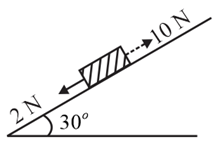
A block kept on a rough inclined plane, as shown in the figure, remains at rest upto a maximum force 2N down the inclined plane. The maximum external force up the inclined plane that does not move the block is 10N. The coefficient of static friction between the block and the plane is: [Take $$g = 10$$ m/s$$^2$$]

Question 4 JEE Mains

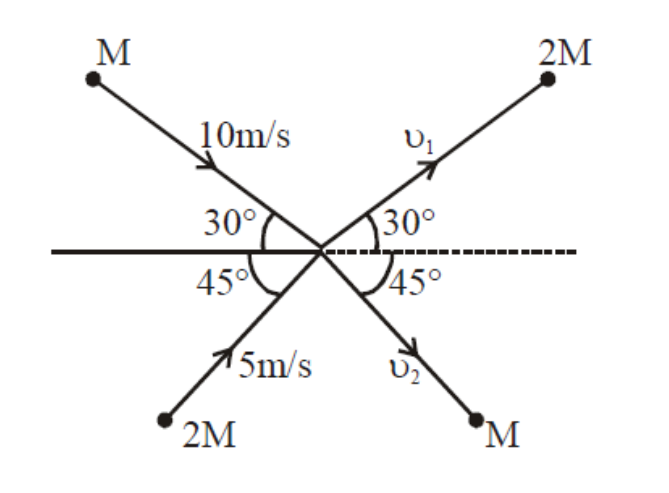
Two particles, of masses $$M$$ and $$2M$$, moving, as shown, with speeds of $$10m/s$$ and $$5m/s$$, collide elastically at the origin. After the collision, they move along the indicated directions with speeds $$υ_1$$  and $$υ_2$$​, respectively. The values of $$υ_1$$ and $$υ_2$$ are nearly : 

image
Question 5 JEE Advanced

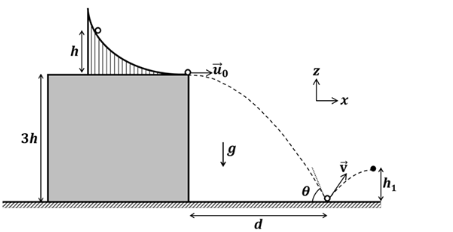
A slide with a frictionless curved surface, which becomes horizontal at its lower end, is fixed on the terrace of a building of height $$3h$$ from the ground, as shown in the figure. A spherical ball of mass m is released on the slide from rest at a height $$h$$ from the top of the terrace. The ball leaves the slide with a velocity $$\vec{u}_0 = u_0 \hat{x}$$ and falls on the ground at a distance $$d$$ from the building making an angle $$\theta$$ with the horizontal. It bounces off with a velocity $$\vec{v}$$ and reaches a maximum height $$h_1$$. The acceleration due to gravity is $$g$$ and the coefficient of restitution of the ground is $$1/\sqrt{3}$$. Which of the following statement(s) is(are) INCORRECT?

image
Question 6 JEE Mains

A ball of mass $$200$$ g rests on a vertical post of height $$20$$ m. A bullet of mass $$10$$ g, travelling in horizontal direction, hits the centre of the ball. After collision both travels independently. The ball hits the ground at a distance $$30$$ m and the bullet at a distance of $$120$$ m from the foot of the post. The value of initial velocity of the bullet will be (if $$g = 10$$ m s$$^{-2}$$):

Question 7 JEE Mains

A mass of $$10$$ kg is suspended vertically by a rope of length $$5$$ m from the roof. A force of $$30$$ N is applied at the middle point of rope in horizontal direction. The angle made by upper half of the rope with vertical is $$\alpha = \tan^{-1}(x \times 10^{-1})$$. The value of $$x$$ is ______.
(Given, $$g = 10$$ m s$$^{-2}$$)

Question 8 JEE Mains

A car is moving on a plane inclined at 30° to the horizontal with an acceleration of 10 m s$$^{-2}$$ parallel to the plane upward. A bob is suspended by a string from the roof of the car. The angle in degrees which the string makes with the vertical is _________. (Take $$g = 10$$ m s$$^{-2}$$)

Question 9 JEE Mains

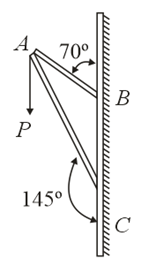
Consider a frame that is made up of two thin massless rods $$AB$$ and $$AC$$ as shown in the figure. A vertical force $$\vec{P}$$ of magnitude 100 N is applied at point $$A$$ of the frame.


Suppose the force $$\vec{P}$$ is resolved parallel to the arms $$AB$$ and $$AC$$ of the frame. The magnitude of the resolved component along the arm $$AC$$ is $$x$$ N. The value of $$x$$, to the nearest integer, is ________.
[Given: $$\sin(35^\circ) = 0.573, \cos(35^\circ) = 0.819, \sin(110^\circ) = 0.939, \cos(110^\circ) = -0.342$$]

Question 10 JEE Mains

A particle moving in the xy-plane experiences a velocity dependent force $$\vec{F} = k(v_y\hat{i} + v_x\hat{j})$$, where $$v_x$$ and $$v_y$$ are the x and y components of its velocity $$\vec{v}$$. If $$\vec{a}$$ is the acceleration of the particle, then which of the following statements is true for the particle?

Question 11 JEE Mains

The sum of two forces $$\vec{P}$$ and $$\vec{Q}$$ is $$\vec{R}$$ such that $$|\vec{R}| = |\vec{P}|$$. Find the angle between resultant of $$2\vec{P}$$ and $$\vec{Q}$$, and $$\vec{Q}$$,________

Question 12 JEE Mains

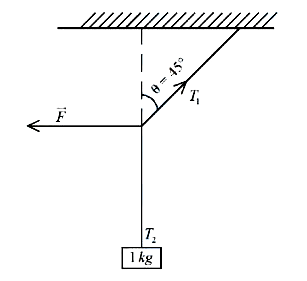
A mass of 10 kg is suspended by a rope of length 4 m, from the ceiling. A force F is applied horizontally at the mid-point of the rope such that the top half of the rope makes an angle of 45$$^\circ$$ with the vertical. Then F equals: (Take g = 10 m s$$^{-2}$$ and the rope to be massless)

Question 13 JEE Mains

A spaceship in space sweeps stationary interplanetary dust. As a result, its mass increases at a rate $$\frac{dM(t)}{dt} = bv^2(t)$$, where $$v(t)$$ is its instantaneous velocity. The instantaneous acceleration of the satellite is:

Question 14 JEE Mains

Particle A of mass $$m_1$$ moving with velocity $$(\sqrt{3}\hat{i} + \hat{j})\,\text{ms}^{-1}$$ collides with another particle B of mass $$m_2$$ which is at rest initially. Let $$\vec{v}_1$$ and $$\vec{v}_2$$ be the velocities of particles A and B after collision respectively. If $$m_1 = 2m_2$$ and after collision $$\vec{v}_1 - (\hat{i} + \sqrt{3}\hat{j})\,\text{ms}^{-1}$$, the angle between $$\vec{v}_1$$ and $$\vec{v}_2$$ is:

Question 15 JEE Mains

Two vectors $$\vec{A}$$ and $$\vec{B}$$ have equal magnitudes. The magnitude of $$(\vec{A} + \vec{B})$$ is '$$n$$' times the magnitude of $$(\vec{A} - \vec{B})$$. The angle between $$\vec{A}$$ and $$\vec{B}$$ is:

Question 16 JEE Mains

A particle of mass m is moving in a straight line with momentum p. Starting at time $$t = 0$$, a force $$F = kt$$ acts in the same direction on the moving particle during time interval T so that its momentum changes from p to 3p. Here k is a constant. The value of T is

Question 17 JEE Mains

A shell is fired from a fixed artillery gun with an initial speed u such that it hits the target on the ground at a distance R from it. If t$$_1$$ and t$$_2$$ are the values of the time taken by it to hit the target in two possible ways, the product t$$_1$$t$$_2$$ is:

Question 18 JEE Mains

The stream of a river is flowing with a speed of 2 km h$$^{-1}$$. A swimmer can swim at a speed of 4 km h$$^{-1}$$. The direction of the swimmer with respect to the flow of the river, to cross the river straight, is:

Question 19 JEE Mains

Two forces P and Q, of magnitude 2F and 3F, respectively, are at an angle $$\theta$$ with each other. If the force Q is doubled, then their resultant also gets doubled. Then, the angle $$\theta$$ is:

Question 20 JEE Mains

A man (mass = 50 kg) and his son (mass = 20 kg) are standing on a frictionless surface facing each other. The man pushes his son so that he starts moving at a speed of 0.70 m s$$^{-1}$$ with respect to the man. The speed of the man with respect to the surface is:

Question 21 JEE Mains

A mass of 10 kg is suspended vertically by a rope from the roof. When a horizontal force is applied on the rope at some point, the rope deviated at an angle of 45$$^{\circ}$$ at the roof point. If the suspended mass is at equilibrium, the magnitude of the force applied is ($$g = 10$$ m s$$^{-2}$$)

Question 22 JEE Mains

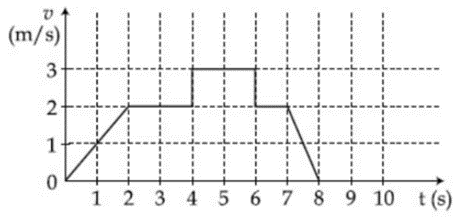
A particle starts from the origin at time $$t = 0$$ and moves along the positive $$x$$-axis. The graph of velocity with respect to time is shown in figure. What is the position of the particle at time $$t = 5s$$?

Question 23 JEE Mains

A particle of mass $$m$$ is moving with speed $$2v$$ and collides with a mass $$2m$$ moving with speed $$v$$ in the same direction. After the collision, the first mass is stopped completely while the second one splits into two particles each of mass $$m$$, which move at an angle 45° with respect to the original direction. The speed of each of the moving particle will be:

Question 24 JEE Mains

A body of mass $$m_1$$ moving with an unknown velocity of $$v_1 \hat{i}$$, undergoes a collinear collision with a body of mass $$m_2$$ moving with a velocity $$v_2 \hat{i}$$. After the collision, $$m_1$$ and $$m_2$$ move with velocities of $$v_3 \hat{i}$$ and $$v_4 \hat{i}$$, respectively. If $$m_2 = 0.5 m_1$$ and $$v_3 = 0.5 v_1$$, then $$v_1$$ is:

Question 25 JEE Mains

A body of mass 2 kg slides down with an acceleration of 3 m/s$$^2$$ on a rough inclined plane having a slope of 30$$^\circ$$. The external force required to take the same body up the plane with the same acceleration will be: (g = 10 m/s$$^2$$)

Question 26 JEE Mains

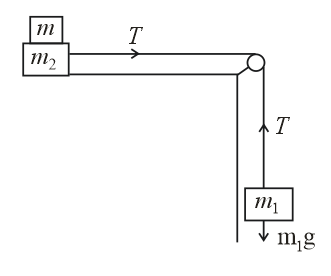
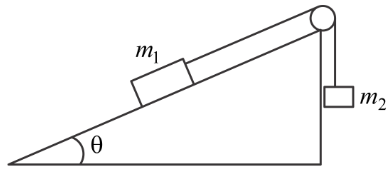
Two masses $$m_1 = 5$$ kg and $$m_2 = 10$$ kg, connected by an inextensible string over a frictionless pulley, are moving as shown in the figure. The coefficient of friction of horizontal surface is 0.15. The minimum weight m that should be put on top of $$m_2$$ to stop the motion is:

Question 27 JEE Mains

A given object takes n times more time to slide down a 45$$^\circ$$ rough inclined plane as it takes to slide down a perfectly smooth 45$$^\circ$$ incline. The coefficient of kinetic friction between the object and the incline is:

Question 28 JEE Mains

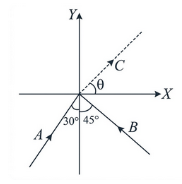
Two particles $$A$$ and $$B$$ of equal mass $$M$$ are moving with the same speed $$v$$ as shown in figure. They collide completely inelastic and move as a single particle $$C$$. The angle $$\theta$$ that the path of $$C$$ makes with the X-axis is given by-

image
Question 29 JEE Mains

A rocket is fired vertically from the earth with an acceleration of 2g, where g is the gravitational acceleration. On an inclined plane inside the rocket, making an angle $$\theta$$ with the horizontal, a point object of mass m is kept. The minimum coefficient of friction $$\mu_{min}$$ between the mass and the inclined surface such that the mass does not move is:

Question 30 JEE Mains

Which of the following option correctly describes the variation of the speed v and acceleration 'a' of a point mass falling vertically in a viscous medium that applies a force $$F = -kv$$, where 'k' is a constant, on the body? (Graphs are schematic and not drawn to scale)

Question 31 JEE Mains

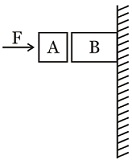
Given in the figure are two blocks A and B of weight 20 N and 100 N, respectively. These are being pressed against a wall by a force F and kept in equilibrium as shown. If the coefficient of friction between the blocks is 0.1 and between block B and the wall is 0.15, the frictional force applied by the wall on block B is:

Question 32 JEE Mains

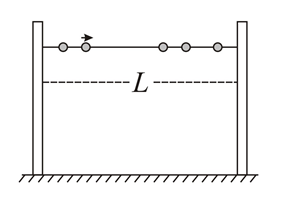
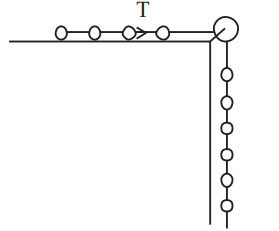
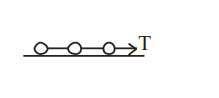
A large number $$(n)$$ of identical beads, each of mass $$m$$ and radius $$r$$ are strung on a thin smooth rigid horizontal rod of length $$L(L \gg r)$$ and are at rest at random positions. The rod is mounted between two rigid supports (see the figure below). If one of the beads is now given a speed $$v$$, the average force experienced by each support after a long time is (assume all collisions are elastic):

Question 33 JEE Mains

A heavy box is to be dragged along a rough horizontal floor. To do so, the person A pushes it at an angle 30° from the horizontal and requires a minimum force $$F_A$$, while the person B pulls the box at an angle 60° from the horizontal and needs minimum force $$F_B$$. If the coefficient of friction between the box and the floor is $$\frac{\sqrt{3}}{5}$$, the ratio $$\frac{F_A}{F_B}$$ is:

Question 34 JEE Mains

A body of mass 5 kg under the action of constant force $$\vec{F} = F_x\hat{i} + F_y\hat{j}$$ has velocity at t = 0 s as $$\vec{v} = (6\hat{i} - 2\hat{j})$$ m/s and at t = 10 s as $$\vec{v} = +6\hat{j}$$ m/s. The force $$\vec{F}$$ is:

Question 35 JEE Mains

A bullet of mass 4 g is fired horizontally with a speed of 300 m/s into 0.8 kg block of wood at rest on a table. If the coefficient of friction between the block and the table is 0.3, how far will the block slide approximately?

Question 36 JEE Mains

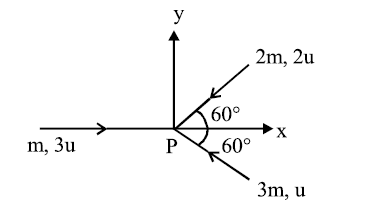
Three masses m, 2m and 3m are moving in the x-y plane with speeds 3u, 2u and u respectively as shown in the figure. The three masses collide at the same point at P and stick together. The velocity of the resulting mass will be:

Question 37 JEE Mains

A block is placed on a rough horizontal plane. A time dependent horizontal force $$F = kt$$ acts on the block, where k is a positive constant. The acceleration - time graph of the block is :

Question 38 JEE Mains

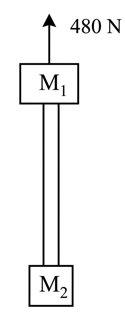
Two blocks of mass $$M_1 = 20$$ kg and $$M_2 = 12$$ kg are connected by a metal rod of mass 8 kg. The system is pulled vertically up by applying a force of 480 N as shown. The tension at the mid-point of the rod is:

image
Question 39 JEE Mains

A body starts from rest on a long inclined plane of slope 45°. The coefficient of friction between the body and the plane varies as $$\mu = 0.3x$$, where x is distance travelled down the plane. The body will have maximum speed (for $$g = 10$$ m/s$$^2$$) when $$x$$ =

Question 40 JEE Mains

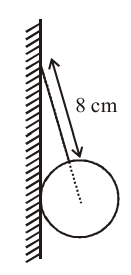
A uniform sphere of weight W and radius 5 cm is being held by a string as shown in the figure. The tension in the string will be :

Question 41 JEE Mains

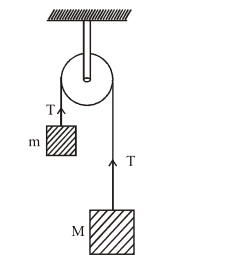
Two blocks of masses m and M are connected by means of a metal wire of cross-sectional area A passing over a frictionless fixed pulley as shown in the figure. The system is then released. If M = 2m, then the stress produced in the wire is:

Question 42 JEE Mains

This question has Statement 1 and Statement 2. Of the four choices given after the Statements, choose the one that best describes the two Statements. 

Statement 1: If you push on a cart being pulled by a horse so that it does not move, the cart pushes you back with an equal and opposite force.

Statement 2: The cart does not move because the force described in statement 1 cancel each other.

Question 43 JEE Mains

A body weighing 13 kg is suspended by two strings 5 m and 12 m long, their other ends being fastened to the extremities of a rod 13 m long. If the rod be so held that the body hangs immediately below the middle point. The tensions in the strings are

Question 44 JEE Mains

A particle of mass $$0.3$$ kg is subjected to a force $$F = -kx$$ with $$k = 15$$ N/m. What will be its initial acceleration if it is released from a point $$20$$ cm away from the origin?

Question 45 JEE Mains

A bullet of mass 0.1 kg moving horizontally with speed 400 m s$$^{-1}$$ hits a wooden block of mass 3.9 kg kept on a horizontal rough surface. The bullet gets embedded into the block and moves 20 m before coming to rest. The coefficient of friction between the block and the surface is

Question 46 JEE Mains

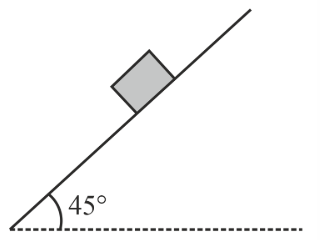
Consider a block kept on an inclined plane (inclined at 45°) as shown in the figure. If the force required to just push it up the incline is 2 times the force required to just prevent it from sliding down, the coefficient of friction between the block and inclined plane ($$\mu$$) is equal to: 

image
Question 47 JEE Mains

Given below are two statements:
Statement-I: An elevator can go up or down with uniform speed when its weight is balanced with the tension of its cable.
Statement-II: Force exerted by the floor of an elevator on the foot of a person standing on it is more than his/her weight when the elevator goes down with increasing speed.
In the light of the above statements, choose the correct answer from the options given below:

Question 48 JEE Mains

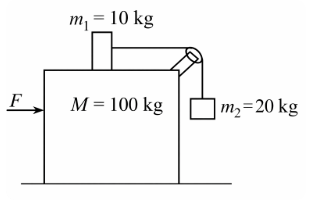
Three masses $$M = 100 \text{ kg}$$, $$m_1 = 10 \text{ kg}$$ and $$m_2 = 20 \text{ kg}$$ are arranged in a system as shown in figure. All the surfaces are frictionless and strings are inextensible and weightless. The pulleys are also weightless and frictionless. A force $$F$$ is applied on the system so that the mass $$m_2$$ moves upward with an acceleration of $$2 \text{ m s}^{-2}$$. The value of $$F$$ is (Take $$g = 10 \text{ m s}^{-2}$$)

image
Question 49 JEE Mains

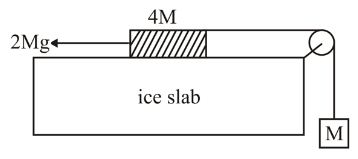
A hanging mass $$M$$ is connected to a four times bigger mass by using a string pulley arrangement, as shown in the figure. The bigger mass is placed on a horizontal ice-slab and being pulled by $$2Mg$$ force. In this situation, tension in the string is $$\frac{x}{5}Mg$$ for $$x =$$ ______. Neglect mass of the string and friction of the block (bigger mass) with ice slab.

image
Question 50 JEE Mains

A force on an object of mass $$100$$ g is $$(10\hat{i} + 5\hat{j})$$ N. The position of that object at $$t = 2$$ s is $$a\hat{i} + b\hat{j}$$ m after starting from rest. The value of $$\frac{a}{b}$$ will be ______.

Question 51 JEE Mains

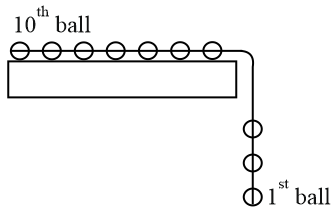
A system to 10 balls each of mass $$2$$ kg are connected via massless and unstretchable string. The system is allowed to slip over the edge of a smooth table as shown in figure. Tension on the string between the $$7^{th}$$ and $$8^{th}$$ ball is ______ N when $$6^{th}$$ ball just leaves the table.

Question 52 JEE Mains

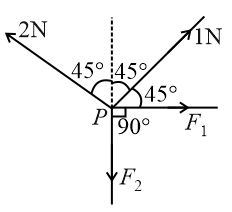
Four forces are acting at a point $$P$$ in equilibrium as shown in figure. The ratio of force $$F_1$$ to $$F_2$$ is $$1:x$$ where $$x =$$ ______.

Question 53 JEE Mains

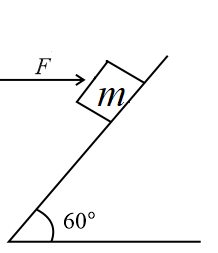
A block of mass $$200$$ g is kept stationary on a smooth inclined plane by applying a minimum horizontal force $$F = \sqrt{x}$$ N as shown in figure. The value of $$x$$ = ______.

Question 54 JEE Mains

Two bodies of masses $$m_1 = 5$$ kg and $$m_2 = 3$$ kg are connected by a light string going over a smooth light pulley on a smooth inclined plane as shown in the figure. The system is at rest. The force exerted by the inclined plane on the body of mass $$m_1$$ will be: [Take $$g = 10$$ m s$$^{-2}$$]

image
Question 55 JEE Mains

The initial mass of a rocket is 1000 kg. Calculate at what rate the fuel should be burnt so that the rocket is given an acceleration of 20 m s$$^{-2}$$. The gases come out at a relative speed of 500 m s$$^{-1}$$, with respect to the rocket: [Use $$g = 10$$ m s$$^{-2}$$]

Question 56 JEE Mains

A simple harmonic motion is represented by: $$y = 5(\sin 3\pi t + \sqrt{3} \cos 3\pi t)$$ cm. The amplitude and time period of the motion are:

Question 57 JEE Mains

A simple pendulum oscillating in air has period T. The bob of the pendulum is completely immersed in a non-viscous liquid. The density of the liquid is $$\frac{1}{16}$$th of the material of the bob. If the bob is inside liquid all the time, its period of oscillation in this liquid is:

Question 58 JEE Mains

A ball is thrown vertically up (taken as +z-axis) from the ground. The correct momentum-height (p-h) diagram is:

Question 59 JEE Mains

The trajectory of a projectile near the surface of the earth is given as $$y = 2x - 9x^2$$. If it were launched at an angle $$\theta_0$$ with speed $$v_0$$ then g = 10 m s$$^{-2}$$:

Question 60 JEE Mains

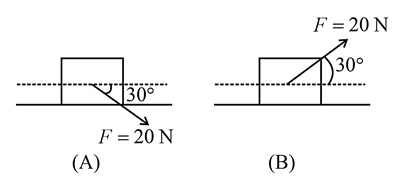
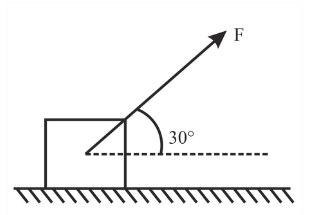
A block of mass 5 kg is (i) pushed in case (A) and (ii) pulled in case (B), by a force F = 20 N, making an angle of 30° with the horizontal, as shown in the figures. The coefficient of friction between the block and floor is $$\mu$$ = 0.2. The difference between the accelerations of the block, in case (B) and case (A) will be: (g = 10 m s$$^{-2}$$)

Question 61 JEE Mains

A car of mass 1000 kg is moving at a speed of $$30\ \text{m/s}$$. Brakes are applied to bring the car to rest. If the net retarding force is $$5000\ \text{N}$$, the car comes to stop after travelling $$d$$ m in $$t$$ s. Then

Question 62 JEE Mains

A particle of mass $$m$$ is at rest at the origin at time $$t=0$$. It is subjected to a force $$F(t) = F_0 e^{-bt}$$ in the $$x$$ direction. Its speed $$v(t)$$ is depicted by which of the following curves?

Question 63 JEE Mains

A satellite moving with velocity $$v$$ in a force free space collects stationary interplanetary dust at a rate of $$\frac{dM}{dt} = \alpha v$$ where $$M$$ is the mass (of satellite + dust) at that instant. The instantaneous acceleration of the satellite is

Question 64 JEE Mains

Sand is being dropped on a conveyer belt at the rate of $$2$$ kg per second. The force necessary to keep the belt moving with a constant speed of $$3$$ ms$$^{-1}$$ will be

Question 65 JEE Mains

A block of weight $$W$$ rests on a horizontal floor with coefficient of static friction $$\mu$$. It is desired to make the block move by applying minimum amount of force. The angle $$\theta$$ from the horizontal at which the force should be applied and magnitude of the force $$F$$ are respectively.

Question 66 JEE Mains

An engine pumps water continuously through a hose. Water leaves the hose with velocity $$v$$ and $$m$$ is mass per unit length of the water jet. If this jet hits a surface and came to rest instantaneously, the force on the surface is

Question 67 JEE Mains

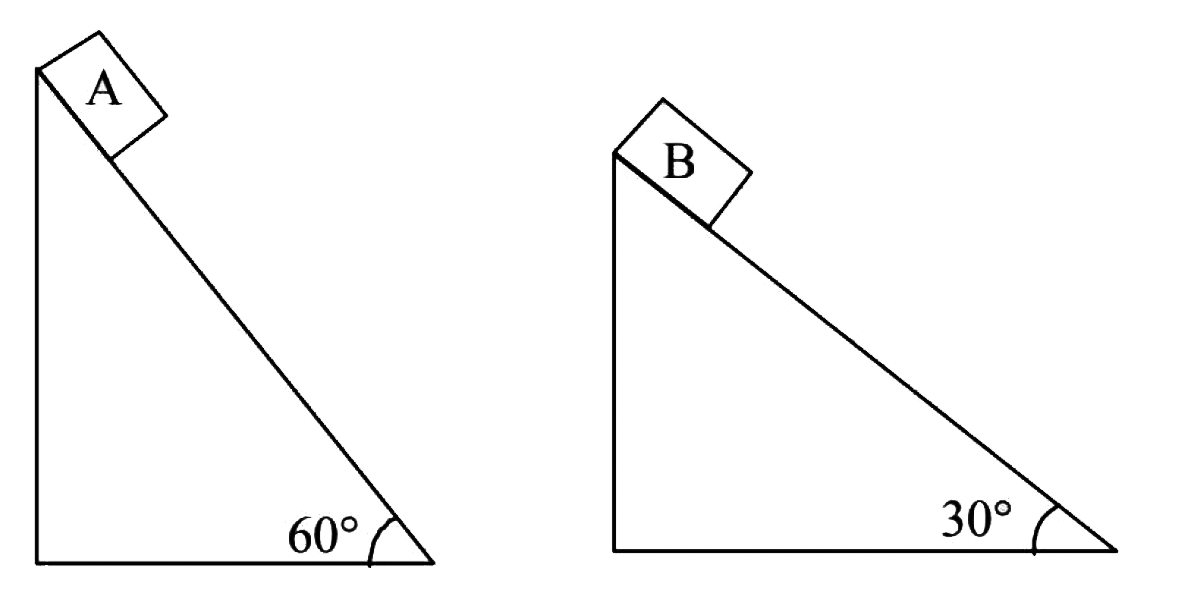
Two fixed frictionless inclined plane making an angle $$30^\circ$$ and $$60^\circ$$ with the vertical are shown in the figure. Two block $$A$$ and $$B$$ are placed on the two planes. What is the relative vertical acceleration of $$A$$ with respect to $$B$$?

JMA_LOM_C03_075_Q01
Question 68 JEE Mains

The figure shows the position - time $$(x - t)$$ graph of one-dimensional motion of a body of mass $$0.4$$ kg. The magnitude of each impulse is

Question 69 JEE Mains

A block of mass '$$m$$' is connected to another block of mass '$$M$$' by a spring (massless) of spring constant '$$k$$'. The blocks are kept on a smooth horizontal plane. Initially the blocks are at rest and the spring is unstretched. Then a constant force '$$F$$' starts acting on the block of mass '$$M$$' to pull it. Find the force on the block of mass '$$m$$'

Question 70 JEE Mains

A player caught a cricket ball of mass $$150\,g$$ moving at a rate of $$20\,m/s$$. If the catching process is completed in $$0.1\,s$$, the force of the blow exerted by the ball on the hand of the player is equal to

Question 71 JEE Mains

Consider a car moving on a straight road with a speed of $$100$$ m/s. The distance at which car can be stopped is $$[\mu_k = 0.5]$$

Question 72 JEE Mains

$$A$$ and $$B$$ are two like parallel forces. A couple of moment $$H$$ lies in the plane of $$A$$ and $$B$$ and is contained with them. The resultant of $$A$$ and $$B$$ after combining is displaced through a distance

Question 73 JEE Advanced

A projectile of mass 200 g is launched in a viscous medium at an angle 60° with the horizontal, with an initial velocity of 270 m/s. It experiences a viscous drag force $$\vec{F} = -c\vec{v}$$ where the drag coefficient $$c = 0.1$$ kg/s and $$\vec{v}$$ is the instantaneous velocity of the projectile. The projectile hits a vertical wall after 2 s. Taking $$e = 2.7$$, the horizontal distance of the wall from the point of projection (in m) is ______.

Question 74 JEE Mains

100 balls each of mass $$m$$ moving with speed $$v$$ simultaneously strike a wall normally and reflected back with same speed, in time $$t$$ s. The total force exerted by the balls on the wall is

Question 75 JEE Mains

A body of mass 500 g moves along $$x$$-axis such that it's velocity varies with displacement $$x$$ according to the relation $$v = 10\sqrt{x}$$ m s$$^{-1}$$. The force acting on the body is:

Question 76 JEE Mains

Force acts for $$20$$ s on a body of mass $$20$$ kg, starting from rest, after which the force ceases and then body describes $$50$$ m in the next $$10$$ s. The value of force will be:

Question 77 JEE Mains

At any instant the velocity of a particle of mass 500 g is $$(2t\hat{i} + 3t^2\hat{j})$$ m s$$^{-1}$$. If the force acting on the particle at $$t = 1$$ s is $$(\hat{i} + x\hat{j})$$ N. Then the value of $$x$$ will be:

Question 78 JEE Mains

A bullet of $$10$$ g leaves the barrel of gun with a velocity of $$600$$ m s$$^{-1}$$. If the barrel of gun is $$50$$ cm long and mass of gun is $$3$$ kg, then value of impulse supplied to the gun will be:

Question 79 JEE Mains

A batsman hits back a ball of mass $$0.4$$ kg straight in the direction of the bowler without changing its initial speed of $$15$$ m s$$^{-1}$$. The impulse imparted to the ball is ______ N s.

Question 80 JEE Mains

A man of $$60$$ kg is running on the road and suddenly jumps into a stationary trolly car of mass $$120$$ kg. Then the trolly car starts moving with velocity $$2$$ m s$$^{-1}$$. The velocity of the running man was ______ m s$$^{-1}$$, when he jumps into the car.

Question 81 JEE Mains

A ball of mass $$0.15 \text{ kg}$$ hits the wall with its initial speed of $$12 \text{ m s}^{-1}$$ and bounces back without changing its initial speed. If the force applied by the wall on the ball during the contact is $$100 \text{ N}$$, calculate the time duration of the contact of ball with the wall.

Question 82 JEE Mains

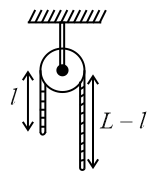
A uniform metal chain of mass $$m$$ and length $$L$$ passes over a massless and frictionless pulley. It is released from rest with a part of its length $$l$$ is hanging on one side and rest of its length $$(L-l)$$ is hanging on the other side of the pulley. At a certain point of time, when $$l = \frac{L}{x}$$, the acceleration of the chain is $$\frac{g}{2}$$. The value of $$x$$ is

Question 83 JEE Mains

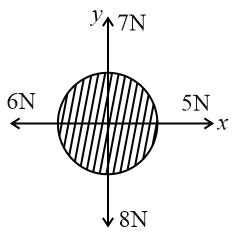
For a free body diagram shown in the figure, the four forces are applied in the '$$x$$' and '$$y$$' directions. What additional force must be applied and at what angle with positive $$x$$-axis so that the net acceleration of body is zero?

Question 84 JEE Mains

A block of mass $$M$$ placed inside a box descends vertically with acceleration $$a$$. The block exerts a force equal to one-fourth of its weight on the floor of the box. The value of '$$a$$' will be

Question 85 JEE Mains

In two different experiments, an object of mass 5 kg moving with a speed of 25 ms$$^{-1}$$ hits two different walls and comes to rest within (i) 3 second, (ii) 5 seconds, respectively. Choose the correct option out of the following:

Question 86 JEE Mains

Statement I: If three forces $$\vec{F}_1$$, $$\vec{F}_2$$ and $$\vec{F}_3$$ are represented by three sides of a triangle and $$\vec{F}_1 + \vec{F}_2 = -\vec{F}_3$$, then these three forces are concurrent forces and satisfy the condition for equilibrium.
Statement II: A triangle made up of three forces $$\vec{F}_1$$, $$\vec{F}_2$$ and $$\vec{F}_3$$ as its sides were taken in the same order, satisfies the condition for translatory equilibrium.
In the light of the above statements, choose the most appropriate answer from the options given below:

Question 87 JEE Mains

A bullet of 4 g mass is fired from a gun of mass 4 kg. If the bullet moves with the muzzle speed of 50 ms$$^1$$, the impulse imparted to the gun and velocity of recoil of gun are

Question 88 JEE Mains

Statement-I: Two forces $$\vec{P} + \vec{Q}$$ and $$\vec{P} - \vec{Q}$$ where $$\vec{P} \perp \vec{Q}$$, when act at an angle $$\theta_1$$ each other, the magnitude of their resultant is $$\sqrt{3P^2 + Q^2}$$, when they act at an angle $$\theta_2$$, the magnitude of their resultant becomes $$\sqrt{2P^2 + Q^2}$$. This is possible only when $$\theta_1 < \theta_2$$.
Statement-II: In the situation given above. $$\theta_1 = 60°$$ and $$\theta_2 = 90°$$
In the light of the above statement, choose the most appropriate answer from the options given below :

Question 89 JEE Mains

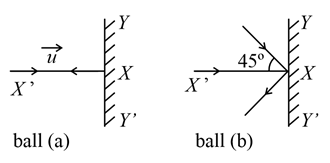
Two billiard balls of equal mass 30 g strike a rigid wall with same speed of 108 kmph (as shown) but at different angles. If the balls get reflected with the same speed, then the ratio of the magnitude of impulses imparted to ball a and ball b by the wall along X direction is:

Question 90 JEE Mains

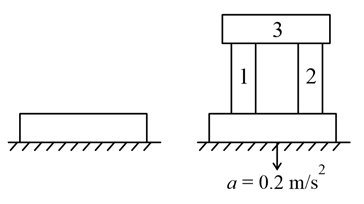
A steel block of 10 kg rests on a horizontal floor as shown. When three iron cylinders are placed on it as shown, the block and cylinders go down with an acceleration 0.2 m s$$^{-2}$$. The normal reaction $$R'$$ by the floor if mass of the iron cylinders are equal and of 20 kg each is (in N),   [Take $$g = 10$$ m s$$^{-2}$$ and $$\mu_s = 0.2$$]

Question 91 JEE Mains

An object of mass $$m_1$$ collides with another object of mass $$m_2$$, which is at rest. After the collision the objects move with equal speeds in opposite direction. The ratio of the masses $$m_2 : m_1$$ is :

Question 92 JEE Mains

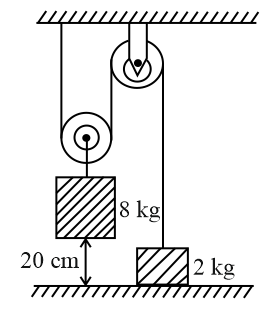
The boxes of masses 2 kg and 8 kg are connected by a massless string passing over smooth pulleys. Calculate the time taken by box of mass 8 kg to strike the ground starting from rest. (g = 10 m s$$^{-2}$$)

Question 93 JEE Mains

A force $$\vec{F} = \left(40\hat{i} + 10\hat{j}\right)$$ N acts on a body of mass 5 kg. If the body starts from rest, its position vector $$\vec{r}$$ at time $$t = 10$$ s will be

Question 94 JEE Mains

The upper half of an inclined plane with inclination $$\phi$$ is perfectly smooth while the lower half is rough. A body starting from rest at the top will again come to rest at the bottom if the coefficient of friction for the lower half is given by

Question 95 JEE Mains

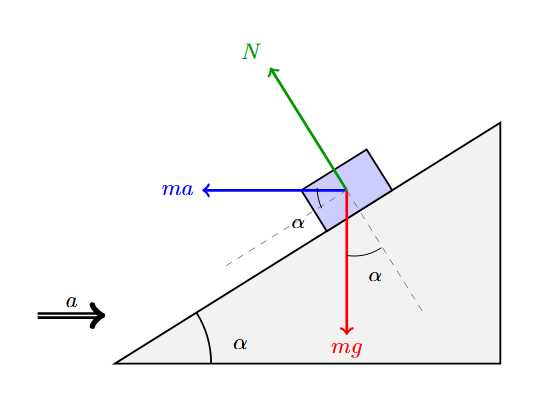
A block is kept on a frictionless inclined surface with angle of inclination $$\alpha$$. The incline is given an acceleration $$a$$ to keep the block stationary. Then $$a$$ is equal to?

Question 96 JEE Mains

An object with mass 500 g moves along x-axis with speed $$v = 4\sqrt{x}$$ m/s. The force acting on the object is :

Question 97 JEE Mains

Three forces $$F_1 = 10$$ N, $$F_2 = 8$$ N, $$F_3 = 6$$ N are acting on a particle of mass 5 kg. The forces $$F_2$$ and $$F_3$$ are applied perpendicularly so that particle remains at rest. If the force $$F_1$$ is removed, then the acceleration of the particle is

Question 98 JEE Mains

As shown in the figure a block of mass 10 kg lying on a horizontal surface is pulled by a force F acting at an angle $$30°$$, with horizontal. For $$\mu_s = 0.25$$, the block will just start to move for the value of $$F$$: [Given $$g = 10$$ m$$\cdot$$s$$^{-2}$$]

image
Question 99 JEE Mains

Two forces having magnitude A and $$\dfrac{A}{2}$$ are perpendicular to each other. The magnitude of their resultant is:

Question 100 JEE Mains

A car is moving with a constant speed of 20 m s$$^{-1}$$ in a circular horizontal track of radius 40 m. A bob is suspended from the roof of the car by a massless string. The angle made by the string with the vertical will be: (Take g = 10 m s$$^{-2}$$)

Question 101 JEE Mains

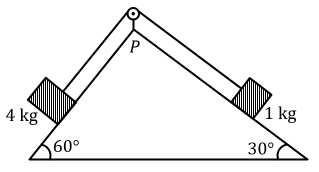
As per given figure, a weightless pulley $$P$$ is attached on a double inclined frictionless surface. The tension in the string (massless) will be (if $$g = 10$$ m s$$^{-2}$$)

Question 102 JEE Mains

As per given figure, a weightless pulley $$P$$ is attached on a double inclined frictionless surface. The tension in the string (massless) will be (if $$g = 10 \text{ m s}^{-2}$$)

image
Question 103 JEE Mains

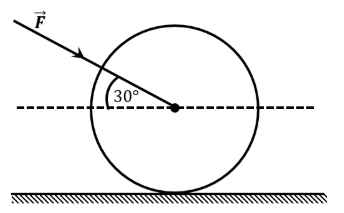
As shown in figure, a 70 kg garden roller is pushed with a force of $$\vec{F} = 200$$ N at an angle of 30° with horizontal. The normal reaction on the roller is (Given $$g = 10$$ m s$$^{-2}$$)

image
Question 104 JEE Mains

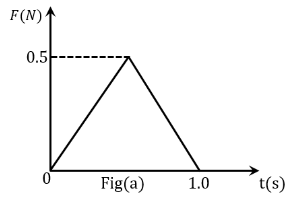
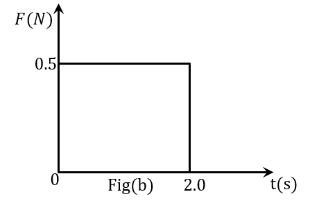
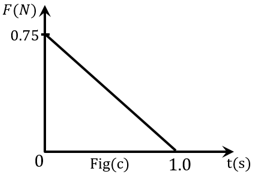
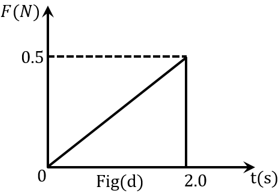
Figures (a), (b), (c) and (d) show variation of force with time.

image image image image


The impulse is highest in figure.

Question 105 JEE Mains

Given below are two statements: one is labelled as Assertion A and the other is labelled as Reason R
Assertion A: An electric fan continues to rotate for some time after the current is switched off.
Reason R: Fan continues to rotate due to inertia of motion.
In the light of above statements, choose the most appropriate answer from the options given below.

Question 106 JEE Mains

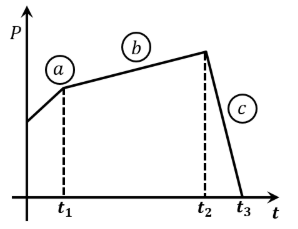
The figure represents the momentum time $$(p - t)$$ curve for a particle moving along an axis under the influence of the force. Identify the regions on the graph where the magnitude of the force is maximum and minimum respectively?
If $$t_3 - t_2 < t_1$$

image
Question 107 JEE Mains

A block of mass $$m$$ slides down the plane inclined at angle $$30°$$ with an acceleration $$\frac{g}{4}$$. The value of coefficient of kinetic friction will be:

Question 108 JEE Mains

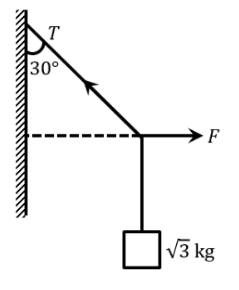
A block of $$\sqrt{3}$$ kg is attached to a string whose other end is attached to the wall. An unknown force $$F$$ is applied so that the string makes an angle of $$30°$$ with the wall. The tension $$T$$ is: (Given $$g = 10$$ m s$$^{-2}$$)

image
Question 109 JEE Mains

A body of mass 10 kg is moving with an initial speed of 20 m s$$^{-1}$$. The body stops after 5 s due to friction between body and the floor. The value of the coefficient of friction is: (Take acceleration due to gravity $$g = 10$$ m s$$^{-2}$$)

Question 110 JEE Mains

A particle of mass $$m$$ moving with velocity $$v$$ collides with a stationary particle of mass $$2m$$. After collision, they stick together and continue to move together with velocity

Question 111 JEE Mains

An average force of 125 N is applied on a machine gun firing bullets each of mass 10 g at the speed of 250 m s$$^{-1}$$ to keep it in position. The number of bullets fired per second by the machine gun is:

Question 112 JEE Mains

The position vector of a particle related to time $$t$$ is given by $$\vec{r} = (10t\hat{i} + 15t^2\hat{j} + 7\hat{k})$$ m. The direction of net force experienced by the particle is :

Question 113 JEE Mains

A machine gun of mass $$10$$ kg fires $$20$$ g bullets at the rate of $$180$$ bullets per minute with a speed of $$100$$ m s$$^{-1}$$ each. The recoil velocity of the gun is:

Question 114 JEE Mains

Two billiard balls of mass $$0.05 \text{ kg}$$ each moving in opposite directions with $$10 \text{ m s}^{-1}$$ collide and rebound with the same speed. If the time duration of contact is $$t = 0.005 \text{ s}$$, then what is the force exerted on the ball due to each other?

Question 115 JEE Mains

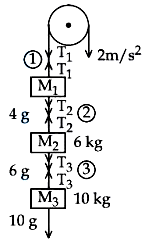
Three blocks $$M_1, M_2, M_3$$ having masses $$4 \text{ kg}, 6 \text{ kg}$$ and $$10 \text{ kg}$$ respectively are hanging from a smooth pulley using rope 1, 2 and 3 as shown in figure. The tension in the rope 1, $$T_1$$ when they are moving upward with acceleration of $$2 \text{ ms}^{-2}$$ is ______ N (if $$g = 10 \text{ m/s}^2$$).

image
Question 116 JEE Mains

A person is standing in an elevator. In which situation, he experiences weight loss?

Question 117 JEE Mains

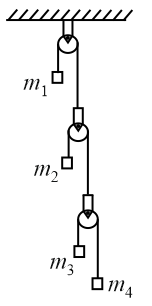
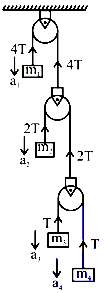
In the arrangement shown in figure $$a_1, a_2, a_3$$ and $$a_4$$ are the accelerations of masses $$m_1, m_2, m_3$$ and $$m_4$$ respectively. Which of the following relation is true for this arrangement?

Question 118 JEE Mains

A block rests on a rough inclined plane making an angle of $$30^\circ$$ with the horizontal. The coefficient of static friction between the block and the plane is $$0.8$$. If the frictional force on the block is $$10$$ N, the mass of the block (in kg) is (take $$g = 10 \text{ m/s}^2$$)

Question 119 JEE Mains

A machine gun fires a bullet of mass $$40$$ g with a velocity $$1200 \text{ ms}^{-1}$$. The man holding it can exert a maximum force of $$144$$ N on the gun. How many bullets can he fire per second at the most?

Question 120 JEE Mains

Two masses of 3.4 kg and 2.5 kg are accelerated from an initial speed of 5 m/s and 12 m/s, respectively. The distances traversed by the masses in the 5$$^{\text{th}}$$ second are 104 m and 129 m, respectively. The ratio of their momenta after 10 s is $$\frac{x}{8}$$. The value of $$x$$ is __________.

Question 121 JEE Mains

A body of mass 2 kg moving with velocity of $$\vec{v}_{in} = 3\hat{i} + 4\hat{j}$$ ms$$^{-1}$$ enters into a constant force field of 6N directed along positive z-axis. If the body remains in the field for a period of $$\frac{5}{3}$$ seconds, then velocity of the body when it emerges from force field is

Question 122 JEE Mains

A balloon and its content having mass $$M$$ is moving up with an acceleration 'a'. The mass that must be released from the content so that the balloon starts moving up with an acceleration '3a' will be (Take ' g ' as acceleration due to gravity)

Question 123 JEE Mains

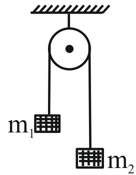
A light string passing over a smooth light fixed pulley connects two blocks of masses $$m_1$$ and $$m_2$$. If the acceleration of the system is $$\frac{g}{8}$$, then the ratio of masses is

image
Question 124 JEE Mains

A light unstretchable string passing over a smooth light pulley connects two blocks of masses $$m_1$$ and $$m_2$$. If the acceleration of the system is $$\frac{g}{8}$$, then the ratio of the masses $$\frac{m_2}{m_1}$$ is :

Question 125 JEE Mains

A body of mass $$1000$$ kg is moving horizontally with a velocity $$6 \text{ m s}^{-1}$$. If $$200$$ kg extra mass is added, the final velocity (in $$\text{m s}^{-1}$$) is:

Question 126 JEE Mains

A wooden block, initially at rest on the ground, is pushed by a force which increases linearly with time t. Which of the following curve best describes acceleration of the block with time:

Question 127 JEE Mains

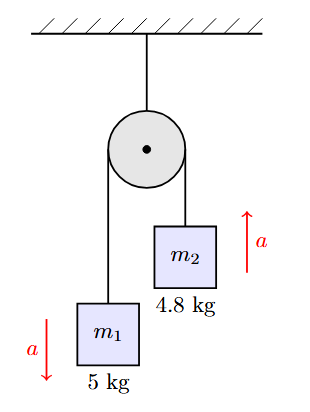
Two masses $$m_1 = 5$$ kg and $$m_2 = 4.8$$ kg tied to a string are hanging over a light frictionless pulley. What is the acceleration of the masses when lift free to move $$(g = 9.8 \text{ m/s}^2)$$?

image
Question 128 JEE Mains
image

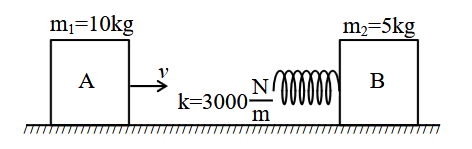
Consider two blocks A and B of masses $$m_1 = 10$$ kg and $$m_2 = 5$$ kg that are placed on a frictionless table. The block A moves with a constant speed $$v = 3$$ m/s towards the block B kept at rest. A spring with spring constant $$k = 3000$$ N/m is attached with the block B as shown in the figure. After the collision, suppose that the blocks A and B, along with the spring in constant compression state, move together, then the compression in the spring is, (Neglect the mass of the spring)

Question 129 JEE Mains

A cubic block of mass m is sliding down on an inclined plane at $$60^{\circ}$$ with an acceleration of $$\frac{g}{2}$$, the value of coefficient of kinetic friction is

Question 130 JEE Mains


A $$1 \text{ kg}$$ mass is suspended from the ceiling by a rope of length $$4 \text{ m}$$. A horizontal force '$$F$$' is applied at the mid point of the rope so that the rope makes an angle of $$45°$$ with respect to the vertical axis as shown in figure.

page1_img1

The magnitude of $$F$$ is : (Assume that the system is in equilibrium and $$g = 10 \text{ m/s}^2$$)

Question 131 JEE Mains

A train starting from rest first accelerates uniformly up to a speed of $$80 \text{ km/h}$$ for time $$t$$, then it moves with a constant speed for time $$3t$$. The average speed of the train for this duration of journey will be (in km/h) :

Question 132 JEE Mains

Three blocks $$A$$, $$B$$ and $$C$$ are pulled on a horizontal smooth surface by a force of 80 N as shown in figure. The tensions $$T_1$$ and $$T_2$$ in the string are respectively:

image
Question 133 JEE Mains

A body of mass 4 kg experiences two forces $$\vec{F_1} = 5\hat{i} + 8\hat{j} + 7\hat{k}$$ and $$\vec{F_2} = 3\hat{i} - 4\hat{j} - 3\hat{k}$$. The acceleration acting on the body is:

Question 134 JEE Mains

A wooden block of mass $$5 \text{ kg}$$ rests on a soft horizontal floor. When an iron cylinder of mass $$25 \text{ kg}$$ is placed on the top of the block, the floor yields and the block and the cylinder together go down with an acceleration of $$0.1 \text{ ms}^{-2}$$. The action force of the system on the floor is equal to:

Question 135 JEE Mains

A player caught a cricket ball of mass $$150 \text{ g}$$ moving at a speed of $$20 \text{ m/s}$$. If the catching process is completed in $$0.1 \text{ s}$$, the magnitude of force exerted by the ball on the hand of the player is:

Question 136 JEE Advanced

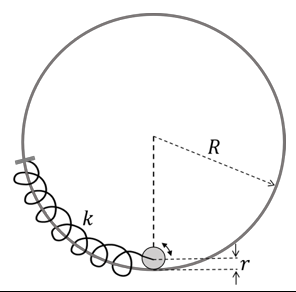
The center of a disk of radius $$r$$ and mass $$m$$ is attached to a spring of spring constant $$k$$, inside a ring of radius $$R > r$$ as shown in the figure. The other end of the spring is attached on the periphery of the ring. Both the ring and the disk are in the same vertical plane. The disk can only roll along the inside periphery of the ring, without slipping. The spring can only be stretched or compressed along the periphery of the ring, following the Hooke's law. In equilibrium, the disk is at the bottom of the ring. Assuming small displacement of the disc, the time period of oscillation of center of mass of the disk is written as $$T = \frac{2\pi}{\omega}$$. The correct expression for $$\omega$$ is ($$g$$ is the acceleration due to gravity):

image
Question 137 JEE Mains

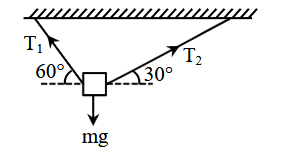
A body of mass m is suspended by two strings making angles $$\theta_1$$ and $$\theta_2$$ with the horizontal ceiling with tensions $$T_1$$ and $$T_2$$ simultaneously. $$T_1$$ and $$T_2$$ are related by $$T_1 = \sqrt{3}T_2$$. The angles $$\theta_1$$ and $$\theta_2$$ are

Question 138 JEE Mains

All surfaces shown in figure are assumed to be frictionless and the pulleys and the string are light. The acceleration of the block of mass $$2 \text{ kg}$$ is

image
Question 139 JEE Mains

A body of mass 1 kg is suspended with the help of two strings making angles as shown in figure. Magnitude of tensions $$T_1$$ and $$T_2$$, respectively, are (in N) :

image
Question 140 JEE Mains

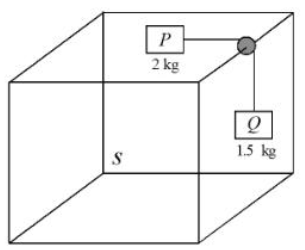
Two blocks (P and Q) with respectively masses 2 kg and 1.5 kg are joined by a massless thread. These blocks are mounted on a frictionless pully which is fixed on the edge of a cube (S), as shown in the figure below. Block P is positioned on the top surface which has no friction and block Q is in contact with side-surface, having coefficient friction $$\mu$$. The cube (S) moves towards the right with acceleration of $$\frac{g}{2}$$, where g is gravitational acceleration. During this movement the block P and Q remain stationary. The value of $$\mu$$ is _______.
(take g = 10 m/s$$^2$$)

image
Question 141 JEE Mains

A flexible chain of mass m hangs between two fixed points at the same level. The inclination of the chain with the horizontal at the two points of support is $$30^{\circ}$$. Considering the equilibrium of each half of the chain, the tension of the chain at the lowest point is __________.

Question 142 JEE Mains

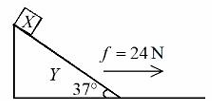
A wedge Y with mass of 10 kg and all frictionless surfaces and the inclined surface making 37° with horizontal. A block X with mass 2 kg is placed at the highest point of the wedge as shown in figure is at rest. At $$t = 0$$ wedge (Y) is pulled toward right with constant force ($$f$$) of 24 N. Taking the block X at rest at $$t = 0$$, the time taken by it to slide down 8.8 m on the slope, while Y is on the move, is _______ s. (take $$\tan(37°) = 3/4$$ and $$g = 10$$ m/s$$^2$$)

image
Question 143 JEE Mains

The time taken by a block of mass $$m$$ to slide down from the highest point to the lowest point on a rough inclined plane is 50% more compared to the time taken by the same block on identical inclined smooth plane. Both inclined planes are at $$45°$$ with the horizontal. The coefficient of kinetic friction between the rough inclined surface and block is :

Question 144 JEE Mains

The position of an object having mass 0.1 kg as a function of time t is given as $$\vec{r} = \left(10t^2 \hat{i} + 5t^3 \hat{j}\right)$$ m. At $$t = 1$$ s, which of the following statements are correct? A. The linear momentum $$\vec{p} = \left(2\hat{i} + 1.5\hat{j}\right)$$ kg·m/s. B. The force acting on the object $$\vec{F} = \left(2\hat{i} + 3\hat{j}\right)$$ N. C. The angular momentum of the object about its origin $$\vec{L} = 15 \hat{k}$$ J·s. D. The torque acting on the object about its origin $$\vec{\tau} = 20 \hat{k}$$ N·m. Choose the correct answer from the options given below :

Question 145 JEE Mains

A body of mass 14 kg initially at rest explodes and breaks into three fragments of masses in the ratio 2 : 2 : 3. The two pieces of equal masses fly off perpendicular to each other with a speed of 18 m/s each. The velocity of the heavier fragment is ______m/s.

Question 146 JEE Mains

At $$t = 0$$, a body of mass $$100$$ g starts moving under the influence of a force $$(5\hat{i} + 10\hat{j})$$ N. After $$2$$ s, its  position is $$(2x\hat{i} + 5y\hat{j})$$ m. The ratio $$x : y$$ is ______.

Question 147 JEE Mains

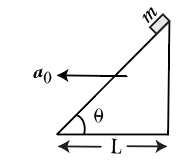
A small block of mass m slides down from the top of a frictionless inclined surface, while the inclined plane is moving towards left with constant acceleration $$a_{0}$$. The angle between the inclined plane and ground is θ and its base length is L. Assuming that initially the small block is at the top of the inclined plane, the time it takes to reach the lowest point of the inclined plane is ___ .

image
Question 148 JEE Mains

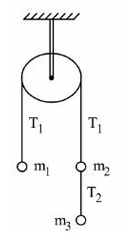
Three masses $$m_1 = 4$$ kg, $$m_2 = 4$$ kg and $$m_3 = 6$$ kg are suspended from a fixed smooth frictionless pully as shown in the figure below. The value of $$T_1/T_2$$ is _______. (take $$g = 10$$ m/s$$^2$$)

image
Question 149 JEE Mains

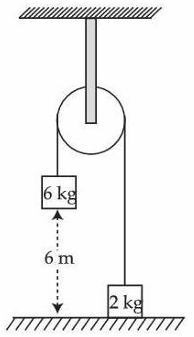
The velocity at which 6 kg mass (shown in figure) strikes the ground when it is released from a height of 6 m above the ground is __________ m/s. Assume pulley is massless and string is light and inextensible. (Take $$g = 10$$ m/s$$^2$$)

image

The PDF can be used for focused revision, while the explanations can help you identify mistakes in free-body diagrams, force directions, sign conventions, and equation formation.

ResourceWhat It Covers
JEE Laws of Motion QuestionsConceptual and numerical problems from the chapter
Question PDFPractice set for focused revision
Video SolutionsStep-by-step explanations of questions
IITian ExplanationsDetailed approach, reasoning, and calculations
Chapter PracticeUseful for JEE Main and JEE Advanced
Revision SupportHelpful before previous papers and mock tests

Try solving the questions yourself before opening the video solution. This makes it easier to compare your approach with the explained method and understand where you need improvement.

Important Laws of Motion Topics for JEE

A strong understanding of Newton's laws is essential for solving most mechanics problems efficiently. Instead of learning formulas in isolation, students should focus on identifying the forces acting on a body and understanding how those forces affect its motion.

Important areas to study include:

TopicWhat to Understand
Newton's First LawInertia and equilibrium
Newton's Second LawRelation between force, mass, and acceleration
Newton's Third LawAction-reaction force pairs
Free-Body DiagramsIdentification and resolution of forces
FrictionStatic and kinetic friction in motion
TensionStrings, pulleys, and connected bodies
Inclined PlanesComponents of weight and acceleration
Pseudo ForceAnalysis of bodies in accelerating frames
Circular MotionRadial force and centripetal acceleration
EquilibriumConditions required for translational equilibrium

Many JEE Questions from Laws of Motion become easier once the free-body diagram is correctly drawn. A problem involving a block, pulley, incline, or friction may contain several forces, and missing even one force can lead to an incorrect equation.

Students should also connect this chapter with other JEE Mains Physics important Chapters from Mechanics. Concepts such as force balance and acceleration form the basis for solving more advanced problems later in the syllabus.

JEE Main & Advanced Laws of Motion Weightage Analysis

The number and difficulty of Laws of Motion questions can vary from one JEE Main shift or JEE Advanced paper to another. For this reason, JEE Physics Chapter-wise Weightage is better used as a planning tool rather than as a fixed indication of how many questions will appear.

Laws of Motion is also closely linked with several other Mechanics topics. A question may test Newton's laws directly or combine them with friction, circular motion, pulleys, inclined planes, or non-inertial frames.

AreaQuestion Applications
Newton's Second LawForce and acceleration calculations
EquilibriumBalanced forces and limiting conditions
FrictionMotion on rough surfaces
TensionConnected blocks and pulley systems
Inclined PlanesAcceleration and force components
Pseudo ForceAccelerating reference frames
Circular MotionRadial forces and constrained motion
Mixed MechanicsCombined application of multiple laws

For JEE Main, students should become comfortable with standard force-balance and numerical problems before moving to more complicated situations. Solving JEE Mains previous year papers is useful for understanding the way familiar concepts are framed under examination conditions.

For JEE Advanced, practise problems that require several free-body diagrams, changing constraints, multiple bodies, or the use of non-inertial frames. The focus should be on building a logical solution rather than trying to memorise a fixed set of question patterns.

Why Practice JEE Laws of Motion Questions?

Laws of Motion is a chapter where problem-solving ability depends heavily on interpretation. Two questions can use the same Newton's law but require completely different approaches because the forces, constraints, or reference frames are different.

Regular practice helps students develop the habit of asking the right questions before starting a calculation: What forces are acting? Which body should be analysed first? Is the system in equilibrium? Is there friction? Is the frame accelerating? Which direction should be taken as positive?

Solving JEE Chapter-wise PYQ from Laws of Motion can help you understand how these concepts have been tested over different years. It also allows you to compare direct questions with problems that require several steps of reasoning.

A useful sequence is to study the concept first, solve basic questions, move to PYQs, and then attempt more challenging problems. Students following a structured JEE Physics Course can use this chapter-wise practice immediately after completing the corresponding lessons.

The IITian-led video solutions in the PDF provide another layer of learning. When your answer is incorrect, review the complete explanation and check whether the issue was with the free-body diagram, force direction, equation setup, or calculation. This type of analysis is more valuable than simply checking the final answer.

Tips to Solve Laws of Motion Questions Faster

Speed in Laws of Motion comes from setting up the problem correctly at the beginning. Spending a few seconds identifying the physical situation can save considerable time during the calculation.

1. Draw the free-body diagram

For every body under consideration, mark the weight, normal reaction, friction, tension, applied forces, and any other relevant force. Keep the diagram simple and avoid including forces that do not actually act on the body.

2. Choose suitable directions

Resolve forces along convenient axes. For an inclined plane, axes parallel and perpendicular to the surface usually make the equations easier to handle.

3. Apply Newton's second law systematically

Write separate equations for different directions when required. For connected bodies, remember that their accelerations may be related by the string or pulley constraint.

4. Revise the essential formulas

Concept

Formula

Newton's Second Law

$$(F_{\text{net}}=ma)$$

Weight

$$(W=mg)$$

Normal Force on Basic Horizontal Surface

$$(N=mg)$$

Friction

$$(f\leq\mu_sN) for static friction$$

Limiting Friction

$$(f_{\max}=\mu_sN)$$

Kinetic Friction

$$(f_k=\mu_kN)$$

Centripetal Acceleration

$$(a_c=\frac{v^2}{r}=\omega^2r)$$

Keep these relations in your revision notes or JEE Physics Formula Sheet, but focus on understanding the conditions under which each relation can be used.

5. Be careful with pseudo force

When solving a problem from an accelerating reference frame, identify whether a pseudo force is required. Its direction is opposite to the acceleration of the reference frame.

6. Practise Laws of Motion PYQs

Regular practice of JEE Laws of Motion PYQ helps you recognise common setups involving blocks, pulleys, friction, inclined surfaces, and accelerating frames. Start with independently solving the question and then use the video explanation to evaluate your method.

Finally, maintain a record of incorrect questions. Classify each error as a concept mistake, force-identification mistake, sign error, equation-setting error, or calculation mistake. Revisiting these errors regularly can make Laws of Motion problems more systematic and improve your performance in full-length JEE practice.

Frequently Asked Questions