Given below are two statements:
Statement I : An object moves from position $$r_{1}$$ to position $$r_{2}$$ under a conservative force field $$\overrightarrow{F}$$.
The work done by the force is W = $$\int_{r_{1}}^{r_{2}} \overrightarrow{F}.\overrightarrow{dr}.$$
Statement II: Any object moving from one location to another location can follow infinite number of paths. Therefore, the amount of work done by the object changes with the path it follows for a conservative force.
In the light of the above statements, choose the correct answer from the options given below :
JEE Work, Energy & Power Questions
We need to evaluate two statements about work done by conservative forces.
An object moves from position $$r_1$$ to position $$r_2$$ under a conservative force field $$\vec{F}$$. The work done by the force is $$W = \int_{r_1}^{r_2} \vec{F} \cdot d\vec{r}$$.
This is true. The work done by any force (conservative or non-conservative) on an object moving from position $$r_1$$ to $$r_2$$ is defined as the line integral:
$$W = \int_{r_1}^{r_2} \vec{F} \cdot d\vec{r}$$
This is the fundamental definition of work in mechanics.
Any object moving from one location to another can follow an infinite number of paths. Therefore, the amount of work done by the object changes with the path it follows for a conservative force.
This statement is false. While it is true that there are infinitely many paths between two points, the defining property of a conservative force is that the work done is path-independent. The work depends only on the initial and final positions, not on the path taken. Mathematically:
$$W = -\Delta U = -(U(r_2) - U(r_1)) = U(r_1) - U(r_2)$$
where $$U$$ is the potential energy function. Since the work depends only on the potential energy values at the two endpoints, it is the same for all paths. This is precisely what distinguishes conservative forces (like gravity, electrostatic force, spring force) from non-conservative forces (like friction).
The correct answer is Option 2: Statement I is true but Statement II is false.
Three masses 200 kg, 300 kg and 400 kg are placed at the vertices of an equilateral triangle with sides 20 m. They are rearranged on the vertices of a bigger triangle of side 25 m and with the same centre. The work done in this process ____ J. (Gravitational constant $$G=6.7 \times 10^{-11} Nm^{2}/kg^{2}$$)
Three point masses of 200 kg, 300 kg, and 400 kg originally occupy the vertices of an equilateral triangle of side 20 m, and they are then rearranged to the vertices of a larger equilateral triangle of side 25 m with the same center. We wish to find the work done in this rearrangement.
The gravitational potential energy of three point masses at the vertices of a triangle is given by $$U = -G\left(\frac{m_1 m_2}{r_{12}} + \frac{m_2 m_3}{r_{23}} + \frac{m_1 m_3}{r_{13}}\right).$$ Since the triangle is equilateral, all pairwise distances are equal to a common value $$r$$, so $$U = -\frac{G}{r}\bigl(m_1m_2 + m_2m_3 + m_1m_3\bigr)\,.$$
Calculating the sum of mass products gives $$m_1m_2 + m_2m_3 + m_1m_3 = 200\times300 + 300\times400 + 200\times400 = 60000 + 120000 + 80000 = 260000 \text{ kg}^2\,.$$
The work done is the change in potential energy, so $$W = U_f - U_i = -\frac{G \cdot 260000}{25} - \Bigl(-\frac{G \cdot 260000}{20}\Bigr).$$ This gives $$W = G \cdot 260000\Bigl(\frac{1}{20} - \frac{1}{25}\Bigr) = G \cdot 260000 \cdot \frac{1}{100} = G \cdot 2600\,.$$
Substituting the gravitational constant $$G = 6.7 \times 10^{-11}$$ yields $$W = 6.7 \times 10^{-11} \times 2600 = 6.7 \times 2.6 \times 10^{-8} = 17.42 \times 10^{-8} = 1.742 \times 10^{-7} \approx 1.74 \times 10^{-7} \text{ J}.\,$$
The correct answer is Option (4): $$1.74 \times 10^{-7}$$.
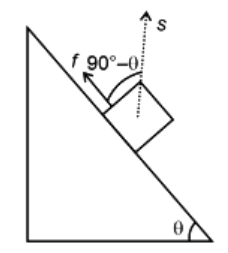
A mass of 1 kg is kept on a inclined plane with 30° inclination with respect to horizontal plane and it is at rest initially. Then the whole assembly is moved up with constant velocity of 4 m/s. The work done by the frictional force in time 2 s is ________ J. (Take g = 10 m/s²)
The rain drop of mass 1 g, starts with zero velocity from a height of 1 km. It hits the ground with a speed of 5 m/s. The work done by the unknown resistive force is _______ J.
(take g = 10 m/s$$^2$$)
Use work-energy theorem:
$$W_{gravity}+W_{resistive}=\Delta K$$
given:
$$m=1g=10^{-3}kg$$
h=1 km=1000 m
u=0,v=5 m/s
step 1: work done by gravity
$$W_g=mgh=10^{-3}\times10\times1000=10J$$
step 2: change in kinetic energy
$$ΔK=\frac{1}{2}mv^2=\frac{1}{2}\times10^{-3}\times25=0.0125J$$
step 3: resistive work
$$10+W_r=0.0125$$
$$W_r=0.0125-10=-9.9875J$$
A body of mass 1 kg moves along a straight line with a velocity $$v = 2x^2$$. The work done by the body during displacement from $$x = 0$$ to 5 m is __________ J.
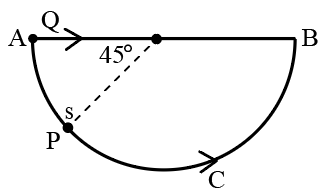
A bead $$P$$ sliding on a frictionless semi-circular string ($$ACE$$) and it is at point $$S$$ at $$t = 0$$ and at this instant the horizontal component of its velocity is $$v$$. Another bead $$Q$$ of the same mass as $$P$$ is ejected from point $$A$$ at $$t = 0$$ along the horizontal string $$AB$$, with the speed $$v$$, friction between the beads and the respective strings may be neglected in both cases. Let $$t_{P}$$ and $$t_{Q}$$ be the respective times taken by beads P and Q to reach the point B, then the relation between $$t_{P}$$ and $$t_{Q}$$ is
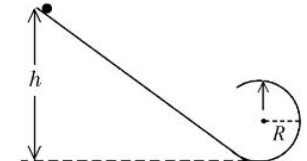
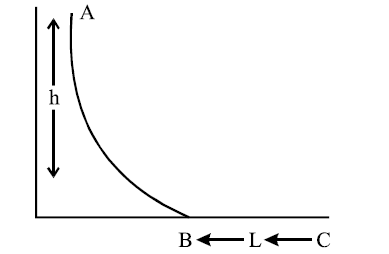
A smooth inclined plane ends in a vertical circular loop, as shown in the figure. A small body is released from height $$h$$ as shown. If the body exerts a force of three times its weight on the plane at the highest point of circle then the height $$h = \alpha R$$. The value of $$\alpha$$ is _______.
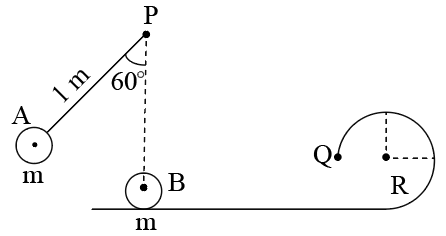
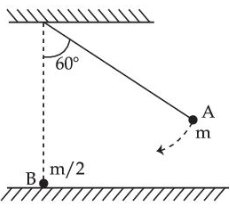
A small bob A of mass m is attached to a massless rigid rod of length 1 m pivoted at point P and kept at an angle of 60° with vertical as shown in figure. At distance of 1 m below point P, an identical bob B is kept at rest on a smooth horizontal surface that extends to a circular track of radius R as shown in figure. If bob B just manages to complete the circular path of radius R upto a point Q after being hit elastically by bob A, then radius R is ____ m.
vertical descent height of bob A.
$$ h = L - L \cos(60^\circ) = 1 - 1\left(\frac{1}{2}\right) = 0.5 \text{ m} $$
Apply conservation of energy
$$ \frac{1}{2} m v_A^2 = mgh \implies v_A = \sqrt{2 \cdot g \cdot 0.5} = \sqrt{g} $$
elastic collision between identical masses.
$$ \text{Velocities are exchanged, so } v_B = v_A = \sqrt{g} $$
minimum velocity required at the bottom to just complete the vertical circular track.
$$ v_B = \sqrt{5gR} $$
$$ \sqrt{g} = \sqrt{5gR} \implies g = 5gR \implies R = \frac{1}{5} = 0.2 \text{ m} $$
A body of mass 2 kg is moving along x-direction such that its displacement as function of time is given by x(t) = $$\alpha t^{2} +\beta t +ym$$, where $$\alpha=1m/s^{2}, \beta=1m/s$$ and y=1m. The work done on the body during the time interval t = 2 s to t = 3 s, is _________ J.
$$x(t) = t^2 + t + 1$$ m, mass = 2 kg. Find work done from $$t = 2$$ to $$t = 3$$.
$$v(t) = \frac{dx}{dt} = 2t + 1$$ m/s
$$v(2) = 5$$ m/s, $$v(3) = 7$$ m/s
Work = Change in KE = $$\frac{1}{2}m(v_3^2 - v_2^2) = \frac{1}{2}(2)(49 - 25) = 24$$ J
The answer is Option 2: 24 J.
A spherical ball of mass 2 kg falls from a height of 10 m and is brought to rest after penetrating 10 cm into sand. The average force exerted by sand on the ball is ______ N.
(Take g=10 m/$$s^{2}$$)
The ball is released from rest, so its entire loss of gravitational potential energy is converted into the work done against the resisting force of the sand during the 10 cm penetration.
Total vertical drop before coming to rest
= free-fall height + penetration depth
$$h = 10 \text{ m} + 0.1 \text{ m} = 10.1 \text{ m}$$
Loss of gravitational potential energy
$$\Delta U = m g h$$
Here, $$m = 2 \text{ kg}$$ and (as usual for JEE) we take $$g = 10 \text{ m s}^{-2}$$.
$$\Delta U = 2 \times 10 \times 10.1 = 202 \text{ J}$$
This entire 202 J is dissipated only while the ball moves the last $$0.1 \text{ m}$$ inside the sand. If $$F_{\text{avg}}$$ is the average upward (resisting) force exerted by the sand, the work it does is
$$W_{\text{sand}} = F_{\text{avg}} \times s$$ where $$s = 0.1 \text{ m}$$ is the penetration depth.
Because the ball finally stops, the work done by the sand equals the loss in potential energy (energy conservation):
$$F_{\text{avg}} \times 0.1 = 202$$
$$\Rightarrow \; F_{\text{avg}} = \frac{202}{0.1} = 2020 \text{ N}$$
Thus the average force exerted by the sand on the ball is
Option B which is: $$2020 \text{ N}$$
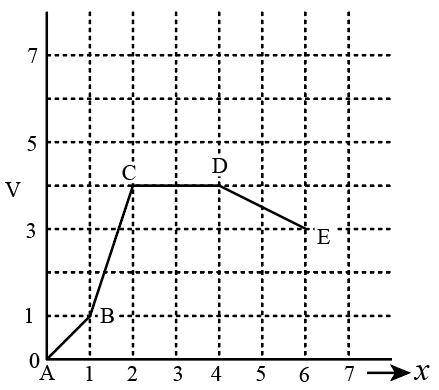
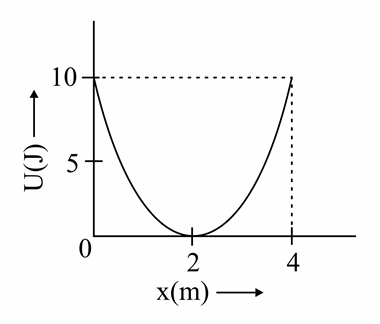
Potential energy (V) versus distance (x) is given by the graph. Rank various regions as per the magnitudes of the force (F) acting on a particle from high lo low.
$$F=-\frac{dV\left(x\right)}{dx}=-slope$$
$$F_{AB}=-\frac{1}{1}=-1\ N$$
$$F_{BC}=-\frac{4-1}{2-1}=-3\ N$$
$$F_{CD}=-\frac{4-4}{4-2}=0\ N$$
$$F_{DE}=-\ \frac{3-4}{6-4}=0.5\ N$$
$$\therefore\ $$ $$F_{BC}>F_{AB}>F_{DE}>F_{CD}$$
Given below are two statements:
Statement I : For a mechanical system of many particles total kinetic energy is the sum of kinetic energies of all the particles.
Statement II: The total kinetic energy can be the sum of kinetic energy of the center of mass w.r.t to the origin and the kinetic energy of all the particles w.r.t. the center of mass as the reference.
In the light of the above statements, choose the correct answer from the options given below :
Consider two statements regarding the kinetic energy of a mechanical system of many particles. Statement I asserts that the total kinetic energy of the system is the sum of the kinetic energies of all the particles. Statement II claims that the total kinetic energy can also be expressed as the sum of the kinetic energy of the centre of mass with respect to the origin and the kinetic energy of all the particles with respect to the centre of mass.
By definition, the total kinetic energy of a system of $$N$$ particles is given by $$K_{\text{total}} = \sum_{i=1}^{N} \frac{1}{2}m_i v_i^2$$. This expression clearly shows that the total kinetic energy is simply the sum of the individual kinetic energies of all particles. Statement I is true.
The decomposition described in Statement II is known as Konig’s theorem (or the decomposition theorem for kinetic energy), which states that $$K_{\text{total}} = \frac{1}{2}Mv_{\text{cm}}^2 + \sum_{i=1}^{N} \frac{1}{2}m_i v_i'^2$$, where $$M$$ is the total mass of the system, $$v_{\text{cm}}$$ is the velocity of the centre of mass, and $$v_i'$$ is the velocity of the $$i$$-th particle relative to the centre of mass. The first term represents the kinetic energy of the centre of mass motion, while the second term corresponds to the kinetic energy of the particles measured in the centre of mass frame. Statement II is true.
The correct answer is Option (3): Both Statement I and Statement II are true.
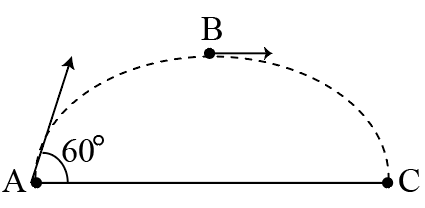
An object is projected with kinetic energy K from a point A at an angle 60° with the horizontal The ratio of the difference in kinetic energies at points B and C to that at point A (see figure), in the absence of air friction is :
An object is projected from point A with kinetic energy KKK at an angle of 60∘60^\circ60∘. Since there is no air resistance, mechanical energy is conserved throughout the motion.
At point A, the total energy is purely kinetic.
$$K_A\ =\ K=\ \ \frac{\ 1}{2}\times\ m\times\ v^2$$ = $$\ \frac{\ mv^2}{2}$$
As the object moves upward to point B, it gains height. Due to this increase in height, some of the kinetic energy is converted into potential energy, so the kinetic energy at B decreases.
$$K_A\ =\ K_B+m\times\ g\times\ h$$
At the highest point B, the vertical component of velocity becomes zero, and only the horizontal component remains. Therefore, kinetic energy at B depends only on the horizontal velocity.
$$v_x=v\cos\ 60^{\circ\ \ }=\ \frac{\ v}{2}$$
So kinetic energy at B:
$$K_B=\ \ \frac{\ 1}{2}\times\ m\times\left(v\cos\ 60^{\circ\ }\right)^2\ =\ \ \frac{\ 1}{2}\times\ m\times\ \left(\ \frac{\ v}{2}\right)^2\ =\frac{\ mv^2}{8}$$ = $$\ \frac{\ K}{4}\ $$
Now, as the object moves from B to C, it comes back to the same vertical level as A. Hence, the potential energy at C is the same as at A, and thus the kinetic energy at C becomes equal to the initial kinetic energy.
$$K_A=K_C=K$$
Now consider the difference in kinetic energies between C and B , and kinetic energy at A
$$K_C-K_B=K-\ \frac{\ K}{4}\ =\ \ \frac{\ 3K}{4}$$
$$K_A=K$$
Finally, take the ratio of these differences.
$$\ \frac{\ diff\ between\ B\ and\ C}{Kinetic\ energy\ at\ A}$$ = $$\ \frac{\ \frac{\ 3K}{4}}{K}$$
= $$\ \frac{\ 3}{4}$$
Thus, the required ratio is 3:4
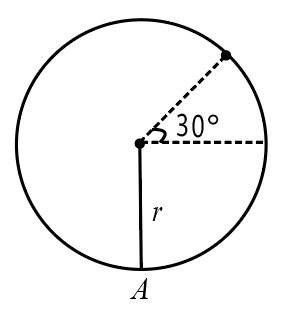
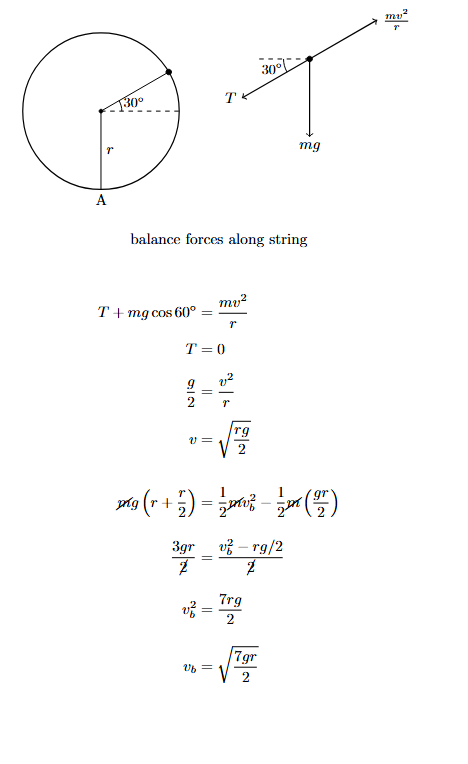
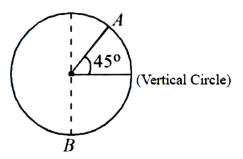
In case of vertical circular motion of a particle by a thread of length r if the tension in the thread is zero at an angle $$30^{\circ}$$ shown in figure, the velocity at the bottom point (A) of the circular path is
(g = gravitational acceleration)
A block is sliding down on an inclined plane of slope $$\theta$$ and at an instant t = 0 this block is given an upward momentum so that it starts moving up on the inclined surface with velocity u. The distance (S) travelled by the block before its velocity become zero, is ______.
(g = gravitational acceleration)
The phrase sliding down in this context implies the block is initially sliding down with constant velocity. This means the downward component of gravity is perfectly balanced by the upward force of kinetic friction.
$$ mg \sin\theta = f_k $$
$$ mg \sin\theta = \mu mg \cos\theta $$
When the block is given an upward momentum and starts moving up the incline with initial velocity $$u$$, the direction of motion changes. Now, kinetic friction acts down the incline, in the exact same direction as the gravity component.
The net opposing force is:
$$ F_{net} = mg \sin\theta + f_k $$
Since we established earlier that $$f_k = mg \sin\theta$$, the net force becomes:
$$ F_{net} = mg \sin\theta + mg \sin\theta = 2mg \sin\theta $$
The deceleration $$a$$ of the block is:
$$ a = \frac{F_{net}}{m} = 2g \sin\theta $$
Now, use the third kinematic equation to find the distance $$S$$ traveled before coming to rest, where final velocity is $$0$$:
$$ v^2 = u^2 - 2aS $$
$$ 0 = u^2 - 2(2g \sin\theta)S $$
$$ 4g \sin\theta \cdot S = u^2 $$
$$ S = \frac{u^2}{4g \sin\theta} $$
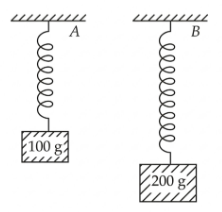
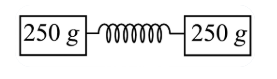
Two blocks with masses 100 g and 200 g are attached to the ends of springs A and B as shown in figure. the energy stored in A is E. The energy stored in B, when spring constants $$K_{A},K_{B}$$ of A and B, respectively satisfy the relation $$4K_{A}=3K_{B}$$ is:
Let extension in spring A = $$x_A$$ and extension in spring B = $$x_B$$
Energy stored in spring A = $$E_A$$ = E and energy stored in spring B = $$E_B$$
From Force balance in spring A,
$$K_Ax_A\ =\ mg\ =\ 0.1\ \times\ 10\ =\ 1N$$
$$\therefore\ x_A\ =\ \frac{1}{K_A}$$
$$E_A\ =\ \frac{1}{2}K_Ax_A^2\ =\ \frac{1}{2}K_A\times\ \frac{1}{K_A^2}=\frac{0.5}{K_A}$$
Similarly, from spring B,
$$K_Bx_B\ =\ 0.2\ \times\ 10\ =\ 2$$
$$\therefore\ x_B\ =\ \frac{2}{K_B}$$
$$E_B\ =\ \frac{1}{2}K_Bx_B^2\ =\ \frac{1}{2}K_B\times\ \frac{4}{K_B^2}\ =\ \frac{2}{K_B}$$
Since, $$K_B\ =\ \frac{4}{3}K_A$$
$$\therefore\ E_B\ =\ \frac{2}{\frac{4}{3}K_A}=\frac{1.5}{K_A}=3\ \times\ \frac{0.5}{K_A}=3E$$
In a perfectly inelastic collision, two spheres made of the same material with masses 15 kg and 25 kg, moving in opposite directions with speeds of 10 m/s and 30 m/s, respectively, strike each other and stick together. The rise in temperature (in $$^{\circ}C$$), if all the heat produced during the collision is retained by these spheres, is :
(specific heat of sphere material 31 cal/kg.$$^{\circ}C$$ and 1 cal =4.2 J)
Let the masses be $$m_1 = 15\ \text{kg}$$ and $$m_2 = 25\ \text{kg}$$, and their velocities before collision be $$v_1 = +10\ \text{m/s}$$ and $$v_2 = -30\ \text{m/s}$$ (opposite directions).
In a perfectly inelastic collision, momentum is conserved. The formula is:
$$m_1v_1 + m_2v_2 = (m_1 + m_2)\,v_f$$ $$-(1)$$
Substitute the given values into $$(1)$$:
$$15\times 10 + 25\times(-30) = 40\,v_f$$
$$150 - 750 = 40\,v_f$$
$$-600 = 40\,v_f$$
$$v_f = -\frac{600}{40} = -15\ \text{m/s}$$ $$-(2)$$
The heat produced equals the loss in kinetic energy. First, compute the initial kinetic energy:
$$K_i = \frac{1}{2}m_1v_1^2 + \frac{1}{2}m_2v_2^2$$ $$-(3)$$
Substitute values:
$$K_i = \frac{1}{2}\times 15\times 10^2 + \frac{1}{2}\times 25\times 30^2$$
$$K_i = 750 + 11250 = 12000\ \text{J}$$ $$-(4)$$
Next, compute the final kinetic energy of the combined mass:
$$K_f = \frac{1}{2}(m_1 + m_2)\,v_f^2$$ $$-(5)$$
Substitute values:
$$K_f = \frac{1}{2}\times 40\times (-15)^2 = 20\times 225 = 4500\ \text{J}$$ $$-(6)$$
Thus, the heat generated is:
$$Q = K_i - K_f = 12000 - 4500 = 7500\ \text{J}$$ $$-(7)$$
Given specific heat in calories: $$c = 31\ \text{cal/kg}^{\circ}\text{C}$$ and $$1\ \text{cal} = 4.2\ \text{J}$$. Converting to SI units:
$$c = 31\times 4.2 = 130.2\ \text{J/kg}^{\circ}\text{C}$$ $$-(8)$$
The total mass is:
$$M = m_1 + m_2 = 15 + 25 = 40\ \text{kg}$$ $$-(9)$$
The temperature rise is:
$$\Delta T = \frac{Q}{M\,c} = \frac{7500}{40\times 130.2} \approx 1.44\ ^{\circ}\text{C}$$ $$-(10)$$
Final Answer: The rise in temperature is $$1.44\ ^{\circ}\text{C}$$ (Option D).
A 1 kg block subjected to two simultaneous forces $$(2\hat{i} + 3\hat{j} + 4\hat{k})$$ N and $$(3\hat{i} - \hat{j} - 2\hat{k})$$ N is moved a distance of 25 m along $$(3\hat{i} - 4\hat{j})$$ direction. The work done in this process is _____ J.
The two simultaneous forces on the block are
$$\mathbf{F}_1 = 2\hat{i} + 3\hat{j} + 4\hat{k} \; \text{N}$$
$$\mathbf{F}_2 = 3\hat{i} - \hat{j} - 2\hat{k} \; \text{N}$$
Step 1 - Find the resultant force.
Add the vectors component-wise:
$$\mathbf{F} = \mathbf{F}_1 + \mathbf{F}_2$$
$$= (2+3)\hat{i} + (3-1)\hat{j} + (4-2)\hat{k}$$
$$= 5\hat{i} + 2\hat{j} + 2\hat{k}\; \text{N}$$
Step 2 - Write the displacement vector.
The block moves 25 m along the direction $$3\hat{i} - 4\hat{j}$$.
First find the unit vector in that direction.
Magnitude of $$3\hat{i} - 4\hat{j}$$ is
$$|\;3\hat{i} - 4\hat{j}\;| = \sqrt{3^{2} + (-4)^{2}} = \sqrt{9 + 16} = 5$$
Hence the unit vector is
$$\hat{u} = \frac{3}{5}\hat{i} - \frac{4}{5}\hat{j}$$
Multiply the unit vector by the distance 25 m to get the displacement vector $$\mathbf{s}$$:
$$\mathbf{s} = 25\hat{u} = 25\left(\frac{3}{5}\hat{i} - \frac{4}{5}\hat{j}\right)$$
$$= 15\hat{i} - 20\hat{j} + 0\hat{k}\; \text{m}$$
Step 3 - Calculate the work done.
Work $$W$$ is the dot product of the resultant force and displacement:
$$W = \mathbf{F} \cdot \mathbf{s}$$
$$= (5\hat{i} + 2\hat{j} + 2\hat{k}) \cdot (15\hat{i} - 20\hat{j} + 0\hat{k})$$
$$= 5 \times 15 + 2 \times (-20) + 2 \times 0$$
$$= 75 - 40 + 0$$
$$= 35 \; \text{J}$$
Therefore, the work done in moving the block is 35 J.
Two masses m and 2m are connected by a light string going over a pulley (disc) of mass 30m with radius r = 0.1 m. The pulley is mounted in a vertical plane and it is free to rotate about its axis. The 2m mass is released from rest and its speed when it has descended through a height of 3.6 m is m/ s. (Assume string does not slip and $$g = 10m/s^{2}$$)
Two masses $$m$$ and $$2m$$ are connected by a light string over a pulley (disc) of mass $$30m$$ with radius $$r = 0.1$$ m, taking $$g = 10$$ m/s$$^2$$. When the $$2m$$ mass is released from rest and descends a height $$h = 3.6$$ m, its speed is found by applying conservation of energy.
Since the string does not slip on the pulley, energy is conserved. Let $$v$$ be the speed of the masses after the $$2m$$ mass has descended by $$h = 3.6$$ m. The $$2m$$ mass descends by $$h$$ while the $$m$$ mass rises by the same amount, so the net loss in potential energy is $$2mgh - mgh = mgh$$.
Both masses move with speed $$v$$, and the pulley rotates with angular velocity $$\omega = v/r$$. For a disc, the moment of inertia about its axis is $$I = \frac{1}{2}(30m)r^2 = 15mr^2$$.
Accordingly, the total kinetic energy is $$\frac{1}{2}(m)v^2 + \frac{1}{2}(2m)v^2 + \frac{1}{2}I\omega^2 = \frac{1}{2}mv^2 + mv^2 + \frac{1}{2}(15mr^2)\frac{v^2}{r^2} = \frac{3}{2}mv^2 + \frac{15}{2}mv^2 = 9mv^2.$$
Equating the net potential energy loss to the total kinetic energy gives $$mgh = 9mv^2,$$ so $$v^2 = \frac{gh}{9} = \frac{10 \times 3.6}{9} = \frac{36}{9} = 4,$$ and hence $$v = 2\text{ m/s}.$$
The speed of the $$2m$$ mass after descending 3.6 m is 2 m/s.
A body of mass 2 kg begins to move under the influence of time dependent force $$\vec{F} = (2t\hat{i} + 6t^2\hat{j})$$ N, where $$\hat{i}$$ and $$\hat{j}$$ are unit vectors along $$x$$ and $$y$$-axis respectively. The power produced by the force at $$t = 2$$ s is _____ W.
The instantaneous power delivered by a force is defined as the scalar (dot) product of the force and the velocity of the body at that instant:
$$P(t)=\vec F(t)\cdot\vec v(t)\quad -(1)$$
We are given the time-dependent force
$$\vec F(t)=\bigl(2t\,\hat i+6t^{2}\,\hat j\bigr)\,{\rm N}$$
and the mass of the body $$m=2\;{\rm kg}$$. To use equation $$(1)$$ we first need the velocity $$\vec v(t)$$.
Step 1: Find the acceleration.
Newton’s second law gives
$$\vec a(t)=\frac{\vec F(t)}{m}=\frac{2t}{2}\,\hat i+\frac{6t^{2}}{2}\,\hat j=t\,\hat i+3t^{2}\,\hat j\;{\rm m\,s^{-2}}.$$
Step 2: Integrate acceleration to get velocity.
The problem states “a body begins to move under the influence of the force,” so we take the initial velocity at $$t=0$$ to be zero: $$\vec v(0)=\vec 0$$.
Integrating component-wise,
$$
v_x(t)=\int_{0}^{t}t'\,dt'=\frac{t^{2}}{2},\qquad
v_y(t)=\int_{0}^{t}3{t'}^{2}\,dt'=t^{3}.
$$
Hence
$$\vec v(t)=\frac{t^{2}}{2}\,\hat i+t^{3}\,\hat j\;{\rm m\,s^{-1}}.$$
Step 3: Evaluate force and velocity at $$t=2\;{\rm s}$$.
Force:
$$\vec F(2)=\bigl(2\!\times\!2\,\hat i+6\!\times\!2^{2}\,\hat j\bigr)
=(4\,\hat i+24\,\hat j)\;{\rm N}.$$
Velocity:
$$\vec v(2)=\frac{2^{2}}{2}\,\hat i+2^{3}\,\hat j
=(2\,\hat i+8\,\hat j)\;{\rm m\,s^{-1}}.$$
Step 4: Compute the power using equation $$(1)$$.
$$
P(2)=\vec F(2)\cdot\vec v(2)
=(4\,\hat i+24\,\hat j)\!\cdot\!(2\,\hat i+8\,\hat j)
=4\times2+24\times8
=8+192
=200\;{\rm W}.
$$
Therefore, the power produced by the force at $$t=2$$ s is 200 W.
The efficiency of a Carnot engine operating with a hot reservoir kept at a temperature of 1000 K is 0.4. It extracts 150 J of heat per cycle from the hot reservoir. The work extracted from this engine is being fully used to run a heat pump which has a coefficient of performance 10. The hot reservoir of the heat pump is at a temperature of 300 K. Which of the following statements is/are correct:
The Carnot engine (CE) and the heat pump (HP) work in tandem, the work output of the CE being the work input of the HP.
Carnot engine
Efficiency of a Carnot engine is defined as $$\eta = 1 - \frac{T_C}{T_H}$$, where $$T_H$$ and $$T_C$$ are the absolute temperatures of the hot and cold reservoirs respectively.
Given $$\eta = 0.4$$ and $$T_H = 1000\,\text{K}$$, we have
$$0.4 = 1 - \frac{T_C}{1000}$$
$$\frac{T_C}{1000} = 1 - 0.4 = 0.6$$
$$T_C = 0.6 \times 1000 = 600\,\text{K}$$
Thus the cold-reservoir temperature of the Carnot engine is $$600\,\text{K}$$ → Option B is correct.
The work obtained from the Carnot engine in one cycle is
$$W = \eta\,Q_H = 0.4 \times 150\,\text{J} = 60\,\text{J}$$
Hence the work delivered per cycle is $$60\,\text{J}$$ → Option A is correct.
Heat pump
The entire $$60\,\text{J}$$ of work produced by the engine drives the heat pump. For a heat pump, the coefficient of performance (COP) is defined as
$$\text{COP} = \frac{Q_H^{(\text{HP})}}{W}$$
Given $$\text{COP} = 10$$ and $$W = 60\,\text{J}$$, the heat delivered to the hot reservoir of the pump is
$$Q_H^{(\text{HP})} = \text{COP}\times W = 10 \times 60\,\text{J} = 600\,\text{J}$$
The cold-reservoir heat extracted by the pump is
$$Q_C^{(\text{HP})} = Q_H^{(\text{HP})} - W = 600\,\text{J} - 60\,\text{J} = 540\,\text{J}$$
The problem states that the heat pump operates between $$T_H^{(\text{HP})}=300\,\text{K}$$ and an (as yet) unknown cold-reservoir temperature $$T_C^{(\text{HP})}$$. For an ideal (Carnot) heat pump,
$$\text{COP} = \frac{T_H}{T_H - T_C}$$
Substituting $$\text{COP}=10$$ and $$T_H = 300\,\text{K}$$,
$$10 = \frac{300}{300 - T_C}$$
$$300 - T_C = \frac{300}{10} = 30$$
$$T_C = 300 - 30 = 270\,\text{K}$$
Thus the cold-reservoir temperature of the heat pump is $$270\,\text{K}$$ → Option C is correct.
Checking Option D
Option D claims that the heat supplied to the hot reservoir of the pump is $$540\,\text{J}$$ per cycle. The calculated value is $$Q_H^{(\text{HP})}=600\,\text{J}$$, so Option D is incorrect.
Correct statements: Option A, Option B, Option C.
A conducting solid sphere of radius $$R$$ and mass $$M$$ carries a charge $$Q$$. The sphere is rotating about an axis passing through its center with a uniform angular speed $$\omega$$. The ratio of the magnitudes of the magnetic dipole moment to the angular momentum about the same axis is given as $$\alpha \frac{Q}{2M}$$. The value of $$\alpha$$ is ______.
Let the surface charge of the conducting sphere be uniformly distributed.
All the charge therefore resides on the outer surface.
Surface charge density:
$$\sigma = \frac{Q}{4\pi R^{2}}$$
Take the rotation axis as the z-axis. Consider a thin surface strip between polar angles $$\theta$$ and $$\theta + d\theta$$.
• Radius of the circular ring in this strip: $$r = R\sin\theta$$.
• Width of the strip: $$R\,d\theta$$.
• Area of the strip: $$dA = 2\pi R^{2}\sin\theta\,d\theta$$.
• Charge on the strip: $$dq = \sigma\,dA
= \frac{Q}{4\pi R^{2}}\;(2\pi R^{2}\sin\theta\,d\theta)
= \frac{Q}{2}\sin\theta\,d\theta.$$
The ring rotates with the sphere at angular speed $$\omega$$. Current in the ring:
$$dI = \frac{dq}{T} = \frac{dq\,\omega}{2\pi}.$$
Magnetic moment of a current loop: $$d\mu = dI \times (\text{area of ring})$$, and the loop area is $$\pi r^{2} = \pi R^{2}\sin^{2}\theta$$.
Therefore $$d\mu = \frac{dq\,\omega}{2\pi}\;(\pi R^{2}\sin^{2}\theta) = \frac{\omega R^{2}}{2}\;dq\,\sin^{2}\theta = \frac{\omega R^{2}}{2}\; \bigl(\frac{Q}{2}\sin\theta\,d\theta\bigr)\sin^{2}\theta = \frac{Q\omega R^{2}}{4}\sin^{3}\theta\,d\theta.$$
Total magnetic dipole moment:
$$\mu = \int_{0}^{\pi} d\mu = \frac{Q\omega R^{2}}{4}\int_{0}^{\pi} \sin^{3}\theta\,d\theta.$$
Using $$\int_{0}^{\pi}\sin^{3}\theta\,d\theta = \frac{4}{3}$$, we obtain
$$\mu = \frac{Q\omega R^{2}}{4}\left(\frac{4}{3}\right) = \frac{Q\omega R^{2}}{3}.$$
Moment of inertia of a solid sphere about a diameter:
$$I = \frac{2}{5}MR^{2}.$$
Angular momentum about the same axis:
$$L = I\omega = \frac{2}{5}MR^{2}\omega.$$
Ratio of magnitudes:
$$\frac{\mu}{L} = \frac{\dfrac{Q\omega R^{2}}{3}} {\dfrac{2}{5}MR^{2}\omega} = \frac{Q}{3}\;\frac{5}{2M} = \frac{5Q}{6M}.$$
The question writes this ratio as $$\alpha \dfrac{Q}{2M}$$, so
$$\alpha\,\frac{Q}{2M} = \frac{5Q}{6M} \;\;\Longrightarrow\;\; \alpha = \frac{5}{3} \approx 1.666.$$
Hence the required value lies in the range 1.65 - 1.67.
Given below are two statements. One is labelled as Assertion (A) and the other is labelled as Reason (R).
Assertion (A) :
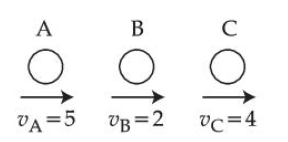
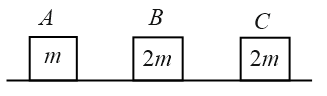
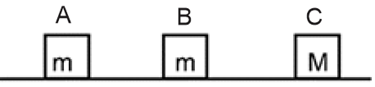
Three identical spheres of same mass undergo one dimensional motion as shown in figure with initial velocities $$v_A = 5\,\text{m/s},\; v_B = 2\,\text{m/s},\; v_C = 4\,\text{m/s}$$. If we wait sufficiently long for elastic collision to happen, then $$v_A = 4\,\text{m/s},\; v_B = 2\,\text{m/s},\; v_C = 5\,\text{m/s}$$, will be the final velocities.
Reason (R): In an elastic collision between identical masses, two objects exchange their velocities. In the light of the above statements, choose the correct answer from the options given below :
When 2 bodies of the same mass undergo elastic collision, their velocities get exchanged.
In the given system, since ball A is faster than ball B, which is slower than ball C, first ball A and ball B will collide and exchange their velocities.
$$v_{A,\ final}=2$$ m/s and $$v_B'=5$$ m/s
Then, ball B and ball C will collide and exchange their velocities
$$v_{B,\ final\ }=4$$ m/s and $$v_{c,\ final\ }=5$$
Therefore, final velocities of the balls are $$v_{A,\ final}=2$$ m/s, $$v_{B,\ final\ }=4$$ m/s and $$v_{c,\ final\ }=5$$
A ball having kinetic energy KE, is projected at an angle of $$60^{\circ}$$ from the horizontal. What will be the kinetic energy of ball at the highest point of its flight ?
A ball with kinetic energy $$KE$$ is projected at 60° from horizontal. At the highest point, only the horizontal component of velocity remains.
$$v_x = v\cos 60° = \frac{v}{2}$$
The kinetic energy at the highest point is
$$KE' = \frac{1}{2}mv_x^2 = \frac{1}{2}m\left(\frac{v}{2}\right)^2 = \frac{1}{4} \times \frac{1}{2}mv^2 = \frac{KE}{4}$$
Hence, the correct answer is Option 4: $$\frac{KE}{4}$$.
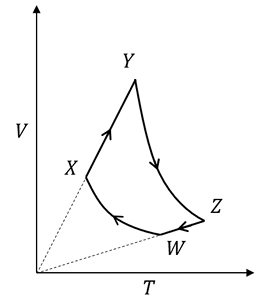
An ideal monatomic gas of $$n$$ moles is taken through a cycle $$WXYZW$$ consisting of consecutive adiabatic and isobaric quasi-static processes, as shown in the schematic $$V$$-$$T$$ diagram. The volume of the gas at $$W$$, $$X$$ and $$Y$$ points are, 64 cm$$^3$$, 125 cm$$^3$$ and 250 cm$$^3$$, respectively. If the absolute temperature of the gas $$T_W$$ at the point $$W$$ is such that $$nRT_W = 1$$ J ($$R$$ is the universal gas constant), then the amount of heat absorbed (in J) by the gas along the path $$XY$$ is ______.
For an ideal monatomic gas, the ratio of specific heats is $$\gamma = \dfrac{5}{3}$$.
Case 1: Adiabatic branch $$W \rightarrow X$$
For a reversible adiabatic process,
$$T V^{\,\gamma-1} = \text{constant}$$
Thus $$T_W V_W^{\,\gamma-1} = T_X V_X^{\,\gamma-1}$$ $$$ \Rightarrow \; T_X = T_W \left(\dfrac{V_W}{V_X}\right)^{\gamma-1} = T_W \left(\dfrac{64}{125}\right)^{\frac{2}{3}} $$$
Since $$64 = 4^3$$ and $$125 = 5^3$$, $$\left(\dfrac{64}{125}\right)^{\frac{2}{3}} = \left(\dfrac{4^3}{5^3}\right)^{\frac{2}{3}} = \left(\dfrac{4}{5}\right)^{2} = \dfrac{16}{25} = 0.64$$
Therefore, $$T_X = 0.64 \,T_W \qquad -(1)$$
Case 2: Isobaric branch $$X \rightarrow Y$$
For an isobaric process, $$P$$ is constant, so from the ideal-gas law $$PV = nRT$$ we have
$$\dfrac{T}{V} = \text{constant} \;\Longrightarrow\; \dfrac{T_Y}{T_X} = \dfrac{V_Y}{V_X}$$
Given $$V_Y = 250\;\text{cm}^3$$ and $$V_X = 125\;\text{cm}^3$$, $$\dfrac{T_Y}{T_X} = \dfrac{250}{125} = 2 \;\Longrightarrow\; T_Y = 2\,T_X \qquad -(2)$$
Using $$(1)$$ in $$(2)$$, $$T_Y = 2 \times 0.64\,T_W = 1.28\,T_W$$
Hence the temperature rise along $$X \rightarrow Y$$ is $$\Delta T = T_Y - T_X = 1.28\,T_W - 0.64\,T_W = 0.64\,T_W$$
The heat absorbed in an isobaric process is $$Q_{XY} = n C_p \Delta T$$ where, for a monatomic gas, $$C_p = \dfrac{5}{2}R$$.
Therefore, $$Q_{XY} = n\left(\dfrac{5}{2}R\right)(0.64\,T_W) = \dfrac{5}{2} \times 0.64 \; (nRT_W)$$
The problem states that $$nRT_W = 1\;\text{J}$$, so $$Q_{XY} = \dfrac{5}{2} \times 0.64 \times 1 = 2.5 \times 0.64 = 1.6\;\text{J}$$
Hence, the heat absorbed by the gas along the path $$X \rightarrow Y$$ is 1.6 J.
A body of mass 4 kg is placed on a plane at a point P having coordinate (3,4)m. Under the action of force $$\overrightarrow{F} = (2\hat{i}+3\hat{j})N$$, it moves to a new point Q having coordinates (6,10)m in 4 sec . The average power and instanteous power at the end of 4 sec are in the ratio of :
Let the displacement from point P to point Q be $$\vec d$$. Then
$$\vec d = (6-3)\,\hat i + (10-4)\,\hat j = 3\,\hat i + 6\,\hat j\quad -(1)$$
The work done by the force $$\overrightarrow{F}=(2\hat i+3\hat j)\,$$N is given by
$$W = \overrightarrow{F}\cdot \vec d = 2\times3 + 3\times6 = 6 + 18 = 24\text{ J}\quad -(2)$$
Average power over the time interval $$\Delta t=4\,$$s is defined by
$$P_{\rm avg} = \frac{W}{\Delta t} = \frac{24}{4} = 6\text{ W}\quad -(3)$$
Since the force is constant, acceleration is
$$\vec a = \frac{\overrightarrow{F}}{m} = \frac{1}{4}(2\hat i +3\hat j) = 0.5\,\hat i + 0.75\,\hat j\;\mathrm{m/s^2}\quad -(4)$$
Assuming the body starts from rest, its velocity at $$t=4\,$$s is
$$\vec v = \vec a\,t = (0.5\times4)\,\hat i + (0.75\times4)\,\hat j = 2\,\hat i + 3\,\hat j\;\mathrm{m/s}\quad -(5)$$
Instantaneous power at $$t=4\,$$s is
$$P_{\rm inst} = \overrightarrow{F}\cdot \vec v = 2\times2 + 3\times3 = 4 + 9 = 13\text{ W}\quad -(6)$$
Hence the ratio of average power to instantaneous power is
$$P_{\rm avg} : P_{\rm inst} = 6 : 13$$
Final Answer: Option D; 6 : 13.
As shown below, bob A of a pendulum having massless string of length 'R' is released from $$60^{\circ}$$ to the vertical. It hits another bob B of half the mass that is at rest on a friction less table in the center. Assuming elastic collision, the magnitude of the velocity of bob A after the collision will be (take g as acceleration due to gravity.)
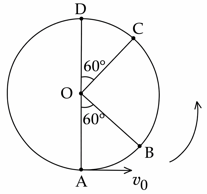
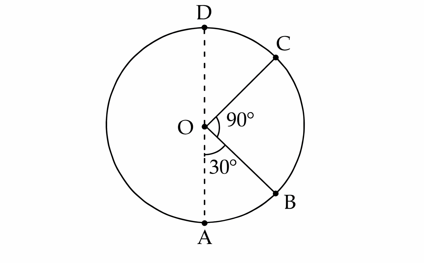
A bob of mass m is suspended at a point O by a light string of length l and left to perform vertical motion (circular) as shown in figure. Initially, by applying horizontal velocity $$v_o$$ at the point ' A ', the string becomes slack when, the bob reaches at the point ' D '. The ratio of the kinetic energy of the bob at the points B and C is
________.
The string becomes slack at the highest point D,means the tension is zero. The centripetal force is provided entirely by gravity at this point.
$$ \frac{m v_D^2}{l} = mg $$
$$ v_D^2 = gl $$
$$ KE_D = \frac{1}{2} m v_D^2 = \frac{1}{2} mgl $$
Let the center O be the reference level for zero potential energy. The height of point D from O is $$l$$, so its potential energy is:
$$ U_D = mgl $$
According to the law of conservation of mechanical energy, the total energy $$E$$ at any point is constant.
$$ E = K_D + U_D $$
$$ E = \frac{1}{2} mgl + mgl = \frac{3}{2} mgl $$
Now, let us find the kinetic energy at point B ($$K_B$$).
The vertical depth of point B below O is $$l \cos 60^\circ$$.
$$ U_B = -mgl \cos 60^\circ = -mgl \left(\frac{1}{2}\right) = -\frac{1}{2} mgl $$
Using energy conservation at point B:
$$ E = K_B + U_B $$
$$ \frac{3}{2} mgl = K_B - \frac{1}{2} mgl $$
$$ K_B = \frac{3}{2} mgl + \frac{1}{2} mgl $$
$$ K_B = 2mgl $$
Next, let us find the kinetic energy at point C ($$K_C$$).
The vertical height of point C above O is $$l \cos 60^\circ$$.
$$ U_C = mgl \cos 60^\circ = mgl \left(\frac{1}{2}\right) = \frac{1}{2} mgl $$
Using energy conservation at point C:
$$ E = K_C + U_C $$
$$ \frac{3}{2} mgl = K_C + \frac{1}{2} mgl $$
$$ K_C = \frac{3}{2} mgl - \frac{1}{2} mgl $$
$$ K_C = mgl $$
Finally, we find the ratio of the kinetic energy at point B to that at point C.
$$ \text{Ratio} = \frac{K_B}{K_C} $$
$$ \text{Ratio} = \frac{2mgl}{mgl} $$
$$ \text{Ratio} = 2 $$
Given below are two statements: one is labelled as Assertion A and the other is labelled as Reason R Assertion A: In a central force field, the work done is independent of the path chosen. Reason R: Every force encountered in mechanics does not have an associated potential energy. In the light of the above statements, choose the most appropriate answer from the options given below
We need to evaluate the Assertion and Reason about central forces and potential energy.
Assertion (A): "In a central force field, the work done is independent of the path chosen."
Analysis: A central force is always directed along the line joining the particle to a fixed center, with magnitude depending only on the distance: $$\vec{F} = f(r)\hat{r}$$. Central forces are conservative forces -- the work done depends only on the initial and final positions, not on the path. This is because the curl of a central force is zero. Assertion (A) is TRUE.
Reason (R): "Every force encountered in mechanics does not have an associated potential energy."
Analysis: This statement says that not every mechanical force has an associated potential energy. This is TRUE -- non-conservative forces like friction and viscous drag do not have an associated potential energy function. Only conservative forces (like gravity, spring force, and central forces) have well-defined potential energy functions.
Relationship between A and R: While both statements are true, R does not explain A. The fact that "some forces don't have potential energy" does not explain why "central forces are path-independent." The reason A is true is that central forces are conservative (they have a potential energy function), which is essentially the opposite situation from what R describes.
The correct answer is Option 2: Both A and R are true but R is NOT the correct explanation of A.
A sand dropper drops sand of mass m(t) on a conveyer belt at a rate proportional to the square root of speed (v)of the belt, i.e. $$\frac{dm}{dt} \propto \sqrt{v}$$. If P is the power delivered to run the belt at constant speed then which of the following relationship is true?
Since $$\frac{dm}{dt} \propto \sqrt{v}$$, we write $$\frac{dm}{dt} = k\sqrt{v}$$ for some constant $$k$$.
The belt runs at constant speed $$v$$. The force needed to maintain constant speed when sand is being dropped is:
$$ F = v\frac{dm}{dt} $$
This is because the sand needs to be accelerated from rest to speed $$v$$.
The power delivered is:
$$ P = Fv = v^2 \frac{dm}{dt} = v^2 \cdot k\sqrt{v} = kv^{5/2} $$
Therefore: $$P \propto v^{5/2}$$
Squaring both sides: $$P^2 \propto v^5$$
The correct answer is Option 3: $$P^2 \propto v^5$$.
A force $$F=\alpha+\beta x^2$$ acts on an object in the $$x$$-direction. The work done by the force is $$5\,J$$ when the object is displaced by $$1\,m.$$ If the constant $$\alpha=1\,N$$ then $$\beta$$ will be:
Given the force $$F = \alpha + \beta x^2$$, the work done is 5 J over a displacement of 1 m and α = 1 N, so we need to find β. Since the work is given by the integral of the force from 0 to 1, we have $$W = \int_0^1(\alpha+\beta x^2)dx = [\alpha x + \frac{\beta x^3}{3}]_0^1 = \alpha + \frac{\beta}{3}$$. Substituting the values gives $$5 = 1 + \frac{\beta}{3}$$, and therefore solving for β yields $$\beta = 12$$ N/m².
Thus the correct answer is Option 2: 12 N/m².
A ball of mass 100 g is projected with velocity 20 m/s at $$60^{\circ}$$ with horizontal. The decrease in kinetic energy of the ball during the motion from point of projection to highest point is
A ball of mass $$m = 100 \text{ g} = 0.1 \text{ kg}$$ is projected with velocity $$u = 20 \text{ m/s}$$ at $$\theta = 60°$$ with the horizontal.
Since the kinetic energy at the point of projection is $$KE_i = \frac{1}{2}mu^2 = \frac{1}{2} \times 0.1 \times 20^2 = \frac{1}{2} \times 0.1 \times 400 = 20 \text{ J}$$
At the highest point of projectile motion, the vertical component of velocity becomes zero and only the horizontal component remains. From this, the velocity at the highest point is $$v = u\cos\theta = 20 \times \cos 60° = 20 \times \frac{1}{2} = 10 \text{ m/s}$$
Next, the kinetic energy at the highest point is $$KE_f = \frac{1}{2}mv^2 = \frac{1}{2} \times 0.1 \times 10^2 = \frac{1}{2} \times 0.1 \times 100 = 5 \text{ J}$$
Finally, the decrease in kinetic energy is calculated as $$\Delta KE = KE_i - KE_f = 20 - 5 = 15 \text{ J}$$
The correct answer is Option (2): $$\boxed{15 \text{ J}}$$.
A body of mass 100 g is moving in circular path of radius 2 m on vertical plane as shown in figure. The velocity of the body at point A is 10 m/s. The ratio of its kinetic energies at point B and C is :
(Take acceleration due to gravity as $$10 m/s^{2}$$)
Kinetic energy at any point on the circle can be calculated using conservation of energy.
$$KE_A\ =\ \frac{1}{2}mv_A^2\ =\ \frac{1}{2}\ \times\ 0.1\ \times\ 10^2\ =\ 5J$$
$$PE_A\ =\ 0\ $$
At point B:-
Height $$H_B\ =\ R\left(1-\cos30^{\circ\ }\right)\ =\ 2-\sqrt{\ 3}\ m$$
$$PE_B\ =\ mgH_B\ =\ 0.1\times10\times\left(2-\sqrt{\ 3}\ \right)$$
$$KE_A\ +\ PE_A\ =\ KE_{B\ }+\ PE_B$$
⇒ $$5+0=KE_B+2-\sqrt{\ 3}$$
$$\therefore\ KE_B\ =\ 3+\sqrt{\ 3}\ J$$
At point C:-
Height $$H_C\ =\ R\left(1+\cos\ 60^{\circ\ }\right)\ =\ 2\left(1+\frac{1}{2}\right)=3\ m$$
$$PE_C\ =\ mgH_C=0.1\times10\times3\ =3\ J\ $$
$$KE_A\ +\ PE_A\ =\ KE_C\ +\ PE_C$$
⇒ $$5+0=KE_C+3$$
$$\therefore\ KE_C\ =\ 5-3\ =2\ J$$
Ratio of Kinetic energy at point B and C is therefore, $$Ratio=\frac{\left(3+\sqrt{\ 3}\right)}{2}$$
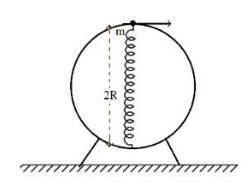
A bead of mass 'm' slides without friction on the wall of a vertical circular hoop of radius 'R' as shown in figure. The bead moves under the combined action of gravity and a massless spring ( k ) attached to the bottom of the hoop. The equilibrium length of the spring is 'R'. If the bead is released from top of the hoop with (negligible) zero initial speed, velocity of bead, when the length of spring becomes ' R ', would be (spring constant is 'k', g is accleration due to gravity
When the length of the spring becomes R, the angle spring will form from the vertical will be $$\theta\ =60^{\circ\ }$$.
Since all forces acting on the body are conservative, total energy remains conserved.
Potential energy of the bead at the top due to gravity, $$PE_{g}=mg\left(2R\right)=2mgR$$
Potential energy of the bead at the top due to the spring, $$PE_{sp}=\frac{1}{2}kx^2\ =\frac{1}{2}k\left(2R-R\right)^2=\frac{1}{2}kR^2$$
⇒ Initial potential energy, $$PE_{initial}=PE_g+PE_{sp}=2mgR+\frac{1}{2}kR^2$$
When spring becomes the length R, the extension in the spring becomes 0. Therefore, Potential energy = gravitational potential energy
Final potential energy, $$PE_{final}=mgH_{final}\ =\ mg\left(R\cos60^{\circ\ }\right)=\frac{mgR}{2}$$
Loss in potential energy = Gain in kinetic energy
$$KE_{final}-KE_{initial}=PE_{initial}-PE_{final}$$
⇒ $$KE_{final}=PE_{initial}-PE_{final}\ =\ 2mgR+\frac{1}{2}kR^2-\frac{mgR}{2}=\frac{3}{2}mgR+\frac{1}{2}kR^2$$
$$\frac{1}{2}mv^2=\frac{3}{2}mgR+\frac{1}{2}kR^2$$
$$\therefore\ v=\sqrt{\ 3gR+\frac{kR^2}{m}}$$
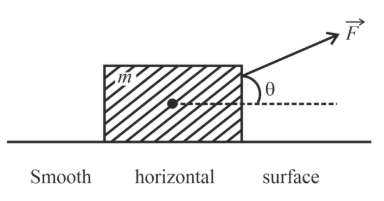
A block of mass 25 kg is pulled along a horizontal surface by a force at an angle 45 degrees with the horizontal. The friction coefficient between the block and the surface is 0.25. The displacement of 5 m of the block is :
The forces on the block are:
• weight $$mg$$ downward
• normal reaction $$N$$ upward
• applied force $$\mathbf{F}$$ making $$45^{\circ}$$ with the horizontal
• kinetic friction $$f_k$$ opposite to the motion along the surface.
Resolve the applied force:
Horizontal component $$F_x = F\cos 45^{\circ} = \dfrac{F}{\sqrt{2}}$$
Vertical component $$F_y = F\sin 45^{\circ} = \dfrac{F}{\sqrt{2}}$$
Vertical equilibrium (no vertical motion):
$$N + F_y = mg$$
so
$$N = mg - \frac{F}{\sqrt{2}} \quad -(1)$$
Friction coefficient is $$\mu = 0.25$$, hence
$$f_k = \mu N = \mu\left( mg - \frac{F}{\sqrt{2}} \right) \quad -(2)$$
The block is pulled steadily (horizontal acceleration zero). Therefore
horizontal forces balance:
$$F_x = f_k$$
$$\frac{F}{\sqrt{2}} = \mu\left( mg - \frac{F}{\sqrt{2}} \right) \quad -(3)$$
Solve equation $$-(3)$$ for $$F$$:
$$\frac{F}{\sqrt{2}} + \mu\frac{F}{\sqrt{2}} = \mu mg$$
$$F(1+\mu)\frac{1}{\sqrt{2}} = \mu mg$$
$$F = \frac{\mu mg\sqrt{2}}{1+\mu}$$
Insert the data $$m = 25\ \text{kg},\; g = 9.8\ \text{m s}^{-2},\; \mu = 0.25$$:
$$F = \frac{0.25 \times 25 \times 9.8 \times 1.414}{1 + 0.25}$$
$$F \approx \frac{86.6}{1.25} \approx 69.3\ \text{N}$$
Horizontal component of the applied force:
$$F_x = \frac{F}{\sqrt{2}} \approx \frac{69.3}{1.414} \approx 49.0\ \text{N}$$
Work done by the external force over the displacement $$s = 5\ \text{m}$$:
$$W = F_x\,s = 49.0 \times 5 \approx 245\ \text{J}$$
Therefore, the work done by the external force is $$245\ \text{J}$$.
Correct option: Option C
Which one of the following forces cannot be expressed in terms of potential energy?
Potential energy $$U$$ is defined only for conservative forces. A conservative force satisfies the following statements:
• Work done by the force depends only on the initial and final positions, not on the actual path.
• For a conservative force $$\vec F_c$$ we can write $$\vec F_c = -\,\boldsymbol{\nabla} U$$, that is, the force equals the negative gradient of a scalar potential energy function $$U(x,y,z)$$.
Let us analyse each force in the options.
Case A: Coulomb’s force between two point charges is $$\vec F = k\,\frac{q_1 q_2}{r^2}\,\hat r$$. It is inverse-square and central, hence conservative. We can define the electrostatic potential energy $$U = k\,\dfrac{q_1 q_2}{r}$$ such that $$\vec F = -\,\dfrac{dU}{dr}\,\hat r$$. Therefore it can be expressed in terms of potential energy.
Case B: Gravitational force between two masses is $$\vec F = -G\,\dfrac{m_1 m_2}{r^2}\,\hat r$$, which is also inverse-square and conservative. The corresponding potential energy is $$U = -G\,\dfrac{m_1 m_2}{r}$$. Hence gravitational force is expressible through potential energy.
Case C: Frictional force (kinetic or static) depends on the nature of surfaces and usually acts opposite to the direction of motion or impending motion. Work done against friction depends on the path length, not merely on initial and final positions. Therefore friction is a non-conservative force. For a non-conservative force we cannot define a single-valued scalar function $$U$$ satisfying $$\vec F = -\,\boldsymbol{\nabla} U$$. So friction cannot be expressed in terms of potential energy.
Case D: A restoring force such as the spring force is $$\vec F = -k\,x\,\hat i$$. It is conservative; its potential energy is the elastic potential energy $$U = \tfrac12 k x^2$$ because $$\vec F = -\,\dfrac{dU}{dx}\,\hat i$$.
Only the frictional force fails to meet the criteria for conservative forces.
Hence the force that cannot be expressed in terms of potential energy is the frictional force → Option C (Option 3).
A particle is released from height S above the surface of the earth. At a certain height its kinetic energy is three times its potential energy. The height from the surface of the earth and the speed of the particle at that instant are respectively.
Let the particle be released from rest at height $$S$$ above the earth’s surface. Choose the earth’s surface as the reference level of zero potential energy.
Initial potential energy: $$U_i = mgS$$
Initial kinetic energy: $$K_i = 0$$ (because it is released from rest)
Total mechanical energy remains constant, so for any later instant
$$K + U = mgS$$ $$-(1)$$
At some height $$h$$ (measured from the surface) the kinetic energy is given to be three times the potential energy:
$$K = 3U$$ $$-(2)$$
Let the potential energy at this instant be $$U = mgh$$.
Using $$-(2)$$, the kinetic energy at the same instant is
$$K = 3mgh$$.
Substitute these values of $$K$$ and $$U$$ into the energy conservation equation $$-(1)$$:
$$3mgh + mgh = mgS$$
$$4mgh = mgS$$
$$h = \frac{S}{4}$$.
Now compute the speed. Kinetic energy at height $$h$$ is also $$K = \frac12 mv^2$$. Equate this with $$3mgh$$:
$$\frac12 mv^2 = 3mgh$$
$$v^2 = 6gh$$
Insert $$h = \frac{S}{4}$$:
$$v^2 = 6g\left(\frac{S}{4}\right) = \frac{3gS}{2}$$
$$v = \sqrt{\frac{3gS}{2}}$$.
Therefore, the height of the particle above the earth’s surface and its speed at that instant are
$$h = \frac{S}{4}, \qquad v = \sqrt{\frac{3gS}{2}}$$.
Hence, the correct option is Option D.
A block of mass 1 kg, moving along x with speed $$v_i = 10$$ m/s enters a rough region ranging from $$x = 0.1$$ m to $$x = 1.9$$ m. The retarding force acting on the block in this range is $$F_r = -kx$$ N, with $$k = 10$$ N/m. Then the final speed of the block as it crosses rough region is
The motion is along the +x-direction. Outside the rough strip the block is free; inside the strip (from $$x_i = 0.1\;{\rm m}$$ to $$x_f = 1.9\;{\rm m}$$) it experiences the position-dependent retarding force
$$F_r = -\,k\,x,$$ with $$k = 10\;{\rm N\,m^{-1}}$$. (The minus sign shows that the force is opposite to the direction of motion, so it removes kinetic energy from the block.)
Case 1 : Work done by the retarding force
The infinitesimal work done by the force over a small displacement $$dx$$ is $$dW = F_r\,dx = -k\,x\,dx.$$ To obtain the total work between the entry and exit points, integrate from $$x = 0.1$$ m to $$x = 1.9$$ m:
$$\begin{aligned} W &= \int_{0.1}^{1.9} (-k\,x)\,dx \\ &= -k \int_{0.1}^{1.9} x\,dx \\ &= -k\left[\frac{x^{2}}{2}\right]_{0.1}^{1.9} \\ &= -\frac{k}{2}\Bigl(x_f^{2}-x_i^{2}\Bigr). \end{aligned}$$
Insert the numerical values:
$$\begin{aligned} x_f^{2}-x_i^{2} &= (1.9)^{2}-(0.1)^{2}=3.61-0.01=3.60,\\[4pt] W &= -\frac{10}{2}\,(3.60) = -5 \times 3.60 = -18\;{\rm J}. \end{aligned}$$
The negative sign confirms that the force takes 18 J of mechanical energy out of the block.
Case 2 : Applying the work-energy theorem
The work-energy theorem states $$W = K_f - K_i,$$ where $$K_i$$ and $$K_f$$ are the initial and final kinetic energies, respectively.
Initial kinetic energy: $$K_i = \frac{1}{2} m v_i^{2} = \tfrac12 (1\;{\rm kg})(10\;{\rm m/s})^{2} = 50\;{\rm J}.$$
Therefore,
$$\begin{aligned} -18\;{\rm J} &= K_f - 50\;{\rm J}\\ K_f &= 50\;{\rm J} - 18\;{\rm J} = 32\;{\rm J}. \end{aligned}$$
Case 3 : Determining the final speed
Let the required speed be $$v_f$$. $$K_f = \frac{1}{2} m v_f^{2} \; \Longrightarrow\; \frac{1}{2}(1)\,v_f^{2} = 32.$$
Solve for $$v_f$$:
$$v_f^{2} = 64 \quad\Longrightarrow\quad v_f = 8\;{\rm m/s}.$$
Hence, when the block leaves the rough region its speed is 8 m s−1.
Final answer : 8 m/s (Option D)
A body of mass 'm' connected to a massless and unstretchable string goes in verticle circle of radius 'R' under gravity g. The other end of the string is fixed at the center of circle. If velocity at top of circular path is $$n\sqrt{gR}$$, where, $$n /geq$$, then ratio of kinetic energy of the body at bottom to that at top of the circle is
The body moves in a vertical circle of radius $$R$$ under gravity $$g$$. The velocity at the top is given as $$v_{\text{top}} = n \sqrt{gR}$$, where $$n \geq 1$$ to ensure the body completes the circle.
The kinetic energy at the top is:
$$KE_{\text{top}} = \frac{1}{2} m v_{\text{top}}^2 = \frac{1}{2} m (n \sqrt{gR})^2 = \frac{1}{2} m n^2 gR$$
To find the kinetic energy at the bottom, use conservation of mechanical energy. Set the reference point for potential energy at the bottom of the circle.
At the bottom, height = 0, so potential energy = 0.
At the top, height = $$2R$$, so potential energy = $$mg \cdot 2R = 2mgR$$.
By conservation of energy:
Total energy at bottom = Total energy at top
$$\frac{1}{2} m v_{\text{bottom}}^2 + 0 = \frac{1}{2} m v_{\text{top}}^2 + 2mgR$$
Simplify:
$$\frac{1}{2} v_{\text{bottom}}^2 = \frac{1}{2} v_{\text{top}}^2 + 2gR$$
Multiply both sides by 2:
$$v_{\text{bottom}}^2 = v_{\text{top}}^2 + 4gR$$
Substitute $$v_{\text{top}} = n \sqrt{gR}$$:
$$v_{\text{bottom}}^2 = (n \sqrt{gR})^2 + 4gR = n^2 gR + 4gR = gR(n^2 + 4)$$
Kinetic energy at the bottom is:
$$KE_{\text{bottom}} = \frac{1}{2} m v_{\text{bottom}}^2 = \frac{1}{2} m gR (n^2 + 4)$$
The ratio of kinetic energy at the bottom to that at the top is:
$$\frac{KE_{\text{bottom}}}{KE_{\text{top}}} = \frac{\frac{1}{2} m gR (n^2 + 4)}{\frac{1}{2} m gR n^2} = \frac{n^2 + 4}{n^2}$$
Comparing with the options:
A. $$\frac{n^{2}}{n^{2}+4}$$
B. $$\frac{n^{2}+4}{n^{2}}$$
C. $$\frac{n+4}{n}$$
D. $$\frac{n}{n+4}$$
Option B matches the result.
Thus, the ratio is $$\frac{n^{2}+4}{n^{2}}$$.
A force $$\overrightarrow{F}=2\widehat{i}+b\widehat{j}+\widehat{k}$$ is applied on a particle and it undergoes a displacement $$\widehat{i}-2\widehat{j}-\widehat{k}$$.What will be the value of , if work done on the particle is zero.
We need to find the value of $$b$$ such that the work done is zero when force $$\vec{F} = 2\hat{i} + b\hat{j} + \hat{k}$$ causes displacement $$\vec{d} = \hat{i} - 2\hat{j} - \hat{k}$$.
Apply the work formula
Work done = $$\vec{F} \cdot \vec{d} = 0$$
Compute the dot product
$$W = (2)(1) + (b)(-2) + (1)(-1) = 2 - 2b - 1 = 1 - 2b$$
Set work equal to zero and solve
$$1 - 2b = 0$$
$$b = \frac{1}{2}$$
The answer is Option B: $$\frac{1}{2}$$.
A force $$f=x^{2}y\widehat{i}+y^{2}\widehat{j}$$ acts on a particle in a plane x+y=10. The work done by this force during a displacement from (0,0) to (4m,2m) is Joule
(round off to the nearest integer)
The work done by $$\vec{F} = x^2 y\,\hat{i} + y^2\,\hat{j}$$ along a displacement from $$(0, 0)$$ to $$(4, 2)$$ is $$W = \int_C x^2 y\,dx + \int_C y^2\,dy$$.
Since the force acts in the plane $$x + y = 10$$, we substitute $$y = 10 - x$$ in the $$x$$-component of the force. The first integral becomes $$\int_0^4 x^2(10 - x)\,dx = \int_0^4 (10x^2 - x^3)\,dx = \left[\dfrac{10x^3}{3} - \dfrac{x^4}{4}\right]_0^4 = \dfrac{640}{3} - 64 = \dfrac{448}{3}$$.
The second integral evaluates directly as $$\int_0^2 y^2\,dy = \left[\dfrac{y^3}{3}\right]_0^2 = \dfrac{8}{3}$$.
Adding both contributions: $$W = \dfrac{448}{3} + \dfrac{8}{3} = \dfrac{456}{3} = \boxed{152}$$ Joule.
A force $$(3x^2 + 2x - 5) \text{ N}$$ displaces a body from $$x = 2 \text{ m}$$ to $$x = 4 \text{ m}$$. Work done by this force is ______ J.
Work = $$\int_2^4 (3x^2+2x-5)dx = [x^3+x^2-5x]_2^4$$
At x=4: 64+16-20 = 60. At x=2: 8+4-10 = 2.
W = 60 - 2 = 58 J.
The answer is $$\boxed{58}$$ J.
A solid sphere and a hollow cylinder roll up without slipping on same inclined plane with same initial speed $$\upsilon$$. The sphere and the cylinder reaches upto maximum heights $$h_1$$ and $$h_2$$, respectively, above the initial level. The ratio $$h_1 : h_2$$ is $$\frac{n}{10}$$. The value of n is _____.
A solid sphere and a hollow cylinder roll up an incline with the same initial velocity $$v$$. The ratio of the heights they reach is $$\frac{h_1}{h_2} = \frac{n}{10}$$. We need to find $$n$$.
Apply energy conservation for rolling bodies.
For a body rolling without slipping, the total kinetic energy converts to potential energy at the maximum height:
$$ \frac{1}{2}mv^2 + \frac{1}{2}I\omega^2 = mgh $$
Using $$\omega = v/r$$ (rolling condition): $$\frac{1}{2}mv^2\left(1 + \frac{I}{mr^2}\right) = mgh$$
$$ h = \frac{v^2}{2g}\left(1 + \frac{I}{mr^2}\right) $$
Calculate height for the solid sphere.
For a solid sphere: $$I = \frac{2}{5}mr^2$$, so $$\frac{I}{mr^2} = \frac{2}{5}$$
$$ h_1 = \frac{v^2}{2g}\left(1 + \frac{2}{5}\right) = \frac{v^2}{2g} \times \frac{7}{5} = \frac{7v^2}{10g} $$
Calculate height for the hollow cylinder.
For a hollow cylinder (thin-walled): $$I = mr^2$$, so $$\frac{I}{mr^2} = 1$$
$$ h_2 = \frac{v^2}{2g}(1 + 1) = \frac{v^2}{g} $$
Find the ratio.
$$ \frac{h_1}{h_2} = \frac{7v^2/(10g)}{v^2/g} = \frac{7v^2}{10g} \times \frac{g}{v^2} = \frac{7}{10} $$
Therefore $$n = 7$$.
The answer is $$\boxed{7}$$.
A body of $$m$$ kg slides from rest along the curve of vertical circle from point $$A$$ to $$B$$ in friction less path. The velocity of the body at $$B$$ is: (given, $$R = 14$$ m, $$g = 10$$ m/s$$^2$$ and $$\sqrt{2} = 1.4$$)
Potential Energy at point A, $$PE_A=mgH_A\ =mgR\left(1+\sin45^{\circ\ }\right)\ =m\times\ 10\times\ \left(1+\frac{1}{\sqrt{\ 2}}\right)\ =\ 240m\ J$$
Potential Energy at point B = 0
From conservation of energy,
$$PE_A+KE_A=PE_B+KE_B$$
⇒ $$KE_B=PE_A+KE_A-PE_B\ =240m+0-0=240m$$
⇒ $$\frac{1}{2}mv_B^2=240m\ ⇒\ v_B^2\ =480$$
$$\therefore\ v_B=\sqrt{\ 480}=21.91\ $$ m/s
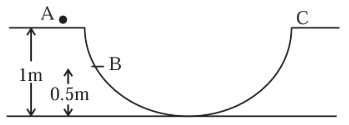
A particle is placed at the point $$A$$ of a frictionless track $$ABC$$ as shown in figure. It is gently pushed towards right. The speed of the particle when it reaches the point $$B$$ is: (Take $$g = 10 \text{ m s}^{-2}$$).
A particle of mass $$m$$ moves on a straight line with its velocity increasing with distance according to the equation $$v = \alpha\sqrt{x}$$, where $$\alpha$$ is a constant. The total work done by all the forces applied on the particle during its displacement from $$x = 0$$ to $$x = d$$, will be :
Work done by all the forces on the particle = change in kinetic energy of the particle
$$KE\ =\ \frac{1}{2}mv^2\ =\ \frac{1}{2}m \left(\alpha \sqrt{\ x}\right)^2\ =\ \frac{1}{2}m\alpha\ ^2x$$
$$KE_{initial}\ =\ 0$$
$$KE_{final}\ =\ \frac{1}{2}m\alpha\ ^2d$$
$$\therefore\ W\ =\ KE_{final}-KE_{initial}\ =\ \frac{1}{2}m\alpha\ ^2d$$
A stationary particle breaks into two parts of masses $$m_A$$ and $$m_B$$ which move with velocities $$v_A$$ and $$v_B$$ respectively. The ratio of their kinetic energies $$(K_B : K_A)$$ is :
A stationary particle breaks into two parts. We need the ratio $$K_B : K_A$$.
By conservation of momentum, the initial momentum is zero since the particle is stationary, so $$m_A v_A = m_B v_B$$.
The kinetic energies of the parts are given by $$K_A = \frac{1}{2}m_A v_A^2, \quad K_B = \frac{1}{2}m_B v_B^2$$.
Thus, the ratio of the kinetic energies is $$\frac{K_B}{K_A} = \frac{m_B v_B^2}{m_A v_A^2} = \frac{m_B v_B}{m_A v_A} \times \frac{v_B}{v_A}$$. Since $$m_B v_B = m_A v_A$$ from conservation of momentum, the first factor equals 1, giving $$\frac{K_B}{K_A} = 1 \times \frac{v_B}{v_A} = \frac{v_B}{v_A}$$.
Therefore $$K_B : K_A = v_B : v_A$$.
The correct answer is Option (1): $$v_B : v_A$$.
The bob of a pendulum was released from a horizontal position. The length of the pendulum is $$10$$ m. If it dissipates $$10\%$$ of its initial energy against air resistance, the speed with which the bob arrives at the lowest point is: [Use, $$g = 10 \text{ m s}^{-2}$$]
Given,
bob of pendulum is released from horizontal position,
Length of Pendulum ,L= $$10$$ m
$$g = 10 \text{ m s}^{-2}$$
At horizontal position, the bob is at height h=L above the lowest point.
Energy of bob at Initial Position is Ei = P.E = mgh
where: m = mass of the bob - $$g = 10 \text{ m s}^{-2}$$ (acceleration due to gravity) - h= $$10$$ m (length of the pendulum) So,
P.E= m$$\times\ $$g$$\times\ 10$$
Now Lets Calculate Energy Dissipated:-
K.E=$$\ \frac{\ 1}{2}\times\ m\times\ v^2$$
Since 10% of the energy is dissipated due to air resistance, the energy available for conversion to kinetic energy (KE) is:
K.E(final)=$$90\ \%\ $$ of $$m\times\ g\times\ h$$ = $$\ \frac{\ 1}{2}\times\ m\times\ v^2$$
K.E(final)=$$\ \frac{\ 90}{100}\times\ m\times\ 10\times\ 10$$= $$\ \frac{\ 1}{2}\times\ m\times\ v^2$$
On cancelling m on both sides,
K.E(final)=$$\ \frac{\ 90}{100}\times\ 10\times\ 10$$= $$\ \frac{\ 1}{2}\times\ v^2$$
$$v^2=2\times\ \ \frac{\ 90}{100}\times\ 10\times\ 10$$
$$v^2=2\times\ \ \frac{\ 90}{100}\times\ 100$$
$$v^2=180$$
$$v=\sqrt{\ 180}$$
$$v=6\sqrt{\ 5}$$
Therefore, Final velocity v=$$6\sqrt{\ 5}$$
Correct answer is A
Two bodies of mass $$4$$ g and $$25$$ g are moving with equal kinetic energies. The ratio of magnitude of their linear momentum is :
The relationship between kinetic energy and momentum is:
$$KE = \frac{p^2}{2m}$$, so $$p = \sqrt{2mKE}$$.
Since both bodies have equal kinetic energy:
$$\frac{p_1}{p_2} = \frac{\sqrt{2m_1 KE}}{\sqrt{2m_2 KE}} = \sqrt{\frac{m_1}{m_2}} = \sqrt{\frac{4}{25}} = \frac{2}{5}$$
The ratio of magnitudes of their linear momenta is $$2 : 5$$, which corresponds to Option (3).
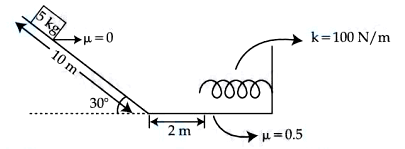
A block is simply released from the top of an inclined plane as shown in the figure above. The maximum compression in the spring when the block hits the spring is :
The kinetic energy at bottom is the potential energy when it was at the top of inclined plane
$$W_{KE}$$= mgh
=$$5 \times 10 \times (10\sin30^\circ)$$
=$$250\text{ J} $$
Friction acts opposite to the motion of block,so this is negative work
$$W_{fr} $$=$$ \mu mgd $$
=$$ 0.5 \times 5 \times 10 \times 2 $$
=$$ 50\text{ J}$$
the leftover energy now, is stored completely in spring as final kinetic energy of mass is 0.
$$W_{spring} $$= $$\frac{1}{2}(100)x^2 $$=$$ 50x^2 $$
250 - 50 = $$50x^2 $$
200=$$50x^2 $$
4=$$x^2 $$
$$x$$=2
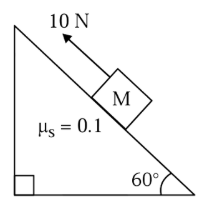
A block of mass 1 kg is pushed up a surface inclined to horizontal at an angle of $$60°$$ by a force of 10 N parallel to the inclined surface as shown in figure. When the block is pushed up by 10 m along inclined surface, the work done against frictional force is : $$g = 10$$ m s$$^{-2}$$
A body is moving unidirectionally under the influence of a constant power source. Its displacement in time $$t$$ is proportional to :
We need to find how displacement depends on time for a body under constant power. The constant power relation is $$P = Fv = mav = \text{constant}$$ so $$ma \cdot v = P \Rightarrow m\frac{dv}{dt} \cdot v = P$$ which gives $$mv \, dv = P \, dt$$. Integrating: $$\frac{mv^2}{2} = Pt$$ (starting from rest) and thus $$v = \sqrt{\frac{2Pt}{m}}$$.
Using $$v = \frac{ds}{dt} = \sqrt{\frac{2P}{m}} \cdot t^{1/2}$$ we find $$s = \sqrt{\frac{2P}{m}} \int_0^t t^{1/2} dt = \sqrt{\frac{2P}{m}} \cdot \frac{2}{3}t^{3/2}$$, so $$s \propto t^{3/2}$$.
Displacement is proportional to $$t^{3/2}$$, which matches Option B. Therefore, the answer is Option B.
A body of mass 2 kg begins to move under the action of a time dependent force given by $$\vec{F} = (6t)\hat{i} + (6t^2)\hat{j}$$ N. The power developed by the force at the time $$t$$ is given by:
$$\vec{F}=(6t)\hat{i}+(6t^2)\hat{j}$$. $$m=2$$ kg. $$\vec{a}=\vec{F}/m=(3t)\hat{i}+(3t^2)\hat{j}$$.
$$\vec{v}=\int\vec{a}dt=\frac{3t^2}{2}\hat{i}+t^3\hat{j}$$.
Power: $$P=\vec{F}\cdot\vec{v}=(6t)(3t^2/2)+(6t^2)(t^3)=9t^3+6t^5$$.
The answer is Option (4): $$(9t^3+6t^5)$$ W.
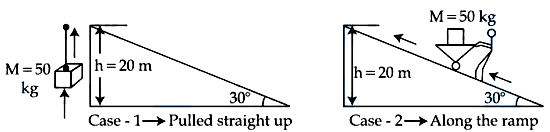
A body of mass $$50 \text{ kg}$$ is lifted to a height of $$20 \text{ m}$$ from the ground in the two different ways as shown in the figures. The ratio of work done against the gravity in both the respective cases, will be :
A bullet of mass $$50 \text{ g}$$ is fired with a speed $$100 \text{ m/s}$$ on a plywood and emerges with $$40 \text{ m/s}$$. The percentage loss of kinetic energy is :
$$KE_i = \frac{1}{2}(0.05)(100^2) = 250$$ J. $$KE_f = \frac{1}{2}(0.05)(40^2) = 40$$ J.
Loss = $$250 - 40 = 210$$ J. Percentage loss = $$\frac{210}{250} \times 100 = 84\%$$.
The correct answer is Option (1): 84%.
A heavy iron bar, of weight $$W$$ is having its one end on the ground and the other on the shoulder of a person. The bar makes an angle $$\theta$$ with the horizontal. The weight experienced by the person is :
At equilibrium, the net moment on the bar would be zero.
Weight acts on the center of the rod (at length L/2 from either end).
Let the reaction force acting on the man's shoulder be R. This is the weight experienced by the man.
Balancing the Moment at the end of the rod on the ground:-
Moment due to the weight of the bar = W $$\times\ $$ $$\frac{L}{2}$$ $$\times\ $$ $$\cos\theta\ $$ (clockwise)
Moment due to reaction force on the shoulder = R $$\times\ $$ $$L$$ $$\times\ $$ $$\cos\theta\ $$ (anticlockwise)
At equilibrium, both of these moments would be equal
⇒ W $$\times\ $$ $$\frac{L}{2}$$ $$\times\ $$ $$\cos\theta\ $$ $$=$$ R $$\times\ $$ $$L$$ $$\times\ $$ $$\cos\theta\ $$
$$\therefore\ \ R\ =\ \frac{W}{2}$$ is the weight experienced by the man
A simple pendulum of length $$1$$ m has a wooden bob of mass $$1$$ kg. It is struck by a bullet of mass $$10^{-2}$$ kg moving with a speed of $$2 \times 10^{2}$$ m s$$^{-1}$$. The bullet gets embedded into the bob. The height to which the bob rises before swinging back is. (use $$g = 10$$ m s$$^{-2}$$)
A bullet of mass 0.01 kg moving at 200 m/s embeds into a 1 kg pendulum bob. In this perfectly inelastic collision, linear momentum is conserved: $$m_{\text{bullet}}u=(m_{\text{bullet}}+m_{\text{bob}})v$$. Substituting gives $$0.01\times200=(0.01+1)\times v\,,\quad2=1.01\,v\,,\quad v=\frac{2}{1.01}\approx1.98\approx2\text{ m/s}\,.$$
After the collision, the combined system converts kinetic energy to potential energy during its rise: $$\frac{1}{2}(m_{\text{bullet}}+m_{\text{bob}})v^2=(m_{\text{bullet}}+m_{\text{bob}})gh\,.$$ Cancelling the mass yields $$h=\frac{v^2}{2g}\,.$$ Substituting $$v=2$$ m/s and $$g=10$$ m/s$$^2$$ gives $$h=\frac{4}{20}=0.20\text{ m}\,.$$
The correct answer is Option B: 0.20 m.
The potential energy function (in J) of a particle in a region of space is given as $$U = (2x^2 + 3y^3 + 2z)$$. Here $$x, y$$ and $$z$$ are in meter. The magnitude of $$x$$-component of force (in N) acting on the particle at point $$P(1, 2, 3)$$ m is:
We need to find the magnitude of the x-component of force at point P(1, 2, 3) given the potential energy function $$U = 2x^2 + 3y^3 + 2z$$.
The force is the negative gradient of the potential energy:
$$\vec{F} = -\nabla U = -\left(\frac{\partial U}{\partial x}\hat{i} + \frac{\partial U}{\partial y}\hat{j} + \frac{\partial U}{\partial z}\hat{k}\right)$$
Therefore, the x-component of force is:
$$F_x = -\frac{\partial U}{\partial x}$$
$$\frac{\partial U}{\partial x} = \frac{\partial}{\partial x}(2x^2 + 3y^3 + 2z) = 4x$$
(The terms $$3y^3$$ and $$2z$$ are treated as constants when differentiating with respect to $$x$$.)
$$F_x = -4x$$
At $$x = 1$$:
$$F_x = -4(1) = -4 \text{ N}$$
The magnitude of the x-component of force is $$|F_x| = 4$$ N.
The correct answer is Option (3): 4 N.
Three bodies A, B and C have equal kinetic energies and their masses are $$400 \text{ g}$$, $$1.2 \text{ kg}$$ and $$1.6 \text{ kg}$$ respectively. The ratio of their linear momenta is :
Three bodies A, B, C with equal kinetic energies and masses 400 g, 1.2 kg, 1.6 kg. Find the ratio of their momenta.
Recall the relation between momentum and kinetic energy. $$KE = \frac{p^2}{2m}$$, so $$p = \sqrt{2mKE}$$.
Since KE is the same for all three: $$p_A : p_B : p_C = \sqrt{m_A} : \sqrt{m_B} : \sqrt{m_C}$$
Substitute the masses. $$m_A = 0.4$$ kg, $$m_B = 1.2$$ kg, $$m_C = 1.6$$ kg. So $$= \sqrt{0.4} : \sqrt{1.2} : \sqrt{1.6}$$
Multiply all by $$\sqrt{10}$$ (equivalently, consider $$4:12:16$$ inside the roots): $$= \sqrt{4} : \sqrt{12} : \sqrt{16} = 2 : 2\sqrt{3} : 4 = 1 : \sqrt{3} : 2$$
The correct answer is Option (2): $$1 : \sqrt{3} : 2$$.
When kinetic energy of a body becomes 36 times of its original value, the percentage increase in the momentum of the body will be:
We are given that the kinetic energy of a body becomes 36 times its original value and asked to determine the percentage increase in momentum.
The relationship between kinetic energy ($$KE$$) and momentum ($$p$$) is $$KE = \frac{p^2}{2m}$$, where $$m$$ is the mass of the body, and rearranging gives $$p = \sqrt{2m \cdot KE}$$.
Letting the initial kinetic energy be $$KE$$ with corresponding momentum $$p$$ leads to $$p = \sqrt{2m \cdot KE}$$.
When the kinetic energy increases to $$KE' = 36 \, KE$$, the new momentum becomes $$p' = \sqrt{2m \cdot KE'} = \sqrt{2m \cdot 36 \, KE} = \sqrt{36} \cdot \sqrt{2m \cdot KE} = 6p$$, since $$\sqrt{36} = 6$$ and $$\sqrt{2m \cdot KE} = p$$.
The increase in momentum is then $$\Delta p = p' - p = 6p - p = 5p$$.
Therefore, the percentage increase in momentum is $$\frac{\Delta p}{p} \times 100 = \frac{5p}{p} \times 100 = 500\%$$.
The correct answer is Option (4): 500%.
Four particles $$A, B, C, D$$ of mass $$\frac{m}{2}, m, 2m, 4m$$, have same momentum, respectively. The particle with maximum kinetic energy is :
All have same momentum $$p$$. $$KE = \frac{p^2}{2m}$$.
Smallest mass has maximum KE. Particle A has mass $$m/2$$ (smallest).
The correct answer is Option (2): A.
If a rubber ball falls from a height h and rebounds upto the height of h/2. The percentage loss of total energy of the initial system as well as velocity of ball before it strikes the ground, respectively, are:
A ball is released from a height h. By applying energy conservation, its speed just before striking the ground is given by $$ v = \sqrt{2gh} $$.
After impact, the ball rebounds to a height of h/2. The potential energy at the initial height is $$E_i = mgh$$, while at the rebound height it is $$E_f = mg(h/2) = mgh/2$$.
The energy lost during the collision is therefore $$\Delta E = mgh - mgh/2 = mgh/2$$, which corresponds to a percentage loss of $$\frac{\Delta E}{E_i} \times 100 = \frac{mgh/2}{mgh} \times 100 = 50\%$$.
Hence, the correct answer is Option 1: $$50\%,\ \sqrt{2gh}$$.
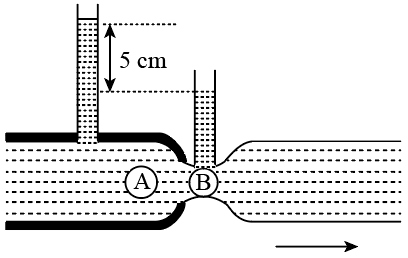
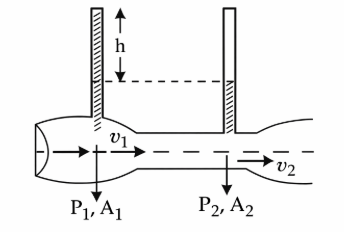
Given below are two statements: Statement I: When speed of liquid is zero everywhere, pressure difference at any two points depends on equation $$P_1 - P_2 = \rho g(h_2 - h_1)$$. Statement II: In venturi tube shown, $$2gh = v_1^2 - v_2^2$$. Choose the most appropriate answer from the options given below.
Statement I:
When the speed of liquid is zero everywhere, the fluid is in hydrostatic condition. In this case, pressure variation depends only on depth. The relation between pressure difference and height difference is given by:
$$P_1-P_2\ =\ \rho\ g\left(h_2-h_1\right)$$
This is the standard hydrostatic pressure relation, so Statement I is correct.
Statement II:
In a venturi tube, fluid is flowing, so Bernoulli’s equation must be applied:
$$P_1+\ \frac{\ 1}{2}\rho\ v_1^2=\ P_2\ +\ \ \frac{\ 1}{2}\ \rho\ v_2^2$$
From Bernoulli’s equation:
Also, from the manometer height difference:
$$P_1-P_2\ =\ \rho\ gh$$
Combining these gives:
$$P_1+\ \frac{\ 1}{2}\rho\ v_1^2=\ P_2\ +\ \ \frac{\ 1}{2}\ \rho\ v_2^2$$
$$\ \ \ P_1-P_2=\frac{\ 1}{2}\ \rho\ v_2^2-\frac{\ 1}{2}\rho\ v_1^2=\rho gh$$
$$\frac{\ 1}{2}\ \rho\ v_2^2-\frac{\ 1}{2}\rho\ v_1^2=\rho gh$$
$$\ \ \rho\ v_2^2-\ \rho\ v_1^2=2\rho gh$$
$$\ v_2^2-\ \ \ v_1^2=2 gh$$
But in the statement it is given as:
$$\ v_1^2-\ \ \ v_2^2=2 gh$$
which has the wrong sign.
Hence, Statement II is incorrect.
If two vectors $$\vec{P} = \hat{i} + 2m\hat{j} + m\hat{k}$$ and $$\vec{Q} = 4\hat{i} - 2\hat{j} + m\hat{k}$$ are perpendicular to each other. Then, the value of $$m$$ will be
Two vectors $$\vec{P}$$ and $$\vec{Q}$$ are perpendicular if their dot product is zero:
$$\vec{P} \cdot \vec{Q} = 0$$
Given:
$$\vec{P} = \hat{i} + 2m\hat{j} + m\hat{k}$$
$$\vec{Q} = 4\hat{i} - 2\hat{j} + m\hat{k}$$
Computing the dot product:
$$\vec{P} \cdot \vec{Q} = (1)(4) + (2m)(-2) + (m)(m) = 0$$
$$4 - 4m + m^2 = 0$$
$$m^2 - 4m + 4 = 0$$
$$(m - 2)^2 = 0$$
$$m = 2$$
The correct answer is Option 2: $$m = 2$$.
A $$0.4$$ kg mass takes $$8$$ s to reach ground when dropped from a certain height $$P$$ above surface of earth. The loss of potential energy in the last second of fall is ______ J. [Take $$g = 10$$ m s$$^{-2}$$]
Find the loss of potential energy in the last second of fall for a 0.4 kg mass dropped from height P, taking 8 seconds to reach ground.
$$h_8 = \frac{1}{2}g t^2 = \frac{1}{2} \times 10 \times 64 = 320 \text{ m}$$
$$h_7 = \frac{1}{2} \times 10 \times 49 = 245 \text{ m}$$
$$\Delta h = h_8 - h_7 = 320 - 245 = 75 \text{ m}$$
$$\Delta PE = mg\Delta h = 0.4 \times 10 \times 75 = 300 \text{ J}$$
The answer is $$\boxed{300}$$.
A block of mass $$10$$ kg is moving along $$x$$-axis under the action of force $$F = 5x$$ N. The work done by the force in moving the block from $$x = 2$$ m to $$4$$ m will be _____ J.
Work done by a variable force: $$W = \int_{x_1}^{x_2} F \, dx$$
$$W = \int_2^4 5x \, dx = 5 \times \frac{x^2}{2}\bigg|_2^4 = \frac{5}{2}(16 - 4) = \frac{5}{2} \times 12 = 30 \text{ J}$$
The work done is $$\mathbf{30}$$ J.
A block of mass 5 kg starting from rest pulled up on a smooth incline plane making an angle of 30$$^\circ$$ with horizontal with an effective acceleration of 1 m s$$^{-2}$$. The power delivered by the pulling force at $$t = 10$$ s from the start is _______ W.
[Use $$g = 10$$ m s$$^{-2}$$]
Given: Mass = 5 kg, angle = 30°, acceleration = 1 m/s², starts from rest, g = 10 m/s².
First, we find the net pulling force.
Along the incline, the pulling force must overcome gravity and provide acceleration:
$$F = m(a + g\sin\theta) = 5(1 + 10 \times \sin 30°) = 5(1 + 5) = 30 \text{ N}$$
Next, we find velocity at t = 10 s.
$$v = u + at = 0 + 1 \times 10 = 10 \text{ m/s}$$
From this, we power delivered.
$$P = Fv = 30 \times 10 = 300 \text{ W}$$
A body of mass 1 kg begins to move under the action of a time dependent force $$\vec{F} = (t\hat{i} + 3t^2\hat{j})$$ N, where $$\hat{i}$$ and $$\hat{j}$$ are the unit vectors along $$x$$ and $$y$$ axis. The power developed by above force, at the time $$t = 2$$ s, will be _____ W.
A body of mass $$m = 1$$ kg starts from rest under the force $$\vec{F} = (t\hat{i} + 3t^2\hat{j})$$ N, so the acceleration is $$\vec{a} = \frac{\vec{F}}{m} = t\hat{i} + 3t^2\hat{j}$$ m/s².
Since the initial velocity is $$\vec{v}(0)=0$$, integrating the acceleration from 0 to $$t$$ gives the velocity as $$ \vec{v} = \int_0^t \vec{a}\,dt = \frac{t^2}{2}\hat{i} + t^3\hat{j}. $$
Next, at $$t = 2$$ s, we obtain $$ \vec{v}(2) = \frac{4}{2}\hat{i} + 8\hat{j} = 2\hat{i} + 8\hat{j} $$ m/s and $$ \vec{F}(2) = 2\hat{i} + 12\hat{j} $$ N, so the power is $$ P = \vec{F}\cdot\vec{v} = (2)(2) + (12)(8) = 4 + 96 = 100 \text{ W}. $$ Therefore the correct answer is 100 W.
A body of mass 5 kg is moving with a momentum of 10 kg m s$$^{-1}$$. Now a force of 2 N acts on the body in the direction of its motion for 5 s. The increase in the Kinetic energy of the body is _______ J.
We have a body of mass $$m = 5$$ kg with initial momentum $$p_i = 10$$ kg m/s, acted upon by a force $$F = 2$$ N for $$t = 5$$ s.
The initial velocity is $$u = \frac{p_i}{m} = \frac{10}{5} = 2$$ m/s, so the initial kinetic energy is:
$$K_i = \frac{1}{2}mu^2 = \frac{1}{2}(5)(4) = 10$$ J
Now, using the impulse-momentum theorem to find the final momentum:
$$p_f = p_i + Ft = 10 + 2 \times 5 = 20 \text{ kg m/s}$$
So the final velocity is $$v = \frac{p_f}{m} = \frac{20}{5} = 4$$ m/s, and the final kinetic energy is:
$$K_f = \frac{1}{2}mv^2 = \frac{1}{2}(5)(16) = 40$$ J
Hence, the increase in kinetic energy is:
$$\Delta K = K_f - K_i = 40 - 10 = 30 \text{ J}$$
So, the answer is $$30$$ J.
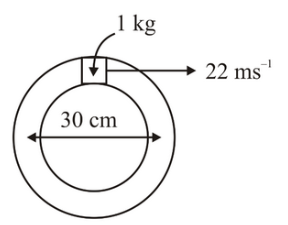
A closed circular tube of average radius 15 cm, whose inner walls are rough, is kept in vertical plane. A block of mass 1 kg just fit inside the tube. The speed of block is 22 m s$$^{-1}$$, when it is introduced at the top of tube. After completing five oscillations, the block stops at the bottom region of tube. The work done by the tube on the block is _______ J. (Given $$g = 10$$ m s$$^{-2}$$).
The tube is a vertical circle of radius $$R = 15 \text{ cm} = 0.15 \text{ m}$$. Take the bottom‐most point of the circle as the reference level of gravitational potential energy (GPE).
Initial (block released at the top)
Height of the top above the bottom is the diameter, $$h = 2R = 0.30 \text{ m}$$.
Initial speed is $$v_0 = 22 \text{ m s}^{-1}$$.
Initial kinetic energy $$K_i = \tfrac12 m v_0^{2} = \tfrac12 (1) (22)^{2} = \tfrac12 (484) = 242 \text{ J}$$.
Initial gravitational potential energy $$U_i = mgh = (1)(10)(0.30) = 3 \text{ J}$$.
Hence the initial total mechanical energy $$E_i = K_i + U_i = 242 + 3 = 245 \text{ J}$$.
Final (block finally comes to rest at the bottom)
Final speed $$v_f = 0$$, so $$K_f = 0$$.
At the bottom, $$U_f = 0$$ by our choice of reference.
Therefore the final mechanical energy $$E_f = 0 + 0 = 0 \text{ J}$$.
Work done by the tube (friction)
For non-conservative forces,
$$W_{\text{tube}} = E_f - E_i$$.
Substituting, $$W_{\text{tube}} = 0 - 245 = -245 \text{ J}$$.
The negative sign shows that the tube removes energy from the block. Thus the magnitude of the work done by the tube on the block is $$245 \text{ J}$$.
Answer: $$245 \text{ J}$$.
A small particle moves to position $$5\hat{i} - 2\hat{j} + \hat{k}$$ from its initial position $$2\hat{i} + 3\hat{j} - 4\hat{k}$$ under the action of force $$5\hat{i} + 2\hat{j} + 7\hat{k}$$ N. The value of work done will be _____ J.
We have initial position $$\vec{r_i} = 2\hat{i} + 3\hat{j} - 4\hat{k}$$, final position $$\vec{r_f} = 5\hat{i} - 2\hat{j} + \hat{k}$$, and force $$\vec{F} = 5\hat{i} + 2\hat{j} + 7\hat{k}$$ N.
The displacement vector is:
$$\vec{d} = \vec{r_f} - \vec{r_i} = (5-2)\hat{i} + (-2-3)\hat{j} + (1-(-4))\hat{k} = 3\hat{i} - 5\hat{j} + 5\hat{k}$$
Now, work done is the dot product of force and displacement:
$$W = \vec{F} \cdot \vec{d} = (5)(3) + (2)(-5) + (7)(5)$$
$$W = 15 - 10 + 35 = 40 \text{ J}$$
So, the answer is $$40$$ J.
If the maximum load carried by an elevator is 1400 kg (600 kg-Passengers + 800 kg-elevator), which is moving up with a uniform speed of 3 m s$$^{-1}$$ and the frictional force acting on it is 2000 N, then the maximum power used by the motor is _______ kW. $$g = 10$$ m s$$^{-2}$$
We need to find the minimum power delivered by the motor of an elevator carrying a maximum load of 1400 kg, moving upward with a uniform speed of 3 m/s, against a frictional force of 2000 N.
We begin by determining the total weight of the system. The total mass is 1400 kg (600 kg passengers + 800 kg elevator). Taking $$g = 10$$ m/s$$^2$$ gives:
$$W = mg = 1400 \times 10 = 14000 \text{ N}$$
Next, we determine the total force the motor must exert. Since the elevator moves upward at uniform speed, the acceleration is zero ($$a = 0$$), so by Newton's second law the net force is zero and the motor must exert an upward force equal to the sum of the weight (downward) and friction (opposing motion):
$$F_{motor} = W + F_{friction} = 14000 + 2000 = 16000 \text{ N}$$
Then, using the power formula for a constant force applied in the direction of motion at constant velocity, namely $$P = F \times v$$, where $$F$$ is the force and $$v$$ is the velocity, and substituting in the values gives:
$$P = 16000 \times 3 = 48000 \text{ W} = 48 \text{ kW}$$
Therefore, the minimum power delivered by the motor is 48 kW.
The momentum of a body is increased by 50%. The percentage increase in the kinetic energy of the body is ______%.
We need to find the percentage increase in kinetic energy when momentum is increased by 50%.
Relationship between kinetic energy and momentum: $$KE = \frac{p^2}{2m}$$
New momentum. If momentum increases by 50%: $$p' = 1.5p = \frac{3p}{2}$$
New kinetic energy: $$KE' = \frac{(p')^2}{2m} = \frac{(1.5p)^2}{2m} = \frac{2.25p^2}{2m} = 2.25 \times KE$$
Percentage increase: $$\% \text{ increase} = \frac{KE' - KE}{KE} \times 100 = (2.25 - 1) \times 100 = 125\%$$
The correct answer is 125%.
To maintain a speed of $$80$$ km h$$^{-1}$$ by a bus of mass $$500$$ kg on a plane rough road for $$4$$ km distance, the work done by the engine of the bus will be _____ kJ. [The coefficient of friction between tyre of bus and road is 0.04]
A body of mass 1 kg collides head on elastically with a stationary body of mass 3 kg. After collision, the smaller body reverses its direction of motion and moves with a speed of 2 m s$$^{-1}$$. The initial speed of the smaller body before collision is _____ m s$$^{-1}$$.
A body of mass 1 kg collides head-on elastically with a stationary body of mass 3 kg. After collision, the smaller body reverses direction and moves at 2 m/s.
Since the collision is elastic and head-on, the velocity of the first body after collision is given by $$v_1 = \frac{m_1 - m_2}{m_1 + m_2} u_1$$ where $$u_1$$ is the initial velocity of the first body.
Substituting $$m_1 = 1$$ kg and $$m_2 = 3$$ kg, and noting that after collision the smaller body reverses direction with speed 2 m/s so $$v_1 = -2$$ m/s (taking the initial direction as positive), we get:
$$-2 = \frac{1 - 3}{1 + 3} \times u_1$$
This simplifies to:
$$-2 = \frac{-2}{4} \times u_1$$
$$-2 = -\frac{u_1}{2}$$
Therefore,
$$u_1 = 4$$ m/s
Now we verify this result using conservation of momentum. The velocity of the second body after collision is:
$$v_2 = \frac{2 m_1}{m_1 + m_2} u_1 = \frac{2}{4} \times 4 = 2$$ m/s
Checking momentum: Before collision the total momentum is $$1 \times 4 = 4$$ kg·m/s, and after collision it is $$1 \times (-2) + 3 \times 2 = -2 + 6 = 4$$ kg·m/s ✓
Checking kinetic energy: Before collision the total kinetic energy is $$\frac{1}{2}(1)(16) = 8$$ J, and after collision it is $$\frac{1}{2}(1)(4) + \frac{1}{2}(3)(4) = 2 + 6 = 8$$ J ✓
Therefore, the initial speed of the smaller body is $$\mathbf{4}$$ m/s.
A force $$\vec{F} = (2 + 3x)\hat{i}$$ acts on a particle in the $$x$$ direction where $$F$$ is in Newton and $$x$$ is in meter. The work done by this force during a displacement from $$x = 0$$ to $$x = 4$$ m is _______ J.
The work done by a variable force is calculated by integration:
$$W = \int_{x_1}^{x_2} F \, dx$$
We are given that $$F = (2 + 3x)$$ N, displacement from $$x = 0$$ to $$x = 4$$ m
$$W = \int_0^4 (2 + 3x) \, dx$$
$$W = \left[2x + \frac{3x^2}{2}\right]_0^4$$
$$W = \left(2(4) + \frac{3(16)}{2}\right) - 0$$
$$W = 8 + 24 = 32 \text{ J}$$
The work done is $$32$$ J.
A lift of mass $$M = 500$$ kg is descending with speed of 2 m s$$^{-1}$$. Its supporting cable begins to slip thus allowing it to fall with a constant acceleration of 2 m s$$^{-2}$$. The kinetic energy of the lift at the end of fall through to a distance of 6 m will be ______ kJ.
An object of mass $$m$$ initially at rest on a smooth horizontal plane starts moving under the action of force $$F = 2$$ N. In the process of its linear motion, the angle $$\theta$$ (as shown in figure) between the direction of force and horizontal varies as $$\theta = kx$$, where $$k$$ is a constant and $$x$$ is the distance covered by the object from its initial position. The expression of kinetic energy of the object will be $$E = \frac{n}{k}\sin\theta$$. The value of $$n$$ is _____.
An object of mass m is placed on a smooth horizontal surface and acted upon by a force F making an angle $$\theta\ $$ with the horizontal, where $$θ=kx$$.
Since the surface is smooth, there is no friction. The vertical component of the force is balanced by the normal reaction, so only the horizontal component contributes to acceleration.
$$F\cos\ \theta\ =ma$$
Now relate acceleration to velocity using:
$$F\cos\left(\ kx\right)\ =m\times\ \frac{\ dv}{dt}$$
$$F\cos\left(\ kx\right)\ =m\times\ \frac{\ dv}{dt}\times\ \ \frac{\ dx}{dx}$$
$$F\cos\left(\ kx\right)\ =m\times\ \frac{\ dv}{dx}\times\ \ \frac{\ dx}{dt}$$
$$F\cos\left(\ kx\right)\ =m\times\ v\times\ \frac{\ dv}{dx}$$
Now separate variables and integrate both sides, taking limits from initial position (where velocity is zero) to any position xxx.
$$F\cos\left(\ kx\ \right)\times\ dx\ \times\ \frac{\ 1}{m} =v\times\ dv$$
$$\int\ F\cos\left(\ kx\ \right)\times\ dx\ \times\ \frac{\ 1}{m}\ =\int\ v\times\ dv$$
$$\ \ \frac{\ F}{k}\sin\ \left(kx\right)\times\ \frac{\ 1}{m}\ =\ \frac{\ v^2}{2}$$
Now express kinetic energy using velocity.
$$\ \ \frac{\ F}{k}\sin\ \left(kx\right)=\ \frac{\ mv^2}{2}=\ K.E$$
Finally, use the relation $$\theta = kx$$ to rewrite the expression in terms of $$\theta\ $$ and compare with the given form.
$$\ \frac{\ F}{k}\sin\theta\ =\frac{n}{k}\sin\theta$$
$$\ \frac{\ 2}{k}\sin\theta\ =\frac{n}{k}\sin\theta$$ (as F = 2)
Thus, the value of n is 2.
A force $$F = (5 + 3y^{2})$$ acts on a particle in the $$y$$-direction, where $$F$$ is newton and $$y$$ is in meter. The work done by the force during a displacement from $$y = 2$$ m to $$y = 5$$ m is ______ J.
A string of length 1 m and mass $$2 \times 10^{-5}$$ kg is under tension T. When the string vibrates, two successive harmonics are found to occur at frequencies 750 Hz and 1000 Hz. The value of tension T is ____ Newton.
For a string fixed at both ends, the frequency of the $$n^{\text{th}}$$ harmonic is given by
$$f_n = \frac{n\,v}{2L}$$
where $$v$$ is the wave speed on the string and $$L$$ is its length.
Successive harmonics correspond to $$n$$ and $$n+1$$, so the difference between their frequencies is
$$\Delta f = f_{n+1} - f_n = \frac{(n+1)v}{2L} - \frac{nv}{2L} = \frac{v}{2L}$$ $$-(1)$$
The two given successive frequencies are 750 Hz and 1000 Hz, hence
$$\Delta f = 1000 - 750 = 250\ \text{Hz}$$
Substituting $$L = 1\ \text{m}$$ into $$(1)$$:
$$v = 2L\,\Delta f = 2 \times 1 \times 250 = 500\ \text{m s}^{-1}$$
The wave speed on a stretched string is also related to the tension $$T$$ and the linear mass density $$\mu$$ by
$$v = \sqrt{\frac{T}{\mu}}$$ $$\Longrightarrow$$ $$T = \mu v^{2}$$ $$-(2)$$
The string’s mass is $$2 \times 10^{-5}\ \text{kg}$$ and its length is $$1\ \text{m}$$, so
$$\mu = \frac{\text{mass}}{\text{length}} = \frac{2 \times 10^{-5}}{1} = 2 \times 10^{-5}\ \text{kg m}^{-1}$$
Substituting $$\mu$$ and $$v = 500\ \text{m s}^{-1}$$ into equation $$(2)$$:
$$T = (2 \times 10^{-5}) \times (500)^{2}$$
$$T = 2 \times 10^{-5} \times 250000$$
$$T = 5\ \text{N}$$
Therefore, the tension in the string is 5 N.
One mole of an ideal gas undergoes two different cyclic processes I and II, as shown in the $$P$$-$$V$$ diagrams below. In cycle I, processes a, b, c and d are isobaric, isothermal, isobaric and isochoric, respectively. In cycle II, processes a', b', c' and d' are isothermal, isochoric, isobaric and isochoric, respectively. The total work done during cycle I is $$W_I$$ and that during cycle II is $$W_{II}$$. The ratio $$W_I/W_{II}$$ is ____.
As per the given figure, a small ball $$P$$ slides down the quadrant of a circle and hits the other ball $$Q$$ of equal mass which is initially at rest. Neglecting the effect of friction and assume the collision to be elastic, the velocity of ball $$Q$$ after collision will be: ($$g = 10$$ m s$$^{-2}$$)
Given:
Mass of both balls = equal
Radius of quarter circle = 20 cm = 0.2 m
Initial velocity of ball P=0 (starts from rest)
Initial velocity of ball Q=0(at rest)
Acceleration due to gravity $$g = 10$$ m s$$^{-2}$$
Collision is perfectly elastic
Friction is neglected
A small ball P starts from rest and slides down a smooth quarter circular path. Since friction is neglected, mechanical energy is conserved during the motion.
As the ball moves from the top point to the bottom, it loses gravitational potential energy which gets converted into kinetic energy.
Initial P.E of the ball P = $$m\times\ g\times\ h$$
Final K.E of the ball is $$\ \frac{\ 1}{2}m\times v^2$$
As both should be equal,
$$\ \frac{\ 1}{2}m\times v^2$$ = $$m\times\ g\times\ h$$
$$v_p=\sqrt{\ 2gh}$$
$$v_p=\sqrt{\ 2\times\ 0.2\times\ 10}$$
$$v_p=\sqrt{\ 4}$$
$$v_p=2 m s^{-1}$$
At the lowest point, the velocity of the ball is horizontal. The ball then collides elastically with another ball Q of equal mass which is initially at rest.
$$v_q=0$$ and $$v_p=2 m s^{-1}$$
Since the collision is perfectly elastic and the masses are equal, the velocities are exchanged after collision.
Thus, after collision, ball P comes to rest and ball Q moves with the velocity that ball P had just before collision.
$$v_q=2 m s^{-1}$$ and $$v_p=0$$
Hence, the required velocity of ball Q is $$2$$ m s$$^{-1}$$
Given below are two statements:
Statement I : A truck and a car moving with same kinetic energy are brought to rest by applying breaks which provide equal retarding forces. Both come to rest in equal distance.
Statement II : A car moving towards east takes a turn and moves towards north, the speed remains unchanged. The acceleration of the car is zero.
In the light of given statements, choose the most appropriate answer from the options given below
Statement I: By work-energy theorem, $$Fd = KE$$. Same KE and same retarding force F → same distance d. True.
Statement II: Direction changes from east to north → velocity direction changed → acceleration is NOT zero (centripetal acceleration exists). False.
Statement I is correct but Statement II is incorrect.
Identify the correct statements from the following:
(A) Work done by a man in lifting a bucket out of a well by means of a rope tied to the bucket is negative
(B) Work done by gravitational force in lifting a bucket out of a well by a rope tied to the bucket is negative
(C) Work done by friction on a body sliding down an inclined plane is positive
(D) Work done by an applied force on a body moving on a rough horizontal plane with uniform velocity is zero
(E) Work done by the air resistance on an oscillating pendulum is negative
Choose the correct answer from the options given below:
We need to identify the correct statements about work done in various situations.
(A) Work done by a man lifting a bucket out of a well:
The man applies an upward force, and the displacement is upward. Since force and displacement are in the same direction, the work done by the man is positive. The statement says negative — INCORRECT.
(B) Work done by gravitational force in lifting a bucket out of a well:
Gravitational force acts downward, while the displacement is upward. Since force and displacement are in opposite directions, the work done by gravity is negative. — CORRECT. ✓
(C) Work done by friction on a body sliding down an incline:
Friction acts up the incline (opposing motion), while the body moves down the incline. Since force and displacement are in opposite directions, the work done by friction is negative. The statement says positive — INCORRECT.
(D) Work done by applied force on a body moving on rough horizontal plane with uniform velocity:
For uniform velocity on a rough surface, the applied force equals the friction force and is in the direction of motion. Therefore, the work done by the applied force is positive, not zero. — INCORRECT.
(E) Work done by air resistance on an oscillating pendulum:
Air resistance always opposes the direction of motion. Since force and displacement are always in opposite directions, the work done by air resistance is negative. — CORRECT. ✓
The correct statements are B and E.
The correct answer is Option 1: B and E only.
A pendulum of length $$2$$ m consists of a wooden bob of mass $$50$$ g. A bullet of mass $$75$$ g is fired towards the stationary bob with a speed $$v$$. The bullet emerges out of the bob with a speed $$\frac{v}{3}$$ and the bob just completes the vertical circle. The value of $$v$$ is ______ m s$$^{-1}$$
(if $$g = 10$$ m s$$^{-2}$$).
A bullet of mass 75 g is fired at a stationary wooden bob of mass 50 g on a pendulum of length 2 m. The bullet emerges with speed v/3 and the bob just completes the vertical circle.
First, for the bob to just complete the vertical circle, the minimum speed at the bottom must satisfy the energy condition. At the top of the circle, the minimum speed requires:
$$mg = \frac{mv_{top}^2}{L} \implies v_{top}^2 = gL$$
Using energy conservation from bottom to top (height = 2L):
$$\frac{1}{2}mv_{bob}^2 = \frac{1}{2}mv_{top}^2 + mg(2L)$$
$$v_{bob}^2 = gL + 4gL = 5gL$$
Substituting values:
$$v_{bob}^2 = 5 \times 10 \times 2 = 100$$
$$v_{bob} = 10 \text{ m/s}$$
Next, applying conservation of momentum for the bullet-bob collision gives:
$$m_{bullet} \cdot v = m_{bullet} \cdot \frac{v}{3} + m_{bob} \cdot v_{bob}$$
Substituting the masses and speeds,
$$75 \times 10^{-3} \cdot v - 75 \times 10^{-3} \cdot \frac{v}{3} = 50 \times 10^{-3} \times 10$$
$$75 \times 10^{-3} \cdot \frac{2v}{3} = 0.5$$
$$50 \times 10^{-3} \cdot v = 0.5$$
$$v = \frac{0.5}{0.05} = 10 \text{ m/s}$$
Therefore, the value of v is 10 m/s.
A ball of mass $$100$$ g is dropped from a height $$h = 10$$ cm on a platform fixed at the top of a vertical spring (as shown in figure). The ball stays on the platform and the platform is depressed by a distance $$\frac{h}{2}$$. The spring constant is ______ N m$$^{-1}$$
(Use $$g = 10$$ m s$$^{-2}$$)
Given,
- Mass, m=100 g ,=0.1 kg ,m = 100
- Height, h=10 cm, h =0.1
- $$g = 10$$ m s$$^{-2}$$
-
Compression of spring =$$\ \frac{\ h}{2}$$=0.05
The ball is dropped from a height above the platform. After reaching the platform, it continues to move downward and compresses the spring by an additional distance$$\ \frac{\ h}{2}$$
Thus, the total downward displacement of the ball from its initial position to the point of maximum compression is $$h\ +\ \ \frac{\ h}{2}\ =\ \ \frac{\ 3h}{2}$$
During this motion, the ball loses gravitational potential energy corresponding to this total displacement.
P.E = $$m\times\ g\times\ h_{total}$$
P.E = $$m\times\ g\times\ \ \frac{\ 3h}{2}$$
At the point of maximum compression, the velocity of the ball becomes zero, and all the lost gravitational potential energy is stored as elastic potential energy in the spring.
$$U=\ \frac{\ 1}{2}\times\ k\times\ x^2$$
$$U=\ \frac{\ 1}{2}\times\ k\times\ \left(\frac{\ h}{2}\right)^2$$
Applying conservation of energy, the loss in gravitational potential energy is equal to the gain in spring potential energy.
P.E = U
$$m\times\ g\times\ \ \frac{\ 3h}{2} = \ \frac{\ 1}{2}\times\ k\times\ \left(\frac{\ h}{2}\right)^2$$
Now substitute the given values of mass, gravity, and height into the equation.
$$0.1\times\ 10\times\ 0.15\ =\ \ \frac{\ 1}{2}\times\ k\times\ \left(\ \frac{\ 0.1}{2}\right)^2$$
On simplifying the expression, we obtain the value of the spring constant.
$$\ 0.15\ =\ k\frac{\ 0.01}{8}$$
$$k\ =\ \ \frac{\ 1.2}{0.01}$$
$$k\ =\ \ \ 120 N m ^{-1}$$
Hence, the spring constant is 120 N m$$^{-1}$$
A block of mass 'm' (as shown in figure) moving with kinetic energy E compresses a spring through a distance 25 cm when, its speed is halved. The value of spring constant of used spring will be $$nE$$ N m$$^{-1}$$ for $$n$$ = _____.
A pendulum is suspended by a string of length $$250$$ cm. The mass of the bob of the pendulum is $$200$$ g. The bob is pulled aside until the string is at $$60°$$ with vertical as shown in the figure. After releasing the bob, the maximum velocity attained by the bob will be ______ m s$$^{-1}$$. (if $$g = 10$$ m s$$^{-2}$$)
From conservation of energy,
Loss in Potential Energy (PE) = Gain in Kinetic Energy (KE)
$$PE_{initial}\ =\ mgh_i$$
From figure, $$h_i\ =\ l\left(1-\sin\left(30^{\circ\ }\right)\right)$$ = $$250\left(1-\frac{1}{2}\right)\ =\ \frac{250}{2}\ =\ 125\ cm\ =\ 1.25\ m$$
Therefore, $$PE_i\ =\ 0.2\ \times\ 10\ \times\ 1.25\ =\ 2.5\ J$$
$$PE_{final}\ =\ 0\ $$
$$KE_{initial}\ =\ 0\ $$ (as the bob is at rest)
Therefore, $$PE_{initial}\ -\ PE_{final}\ =\ KE_{final}\ -\ KE_{initial}$$
$$\therefore\ \ KE_{final}\ =\ PE_{initial}\ =\ 2.5\ J$$
$$\therefore\ \ \frac{1}{2}mv_{\max}^2\ =\ 2.5\ J\ $$
$$\therefore\ \ v_{\max}\ =\ \sqrt{\frac{\left(\ 2\times\ 2.5\right)}{0.2}\ }=\ 5$$m/s
A rod of length 2 cm makes an angle $$\frac{2\pi}{3}$$ rad with the principal axis of a thin convex lens. The lens has a focal length of 10 cm and is placed at a distance of $$\frac{40}{3}$$ cm from the object as shown in the figure. The height of the image is $$\frac{30\sqrt{3}}{13}$$ cm and the angle made by it with respect to the principal axis is $$\alpha$$ rad. The value of $$\alpha$$ is $$\frac{\pi}{n}$$ rad, where $$n$$ is ______.
Let the convex lens be taken as the origin and its principal axis as the positive $$x$$-axis. Distances measured to the left of the lens are negative.
The focal length is $$f = 10\text{ cm}$$ and the foot of the rod on the axis is kept at an object distance
$$u_A = -\frac{40}{3}\text{ cm}$$.
Object end A (on the principal axis)
Applying the thin-lens formula $$\frac{1}{v} - \frac{1}{u} = \frac{1}{f}$$,
$$\frac{1}{v_A} - \frac{1}{-\frac{40}{3}} = \frac{1}{10} \\ \Rightarrow \frac{1}{v_A} + \frac{3}{40} = \frac{1}{10} \\ \Rightarrow \frac{1}{v_A} = \frac{1}{40} \\ \Rightarrow v_A = 40\text{ cm}$$
The transverse magnification for this point is
$$m_A = \frac{v_A}{u_A} = \frac{40}{-\frac{40}{3}} = -3$$.
Since $$y_A = 0$$, the image coordinate is $$y'_A = m_A y_A = 0$$.
Second end B of the rod
The rod has length $$L = 2\text{ cm}$$ and is inclined at
$$\theta = \frac{2\pi}{3} = 120^{\circ}$$ to the axis.
Its components are
$$\Delta x = L\cos\theta = 2(-\tfrac12) = -1\text{ cm},\;
\Delta y = L\sin\theta = 2\!\left(\tfrac{\sqrt3}{2}\right) = \sqrt3\text{ cm}$$.
Hence the coordinates of B are
$$x_B = u_A+\Delta x = -\frac{40}{3}-1 = -\frac{43}{3}\text{ cm},\;
y_B = 0+\Delta y = \sqrt3\text{ cm}$$.
Using the lens formula again for B,
$$\frac{1}{v_B} - \frac{1}{-\frac{43}{3}} = \frac{1}{10} \\ \Rightarrow \frac{1}{v_B} + \frac{3}{43} = \frac{1}{10} \\ \Rightarrow \frac{1}{v_B} = \frac{13}{430} \\ \Rightarrow v_B = \frac{430}{13}\text{ cm}$$
The magnification for B is
$$m_B = \frac{v_B}{u_B} = \frac{\tfrac{430}{13}}{-\tfrac{43}{3}}
= -\frac{30}{13}$$.
Therefore the image coordinate of B is
$$y'_B = m_B y_B = -\frac{30}{13}\,\sqrt3\text{ cm}$$,
while $$x'_B = v_B = \frac{430}{13}\text{ cm}$$.
Length and orientation of the image rod
The differences between image coordinates are
$$\Delta y' = y'_B - y'_A
= -\frac{30\sqrt3}{13}\text{ cm} \\
\Delta x' = x'_B - x'_A
= \frac{430}{13} - 40
= \frac{430 - 520}{13}
= -\frac{90}{13}\text{ cm}$$.
The magnitude of the height is indeed
$$|\Delta y'| = \frac{30\sqrt3}{13}\text{ cm},$$
matching the data given.
The angle $$\alpha$$ that the image makes with the axis is obtained from
$$\tan\alpha = \left|\frac{\Delta y'}{\Delta x'}\right| = \frac{30\sqrt3/13}{90/13} = \frac{\sqrt3}{3} = \tan\!\left(\frac{\pi}{6}\right).$$
Hence $$\alpha = \frac{\pi}{6}\text{ rad}$$. Writing $$\alpha = \frac{\pi}{n}$$ gives $$n = 6$$.
Answer (numerical): 6
A $$0.5$$ kg block moving at a speed of $$12$$ ms$$^{-1}$$ compresses a spring through a distance $$30$$ cm when its speed is halved. The spring constant of the spring will be ______ Nm$$^{-1}$$
A block of mass $$m = 0.5$$ kg moving with initial speed $$v_i = 12$$ m/s compresses a spring by $$x = 30$$ cm $$= 0.3$$ m and slows to a final speed $$v_f = \frac{12}{2} = 6$$ m/s.
By the work-energy theorem, the decrease in kinetic energy of the block is stored as elastic potential energy in the spring:
$$\frac{1}{2}mv_i^2 - \frac{1}{2}mv_f^2 = \frac{1}{2}kx^2$$
Substituting the values gives the initial kinetic energy $$KE_i = \frac{1}{2}(0.5)(12)^2 = \frac{1}{2}(0.5)(144) = 36 \text{ J}$$ and the final kinetic energy $$KE_f = \frac{1}{2}(0.5)(6)^2 = \frac{1}{2}(0.5)(36) = 9 \text{ J}$$, so the loss in kinetic energy is $$36 - 9 = 27 \text{ J}$$.
Equating this to the spring’s potential energy, $$\frac{1}{2}kx^2 = 27$$, and using $$x = 0.3$$ m leads to $$\frac{1}{2}k(0.3)^2 = 27$$ or $$\frac{1}{2}k(0.09) = 27$$, from which $$k = \frac{27 \times 2}{0.09} = \frac{54}{0.09} = 600 \text{ Nm}^{-1}$$.
The spring constant is 600 Nm$$^{-1}$$.
A block of mass 2 kg moving on a horizontal surface with speed of 4 m s$$^{-1}$$ enters a rough surface ranging from $$x = 0.5$$ m to $$x = 1.5$$ m. The retarding force in this range of rough surface is related to distance by $$F = -kx$$ where $$k = 12$$ N m$$^{-1}$$. The speed of the block as it just crosses the rough surface will be
A block of mass $$m = 2$$ kg has initial speed $$v_0 = 4$$ m s$$^{-1}$$. It encounters a rough surface from $$x = 0.5$$ m to $$x = 1.5$$ m with retarding force $$F = -kx$$, where $$k = 12$$ N m$$^{-1}$$. The initial kinetic energy is $$KE_i = \frac{1}{2}mv_0^2 = \frac{1}{2}(2)(4^2) = 16 \text{ J}$$.
The work done by the retarding force is $$W = \int_{0.5}^{1.5} F \, dx = -\int_{0.5}^{1.5} 12x \, dx = -12 \left[\frac{x^2}{2}\right]_{0.5}^{1.5}$$ which gives $$W = -6\left[(1.5)^2 - (0.5)^2\right] = -6[2.25 - 0.25] = -6 \times 2 = -12 \text{ J}$$. Applying the work-energy theorem, $$KE_f = KE_i + W = 16 - 12 = 4 \text{ J}$$ so that $$\frac{1}{2}mv^2 = 4$$ and hence $$v = \sqrt{\frac{2 \times 4}{2}} = \sqrt{4} = 2 \text{ m s}^{-1}$$. The correct answer is Option A.
A particle of mass $$m$$ is moving in a circular path of constant radius $$r$$ such that its centripetal acceleration $$a_c$$ is varying with time $$t$$ as $$a_c = k^2rt^2$$, where $$k$$ is a constant. The power delivered to the particle by the force acting on it is
A particle of mass $$m$$ moves in a circular path of constant radius $$r$$ with centripetal acceleration $$a_c = k^2rt^2$$. Since centripetal acceleration is also given by $$a_c = \frac{v^2}{r}$$, substituting the given expression yields $$\frac{v^2}{r} = k^2rt^2$$, which leads to $$v^2 = k^2r^2t^2$$ and hence $$v = krt$$.
Differentiating this velocity with respect to time gives the tangential acceleration $$a_t = \frac{dv}{dt} = kr$$, so the corresponding tangential force is $$F_t = ma_t = mkr$$.
The power delivered by this force is $$P = F_t \times v = mkr \times krt = mk^2r^2t$$. Since the centripetal force does no work (it is perpendicular to the velocity), only the tangential force contributes to the power. Therefore, the power delivered to the particle is $$mk^2r^2t$$.
The correct answer is Option C.
Arrange the four graphs in descending order of total work done; where $$W_1, W_2, W_3$$ and $$W_4$$ are the work done corresponding to figure a, b, c and d respectively.
Here 4 graphs are given and were asked to be arranged in descending order of work done
We know that work done in an F-x graph is equal to the area under the curve.
- Area above x-axis → positive work
- Area below x-axis → negative work
- Net work = (positive area − negative area)
Graph (1);-
Here work done $$W_1$$ is area of this graph which is combination of 2 triangles
One from $$0\ to\ x_0$$ with a Force of -F
Another from $$x_0\ to\ x_1$$ with a Force of F
Here both are triangles, so area is
$$Net\ Area\ =\ W_1\ =\ \ \frac{\ 1}{2}\times\ -F\times\ \left(x_0-0\right)\ \ +\ \ \frac{\ 1}{2}\times\ F\times\ \left(x_1-x_0\right)$$
$$Net\ Area\ =\ W_1\ =\ \ -\frac{\ 1}{2}Fx_0\ \ +\ \ \frac{\ 1}{2}\ F\ \left(x_1-x_0\right)$$
Graph (2);-
Here work done $$W_2$$ is area of this graph which is combination of 2 triangles and one rectangle
One triangle from $$0\ to\ x_0$$ with a Force of -F
Another triangle from $$x_0\ to\ x_1$$ with a Force of F
Rectangle from $$x_1to\ x_2$$ with a Force of F
So area is
$$Net\ Area\ =\ W_2\ =\ \ \frac{\ 1}{2}\times\ -F\times\ \left(x_0-0\right)\ \ +\ \ \frac{\ 1}{2}\times\ F\times\ \left(x_1-x_0\right)\ +\ F\times\ \left(x_2-x_1\right)$$
$$Net\ Area\ =\ W_2\ =\ \ -\frac{\ 1}{2}Fx_0\ \ +\ \ \frac{\ 1}{2}\ F\ \left(x_1-x_0\right)\ +\ F\left(x_2-x_1\right)$$
Graph (3);-
Here work done $$W_3$$ is area of this graph which is combination of 3 triangles and one rectangle
First triangle from $$0\ to\ x_0$$ with a Force of -F
Second from $$x_0\ to\ x_1$$ with a Force of F
Third from $$x_2\ to\ x_3$$ with a Force of F
Rectangle from $$x_1to\ x_2$$ with a Force of F
So area is,
$$Net\ Area\ =\ W_3\ =\ \ \frac{\ 1}{2}\times\ -F\times\ \left(x_0-0\right)\ \ +\ \ \frac{\ 1}{2}\times\ F\times\ \left(x_1-x_0\right)\ +\ F\times\ \left(x_2-x_1\right)\ +\ \ \frac{\ 1}{2}\times\ F\times\ \left(x_3-x_2\right)$$
$$Net\ Area\ =\ W_3\ =\ \ -\frac{\ 1}{2}Fx_0\ \ +\ \ \frac{\ 1}{2}\ F\ \left(x_1-x_0\right)\ +\ F\left(x_2-x_1\right)\ +\ \ \frac{\ 1}{2}\ F\ \left(x_3-x_2\right)$$
Graph (4);-
Here work done $$W_4$$ is area of this graph which is combination of 3 triangles and one rectangle
One from $$0\ to\ x_0$$ with a Force of F
Another from $$x_0\ to\ x_1$$ with a Force of -F
Rectangle from $$x_1to\ x_2$$ with a Force of -F
Another from $$x_2\ to\ x_3$$ with a Force of F
So area is,
$$Net\ Area\ =\ W_4\ =\ \ \frac{\ 1}{2}\times\ F\times\ \left(x_0-0\right)\ \ +\ \ \frac{\ 1}{2}\times\ -F\times\ \left(x_1-x_0\right)\ +\ -F\times\ \left(x_2-x_1\right)\ +\ \ \frac{\ 1}{2}\times\ F\times\ \left(x_3-x_2\right)$$
$$Net\ Area\ =\ W_4\ =\ \ \frac{\ 1}{2}\ F\ \left(x_0-0\right)\ \ \ -\ \ \ \frac{\ 1}{2}\ F\ \left(x_1-x_0\right)\ +\ -F\ \left(x_2-x_1\right)\ +\ \ \frac{\ 1}{2}\ F\ \left(x_3-x_2\right)$$
⇒ $$W_2$$>$$W_1$$
$$W_3$$ has an additional positive triangular area compared to $$W_2$$
⇒ $$W_3$$>$$W_2$$
$$W_4$$ contains a negative rectangular term and a negative triangular term $$-\ \ \ \frac{\ 1}{2}\ F\ \left(x_1-x_0\right)\ +\ -F\ \left(x_2-x_1\right)\ $$ which reduces total work significantly
⇒ $$W_4$$<$$W_1$$
Final answer :- $$W_3 > W_2 > W_1 > W_4$$
So option (1) is correct.
A bag of sand of mass $$9.8 \text{ kg}$$ is suspended by a rope. A bullet of $$200 \text{ g}$$ travelling with speed $$10 \text{ m s}^{-1}$$ gets embedded in it, then loss of kinetic energy will be
A bullet of mass $$m = 0.2 \text{ kg}$$ moving at $$v = 10 \text{ m s}^{-1}$$ embeds in a sandbag of mass $$M = 9.8 \text{ kg}$$. This is a perfectly inelastic collision.
Conservation of momentum yields:
$$mv = (m + M)V$$ $$0.2 \times 10 = (0.2 + 9.8) \times V$$ $$2 = 10V$$ $$V = 0.2 \text{ m s}^{-1}$$We now calculate the kinetic energies before and after the collision.
Initial kinetic energy (only the bullet is moving):
$$KE_i = \frac{1}{2}mv^2 = \frac{1}{2} \times 0.2 \times 10^2 = 10 \text{ J}$$Final kinetic energy (combined system):
$$KE_f = \frac{1}{2}(m + M)V^2 = \frac{1}{2} \times 10 \times (0.2)^2 = \frac{1}{2} \times 10 \times 0.04 = 0.2 \text{ J}$$The loss in kinetic energy is therefore:
$$\Delta KE = KE_i - KE_f = 10 - 0.2 = 9.8 \text{ J}$$Hence, the correct answer is Option B: $$9.8 \text{ J}$$.
A body of mass $$0.5 \text{ kg}$$ travels on a straight line path with velocity $$v = (3x^2 + 4) \text{ m s}^{-1}$$. The net work done by the force during its displacement from $$x = 0$$ to $$x = 2 \text{ m}$$ is
We are given a body of mass $$m = 0.5 \text{ kg}$$ with velocity $$v = (3x^2 + 4) \text{ m/s}$$, and we need to find the net work done as it moves from $$x = 0$$ to $$x = 2 \text{ m}$$.
By the Work-Energy Theorem, the net work done equals the change in kinetic energy, so we have $$W = \Delta KE = \frac{1}{2}m(v_f^2 - v_i^2)$$.
At the initial position $$x = 0$$ the velocity is $$v_i = 3(0)^2 + 4 = 4 \text{ m/s}$$, and at the final position $$x = 2$$ it becomes $$v_f = 3(2)^2 + 4 = 12 + 4 = 16 \text{ m/s}$$.
Substituting these values into the work expression yields $$W = \frac{1}{2} \times 0.5 \times (16^2 - 4^2)$$, which simplifies to $$W = 0.25 \times (256 - 16)$$ and then to $$W = 0.25 \times 240$$, giving $$W = 60 \text{ J}$$.
Hence, the correct answer is Option B.
A body of mass $$8 \text{ kg}$$ and another of mass $$2 \text{ kg}$$ are moving with equal kinetic energy. The ratio of their respective momenta will be
Two bodies of masses $$8 \text{ kg}$$ and $$2 \text{kg}$$ have equal kinetic energy and we need to find the ratio of their momenta.
Kinetic energy can be expressed in terms of momentum as $$KE = \dfrac{p^2}{2m}$$. Rearranging gives $$p = \sqrt{2m \cdot KE}$$.
Since $$KE_1 = KE_2 = KE$$, substituting yields $$p_1 = \sqrt{2 \times 8 \times KE} = \sqrt{16 \cdot KE}$$ and $$p_2 = \sqrt{2 \times 2 \times KE} = \sqrt{4 \cdot KE}$$.
From this, $$\dfrac{p_1}{p_2} = \dfrac{\sqrt{16 \cdot KE}}{\sqrt{4 \cdot KE}} = \sqrt{\dfrac{16}{4}} = \sqrt{4} = 2$$ so that $$p_1 : p_2 = 2 : 1$$.
The correct answer is Option B: $$2:1$$.
A bullet of mass 200 g having initial kinetic energy 90 J is shot inside a long swimming pool as shown in the figure. If it's kinetic energy reduces to 40 J within 1 s, the minimum length of the pool, the bullet has to travel so that it completely comes to rest is
Potential energy as a function of $$r$$ is given by $$U = \frac{A}{r^{10}} - \frac{B}{r^5}$$, where $$r$$ is the interatomic distance, $$A$$ and $$B$$ are positive constants. The equilibrium distance between the two atoms will be :
Given the potential energy function $$U = \frac{A}{r^{10}} - \frac{B}{r^{5}}$$ where $$A$$ and $$B$$ are positive constants, the force is the negative derivative of potential energy with respect to $$r$$, so $$F = -\frac{dU}{dr}$$. Computing the derivative gives $$\frac{dU}{dr} = \frac{d}{dr}\left(\frac{A}{r^{10}}\right) - \frac{d}{dr}\left(\frac{B}{r^{5}}\right) = -\frac{10A}{r^{11}} + \frac{5B}{r^{6}}$$. Therefore, $$F = -\frac{dU}{dr} = \frac{10A}{r^{11}} - \frac{5B}{r^{6}}$$.
At equilibrium, the net force is zero ($$F = 0$$), leading to $$\frac{10A}{r^{11}} = \frac{5B}{r^{6}}$$. Multiplying both sides by $$r^{11}$$ yields $$10A = 5B \cdot r^{5}$$, so $$r^{5} = \frac{10A}{5B} = \frac{2A}{B}$$ and hence $$r = \left(\frac{2A}{B}\right)^{\frac{1}{5}}$$. The equilibrium distance between the two atoms is $$\left(\frac{2A}{B}\right)^{1/5}$$. The correct answer is Option C.
Sand is being dropped from a stationary dropper at a rate of $$0.5 \text{ kg s}^{-1}$$ on a conveyor belt moving with a velocity of $$5 \text{ m s}^{-1}$$. The power needed to keep belt moving with the same velocity will be
Sand is dropped from a stationary dropper at a rate of $$\frac{dm}{dt} = 0.5 \text{ kg s}^{-1}$$ onto a conveyor belt moving with velocity $$v = 5 \text{ m/s}$$. When the sand falls on the belt it has zero horizontal velocity, so the belt must accelerate each sand particle from 0 to $$v = 5$$ m/s, requiring a continuous force to maintain the belt speed against the momentum gained by the falling sand.
The rate of change of momentum of the sand gives the force required: $$F = v \cdot \frac{dm}{dt}$$ because each unit of sand gains momentum $$v \cdot dm$$ in time $$dt$$. Substituting the values, $$F = 5 \times 0.5 = 2.5 \text{ N}.$$
The power supplied by the motor is the force multiplied by the belt’s velocity: $$P = F \times v = v^2 \cdot \frac{dm}{dt}$$ so $$P = (5)^2 \times 0.5 = 25 \times 0.5 = 12.5 \text{ W}.$$
Note: The kinetic energy gained by the sand per second is $$\tfrac{1}{2}\,\frac{dm}{dt}\,v^2 = \tfrac{1}{2} \times 0.5 \times 25 = 6.25\text{ W},$$ and the remaining $$12.5 - 6.25 = 6.25\text{ W}$$ is dissipated as heat due to friction between the sand and the belt. The total power supplied by the motor must therefore be $$12.5\text{ W}$$ to account for both the kinetic energy gain and the frictional losses.
The correct answer is Option D: $$12.5 \text{ W}$$.
Water falls from a 40 m high dam at the rate of $$9 \times 10^4$$ kg per hour. Fifty percentage of gravitational potential energy can be converted into electrical energy. Using this hydro electric energy number of 100 W lamps, that can be lit, is
(Take $$g = 10$$ ms$$^{-2}$$)
Water falls from a height $$h = 40$$ m at a rate of $$\frac{dm}{dt} = 9 \times 10^4$$ kg per hour. 50% of gravitational potential energy is converted to electrical energy.
Calculate the gravitational potential energy released per hour.
$$PE = mgh = 9 \times 10^4 \times 10 \times 40 = 3.6 \times 10^7 \text{ J per hour}$$
Convert to power (energy per second).
$$P_{total} = \frac{3.6 \times 10^7}{3600} = 10000 \text{ W} = 10^4 \text{ W}$$
Calculate the electrical power available (50% efficiency).
$$P_{electrical} = 0.5 \times 10^4 = 5000 \text{ W}$$
Find the number of 100 W lamps that can be lit.
$$n = \frac{5000}{100} = 50$$
The correct answer is Option B.
A particle experiences a variable force $$\vec{F} = \left(4x\hat{i} + 3y^2\hat{j}\right)$$ in a horizontal $$x - y$$ plane. Assume distance in meters and force in Newton. If the particle moves from point $$(1, 2)$$ to point $$(2, 3)$$ in the $$x - y$$ plane, then Kinetic Energy changes by :
We are given: $$\vec{F} = 4x\hat{i} + 3y^2\hat{j}$$ N. The particle moves from point $$(1, 2)$$ to point $$(2, 3)$$.
Apply the Work-Energy theorem: the change in kinetic energy equals the work done by the force:
$$ \Delta KE = W = \int \vec{F} \cdot d\vec{r} $$
Check if the force is conservative: $$\frac{\partial F_x}{\partial y} = \frac{\partial (4x)}{\partial y} = 0$$ and $$\frac{\partial F_y}{\partial x} = \frac{\partial (3y^2)}{\partial x} = 0$$.
Since $$\frac{\partial F_x}{\partial y} = \frac{\partial F_y}{\partial x}$$, the force is conservative, and the work done is path-independent.
Calculate the work done: $$ W = \int_1^2 4x\,dx + \int_2^3 3y^2\,dy $$
$$ W = \left[2x^2\right]_1^2 + \left[y^3\right]_2^3 $$
$$ W = (2 \times 4 - 2 \times 1) + (27 - 8) $$
$$ W = (8 - 2) + (19) = 6 + 19 = 25 \text{ J} $$
Therefore, the kinetic energy changes by $$25$$ J.
The correct answer is Option A.
If momentum of a body is increased by 20%, then its kinetic energy increases by:
We have the kinetic energy expressed in terms of momentum as $$K = \frac{p^2}{2m}$$.
If the momentum is increased by 20%, the new momentum is $$p' = 1.2\,p$$. The new kinetic energy is $$K' = \frac{(1.2\,p)^2}{2m} = \frac{1.44\,p^2}{2m} = 1.44\,K$$.
The percentage increase in kinetic energy is $$(1.44 - 1) \times 100\% = 44\%$$.
Hence, the correct answer is Option 3.
In the given figure, the block of mass $$m$$ is dropped from the point 'A'. The expression for kinetic energy of block when it reaches point 'B' is
A stone tied to a string of length $$L$$ is whirled in a vertical circle with the other end of the string at the centre. At a certain instant of time, the stone is at its lowest position and has a speed $$u$$. The magnitude of change in its velocity, as it reaches a position where the string is horizontal, is $$\sqrt{x(u^2 - gL)}$$. The value of $$x$$ is
A stone tied to a string of length $$L$$ is whirled in a vertical circle. At the lowest position, it has speed $$u$$. We need to find the magnitude of change in velocity when the string becomes horizontal.
Find the speed at the horizontal position.
Using energy conservation from the lowest point to the point where the string is horizontal (height = $$L$$):
$$\frac{1}{2}mu^2 = \frac{1}{2}mv^2 + mgL$$
$$v^2 = u^2 - 2gL$$
Find the change in velocity vector.
At the lowest point, the velocity is horizontal (say, to the right): $$\vec{v_1} = u\hat{i}$$
At the horizontal position (string horizontal means the stone is at the same height as the center), the velocity is directed vertically (upward or downward). Since the stone moves in a circle, at the 90° position the velocity is vertical: $$\vec{v_2} = v\hat{j}$$
Calculate $$|\Delta \vec{v}|$$.
$$|\Delta \vec{v}| = |\vec{v_2} - \vec{v_1}| = \sqrt{u^2 + v^2}$$
Substituting $$v^2 = u^2 - 2gL$$:
$$|\Delta \vec{v}| = \sqrt{u^2 + u^2 - 2gL} = \sqrt{2u^2 - 2gL} = \sqrt{2(u^2 - gL)}$$
Comparing with $$\sqrt{x(u^2 - gL)}$$, we get $$x = 2$$.
The correct answer is Option A.
What percentage of kinetic energy of a moving particle is transferred to a stationary particle when it strikes the stationary particle of $$5$$ times its mass?
(Assume the collision to be head-on elastic collision)
First, we note that a particle of mass $$m$$ moving with velocity $$u$$ strikes a stationary particle of mass $$5m$$ in a head-on elastic collision, and we wish to find the percentage of kinetic energy transferred.
Next, we apply conservation of momentum, which gives $$mu = mv_1 + 5mv_2.$$ Dividing by $$m$$ yields $$u = v_1 + 5v_2 \quad \cdots(1).$$
Since the collision is elastic, conservation of kinetic energy implies $$\tfrac{1}{2}mu^2 = \tfrac{1}{2}mv_1^2 + \tfrac{1}{2}(5m)v_2^2.$$ Dividing by $$\tfrac{1}{2}m$$ leads to $$u^2 = v_1^2 + 5v_2^2 \quad \cdots(2).$$
Now, using the coefficient of restitution condition for a perfectly elastic collision, the relative velocity of separation equals the relative velocity of approach: $$v_2 - v_1 = u \quad \cdots(3).$$
Substituting from equation (3) into equation (1) allows us to solve for the velocities. Since $$v_1 = v_2 - u$$, equation (1) becomes $$u = (v_2 - u) + 5v_2 = 6v_2 - u,$$ so $$2u = 6v_2$$ and therefore $$v_2 = \frac{u}{3}.$$ Then equation (3) gives $$v_1 = \frac{u}{3} - u = \frac{-2u}{3}.$$
Next, we calculate the kinetic energy transferred to the initially stationary particle of mass $$5m$$. The initial kinetic energy of the system is $$KE_i = \frac{1}{2}mu^2,$$ and the final kinetic energy of the $$5m$$ particle is $$KE_2 = \frac{1}{2}(5m)\left(\frac{u}{3}\right)^2 = \frac{1}{2}(5m)\left(\frac{u^2}{9}\right) = \frac{5mu^2}{18}.$$
Therefore, the percentage of kinetic energy transferred is $$\text{Percentage} = \frac{KE_2}{KE_i} \times 100 = \frac{\frac{5mu^2}{18}}{\frac{mu^2}{2}} \times 100 = \frac{5}{18} \times 2 \times 100 = \frac{10}{18} \times 100 = \frac{5}{9} \times 100 \approx 55.6\%.$$ Thus, the correct answer is Option C.
If $$\vec{A}$$ and $$\vec{B}$$ are two vectors satisfying the relation $$\vec{A} \cdot \vec{B} = |\vec{A} \times \vec{B}|$$. Then the value of $$|\vec{A} - \vec{B}|$$ will be:
The condition $$\vec{A} \cdot \vec{B} = |\vec{A} \times \vec{B}|$$ gives $$AB\cos\theta = AB\sin\theta$$, where $$\theta$$ is the angle between the two vectors. Dividing both sides by $$AB\cos\theta$$ yields $$\tan\theta = 1$$, so $$\theta = 45°$$.
The magnitude of the difference of two vectors is given by $$|\vec{A} - \vec{B}|^2 = A^2 + B^2 - 2\vec{A}\cdot\vec{B} = A^2 + B^2 - 2AB\cos\theta$$.
Substituting $$\theta = 45°$$, so $$\cos 45° = \frac{1}{\sqrt{2}}$$, we get $$|\vec{A} - \vec{B}|^2 = A^2 + B^2 - 2AB \cdot \frac{1}{\sqrt{2}} = A^2 + B^2 - \sqrt{2}\,AB$$.
Therefore, $$|\vec{A} - \vec{B}| = \sqrt{A^2 + B^2 - \sqrt{2}\,AB}$$.
In an octagon $$ABCDEFGH$$ of equal side, what is the sum of $$\vec{AB} + \vec{AC} + \vec{AD} + \vec{AE} + \vec{AF} + \vec{AG} + \vec{AH}$$, if, $$\vec{AO} = 2\hat{i} + 3\hat{j} - 4\hat{k}$$
Two identical blocks $$A$$ and $$B$$ each of mass $$m$$ resting on the smooth horizontal floor are connected by a light spring of natural length $$L$$ and spring constant $$K$$. A third block $$C$$ of mass $$m$$ moving with a speed $$v$$ along the line joining $$A$$ and $$B$$ collides with $$A$$. The maximum compression in the spring is:
A force of $$F = (5y + 20)\hat{j}$$ N acts on a particle. The work done by this force when the particle is moved from $$y = 0$$ m to $$y = 10$$ m is _________ J.
We start with the definition of mechanical work done by a variable force. In vector form, the small (differential) work done $$dW$$ when the particle is displaced by an element $$d\vec r$$ is given by the dot-product formula
$$dW \;=\; \vec F \,\cdot\, d\vec r.$$
To obtain the total work $$W$$ along a path, we integrate this expression:
$$W \;=\; \displaystyle\int \vec F \,\cdot\, d\vec r.$$
In the present situation the force is purely in the $$\hat{j}$$ (i.e., $$y$$) direction and has the magnitude
$$\vec F \;=\; (5y + 20)\,\hat{j}\;\text{N}.$$
The particle is moved only along the $$y$$-axis, from the initial point $$y = 0\;\text{m}$$ to the final point $$y = 10\;\text{m}$$. Hence the displacement element is purely $$d\vec r = dy\,\hat{j}$$. The dot product of the force with this displacement is therefore simply the product of their magnitudes because both vectors are parallel:
$$\vec F \,\cdot\, d\vec r = (5y + 20)\,\hat{j}\;\cdot\; dy\,\hat{j} = (5y + 20)\,dy.$$
Now substitute this result into the integral for work:
$$W = \displaystyle\int_{y=0}^{y=10} (5y + 20)\,dy.$$
We split the integral into two separate, easier integrals:
$$W = \int_{0}^{10} 5y\,dy \;+\; \int_{0}^{10} 20\,dy.$$
Let us evaluate each part one by one.
For the first integral, we use the power rule $$\int y\,dy = \dfrac{y^{2}}{2}\,.$$ Hence
$$\int_{0}^{10} 5y\,dy \;=\; 5 \left[\dfrac{y^{2}}{2}\right]_{0}^{10} = 5 \left(\dfrac{10^{2}}{2} - \dfrac{0^{2}}{2}\right) = 5 \left(\dfrac{100}{2}\right) = 5 \times 50 = 250 \;\text{J}.$$
For the second integral, $$\int 20\,dy = 20y$$. So
$$\int_{0}^{10} 20\,dy \;=\; 20\,[y]_{0}^{10} = 20\,(10 - 0) = 20 \times 10 = 200 \;\text{J}.$$
Finally, we add the two contributions to obtain the total work:
$$W = 250 \;\text{J} + 200 \;\text{J} = 450 \;\text{J}.$$
So, the answer is $$450$$.
If $$\vec{P} \times \vec{Q} = \vec{Q} \times \vec{P}$$, the angle between $$\vec{P}$$ and $$\vec{Q}$$ is $$\theta$$ ($$0° < \theta < 360°$$). The value of $$\theta$$ will be ______ °.
We are given that $$\vec{P} \times \vec{Q} = \vec{Q} \times \vec{P}$$.
From the properties of the cross product, we know that $$\vec{Q} \times \vec{P} = -(\vec{P} \times \vec{Q})$$. Substituting this into the given equation: $$\vec{P} \times \vec{Q} = -(\vec{P} \times \vec{Q})$$.
This gives $$2(\vec{P} \times \vec{Q}) = \vec{0}$$, which means $$\vec{P} \times \vec{Q} = \vec{0}$$.
The cross product $$\vec{P} \times \vec{Q} = |\vec{P}||\vec{Q}|\sin\theta \; \hat{n}$$, where $$\theta$$ is the angle between the two vectors. For this to be zero (assuming neither vector is a zero vector), we need $$\sin\theta = 0$$.
In the range $$0° < \theta < 360°$$, $$\sin\theta = 0$$ at $$\theta = 180°$$. (Note: $$\theta = 0°$$ is excluded by the given constraint.)
Therefore, the angle between $$\vec{P}$$ and $$\vec{Q}$$ is $$\theta = 180°$$.
Two solids $$A$$ and $$B$$ of mass 1 kg and 2 kg respectively are moving with equal linear momentum. The ratio of their kinetic energies $$(K.E.)_A : (K.E.)_B$$ will be $$\frac{A}{1}$$, so the value of $$A$$ will be ______.
The kinetic energy of a body can be expressed in terms of its linear momentum $$p$$ as $$K.E. = \frac{p^2}{2m}$$, since $$p = mv$$ gives $$K.E. = \frac{1}{2}mv^2 = \frac{p^2}{2m}$$.
Given that solids $$A$$ and $$B$$ have equal linear momentum, i.e., $$p_A = p_B = p$$, their kinetic energies are $$(K.E.)_A = \frac{p^2}{2m_A} = \frac{p^2}{2 \times 1} = \frac{p^2}{2}$$ and $$(K.E.)_B = \frac{p^2}{2m_B} = \frac{p^2}{2 \times 2} = \frac{p^2}{4}$$.
The ratio of their kinetic energies is $$\frac{(K.E.)_A}{(K.E.)_B} = \frac{p^2/2}{p^2/4} = \frac{4}{2} = \frac{2}{1}$$.
Since the ratio is given as $$\frac{A}{1}$$, the value of $$A$$ is $$2$$.
The correct answer is 2.
A block moving horizontally on a smooth surface with a speed of 40 m s$$^{-1}$$ splits into two equal parts. If one of the parts moves at 60 m s$$^{-1}$$ in the same direction, then the fractional change in the kinetic energy will be $$x : 4$$ where $$x$$ = _________.
Let us denote the original (total) mass of the block by $$m$$ and its initial speed by $$u = 40\ \text{m s}^{-1}$$. Since the surface is smooth, there is no external horizontal force, so the linear momentum of the system will be conserved at the instant the block splits.
After splitting, the block forms two equal parts, each of mass $$\dfrac{m}{2}$$. One part is observed to move in the same original direction with speed $$60\ \text{m s}^{-1}$$. We shall call the speed of the other part $$v$$ (also in the original direction, because nothing in the statement suggests reversal).
Conservation of linear momentum states:
$$\text{Initial momentum} = \text{Final total momentum}.$$
Mathematically,
$$m\,u = \frac{m}{2}\,(60) + \frac{m}{2}\,v.$$
Substituting $$u = 40\ \text{m s}^{-1}$$, we have
$$m\,(40) = \frac{m}{2}\,(60) + \frac{m}{2}\,v.$$
Cancelling the common factor $$m$$ on both sides:
$$40 = 30 + \frac{v}{2}.$$
Re-arranging,
$$40 - 30 = \frac{v}{2}\quad\Longrightarrow\quad 10 = \frac{v}{2}.$$
So,
$$v = 20\ \text{m s}^{-1}.$$
Now we evaluate the kinetic energies.
The initial kinetic energy of the single block is given by the familiar formula $$K = \dfrac12 m u^{2}$$:
$$K_{\text{initial}} = \frac12\,m\,(40)^{2} = \frac12\,m\,(1600) = 800\,m.$$
The final kinetic energy is the sum of the kinetic energies of the two fragments:
$$K_{\text{final}} = \frac12\left(\frac{m}{2}\right)(60)^{2} + \frac12\left(\frac{m}{2}\right)(20)^{2}.$$
Simplifying step by step,
$$K_{\text{final}} = \frac{m}{4}\bigl(60^{2} + 20^{2}\bigr) = \frac{m}{4}\bigl(3600 + 400\bigr) = \frac{m}{4}\,(4000) = 1000\,m.$$
The change in kinetic energy is therefore
$$\Delta K = K_{\text{final}} - K_{\text{initial}} = 1000\,m - 800\,m = 200\,m.$$
The fractional change (ratio of the change to the original value) is
$$\frac{\Delta K}{K_{\text{initial}}} = \frac{200\,m}{800\,m} = \frac14.$$
The problem states that this fractional change can be written in the form $$x : 4$$. Comparing, we identify
$$x = 1.$$
So, the answer is $$1$$.
A small block slides down from the top of hemisphere of radius $$R = 3$$ m as shown in the figure. The height $$h$$ at which the block will lose contact with the surface of the sphere is _________ m. (Assume there is no friction between the block and the hemisphere)
A uniform chain of length 3 m and mass 3 kg overhangs a smooth table with 2 m laying on the table. If $$K$$ is the kinetic energy of the chain in J as it completely slips off the table, then the value of $$K$$ is _________
(Take g = 10 m s$$^{-2}$$)
We have a uniform chain of total length $$L = 3\ \text{m}$$ and total mass $$M = 3\ \text{kg}$$. Because the chain is uniform, its linear mass density is given by the formula $$\lambda = \dfrac{M}{L}$$. Substituting the given values, $$\lambda = \dfrac{3\ \text{kg}}{3\ \text{m}} = 1\ \text{kg m}^{-1}$$.
At the beginning, $$2\ \text{m}$$ of the chain rests on the smooth table and $$1\ \text{m}$$ overhangs. The mass that is hanging is therefore $$m_{\text{hang}} = \lambda \times 1\ \text{m} = 1\ \text{kg}$$, while the mass on the table is $$m_{\text{table}} = \lambda \times 2\ \text{m} = 2\ \text{kg}$$.
We choose the level of the tabletop as our reference level for gravitational potential energy (GPE). Hence any element of chain that is below the tabletop has negative potential energy.
Initial gravitational potential energy
Only the hanging part contributes because the portion on the table is at the reference level. For a uniform hanging segment of length $$1\ \text{m}$$, its centre of mass lies halfway down, i.e. at a vertical distance $$h_i = 0.5\ \text{m}$$ below the table. The GPE of this part is obtained from the standard formula $$U = m g h$$. Since the height is downward (negative), $$h = -0.5\ \text{m}$$. Thus
$$U_i = m_{\text{hang}}\; g\; h_i = (1\ \text{kg})(10\ \text{m s}^{-2})(-0.5\ \text{m}) = -5\ \text{J}.$$
The portion on the table has $$h = 0$$, so its GPE is zero. Therefore the total initial potential energy of the chain is $$U_i = -5\ \text{J}$$.
Final gravitational potential energy
When the chain has completely slipped off, the whole length $$3\ \text{m}$$ hangs vertically. For any uniform body, the centre of mass lies at its midpoint. Hence the centre of mass is now at a distance $$h_f = 1.5\ \text{m}$$ below the tabletop, i.e. $$h_f = -1.5\ \text{m}$$. Applying the same formula,
$$U_f = M g h_f = (3\ \text{kg})(10\ \text{m s}^{-2})(-1.5\ \text{m}) = -45\ \text{J}.$$
Change in potential energy
The change is
$$\Delta U = U_f - U_i = (-45\ \text{J}) - (-5\ \text{J}) = -40\ \text{J}.$$
The negative sign means the chain has lost $$40\ \text{J}$$ of gravitational potential energy.
The table is smooth, so there is no friction and hence no non-conservative work. By conservation of mechanical energy, the loss in potential energy equals the gain in kinetic energy. Therefore,
$$K = -\Delta U = 40\ \text{J}.$$
Hence, the correct answer is Option 40.
An engine is attached to a wagon through a shock absorber of length 1.5 m. The system with a total mass of 40,000 kg is moving with a speed of 72 km h$$^{-1}$$ when the brakes are applied to bring it to rest. In the process of the system being brought to rest, the spring of the shock absorber gets compressed by 1.0 m. If 90% of energy of the wagon is lost due to friction, the spring constant is _________ $$\times 10^5$$ N m$$^{-1}$$.
First, we note that the only mechanical energy initially present in the engine-wagon system is its translational kinetic energy. The mass of the entire system is given as $$m = 40\,000\ \text{kg}$$ and its initial speed is stated as $$72\ \text{km h}^{-1}$$. We convert this speed into the SI unit metres per second:
$$72\ \text{km h}^{-1} = 72 \times \frac{1000\ \text{m}}{3600\ \text{s}} = 20\ \text{m s}^{-1}.$$
Now we write the formula for kinetic energy:
$$\text{Kinetic energy} = \frac12 m v^{2}.$$
Substituting the numerical values, we obtain
$$\frac12 \times 40\,000\ \text{kg} \times (20\ \text{m s}^{-1})^{2} = \frac12 \times 40\,000 \times 400 = 20\,000 \times 400 = 8\,000\,000\ \text{J}.$$
Thus the initial kinetic energy is $$8.0 \times 10^{6}\ \text{J}.$$
The problem statement tells us that, while the brakes are applied, 90 % of this energy is dissipated as heat and other losses due to friction. Therefore only 10 % of the original kinetic energy remains to be stored as elastic potential energy in the spring (shock absorber) when it is fully compressed.
We calculate this remaining energy:
$$E_{\text{spring}} = 0.10 \times 8.0 \times 10^{6}\ \text{J} = 0.8 \times 10^{6}\ \text{J} = 8.0 \times 10^{5}\ \text{J}.$$
The spring is stated to compress by $$x = 1.0\ \text{m}$$. The formula for elastic potential energy stored in a spring is
$$E_{\text{spring}} = \frac12 k x^{2},$$
where $$k$$ is the spring (force) constant that we need to determine. We already know $$E_{\text{spring}} = 8.0 \times 10^{5}\ \text{J}$$ and $$x = 1.0\ \text{m}$$. Inserting these into the formula gives
$$8.0 \times 10^{5} = \frac12 k (1.0)^{2}.$$
Solving for $$k$$, we multiply both sides by 2:
$$k = 2 \times 8.0 \times 10^{5} = 1.6 \times 10^{6}\ \text{N m}^{-1}.$$
Finally, we express this value in the form asked for in the question, namely as a multiple of $$10^{5}\ \text{N m}^{-1}$$:
$$k = 16 \times 10^{5}\ \text{N m}^{-1}.$$
Hence, the correct answer is Option 16.
The potential energy (U) of a diatomic molecule is a function dependent on $$r$$ (interatomic distance) as $$U = \frac{\alpha}{r^{10}} - \frac{\beta}{r^5} - 3$$ where, $$\alpha$$ and $$\beta$$ are positive constants. The equilibrium distance between two atoms will be $$\left(\frac{2\alpha}{\beta}\right)^{\frac{a}{b}}$$, where $$a$$ = ______.
The potential energy of the diatomic molecule is given by $$U = \frac{\alpha}{r^{10}} - \frac{\beta}{r^5} - 3$$.
At equilibrium, the net force on the molecule is zero, which means $$\frac{dU}{dr} = 0$$.
Differentiating with respect to $$r$$:
$$\frac{dU}{dr} = -\frac{10\alpha}{r^{11}} + \frac{5\beta}{r^6} = 0$$
$$\frac{10\alpha}{r^{11}} = \frac{5\beta}{r^6}$$
$$\frac{2\alpha}{r^5} = \beta$$
$$r^5 = \frac{2\alpha}{\beta}$$
$$r = \left(\frac{2\alpha}{\beta}\right)^{\frac{1}{5}}$$
Comparing with the given form $$\left(\frac{2\alpha}{\beta}\right)^{\frac{a}{b}}$$, where $$\frac{a}{b} = \frac{1}{5}$$, we get $$a = 1$$.
The answer is $$a = 1$$.
Two particles having masses 4 g and 16 g respectively are moving with equal kinetic energies. The ratio of the magnitudes of their linear momentum is $$n : 2$$. The value of $$n$$ will be ______.
We are given two particles with masses $$m_1 = 4$$ g and $$m_2 = 16$$ g moving with equal kinetic energies. We need to find the ratio of their linear momenta.
The kinetic energy of a particle is related to its momentum by $$K = \frac{p^2}{2m}$$, which gives $$p = \sqrt{2mK}$$.
Since both particles have equal kinetic energies ($$K_1 = K_2 = K$$):
$$p_1 = \sqrt{2m_1 K} = \sqrt{2 \times 4 \times K} = \sqrt{8K}$$
$$p_2 = \sqrt{2m_2 K} = \sqrt{2 \times 16 \times K} = \sqrt{32K}$$
The ratio of their momenta is: $$\frac{p_1}{p_2} = \frac{\sqrt{8K}}{\sqrt{32K}} = \sqrt{\frac{8}{32}} = \sqrt{\frac{1}{4}} = \frac{1}{2}$$.
So $$p_1 : p_2 = 1 : 2$$. Comparing with the given ratio $$n : 2$$, we get $$n = 1$$.
Two persons $$A$$ and $$B$$ perform same amount of work in moving a body through a certain distance $$d$$ with application of forces acting at angles 45° and 60° with the direction of displacement respectively. The ratio of force applied by person $$A$$ to the force applied by person $$B$$ is $$\frac{1}{\sqrt{x}}$$. The value of $$x$$ is _________.
We know that “work” is defined as the dot product of force and displacement. Mathematically, the magnitude of work done by a force $$\vec F$$ in producing a displacement $$\vec d$$ is given by the formula
$$W = F\,d \,\cos\theta,$$
where $$F$$ is the magnitude of the force, $$d$$ is the magnitude of the displacement and $$\theta$$ is the angle between the directions of $$\vec F$$ and $$\vec d$$.
Person $$A$$ applies a force $$F_A$$ at an angle $$45^\circ$$ with the displacement. Therefore the work done by $$A$$ is
$$W_A \;=\; F_A \, d \, \cos 45^\circ.$$
Person $$B$$ applies a force $$F_B$$ at an angle $$60^\circ$$ with the displacement. Hence the work done by $$B$$ is
$$W_B \;=\; F_B \, d \, \cos 60^\circ.$$
According to the statement of the problem, both persons perform the same amount of work in moving the body through the same distance $$d$$. So we equate the two expressions:
$$W_A \;=\; W_B.$$
Substituting the detailed expressions for $$W_A$$ and $$W_B$$, we get
$$F_A \, d \, \cos 45^\circ \;=\; F_B \, d \, \cos 60^\circ.$$
The distance $$d$$ is common on both sides, so we cancel it out:
$$F_A \,\cos 45^\circ \;=\; F_B \,\cos 60^\circ.$$
Now we isolate the required ratio $$\dfrac{F_A}{F_B}$$ by dividing both sides by $$F_B \cos 45^\circ$$:
$$\frac{F_A}{F_B} \;=\; \frac{\cos 60^\circ}{\cos 45^\circ}.$$
We recall the standard cosine values:
$$\cos 60^\circ = \frac{1}{2}, \qquad \cos 45^\circ = \frac{1}{\sqrt{2}}.$$
Substituting these numerical values, we obtain
$$\frac{F_A}{F_B} \;=\; \frac{\dfrac{1}{2}}{\dfrac{1}{\sqrt{2}}}.$$
To simplify the complex fraction, we multiply numerator and denominator appropriately:
$$\frac{F_A}{F_B} \;=\; \frac{1}{2} \times \frac{\sqrt{2}}{1} \;=\; \frac{\sqrt{2}}{2}.$$
Notice that $$\dfrac{\sqrt{2}}{2}$$ can also be written as $$\dfrac{1}{\sqrt{2}}$$, because
$$\frac{\sqrt{2}}{2} = \frac{1}{\sqrt{2}}.$$
The problem statement expresses the ratio in the form $$\dfrac{1}{\sqrt{x}}$$, so by direct comparison we identify
$$x = 2.$$
Hence, the correct answer is Option 2.
A ball of mass 4 kg, moving with a velocity of 10 m s$$^{-1}$$, collides with a spring of length 8 m and force constant 100 N m$$^{-1}$$. The length of the compressed spring is $$x$$ m. The value of $$x$$, to the nearest integer, is ___.
When the ball collides with the spring and compresses it maximally, all the kinetic energy of the ball is converted into the potential energy stored in the spring. At maximum compression, the ball momentarily comes to rest.
Using energy conservation: $$\frac{1}{2}mv^2 = \frac{1}{2}kx_c^2$$, where $$x_c$$ is the compression of the spring. Substituting the given values: $$\frac{1}{2}(4)(10)^2 = \frac{1}{2}(100)x_c^2$$, which gives $$200 = 50 x_c^2$$, so $$x_c^2 = 4$$ and $$x_c = 2$$ m.
The natural length of the spring is 8 m. After compression by 2 m, the length of the compressed spring is $$x = 8 - 2 = 6$$ m.
The value of $$x$$ is $$6$$.
A pendulum bob has a speed of 3 m s$$^{-1}$$ at its lowest position. The pendulum is 50 cm long. The speed of bob, when the length makes an angle of 60$$^\circ$$ to the vertical will be ___ m s$$^{-1}$$. ($$g = 10$$ m s$$^{-2}$$)
Let the mass of the pendulum bob be $$m$$ and the length of the string be $$L = 0.50\ \text{m}$$. At its lowest position the bob has speed $$v_0 = 3\ \text{m s}^{-1}$$. We take the gravitational potential energy to be zero at this lowest point.
The principle we use is the conservation of mechanical energy, which states:
$$\text{Total mechanical energy at any position} = \text{constant.}$$
Hence,
$$\tfrac12 m v_0^{\,2} + 0 = \tfrac12 m v^{\,2} + m g h,$$
where
- $$v$$ is the speed of the bob when the string makes an angle $$\theta = 60^\circ$$ with the vertical,
- $$h$$ is the vertical height gained by the bob relative to the lowest point.
The height $$h$$ is obtained from simple geometry of the circle traced by the pendulum. When the string of length $$L$$ makes an angle $$\theta$$ with the vertical, the bob rises from the lowest point by
$$h = L - L\cos\theta = L(1 - \cos\theta).$$
Substituting $$L = 0.50\ \text{m}$$ and $$\theta = 60^\circ$$, and recalling that $$\cos 60^\circ = \tfrac12$$, we get
$$h = 0.50(1 - \tfrac12) = 0.50 \times 0.50 = 0.25\ \text{m}.$$
Now we substitute $$h$$ into the energy conservation equation:
$$\tfrac12 m (3)^{2} = \tfrac12 m v^{\,2} + m(10)(0.25).$$
Simplifying term by term, first compute the left side kinetic energy:
$$\tfrac12 m (3)^{2} = \tfrac12 m \times 9 = 4.5 m.$$
The potential energy term is
$$m g h = m \times 10 \times 0.25 = 2.5 m.$$
So the equation becomes
$$4.5 m = \tfrac12 m v^{\,2} + 2.5 m.$$
Subtract $$2.5 m$$ from both sides:
$$4.5 m - 2.5 m = \tfrac12 m v^{\,2}.$$
That gives
$$2.0 m = \tfrac12 m v^{\,2}.$$
Divide both sides by $$\tfrac12 m$$ (which is equivalent to multiplying by 2):
$$v^{\,2} = 4.$$
Finally, take the positive square root (speed is positive):
$$v = 2\ \text{m s}^{-1}.$$
So, the answer is $$2\ \text{m s}^{-1}$$.
A body at rest is moved along a horizontal straight line by a machine delivering a constant power. The distance moved by the body in time $$t$$ is proportional to:
When a constant power $$P$$ is delivered to a body of mass $$m$$ starting from rest, the work-energy theorem tells us that all power goes into kinetic energy: $$P = \frac{d}{dt}\!\left(\frac{1}{2}mv^2\right) = mv\frac{dv}{dt}$$.
Rearranging: $$mv\,dv = P\,dt$$. Integrating the left side from $$v=0$$ to $$v$$ and the right side from $$0$$ to $$t$$: $$\int_0^v mv'\,dv' = \int_0^t P\,dt'$$, which gives $$\frac{1}{2}mv^2 = Pt$$.
So the velocity at time $$t$$ is $$v = \sqrt{\frac{2P}{m}} \cdot t^{1/2}$$, i.e., $$v \propto t^{1/2}$$.
The distance $$x$$ is found by integrating velocity: $$x = \int_0^t v\,dt' = \int_0^t \sqrt{\frac{2P}{m}}\,(t')^{1/2}\,dt' = \sqrt{\frac{2P}{m}} \cdot \frac{(t')^{3/2}}{3/2}\Bigg|_0^t = \sqrt{\frac{2P}{m}} \cdot \frac{2}{3}\,t^{3/2}$$.
Therefore $$x \propto t^{3/2}$$.
A boy is rolling a 0.5 kg ball on the frictionless floor with the speed of 20 m s$$^{-1}$$. The ball gets deflected by an obstacle on the way. After deflection it moves with 5% of its initial kinetic energy. What is the speed of the ball now?
The initial kinetic energy of the ball is $$K_i = \frac{1}{2}mv^2 = \frac{1}{2}(0.5)(20)^2 = 100$$ J. After deflection the ball retains 5% of this energy, so $$K_f = 0.05 \times 100 = 5$$ J.
Using $$K_f = \frac{1}{2}mv_f^2$$, we get $$5 = \frac{1}{2}(0.5)v_f^2$$, which gives $$v_f^2 = 20$$, so $$v_f = \sqrt{20} = 2\sqrt{5} \approx 4.47$$ m/s.
This is closest to 4.4 m s$$^{-1}$$, so the correct answer is option 2.
A block moving horizontally on a smooth surface with a speed of 40 m s$$^{-1}$$ splits into two parts with masses in the ratio of 1 : 2. If the smaller part moves at 60 m s$$^{-1}$$ in the same direction, then the fractional change in kinetic energy is:
Let the original mass of the single block be $$M$$ and its initial speed be $$u = 40\ \text{m s}^{-1}$$. The initial kinetic energy is given by the formula $$K = \dfrac12 m v^{2}$$, so we have
$$K_i = \dfrac12\,M\,u^{2} = \dfrac12\,M\,(40)^{2} = \dfrac12\,M\,(1600) = 800\,M.$$
The block breaks into two pieces whose masses are in the ratio $$1:2$$. We denote the smaller mass by $$m$$ and the larger mass by $$2m$$. Because the total mass must remain the same,
$$m + 2m = 3m = M \;\;\Longrightarrow\;\; m = \dfrac{M}{3}, \qquad 2m = \dfrac{2M}{3}.$$
The problem states that the smaller piece moves forward with speed $$v_1 = 60\ \text{m s}^{-1}$$. We still have to find the speed $$v_2$$ of the larger piece.
The surface is smooth, so no external horizontal force acts on the system; therefore linear momentum is conserved. The law of conservation of momentum says
$$\text{(total momentum before)} = \text{(total momentum after)}.$$
This gives
$$M\,u = m\,v_1 + (2m)\,v_2.$$
Substituting $$u = 40\ \text{m s}^{-1}$$, $$m = \dfrac{M}{3}$$ and $$v_1 = 60\ \text{m s}^{-1}$$, we obtain
$$M(40) = \dfrac{M}{3}(60) + \dfrac{2M}{3}\,v_2.$$
Dividing every term by $$M$$ to cancel the common factor,
$$40 = \dfrac{60}{3} + \dfrac{2}{3}\,v_2.$$
Since $$\dfrac{60}{3} = 20$$, we have
$$40 = 20 + \dfrac{2}{3}\,v_2 \;\;\Longrightarrow\;\; 40 - 20 = \dfrac{2}{3}\,v_2 \;\;\Longrightarrow\;\; 20 = \dfrac{2}{3}\,v_2.$$
Multiplying both sides by $$\dfrac{3}{2}$$ to isolate $$v_2$$, we find
$$v_2 = 20\left(\dfrac{3}{2}\right) = 30\ \text{m s}^{-1}.$$
Now we calculate the kinetic energy after the split. Using $$K = \dfrac12 m v^{2}$$ for each part,
$$\begin{aligned} K_f &= \dfrac12\,m\,v_1^{2} + \dfrac12\,(2m)\,v_2^{2} \\ &= \dfrac12\left(\dfrac{M}{3}\right)(60)^{2} + \dfrac12\left(\dfrac{2M}{3}\right)(30)^{2}. \end{aligned}$$
Simplifying each term one at a time:
First term:
$$\dfrac12\left(\dfrac{M}{3}\right)(60)^{2} = \dfrac{M}{6}\,(3600) = 600\,M.$$
Second term:
$$\dfrac12\left(\dfrac{2M}{3}\right)(30)^{2} = \dfrac{M}{3}\,(900) = 300\,M.$$
Adding these contributions gives
$$K_f = 600\,M + 300\,M = 900\,M.$$
The change in kinetic energy is
$$\Delta K = K_f - K_i = 900\,M - 800\,M = 100\,M.$$
The fractional change in kinetic energy is the ratio $$\dfrac{\Delta K}{K_i}$$, so
$$\dfrac{\Delta K}{K_i} = \dfrac{100\,M}{800\,M} = \dfrac{1}{8}.$$
Hence, the correct answer is Option D.
A large block of wood of mass $$M = 5.99$$ kg is hanging from two long massless cords. A bullet of mass $$m = 10$$ g is fired into the block and gets embedded in it. The (block + bullet) then swing upwards, their center of mass rising a vertical distance $$h = 9.8$$ cm before the (block + bullet) pendulum comes momentarily to rest at the end of its arc. The speed of the bullet just before the collision is: (Take $$g = 9.8$$ m s$$^{-2}$$)
A porter lifts a heavy suitcase of mass 80 kg and at the destination lowers it down by a distance of 80 cm with a constant velocity. Calculate the work done by the porter in lowering the suitcase. (take $$g = 9.8$$ ms$$^{-2}$$)
The porter lowers the suitcase with constant velocity, meaning the net force is zero. We need to find the work done by the porter (i.e., the work done by the force applied by the porter).
The suitcase has mass $$m = 80 \text{ kg}$$ and is lowered by a distance $$d = 80 \text{ cm} = 0.80 \text{ m}$$.
Since the suitcase moves down with constant velocity, the porter applies an upward force equal in magnitude to the weight: $$F_{\text{porter}} = mg = 80 \times 9.8 = 784 \text{ N (upward)}$$
The displacement is downward ($$d = 0.80 \text{ m}$$ downward), while the force is upward. Since force and displacement are in opposite directions, the work done by the porter is negative: $$W_{\text{porter}} = -F \cdot d = -(784)(0.80) = -627.2 \text{ J}$$
The work done by the porter in lowering the suitcase is $$-627.2 \text{ J}$$.
Given below is the plot of a potential energy function U(x) for a system, in which a particle is in one dimensional motion, while a conservative force F(x) acts on it. Suppose that $$E_{mech} = 8$$ J, the incorrect statement for this system is:
A body of mass $$m$$ dropped from a height $$h$$ reaches the ground with a speed of $$0.8\sqrt{gh}$$. The value of work done by the air-friction is:
Initially the body is at rest at a height $$h$$ above the ground, so its kinetic energy is zero and its gravitational potential energy is $$mgh$$.
At the moment of release we declare this to be the initial state. Let us write the energy-work relation that includes non-conservative forces (air friction):
$$U_{\text i}+K_{\text i}+W_{\text{air}}=U_{\text f}+K_{\text f}.$$
Here $$U$$ denotes gravitational potential energy, $$K$$ denotes kinetic energy and $$W_{\text{air}}$$ is the work done by air friction (which we need to find).
For the initial state we have
$$U_{\text i}=mgh,\qquad K_{\text i}=0.$$
For the final state (just before touching the ground) the height is zero, so
$$U_{\text f}=0.$$
The speed on reaching the ground is given to be $$0.8\sqrt{gh}$$. Hence the final kinetic energy is
$$K_{\text f}=\dfrac12 m\bigl(0.8\sqrt{gh}\bigr)^2 =\dfrac12 m\,(0.64\,gh) =0.32\,mgh.$$
Substituting every quantity into the energy-work relation gives
$$mgh+0+W_{\text{air}}=0+0.32\,mgh.$$
Now we isolate $$W_{\text{air}}$$:
$$W_{\text{air}}=0.32\,mgh-mgh =-0.68\,mgh.$$
The negative sign tells us that air friction has removed mechanical energy from the system.
Hence, the correct answer is Option A.
An automobile of mass $$m$$ accelerates starting from the origin and initially at rest, while the engine supplies constant power $$P$$. The position is given as a function of time by:
We begin by recalling the definition of mechanical power. When a force $$F$$ moves an object with instantaneous speed $$v$$, the power delivered is
$$P = F\,v.$$
For the automobile of mass $$m$$, the only horizontal force producing acceleration is the net engine force. Newton’s second law gives
$$F = m\,a = m\,\frac{dv}{dt}.$$
Substituting this value of $$F$$ in the power expression, we get
$$P = \left(m\frac{dv}{dt}\right)v.$$
So
$$m\,v\,\frac{dv}{dt} = P.$$
To separate the variables, multiply both sides by $$dt$$:
$$m\,v\,dv = P\,dt.$$
Now integrate each side. At $$t = 0$$ the car is at rest, so the lower limit for velocity is $$0$$.
$$\int_{0}^{v} m\,v\,dv = \int_{0}^{t} P\,dt.$$
Carry out the integrations:
$$m\left[\frac{v^{2}}{2}\right]_{0}^{v} = P\,[t]_{0}^{t}.$$
So
$$\frac{m\,v^{2}}{2} = P\,t.$$
Solving for $$v^{2}$$ gives
$$v^{2} = \frac{2P}{m}\,t.$$
Taking the positive square root (speed is non-negative), we obtain the velocity as a function of time:
$$v = \sqrt{\frac{2P}{m}}\;t^{1/2}.$$
Next, we use the relationship between velocity and position, namely
$$v = \frac{dx}{dt}.$$
Substituting the expression for $$v$$ just found, we have
$$\frac{dx}{dt} = \sqrt{\frac{2P}{m}}\;t^{1/2}.$$
Separate the variables:
$$dx = \sqrt{\frac{2P}{m}}\;t^{1/2}\,dt.$$
Integrate again, with the initial condition that the car starts from the origin $$x = 0$$ at $$t = 0$$:
$$\int_{0}^{x} dx = \sqrt{\frac{2P}{m}}\int_{0}^{t} t^{1/2}\,dt.$$
The left integral simply yields $$x$$. For the right side, recall the power rule of integration, $$\int t^{n}\,dt = \frac{t^{\,n+1}}{n+1}$$. Here $$n = \tfrac{1}{2}$$, so
$$\int t^{1/2}\,dt = \frac{t^{3/2}}{3/2} = \frac{2}{3}t^{3/2}.$$
Therefore,
$$x = \sqrt{\frac{2P}{m}}\;\left(\frac{2}{3}\,t^{3/2}\right).$$
Simplify the coefficient. The numerical factor becomes $$\frac{2}{3}$$, and under the radical we can combine constants:
$$\frac{2}{3}\sqrt{\frac{2P}{m}} = \sqrt{\frac{4}{9}}\;\sqrt{\frac{2P}{m}} = \sqrt{\frac{8P}{9m}}.$$
Thus the position as a function of time is finally
$$x(t) = \left(\frac{8P}{9m}\right)^{\frac{1}{2}}\,t^{\frac{3}{2}}.$$
This matches Option D.
Hence, the correct answer is Option 4.
If the kinetic energy of a moving body becomes four times its initial kinetic energy, then the percentage change in its momentum will be:
Kinetic energy and momentum are related by $$KE = \frac{p^2}{2m}$$, so $$p = \sqrt{2m \cdot KE}$$, meaning $$p \propto \sqrt{KE}$$.
If the kinetic energy becomes 4 times its initial value, i.e., $$KE_f = 4\,KE_i$$, then $$p_f = \sqrt{4\,KE_i \cdot 2m} = 2\sqrt{2m \cdot KE_i} = 2p_i$$.
The percentage change in momentum is $$\frac{p_f - p_i}{p_i} \times 100 = \frac{2p_i - p_i}{p_i} \times 100 = 100\%$$.
The height of victoria's falls is 63 m. What is the difference in the temperature of water at the top and at the bottom of the fall? [Given 1 cal = 4.2 J and specific heat of water = 1 cal g$$^{-1}$$ °C$$^{-1}$$]
We begin by realising that when water falls from the top of the falls to the bottom, the gravitational potential energy it loses is converted almost entirely into internal (thermal) energy, and this causes its temperature to rise. Hence we equate the loss in potential energy to the heat gained by the water.
The loss of gravitational potential energy for a mass $$m$$ falling through a height $$h$$ is given by the well-known expression
$$\text{Potential energy lost}=mgh,$$
where $$g$$ is the acceleration due to gravity.
We take a convenient mass of water, say $$m=1\ \text{g}$$. To use SI units in the energy calculation we write this as
$$m=1\ \text{g}=0.001\ \text{kg}.$$
The height of Victoria’s Falls is given as
$$h = 63\ \text{m},$$
and we use the standard value
$$g = 9.8\ \text{m s}^{-2}.$$
Substituting these values into the potential-energy formula, we obtain
$$\begin{aligned} \text{Potential energy lost} &= m g h \\ &= (0.001\ \text{kg})(9.8\ \text{m s}^{-2})(63\ \text{m}) \\ &= 0.6174\ \text{J}. \end{aligned}$$
Now, this energy becomes heat $$Q$$ absorbed by the same mass of water. To find the corresponding heat in calories, we recall the conversion factor stated in the question,
$$1\ \text{cal} = 4.2\ \text{J}.$$
Hence
$$\begin{aligned} Q &= \frac{0.6174\ \text{J}}{4.2\ \text{J cal}^{-1}} \\ &= 0.147\ \text{cal}. \end{aligned}$$
Next, we relate this heat to the rise in temperature using the definition of specific heat capacity. For a substance of mass $$m$$, specific heat $$c$$, and temperature change $$\Delta T$$, the heat absorbed is
$$Q = m c \Delta T.$$
The specific heat of water is given as
$$c = 1\text{ cal g}^{-1}\,^{\circ}\text{C}^{-1}$$
and we are still considering $$m = 1\ \text{g}$$ of water. Substituting these values, we get
$$\begin{aligned} 0.147\ \text{cal} &= (1\ \text{g})(1\ \text{cal g}^{-1}\,^{\circ}\text{C}^{-1})\Delta T \\ \Delta T &= 0.147\ ^{\circ}\text{C}. \end{aligned}$$
Thus the water becomes warmer by approximately $$0.147\ ^{\circ}\text{C}$$ between the top and the bottom of the falls.
Hence, the correct answer is Option C.
A 60HP electric motor lifts an elevator having a maximum total load capacity of 2000 kg. If the frictional force on the elevator is 4000 N, the speed of the elevator at full load is close to: (1 HP = 746 W, $$g = 10$$ m s$$^{-2}$$)
First, we translate the given horse‐power of the motor into the standard SI unit of power, the watt. The relation stated in the question is $$1\text{ HP}=746\text{ W}.$$ We have a $$60\text{ HP}$$ motor, so the available mechanical power is $$P = 60 \times 746\ \text{W}.$$
Carrying out the multiplication step by step, $$60 \times 700 = 42000,$$ $$60 \times 40 = 2400,$$ $$60 \times 6 = 360,$$ and adding these partial products, $$42000 + 2400 + 360 = 44760.$$ So, $$P = 44760\ \text{W}.$$
Next we examine all the forces that the motor must overcome while lifting the elevator at steady speed. There are two such forces:
1. The gravitational weight of the fully loaded elevator. With a maximum mass $$m = 2000\ \text{kg}$$ and taking the acceleration due to gravity as $$g = 10\ \text{m s}^{-2},$$ the weight is $$W = m g = 2000 \times 10 = 20000\ \text{N}.$$
2. The additional constant frictional force acting downward, given directly as $$F_{\text{fr}} = 4000\ \text{N}.$$
Since both forces oppose the upward motion, the motor must supply enough power to counter their combined effect. Therefore the total opposing or effective force is $$F_{\text{total}} = W + F_{\text{fr}} = 20000 + 4000 = 24000\ \text{N}.$$
For uniform upward motion, the mechanical power needed is related to force and speed by the general formula $$P = F v,$$ where $$v$$ is the (constant) speed of the elevator. Solving this formula for speed gives $$v = \frac{P}{F}.$$
Substituting the numerical values we have determined, $$v = \frac{44760\ \text{W}}{24000\ \text{N}}.$$
Performing the division carefully, we first note that both numerator and denominator have the same factor of 1000, so we can simplify: $$\frac{44760}{24000} = \frac{4476}{2400}.$$ Now dividing, $$\frac{4476}{2400} \approx 1.865.$$ Rounding to two significant figures that match the precision of the data, $$v \approx 1.9\ \text{m s}^{-1}.$$
Hence, the correct answer is Option B.
An elevator in a building can carry a maximum of 10 persons, with the average mass of each person being 68 kg. The mass of the elevator itself is 920 kg and it moves with a constant speed of 3 m/s. The frictional force opposing the motion is 6000 N. If the elevator is moving up with its full capacity, the power delivered by the motor to the elevator (g = 10 m/s$$^2$$) must be at least:
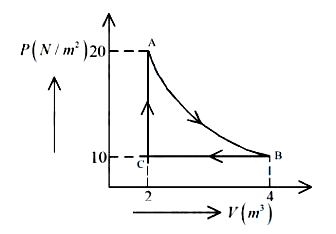
We begin by noting that the motor has to do two kinds of work while the elevator moves upward with uniform speed:
1. It must balance the gravitational pull on the combined mass of the elevator and all the passengers.
2. It must overcome the constant frictional force that opposes the motion.
The useful relation to find the power of the motor is the mechanical power formula
$$P = F \, v$$
where $$P$$ is the power delivered, $$F$$ is the total force that the motor must supply, and $$v$$ is the constant speed of the elevator.
Now we calculate each quantity step by step.
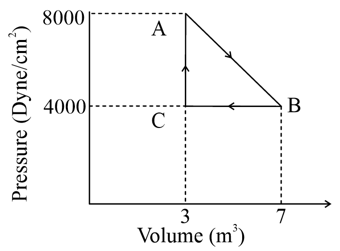
Step 1: Mass of passengers.
The problem states that the elevator is carrying its full capacity of 10 persons, each of average mass 68 kg. Hence
$$m_{\text{persons}} = 10 \times 68 \text{ kg} = 680 \text{ kg}.$$
Step 2: Mass of the empty elevator.
This is given directly as
$$m_{\text{elevator}} = 920 \text{ kg}.$$
Step 3: Total mass being lifted.
Adding the two masses, we obtain
$$m_{\text{total}} = m_{\text{persons}} + m_{\text{elevator}} = 680 \text{ kg} + 920 \text{ kg} = 1600 \text{ kg}.$$
Step 4: Gravitational force on this mass.
Using the standard relation $$\text{Weight} = m g$$ with $$g = 10 \text{ m/s}^2$$, we get
$$F_{\text{gravity}} = m_{\text{total}} \, g = 1600 \text{ kg} \times 10 \text{ m/s}^2 = 16000 \text{ N}.$$
Step 5: Frictional force.
The friction opposing the upward motion is specified as
$$F_{\text{friction}} = 6000 \text{ N}.$$
Step 6: Total opposing force.
Since the motor must counter both gravity and friction simultaneously, we add the two forces:
$$F_{\text{total}} = F_{\text{gravity}} + F_{\text{friction}} = 16000 \text{ N} + 6000 \text{ N} = 22000 \text{ N}.$$
Step 7: Constant speed of the elevator.
The elevator moves upward at
$$v = 3 \text{ m/s}.$$
Step 8: Required power of the motor.
Substituting $$F_{\text{total}}$$ and $$v$$ into $$P = F v$$, we obtain
$$ P = F_{\text{total}} \times v = 22000 \text{ N} \times 3 \text{ m/s} = 66000 \text{ W}. $$
Thus, the motor must supply at least $$66\,000 \text{ watts}$$ of power while lifting the fully-loaded elevator at the stated speed.
Hence, the correct answer is Option D.
Consider a force $$\vec{F} = -x\hat{i} + y\hat{j}$$. The work done by this force in moving a particle from point $$A(1,0)$$ to $$B(0,1)$$ along the line segment is: (all quantities are in SI units)
A body of mass $$2\,\text{kg}$$ is driven by an engine delivering a constant power of $$1\,\text{J s}^{-1}$$. The body starts from rest and moves in a straight line. After $$9\,\text{s}$$, the body has moved a distance (in m)....
We are told that the engine supplies a constant power $$P = 1\,\text{J s}^{-1}$$ to a body of mass $$m = 2\,\text{kg}$$. The body starts from rest, so its initial velocity is $$v_0 = 0$$. Power is defined as the rate at which work is done, and, for translational motion in a straight line, we have the relation
$$P \;=\; \frac{dW}{dt} \;=\; F\,v$$
Because the force responsible for the motion provides the acceleration, we can rewrite the force in terms of mass and acceleration: $$F = m\,a$$. Substituting this into the power expression gives
$$P \;=\; (m\,a)\,v \;=\; m\,a\,v$$
The acceleration $$a$$ is the time derivative of velocity, $$a = \dfrac{dv}{dt}$$. Replacing $$a$$ by $$\dfrac{dv}{dt}$$, we obtain
$$P \;=\; m\,v\,\frac{dv}{dt}$$
All the quantities in this differential equation are separable, so we rearrange to isolate the variables:
$$v\,dv \;=\; \frac{P}{m}\,dt$$
Now we integrate both sides from the initial state (velocity $$0$$ at time $$0$$) to some general state (velocity $$v$$ at time $$t$$):
$$\int_{0}^{v} v\,dv \;=\; \frac{P}{m}\int_{0}^{t} dt$$
Evaluating the integrals, we get
$$\frac{1}{2}v^{2} \;=\; \frac{P}{m}\,t$$
Multiplying by $$2$$ yields an explicit expression for the square of the velocity:
$$v^{2} \;=\; 2\,\frac{P}{m}\,t$$
Taking the positive square root (because the body moves forward), we find the velocity as a function of time:
$$v(t) \;=\; \sqrt{\frac{2P}{m}\,t}$$
The displacement $$s$$ in time $$t$$ is the time integral of the velocity:
$$s \;=\; \int_{0}^{t} v(t')\,dt' \;=\; \int_{0}^{t} \sqrt{\frac{2P}{m}\,t'}\,dt'$$
We factor out the constants to simplify the integral:
$$s \;=\; \sqrt{\frac{2P}{m}}\;\int_{0}^{t} (t')^{1/2}\,dt'$$
We now integrate the power-law function. The integral of $$t'^{1/2}$$ is $$\tfrac{2}{3}t'^{3/2}$$. Substituting the bounds gives
$$s \;=\; \sqrt{\frac{2P}{m}}\;\left[\frac{2}{3}\,t^{3/2}\right]$$
This can be rewritten more compactly as
$$s \;=\; \frac{2}{3}\,\sqrt{\frac{2P}{m}}\;t^{3/2}$$
We now substitute the numerical values $$P = 1\,\text{J s}^{-1}$$, $$m = 2\,\text{kg}$$ and $$t = 9\,\text{s}$$.
First, calculate the square-root factor:
$$\sqrt{\frac{2P}{m}} \;=\; \sqrt{\frac{2 \times 1}{2}} \;=\; \sqrt{1} \;=\; 1$$
With this, the expression for $$s$$ simplifies to
$$s \;=\; \frac{2}{3}\;t^{3/2}$$
Next, evaluate $$t^{3/2}$$ for $$t = 9\,\text{s}$$. We note that $$9^{1/2} = 3$$, so
$$9^{3/2} \;=\; (9^{1/2})^{3} \;=\; 3^{3} \;=\; 27$$
Substituting this value, we find
$$s \;=\; \frac{2}{3}\times 27 \;=\; 18$$
Therefore, after $$9\,\text{s}$$ the body has travelled a distance of $$18\,\text{m}$$.
So, the answer is $$18\,\text{m}$$.
A cricket ball of mass 0.15 kg is thrown vertically up by a bowling machine so that it rises to a maximum height of 20 m after leaving the machine. If the part pushing the ball applies a constant force $$F$$ on the ball and moves horizontally a distance of 0.2 m while launching the ball, the value of $$F$$ (in N) is $$(g = 10$$ m s$$^{-2})$$
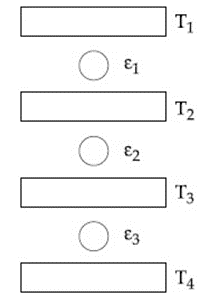
The mass of the cricket ball is given as $$m = 0.15 \text{ kg}$$ and the ball finally rises to a maximum height of $$h = 20 \text{ m}$$ after leaving the machine. We first find the speed with which the ball must leave the machine.
According to the principle of conservation of mechanical energy, the kinetic energy with which the ball leaves the machine is completely converted into gravitational potential energy at the highest point. Writing this idea mathematically, we state the formulae:
Potential energy at height $$h$$: $$U = mgh$$
Kinetic energy at launch: $$K = \dfrac12 m v^2$$
Since all of the kinetic energy changes into potential energy, we have
$$\dfrac12 m v^2 = m g h.$$
Dividing both sides by $$m$$ (because $$m \neq 0$$) gives
$$\dfrac12 v^2 = g h.$$
Multiplying both sides by $$2$$, we obtain
$$v^2 = 2 g h.$$
Now we substitute the numerical values $$g = 10 \text{ m s}^{-2}$$ and $$h = 20 \text{ m}$$:
$$v^2 = 2 \times 10 \times 20 = 400.$$
Taking the square root, we get the speed at launch:
$$v = \sqrt{400} = 20 \text{ m s}^{-1}.$$
Next, we relate this speed to the force that the bowling machine exerts. While the ball is in contact with the machine, it travels a distance $$s = 0.2 \text{ m}$$ under the action of a constant force $$F$$. The work-energy theorem tells us that the work done by this force equals the change in kinetic energy of the ball:
Work done by the force: $$W = F s.$$
Change in kinetic energy (initially the ball is at rest): $$\Delta K = \dfrac12 m v^2 - 0.$$
Equating the two, we write
$$F s = \dfrac12 m v^2.$$
Solving for $$F$$, we have
$$F = \dfrac{\dfrac12 m v^2}{s}.$$
Substituting $$m = 0.15 \text{ kg}$$, $$v = 20 \text{ m s}^{-1}$$, and $$s = 0.2 \text{ m}$$, we get
$$F = \dfrac{\dfrac12 \times 0.15 \times (20)^2}{0.2}.$$
First compute the numerator:
$$\dfrac12 \times 0.15 = 0.075,$$ $$0.075 \times (20)^2 = 0.075 \times 400 = 30.$$
Now divide by the distance $$s$$:
$$F = \dfrac{30}{0.2} = 150 \text{ N}.$$
So, the answer is $$150$$.
A particle (m = 1 kg) slides down a frictionless track (AOC) starting from rest at a point A (height 2m). After reaching C, the particle continues to move freely in air as a projectile. When it reaches its highest point P (height 1m), the kinetic energy of the particle (in J) is: (Figure drawn is schematic and not to scale; take $$g = 10$$ ms$$^{-2}$$)
A particle of mass m is moving along the x-axis with initial velocity $$u\hat{i}$$. It collides elastically with a particle of mass 10m at rest and then moves with half its initial kinetic energy (see figure). If $$\sin\theta_1 = \sqrt{n}\sin\theta_2$$, then value of n is ___________.
Hydrogen ion and singly ionized helium atom are accelerated, from rest, through the same potential difference. The ratio of final speeds of hydrogen and helium ions is close to:
We begin by recalling the energy principle for a charged particle moving through an electric potential difference. The work done by the electric field is converted into kinetic energy. Mathematically we state the relation
$$\text{Work done} \;=\; qV \;=\; \tfrac12 m v^{2},$$
where $$q$$ is the charge on the particle, $$V$$ is the potential difference, $$m$$ is the mass of the particle and $$v$$ is the final speed acquired from rest.
We now apply this relation separately to the hydrogen ion (proton) and to the singly ionised helium atom.
For the hydrogen ion (symbolically $$\text{H}^{+}$$):
Its charge is that of one proton, so $$q_{\text{H}} = +e$$. We denote its mass by $$m_{\text{H}}$$. Substituting these into the energy equation we have
$$q_{\text{H}} V = \tfrac12 m_{\text{H}} v_{\text{H}}^{2}.$$
Explicitly, that reads
$$e\,V = \tfrac12\,m_{\text{H}}\,v_{\text{H}}^{2}.$$
Solving for the speed $$v_{\text{H}}$$ gives
$$v_{\text{H}}^{2} = \frac{2eV}{m_{\text{H}}}, \qquad\text{so}\qquad v_{\text{H}} = \sqrt{\frac{2eV}{m_{\text{H}}}}.$$
For the singly ionised helium atom (symbolically $$\text{He}^{+}$$):
Although the helium nucleus contains two protons, the phrase “singly ionised” means it has lost only one electron, so its net charge is still just one elementary charge. Hence
$$q_{\text{He}} = +e.$$
The mass of a helium nucleus is essentially four times the proton mass, so we write
$$m_{\text{He}} = 4\,m_{\text{H}}.$$
Inserting these values into the same energy equation gives
$$q_{\text{He}} V = \tfrac12 m_{\text{He}} v_{\text{He}}^{2}$$
$$e\,V = \tfrac12 \left(4m_{\text{H}}\right) v_{\text{He}}^{2}.$$
Rearranging to isolate $$v_{\text{He}}^{2}$$:
$$v_{\text{He}}^{2} = \frac{2eV}{4m_{\text{H}}} = \frac{1}{4}\,\frac{2eV}{m_{\text{H}}},$$
and therefore
$$v_{\text{He}} = \sqrt{\frac{1}{4}\,\frac{2eV}{m_{\text{H}}}} = \frac{1}{2}\,\sqrt{\frac{2eV}{m_{\text{H}}}}.$$
Computing the ratio of the two speeds:
$$\frac{v_{\text{H}}}{v_{\text{He}}} = \frac{\sqrt{\dfrac{2eV}{m_{\text{H}}}}} {\dfrac{1}{2}\sqrt{\dfrac{2eV}{m_{\text{H}}}}} = \frac{\sqrt{\dfrac{2eV}{m_{\text{H}}}}}{\sqrt{\dfrac{2eV}{m_{\text{H}}}}/2} = 2.$$
Thus,
$$v_{\text{H}} : v_{\text{He}} = 2 : 1.$$
Hence, the correct answer is Option C.
If the potential energy between two molecules is given by $$U = \frac{A}{r^6} + \frac{B}{r^{12}}$$, then at equilibrium, separation between molecules, and the potential energy are:
Two particles of equal mass $$m$$ have respective initial velocities $$u\hat{i}$$ and $$u\left(\frac{\hat{i}+\hat{j}}{2}\right)$$. They collide completely inelastically. The energy lost in the process is:
We have two particles, each of mass $$m$$. Their initial velocity vectors are given as
$$\vec{u}_1 = u\,\hat{i}$$
and
$$\vec{u}_2 = u\left(\frac{\hat{i}+\hat{j}}{2}\right).$$
It is convenient to write the second velocity in component form. Distributing the factor $$u$$ inside the bracket, we obtain
$$\vec{u}_2 = \frac{u}{2}\,\hat{i} + \frac{u}{2}\,\hat{j}.$$
Because the collision is completely inelastic, the two particles stick together. Momentum is conserved, so we equate the total initial momentum to the total final momentum.
Total initial momentum:
$$\vec{p}_{\text{initial}} = m\vec{u}_1 + m\vec{u}_2 = m\left(u\,\hat{i}\right) + m\left(\frac{u}{2}\,\hat{i} + \frac{u}{2}\,\hat{j}\right) = mu\left(1 + \frac12\right)\hat{i} + mu\left(\frac12\right)\hat{j} = \frac{3}{2}mu\,\hat{i} + \frac{1}{2}mu\,\hat{j}.$$
Let the common final velocity after sticking together be $$\vec{v}$$, and note that the combined mass is $$2m$$. Conservation of linear momentum gives
$$\frac{3}{2}mu\,\hat{i} + \frac{1}{2}mu\,\hat{j} = 2m\,\vec{v}.$$
Dividing both sides by $$2m$$, we obtain the final velocity vector:
$$\vec{v} = \frac{3}{4}u\,\hat{i} + \frac{1}{4}u\,\hat{j}.$$
Next we compute the initial kinetic energy. The formula for translational kinetic energy is $$K = \frac12 m v^2$$, where $$v$$ is the magnitude of the velocity.
For particle 1, the speed is simply $$u$$, so
$$K_{1i} = \frac12 m u^2.$$
For particle 2, the magnitude of its velocity is
$$\left|\vec{u}_2\right| = \sqrt{\left(\frac{u}{2}\right)^2 + \left(\frac{u}{2}\right)^2} = \sqrt{\frac{u^2}{4} + \frac{u^2}{4}} = \sqrt{\frac{u^2}{2}} = \frac{u}{\sqrt{2}}.$$
Therefore
$$K_{2i} = \frac12 m \left(\frac{u}{\sqrt{2}}\right)^2 = \frac12 m \left(\frac{u^2}{2}\right) = \frac14 m u^2.$$
The total initial kinetic energy is then
$$K_i = K_{1i} + K_{2i} = \frac12 m u^2 + \frac14 m u^2 = \frac34 m u^2.$$
We now calculate the final kinetic energy of the combined mass. First we need the magnitude squared of the final velocity:
$$|\vec{v}|^2 = \left(\frac{3u}{4}\right)^2 + \left(\frac{u}{4}\right)^2 = \frac{9u^2}{16} + \frac{u^2}{16} = \frac{10u^2}{16} = \frac{5u^2}{8}.$$
The final kinetic energy (with total mass $$2m$$) is
$$K_f = \frac12 (2m) |\vec{v}|^2 = m\,|\vec{v}|^2 = m\left(\frac{5u^2}{8}\right) = \frac{5}{8} m u^2.$$
The loss in kinetic energy during the collision is the difference between the initial and final values:
$$\Delta K = K_i - K_f = \frac34 m u^2 - \frac58 m u^2.$$ Converting the fractions to a common denominator, $$\frac34 = \frac68,$$ so
$$\Delta K = \frac68 m u^2 - \frac58 m u^2 = \frac{1}{8} m u^2.$$
Thus the energy lost in the completely inelastic collision is $$\frac{1}{8}mu^2$$.
Hence, the correct answer is Option B.
A block of mass 1.9 kg is at rest at the edge of a table, of height 1 m. A bullet of mass 0.1 kg collides with the block and sticks to it. If the velocity of the bullet is 20 m s$$^{-1}$$ in the horizontal direction just before the collision then the kinetic energy just before the combined system strikes the floor, is [Take g = 10 m s$$^{-2}$$. Assume there is no rotational motion and loss of energy after the collision is negligible.]
We have a block of mass $$M = 1.9\ \text{kg}$$ initially at rest at the edge of a table of height $$h = 1\ \text{m}$$. A bullet of mass $$m = 0.1\ \text{kg}$$ comes horizontally with speed $$u = 20\ \text{m s}^{-1}$$ and sticks to the block. Because the bullet embeds itself, the collision is perfectly inelastic.
During the very short collision time, external horizontal forces are negligible, so we apply conservation of linear momentum in the horizontal direction. The formula is
$$\text{Initial momentum} = \text{Final momentum}.$$
Initially only the bullet moves, so
$$m u = (m + M)\,v,$$
where $$v$$ is the common horizontal velocity of the combined system immediately after the collision.
Substituting the numbers, we get
$$0.1 \times 20 = (0.1 + 1.9)\,v$$
$$2 = 2.0\,v$$
$$v = 1\ \text{m s}^{-1}.$$
This horizontal speed remains unchanged during the subsequent flight because air resistance is neglected.
Now the block-bullet system moves off the table edge with
horizontal speed $$v_x = 1\ \text{m s}^{-1},$$
vertical speed $$v_y = 0$$ at the moment it leaves the table, and falls through a vertical distance $$h = 1\ \text{m}$$ under gravity.
For the vertical motion, we use the kinematic relation for a body starting from rest:
$$v_y^2 = u_y^2 + 2 g h,$$
where $$u_y = 0$$ (no initial vertical speed). Hence
$$v_y^2 = 0 + 2 \times 10 \times 1 = 20,$$
so
$$v_y = \sqrt{20}\ \text{m s}^{-1} \approx 4.47\ \text{m s}^{-1}.$$
Thus, just before striking the floor, the system has two perpendicular components of velocity:
$$v_x = 1\ \text{m s}^{-1}, \quad v_y = \sqrt{20}\ \text{m s}^{-1}.$$
The magnitude of the resultant speed is obtained from Pythagoras, but for kinetic energy we can add the squares directly. The total kinetic energy is
$$ K = \dfrac{1}{2}\,(m + M)\,\left(v_x^2 + v_y^2\right). $$
Substituting,
$$ K = \dfrac{1}{2}\,(0.1 + 1.9)\,\left(1^2 + (\sqrt{20})^2\right) = \dfrac{1}{2}\times 2.0 \times (1 + 20) = 1 \times 21 = 21\ \text{J}. $$
Hence, the correct answer is Option A.
A person pushes a box on a rough horizontal platform surface. He applies a force of 200 N over a distance of 15 m. Thereafter, he gets progressively tired and his applied force reduces linearly with distance to 100 N. The total distance through which the box has been moved is 30 m. What is the work done by the person during the total movement of the box?
We first recall the definition of mechanical work. The work $$W$$ done by a variable or constant force acting along the line of motion is given by the formula
$$W = \int F\,\mathrm{d}x,$$
where $$F$$ is the instantaneous force and $$x$$ is the displacement. When the force remains constant over a segment, the integral reduces to the simple product of the constant force and the distance covered, $$W = F \times x$$. When the force varies linearly, the integral is numerically equal to the product of the average force and the distance.
According to the statement, the motion of the box can be divided into two successive parts:
(i) A first stretch of $$15\ \text{m}$$ during which the person keeps pushing with a constant force of $$200\ \text{N}$$.
(ii) A second and equal stretch of $$15\ \text{m}$$ during which the force decreases uniformly (linearly) from $$200\ \text{N}$$ down to $$100\ \text{N}$$ because the person is getting tired.
We now compute the work done in each part and then add the two contributions.
Work during the first 15 m
The force is constant, so we apply $$W = F \times x$$ directly:
$$W_1 = 200\ \text{N} \times 15\ \text{m} = 3000\ \text{J}.$$
Work during the next 15 m
Here the force varies linearly from $$200\ \text{N}$$ at the start of the segment to $$100\ \text{N}$$ at the end. For a linear variation, the average (mean) force $$F_{\text{avg}}$$ is simply the arithmetic mean:
$$F_{\text{avg}} = \dfrac{F_{\text{initial}} + F_{\text{final}}}{2} = \dfrac{200\ \text{N} + 100\ \text{N}}{2} = 150\ \text{N}.$$
Using again the constant-force formula with this average value gives the work for that segment:
$$W_2 = F_{\text{avg}} \times x = 150\ \text{N} \times 15\ \text{m} = 2250\ \text{J}.$$
Total work
Now we add the two pieces together:
$$W_{\text{total}} = W_1 + W_2 = 3000\ \text{J} + 2250\ \text{J} = 5250\ \text{J}.$$
Hence, the correct answer is Option D.
Blocks of masses m, 2m, 4m and 8m are arranged in a line of a frictionless floor. Another block of mass m, moving with speed v along the same line (see figure) collides with mass m in perfectly inelastic manner. All the subsequent collisions are also perfectly inelastic. By the time the last block of mass 8m starts moving the total energy loss is p% of the original energy. Value of 'p' is close to:
A particle of mass m with an initial velocity $$u\hat{i}$$ collides perfectly elastically with a mass 3m at rest. It moves with a velocity $$v\hat{j}$$ after collision, then, v is given by:
In the cube of side 'a' shown in the figure, the vector from the central point of the face ABOD to the central point of the face BEFO will be:
A bullet of mass 20 g has an initial speed of 1 m s$$^{-1}$$, just before it starts penetrating a mud wall of thickness 20 cm. If the wall offers a mean resistance of $$2.5 \times 10^{-2}$$ N, the speed of the bullet after emerging from the other side of the wall is close to:
First, we translate every given quantity into standard SI units. The mass of the bullet is 20 g, and since $$1\ \text{kg}=1000\ \text{g}$$, we have
$$m = 20\ \text{g} = 20 \times 10^{-3}\ \text{kg}=0.02\ \text{kg}.$$
The initial speed of the bullet, just before entering the wall, is already given in metres per second:
$$u = 1\ \text{m s}^{-1}.$$
The thickness of the mud wall is 20 cm. Converting centimetres to metres (because $$1\ \text{m}=100\ \text{cm}$$):
$$s = 20\ \text{cm}=20 \times 10^{-2}\ \text{m}=0.20\ \text{m}.$$
The wall offers a mean resistive force of $$2.5 \times 10^{-2}\ \text{N}$$, so
$$F = 2.5 \times 10^{-2}\ \text{N}.$$
Now we invoke the Work-Energy Theorem, which states:
$$\text{Work done by all forces} = \text{Change in kinetic energy}.$$
The resistive force does negative work (it removes energy from the bullet). The magnitude of the work done by this constant resistive force while the bullet travels the full thickness of the wall is
$$W = F \, s.$$
Substituting the known values, we obtain
$$W = \left(2.5 \times 10^{-2}\ \text{N}\right)\left(0.20\ \text{m}\right) = 0.5 \times 10^{-2}\ \text{J} = 5.0 \times 10^{-3}\ \text{J}.$$
The bullet’s initial kinetic energy is found from the standard formula $$K = \tfrac12 m u^2$$:
$$K_{\text{initial}} = \frac12 (0.02\ \text{kg}) (1\ \text{m s}^{-1})^{2} = \frac12 (0.02)\,(1) = 0.01\ \text{J}.$$
Because the wall’s resistive force removes energy, the final kinetic energy of the bullet after it just emerges is
$$K_{\text{final}} = K_{\text{initial}} - W.$$
Substituting the numerical results,
$$K_{\text{final}} = 0.01\ \text{J} - 5.0 \times 10^{-3}\ \text{J} = 5.0 \times 10^{-3}\ \text{J}.$$
Let $$v$$ denote the bullet’s speed on emerging. Using the kinetic-energy relation once more,
$$K_{\text{final}} = \frac12 m v^{2}.$$
Therefore,
$$\frac12 m v^{2} = 5.0 \times 10^{-3}\ \text{J}.$$
Solving explicitly for $$v^{2}$$:
$$v^{2} = \frac{2 \times 5.0 \times 10^{-3}\ \text{J}}{0.02\ \text{kg}} = \frac{1.0 \times 10^{-2}}{0.02} = 0.50.$$
Taking the positive square root (speed is positive by definition),
$$v = \sqrt{0.50}\ \text{m s}^{-1} \approx 0.707\ \text{m s}^{-1}.$$
This value is most nearly $$0.7\ \text{m s}^{-1}$$ among the listed choices.
Hence, the correct answer is Option A.
A particle moves in one dimension from rest under the influence of a force that varies with the distance traveled by the particle as shown in the figure. The kinetic energy of the particle after it has traveled 3 m is:
According to the work-energy theorem,
$$\text{Work done}=\Delta KE$$
$$W=KE_{\text{final}}-KE_{\text{initial}}$$
The particle starts from rest, therefore
$$KE_{\text{initial}}=0$$
Work done is equal to the area under the F-x graph.
From the graph:
Rectangle area:
$$2\times2=4$$
Trapezium area:
$$\frac{1}{2}(2+3)\times1=2.5$$
Therefore,
$$W=4+2.5$$
$$W=6.5\ \text{J}$$
Hence,
$$KE_{\text{final}}=6.5\ \text{J}$$
$$\boxed{6.5\ \text{J}}$$
A simple pendulum, made of a string of length $$l$$ and a bob of mass $$m$$, is released from a small angle $$\theta_0$$. It strikes a block of mass $$M$$, kept on horizontal surface at its lowest point of oscillations, elastically. It bounces back and goes up to an angle $$\theta_1$$. Then M is given by:
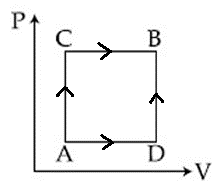
We begin with the bob of the simple pendulum. It is released from the angle $$\theta_0$$ and swings down to the lowest point. At the lowest point all the gravitational potential energy that the bob lost has been converted into kinetic energy.
The change in height of the bob, measured vertically from the lowest point, is obtained from the length $$l$$ of the pendulum. For a small angle $$\theta$$ we use the approximation $$\cos\theta \simeq 1-\dfrac{\theta^2}{2}$$, so
$$h = l - l\cos\theta \;\; \Longrightarrow \;\; h \simeq l\left(1-\Bigl[1-\frac{\theta^2}{2}\Bigr]\right)=\frac{l\theta^2}{2}.$$
Hence the speed of the bob just before impact is found from conservation of mechanical energy:
$$\frac{1}{2}m v_0^2 = m g h \;\; \Longrightarrow \;\; \frac{1}{2}m v_0^2 = m g \Bigl(\frac{l\theta_0^2}{2}\Bigr)$$
which simplifies to
$$v_0 = \sqrt{g l}\;\theta_0.$$ (Note that $$\sqrt{g l}$$ is the natural speed scale of a simple pendulum.)
The bob collides elastically with a block of mass $$M$$ that is initially at rest on a horizontal surface. For a perfectly elastic, one-dimensional collision we invoke the standard results (stated first):
For masses $$m$$ and $$M$$ with initial velocities $$u_m$$ and $$u_M$$, the velocities just after collision are $$ v_m = \frac{m-M}{m+M}\;u_m + \frac{2M}{m+M}\;u_M , \qquad v_M = \frac{2m}{m+M}\;u_m + \frac{M-m}{m+M}\;u_M . $$
Because the block is initially at rest, we put $$u_m = v_0$$ and $$u_M = 0$$, giving
$$ v_1 = \frac{m-M}{m+M}\;v_0, \qquad V = \frac{2m}{m+M}\;v_0, $$
where $$v_1$$ is the speed of the bob just after the collision (now moving upward) and $$V$$ is the speed of the block.
After the bounce the bob rises to an angle $$\theta_1$$ before momentarily coming to rest. Using the same energy argument as before, the kinetic energy at the lowest point converts back into gravitational potential energy at that maximum angle:
$$\frac{1}{2}m v_1^2 = m g \Bigl(\frac{l\theta_1^2}{2}\Bigr).$$
Solving for $$v_1$$ yields
$$v_1 = \sqrt{g l}\;\theta_1.$$
We now have two expressions for $$v_1$$, so we equate them:
$$\sqrt{g l}\;\theta_1 = \frac{m-M}{m+M}\;\Bigl(\sqrt{g l}\;\theta_0\Bigr).$$
Dividing both sides by $$\sqrt{g l}$$ gives a purely algebraic relation:
$$\theta_1 = \frac{m-M}{m+M}\;\theta_0.$$ Multiplying both sides by $$(m+M)$$ we obtain $$m\theta_1 + M\theta_1 = m\theta_0 - M\theta_0.$$
Gathering the terms that contain $$M$$ on the left and those that contain $$m$$ on the right:
$$M\theta_1 + M\theta_0 = m\theta_0 - m\theta_1.$$ Factoring the common symbols, $$M(\theta_1+\theta_0) = m(\theta_0-\theta_1).$$
Finally, solving for $$M$$ we divide both sides by $$(\theta_1+\theta_0)$$:
$$ M = m\;\frac{\theta_0 - \theta_1}{\theta_0 + \theta_1}. $$
This matches Option A.
Hence, the correct answer is Option A.
A body of mass 1 kg falls freely from a height of 100 m, on a platform of mass 3 kg which is mounted on a spring having spring constant $$k = 1.25 \times 10^6$$ N/m. The body sticks to the platform and the spring's maximum compression is found to be $$x$$. Given that $$g = 10 \text{ ms}^{-2}$$, the value of $$x$$ will be close to:
We have a body of mass $$m_1 = 1\;\text{kg}$$ that is released from rest at a height $$h = 100\;\text{m}$$ above a platform of mass $$m_2 = 3\;\text{kg}$$. The platform is fixed to the upper end of a vertical spring whose force constant is $$k = 1.25 \times 10^{6}\;\text{N\,m}^{-1}$$. During the motion the body falls, strikes the platform, sticks to it (perfectly inelastic impact) and then the combined system moves downward, compressing the spring.
The body of mass $$m_1$$ possesses an initial gravitational potential energy (taking the top of the spring as the reference level) equal to
$$U_{\text{g,\,initial}} \;=\; m_1 g h \;=\; 1 \times 10 \times 100 \;=\; 1000\;\text{J}. $$
After impact the two masses move together. Let $$x$$ be the maximum compression of the spring measured from its natural (unstretched) length. While the spring is being compressed, the centre of mass of the combined load $$M = m_1 + m_2 = 4\;\text{kg}$$ moves downward through the same distance $$x$$, so its gravitational potential energy decreases by
$$\Delta U_{\text{g,\,down}} \;=\; Mgx \;=\; 4 \times 10 \times x \;=\; 40x\;\text{J}. $$
At the instant of maximum compression the kinetic energy of the system has become zero, and the entire mechanical energy that was available has been stored as elastic potential energy of the spring. The elastic potential energy of a compressed spring is given by the well-known formula
$$U_{\text{spring}} \;=\; \frac12 k x^{2}. $$
Applying conservation of mechanical energy between the moment just before compression starts and the moment of maximum compression, we have
$$\underbrace{m_1 g h}_{1000} \;+\; \underbrace{Mgx}_{40x} \;=\; \underbrace{\frac12 k x^{2}}_{ \tfrac12 (1.25 \times 10^{6}) x^{2} }. $$
Substituting the numerical values,
$$1000 \;+\; 40x \;=\; \frac{1}{2}\bigl(1.25 \times 10^{6}\bigr)x^{2}. $$
Simplifying the right-hand side first,
$$\frac{1}{2}\bigl(1.25 \times 10^{6}\bigr) \;=\; 6.25 \times 10^{5},$$
so the equation becomes
$$6.25 \times 10^{5}\,x^{2} \;-\; 40x \;-\; 1000 \;=\; 0.$$
To solve the quadratic equation we divide every term by $$6.25 \times 10^{5}$$:
$$x^{2} \;-\; \frac{40}{6.25 \times 10^{5}}\,x \;-\; \frac{1000}{6.25 \times 10^{5}} \;=\; 0,$$
and evaluate the small fractions:
$$\frac{40}{6.25 \times 10^{5}} \;=\; 6.4 \times 10^{-5},\qquad \frac{1000}{6.25 \times 10^{5}} \;=\; 1.6 \times 10^{-3}.$$
Thus the quadratic is
$$x^{2} \;-\; 6.4 \times 10^{-5}x \;-\; 1.6 \times 10^{-3} \;=\; 0.$$
Using the quadratic-formula $$x = \dfrac{-b + \sqrt{\,b^{2} - 4ac\,}}{2a}$$ with $$a = 1,\; b = -6.4 \times 10^{-5},\; c = -1.6 \times 10^{-3},$$ we get
$$x \;=\; \frac{6.4 \times 10^{-5} \;+\; \sqrt{\bigl(6.4 \times 10^{-5}\bigr)^{2} + 4 \times 1.6 \times 10^{-3}}} {2}.$$
The term $$(6.4 \times 10^{-5})^{2}$$ is negligibly small, so we have approximately
$$x \;\approx\; \frac{6.4 \times 10^{-5} \;+\; \sqrt{0.0064}}{2} \;=\; \frac{6.4 \times 10^{-5} \;+\; 0.08}{2} \;=\; \frac{0.080064}{2} \;\approx\; 0.040\;\text{m}.$$
Converting metres to centimetres,
$$x \;\approx\; 0.040\;\text{m} = 4.0\;\text{cm}.$$
Hence, the correct answer is Option B.
A uniform cable of mass $$M$$ and length $$L$$ is placed on a horizontal surface such that its $$\left(\frac{1}{n}\right)^{th}$$ part is hanging below the edge of the surface. To lift the hanging part of the cable upto the surface, the work done should be:
Let us begin by noting that the cable is uniform, so its mass per unit length (linear mass density) is constant. We denote this density by $$\lambda$$ and write
$$\lambda \;=\;\frac{M}{L},$$
because the total mass $$M$$ is uniformly distributed along the total length $$L$$.
According to the statement, a fraction $$\left(\frac{1}{n}\right)^{\!th}$$ of the cable hangs below the horizontal surface. Hence the vertical length that is hanging is
$$\ell_h \;=\;\frac{L}{n}.$$
We choose the horizontal surface as the reference level $$y = 0$$. Positive $$y$$ is taken upward, so the hanging portion originally lies at negative values of $$y$$. Every small element of cable located at a distance $$y$$ below the surface (that is, at $$y$$ between $$-\,\frac{L}{n}$$ and $$0$$) has to be raised through a height equal to the absolute value of its initial coordinate, namely $$|y| = -y$$.
Let us label a small element of length $$dy$$ on the hanging part. Its mass is
$$dm \;=\;\lambda\,dy \;=\;\frac{M}{L}\,dy.$$
Initially this element is at a coordinate $$y$$ (negative), so it must be lifted through a vertical distance $$h = -y$$ to reach the surface. The elementary work $$dW$$ required to lift this element is given by the basic work formula
$$dW \;=\;(\text{force})\times(\text{displacement}) \;=\; (dm\,g)\,h.$$
Substituting $$dm$$ and $$h$$, we have
$$dW \;=\;\left(\frac{M}{L}\,dy\right)g\,(-y) \;=\;-\frac{M g}{L}\,y\,dy.$$
Because $$y$$ runs from $$-\frac{L}{n}$$ (bottom of the hanging part) up to $$0$$ (surface), the total work $$W$$ is obtained by integrating $$dW$$ over this interval:
$$W \;=\;\int_{y=-L/n}^{\,0} \left(-\frac{M g}{L}\,y\right)\,dy.$$
We now carry out the algebraic steps of the integration:
$$W \;=\;-\frac{M g}{L}\int_{-L/n}^{\,0} y\,dy \;=\;-\frac{M g}{L}\left[\,\frac{y^{2}}{2}\,\right]_{-L/n}^{\,0}.$$
Evaluating the definite integral, we get
$$\left[\,\frac{y^{2}}{2}\,\right]_{-L/n}^{\,0} \;=\;\frac{(0)^{2}}{2} \;-\;\frac{\left(-\dfrac{L}{n}\right)^{2}}{2} \;=\;0 \;-\;\frac{L^{2}}{2n^{2}} \;=\;-\frac{L^{2}}{2n^{2}}.$$
Substituting this back,
$$W \;=\;-\frac{M g}{L}\left(-\frac{L^{2}}{2n^{2}}\right) \;=\;\frac{M g}{L}\,\frac{L^{2}}{2n^{2}} \;=\;\frac{M g L}{2n^{2}}.$$
Thus the work needed to raise the entire hanging part of the cable to the level of the surface is
$$W \;=\;\frac{M g L}{2 n^{2}}.$$
Comparing this result with the given options, we see that it matches Option A.
Hence, the correct answer is Option A.
A wedge of mass $$M = 4m$$ lies on a frictionless plane. A particle of mass $$m$$ approaches the wedge with speed $$v$$. There is no friction between the particle and the plane or between the particle and the wedge. The maximum height climbed by the particle on the wedge is given by:
We are told that a wedge of mass $$M$$ rests on a perfectly smooth horizontal table and that a small particle of mass $$m$$ slides up the wedge without any friction anywhere. Numerically, the wedge is four times heavier than the particle, so $$M = 4m$$. The particle is launched horizontally towards the wedge with speed $$v$$.
Because the horizontal table is friction-free, no external horizontal force acts on the two-body system “particle + wedge”. Therefore the total horizontal linear momentum of the system will remain constant throughout the motion. This is our first key principle:
(i) Conservation of horizontal momentum: $$P_{\text{initial}} = P_{\text{final}}$$.
Secondly, all surfaces are smooth, so no mechanical energy is dissipated as heat. The only potential energy that changes is the gravitational potential energy of the particle as it climbs the wedge. Therefore the total mechanical energy of the system is also conserved:
(ii) Conservation of mechanical energy: $$E_{\text{initial}} = E_{\text{final}}$$.
We now apply these two principles step by step.
Initial state (just before contact)
The wedge is at rest, so its horizontal velocity is $$0$$. The particle of mass $$m$$ moves towards the wedge with speed $$v$$. Hence
Initial horizontal momentum: $$P_{\text{initial}} = m\,v.$$
Initial kinetic energy: $$E_{\text{kin,\,initial}} = \frac12\,m\,v^{2}.$$
The initial gravitational potential energy of the particle can be taken as zero (reference level at the foot of the wedge).
Final state (highest point reached by the particle on the wedge)
At the highest point the particle is momentarily at rest relative to the wedge. Because both bodies are still free to slide on the table, the particle and the wedge must, at that instant, move together with some common horizontal speed, say $$u$$, relative to the ground. Therefore
Final horizontal momentum: $$P_{\text{final}} = (M + m)\,u.$$
Final kinetic energy: $$E_{\text{kin,\,final}} = \frac12\,(M + m)\,u^{2}.$$
Let the particle have climbed a vertical height $$h$$ on the wedge. Its gain in gravitational potential energy is then
$$E_{\text{pot,\,gain}} = m\,g\,h.$$
We now write the conservation equations explicitly.
Step 1 : Linear momentum conservation
$$m\,v = (M + m)\,u.$$
We solve this for $$u$$:
$$u = \frac{m\,v}{M + m}.$$
Given $$M = 4m$$, we substitute:
$$u = \frac{m\,v}{4m + m} = \frac{m\,v}{5m} = \frac{v}{5}.$$
Step 2 : Mechanical energy conservation
Initial total energy = Final total energy:
$$\frac12\,m\,v^{2} = \frac12\,(M + m)\,u^{2} + m\,g\,h.$$
First we insert $$M + m = 4m + m = 5m$$ and $$u = \dfrac{v}{5}$$:
$$\frac12\,m\,v^{2} = \frac12\,(5m)\left(\frac{v}{5}\right)^{2} + m\,g\,h.$$
We now simplify term by term. Start with the kinetic term on the right:
$$\left(\frac{v}{5}\right)^{2} = \frac{v^{2}}{25},$$
so
$$\frac12\,(5m)\left(\frac{v^{2}}{25}\right) = \frac12 \times 5m \times \frac{v^{2}}{25} = \frac{5m\,v^{2}}{50} = \frac{m\,v^{2}}{10}.$$
Our energy equation is now
$$\frac12\,m\,v^{2} = \frac{m\,v^{2}}{10} + m\,g\,h.$$
To clear the fractions, multiply every term by $$\dfrac{2}{m}$$ (this also cancels the common factor $$m$$):
$$v^{2} = \frac{2}{m}\times\frac{m\,v^{2}}{10} + 2\,g\,h \;\;\Longrightarrow\;\; v^{2} = \frac{2\,v^{2}}{10} + 2\,g\,h.$$
Simplify the first term on the right:
$$\frac{2\,v^{2}}{10} = \frac{v^{2}}{5}.$$
Hence
$$v^{2} = \frac{v^{2}}{5} + 2\,g\,h.$$
Subtract $$\dfrac{v^{2}}{5}$$ from both sides:
$$v^{2} - \frac{v^{2}}{5} = 2\,g\,h.$$
Write the left side with a common denominator:
$$\frac{5v^{2}}{5} - \frac{v^{2}}{5} = \frac{4v^{2}}{5}.$$
Thus
$$\frac{4v^{2}}{5} = 2\,g\,h.$$
Finally, solve for $$h$$ by dividing both sides by $$2g$$:
$$h = \frac{\frac{4v^{2}}{5}}{2g} = \frac{4v^{2}}{10g} = \frac{2v^{2}}{5g}.$$
We have reached an explicit expression for the maximum height climbed by the particle. Comparing with the options given, this corresponds to Option C.
Hence, the correct answer is Option C.
A body of mass 2 kg makes an elastic collision with a second body at rest and continues to move in the original direction but with one fourth of its original speed. What is the mass of the second body?
Let the mass of the projectile (first body) be $$m_1 = 2\ \text{kg}$$ and its initial speed be $$u_1.$$
The second body is at rest, so for it $$u_2 = 0.$$ Let its mass be $$m_2,$$ which we have to find.
After an elastic collision in one dimension we denote the final speeds by $$v_1$$ and $$v_2$$ for the first and the second bodies respectively. According to the statement, the first body continues in the same direction with one-fourth of its original speed, so
$$v_1 = \frac{u_1}{4}.$$
For a perfectly elastic head-on collision we use the standard velocity-transfer formula (derived from simultaneous conservation of linear momentum and kinetic energy):
$$v_1 \;=\; \frac{m_1 - m_2}{m_1 + m_2}\;u_1.$$
Now we substitute the known value $$v_1 = u_1/4$$ into this formula:
$$\frac{u_1}{4} \;=\; \frac{m_1 - m_2}{m_1 + m_2}\;u_1.$$
Because $$u_1 \neq 0,$$ we cancel it from both sides:
$$\frac{1}{4} \;=\; \frac{m_1 - m_2}{m_1 + m_2}.$$
Cross-multiplying gives
$$4\,(m_1 - m_2) \;=\; m_1 + m_2.$$
Expanding and bringing like terms together, we have
$$4m_1 - 4m_2 \;=\; m_1 + m_2$$
$$4m_1 - m_1 \;=\; 4m_2 + m_2$$
$$3m_1 \;=\; 5m_2.$$
Solving for $$m_2$$ yields
$$m_2 \;=\; \frac{3}{5}\,m_1.$$
Finally, substituting $$m_1 = 2\ \text{kg}$$ gives
$$m_2 \;=\; \frac{3}{5}\times 2\ \text{kg} \;=\; \frac{6}{5}\ \text{kg} \;=\; 1.2\ \text{kg}.$$
Hence, the correct answer is Option B.
A force acts on a 2 kg object so that its position is given as a function of time as $$x = 3t^2 + 5$$. What is the work done by this force in first 5 seconds?
We are told that the position of the 2 kg object varies with time according to the law $$x = 3t^{2} + 5$$, where $$x$$ is in metres and $$t$$ in seconds. From this function we can find velocity, then acceleration, then force, and finally the work done.
First we differentiate the position function to obtain velocity, because by definition $$v = \dfrac{dx}{dt}$$.
So, $$v = \dfrac{d}{dt}\left(3t^{2} + 5\right) = 6t.$$
Next, we differentiate velocity with respect to time to obtain acceleration, since $$a = \dfrac{dv}{dt}$$.
Thus, $$a = \dfrac{d}{dt}\left(6t\right) = 6\; \text{m s}^{-2}.$$
Notice that the acceleration is a constant 6 m s−2. Because the mass is 2 kg, Newton’s second law $$F = ma$$ gives the magnitude of the force:
$$F = m a = 2 \times 6 = 12\;\text{N}.$$
We need the work done by this force in the time interval from $$t = 0$$ to $$t = 5\;\text{s}$$. A convenient route is to use the Work-Energy Theorem, which states:
“The net work done on a particle equals the change in its kinetic energy,” i.e. $$W = K_{\text{final}} - K_{\text{initial}}.$$
We already have the expression for velocity; let us evaluate it at the two instants.
At $$t = 0$$, $$v_{0} = 6(0) = 0\;\text{m s}^{-1}.$$
At $$t = 5\;\text{s}$$, $$v_{5} = 6(5) = 30\;\text{m s}^{-1}.$$
The kinetic energy formula is $$K = \tfrac{1}{2} m v^{2}.$$ Substituting the respective velocities:
Initial kinetic energy $$K_{0} = \tfrac{1}{2} \times 2 \times (0)^{2} = 0\;\text{J}.$$
Final kinetic energy $$K_{5} = \tfrac{1}{2} \times 2 \times (30)^{2} = 1 \times 900 = 900\;\text{J}.$$
Now we apply the Work-Energy Theorem:
$$W = K_{5} - K_{0} = 900 - 0 = 900\;\text{J}.$$
Hence, the correct answer is Option D.
A particle which is experiencing a force, given by $$\vec{F} = 3\hat{i} - 12\hat{j}$$, undergoes a displacement of $$\vec{d} = 4\hat{i}$$. If the particle had a kinetic energy of 3 J at the beginning of the displacement, what is its kinetic energy at the end of the displacement?
We begin by recalling the work-energy theorem, which states that the work $$W$$ done by the net force on a particle equals the change in its kinetic energy $$\Delta K$$. In symbols, $$W = K_{\text{final}} - K_{\text{initial}}.$$
Next, we find the work done by the given force during the specified displacement. The work by a constant force is the dot product of the force vector $$\vec F$$ and the displacement vector $$\vec d$$:
$$W = \vec F \cdot \vec d.$$
Substituting the given vectors, we have
$$\vec F = 3\hat i - 12\hat j,$$
$$\vec d = 4\hat i.$$
Carrying out the dot product component-wise,
$$W = (3\hat i - 12\hat j) \cdot (4\hat i)$$
$$\;\; = (3)(4)\, (\hat i \cdot \hat i) \;+\; (-12)(4)\, (\hat j \cdot \hat i).$$
Because the unit vectors are orthogonal, $$\hat i \cdot \hat i = 1$$ and $$\hat j \cdot \hat i = 0$$. Therefore,
$$W = (3)(4)(1) + (-12)(4)(0)$$
$$\;\; = 12 + 0$$
$$\;\; = 12 \text{ J}.$$
So the force does 12 J of work on the particle.
Now, the particle’s initial kinetic energy is given as $$K_{\text{initial}} = 3 \text{ J}.$$
Applying the work-energy theorem:
$$K_{\text{final}} - K_{\text{initial}} = W$$
$$\Rightarrow K_{\text{final}} = K_{\text{initial}} + W$$
$$\Rightarrow K_{\text{final}} = 3 \text{ J} + 12 \text{ J}$$
$$\Rightarrow K_{\text{final}} = 15 \text{ J}.$$
Hence, the correct answer is Option B.
A person of mass M is sitting on a swing of length L and swinging with an angular amplitude $$\theta_0$$. If the person stands up when the swing passes through its lowest point, the work done by him, assuming that his centre of mass moves by a distance $$l$$ ($$l << L$$), is close to:
We treat the man-swing system as a simple pendulum whose bob (the person’s centre of mass while he is sitting) is at a distance $$L$$ from the pivot. The swing is released from an angular amplitude $$\theta_0$$ and reaches the lowest position (the vertical) with a certain speed. Exactly at this lowest point the person suddenly stands up, raising his centre of mass vertically by a small amount $$l$$ ($$l \ll L$$). We have to calculate the work that the person must do in order to achieve this rise and the accompanying change in kinetic energy of the swing.
First, let us find the speed just before the person stands up. Using mechanical-energy conservation for a pendulum of length $$L$$:
Initial potential energy (at amplitude $$\theta_0$$) relative to the lowest point is
$$U_i \;=\; MgL\bigl(1-\cos\theta_0\bigr).$$
At the lowest point this potential energy has completely converted into kinetic energy, so
$$\tfrac12 Mv_1^2 \;=\; MgL\bigl(1-\cos\theta_0\bigr).$$
Therefore the linear speed just before standing up is
$$v_1 \;=\; \sqrt{\,2gL\bigl(1-\cos\theta_0\bigr)}.$$
Now the person suddenly reduces the radius of circular motion from $$L$$ to
$$R_2 \;=\; L-l,$$
because his centre of mass rises by $$l$$. The interval in which he stands is taken to be very short, so the external torque about the pivot is practically zero (gravity acts along the vertical line through the pivot at that instant), and angular momentum about the pivot is conserved.
The angular momentum just before standing is
$$L_{\text{ang},1} \;=\; Mv_1 L.$$
Let the new speed immediately after standing be $$v_2$$. Conservation of angular momentum gives
$$Mv_1L \;=\; Mv_2\bigl(L-l\bigr)$$
$$\Longrightarrow\; v_2 \;=\; v_1\,\frac{L}{L-l}.$$
Hence the new kinetic energy is
$$K_2 = \tfrac12 Mv_2^2 = \tfrac12 Mv_1^2 \left(\frac{L}{L-l}\right)^2.$$
The potential energy has also increased, because the centre of mass is now higher by $$l$$. The increase in gravitational potential energy is
$$\Delta U \;=\; Mg\,l.$$
The work done by the person equals the total increase in mechanical energy, i.e.
$$W \;=\; (K_2 + U_2) - (K_1 + U_1) \;=\; (K_2 - K_1) + \Delta U.$$
Let us compute the kinetic-energy change:
$$K_2 - K_1 = \tfrac12 Mv_1^2\!\left[\left(\frac{L}{L-l}\right)^2 - 1\right].$$
Because $$l\ll L$$, we introduce the small parameter
$$\varepsilon \;=\; \frac{l}{L}, \quad\text{with } \varepsilon\ll 1.$$
Then $$\dfrac{L}{L-l} = \dfrac{1}{1-\varepsilon},$$ and for small $$\varepsilon$$ we use the binomial expansion
$$\frac{1}{1-\varepsilon} \;\approx\; 1 + \varepsilon + \varepsilon^2 + \ldots$$
Keeping only the first-order term,
$$\left(\frac{L}{L-l}\right)^2 = \frac{1}{(1-\varepsilon)^2} \;\approx\; 1 + 2\varepsilon.$$
Therefore
$$K_2 - K_1 \;\approx\; \tfrac12 Mv_1^2 (1 + 2\varepsilon - 1) = \tfrac12 Mv_1^2 (2\varepsilon) = Mv_1^2 \varepsilon.$$
Substituting $$\varepsilon = \dfrac{l}{L}$$ and $$v_1^2 = 2gL(1-\cos\theta_0),$$ we get
$$K_2 - K_1 = M \bigl[2gL(1-\cos\theta_0)\bigr]\frac{l}{L} = 2Mg(1-\cos\theta_0)\,l.$$
For small angular amplitudes we may use the standard approximation
$$\cos\theta_0 \;\approx\; 1 - \frac{\theta_0^{\,2}}{2},$$
so that
$$1-\cos\theta_0 \;\approx\; \frac{\theta_0^{\,2}}{2}.$$
Hence
$$K_2 - K_1 \;\approx\; 2Mg\left(\frac{\theta_0^{\,2}}{2}\right) l = Mg\theta_0^{\,2} l.$$
Now add the potential-energy change:
$$W = (K_2 - K_1) + \Delta U = Mg\theta_0^{\,2}l + Mg\,l = Mg\,l\,(1 + \theta_0^{\,2}).$$
Thus the work that the person has to do is approximately
$$W \;\approx\; Mg\,l\bigl(1 + \theta_0^{\,2}\bigr).$$
Hence, the correct answer is Option D.
An alpha-particle of mass m suffers 1-dimensional elastic collision with a nucleus at rest of unknown mass. It is scattered directly backwards losing 64% of its initial kinetic energy. The mass of the nucleus is
Let $$\vec{A} = (\hat{i} + \hat{j})$$ and $$\vec{B} = (2\hat{i} - \hat{j})$$. The magnitude of a coplanar vector $$\vec{C}$$ such that $$\vec{A} \cdot \vec{C} = \vec{B} \cdot \vec{C} = \vec{A} \cdot \vec{B}$$ is given by:
We are given two vectors in the plane
$$\vec A = (\,\hat i + \hat j\,) \qquad\text{and}\qquad \vec B = (\,2\hat i - \hat j\,).$$
Let the required coplanar vector be
$$\vec C = (\,x\hat i + y\hat j\,).$$
Because all three vectors lie in the same plane, no further restriction on direction is needed; any ordered pair $$\,(x,y)\,$ represents a coplanar vector.
The condition stated in the problem is
$$\vec A\cdot\vec C \;=\;\vec B\cdot\vec C \;=\;\vec A\cdot\vec B.$$
First we compute $$\vec A\cdot\vec B.$$ The dot-product formula is
$$\vec u\cdot\vec v = u_xv_x + u_yv_y,$$ so, substituting $$\vec A = (1,1)$$ and $$\vec B = (2,-1),$$ we obtain
$$\vec A\cdot\vec B \;=\; 1\cdot 2 + 1\cdot(-1) \;=\; 2 - 1 \;=\; 1.$$
Next we impose the two equality conditions one by one.
1. The dot product $$\vec A\cdot\vec C$$ is, again using the same formula,
$$\vec A\cdot\vec C \;=\; 1\cdot x + 1\cdot y \;=\; x + y.$$
2. Similarly,
$$\vec B\cdot\vec C \;=\; 2\cdot x + (-1)\cdot y \;=\; 2x - y.$$
The given relations now read
$$x + y = 1 \quad\text{and}\quad 2x - y = 1.$$
We solve this pair of simultaneous linear equations step by step. Adding the two equations eliminates $$y$$:
$$(x + y) + (2x - y) \;=\; 1 + 1 \;\;\Longrightarrow\;\; 3x \;=\; 2 \;\;\Longrightarrow\;\; x \;=\; \frac{2}{3}.$$
Substituting $$x = \dfrac{2}{3}$$ back into $$x + y = 1$$ gives
$$\frac{2}{3} + y = 1 \;\;\Longrightarrow\;\; y = 1 - \frac{2}{3} = \frac{1}{3}.$$
Hence the vector $$\vec C$$ that satisfies both equalities is
$$\vec C = \left(\frac{2}{3}\hat i + \frac{1}{3}\hat j\right).$$
Finally, we calculate its magnitude. The magnitude (length) of a vector $$\vec v = (v_x,v_y)$$ is given by
$$|\vec v| = \sqrt{v_x^{\,2} + v_y^{\,2}}.$$
Applying this to $$\vec C,$$ we have
$$|\vec C| = \sqrt{\left(\frac{2}{3}\right)^{\!2} + \left(\frac{1}{3}\right)^{\!2}} = \sqrt{\frac{4}{9} + \frac{1}{9}} = \sqrt{\frac{5}{9}} = \frac{\sqrt5}{3}.$$
Thus the magnitude of the required vector is $$\sqrt{\dfrac{5}{9}}.$$
Hence, the correct answer is Option C.
A body of mass m starts moving from rest along x-axis so that its velocity varies as $$v = a\sqrt{s}$$ where a is a constant and s is the distance covered by the body. The total work done by all the forces acting on the body in the first t second after the start of the motion is:
The velocity at any instant is given as $$v = a\sqrt{s}$$, where $$s$$ is the distance already covered.
By definition of velocity we also have $$v = \dfrac{ds}{dt}$$.
Hence $$\dfrac{ds}{dt} = a\sqrt{s}\;.$$
We separate the variables: $$\dfrac{ds}{\sqrt{s}} = a\,dt\;.$$
Now we integrate both sides from the start of motion (when $$t = 0,\,s = 0$$) to a general instant $$t$$ (when the distance is $$s$$):
$$\int_{0}^{s}\dfrac{ds}{\sqrt{s}} = \int_{0}^{t} a\,dt\;.$$
The left integral is a standard one: the formula $$\int s^{n}\,ds = \dfrac{s^{n+1}}{n+1} + C$$ gives for $$n = -\dfrac12$$
$$\int s^{-1/2}\,ds = 2\sqrt{s}\;.$$
So we get $$\bigl[\,2\sqrt{s}\,\bigr]_{0}^{s} = 2\sqrt{s} - 0 = 2\sqrt{s}\;.$$
The right integral is simply $$a t\;.$$
Equating, $$2\sqrt{s} = a t\;.$$
Therefore $$\sqrt{s} = \dfrac{a t}{2}\quad\Longrightarrow\quad s = \dfrac{a^{2}t^{2}}{4}\;.$$
We now determine the velocity at that time. Substituting $$\sqrt{s} = \dfrac{a t}{2}$$ in the given expression $$v = a\sqrt{s}$$, we get
$$v = a\left(\dfrac{a t}{2}\right) = \dfrac{a^{2}t}{2}\;.$$
The body started from rest, so its initial kinetic energy was zero. The kinetic energy at time $$t$$ is
$$K = \dfrac12 m v^{2}\;.$$
Using $$v = \dfrac{a^{2}t}{2}$$ we write
$$K = \dfrac12 m\left(\dfrac{a^{2}t}{2}\right)^{2} = \dfrac12 m \dfrac{a^{4}t^{2}}{4} = \dfrac{m a^{4} t^{2}}{8}\;.$$
According to the work-energy theorem, the total work done by all the forces equals the change in kinetic energy:
$$W = K_{\text{final}} - K_{\text{initial}} = \dfrac{m a^{4} t^{2}}{8} - 0 = \dfrac{m a^{4} t^{2}}{8}\;.$$
Hence, the correct answer is Option 4.
A particle is moving in a circular path of radius a under the action of an attractive potential $$U = -\frac{k}{2r^2}$$. Its total energy is:
We are given the attractive potential energy function
$$U(r)=-\dfrac{k}{2\,r^{2}},$$
and we are told that the particle is executing uniform circular motion of radius $$a$$ under the influence of this central potential. To obtain the total mechanical energy, we must find both the kinetic energy in the circular orbit and the value of the potential energy at the orbital radius $$r=a$$.
First we need the magnitude of the central force produced by this potential. For any conservative central potential $$U(r)$$, the radial force is obtained from the relation
$$F(r)=-\dfrac{dU}{dr}.$$
We therefore differentiate $$U(r)$$ with respect to $$r$$ step by step:
We may rewrite the potential as $$U(r)=-\dfrac{k}{2}\,r^{-2}.$$ Taking the derivative,
$$\dfrac{dU}{dr}=-\dfrac{k}{2}\,\dfrac{d}{dr}\!\left(r^{-2}\right)=-\dfrac{k}{2}\left(-2r^{-3}\right)=k\,r^{-3}.$$
Hence the radial force is
$$F(r)=-\dfrac{dU}{dr}=-\bigl(k\,r^{-3}\bigr)=-\dfrac{k}{r^{3}}.$$
The negative sign confirms that the force is attractive, i.e. directed toward the centre.
Now, for uniform circular motion of radius $$a$$, the necessary centripetal force is supplied entirely by the magnitude of this attractive central force. Therefore we impose the balance
$$\dfrac{m\,v^{2}}{a}= \left|F(a)\right|=\dfrac{k}{a^{3}},$$
where $$m$$ is the mass of the particle and $$v$$ is its constant tangential speed in the orbit. Multiplying both sides by $$a$$ gives
$$m\,v^{2}=\dfrac{k}{a^{2}}.$$
Dividing by $$m$$ to isolate $$v^{2}$$, we obtain
$$v^{2}=\dfrac{k}{m\,a^{2}}.$$
With the speed known, we can evaluate the kinetic energy $$K$$. The kinetic energy of a particle of mass $$m$$ moving with speed $$v$$ is given by the well-known formula
$$K=\dfrac{1}{2}\,m\,v^{2}.$$
Substituting the expression for $$v^{2}$$ derived above we get
$$K=\dfrac{1}{2}\,m\left(\dfrac{k}{m\,a^{2}}\right)=\dfrac{1}{2}\,\dfrac{k}{a^{2}}.$$
Next, we evaluate the potential energy at the orbital radius $$r=a$$. Simply replacing $$r$$ with $$a$$ in the given expression for $$U(r)$$, we have
$$U(a)=-\dfrac{k}{2\,a^{2}}.$$
The total mechanical energy $$E$$ of the particle is the sum of its kinetic and potential energies, so
$$E=K+U(a)=\dfrac{1}{2}\,\dfrac{k}{a^{2}}+\left(-\dfrac{k}{2\,a^{2}}\right).$$
Because the two terms are exact negatives of each other, they cancel identically:
$$E=\dfrac{1}{2}\,\dfrac{k}{a^{2}}-\dfrac{1}{2}\,\dfrac{k}{a^{2}}=0.$$
Thus the total energy of the particle in this circular orbit is zero.
Hence, the correct answer is Option D.
In a collinear collision, a particle with an initial speed $$v_0$$ strikes a stationary particle of the same mass. If the final total kinetic energy is 50% greater than the original kinetic energy, the magnitude of the relative velocity between the two particles, after the collision, is:
Let the mass of each particle be $$m$$. The incident particle has an initial speed $$v_0$$, while the target particle is at rest.
We first apply conservation of linear momentum, because no external force acts along the line of motion.
After the collision, let the speeds of the two particles be $$v_1$$ and $$v_2$$ (positive to the right). Then
$$\text{Initial momentum}=m\,v_0,$$
$$\text{Final momentum}=m\,v_1+m\,v_2.$$
Equating the two, we obtain
$$$m\,v_0=m\,v_1+m\,v_2 \;\;\Longrightarrow\;\; v_1+v_2=v_0.\tag1$$$
Next we use the information about kinetic energy. The total kinetic energy after the collision is said to be 50 % greater than the initial kinetic energy. Stating the formula first, the kinetic energy of a particle of mass $$m$$ moving with speed $$v$$ is $$\tfrac12 m v^2$$.
Initial kinetic energy:
$$K_i=\frac12 m v_0^{\,2}.$$
Final kinetic energy:
$$K_f=\frac12 m v_1^{\,2}+\frac12 m v_2^{\,2}.$$
According to the question,
$$K_f=1.5\,K_i.$$
Substituting the expressions,
$$\frac12 m\left(v_1^{\,2}+v_2^{\,2}\right)=1.5\left(\frac12 m v_0^{\,2}\right).$$
The common factor $$\tfrac12 m$$ cancels out, giving
$$$v_1^{\,2}+v_2^{\,2}=1.5\,v_0^{\,2}=\frac32\,v_0^{\,2}.\tag2$$$
Our goal is the magnitude of the relative speed after the collision, namely $$|v_1-v_2|$$. To find this, we compute $$(v_1-v_2)^2$$ and then take the square root.
We know the algebraic identity
$$(v_1-v_2)^2=(v_1+v_2)^2-4v_1 v_2.$$
First, from equation (1),
$$(v_1+v_2)^2=v_0^{\,2}.$$
Second, we find the product $$v_1 v_2$$. Starting with
$$(v_1+v_2)^2=v_1^{\,2}+v_2^{\,2}+2v_1 v_2,$$
we substitute the known values:
$$v_0^{\,2}= \frac32\,v_0^{\,2}+2v_1 v_2.$$
Rearranging,
$$2v_1 v_2=v_0^{\,2}-\frac32\,v_0^{\,2}=-\frac12\,v_0^{\,2},$$
so
$$$v_1 v_2=-\frac14\,v_0^{\,2}.\tag3$$$
Now we evaluate the relative speed:
$$(v_1-v_2)^2=(v_1+v_2)^2-4v_1 v_2=v_0^{\,2}-4\left(-\frac14 v_0^{\,2}\right)=v_0^{\,2}+v_0^{\,2}=2\,v_0^{\,2}.$$
Taking the positive square root (because speed is positive), we find
$$|v_1-v_2|=\sqrt{2}\;v_0.$$
Hence, the correct answer is Option C.
A proton of mass m collides elastically with a particle of unknown mass at rest. After the collision, the proton and the unknown particle are seen moving at an angle of 90$$^\circ$$ with respect to each other. The mass of unknown particle is:
Let the proton of mass $$m$$ approach along the positive $$x$$-axis with speed $$u$$. The target particle of unknown mass $$M$$ is initially at rest, so its initial momentum is zero.
After the perfectly elastic collision the proton acquires speed $$v_1$$ and the unknown particle acquires speed $$v_2$$. The two velocities are given to be at right angles, so the angle between the vectors $$\mathbf v_1$$ and $$\mathbf v_2$$ is $$90^\circ$$, i.e. $$\mathbf v_1 \cdot \mathbf v_2 = 0$$.
Because the collision is elastic, both linear momentum and kinetic energy are conserved. We now write these two vector equations and then expand them algebraically.
Conservation of momentum (vector form): $$m\,\mathbf u = m\,\mathbf v_1 + M\,\mathbf v_2.$$
Taking the square (dot-product) of both sides and using $$\mathbf v_1 \cdot \mathbf v_2 = 0$$ (since the angle is $$90^\circ$$) we get $$\bigl(mu\bigr)^2 = (m v_1)^2 + (M v_2)^2 + 2\,m\,M\,\mathbf v_1 \cdot \mathbf v_2$$ $$\Rightarrow m^2 u^2 = m^2 v_1^2 + M^2 v_2^2.$$
Conservation of kinetic energy: $$\tfrac12 m u^2 = \tfrac12 m v_1^2 + \tfrac12 M v_2^2.$$
For convenience we multiply the energy equation by 2 to eliminate the fractions: $$m u^2 = m v_1^2 + M v_2^2.$$
Next we multiply this last equation by another factor of $$m$$ so that the left side becomes $$m^2 u^2$$, matching the momentum equation: $$m^2 u^2 = m^2 v_1^2 + m\,M\,v_2^2.$$
We now have two equations with identical left-hand sides:
From momentum: $$m^2 u^2 = m^2 v_1^2 + M^2 v_2^2,$$ From energy : $$m^2 u^2 = m^2 v_1^2 + m\,M\,v_2^2.$$
Since the left sides are equal, their right sides must also be equal: $$m^2 v_1^2 + M^2 v_2^2 = m^2 v_1^2 + m\,M\,v_2^2.$$
Subtracting the common term $$m^2 v_1^2$$ from both sides we obtain $$M^2 v_2^2 = m\,M\,v_2^2.$$
The speed $$v_2$$ cannot be zero (the second particle does move after collision), so we can cancel $$v_2^2$$. We then also divide by the non-zero factor $$M$$, giving
$$M = m.$$
Thus the unknown particle must have the same mass as the proton.
Hence, the correct answer is Option D.
A time dependent force $$F = 6t$$ acts on a particle of mass 1 kg. If the particle starts from the rest, the work done by the force during the first 1 sec will be:
We have a force that changes with time according to the relation $$F = 6t \;{\rm N}$$. The mass of the particle is given as $$m = 1\ {\rm kg}$$ and the particle starts from rest, so its initial velocity is $$u = 0\ {\rm m\,s^{-1}}$$ at $$t = 0\ {\rm s}$$.
Because the force is the only agent acting, Newton’s second law $$F = ma$$ connects force and acceleration. Stating the formula first, $$F = ma \;\Rightarrow\; a = \dfrac{F}{m}.$$ Substituting the given expressions, we get
$$a = \dfrac{6t}{1} = 6t\ {\rm m\,s^{-2}}.$$
Acceleration is the time derivative of velocity, that is $$a = \dfrac{dv}{dt}.$$ So we write
$$\dfrac{dv}{dt} = 6t.$$
To obtain velocity, we integrate both sides with respect to time from the initial instant $$t = 0$$ (where $$v = 0$$) to a general time $$t$$:
$$\int_{0}^{v} dv = \int_{0}^{t} 6t'\,dt'.$$
The left‐hand side simply gives $$v - 0 = v$$. The right‐hand side integrates as follows:
$$\int_{0}^{t} 6t'\,dt' = 6\left[\dfrac{t'^2}{2}\right]_{0}^{t} = 3t^2.$$
Hence the velocity as a function of time is
$$v = 3t^2\ {\rm m\,s^{-1}}.$$
Next, displacement $$s$$ is the integral of velocity with respect to time, using $$v = \dfrac{ds}{dt}$$. Performing the integration from $$t = 0$$ to $$t = 1\ {\rm s}$$ (the interval of interest), we get
$$s = \int_{0}^{1} v\,dt = \int_{0}^{1} 3t^2\,dt.$$
Carrying out the integration:
$$\int_{0}^{1} 3t^2\,dt = 3\left[\dfrac{t^3}{3}\right]_{0}^{1} = 1\ {\rm m}.$$
Now, the work done by a force is the integral of the force along the displacement. Since everything is along one line, we can write work $$W$$ in the time‐integral form $$W = \int F\,v\,dt$$, because $$F\,ds = F\,v\,dt$$ and $$ds = v\,dt.$$ Substituting the expressions for $$F$$ and $$v$$, we obtain
$$W = \int_{0}^{1} (6t)(3t^2)\,dt = \int_{0}^{1} 18t^3\,dt.$$
Integrating term by term:
$$\int_{0}^{1} 18t^3\,dt = 18\left[\dfrac{t^4}{4}\right]_{0}^{1} = 18 \times \dfrac{1}{4} = 4.5\ {\rm J}.$$
For verification, we may also use the work-energy theorem, which states that the net work done equals the change in kinetic energy, $$W = \Delta K = \dfrac{1}{2} m v^2 - \dfrac{1}{2} m u^2.$$ At $$t = 1\ {\rm s}$$ we have already found $$v = 3\ {\rm m\,s^{-1}}$$, so
$$\Delta K = \dfrac{1}{2}(1)(3)^2 - 0 = \dfrac{9}{2} = 4.5\ {\rm J},$$
exactly matching the result obtained above.
Hence, the correct answer is Option B.
An object is dropped from a height $$h$$ from the ground. Every time it hits the ground it loses 50% of its kinetic energy. The total distance covered as $$t \to \infty$$ is:
We begin by noting that the body is released from rest at a height $$h$$ above the ground, so on its very first fall it travels a distance $$h$$ straight down to the ground.
On striking the ground the object loses 50 % of its kinetic energy. We recall the basic relation between kinetic energy just before impact and the maximum height attained just after the rebound. If the kinetic energy immediately after the collision is $$K_{\text{after}}$$, then the object will rise to a height $$H$$ given by the conservation of mechanical energy
$$K_{\text{after}} = m g H.$$
Likewise, the kinetic energy just before the collision is $$K_{\text{before}} = m g h_0,$$ where $$h_0$$ is the height from which it has just descended. If a fixed percentage of kinetic energy is retained, then the corresponding percentage of height is retained as well, because in the relation $$K = m g h$$ the mass $$m$$ and the gravitational acceleration $$g$$ remain the same.
Here, only 50 % of the kinetic energy is retained, so 50 % of the height is also retained. Writing this explicitly, if the object falls from a height $$h_n$$ before the $$n^{\text{th}}$$ impact, then after the rebound it will rise to a height
$$h_{n+1} = 0.50 \, h_n = \dfrac{1}{2}\,h_n.$$
Thus the sequence of maximum heights forms a geometric progression:
$$h,\; \dfrac{h}{2},\; \dfrac{h}{4},\; \dfrac{h}{8},\; \dots$$
Let us now add up the total distance travelled. The motion occurs in segments:
1. First fall: a distance $$h$$ downward.
2. First rise: a distance $$\dfrac{h}{2}$$ upward.
3. Second fall: a distance $$\dfrac{h}{2}$$ downward.
4. Second rise: a distance $$\dfrac{h}{4}$$ upward.
⋮
Except for the very first segment, every height in the sequence is traversed twice—once going up and once coming down. Hence we separate the first fall and then double the remaining series of heights:
$$\text{Total distance} = h + 2\!\left(\dfrac{h}{2} + \dfrac{h}{4} + \dfrac{h}{8} + \cdots\right).$$
The expression inside the parenthesis is itself an infinite geometric series with first term $$\dfrac{h}{2}$$ and common ratio $$r = \dfrac{1}{2}.$$ For an infinite geometric series the sum formula is
$$S_{\infty} = \dfrac{\text{first term}}{1 - r}.$$
Substituting the appropriate values, we get
$$S_{\infty} = \dfrac{\dfrac{h}{2}}{1 - \dfrac{1}{2}} = \dfrac{\dfrac{h}{2}}{\dfrac{1}{2}} = h.$$
Putting this result back into the expression for the total distance, we have
$$\text{Total distance} = h + 2 \times h = 3h.$$
Hence, the correct answer is Option A.
A body of mass $$m = 10^{-2}$$ kg is moving in a medium and experiences a frictional force $$F = -kv^{2}$$. Its initial speed is $$v_{0} = 10$$ m s$$^{-1}$$. After 10 s its kinetic energy is $$\frac{1}{8}mv_{0}^{2}$$, then the value of $$k$$ will be:
We have a body of mass $$m = 10^{-2}\,{\rm kg}$$ that is moving through a medium where the resisting force is proportional to the square of the speed and is given by $$F = -k v^{2}$$. The negative sign only tells us that the force is opposite to the motion.
First we determine the speed of the body after 10 s from the information about its kinetic energy. The definition of kinetic energy is the well-known formula
$$K = \frac12 m v^{2}.$$
Initially the kinetic energy is
$$K_0 = \frac12 m v_0^{2}.$$
After a time of 10 s the kinetic energy is given to be
$$K = \frac18 m v_0^{2}.$$
Equating this to the general expression $$K=\frac12 m v^{2}$$ for the final speed $$v(t)$$, we get
$$\frac12 m v^{2} = \frac18 m v_0^{2}.$$
The mass cancels out on both sides, leaving
$$\frac12\,v^{2} = \frac18\,v_0^{2}$$
$$\Longrightarrow\; v^{2} = \frac14\,v_0^{2}$$
$$\Longrightarrow\; v = \frac{v_0}{2}.$$
Thus after 10 s the speed has dropped to one-half of its initial value:
$$v(10\,{\rm s}) = \frac{v_0}{2} = \frac{10}{2} = 5\ {\rm m\,s^{-1}}.$$
Now we turn to the dynamics. Newton’s second law gives the acceleration in terms of the force:
$$m\,\frac{dv}{dt} = -k v^{2}.$$
Dividing both sides by $$m$$ and rearranging the differentials we obtain
$$\frac{dv}{v^{2}} = -\frac{k}{m}\,dt.$$
We now integrate. At time $$t = 0$$ the speed is $$v = v_0$$, and at time $$t = T = 10\ {\rm s}$$ the speed is $$v = v(T) = v_0/2$$:
$$\int_{v_0}^{v_0/2}\!\frac{dv}{v^{2}} = -\frac{k}{m}\int_{0}^{T}\!dt.$$
On the left we use the integral $$\displaystyle\int\!v^{-2}\,dv = -\frac1v$$. Carrying out both integrations yields
$$\Bigl[-\frac{1}{v}\Bigr]_{v_0}^{v_0/2} = -\frac{k}{m}\,[\,t\,]_{0}^{T}$$
$$\left(-\frac1{v_0/2}\right) - \left(-\frac1{v_0}\right) \;=\; -\frac{k}{m}\,(T - 0).$$
Simplifying the bracket on the left:
$$-\frac{2}{v_0} + \frac{1}{v_0} = -\frac{k}{m}\,T$$
$$-\frac{1}{v_0} = -\frac{k}{m}\,T.$$
We can cancel the negative signs on both sides, giving the beautifully simple relation
$$\frac{1}{v_0} = \frac{k}{m}\,T.$$
Solving this for the unknown constant $$k$$, we find
$$k = \frac{m}{T\,v_0}.$$
All that remains is to substitute the numerical values:
$$m = 10^{-2}\ {\rm kg}, \qquad T = 10\ {\rm s}, \qquad v_0 = 10\ {\rm m\,s^{-1}}.$$
Substituting, we obtain
$$k = \frac{10^{-2}}{\,10 \times 10\,} = \frac{10^{-2}}{10^{2}} = 10^{-4}\ {\rm kg\,m^{-1}}.$$
Hence, the correct answer is Option D.
A point particle of mass m, moves along the uniformly rough track PQR as shown in the figure. The coefficient of friction, between the particle and the rough track equals $$\mu$$. The particle is released, from rest, from the point P and it comes to rest at a point R. The energies, lost by the ball, over the parts, PQ and QR, of the track, are equal to each other, and no energy is lost when particle changes direction from PQ to QR. The values of the coefficient of friction $$\mu$$ and the distance x = (QR), are respectively close to:
On the inclined track $$PQ$$, the distance $$d$$ is $$h / \sin(30^\circ) = 2 / 0.5 = 4\text{ m}$$. The normal force acting on the particle is $$mg \cos(30^\circ)$$. The energy lost ($$W_1$$) is: $$W_1 = \text{Friction} \times \text{Distance} = (\mu mg \cos 30^\circ) \times 4$$
$$W_1 = \mu mg \left( \frac{\sqrt{3}}{2} \right) \times 4 = 2\sqrt{3} \mu mg$$
On the horizontal track $$QR$$ of length $$x$$, the normal force is simply $$mg$$. The energy lost is $$W_2 = \mu mgx$$.
The energy lost over $$PQ$$ is equal to the energy lost over $$QR$$ ($$W_1 = W_2$$):
$$2\sqrt{3} \mu mg = \mu mgx$$
$$x = 2\sqrt{3} \approx 2 \times 1.732 = 3.464\text{ m}$$
This is approximately $$3.5\text{ m}$$.
By conservation of energy, the total initial potential energy ($$mgh$$) equals the total energy dissipated by friction:
$$mgh = W_1 + W_2$$
Since $$W_1 = W_2$$, $$mgh = 2W_1$$
$$mg(2) = 2(2\sqrt{3} \mu mg)$$
$$2 = 4\sqrt{3} \mu$$
$$\mu = \frac{1}{2\sqrt{3}} \approx \frac{1}{3.464} \approx 0.2887$$
This value is approximately $$0.29$$.
A person trying to lose weight by burning fat lifts a mass of 10 kg upto a height of 1 m 1000 times. Assume that the potential energy lost each time he lowers the mass is dissipated. How much fat will he use up considering the work done only when the weight is lifted up? Fat supplies $$3.8 \times 10^{7}$$ J of energy per kg which is converted to mechanical energy with a 20% efficiency rate. Take $$g = 9.8$$ ms$$^{-2}$$:
First, we recall the expression for the gravitational potential energy gained when a body of mass $$m$$ is raised through a height $$h$$ in a uniform gravitational field:
$$W = mgh$$
Here we have
$$m = 10 \text{ kg}, \qquad g = 9.8 \text{ m s}^{-2}, \qquad h = 1 \text{ m}.$$
So, for one single lift the mechanical work done is
$$W_1 = (10)(9.8)(1) = 98 \text{ J}.$$
The person repeats this lift $$1000$$ times. Therefore the total mechanical work performed while lifting, denoted by $$W_{\text{tot}},$$ is
$$W_{\text{tot}} = 1000 \times 98 = 98\,000 \text{ J}.$$
The body converts chemical energy stored in fat into mechanical energy with an efficiency of $$20\%$$. Stating the efficiency relation, we have
$$\text{Efficiency} = \eta = \frac{\text{Mechanical energy output}}{\text{Chemical energy input}}.$$
With $$\eta = 0.20$$ we can solve for the chemical energy that must be supplied by the fat:
$$E_{\text{fat}} = \frac{W_{\text{tot}}}{\eta} = \frac{98\,000}{0.20} = 4.9 \times 10^{5} \text{ J}.$$
Next, we use the given calorific value of fat. One kilogram of fat can release
$$e = 3.8 \times 10^{7} \text{ J}$$
of energy.
Therefore, the mass of fat actually consumed, $$m_{\text{fat}},$$ is obtained from
$$m_{\text{fat}} = \frac{E_{\text{fat}}}{e} = \frac{4.9 \times 10^{5}}{3.8 \times 10^{7}} \text{ kg}.$$
Now we carry out the division step by step. First, factor out the powers of ten:
$$\frac{4.9 \times 10^{5}}{3.8 \times 10^{7}} = \frac{4.9}{3.8} \times 10^{5 - 7} = \frac{4.9}{3.8} \times 10^{-2}.$$
Next, divide the numerators:
$$\frac{4.9}{3.8} = 1.289\ (\text{approximately}).$$
Combining this with the power of ten gives
$$m_{\text{fat}} \approx 1.289 \times 10^{-2} \text{ kg}.$$
Writing this in the same form as the options, we have
$$m_{\text{fat}} \approx 12.89 \times 10^{-3} \text{ kg}.$$
This numerical value matches the second choice in the list.
Hence, the correct answer is Option B.
A car of weight W is on an inclined road that rises by 100 m over a distance of 1 km and applies a constant frictional force $$\frac{W}{20}$$ on the car. While moving uphill on the road at a speed of 10 ms$$^{-1}$$, the car needs power P. If it needs power $$\frac{P}{2}$$ while moving downhill at speed v then the value of v is:
First we translate the geometry of the road into a mathematical form. The road climbs 100 m in a horizontal distance of 1 km (that is 1000 m). For an inclined plane the trigonometric relation is $$\sin\theta=\frac{\text{vertical rise}}{\text{length of road}}.$$ So we have
$$\sin\theta=\frac{100}{1000}=0.1.$$
Now let us examine the car while it is going uphill with constant speed 10 ms$$^{-1}$$. Three forces act along the slope:
1. The component of the weight trying to pull the car downward: $$W\sin\theta=W\times0.1.$$ 2. The frictional force opposing motion, given directly as $$\frac{W}{20}=0.05W.$$ 3. The driving force supplied by the engine, which we shall call $$F_u$$.
Because the speed is constant, the net force along the slope must be zero, hence
$$F_u=W\sin\theta+\frac{W}{20}=0.1W+0.05W=0.15W.$$
The standard formula for mechanical power is
$$\text{Power}= \text{Force}\times\text{Velocity}.$$
Therefore the power needed for uphill motion is
$$P = F_u \times 10 = 0.15W \times 10 = 1.5W.$$
Next we repeat the analysis for downhill motion. While descending the car moves down the slope, so the component of the weight now helps the motion, whereas friction still resists it. Let $$F_d$$ be the force supplied by the engine when the car comes downhill at constant speed $$v$$. Taking the downward direction as positive, the force balance is
$$W\sin\theta - \frac{W}{20} + F_d = 0.$$
Substituting $$\sin\theta=0.1$$ and $$\frac{W}{20}=0.05W$$ we get
$$0.1W - 0.05W + F_d = 0 \quad\Longrightarrow\quad F_d = -0.05W.$$
The negative sign tells us that the engine must actually apply a force uphill (i.e. it is acting like a brake) whose magnitude is $$0.05W$$. The power that the engine must supply in this situation is therefore
$$P_{\text{down}} = |F_d| \times v = 0.05W \times v.$$
According to the problem this downhill power equals $$\dfrac{P}{2}$$, so
$$0.05W \times v = \frac{1}{2}P = \frac{1}{2}\times1.5W = 0.75W.$$
Dividing both sides by $$0.05W$$ gives
$$v = \frac{0.75W}{0.05W} = 15\ \text{ms}^{-1}.$$
Hence, the correct answer is Option C.
The velocity-time graph of a particle of mass 10 kg is shown in the figure. The net work done on the particle in the first two seconds of the motion is
$$W_{net} = \Delta K.E. = \frac{1}{2} m v^2 - \frac{1}{2} m u^2$$
$$W_{net} = \frac{1}{2} m (v^2 - u^2)$$
$$a = \frac{v_f - v_i}{t_f - t_i} = \frac{0 - 50}{10 - 0} = -5\text{ m/s}^2$$
$$u = 50\text{m/s}$$
$$v = u + at$$: $$v = 50 + (-5)(2)$$
$$W = \frac{1}{2} \times 10 \times (40^2 - 50^2)$$
$$W = 5 \times (1600 - 2500)$$
$$W = -4500\text{ J}$$
A block of mass $$m = 0.1$$ kg is connected to a spring of unknown spring constant k. It is compressed to a distance $$x$$ from its equilibrium position and released from rest. After approaching half the distance $$\left(\frac{x}{2}\right)$$ from the equilibrium position, it hits another block and comes to rest momentarily, while the other block moves with velocity 3 m s$$^{-1}$$. The total initial energy of the spring is:
A block of mass $$ m = 0.1 $$ kg is attached to a spring with an unknown spring constant $$ k $$. The block is compressed to a distance $$ x $$ from its equilibrium position and released from rest. At this initial point, the block has zero kinetic energy because it is stationary, and the total energy is stored as spring potential energy, given by $$ E_i = \frac{1}{2} k x^2 $$. This energy is conserved until the collision occurs.
As the block moves towards the equilibrium position, it reaches a point where the displacement from equilibrium is $$ \frac{x}{2} $$. At this position, the spring potential energy is $$ \frac{1}{2} k \left( \frac{x}{2} \right)^2 = \frac{1}{2} k \cdot \frac{x^2}{4} = \frac{1}{8} k x^2 $$. Let the velocity of the block at this point, just before collision, be $$ v $$. The kinetic energy at this position is $$ \frac{1}{2} m v^2 $$.
By conservation of energy between the initial compressed position and the point at $$ \frac{x}{2} $$, the initial total energy equals the sum of potential and kinetic energy at $$ \frac{x}{2} $$:
$$ \frac{1}{2} k x^2 = \frac{1}{8} k x^2 + \frac{1}{2} m v^2 $$
Subtract $$ \frac{1}{8} k x^2 $$ from both sides:
$$ \frac{1}{2} k x^2 - \frac{1}{8} k x^2 = \frac{1}{2} m v^2 $$
$$ \frac{4}{8} k x^2 - \frac{1}{8} k x^2 = \frac{1}{2} m v^2 $$
$$ \frac{3}{8} k x^2 = \frac{1}{2} m v^2 $$
Multiply both sides by 8 to eliminate the denominator:
$$ 3 k x^2 = 4 m v^2 $$
Rearrange to solve for $$ k x^2 $$:
$$ k x^2 = \frac{4 m v^2}{3} \quad \text{(Equation 1)} $$
At the displacement $$ \frac{x}{2} $$, the block collides with another block. After the collision, the first block comes to rest momentarily, and the second block moves with a velocity of 3 m/s. Let the mass of the first block be $$ m_1 = m = 0.1 $$ kg and the mass of the second block be $$ m_2 $$ (unknown). Before the collision, the second block is at rest, so its velocity is 0 m/s. After the collision, the first block has velocity 0 m/s, and the second block has velocity 3 m/s.
Apply conservation of momentum. The momentum before the collision equals the momentum after the collision:
$$ m_1 v + m_2 \cdot 0 = m_1 \cdot 0 + m_2 \cdot 3 $$
$$ m_1 v = 3 m_2 \quad \text{(Equation 2)} $$
For the collision to result in the first block stopping and the second block moving with 3 m/s, it must be an elastic collision where the masses are equal. This is a standard result for head-on elastic collisions between objects of equal mass. Thus, $$ m_1 = m_2 $$. Since $$ m_1 = 0.1 $$ kg, $$ m_2 = 0.1 $$ kg. Substitute into Equation 2:
$$ 0.1 \cdot v = 3 \cdot 0.1 $$
$$ 0.1 v = 0.3 $$
$$ v = \frac{0.3}{0.1} = 3 \text{ m/s} $$
So, the velocity of the first block just before the collision is $$ v = 3 $$ m/s.
Now substitute $$ m = 0.1 $$ kg and $$ v = 3 $$ m/s into Equation 1:
$$ k x^2 = \frac{4 \times 0.1 \times (3)^2}{3} $$
First, compute $$ (3)^2 = 9 $$:
$$ k x^2 = \frac{4 \times 0.1 \times 9}{3} $$
$$ k x^2 = \frac{4 \times 0.9}{3} $$
$$ k x^2 = \frac{3.6}{3} $$
$$ k x^2 = 1.2 $$
The initial energy of the spring is $$ E_i = \frac{1}{2} k x^2 $$:
$$ E_i = \frac{1}{2} \times 1.2 = 0.6 \text{ J} $$
Hence, the total initial energy of the spring is 0.6 J.
Therefore, the correct answer is Option A.
A particle of mass $$m$$ moving in the $$x$$ direction with speed $$2v$$ is hit by another particle of mass $$2m$$ moving in the $$y$$ direction with speed $$v$$. If the collision is perfectly inelastic, the percentage loss in the energy during the collision is close to
We have two particles approaching each other at right angles. The first particle has mass $$m$$ and moves along the $$x$$-axis with speed $$2v$$, therefore its velocity vector is $$\vec u_1=(2v,\,0)$$. The second particle has mass $$2m$$ and moves along the $$y$$-axis with speed $$v$$, so its velocity vector is $$\vec u_2=(0,\,v)$$.
Because the collision is perfectly inelastic, the two particles stick together after impact and move as a single composite body of mass $$m_{\text{final}} = m + 2m = 3m.$$
According to the law of conservation of linear momentum, the vector sum of momenta before collision equals the momentum after collision:
$$m\vec u_1 + 2m\vec u_2 = (3m)\vec V,$$
where $$\vec V=(V_x,\,V_y)$$ is the common velocity of the combined mass.
Substituting the given velocities, we obtain
$$m(2v,\,0) + 2m(0,\,v) = (2mv,\,2mv) = 3m\,(V_x,\,V_y).$$
Dividing both components by $$3m$$ gives
$$V_x = \frac{2mv}{3m} = \frac{2v}{3}, \qquad V_y = \frac{2mv}{3m} = \frac{2v}{3}.$$
Hence the magnitude of the final velocity is
$$|\vec V| = \sqrt{V_x^2 + V_y^2} = \sqrt{\left(\frac{2v}{3}\right)^2 + \left(\frac{2v}{3}\right)^2} = \frac{2v}{3}\sqrt{2}.$$
Now we compare kinetic energies. The formula for kinetic energy is $$K=\tfrac{1}{2}mv^{2}.$$ First, the initial kinetic energy of each particle:
For mass $$m$$: $$K_1 = \frac{1}{2}m(2v)^2 = \frac{1}{2}m\cdot4v^{2} = 2mv^{2}.$$
For mass $$2m$$: $$K_2 = \frac{1}{2}(2m)(v)^2 = m v^{2}.$$
So the total initial kinetic energy is
$$K_{\text{initial}} = K_1 + K_2 = 2mv^{2} + mv^{2} = 3mv^{2}.$$
Next, the final kinetic energy of the composite mass:
$$K_{\text{final}} = \frac{1}{2}(3m)\,|\vec V|^{2} = \frac{1}{2}(3m)\left(\frac{2v\sqrt{2}}{3}\right)^{2} = \frac{1}{2}(3m)\left(\frac{8v^{2}}{9}\right) = \frac{24}{18}mv^{2} = \frac{4}{3}mv^{2}.$$
The loss in kinetic energy is therefore
$$\Delta K = K_{\text{initial}} - K_{\text{final}} = 3mv^{2} - \frac{4}{3}mv^{2} = \frac{9}{3}mv^{2} - \frac{4}{3}mv^{2} = \frac{5}{3}mv^{2}.$$
Finally, the percentage loss is
$$\text{Percentage loss} = \left(\frac{\Delta K}{K_{\text{initial}}}\right)\times100 = \left(\frac{\tfrac{5}{3}mv^{2}}{3mv^{2}}\right)\times100 = \left(\frac{5}{9}\right)\times100 \approx 55.6\%.$$
This value is closest to $$56\%$$.
Hence, the correct answer is Option D.
A particle is moving in a circle of radius $$r$$ under the action of a force $$F = \alpha r^2$$ which is directed towards centre of the circle. Total mechanical energy (kinetic energy + potential energy) of the particle is (take potential energy = 0 for $$r = 0$$):
We begin by noting that the force acting on the particle is central and is given in magnitude by $$F = \alpha r^2$$, always directed toward the centre of the circle. A central force is conservative, so we can define a potential energy function $$U(r)$$ such that $$F_r = -\dfrac{dU}{dr}$$, where the minus sign indicates that the force is attractive (towards the centre).
Because the particle is executing uniform circular motion of radius $$r$$, the required centripetal force is provided entirely by this central force. Hence we equate the magnitudes
$$\dfrac{mv^2}{r} = \alpha r^2.$$
Solving this relation for the square of the speed $$v^2$$, we multiply both sides by $$r$$:
$$mv^2 = \alpha r^3 \quad \Rightarrow \quad v^2 = \dfrac{\alpha r^3}{m}.$$
Now we write the kinetic energy. The standard formula for kinetic energy is $$K = \dfrac12 m v^2$$, so substituting the value of $$v^2$$ obtained above gives
$$K = \dfrac12 m \left( \dfrac{\alpha r^3}{m} \right) = \dfrac12 \alpha r^3.$$
Next we calculate the potential energy. From the definition $$F_r = -\dfrac{dU}{dr}$$ and using $$F_r = -\alpha r^2$$ (negative sign because the force is inward), we have
$$-\alpha r^2 = -\dfrac{dU}{dr} \quad \Rightarrow \quad \dfrac{dU}{dr} = \alpha r^2.$$
We integrate from the reference point $$r = 0$$, where the problem states $$U = 0$$, up to the general radius $$r$$:
$$U(r) = \int_{0}^{r} \alpha s^2 \, ds = \alpha \int_{0}^{r} s^2 \, ds = \alpha \left[ \dfrac{s^3}{3} \right]_{0}^{r} = \dfrac{\alpha r^3}{3}.$$
Finally, the total mechanical energy $$E$$ is the sum of kinetic and potential energies:
$$E = K + U = \dfrac12 \alpha r^3 + \dfrac13 \alpha r^3 = \left(\dfrac{3}{6} + \dfrac{2}{6}\right)\alpha r^3 = \dfrac56 \alpha r^3.$$
Hence, the correct answer is Option A.
A small ball of mass m starts at a point A with speed $$v_o$$ and moves along a frictionless track AB as shown. The track BC has coefficient of friction $$\mu$$. The ball comes to stop at C after travelling a distance L which is:
$$E_A = mgh + \frac{1}{2}mv_o^2$$
$$E_C = 0$$ (ball comes to stop)
$$W_{friction} = -f \cdot L = -\mu mgL$$
$$mgh + \frac{1}{2}mv_o^2 = \mu mgL$$ (The initial energy is dissipated by the work done by friction)
$$L = \frac{mgh}{\mu mg} + \frac{\frac{1}{2}mv_o^2}{\mu mg}$$
$$L = \frac{h}{\mu} + \frac{v_o^2}{2\mu g}$$
A spring of unstretched length l has a mass m with one end fixed to a rigid support. Assuming spring to be made of a uniform wire, the kinetic energy possessed by it if its free end is pulled with uniform velocity v is:
A spring of unstretched length $$l$$ and mass $$m$$ is fixed at one end and pulled at the free end with a uniform velocity $$v$$. The spring is made of a uniform wire, so its mass per unit length is constant. We need to find the kinetic energy of the entire spring.
Since the spring is uniform, its mass distribution is linear along its unstretched length. Let the mass per unit length be $$\mu = \frac{m}{l}$$. Consider a small element of the spring at a distance $$s$$ from the fixed end in the unstretched state. The mass of this element is $$dm = \mu ds = \frac{m}{l} ds$$.
When the free end is pulled with uniform velocity $$v$$, the spring stretches uniformly. The displacement of a point originally at distance $$s$$ from the fixed end is proportional to $$s$$. If the displacement of the free end (at $$s = l$$) is $$\delta(t) = v t$$ (since velocity is constant), then the displacement of a point at $$s$$ is $$u(s, t) = \frac{s}{l} \delta(t) = \frac{s}{l} v t$$.
The velocity of this point is the time derivative of displacement: $$v(s) = \frac{\partial u}{\partial t} = \frac{s}{l} v$$.
The kinetic energy of the small element is $$dK = \frac{1}{2} dm [v(s)]^2$$. Substituting $$dm$$ and $$v(s)$$:
$$dK = \frac{1}{2} \left( \frac{m}{l} ds \right) \left( \frac{s}{l} v \right)^2$$
Simplify the expression:
$$dK = \frac{1}{2} \cdot \frac{m}{l} \cdot \frac{s^2}{l^2} v^2 ds = \frac{1}{2} \cdot \frac{m v^2}{l^3} s^2 ds$$
To find the total kinetic energy, integrate $$dK$$ over the entire length of the spring from $$s = 0$$ to $$s = l$$:
$$K = \int_{0}^{l} dK = \int_{0}^{l} \frac{1}{2} \cdot \frac{m v^2}{l^3} s^2 ds$$
Factor out the constants:
$$K = \frac{1}{2} \cdot \frac{m v^2}{l^3} \int_{0}^{l} s^2 ds$$
Evaluate the integral:
$$\int_{0}^{l} s^2 ds = \left[ \frac{s^3}{3} \right]_{0}^{l} = \frac{l^3}{3}$$
Substitute back:
$$K = \frac{1}{2} \cdot \frac{m v^2}{l^3} \cdot \frac{l^3}{3} = \frac{1}{2} \cdot \frac{m v^2}{3} = \frac{1}{6} m v^2$$
Hence, the kinetic energy possessed by the spring is $$\frac{1}{6} m v^2$$. Comparing with the options, this corresponds to Option D.
So, the answer is Option D.
When a rubber-band is stretched by a distance x, it exerts a restoring force of magnitude $$F = ax + bx^2$$ where a and b are constants. The work done in stretching the unstretched rubber-band by L is:
We begin by recalling the basic definition of mechanical work. The work $$W$$ done in stretching (or compressing) a body from an initial extension $$x = 0$$ to a final extension $$x = L$$ against a variable restoring force $$F(x)$$ is given by the line integral
$$ W \;=\; \int_{0}^{L} F(x)\,dx . $$
In the present problem the magnitude of the restoring force supplied by the rubber-band is described by the expression
$$ F(x) \;=\; a\,x + b\,x^{2}, $$
where $$a$$ and $$b$$ are constants. Substituting this force function into the integral for work, we get
$$ W = \int_{0}^{L} \left(a\,x + b\,x^{2}\right) dx. $$
Now we evaluate the integral term by term. First, for the linear term $$a\,x$$ we have
$$ \int a\,x \;dx = a \int x \;dx = a \left(\frac{x^{2}}{2}\right) = \frac{a x^{2}}{2}. $$
Second, for the quadratic term $$b\,x^{2}$$ we have
$$ \int b\,x^{2} \;dx = b \int x^{2} \;dx = b \left(\frac{x^{3}}{3}\right) = \frac{b x^{3}}{3}. $$
Combining these two antiderivatives, the total work integral becomes
$$ W = \left[\,\frac{a x^{2}}{2} + \frac{b x^{3}}{3}\,\right]_{0}^{L}. $$
We now apply the limits. At the upper limit $$x = L$$ the expression is $$\dfrac{a L^{2}}{2} + \dfrac{b L^{3}}{3}$$, and at the lower limit $$x = 0$$ the expression is clearly zero. Therefore,
$$ W = \left(\frac{a L^{2}}{2} + \frac{b L^{3}}{3}\right) - 0 = \frac{a L^{2}}{2} + \frac{b L^{3}}{3}. $$
This result matches Option C in the given list.
Hence, the correct answer is Option C.
A 70 kg man leaps vertically into the air from a crouching position. To take the leap the man pushes the ground with a constant force F to raise himself. The center of gravity rises by 0.5 m before he leaps. After the leap the c.g. rises by another 1 m. The maximum power delivered by the muscles is : (Take g = 10 ms$$^{-2}$$)
The man crouches and pushes the ground with a constant force $$F$$, raising his centre of gravity by $$0.5 \text{ m}$$ before his feet leave the ground. After take-off the centre of gravity rises an additional $$1 \text{ m}$$.
After take-off no external force acts other than gravity, so the kinetic energy at take-off equals the gain in gravitational potential energy during the aerial phase: $$\frac{1}{2}mv^{2} = mg \times 1$$. With $$m = 70 \text{ kg}$$ and $$g = 10 \text{ m/s}^{2}$$, this gives $$\frac{1}{2}(70)v^{2} = 700$$, hence $$v^{2} = 20 \text{ m}^{2}\text{/s}^{2}$$ and $$v = 2\sqrt{5} \text{ m/s}$$.
During the push phase the net upward force $$F_{\text{net}} = F - mg$$ does work over $$0.5 \text{ m}$$, producing the take-off kinetic energy: $$F_{\text{net}} \times 0.5 = 700$$, so $$F_{\text{net}} = 1400 \text{ N}$$. Because the man starts from rest and accelerates uniformly, the velocity increases from zero to $$v = 2\sqrt{5} \text{ m/s}$$ over this distance, meaning the maximum velocity occurs at the instant of take-off.
The maximum power delivered by the muscles equals the net force times the velocity at take-off: $$P_{\max} = F_{\text{net}} \times v = 1400 \times 2\sqrt{5} = 2800\sqrt{5} \approx 6.26 \times 10^{3} \text{ Watts}$$.
This maximum power is delivered at the moment of take-off, corresponding to option (B).
Two springs of force constants 300 N/m (Spring A) and 400 N/m (Spring B) are joined together in series. The combination is compressed by 8.75 cm. The ratio of energy stored in A and B is $$\frac{E_A}{E_B}$$. Then $$\frac{E_A}{E_B}$$ is equal to:
Two springs, A and B, with force constants $$k_A = 300 \text{N/m}$$ and $$k_B = 400 \text{N/m}$$, are connected in series. The total compression of the combination is $$8.75 \text{cm}$$, which is $$8.75 / 100 = 0.0875 \text{m}$$. We need to find the ratio of energy stored in spring A to that in spring B, $$E_A / E_B$$.
For springs in series, the same force $$F$$ acts through both springs, but the displacements are different. Let $$x_A$$ be the compression in spring A and $$x_B$$ be the compression in spring B. The total compression is the sum: $$x_A + x_B = 0.0875 \text{m}$$.
By Hooke's law, the force is given by $$F = k_A x_A = k_B x_B$$. Substituting the values, we get:
$$300 x_A = 400 x_B$$
Simplifying this equation:
$$300 x_A = 400 x_B \implies \frac{x_A}{x_B} = \frac{400}{300} = \frac{4}{3}$$
So, $$x_A = \frac{4}{3} x_B$$. Now substitute this into the total compression equation:
$$x_A + x_B = 0.0875 \implies \frac{4}{3} x_B + x_B = 0.0875 \implies \frac{7}{3} x_B = 0.0875$$
Solving for $$x_B$$:
$$x_B = 0.0875 \times \frac{3}{7}$$
Note that $$0.0875 = \frac{7}{80}$$ (since $$7 \div 80 = 0.0875$$). So:
$$x_B = \frac{7}{80} \times \frac{3}{7} = \frac{3}{80} \text{m}$$
Then, $$x_A = \frac{4}{3} x_B = \frac{4}{3} \times \frac{3}{80} = \frac{4}{80} = \frac{1}{20} \text{m}$$.
The energy stored in a spring is given by $$E = \frac{1}{2} k x^2$$. So for spring A:
$$E_A = \frac{1}{2} \times 300 \times \left( \frac{1}{20} \right)^2 = \frac{1}{2} \times 300 \times \frac{1}{400} = \frac{300}{800} = \frac{3}{8} \text{J}$$
For spring B:
$$E_B = \frac{1}{2} \times 400 \times \left( \frac{3}{80} \right)^2 = \frac{1}{2} \times 400 \times \frac{9}{6400} = \frac{3600}{12800} = \frac{9}{32} \text{J}$$
The ratio $$E_A / E_B$$ is:
$$\frac{E_A}{E_B} = \frac{3/8}{9/32} = \frac{3}{8} \times \frac{32}{9} = \frac{3 \times 32}{8 \times 9} = \frac{96}{72} = \frac{4}{3}$$
Alternatively, using the formula for the energy ratio:
$$\frac{E_A}{E_B} = \frac{k_A}{k_B} \times \left( \frac{x_A}{x_B} \right)^2$$
We have $$k_A / k_B = 300 / 400 = 3/4$$ and $$x_A / x_B = 4/3$$, so:
$$\frac{E_A}{E_B} = \frac{3}{4} \times \left( \frac{4}{3} \right)^2 = \frac{3}{4} \times \frac{16}{9} = \frac{48}{36} = \frac{4}{3}$$
Both methods give the same result. Comparing with the options, $$\frac{4}{3}$$ corresponds to option A.
Hence, the correct answer is Option A.
A wind-powered generator converts wind energy into electrical energy. Assume that the generator converts a fixed fraction of the wind energy intercepted by its blades into electrical energy. For wind speed $$v$$, the electrical power output will be most likely proportional to
The wind-powered generator converts a fixed fraction of the wind energy intercepted by its blades into electrical energy. To find how the electrical power output depends on wind speed $$ v $$, we need to determine the power available from the wind.
The kinetic energy of a mass $$ m $$ of air moving at speed $$ v $$ is given by $$ \frac{1}{2} m v^2 $$. Power is energy per unit time, so the power from the wind is the rate at which this kinetic energy is delivered to the blades. This can be expressed as:
$$ P_{\text{wind}} = \frac{d}{dt} \left( \frac{1}{2} m v^2 \right) $$
Since the wind speed $$ v $$ is constant, we can factor it out:
$$ P_{\text{wind}} = \frac{1}{2} v^2 \frac{dm}{dt} $$
Here, $$ \frac{dm}{dt} $$ is the mass flow rate of air passing through the blades per unit time. The mass flow rate depends on the density of air $$ \rho $$, the area $$ A $$ swept by the blades, and the wind speed $$ v $$. The volume of air passing through area $$ A $$ per unit time is $$ A v $$, so the mass flow rate is:
$$ \frac{dm}{dt} = \rho \times A v $$
Substituting this into the power expression:
$$ P_{\text{wind}} = \frac{1}{2} v^2 \times (\rho A v) = \frac{1}{2} \rho A v^3 $$
Thus, the power available from the wind is proportional to $$ v^3 $$.
The problem states that the generator converts a fixed fraction of this intercepted wind energy into electrical energy. Let this fixed fraction (efficiency) be $$ \eta $$. The electrical power output is then:
$$ P_{\text{electrical}} = \eta \times P_{\text{wind}} = \eta \times \frac{1}{2} \rho A v^3 $$
Since $$ \eta $$, $$ \rho $$, and $$ A $$ are constants for a given generator and location, the electrical power output is proportional to $$ v^3 $$.
Therefore, the electrical power output is most likely proportional to $$ v^3 $$. Comparing with the options:
A. $$ v^4 $$
B. $$ v^2 $$
C. $$ v $$
D. $$ v^3 $$
Hence, the correct answer is Option D.
This question has Statement - I and Statement - II. Of the four choices given after the Statements, choose the one that best describes the two Statements.
Statement - I: A point particle of mass $$m$$ moving with speed $$v$$ collides with stationary point particle of mass $$M$$. If the maximum energy loss possible is given as $$f\left(\frac{1}{2}mv^2\right)$$ then $$f = \left(\frac{m}{M+m}\right)$$.
Statement - II: Maximum energy loss occurs when the particles get stuck together as a result of the collision.
We have a one-dimensional situation in which a point particle of mass $$m$$ is moving with speed $$v$$ and strikes another point particle of mass $$M$$ that is initially at rest. The kinetic energy before collision is therefore
$$K_{\text{initial}}=\dfrac12\,m\,v^{2}.$$
Linear momentum is conserved in every type of collision, so the total initial momentum is
$$p_{\text{initial}} = m\,v.$$
Statement II tells us that the greatest possible loss of kinetic energy occurs when the two particles stick together. Such a collision is called a perfectly inelastic collision. We now analyse this perfectly inelastic case in detail.
After sticking, the two particles move as a single composite body of mass $$m+M$$ with some common speed $$V.$$ By conservation of linear momentum,
$$p_{\text{initial}} = p_{\text{final}}, \qquad\text{so}\qquad m\,v = (m+M)\,V.$$
Hence,
$$V = \dfrac{m\,v}{m+M}.$$
The kinetic energy after the collision is
$$K_{\text{final}} = \dfrac12\,(m+M)\,V^{2}.$$
Substituting the value of $$V$$ obtained above, we get
$$\begin{aligned} K_{\text{final}} &= \dfrac12\,(m+M)\left(\dfrac{m\,v}{m+M}\right)^{2} \\ &= \dfrac12\,(m+M)\,\dfrac{m^{2}\,v^{2}}{(m+M)^{2}} \\ &= \dfrac12\,\dfrac{m^{2}\,v^{2}}{m+M}. \end{aligned}$$
The loss of kinetic energy, $$\Delta K,$$ is the difference between the initial and final kinetic energies:
$$\begin{aligned} \Delta K &= K_{\text{initial}} - K_{\text{final}} \\ &= \dfrac12\,m\,v^{2} \;-\; \dfrac12\,\dfrac{m^{2}\,v^{2}}{m+M}. \end{aligned}$$
We now factor out the common factor $$\dfrac12\,m\,v^{2}:$$
$$\begin{aligned} \Delta K &= \dfrac12\,m\,v^{2}\left[1 - \dfrac{m}{m+M}\right]. \end{aligned}$$
Simplifying the bracket,
$$\begin{aligned} 1 - \dfrac{m}{m+M} &= \dfrac{m+M}{m+M} - \dfrac{m}{m+M} \\ &= \dfrac{m+M - m}{m+M} \\ &= \dfrac{M}{m+M}. \end{aligned}$$
Therefore, the maximum possible loss of kinetic energy is
$$\Delta K_{\max} = \dfrac12\,m\,v^{2}\left(\dfrac{M}{m+M}\right).$$
Comparing this result with the form stated in Statement I, namely $$f\left(\dfrac12\,m\,v^{2}\right),$$ we see that
$$f = \dfrac{M}{m+M},$$
whereas Statement I claims $$f = \dfrac{m}{M+m}.$$ Hence Statement I is false.
Statement II, asserting that maximum energy loss occurs when the particles stick together, is exactly what we have used above; it is therefore true.
Combining these conclusions, we find that Statement I is false while Statement II is true. This matches Option B in the list provided.
Hence, the correct answer is Option B.
This question has statement 1 and statement 2. Of the four choices given after the statements, choose the one that best describes the two statements. If two springs $$S_1$$ and $$S_2$$ of force constants $$k_1$$ and $$k_2$$, respectively, are stretched by the same force, it is found that more work is done on spring $$S_1$$ than on spring $$S_2$$. Statement 1: If stretched by the same amount, work done on $$S_1$$, will be more than that on $$S_2$$. Statement 2: $$k_1 < k_2$$
A particle gets displaced by $$\Delta \vec{r} = (2\hat{i} + 3\hat{j} + 4\hat{k})\ \text{m}$$ under the action of a force $$\vec{F} = (7\hat{i} + 4\hat{j} + 3\hat{k})$$. The change in its kinetic energy is
The force $$\vec{F} = F\hat{i}$$ on a particle of mass 2 kg, moving along the $$x$$-axis is given in the figure as a function of its position $$x$$. The particle is moving with a velocity of 5 m/s along the $$x$$-axis at $$x = 0$$. What is the kinetic energy of the particle at $$x = 8$$ m?
Two bodies $$A$$ and $$B$$ of mass $$m$$ and $$2m$$ respectively are placed on a smooth floor. They are connected by a spring of negligible mass. A third body $$C$$ of mass $$m$$ is placed on the floor. The body $$C$$ moves with a velocity $$v_0$$ along the line joining $$A$$ and $$B$$ and collides elastically with $$A$$. At a certain time after the collision it is found that the instantaneous velocities of $$A$$ and $$B$$ are same and the compression of the spring is $$x_0$$. The spring constant $$k$$ will be
A moving particle of mass $$m$$, makes a head on elastic collision with another particle of mass $$2m$$, which is initially at rest. The percentage loss in energy of the colliding particle on collision, is close to
A spring is compressed between two blocks of masses $$m_1$$ and $$m_2$$ placed on a horizontal frictionless surface as shown in the figure. When the blocks are released, they have initial velocity of $$v_1$$ and $$v_2$$ as shown. The blocks travel distances $$x_1$$ and $$x_2$$ respectively before coming to rest. The ratio $$\left(\dfrac{x_1}{x_2}\right)$$ is
The potential energy function for the force between two atoms in a diatomic molecule is approximately given by $$U(x) = \frac{a}{x^{12}} - \frac{b}{x^6}$$, where $$a$$ and $$b$$ are constants and $$x$$ is the distance between the atoms. If the dissociation energy of the molecule is $$D = [U(x = \infty) - U_{\text{at equilibrium}}]$$, $$D$$ is
Statement-1 : Two particles moving in the same direction do not lose all their energy in a completely inelastic collision. Statement-2 : Principle of conservation of momentum holds true for all kinds of collisions. Of the four choices given after the statements, choose the one that best describes the two statements.
An athlete in the olympic games covers a distance of 100 m in 10 s. His kinetic energy can be estimated to be in the range
A block of mass 0.50 kg is moving with a speed of 2.00 m/s on a smooth surface. It strikes another mass of 1.00 kg and then they move together as a single body. The energy loss during the collision is
A 2 kg block slides on a horizontal floor with a speed of 4 m/s. It strikes a uncompressed spring, and compresses it till the block is motionless. The kinetic friction force is 15 N and spring constant is 10,000 N/m. The spring compresses by
A particle of mass $$100\,g$$ is thrown vertically upwards with a speed of $$5\,m/s$$. The work done by the force of gravity during the time the particle goes up is
A ball of mass $$0.2\,kg$$ is thrown vertically upwards by applying a force by hand. If the hand moves $$0.2\,m$$ while applying the force and the ball goes upto $$2\,m$$ height further, find the magnitude of the force. Consider $$g = 10\,m/s^2$$
The potential energy of a $$1\,kg$$ particle free move along the x-axis is given by $$$V(x) = \left(\frac{x^4}{4} - \frac{x^2}{2}\right)J$$$ The total mechanical energy of the particle $$2\,J$$. Then, the maximum speed (in $$m/s$$) is
A bomb of mass $$16\,kg$$ at rest explodes into two pieces of masses of $$4\,kg$$ and $$12\,kg$$. The velocity of the $$12\,kg$$ mass is $$4\,ms^{-1}$$. The kinetic energy of the other mass is
A bullet fired into a fixed target loses half of its velocity after penetrating $$3$$ cm. How much further it will penetrate before coming to rest assuming that it faces constant resistance to motion?
A spherical ball of mass $$20$$ kg is stationary at the top of a hill of height $$100$$ m. It rolls down a smooth surface to the ground, then climbs up another hill of height $$30$$ m and finally rolls down to a horizontal base at a height of $$20$$ m above the ground. The velocity attained by the ball is
A body of mass $$m$$ is accelerated uniformly from rest to a speed $$v$$ in a time $$T$$. The instantaneous power delivered to the body as a function of time is given by
The block of mass $$M$$ moving on the frictionless horizontal surface collides with a spring of spring constant $$K$$ and compresses it by length $$L$$. The maximum momentum of the block after collision is 
A mass '$$m$$' moves with a velocity $$v$$ and collides inelastically with another identical mass. After collision the $$1^{st}$$ mass moves with velocity $$v/\sqrt{3}$$ in a direction perpendicular to the initial direction of motion. Find the speed of the $$2^{nd}$$ mass after collision 
If $$\vec{A} \times \vec{B} = \vec{B} \times \vec{A}$$, then the angle between $$A$$ and $$B$$ is
A particle moves in a straight line with retardation proportional to its displacement. Its loss of kinetic energy for any displacement $$x$$ is proportional to
A uniform chain of length $$2$$ m is kept on a table such that a length of $$60$$ cm hangs freely from the edge of the table. The total mass of the chain is $$4$$ kg. What is the work done in pulling the entire chain on the table?
A force $$\vec{F} = (5\hat{i} + 3\hat{j} + 2\hat{k})N$$ is applied over a particle which displaces it from its origin to the point $$\vec{r} = (2\hat{i} - \hat{j})$$ m. The work done on the particle in joules is
A body of mass $$m$$, accelerates uniformly from rest to $$v_1$$ in time $$t_1$$. The instantaneous power delivered to the body as a function of time $$t$$ is
A particle is acted upon by a force of constant magnitude which is always perpendicular to the velocity of the particle, the motion of the particle takes place in a plane. It follows that