
Join Our JEE Preparation Group
Prep with like-minded aspirants; Get access to free daily tests and study material.
Sign in
Please select an account to continue using cracku.in
↓ →
Join Our JEE Preparation Group
Prep with like-minded aspirants; Get access to free daily tests and study material.
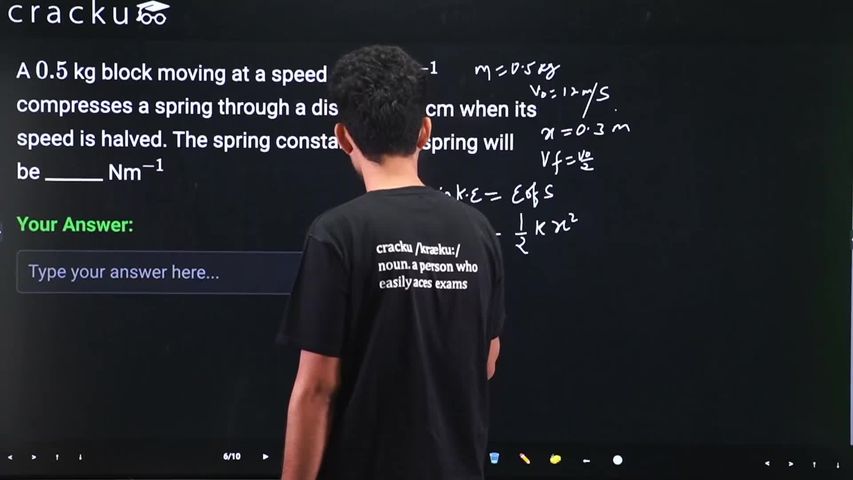
A $$0.5$$ kg block moving at a speed of $$12$$ ms$$^{-1}$$ compresses a spring through a distance $$30$$ cm when its speed is halved. The spring constant of the spring will be ______ Nm$$^{-1}$$
Correct Answer: 600
A block of mass $$m = 0.5$$ kg moving with initial speed $$v_i = 12$$ m/s compresses a spring by $$x = 30$$ cm $$= 0.3$$ m and slows to a final speed $$v_f = \frac{12}{2} = 6$$ m/s.
By the work-energy theorem, the decrease in kinetic energy of the block is stored as elastic potential energy in the spring:
$$\frac{1}{2}mv_i^2 - \frac{1}{2}mv_f^2 = \frac{1}{2}kx^2$$
Substituting the values gives the initial kinetic energy $$KE_i = \frac{1}{2}(0.5)(12)^2 = \frac{1}{2}(0.5)(144) = 36 \text{ J}$$ and the final kinetic energy $$KE_f = \frac{1}{2}(0.5)(6)^2 = \frac{1}{2}(0.5)(36) = 9 \text{ J}$$, so the loss in kinetic energy is $$36 - 9 = 27 \text{ J}$$.
Equating this to the spring’s potential energy, $$\frac{1}{2}kx^2 = 27$$, and using $$x = 0.3$$ m leads to $$\frac{1}{2}k(0.3)^2 = 27$$ or $$\frac{1}{2}k(0.09) = 27$$, from which $$k = \frac{27 \times 2}{0.09} = \frac{54}{0.09} = 600 \text{ Nm}^{-1}$$.
The spring constant is 600 Nm$$^{-1}$$.
Was this solution helpful?
Click on the Email ☝️ to Watch the Video Solution
Create a FREE account and get:
_1.webp)

Educational materials for JEE preparation

Ask our AI anything

AI can make mistakes. Please verify important information.
AI can make mistakes. Please verify important information.
