
Join Our JEE Preparation Group
Prep with like-minded aspirants; Get access to free daily tests and study material.
Sign in
Please select an account to continue using cracku.in
↓ →
Join Our JEE Preparation Group
Prep with like-minded aspirants; Get access to free daily tests and study material.
The velocity of upper layer of water in a river is $$36$$ km h$$^{-1}$$. Shearing stress between horizontal layers of water is $$10^{-3}$$ N m$$^{-2}$$. Depth of the river is ______ m. (Co-efficient of viscosity of water is $$10^{-2}$$ Pa s)
Correct Answer: 100
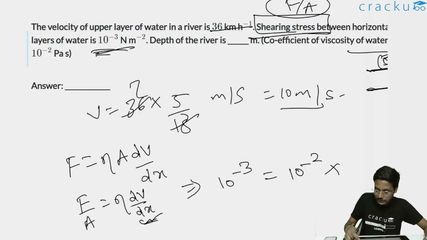
Velocity of the upper layer is given as $$v = 36$$ km/h, the shearing stress is $$\tau = 10^{-3}$$ N/m$$^2$$, and the coefficient of viscosity is $$\eta = 10^{-2}$$ Pa·s. Converting this velocity to metres per second yields $$v = 36 \times \frac{5}{18} = 10 \text{ m/s}$$.
According to Newton’s law of viscosity, the shearing stress is related to the velocity gradient by $$\tau = \eta \frac{dv}{dx}$$. The velocity gradient $$\frac{dv}{dx}$$ represents the change in velocity over the depth $$d$$ of the river. Assuming the bottom layer is stationary and the top layer moves at velocity $$v$$, we have $$\frac{dv}{dx} = \frac{v}{d}$$.
Substituting into the law of viscosity gives $$\tau = \eta \frac{v}{d}$$, which can be rearranged to solve for the depth:
$$d = \frac{\eta v}{\tau} = \frac{10^{-2} \times 10}{10^{-3}} = \frac{10^{-1}}{10^{-3}} = 10^{2} = 100 \text{ m}$$.
Thus, the depth of the river is 100 m.
Was this solution helpful?
Click on the Email ☝️ to Watch the Video Solution
Create a FREE account and get:
_1.webp)

Educational materials for JEE preparation

Ask our AI anything

AI can make mistakes. Please verify important information.
AI can make mistakes. Please verify important information.
