
Join Our JEE Preparation Group
Prep with like-minded aspirants; Get access to free daily tests and study material.
Sign in
Please select an account to continue using cracku.in
↓ →
Join Our JEE Preparation Group
Prep with like-minded aspirants; Get access to free daily tests and study material.
A 1 kg block subjected to two simultaneous forces $$(2\hat{i} + 3\hat{j} + 4\hat{k})$$ N and $$(3\hat{i} - \hat{j} - 2\hat{k})$$ N is moved a distance of 25 m along $$(3\hat{i} - 4\hat{j})$$ direction. The work done in this process is _____ J.
Correct Answer: 35
The two simultaneous forces on the block are
$$\mathbf{F}_1 = 2\hat{i} + 3\hat{j} + 4\hat{k} \; \text{N}$$
$$\mathbf{F}_2 = 3\hat{i} - \hat{j} - 2\hat{k} \; \text{N}$$
Step 1 - Find the resultant force.
Add the vectors component-wise:
$$\mathbf{F} = \mathbf{F}_1 + \mathbf{F}_2$$
$$= (2+3)\hat{i} + (3-1)\hat{j} + (4-2)\hat{k}$$
$$= 5\hat{i} + 2\hat{j} + 2\hat{k}\; \text{N}$$
Step 2 - Write the displacement vector.
The block moves 25 m along the direction $$3\hat{i} - 4\hat{j}$$.
First find the unit vector in that direction.
Magnitude of $$3\hat{i} - 4\hat{j}$$ is
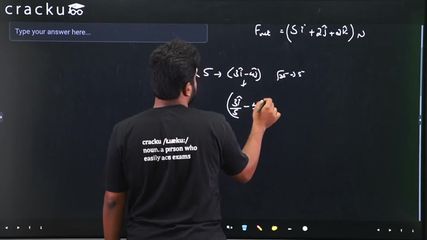
$$|\;3\hat{i} - 4\hat{j}\;| = \sqrt{3^{2} + (-4)^{2}} = \sqrt{9 + 16} = 5$$
Hence the unit vector is
$$\hat{u} = \frac{3}{5}\hat{i} - \frac{4}{5}\hat{j}$$
Multiply the unit vector by the distance 25 m to get the displacement vector $$\mathbf{s}$$:
$$\mathbf{s} = 25\hat{u} = 25\left(\frac{3}{5}\hat{i} - \frac{4}{5}\hat{j}\right)$$
$$= 15\hat{i} - 20\hat{j} + 0\hat{k}\; \text{m}$$
Step 3 - Calculate the work done.
Work $$W$$ is the dot product of the resultant force and displacement:
$$W = \mathbf{F} \cdot \mathbf{s}$$
$$= (5\hat{i} + 2\hat{j} + 2\hat{k}) \cdot (15\hat{i} - 20\hat{j} + 0\hat{k})$$
$$= 5 \times 15 + 2 \times (-20) + 2 \times 0$$
$$= 75 - 40 + 0$$
$$= 35 \; \text{J}$$
Therefore, the work done in moving the block is 35 J.
Was this solution helpful?
Click on the Email ☝️ to Watch the Video Solution
Create a FREE account and get:
_1.webp)

Educational materials for JEE preparation

Ask our AI anything

AI can make mistakes. Please verify important information.
AI can make mistakes. Please verify important information.


