
Join Our JEE Preparation Group
Prep with like-minded aspirants; Get access to free daily tests and study material.
Sign in
Please select an account to continue using cracku.in
↓ →
Join Our JEE Preparation Group
Prep with like-minded aspirants; Get access to free daily tests and study material.
An unpolarized light is incident on the plane interface of air-dielectric medium shown in figure. If the incident angle is equal to Brewster angle, identify the expression representing reflected wave.
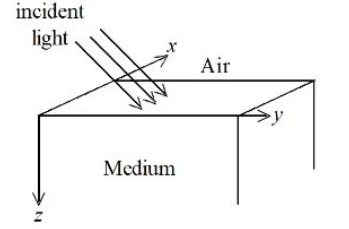
An unpolarised beam can be resolved into two mutually perpendicular components: one whose electric field lies in the plane of incidence (p-polarisation) and one whose electric field is perpendicular to the plane of incidence (s-polarisation).
Let the interface be the $$xy$$-plane and let the incident ray lie in the $$xz$$-plane. Hence the $$xz$$-plane is the plane of incidence; the direction $$\hat{y}$$ is perpendicular to this plane.
For reflection at an angle of incidence equal to the Brewster angle $$\theta_B$$ we have $$\tan\theta_B = \frac{n_2}{n_1}$$, and the Fresnel reflection coefficient for the p-component becomes zero: $$r_p(\theta_B)=0$$. Therefore the parallel (p) component is completely transmitted and the reflected light contains only the s-component.
Consequently the electric field of the reflected wave must be perpendicular to the plane of incidence, i.e. directed along $$\hat{y}$$. No component along $$\hat{x}$$ (parallel to the plane) or $$\hat{z}$$ (normal to the interface) can survive in the reflected beam.
Next, consider the phase of the reflected wave. For an incident wave whose wave vector lies in the $$xz$$-plane, reflection changes the sign of the normal component $$k_z$$ but leaves the tangential component $$k_x$$ unchanged. Hence the phase of the reflected wave can be written as $$k_x x - k_z z - \omega t \;.$$
Among the given expressions, the only one that
is
$$\bigl(E_x\hat{i}+E_y\hat{j}\bigr)\sin(kx-kz-\omega t).$$
Thus the reflected wave is represented by
Option A which is: $$(E_x \hat{i} + E_y \hat{j})\sin(kx - kz - \omega t).$$
Was this solution helpful?
Create a FREE account and get:
_1.webp)

Educational materials for JEE preparation

Ask our AI anything

AI can make mistakes. Please verify important information.
AI can make mistakes. Please verify important information.


