
Join Our JEE Preparation Group
Prep with like-minded aspirants; Get access to free daily tests and study material.
Sign in
Please select an account to continue using cracku.in
↓ →
Join Our JEE Preparation Group
Prep with like-minded aspirants; Get access to free daily tests and study material.
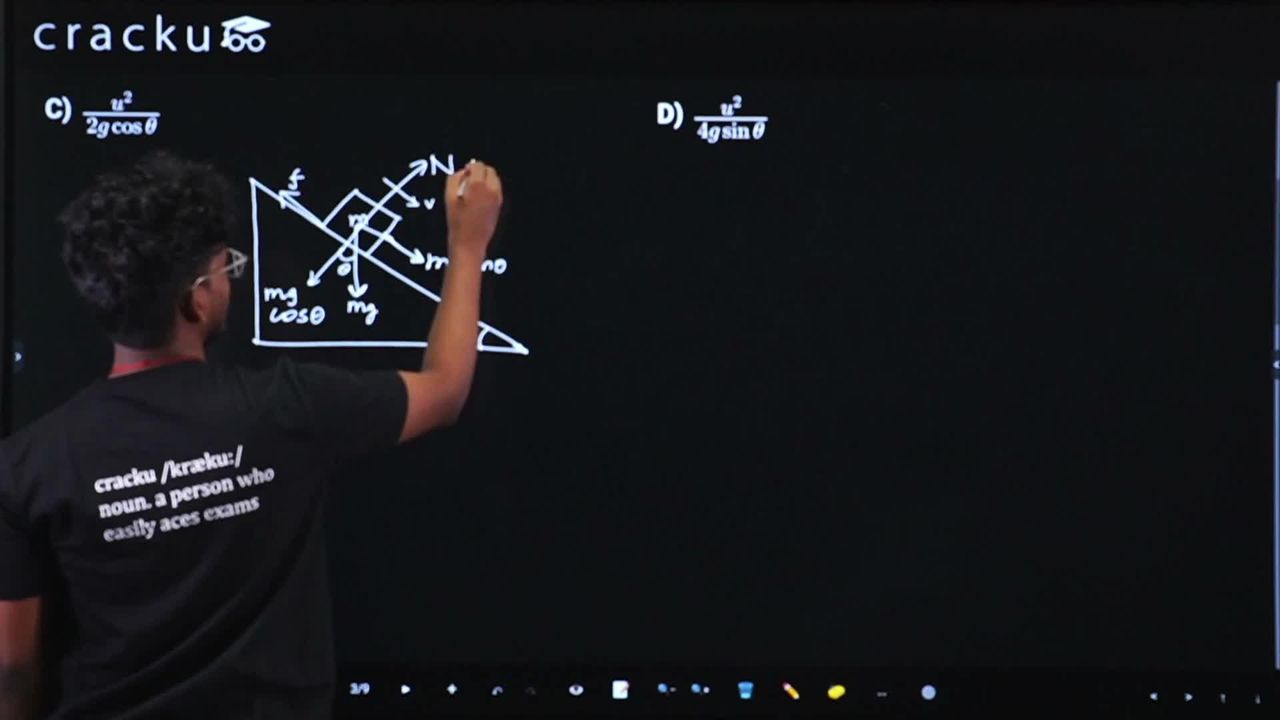
A block is sliding down on an inclined plane of slope $$\theta$$ and at an instant t = 0 this block is given an upward momentum so that it starts moving up on the inclined surface with velocity u. The distance (S) travelled by the block before its velocity become zero, is ______.
(g = gravitational acceleration)
The phrase sliding down in this context implies the block is initially sliding down with constant velocity. This means the downward component of gravity is perfectly balanced by the upward force of kinetic friction.
$$ mg \sin\theta = f_k $$
$$ mg \sin\theta = \mu mg \cos\theta $$
When the block is given an upward momentum and starts moving up the incline with initial velocity $$u$$, the direction of motion changes. Now, kinetic friction acts down the incline, in the exact same direction as the gravity component.
The net opposing force is:
$$ F_{net} = mg \sin\theta + f_k $$
Since we established earlier that $$f_k = mg \sin\theta$$, the net force becomes:
$$ F_{net} = mg \sin\theta + mg \sin\theta = 2mg \sin\theta $$
The deceleration $$a$$ of the block is:
$$ a = \frac{F_{net}}{m} = 2g \sin\theta $$
Now, use the third kinematic equation to find the distance $$S$$ traveled before coming to rest, where final velocity is $$0$$:
$$ v^2 = u^2 - 2aS $$
$$ 0 = u^2 - 2(2g \sin\theta)S $$
$$ 4g \sin\theta \cdot S = u^2 $$
$$ S = \frac{u^2}{4g \sin\theta} $$
Was this solution helpful?
Click on the Email ☝️ to Watch the Video Solution
Create a FREE account and get:
_1.webp)

Educational materials for JEE preparation

Ask our AI anything

AI can make mistakes. Please verify important information.
AI can make mistakes. Please verify important information.
