
Join Our JEE Preparation Group
Prep with like-minded aspirants; Get access to free daily tests and study material.
Sign in
Please select an account to continue using cracku.in
↓ →
Join Our JEE Preparation Group
Prep with like-minded aspirants; Get access to free daily tests and study material.
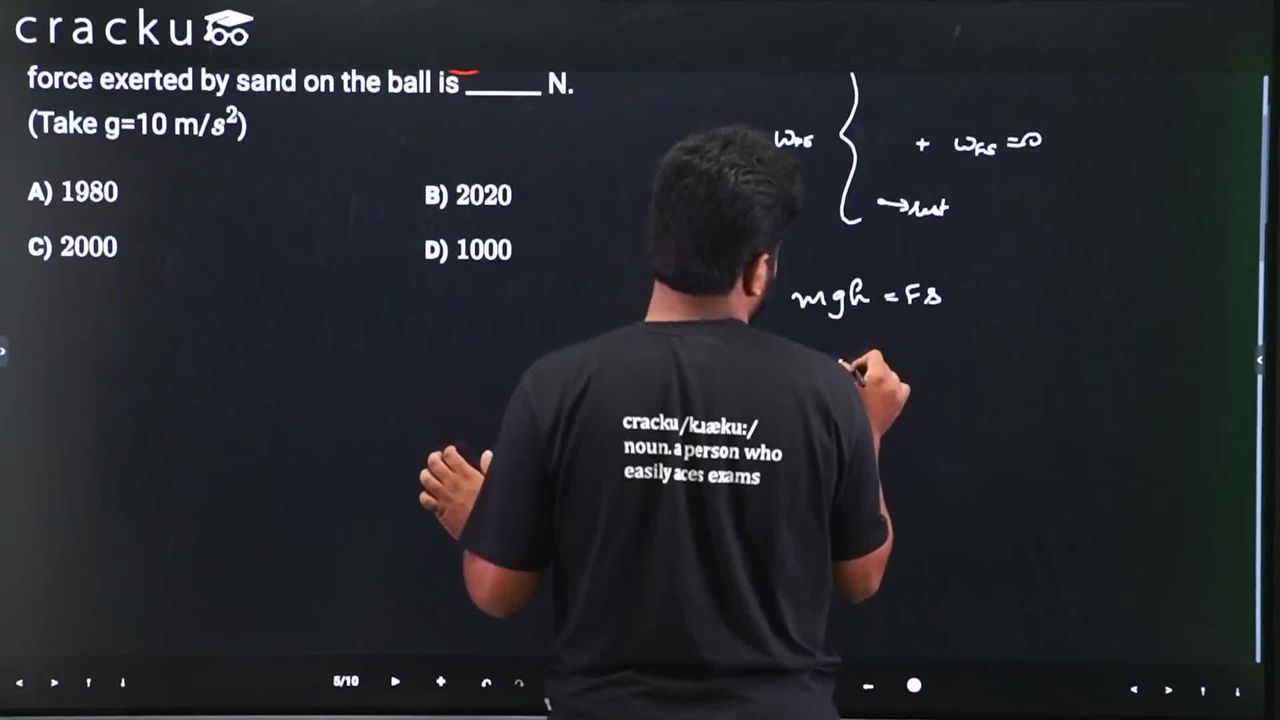
A spherical ball of mass 2 kg falls from a height of 10 m and is brought to rest after penetrating 10 cm into sand. The average force exerted by sand on the ball is ______ N.
(Take g=10 m/$$s^{2}$$)
The ball is released from rest, so its entire loss of gravitational potential energy is converted into the work done against the resisting force of the sand during the 10 cm penetration.
Total vertical drop before coming to rest
= free-fall height + penetration depth
$$h = 10 \text{ m} + 0.1 \text{ m} = 10.1 \text{ m}$$
Loss of gravitational potential energy
$$\Delta U = m g h$$
Here, $$m = 2 \text{ kg}$$ and (as usual for JEE) we take $$g = 10 \text{ m s}^{-2}$$.
$$\Delta U = 2 \times 10 \times 10.1 = 202 \text{ J}$$
This entire 202 J is dissipated only while the ball moves the last $$0.1 \text{ m}$$ inside the sand. If $$F_{\text{avg}}$$ is the average upward (resisting) force exerted by the sand, the work it does is
$$W_{\text{sand}} = F_{\text{avg}} \times s$$ where $$s = 0.1 \text{ m}$$ is the penetration depth.
Because the ball finally stops, the work done by the sand equals the loss in potential energy (energy conservation):
$$F_{\text{avg}} \times 0.1 = 202$$
$$\Rightarrow \; F_{\text{avg}} = \frac{202}{0.1} = 2020 \text{ N}$$
Thus the average force exerted by the sand on the ball is
Option B which is: $$2020 \text{ N}$$
Click on the Email ☝️ to Watch the Video Solution
Create a FREE account and get:
_1.webp)

Educational materials for JEE preparation

Ask our AI anything

AI can make mistakes. Please verify important information.
AI can make mistakes. Please verify important information.


