
Join Our JEE Preparation Group
Prep with like-minded aspirants; Get access to free daily tests and study material.
Sign in
Please select an account to continue using cracku.in
↓ →
Join Our JEE Preparation Group
Prep with like-minded aspirants; Get access to free daily tests and study material.
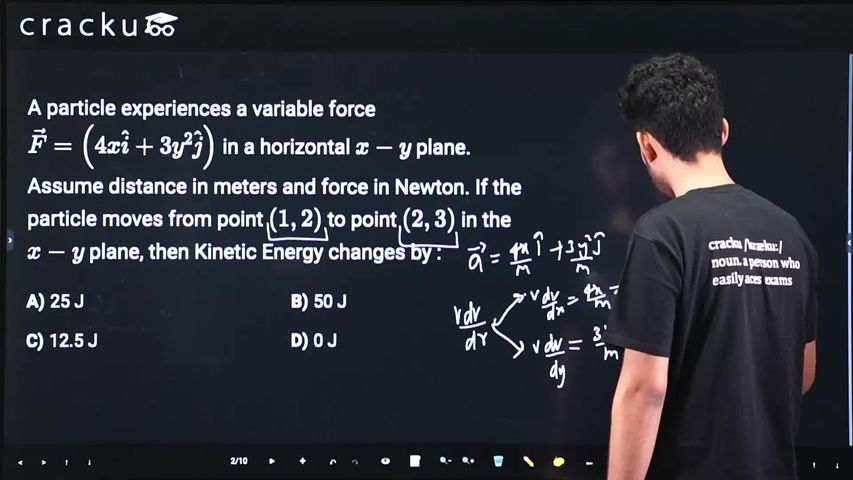
A particle experiences a variable force $$\vec{F} = \left(4x\hat{i} + 3y^2\hat{j}\right)$$ in a horizontal $$x - y$$ plane. Assume distance in meters and force in Newton. If the particle moves from point $$(1, 2)$$ to point $$(2, 3)$$ in the $$x - y$$ plane, then Kinetic Energy changes by :
We are given: $$\vec{F} = 4x\hat{i} + 3y^2\hat{j}$$ N. The particle moves from point $$(1, 2)$$ to point $$(2, 3)$$.
Apply the Work-Energy theorem: the change in kinetic energy equals the work done by the force:
$$ \Delta KE = W = \int \vec{F} \cdot d\vec{r} $$
Check if the force is conservative: $$\frac{\partial F_x}{\partial y} = \frac{\partial (4x)}{\partial y} = 0$$ and $$\frac{\partial F_y}{\partial x} = \frac{\partial (3y^2)}{\partial x} = 0$$.
Since $$\frac{\partial F_x}{\partial y} = \frac{\partial F_y}{\partial x}$$, the force is conservative, and the work done is path-independent.
Calculate the work done: $$ W = \int_1^2 4x\,dx + \int_2^3 3y^2\,dy $$
$$ W = \left[2x^2\right]_1^2 + \left[y^3\right]_2^3 $$
$$ W = (2 \times 4 - 2 \times 1) + (27 - 8) $$
$$ W = (8 - 2) + (19) = 6 + 19 = 25 \text{ J} $$
Therefore, the kinetic energy changes by $$25$$ J.
The correct answer is Option A.
Was this solution helpful?
Click on the Email ☝️ to Watch the Video Solution
Create a FREE account and get:
_1.webp)

Educational materials for JEE preparation

Ask our AI anything

AI can make mistakes. Please verify important information.
AI can make mistakes. Please verify important information.
