
Join Our JEE Preparation Group
Prep with like-minded aspirants; Get access to free daily tests and study material.
Sign in
Please select an account to continue using cracku.in
↓ →
Join Our JEE Preparation Group
Prep with like-minded aspirants; Get access to free daily tests and study material.
Given below are two statements: Statement I: When speed of liquid is zero everywhere, pressure difference at any two points depends on equation $$P_1 - P_2 = \rho g(h_2 - h_1)$$. Statement II: In venturi tube shown, $$2gh = v_1^2 - v_2^2$$. Choose the most appropriate answer from the options given below.
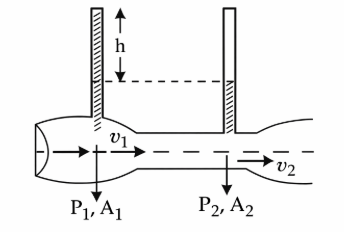
Statement I:
When the speed of liquid is zero everywhere, the fluid is in hydrostatic condition. In this case, pressure variation depends only on depth. The relation between pressure difference and height difference is given by:
$$P_1-P_2\ =\ \rho\ g\left(h_2-h_1\right)$$
This is the standard hydrostatic pressure relation, so Statement I is correct.
Statement II:
In a venturi tube, fluid is flowing, so Bernoulli’s equation must be applied:
$$P_1+\ \frac{\ 1}{2}\rho\ v_1^2=\ P_2\ +\ \ \frac{\ 1}{2}\ \rho\ v_2^2$$
From Bernoulli’s equation:
Also, from the manometer height difference:
$$P_1-P_2\ =\ \rho\ gh$$
Combining these gives:
$$P_1+\ \frac{\ 1}{2}\rho\ v_1^2=\ P_2\ +\ \ \frac{\ 1}{2}\ \rho\ v_2^2$$
$$\ \ \ P_1-P_2=\frac{\ 1}{2}\ \rho\ v_2^2-\frac{\ 1}{2}\rho\ v_1^2=\rho gh$$
$$\frac{\ 1}{2}\ \rho\ v_2^2-\frac{\ 1}{2}\rho\ v_1^2=\rho gh$$
$$\ \ \rho\ v_2^2-\ \rho\ v_1^2=2\rho gh$$
$$\ v_2^2-\ \ \ v_1^2=2 gh$$
But in the statement it is given as:
$$\ v_1^2-\ \ \ v_2^2=2 gh$$
which has the wrong sign.
Hence, Statement II is incorrect.
Was this solution helpful?
Click on the Email ☝️ to Watch the Video Solution
Create a FREE account and get:
_1.webp)

Educational materials for JEE preparation

Ask our AI anything

AI can make mistakes. Please verify important information.
AI can make mistakes. Please verify important information.
