
Join Our JEE Preparation Group
Prep with like-minded aspirants; Get access to free daily tests and study material.
Sign in
Please select an account to continue using cracku.in
↓ →
Join Our JEE Preparation Group
Prep with like-minded aspirants; Get access to free daily tests and study material.
An object is projected with kinetic energy K from a point A at an angle 60° with the horizontal The ratio of the difference in kinetic energies at points B and C to that at point A (see figure), in the absence of air friction is :
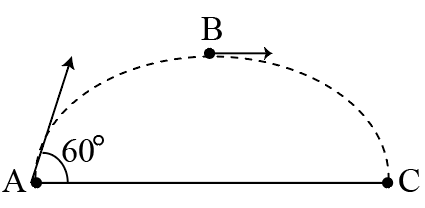
An object is projected from point A with kinetic energy KKK at an angle of 60∘60^\circ60∘. Since there is no air resistance, mechanical energy is conserved throughout the motion.
At point A, the total energy is purely kinetic.
$$K_A\ =\ K=\ \ \frac{\ 1}{2}\times\ m\times\ v^2$$ = $$\ \frac{\ mv^2}{2}$$
As the object moves upward to point B, it gains height. Due to this increase in height, some of the kinetic energy is converted into potential energy, so the kinetic energy at B decreases.
$$K_A\ =\ K_B+m\times\ g\times\ h$$
At the highest point B, the vertical component of velocity becomes zero, and only the horizontal component remains. Therefore, kinetic energy at B depends only on the horizontal velocity.
$$v_x=v\cos\ 60^{\circ\ \ }=\ \frac{\ v}{2}$$
So kinetic energy at B:
$$K_B=\ \ \frac{\ 1}{2}\times\ m\times\left(v\cos\ 60^{\circ\ }\right)^2\ =\ \ \frac{\ 1}{2}\times\ m\times\ \left(\ \frac{\ v}{2}\right)^2\ =\frac{\ mv^2}{8}$$ = $$\ \frac{\ K}{4}\ $$
Now, as the object moves from B to C, it comes back to the same vertical level as A. Hence, the potential energy at C is the same as at A, and thus the kinetic energy at C becomes equal to the initial kinetic energy.
$$K_A=K_C=K$$
Now consider the difference in kinetic energies between C and B , and kinetic energy at A
$$K_C-K_B=K-\ \frac{\ K}{4}\ =\ \ \frac{\ 3K}{4}$$
$$K_A=K$$
Finally, take the ratio of these differences.
$$\ \frac{\ diff\ between\ B\ and\ C}{Kinetic\ energy\ at\ A}$$ = $$\ \frac{\ \frac{\ 3K}{4}}{K}$$
= $$\ \frac{\ 3}{4}$$
Thus, the required ratio is 3:4
Was this solution helpful?
Click on the Email ☝️ to Watch the Video Solution
Create a FREE account and get:
_1.webp)

Educational materials for JEE preparation

Ask our AI anything

AI can make mistakes. Please verify important information.
AI can make mistakes. Please verify important information.
