
Join Our JEE Preparation Group
Prep with like-minded aspirants; Get access to free daily tests and study material.
Sign in
Please select an account to continue using cracku.in
↓ →
Join Our JEE Preparation Group
Prep with like-minded aspirants; Get access to free daily tests and study material.
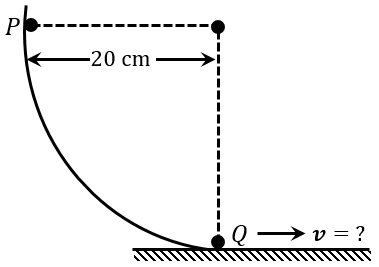
As per the given figure, a small ball $$P$$ slides down the quadrant of a circle and hits the other ball $$Q$$ of equal mass which is initially at rest. Neglecting the effect of friction and assume the collision to be elastic, the velocity of ball $$Q$$ after collision will be: ($$g = 10$$ m s$$^{-2}$$)
Given:
Mass of both balls = equal
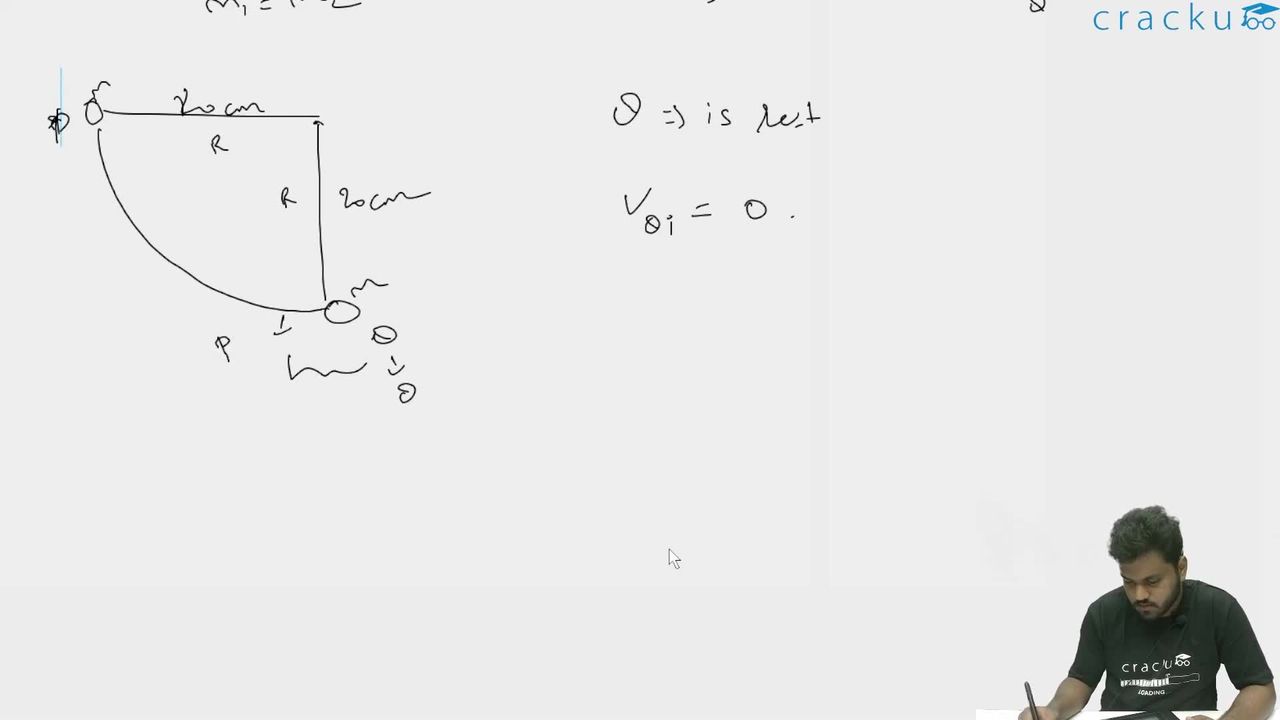
Radius of quarter circle = 20 cm = 0.2 m
Initial velocity of ball P=0 (starts from rest)
Initial velocity of ball Q=0(at rest)
Acceleration due to gravity $$g = 10$$ m s$$^{-2}$$
Collision is perfectly elastic
Friction is neglected
A small ball P starts from rest and slides down a smooth quarter circular path. Since friction is neglected, mechanical energy is conserved during the motion.
As the ball moves from the top point to the bottom, it loses gravitational potential energy which gets converted into kinetic energy.
Initial P.E of the ball P = $$m\times\ g\times\ h$$
Final K.E of the ball is $$\ \frac{\ 1}{2}m\times v^2$$
As both should be equal,
$$\ \frac{\ 1}{2}m\times v^2$$ = $$m\times\ g\times\ h$$
$$v_p=\sqrt{\ 2gh}$$
$$v_p=\sqrt{\ 2\times\ 0.2\times\ 10}$$
$$v_p=\sqrt{\ 4}$$
$$v_p=2 m s^{-1}$$
At the lowest point, the velocity of the ball is horizontal. The ball then collides elastically with another ball Q of equal mass which is initially at rest.
$$v_q=0$$ and $$v_p=2 m s^{-1}$$
Since the collision is perfectly elastic and the masses are equal, the velocities are exchanged after collision.
Thus, after collision, ball P comes to rest and ball Q moves with the velocity that ball P had just before collision.
$$v_q=2 m s^{-1}$$ and $$v_p=0$$
Hence, the required velocity of ball Q is $$2$$ m s$$^{-1}$$
Was this solution helpful?
Click on the Email ☝️ to Watch the Video Solution
Create a FREE account and get:
_1.webp)

Educational materials for JEE preparation

Ask our AI anything

AI can make mistakes. Please verify important information.
AI can make mistakes. Please verify important information.


