
Join Our JEE Preparation Group
Prep with like-minded aspirants; Get access to free daily tests and study material.
Sign in
Please select an account to continue using cracku.in
↓ →
Join Our JEE Preparation Group
Prep with like-minded aspirants; Get access to free daily tests and study material.
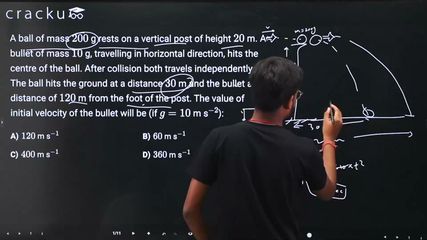
A ball of mass $$200$$ g rests on a vertical post of height $$20$$ m. A bullet of mass $$10$$ g, travelling in horizontal direction, hits the centre of the ball. After collision both travels independently. The ball hits the ground at a distance $$30$$ m and the bullet at a distance of $$120$$ m from the foot of the post. The value of initial velocity of the bullet will be (if $$g = 10$$ m s$$^{-2}$$):
A ball of mass $$200$$ g rests on a vertical post of height $$20$$ m. A bullet of mass $$10$$ g hits it horizontally. After collision, both travel independently.
Both the ball and bullet undergo projectile motion from height $$h = 20$$ m with zero initial vertical velocity.
$$h = \frac{1}{2}gt^2 \implies t = \sqrt{\frac{2h}{g}} = \sqrt{\frac{2 \times 20}{10}} = 2$$ s
Ball lands at 30 m: $$v_{\text{ball}} = \frac{30}{2} = 15$$ m/s
Bullet lands at 120 m: $$v_{\text{bullet}} = \frac{120}{2} = 60$$ m/s
Before collision: only bullet has momentum.
$$m_{\text{bullet}} \times u = m_{\text{ball}} \times v_{\text{ball}} + m_{\text{bullet}} \times v_{\text{bullet}}$$
$$0.01 \times u = 0.2 \times 15 + 0.01 \times 60$$
$$0.01u = 3 + 0.6 = 3.6$$
$$u = 360$$ m/s
The initial velocity of the bullet is $$360$$ m/s.
The correct answer is Option 4: $$360$$ m/s.
3015150
Was this solution helpful?
Click on the Email ☝️ to Watch the Video Solution
Create a FREE account and get:
_1.webp)

Educational materials for JEE preparation

Ask our AI anything

AI can make mistakes. Please verify important information.
AI can make mistakes. Please verify important information.


