
Join Our JEE Preparation Group
Prep with like-minded aspirants; Get access to free daily tests and study material.
Sign in
Please select an account to continue using cracku.in
↓ →
Join Our JEE Preparation Group
Prep with like-minded aspirants; Get access to free daily tests and study material.
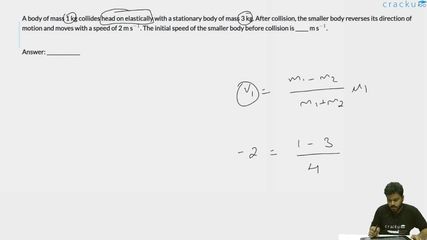
A body of mass 1 kg collides head on elastically with a stationary body of mass 3 kg. After collision, the smaller body reverses its direction of motion and moves with a speed of 2 m s$$^{-1}$$. The initial speed of the smaller body before collision is _____ m s$$^{-1}$$.
Correct Answer: 4
A body of mass 1 kg collides head-on elastically with a stationary body of mass 3 kg. After collision, the smaller body reverses direction and moves at 2 m/s.
Since the collision is elastic and head-on, the velocity of the first body after collision is given by $$v_1 = \frac{m_1 - m_2}{m_1 + m_2} u_1$$ where $$u_1$$ is the initial velocity of the first body.
Substituting $$m_1 = 1$$ kg and $$m_2 = 3$$ kg, and noting that after collision the smaller body reverses direction with speed 2 m/s so $$v_1 = -2$$ m/s (taking the initial direction as positive), we get:
$$-2 = \frac{1 - 3}{1 + 3} \times u_1$$
This simplifies to:
$$-2 = \frac{-2}{4} \times u_1$$
$$-2 = -\frac{u_1}{2}$$
Therefore,
$$u_1 = 4$$ m/s
Now we verify this result using conservation of momentum. The velocity of the second body after collision is:
$$v_2 = \frac{2 m_1}{m_1 + m_2} u_1 = \frac{2}{4} \times 4 = 2$$ m/s
Checking momentum: Before collision the total momentum is $$1 \times 4 = 4$$ kg·m/s, and after collision it is $$1 \times (-2) + 3 \times 2 = -2 + 6 = 4$$ kg·m/s ✓
Checking kinetic energy: Before collision the total kinetic energy is $$\frac{1}{2}(1)(16) = 8$$ J, and after collision it is $$\frac{1}{2}(1)(4) + \frac{1}{2}(3)(4) = 2 + 6 = 8$$ J ✓
Therefore, the initial speed of the smaller body is $$\mathbf{4}$$ m/s.
Was this solution helpful?
Click on the Email ☝️ to Watch the Video Solution
Create a FREE account and get:
_1.webp)

Educational materials for JEE preparation

Ask our AI anything

AI can make mistakes. Please verify important information.
AI can make mistakes. Please verify important information.


