For the following questions answer them individually
Match List I with List II
List I List II
A. Young's Modulus (Y) I. [ML$$^{-1}$$T$$^{-1}$$]
B. Co-efficient of Viscosity ($$\eta$$) II. [ML$$^2$$T$$^{-1}$$]
C. Planck's Constant (h) III. [ML$$^{-1}$$T$$^{-2}$$]
D. Work Function ($$\phi$$) IV. [ML$$^2$$T$$^{-2}$$]
The distance travelled by a particle is related to time $$t$$ as $$x = 4t^2$$. The velocity of the particle at $$t = 5$$ s is
Two objects are projected with same velocity $$u$$ however at different angles $$\alpha$$ and $$\beta$$ with the horizontal. If $$\alpha + \beta = 90°$$, the ratio of horizontal range of the first object to the 2$$^{nd}$$ object will be:
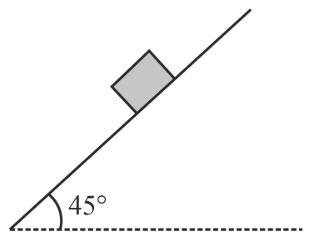
Consider a block kept on an inclined plane (inclined at 45°) as shown in the figure. If the force required to just push it up the incline is 2 times the force required to just prevent it from sliding down, the coefficient of friction between the block and inclined plane ($$\mu$$) is equal to:
A body of mass is taken from earth surface to the height $$h$$ equal to twice the radius of earth ($$R_e$$), the increase in potential energy will be: ($$g$$ = acceleration due to gravity on the surface of earth)
Every planet revolves around the sun in an elliptical orbit:
A. The force acting on a planet is inversely proportional to square of distance from sun.
B. Force acting on planet is inversely proportional to product of the masses of the planet and the sun.
C. The centripetal force acting on the planet is directed away from the sun.
D. The square of time period of revolution of planet around sun is directly proportional to cube of semi-major axis of elliptical orbit.
Choose the correct answer from the options below:
According to law of equipartition of energy the molar specific heat of a diatomic gas at constant volume where the molecule has one additional vibrational mode is:-
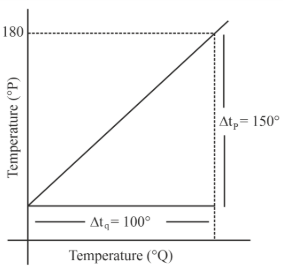
The graph between two temperature scales P and Q is shown in the figure. Between upper fixed point and lower fixed point there are 150 equal divisions of scale P and 100 divisions on scale Q. The relationship for conversion between the two scales is given by:
Match List I with List II:
A. Isothermal Process I. Work done by the gas decreases internal energy
B. Adiabatic Process II. No change in internal energy
C. Isochoric Process III. The heat absorbed goes partly to increase internal energy and partly to do work
D. Isobaric Process IV. No work is done on or by the gas
Choose the correct answer from the options below:
A particle executes simple harmonic motion between $$x = -A$$ and $$x = +A$$. If time taken by particle to go from $$x = 0$$ to $$\frac{A}{2}$$ is 2 s; then time taken by particle in going from $$x = \frac{A}{2}$$ to $$A$$ is: