
Join Our JEE Preparation Group
Prep with like-minded aspirants; Get access to free daily tests and study material.
Sign in
Please select an account to continue using cracku.in
↓ →
Join Our JEE Preparation Group
Prep with like-minded aspirants; Get access to free daily tests and study material.
Based on the given figure, the number of correct statement/s is/are
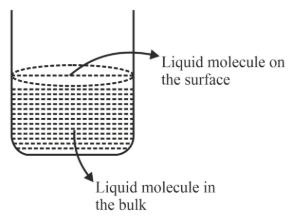
A. Surface tension is the outcome of equal attractive and repulsion forces acting on the liquid molecule in bulk.
B. Surface tension is due to uneven forces acting on the molecules present on the surface.
C. The molecule in the bulk can never come to the liquid surface.
D. The molecules on the surface are responsible for vapour pressure if the system is a closed system.
Correct Answer: 2
Statement A is incorrect. Molecules present in the bulk of a liquid are surrounded by neighbouring molecules from all directions and experience equal intermolecular attractive forces, resulting in zero net force. Surface tension does not arise due to these balanced forces.
Statement B is correct. Molecules present at the surface experience unbalanced intermolecular forces because there are no molecules above them. This net inward force causes the liquid surface to contract and gives rise to surface tension.
Statement C is incorrect. Molecules in a liquid are in continuous random motion and can move freely between the bulk and the surface. Therefore, a molecule in the bulk can reach the liquid surface.
Statement D is correct. Vapour pressure is produced when surface molecules escape into the vapour phase in a closed system until dynamic equilibrium is established. Hence, the molecules present on the surface are responsible for vapour pressure.
Therefore, Statements B and D are correct, while Statements A and C are incorrect. Hence, the number of correct statements is $$\boxed{2}$$.
Was this solution helpful?
Create a FREE account and get:
_1.webp)

Educational materials for JEE preparation

Ask our AI anything

AI can make mistakes. Please verify important information.
AI can make mistakes. Please verify important information.


