
Join Our JEE Preparation Group
Prep with like-minded aspirants; Get access to free daily tests and study material.
Sign in
Please select an account to continue using cracku.in
↓ →
Join Our JEE Preparation Group
Prep with like-minded aspirants; Get access to free daily tests and study material.
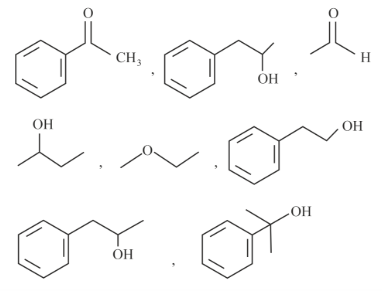
Number of compounds giving (i) red colouration with ceric ammonium nitrate and also (ii) positive iodoform test from the following is _____
Correct Answer: 2
A compound must satisfy both of the following conditions:
• It should give a positive Ceric Ammonium Nitrate (CAN) test, indicating the presence of an alcohol group.
• It should give a positive iodoform test, which requires either a methyl ketone group or the $$CH_3-CH(OH)-R$$ substructure.
Therefore, the compound must be an alcohol containing the $$CH_3-CH(OH)-R$$ moiety.
Evaluation of the given compounds:
• Acetophenone $$\left(PhCOCH_3\right)$$ gives a positive iodoform test but does not contain an alcohol group. Hence, it fails the CAN test.
• 2-Phenylethanol $$\left(PhCH_2CH_2OH\right)$$ gives a positive CAN test but lacks the $$CH_3-CH(OH)-$$ unit required for the iodoform test.
• Acetaldehyde $$\left(CH_3CHO\right)$$ gives a positive iodoform test but is not an alcohol and therefore fails the CAN test.
• 2-Butanol $$\left(CH_3CH(OH)CH_2CH_3\right)$$ is an alcohol and contains the $$CH_3-CH(OH)-$$ group. It gives positive results in both tests.
• Diethyl ether $$\left(CH_3CH_2OCH_2CH_3\right)$$ is an ether and gives neither test.
• 3-Phenylpropan-1-ol $$\left(PhCH_2CH_2CH_2OH\right)$$ gives a positive CAN test but lacks the required $$CH_3-CH(OH)-$$ unit.
• 1-Phenylpropan-2-ol $$\left(PhCH_2CH(OH)CH_3\right)$$ is an alcohol and contains the $$CH_3-CH(OH)-$$ group. It gives positive results in both tests.
• 2-Phenylpropan-2-ol $$\left(PhC(CH_3)_2OH\right)$$ is a tertiary alcohol. Although it gives a positive CAN test, it does not give the iodoform test.
Thus, only the following compounds satisfy both tests:
• 2-Butanol
• 1-Phenylpropan-2-ol
Hence, the number of compounds giving both a positive CAN test and a positive iodoform test is
$$\boxed{2}$$
Was this solution helpful?
Create a FREE account and get:
_1.webp)

Educational materials for JEE preparation

Ask our AI anything

AI can make mistakes. Please verify important information.
AI can make mistakes. Please verify important information.


