Join Our JEE Preparation Group
Prep with like-minded aspirants; Get access to free daily tests and study material.
Sign in
Please select an account to continue using cracku.in
↓ →
Join Our JEE Preparation Group
Prep with like-minded aspirants; Get access to free daily tests and study material.
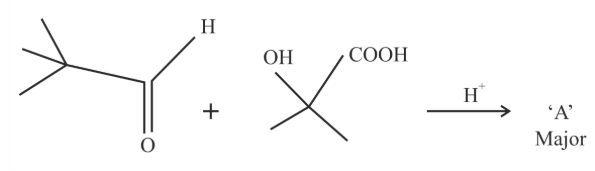
The reaction takes place under acidic conditions and involves the condensation of pivalaldehyde with an $$\alpha$$-hydroxy acid (2-hydroxyisobutyric acid).
The carbonyl oxygen of the aldehyde is first protonated by $$H^+$$, increasing the electrophilicity of the carbonyl carbon.
The hydroxyl group $$(-OH)$$ of the $$\alpha$$-hydroxy acid attacks the protonated carbonyl carbon, forming a hemiacetal intermediate.
Subsequently, the carboxyl group participates in intramolecular cyclization. The oxygen of the $$-COOH$$ group attacks the hemiacetal carbon, followed by elimination of water, producing a stable five-membered cyclic product.
The resulting product is a cyclic dioxolanone, in which:
• One oxygen atom originates from the hydroxyl group.
• The second oxygen atom originates from the carboxyl group.
• The carbonyl $$\left(C=O\right)$$ of the original carboxylic acid is retained within the ring.
Among the given structures:
• Option A represents a cyclic acetal and lacks the required carbonyl group.
• Option B represents the correct five-membered cyclic dioxolanone.
• Option C is an open-chain ester and is not the major product under these conditions.
• Option D does not correspond to the expected cyclized product.
Hence, the major product formed is the cyclic dioxolanone shown in
$$\boxed{\text{Option B}}$$
Was this solution helpful?
Create a FREE account and get:
_1.webp)

Educational materials for JEE preparation

Ask our AI anything

AI can make mistakes. Please verify important information.
AI can make mistakes. Please verify important information.