Join Our JEE Preparation Group
Prep with like-minded aspirants; Get access to free daily tests and study material.
Sign in
Please select an account to continue using cracku.in
↓ →
Join Our JEE Preparation Group
Prep with like-minded aspirants; Get access to free daily tests and study material.
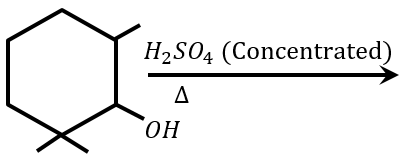
The reaction is an acid-catalyzed dehydration of an alcohol using concentrated (H_2SO_4).
Under acidic conditions, the hydroxyl group is first protonated to form a good leaving group ((-OH_2^+)). Loss of water then generates a secondary carbocation at the carbon originally bearing the hydroxyl group.
Since a more stable carbocation can be formed, the secondary carbocation undergoes a (1,2)-hydride shift from the adjacent tertiary carbon, producing a tertiary carbocation.
From this rearranged carbocation, elimination of a (\beta)-hydrogen takes place to form an alkene. According to Zaitsev’s rule, the major product is the most substituted and therefore the most thermodynamically stable alkene.
Among the given options, Option A corresponds to the tetrasubstituted alkene formed after carbocation rearrangement and subsequent elimination. This is more stable than the other possible alkene products and is therefore the major product.
Hence, the correct answer is
$$\boxed{\text{Option A}}.$$
The answer key indicating the last option is incorrect because it does not account for the carbocation rearrangement that occurs before elimination.
Was this solution helpful?
Create a FREE account and get:
_1.webp)

Educational materials for JEE preparation

Ask our AI anything

AI can make mistakes. Please verify important information.
AI can make mistakes. Please verify important information.