
Join Our JEE Preparation Group
Prep with like-minded aspirants; Get access to free daily tests and study material.
Sign in
Please select an account to continue using cracku.in
↓ →
Join Our JEE Preparation Group
Prep with like-minded aspirants; Get access to free daily tests and study material.
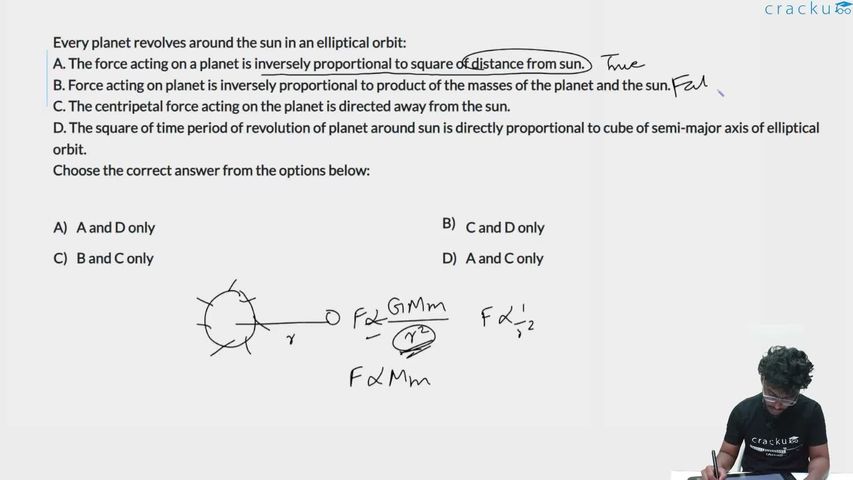
Every planet revolves around the sun in an elliptical orbit:
A. The force acting on a planet is inversely proportional to square of distance from sun.
B. Force acting on planet is inversely proportional to product of the masses of the planet and the sun.
C. The centripetal force acting on the planet is directed away from the sun.
D. The square of time period of revolution of planet around sun is directly proportional to cube of semi-major axis of elliptical orbit.
Choose the correct answer from the options below:
According to Newton’s law of gravitation, the gravitational force between the sun and a planet is :
$$F = \frac{GMm}{r^2}$$
Hence, force is inversely proportional to square of distance from the sun.
Therefore,
A is correct.
The force is directly proportional to the product of masses of the sun and the planet, not inversely proportional.
Therefore,
B is incorrect.
Centripetal force acting on the planet is always directed towards the sun.
Therefore,
C is incorrect.
According to Kepler’s third law :
$$T^2 \propto a^3$$
where \(T\) is the time period and \(a\) is the semi-major axis of the elliptical orbit.
Therefore,
D is correct.
Final Answer :
A and D
Was this solution helpful?
Click on the Email ☝️ to Watch the Video Solution
Create a FREE account and get:
_1.webp)

Educational materials for JEE preparation

Ask our AI anything

AI can make mistakes. Please verify important information.
AI can make mistakes. Please verify important information.


