JEE Waves Questions

Question 1 JEE Advanced

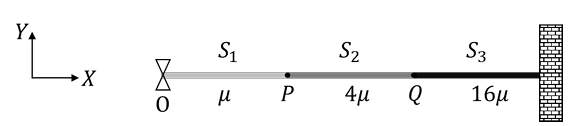
Consider a system of three connected strings, $$S_1$$, $$S_2$$ and $$S_3$$ with uniform linear mass densities $$\mu$$ kg/m, $$4\mu$$ kg/m and $$16\mu$$ kg/m, respectively, as shown in the figure. $$S_1$$ and $$S_2$$ are connected at the point $$P$$, whereas $$S_2$$ and $$S_3$$ are connected at the point $$Q$$, and the other end of $$S_3$$ is connected to a wall. A wave generator O is connected to the free end of $$S_1$$. The wave from the generator is represented by $$y = y_0 \cos(\omega t - kx)$$ cm, where $$y_0$$, $$\omega$$ and $$k$$ are constants of appropriate dimensions. Which of the following statements is/are correct:

image
Question 2 JEE Advanced

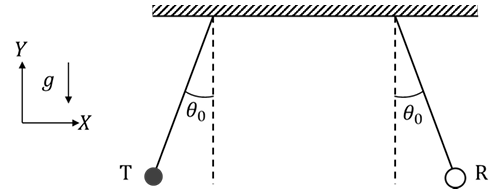
An audio transmitter (T) and a receiver (R) are hung vertically from two identical massless strings of length 8 m with their pivots well separated along the $$X$$ axis. They are pulled from the equilibrium position in opposite directions along the $$X$$ axis by a small angular amplitude $$\theta_0 = \cos^{-1}(0.9)$$ and released simultaneously. If the natural frequency of the transmitter is 660 Hz and the speed of sound in air is 330 m/s, the maximum variation in the frequency (in Hz) as measured by the receiver is ______.

(Take the acceleration due to gravity $$g = 10$$ m/s$$^2$$)

image
Question 3 JEE Advanced

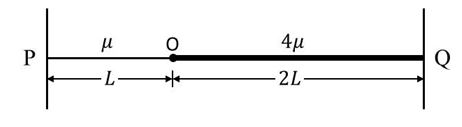
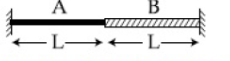
Two uniform strings of mass per unit length $$\mu$$ and $$4\mu$$, and length $$L$$ and $$2L$$, respectively, are joined at point $$O$$, and tied at two fixed ends $$P$$ and $$Q$$, as shown in the figure. The strings are under a uniform tension $$T$$. If we define the frequency $$\nu_0 = \frac{1}{2L}\sqrt{\frac{T}{\mu}}$$, which of the following statement(s) is(are) correct?

image
Question 4 JEE Mains

A tuning fork resonates with a sonometer wire of length $$1$$ m stretched with a tension of $$6$$ N. When the tension in the wire is changed to $$54$$ N, the same tuning fork produces $$12$$ beats per second with it. The frequency of the tuning fork is _______ Hz.

Question 5 JEE Mains

In a closed organ pipe, the frequency of fundamental note is $$30 \text{ Hz}$$. A certain amount of water is now poured in the organ pipe so that the fundamental frequency is increased to $$110 \text{ Hz}$$. If the organ pipe has a cross-sectional area of $$2 \text{ cm}^2$$, the amount of water poured in the organ tube is ________ g. (Take speed of sound in air is $$330 \text{ m s}^{-1}$$)

Question 6 JEE Advanced

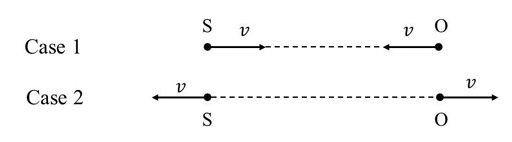
A source ($$S$$) of sound has frequency 240 Hz. When the observer ($$O$$) and the source move towards each other at a speed $$v$$ with respect to the ground (as shown in Case 1 in the figure), the observer measures the frequency of the sound to be 288 Hz. However, when the observer and the source move away from each other at the same speed $$v$$ with respect to the ground (as shown in Case 2 in the figure), the observer measures the frequency of sound to be $$n$$ Hz. The value of $$n$$ is ______.

image
Question 7 JEE Mains

A person driving car at a constant speed of 15 m s$$^{-1}$$ is approaching a vertical wall. The person notices a change of 40 Hz in the frequency of his car's horn upon reflection from the wall. The frequency of horn is ______ Hz.
(Given: Speed of sound: 330 m s$$^{-1}$$)

Question 8 JEE Mains

A car $$P$$ travelling at 20 m s$$^{-1}$$ sounds its horn at a frequency of 400 Hz. Another car $$Q$$ is travelling behind the first car in the same direction with a velocity 40 m s$$^{-1}$$. The frequency heard by the passenger of the car $$Q$$ is approximately [Take, velocity of sound = 360 m s$$^{-1}$$]

Question 9 JEE Mains

A person observes two moving trains, $$A$$ reaching the station and $$B$$ leaving the station with equal speed of $$30$$ m s$$^{-1}$$. If both trains emit sounds with frequency $$300$$ Hz, (Speed of sound: $$330$$ m s$$^{-1}$$) approximate difference of frequencies heard by the person will be:

Instructions

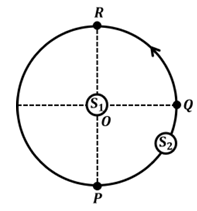
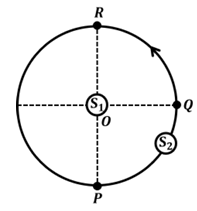
$$S_1$$ and $$S_2$$ are two identical sound sources of frequency 656 Hz. The source $$S_1$$ is located at O and $$S_2$$ moves anti-clockwise with a uniform speed $$4\sqrt{2}$$ ms$$^{-1}$$ on a circular path around O, as shown in the figure. There are three points P, Q and R on this path such that P and R are diametrically opposite while Q is equidistant from them. A sound detector is placed at point P. The source $$S_1$$ can move along direction OP.

[Given: The speed of sound in air is 324 ms$$^{-1}$$]

Question 10 JEE Advanced

When only $$S_2$$ is emitting sound and it is $$Q$$, the frequency of sound measured by the detector in Hz is ____.

image
Question 11 JEE Advanced

Consider both sources emitting sound. When $$S_2$$ is at R and $$S_1$$ approaches the detector with a speed 4 ms$$^{-1}$$, the beat frequency measured by the detector is ____ Hz.

image
Question 12 JEE Mains

A student is performing the experiment of the resonance column. The diameter of the column tube is 6 cm. The frequency of the tuning fork is 504 Hz. Speed of the sound at the given temperature is 336 m s$$^{-1}$$. The zero of the meter scale coincides with the top end of the resonance column tube. The reading of the water level in the column when the first resonance occurs is:

Question 13 JEE Mains

Two cars are approaching each other at an equal speed of 7.2 km hr$$^{-1}$$. When they see each other, both blow horns having a frequency of 676 Hz. The beat frequency heard by each driver will be ______ Hz. [Velocity of sound in air is 340 m s$$^{-1}$$.]

Question 14 JEE Mains

A source and a detector move away from each other in absence of wind with a speed of 20 m s$$^{-1}$$, with respect to the ground. If the detector detects a frequency of 1800 Hz of the sound coming from the source, then the original frequency of source considering the speed of sound in the air 340 m s$$^{-1}$$ will be _________ Hz.

Question 15 JEE Mains

The driver of bus approaching a big wall notices that the frequency of his bus's horn changes from 420 Hz to 490 Hz when he hears it after it gets reflected from the wall. Find the speed of the bus if speed of the sound is 330 ms$$^{-1}$$:

Question 16 JEE Mains

A driver in a car, approaching a vertical wall notices that the frequency of his car horn has changed from $$440$$ Hz to $$480$$ Hz, when it gets reflected from the wall. If the speed of sound in air is $$345\,\text{m s}^{-1}$$, then the speed of the car is:

Question 17 JEE Mains

A sound source S is moving along a straight track with speed $$v$$, and is emitting sound of frequency $$v_0$$. An observer is standing at a finite distance, at the point O, from the track. The time variation of frequency heard by the observer is best represented by: ($$t_0$$ represents the instant when the distance between the source and observer is minimum)

Question 18 JEE Mains

A stationary observer receives sound from two identical tuning forks, one of which approaches and the other one recedes with the same speed (much less than the speed of sound). The observer hears 2 beats/sec. The oscillation frequency of each tuning fork is $$v_0 = 1400$$ Hz and the velocity of sound in air is 350 m/s. The speed of each tuning fork is close to:

Question 19 JEE Mains

A stationary source emits sound waves of frequency 500 Hz. Two observers moving along a line passing through the source detect sound to be of frequencies 480 Hz and 530 Hz. Their respective speeds are, in m s$$^{-1}$$,
(Given speed of sound = 300 m/s)

Question 20 JEE Mains

A submarine A travelling at 18 km hr$$^{-1}$$ is being chased along the line of its velocity by another submarine B travelling at 27 km hr$$^{-1}$$. B sends a sonar signal of 500 Hz to detect A and receives a reflected sound of frequency v. The value of v is close to (Speed of sound in water 1500 m s$$^{-1}$$)

Question 21 JEE Mains

A train moves towards a stationary observer with speed 34 m/s. The train sounds a whistle and its frequency registered by the observer is $$f_1$$. If the speed of the train is reduced to 17 m/s, the frequency registered is $$f_2$$. If speed of sound is 340 m/s, then the ratio $$f_1/f_2$$ is:

Question 22 JEE Mains

A musician using an open flute of length 50 cm produces second harmonic sound waves. A person runs towards the musician from another end of a hall at a speed of 10 km h$$^{-1}$$. If the wave speed is 330 m s$$^{-1}$$, the frequency heard by the running person shall be close to:

Question 23 JEE Mains

Two cars A and B are moving away from each other in opposite directions. Both the cars are moving with speed of 20 m s$$^{-1}$$ with respect to the ground. If an observer in car A detects a frequency 2000 Hz of the sound coming from car B, what is the natural frequency of the sound source in car B? (speed of sound in air = 340 m s$$^{-1}$$)

Question 24 JEE Mains

Two sources of sound S$$_1$$ and S$$_2$$ produce sound waves of same frequency 660 Hz. A listener is moving from source S$$_1$$ towards S$$_2$$ with a constant speed u$$_0$$ m/s and he hears 10 beats/s. The velocity of sound is 330 m/s. Then, u$$_0$$ equals:

Question 25 JEE Mains

A source of sound S is moving with a velocity of 50 m s$$^{-1}$$ towards a stationary observer. The observer measures the frequency of the source as 1000 Hz. What will be the apparent frequency of the source when it is moving away from the observer after crossing him? (Take velocity of sound in air is 350 m s$$^{-1}$$)

Question 26 JEE Mains

5 beats/second are heard when a turning fork is sounded with a sonometer wire under tension, when the length of the sonometer wire is either 0.95 m or 1 m. The frequency of the fork will be:

Question 27 JEE Mains

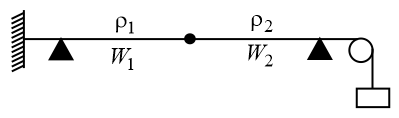
Two wires $$W_1$$ and $$W_2$$ have the same radius $$r$$ and respective densities $$\rho_1$$ and $$\rho_2$$, such that $$\rho_2 = 4\rho_1$$. They are joined together at the point $$O$$, as shown in the figure. The combination is used as a sonometer wire and kept under tension $$T$$. The point $$O$$ is midway between the two bridges. When a stationary wave is set up in the composite wire, the joint is found to be a node. The ratio of the number of antinodes formed in $$W_1$$ to $$W_2$$ is:

Question 28 JEE Mains

A toy-car, blowing its horn, is moving with a steady speed of 5 m s$$^{-1}$$, away from a wall. An observer, towards whom the toy car is moving, is able to hear 5 beats per second. If the velocity of sound in air is 340 m s$$^{-1}$$, the frequency of the horn of the toy car is close to

Question 29 JEE Mains

Two engines pass each other moving in opposite directions with uniform speed of 30 m/s. One of them is blowing a whistle of frequency 540 Hz. Calculate the frequency heard by driver of second engine before they pass each other. Speed of sound is 330 m/sec:

Question 30 JEE Mains

A train is moving on a straight track with speed 20 m s$$^{-1}$$. It is blowing its whistle at the frequency of 1000 Hz. The percentage change in the frequency heard by a person standing near the track as the train passes him is (speed of sound = 320 m s$$^{-1}$$) close to:

Question 31 JEE Mains

A bat moving at 10 m s$$^{-1}$$ towards a wall sends a sound signal of 8000 Hz towards it. On reflection, it hears a sound of frequency $$f$$. The value of $$f$$ in Hz is close to (speed of sound = 320 m s$$^{-1}$$)

Question 32 JEE Mains

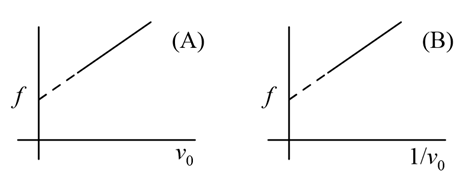
A source of sound emits sound waves at frequency $$f_0$$. It is moving towards an observer with fixed speed $$v_s$$ $$(v_s < v)$$, where $$v$$ is the speed of sound in air. If the observer were to move towards the source with speed $$v_0$$, one of the following two graphs (A and B) will give the correct variation of the frequency $$f$$ heard by the observer as $$v_0$$ is changed.

The variation of $$f$$ with $$v_0$$ is given correctly by:

Question 33 JEE Mains

Two factories are sounding their sirens at 800 Hz. A man goes from one factory to other at a speed of 2 m/s. The velocity of sound is 320 m/s. The number of beats heard by the person in one second will be:

Question 34 JEE Mains

Two harmonic waves moving in the same direction superimpose to form a wave $$x = a \cos(1.5t) \cos(50.5t)$$ where t is in seconds. Find the period with which they beat (close to nearest integer)

Question 35 JEE Mains

A sinusoidal wave of wavelength 7.5 cm travels a distance of 1.2 cm along the x-direction in 0.3 sec. The crest P is at $$x = 0$$ at $$t = 0$$ sec and maximum displacement of the wave is 2 cm. Which equation correctly represents this wave ?

Question 36 JEE Mains

In an experiment with a closed organ pipe, it is filled with water by $$\left(\dfrac{1}{5}\right)$$th of its volume. The frequency of the fundamental note will change by

Question 37 JEE Mains

The amplitude and phase of a wave formed by the superposition of two harmonic travelling waves, $$y_1(x, t) = 4\sin(kx - \omega t)$$ and $$y_2(x, t) = 2\sin(kx - \omega t + \frac{2\pi}{3})$$, are :
(Take the angular frequency of initial waves same
as $$\omega$$)

Question 38 JEE Mains

A closed organ pipe 150 cm long gives 7 beats per second with an open organ pipe of length 350 cm, both vibrating in fundamental mode. The velocity of sound is _____ m s$$^{-1}$$.

Question 39 JEE Mains

Two open organ pipes of lengths $$60 \text{ cm}$$ and $$90 \text{ cm}$$ resonate at $$6^{th}$$ and $$5^{th}$$ harmonics respectively. The difference of frequencies for the given modes is ___________ Hz. (Velocity of sound in air $$= 333 \text{ m/s}$$)

Question 40 JEE Mains

A steel wire with mass per unit length $$7.0 \times 10^{-3}$$ kg m$$^{-1}$$ is under tension of 70 N. The speed of transverse waves in the wire will be:

Question 41 JEE Mains

The engine of a train moving with speed 10 m s$$^{-1}$$ towards a platform sounds a whistle at frequency 400 Hz. The frequency heard by a passenger inside the train is: (Neglect air speed. Speed of sound in air = 330 m s$$^{-1}$$)

Question 42 JEE Mains

A train blowing a whistle of frequency 320 Hz approaches an observer standing on the platform at a speed of 66 m s$$^{-1}$$. The frequency observed by the observer will be (given speed of sound = 330 m s$$^{-1}$$) _____ Hz.

Question 43 JEE Mains

A wire of density $$8 \times 10^3$$ kg m$$^{-3}$$ is stretched between two clamps 0.5 m apart. The extension developed in the wire is $$3.2 \times 10^{-4}$$ m. If $$Y = 8 \times 10^{10}$$ N m$$^{-2}$$, the fundamental frequency of vibration in the wire will be _______ Hz

Question 44 JEE Mains

The displacement equations of two interfering waves are given by $$y_1 = 10 \sin\left(\omega t + \dfrac{\pi}{3}\right)$$ cm, $$y_2 = 5\left[\sin(\omega t) + \sqrt{3}\cos(\omega t)\right]$$ cm respectively. The amplitude of the resultant wave is ______ cm.

Question 45 JEE Mains

The equation of wave is given by $$Y = 10^{-2}\sin 2\pi(160t - 0.5x + \frac{\pi}{4})$$, where $$x$$ and $$Y$$ are in m and $$t$$ in s. The speed of the wave is _______ km h$$^{-1}$$.

Question 46 JEE Mains

For a solid rod, the Young's modulus of elasticity is $$3.2 \times 10^{11}$$ N m$$^{-2}$$ and density is $$8 \times 10^3$$ kg m$$^{-3}$$. The velocity of longitudinal wave in the rod will be

Question 47 JEE Mains

An observer moves towards a stationary source of sound with a velocity one-fifth of the velocity of sound. The percentage change in the apparent frequency is

Question 48 JEE Mains

An observer is riding on a bicycle and moving towards a hill at $$18 \text{ km h}^{-1}$$. He hears a sound from a source at some distance behind him directly as well as after its reflection from the hill. If the original frequency of the sound as emitted by source is $$640 \text{ Hz}$$ and velocity of the sound in air is $$320 \text{ m s}^{-1}$$, the beat frequency between the two sounds heard by observer will be ______ Hz.

Question 49 JEE Mains

Two waves are simultaneously passing through a string and their equations are:
$$y_1 = A_1 \sin k(x - vt)$$, $$y_2 = A_2 \sin k(x - vt + x_0)$$. Given amplitudes $$A_1 = 12$$ mm and $$A_2 = 5$$ mm, $$x_0 = 3.5$$ cm and wave number $$k = 6.28$$ cm$$^{-1}$$. The amplitude of resulting wave will be _________ mm.

Question 50 JEE Mains

A wire having a linear mass density $$9.0 \times 10^{-4}$$ kg m$$^{-1}$$ is stretched between two rigid supports with a tension of 900 N. The wire resonates at a frequency of 500 Hz. The next higher frequency at which the same wire resonates is 550 Hz. The length of the wire is _________ m.

Question 51 JEE Mains

The percentage increase in the speed of transverse waves produced in a stretched string if the tension is increased by 4%, will be ______ %.

Question 52 JEE Mains

The amplitude of wave disturbance propagating in the positive $$x$$-direction is given by $$y = \frac{1}{(1+x)^2}$$ at time $$t = 0$$ and $$y = \frac{1}{1+(x-2)^2}$$ at $$t = 1$$ s, where $$x$$ and $$y$$ are in metres. The shape of wave does not change during the propagation. The velocity of the wave will be ___ m s$$^{-1}$$.

Question 53 JEE Mains

A closed organ pipe of length $$L$$ and an open organ pipe contain gases of densities $$\rho_1$$ and $$\rho_2$$ respectively. The compressibility of gases are equal in both the pipes. Both the pipes are vibrating in their first overtone with same frequency. The length of the open pipe is $$\frac{x}{3}L\sqrt{\frac{\rho_1}{\rho_2}}$$, where $$x$$ is ________. (Round off to the Nearest Integer)

Question 54 JEE Mains

The frequency of a car horn encountered a change from 400 Hz to 500 Hz. When the car approaches a vertical wall. If the speed of sound is 330 m s$$^{-1}$$. Then the speed of car is ___ km h$$^{-1}$$.

Question 55 JEE Mains

A transverse wave travels on a taut steel wire with a velocity of $$v$$ when tension in it is $$2.06 \times 10^4$$ N. When the tension is changed to T, the velocity changed to $$\frac{v}{2}$$. The value of T is close to:

Question 56 JEE Mains

Assume that the displacement (s) of air is proportional to the pressure difference $$(\Delta p)$$ created by a sound wave. Displacement (s) further depends on the speed of sound (v), density of air ($$\rho$$) and the frequency (f). If $$\Delta p \sim 10\,\text{Pa}$$, $$v \sim 300\,\text{m/s}$$, $$\rho \sim 1\,\text{kg/m}^3$$, $$f \sim 1000\,\text{Hz}$$, then $$s$$ will be of the order of (take the multiplicative constant to be 1):

Question 57 JEE Mains

A wire of length $$L$$ and mass per unit length $$6.0 \times 10^{-3}$$ kg m$$^{-1}$$ is put under tension of 540 N. Two consecutive frequencies that it resonates at are: 420 Hz and 490 Hz. Then $$L$$ in meters is:

Question 58 JEE Mains

In a resonance tube experiment when the tube is filled with water up to a height of $$17.0\,\text{cm}$$, from bottom, it resonates with a given tuning fork. When the water level is raised the next resonance with the same tuning fork occurs at a height of $$24.5\,\text{cm}$$. If the velocity of sound in air is $$330\,\text{m s}^{-1}$$, the tuning fork frequency is:

Question 59 JEE Mains

Two identical strings X and Z made of same material have tension $$T_X$$ and $$T_Z$$ in them. If their fundamental frequencies are 450 Hz and 300 Hz, respectively, then the ratio $$T_X/T_Z$$ is:

Question 60 JEE Mains

A one metre long (both ends open) organ pipe is kept in a gas that has double the density of air at STP. Assuming the speed of sound in air at STP is 300 m/s, the frequency difference between the fundamental and second harmonic of this pipe is __________ Hz.

Question 61 JEE Mains

A wire of density $$9 \times 10^{-3}$$ kg cm$$^{-3}$$ is stretched between two clamps 1 m apart. The resulting strain in the wire is $$4.9 \times 10^{-4}$$. The lowest frequency of the transverse vibrations in the wire (Young's modulus of wire $$Y = 9 \times 10^{10}$$ Nm$$^{-2}$$), (to the nearest integer) is ___________.

Question 62 JEE Mains

Speed of a transverse wave on a straight wire (mass 6.0 g, length 60 cm and area of cross-section 1.0 mm$$^2$$) is 90 m s$$^{-1}$$. If the Young's modulus of wire is $$16 \times 10^{11}$$ N m$$^{-2}$$, the extension of wire over its natural length is:

Question 63 JEE Mains

A uniform thin rope of length 12 m and mass 6 kg hangs vertically from a rigid support and a block of mass 2 kg is attached to its free end. A transverse short wave train of wavelength 6 cm is produced at the lower end of the rope. What is the wavelength of the wave train (in cm) when it reaches the top of the rope?

Question 64 JEE Mains

A travelling harmonic wave is represented by the equation $$y(x, t) = 10^{-3} \sin(50t + 2x)$$, where x and y are in meter and t is in seconds. Which of the following is a correct statement about the wave?

Question 65 JEE Mains

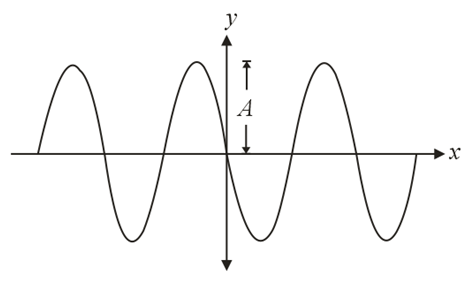
A progressive wave travelling along the positive x-direction is represented by $$y(x, t) = A\sin(kx - \omega t + \phi)$$. Its snapshot at t = 0 is given in the figure.

For this wave, the phase $$\phi$$ is:

Question 66 JEE Mains

A resonance tube is old and has a jagged end. It is still used in the laboratory to determine the velocity of sound in air. A tuning fork of frequency 512 Hz produces first resonance when the tube is filled with water to a mark 11 cm below a reference mark, near the open end of the tube. The experiment is repeated with another fork of frequency 256 Hz which produces first resonance when water reaches a mark 27 cm below the reference mark. The velocity of sound in air, obtained in the experiment, is close to

Question 67 JEE Mains

A string of length 1 m and mass 5 g is fixed at both ends. The tension in the string is 8.0 N. The string is set into vibration using an external vibrator of frequency 100 Hz. The separation between successive nodes on the string is close to:

Question 68 JEE Mains

A wire of length 2L, is made by joining two wires A and B of same length but different radii r and 2r and made of the same material. It is vibrating at a frequency such that the joint of the two wires forms a node. If the number of antinodes in wire A is p and that in B is q then ratio p:q is:

Question 69 JEE Mains

Equation of travelling wave on a stretched string of linear density 5 g/m is $$y = 0.03 \sin(450t - 9x)$$ where distance and time are measured in SI units. The tension in the string is:

Question 70 JEE Mains

A small speaker delivers 2 W of audio output. At what distance from the speaker will one detect 120 dB intensity sound? [Given reference intensity of sound as $$10^{-12}$$ W/m$$^2$$]

Question 71 JEE Mains

A string 2.0 m long and fixed at its ends is driven by a 240 Hz vibrator. The string vibrates in its third harmonic mode. The speed of the wave and its fundamental frequency is:

Question 72 JEE Mains

A string is clamped at both the ends and it is vibrating in its 4th harmonic. The equation of the stationary wave is $$y = 0.3 \sin(0.157x) \cos(200\pi t)$$. The length of the string is: (All quantities are in SI units.)

Question 73 JEE Mains

A closed organ pipe has a fundamental frequency of 1.5 kHz. The number of overtones that can be distinctly heard by a person with this organ pipe will be (Assume that the highest frequency a person can hear is 20,000 Hz).

Question 74 JEE Mains

The pressure wave, $$P = 0.01 \sin[1000t - 3x]$$ N m$$^{-2}$$, corresponds to the sound produced by a vibrating blade on a day when atmospheric temperature is 0°C. On some other day when temperature is T, the speed of sound produced by the same blade and at the same frequency is found to be 336 m s$$^{-1}$$. Approximate value of T is:

Question 75 JEE Mains

A tuning fork of frequency 480 Hz is used in an experiment for measuring speed of sound (v) in air by resonance tube method. Resonance is observed to occur at two successive lengths of the air column, l$$_1$$ = 30 cm and l$$_2$$ = 70 cm. Then, v is equal to:

Question 76 JEE Mains

A heavy ball of mass $$M$$ is suspended from the ceiling of a car by a light string of mass $$m$$ ($$m \ll M$$). When the car is at rest, the speed of transverse waves in the string is 60 ms$$^{-1}$$. When the car has acceleration $$a$$, the wave-speed increases to 60.5 ms$$^{-1}$$. The value of $$a$$, in terms of gravitational acceleration $$g$$, is closest to:

Question 77 JEE Mains

A tuning fork vibrates with frequency 256 Hz and gives one beat per second with the third normal mode of vibration of an open pipe. What is the length of the pipe? (Speed of sound in air is 340 ms$$^{-1}$$)

Question 78 JEE Mains

The end correction of a resonance column is 1 cm. If the shortest length resonating with the tuning fork is 10 cm, the next resonating length should be:

Question 79 JEE Mains

A granite rod of 60 cm length is clamped at its middle point and is set into longitudinal vibrations. The density of granite is $$2.7 \times 10^3$$ kg m$$^{-3}$$ and its Young's modulus is $$9.27 \times 10^{10}$$ Pa. What will be the fundamental frequency of the longitudinal vibrations?

Question 80 JEE Mains

Two sitar strings, A and B playing the note 'Dha' are slightly out of tune and produce beats of frequency 5 Hz. The tension of the string B is slightly increased and the beat frequency is found to decrease by 3 Hz. If the frequency of A is 425 Hz. The original frequency of B is:

Question 81 JEE Mains

A pipe open at both ends has a fundamental frequency $$f$$ in air. The pipe is dipped vertically in water so that half of it is in water. The fundamental frequency of the air column is now:

Question 82 JEE Mains

A uniform string of length 20 m is suspended from a rigid support. A short wave pulse is introduced at its lowest end. It starts moving up the string. The time taken to reach the support is (Take, $$g = 10$$ m s$$^{-2}$$)

Question 83 JEE Mains

A source of sound A emitting waves of frequency 1800 Hz is falling towards ground with a terminal speed v. The observer B on the ground directly beneath the source receives waves of frequency 2150 Hz. The source A receives waves, reflected from ground of frequency nearly: (Speed of sound = 343 m/s)

Question 84 JEE Mains

A transverse wave is represented by: $$y = \frac{10}{\pi} \sin\left(\frac{2\pi}{T}t - \frac{2\pi}{\lambda}x\right)$$. For what value of the wavelength the wave velocity is twice the maximum particle velocity?

Question 85 JEE Mains

The total length of a sonometer wire fixed between two bridges is 110 cm. Now, two more bridges are placed to divide the length of the wire in the ratio 6 : 3 : 2. If the tension in the wire is 400 N and the mass per unit length of the wire is 0.01 kg m$$^{-1}$$, then the minimum common frequency with which all the three parts can vibrate, is:

Question 86 JEE Mains

A sonometer wire of length 1.5 m is made of steel. The tension in it produces an elastic strain of 1%. What is the fundamental frequency of steel if density and elasticity of steel are $$7.7 \times 10^3$$ kg m$$^{-3}$$ and $$2.2 \times 10^{11}$$ N m$$^{-2}$$ respectively?

Question 87 JEE Mains

A sonometer wire of length 114 cm is fixed at both the ends. Where should the two bridges be placed so as to divide the wire into three segments whose fundamental frequencies are in the ratio 1 : 3 : 4?

Question 88 JEE Mains

In the resonance experiment, two air columns (closed at one end) of 100 cm and 120 cm long, give 15 beats per second when each one is sounding in the respective fundamental modes. The velocity of sound in the air column is:

Question 89 JEE Mains

Consider the sound wave travelling in ideal gases of He, $$CH_4$$, and $$CO_2$$. All the gases have the same ratio $$\dfrac{p}{\rho}$$, where P is the pressure and $$\rho$$ is the density. The ratio of the speed of sound through the gases $$v_{He} : v_{CH_4} : v_{CO_2}$$ is given by

Question 90 JEE Mains

A closed organ and an open organ tube are filled by two different gases having same bulk modulus but different densities $$\rho_1$$ and $$\rho_2$$, respectively. The frequency of $$9^{th}$$ harmonic of closed tube is identical with $$4^{th}$$ harmonic of open tube. If the length of the closed tube is 10 cm and the density ratio of the gases is $$\rho_1 : \rho_2=1:16$$, then the length of the open tube is :

Question 91 JEE Mains

The equation of a wave travelling on a string is $$y = \sin[20\pi x + 10\pi t]$$, where x and t are in SI units. The minimum distance between two points having the same oscillating speed is :

Question 92 JEE Mains

Two strings with circular cross section and made of same material, are stretched to have same amount of tension. A transverse wave is then made to pass through both the strings. The velocity of the wave in the first string having the radius of cross section R is $$v_1$$, and that in the other string having the radius of cross section R/2 is $$v_2$$. Then $$\frac{v_2}{v_1}$$ =

Question 93 JEE Mains

The equation of a transverse wave travelling along a string is $$y(x,t)=4.0\sin[20\times 10^{-3}x+600t]mm$$ where x is in mm and t is in second. The velocity of the wave is :

Question 94 JEE Mains

Displacement of a wave is expressed as $$x(t) = 5\cos\left(628t + \frac{\pi}{2}\right)$$ m. The wavelength of the wave when its velocity is 300 m/s is :

Question 95 JEE Mains

The fundamental frequency of a closed organ pipe is equal to the first overtone frequency of an open organ pipe. If length of the open pipe is 60 cm, the length of the closed pipe will be :

Question 96 JEE Mains

A sonometer wire of resonating length $$90$$ cm has a fundamental frequency of $$400$$ Hz when kept under some tension. The resonating length of the wire with fundamental frequency of $$600$$ Hz under same tension ______ cm.

Question 97 JEE Mains

The speed of sound in oxygen at S.T.P. will be approximately: (Given, $$R = 8.3$$ J K$$^{-1}$$, $$\gamma = 1.4$$)

Question 98 JEE Mains

The ratio of speed of sound in hydrogen gas to the speed of sound in oxygen gas at the same temperature is:

Question 99 JEE Mains

A guitar string of length 90 cm vibrates with a fundamental frequency of 120 Hz. The length of the string producing a fundamental of 180 Hz will be _______ cm.

Question 100 JEE Mains

A transverse harmonic wave on a string is given by $$y(x, t) = 5\sin6t + 0.003x$$ where $$x$$ and $$y$$ are in cm and $$t$$ in sec. The wave velocity is _______ m s$$^{-1}$$.

Question 101 JEE Mains

An organ pipe 40 cm long is open at both ends. The speed of sound in air is 360 m s$$^{-1}$$. The frequency of the second harmonic is ________ Hz.

Question 102 JEE Mains

In an experiment with sonometer when a mass of $$180$$ g is attached to the string, it vibrates with fundamental frequency of $$30$$ Hz. When a mass $$m$$ is attached, the string vibrates with fundamental frequency of $$50$$ Hz. The value of $$m$$ is _____ g.

Question 103 JEE Mains

The fundamental frequency of vibration of a string between two rigid support is $$50$$ Hz. The mass of the string is $$18$$ g and its linear mass density is $$20$$ g m$$^{-1}$$. The speed of the transverse waves so produced in the string is _____ m s$$^{-1}$$.

Question 104 JEE Mains

Two simple harmonic waves having equal amplitudes of $$8$$ cm and equal frequency of $$10$$ Hz are moving along the same direction. The resultant amplitude is also $$8$$ cm. The phase difference between the individual waves is ______ degree.

Question 105 JEE Mains

For a certain organ pipe, the first three resonance frequencies are in the ratio of $$1 : 3 : 5$$ respectively. If the frequency of fifth harmonic is $$405$$ Hz and the speed of sound in air is $$324$$ m s$$^{-1}$$, the length of the organ pipe is _____ m.

Question 106 JEE Mains

The distance between two consecutive points with phase difference of 60° in a wave of frequency 500 Hz is 6.0 m. The velocity with which wave is travelling is _____ km s$$^{-1}$$.

Question 107 JEE Mains

A travelling wave is described by the equation $$y(x, t) = 0.05 \sin(8x - 4t)$$ m. The velocity of the wave is: [All the quantities are in SI unit]

Question 108 JEE Mains

A travelling wave is described by the equation $$y(x, t) = 0.05\sin(8x - 4t)$$ m. The velocity of the wave is: [All the quantities are in SI unit]

Question 109 JEE Mains

In an experiment to determine the velocity of sound in air at room temperature using a resonance tube, the first resonance is observed when the air column has a length of 20.0 cm for a tuning fork of frequency 400 Hz is used. The velocity of the sound at room temperature is 336 m s$$^{-1}$$. The third resonance is observed when the air column has a length of ______ cm.

Question 110 JEE Mains

A tunning fork of frequency 340 Hz resonates in the fundamental mode with an air column of length 125 cm in a cylindrical tube closed at one end. When water is slowly poured in it, the minimum height of water required for observing resonance once again is ______ cm.
(Velocity of sound in air is 340 ms$$^{-1}$$)

Question 111 JEE Mains

Two travelling waves of equal amplitudes and equal frequencies move in opposite directions along a string. They interfere to produce a stationary wave whose equation is given by $$y = \left(10 \cos \pi x \sin \frac{2\pi t}{T}\right)$$ cm. The amplitude of the particle at $$x = \frac{4}{3}$$ cm will be ______ cm.

Question 112 JEE Mains

A wire of length 30 cm, stretched between rigid supports, has its $$n^{th}$$ and $$(n+1)^{th}$$ harmonics at 400 Hz and 450 Hz, respectively. If tension in the string is 2700 N, its linear mass density is _____ kg m$$^{-1}$$.

Question 113 JEE Mains

The first overtone frequency of an open organ pipe is equal to the fundamental frequency of a closed organ pipe. If the length of the closed organ pipe is $$20$$ cm. The length of the open organ pipe is ______ cm

Question 114 JEE Mains

A tuning fork $$A$$ of unknown frequency produces 5 beats s$$^{-1}$$ with a fork of known frequency 340 Hz. When fork $$A$$ is filed, the beat frequency decreases to 2 beats s$$^{-1}$$. What is the frequency of fork $$A$$?

Question 115 JEE Mains

A person standing on an open ground hears the sound of a jet aeroplane, coming from north at an angle $$60°$$ with ground level, but he finds the aeroplane right vertically above his position. If $$v$$ is the speed of sound, speed of the plane is:

Question 116 JEE Mains

A standing wave is formed by the superposition of two waves travelling in opposite directions. The transverse displacement is given by, $$y(x, t) = 0.5 \sin\left(\frac{5\pi}{4}x\right) \cos(200\pi t)$$. What is the speed of the travelling wave moving in the positive $$x$$ direction? ($$x$$ and $$t$$ are in meter and second, respectively)

Question 117 JEE Mains

When two sound waves travel in the same direction in a medium, the displacements of a particle located at 'x' at time 't' is given by :
$$y_1 = 0.05\cos(0.50\pi x - 100\pi t)$$
$$y_2 = 0.05\cos(0.46\pi x - 92\pi t)$$
where $$y_1$$, $$y_2$$ and x are in meters and t in seconds. The speed of sound in the medium is :

Question 118 JEE Mains

A and B are two sources generating sound waves. A listener is situated at C. The frequency of the source at A is 500 Hz. A, now, moves towards C with a speed 4 m/s. The number of beats heard at C is 6. When A moves away from C with speed 4 m/s, the number of beats heard at C is 18. The speed of sound is 340 m/s. The frequency of the source at B is :

Question 119 JEE Mains

An engine approaches a hill with a constant speed. When it is at a distance of 0.9 km, it blows a whistle whose echo is heard by the driver after 5 seconds. If the speed of sound in air is 330 m/s, then the speed of the engine is :

Question 120 JEE Mains

A wave pulse is propagating on a long string along the length taken as +x axis. Shape of the string

at $$t=0$$ is given by $$y=\frac{1}{x^2+8x+19}$$ and at $$t=2\ \sec$$ the shape is $$y=\frac{1}{x^2+3}$$. find the speed of wave on string

Question 121 JEE Mains

Two tuning forks A and Bare sounded together giving rise to 8 beats in 2 s. When fork A is loaded with wax, the beat frequency is reduced to 4 beats in 2 s. If the original frequency of tuning fork B is 380 Hz then original frequency of tuning fork A is ____ Hz.

Question 122 JEE Mains

A pipe of length 85 cm is closed from one end. Find the number of possible natural oscillations of air column in the pipe whose frequencies lie below 1250 Hz. The velocity of sound in air is 340 m/s.

Question 123 JEE Mains

In a transverse wave the distance between a crest and neighbouring trough at the same instant is 4.0 cm and the distance between a crest and trough at the same place is 1.0 cm. The next crest appears at the same place after a time interval of 0.4 s. The maximum speed of the vibrating particles in the medium is:

Question 124 JEE Mains

The velocity of sound in air is doubled when the temperature is raised from $$O^{o}$$C to $$\alpha ^{o}$$ C. The value of $$\alpha$$ is _______.

Question 125 JEE Mains

The speed of a longitudinal wave in a metallic bar is 400 m/s. If the density and Young's modulus of the bar material are increased by 0.5% and 1 %, respectively then the speed of the wave is changed approximately to m/ s.

Question 126 JEE Advanced

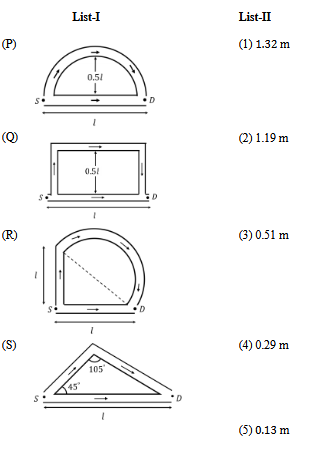
List-I shows four configurations made of straight and semi-circular narrow tubes containing air. A sound wave of wavelength $$\lambda=0.29\,\mathrm{m}$$ enters these structures at the point $$S$$ and a sound detector is placed at $$D$$. Between the points $$S$$ and $$D$$, the sound travels only through the tubes. List-II contains the possible smallest values of $$l$$ (refer to the figures) for which the detector $$D$$ records maximum amplitude. Ignore effects of sharp corners. [Given $$\cos(15^\circ)=0.97$$]

Choose the option that best describes the match between the entries in List-I to those in List-II.

image
Question 127 JEE Mains

The fifth harmonic of a closed organ pipe is found to be in unison with the first harmonic of an open pipe. The ratio of lengths of closed pipe to that of the open pipe is 5/x. The value of x is ______.