
 Group
 Group


 Preferred Source

 Google Discover
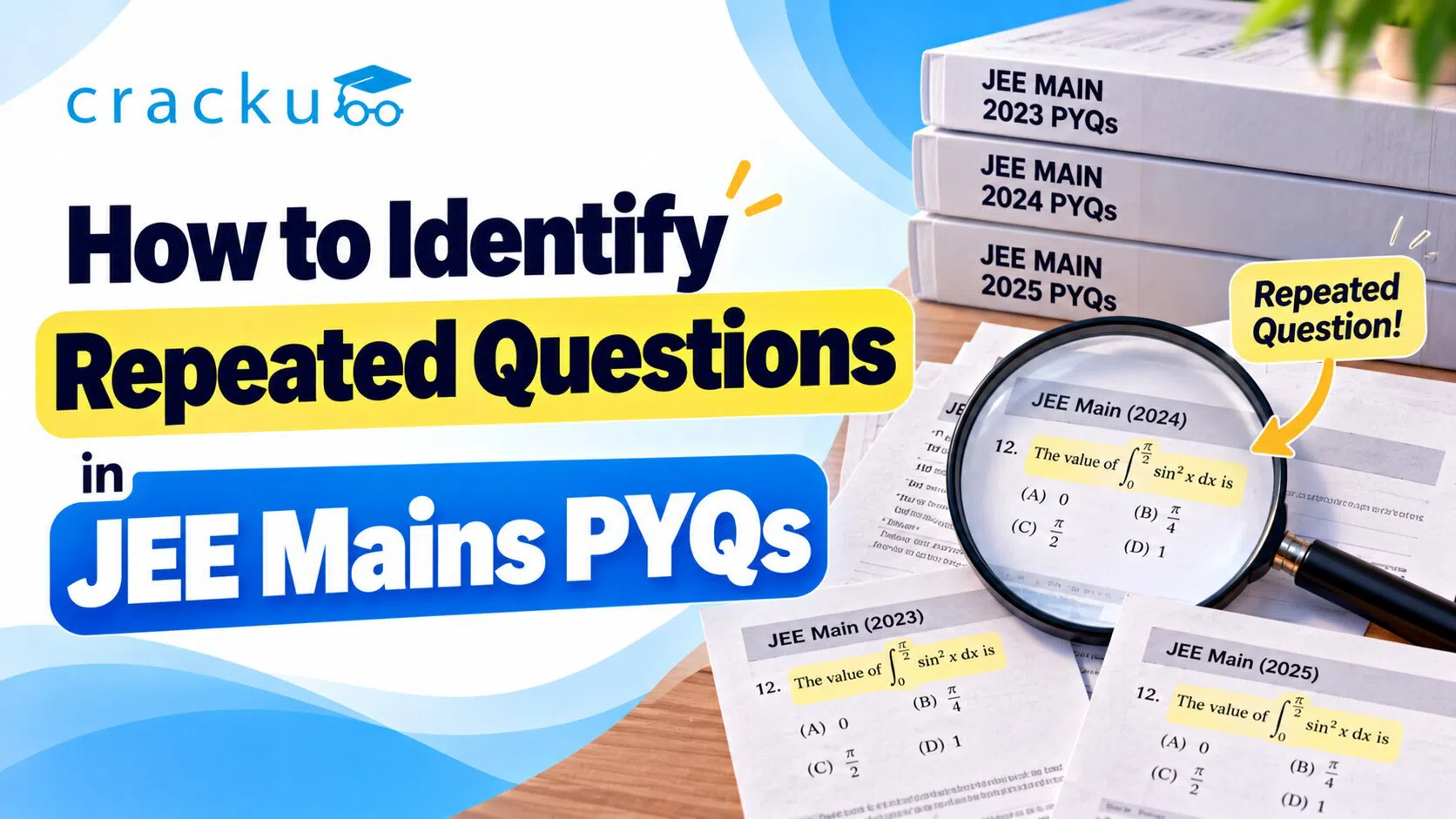
JEE Main preparation is not only about completing the whole syllabus and memorising all the formulas. It is also important to be aware of the kind of questions, the repeated topics and the different levels of difficulty in different sittings of the exam. One of the ways to do so is by analysing the JEE Main Previous Year Questions (PYQs). It might not be the exact same questions that repeat every year, but many similar topics, formulas and approaches keep repeating. Learning how to identify repeated questions in JEE Main PYQs will enable you to practise the important topics with better accuracy and efficiency.
How to Identify Repeated Questions in JEE Mains PYQs
Students should solve JEE Mains previous papers to find repeated questions and look for similar types of questions. Get the papers from the last five to seven years and classify them subject-wise and chapter-wise. Follow these quick steps:
- Get old-year papers: Get the JEE Main question paper and answers from various sources, including the NTA website.
- Categorise questions by chapter: Separate the questions into Physics, Chemistry, and Math, and categorize them according to the chapters of each topic.
- Recognize repeated questions: Find problems that contain a repeated formula, concept, reaction, theorem, or problem-solving method.
- Observe frequency: Determine the frequency of the appearance of each concept every year.
- Track variations: See if there are any changes in the presentation of the concept, i.e., whether it is asked using numerical problems or conceptual questions.
Also Read: How to Prepare for JEE Mains 2027, The Ultimate Strategy
How to Spot Recurring Concepts in JEE Main Previous Year Questions
Repeated concepts among the JEE Main previous year questions can be identified through comparisons. These concepts could repeat in terms of formulas, concepts, or approach despite variation in the numbers used. The following are some basic tips:
- Identify the main concept: Identify the formula and/or concept behind the solution of the question.
- Identify the similar questions: Try to identify other questions solved using the same approach.
- Review chapter-wise questions: Analyze how many questions have been asked in the past years about the chapter.
- Analyze the type of questions: Try to see how the same concept is presented in different types of questions.
- List down the concepts: List down the repeated concepts from Physics, Chemistry, and Mathematics chapters for revision.
Also Read: JEE Mains 2027, Exam Dates, Registration & Eligibility Criteria
Which JEE Main Chapters Show Similar Question Patterns?
A few chapters in Physics, Chemistry, and Mathematics provide scope for recognizing repeated ideas and question types. Yet, their occurrence may differ from year to year and shift to shift, and so, it is necessary for students to confirm patterns by referring to past examination papers.
Subject | Chapters to Analyse | Common Patterns to Track |
Physics | Current Electricity, Electrostatics, Modern Physics, Ray Optics, Thermodynamics | Formula applications, numerical problems, conceptual relationships |
Chemistry | Chemical Bonding, Coordination Compounds, Chemical Kinetics, Electrochemistry, Organic Chemistry | Reaction-based questions, trends, calculations, conceptual statements |
Mathematics | Matrices and Determinants, Vectors and 3D Geometry, Limits and Continuity, Definite Integration, Coordinate Geometry | Standard methods, identities, calculations, recurring problem structures |
How to Compare PYQs Across Different Years and Shifts
Analysing the question papers of several years and shifts helps in detecting the pattern easily. There are several sessions and shifts in JEE Main, so looking at one paper will be less helpful. The following steps will help in comparing the papers:
Begin with chapter-wise classification: Categorise the questions in a particular chapter and topic from different years.
Find similarities among the concepts: Questions that use the same concept or solution approach should be identified.
Identify differences in question format: Identify the way in which a particular concept is being asked in either the multiple-choice type, numerical value or statement type question.
Identify difficulty level of the question: Identify whether the question is easy, medium or tough in accordance with your preparation.
Identify number of occurrences: Identify the frequency of occurrence of the topic in your set of papers and shifts.
Keep updating regularly: Keep adding the newly received papers to your collection.
Tools and Methods to Track Patterns in JEE Mains PYQs
Some simple tools can be used to arrange PYQ analysis and improve the process of revision. The best way would be a tool that can be easily maintained during the preparation process.
Chapter wise PYQ books: They help students to practice previous questions according to their topics. A good edition of books having accurate solutions and up-to-date papers should be preferred.
Spreadsheets: It is possible to create spreadsheets with columns for year, session, shift, subject, chapter, concept, question type, difficulty level, and correct answers for the questions.
PYQ practice portals: The online portal might be able to give you chapter-wise questions, practice sessions, answers, and results. Make sure the content is accurate and the papers are in accordance with the syllabus.
Mistake notebook: It will help you jot down those questions that you had gotten wrong, those concepts you had forgotten, and those formulas which you used wrongly.
Revision indicator: Indicate on your revision sheet whether you have done something or not done yet or partially done. You can indicate those things separately which you find difficult.
How to Use Repeated Question Patterns to Improve Exam Preparation
There are certain patterns in JEE Main past year questions that can be used by students to better prepare themselves for the examination. These are some tips for JEE Main preparation:
- Pay attention to important topics: Work on the topics that are frequently asked in the previous year’s questions.
- Practice similar questions: Solve questions related to the same concept with different values.
- Revise formulas: Keep on revising the formulas and concepts of all the three subjects.
- Practice mock tests: Attempt mock tests to increase speed and timing.
- Analyze errors: Look at the questions that were answered incorrectly and understand why they went wrong.
- Revise difficult topics: Practice questions from topics that are difficult for you.
How to Identify Repeated Questions in JEE Main PYQs: Conclusion
Learning how to identify repeated questions in JEE Main PYQs may help in making preparation for the examination more effective and efficient. With the help of grouping past papers chapter wise, comparing questions over time and across shifts, noting down recurring concepts, and analyzing errors, candidates may find helpful patterns in their preparation.
There is no such pattern through which one can predict that any particular question will recur in the examination. One should use PYQs to learn about the question patterns of the examination, build a foundation of the concepts, and practice varied applications