
 Group
 Group


 Preferred Source

 Google Discover
How to make the Best use of JEE Mains PYQs?
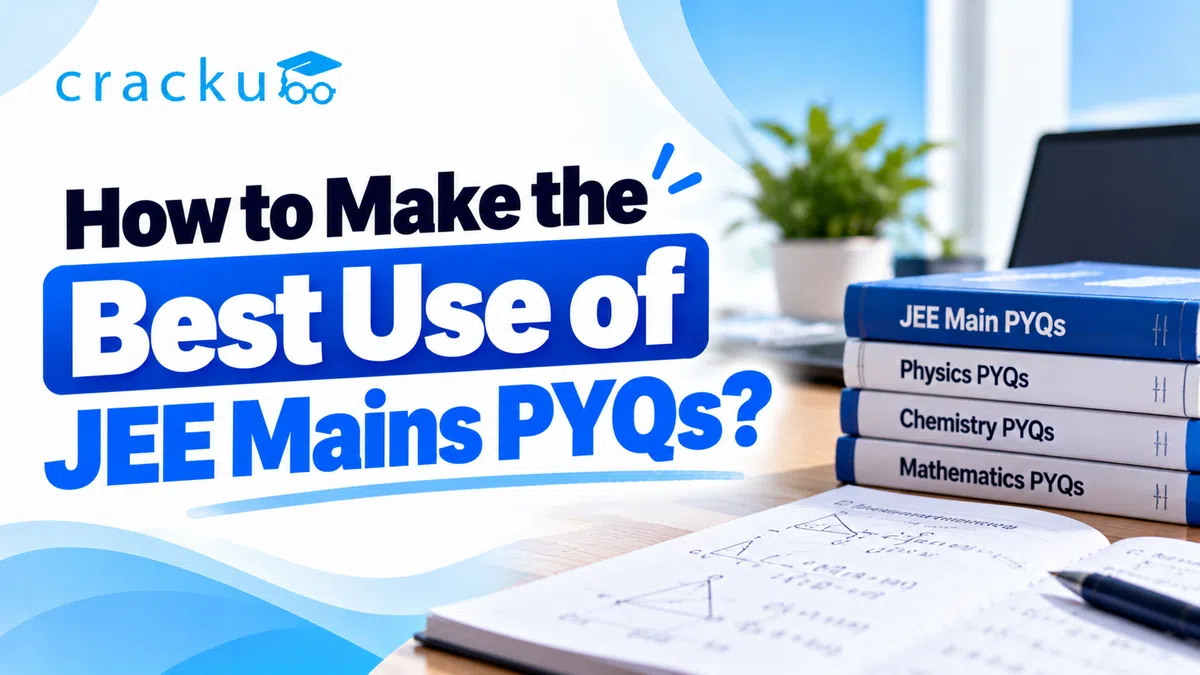
To make the proper use of JEE Mains PYQ, you need to keep track of your performance. Check where you have lost marks, which areas are weak and so on. Solving lots of questions does not mean that you are making the best use of JEE Mains PYQs. PYQ helps you identify the recurring topics and improve your weaknesses.
If you decide to focus on proper JEE Main PYQs practice, it is important to remain consistent. Your first step towards improvement must begin with a practice of the questions from those chapters which you have completed. Solve questions from PYQs without help such as answer keys or solutions. Keep a detailed track of your mistakes. As you complete more syllabus, it is important to change your revision and practice strategy.
JEE Main PYQ Practice Strategy
Start solving JEE Main PYQ right after completion of the basic concepts of each chapter. Review your mistakes after each practice session otherwise you might repeat the same mistakes in your later PYQ papers. Cracku's JEE Mains Previous Papers include year-wise and shift-wise questions, PDF downloads, online tests and more which you can use for practice. Here are 4 key steps to follow when you practice.
- Revise: Read the important concepts and formulas before attempting questions from a chapter.
- Attempt: Solve questions independently without checking the answers or solutions midway.
- Analyse: Identify what took time, questions solved wrong and what was skipped
- Reattempt: Revise the relevant concepts and solve different questions to check your understanding.
Before you rush to complete another paper, check your score and correct mistakes from your previous attempt.
Preparation Stage | Recommended PYQ Practice | Main Purpose |
Learning individual chapters | Chapter-wise PYQs | Apply concepts |
Partial syllabus completed | Mixed and subject-wise PYQs | Find weak areas |
Most chapters completed | Full-length previous papers | Improve question selection |
Final revision | Recent timed papers and reattempts | Improve accuracy and time management |
Also Read: JEE Mains PYQ Practice Strategy 2027: Check Tips Now
JEE Main PYQ Chapter-wise Strategy
Chapter-wise PYQs are useful when you have just finished studying a topic. Suppose you completed electrostatics today. You can start practising its previous questions before moving to another Physics chapter. This gives you a chance to check whether you can apply the formulas without looking at notes.
Physics, Chemistry, and Mathematics all require methods to review past exam questions. Physics involves discovering the principles and applying the equations accurately. Chemistry involves recalling concepts, understanding reactions, and applying calculations. Mathematics involves performing calculations and selecting the appropriate methods to address issues. Students ought to apply this approach for every subject.
Subject | Chapter-wise PYQ Strategy | What to Check |
Physics | Solve conceptual and numerical questions | Formula selection, units, calculations |
Chemistry | Practise theory, reactions, and numerical questions | Concept recall, reactions, factual accuracy |
Mathematics | Solve questions independently with complete steps | Solving method, accuracy, time taken |
After completing a chapter's PYQs, record your attempts and mistakes in a notebook. Include the chapter name, correct answers, wrong answers, skipped questions, and time spent. Separate conceptual mistakes from forgotten formulas and calculation errors. Review multiple attempts before deciding whether a chapter needs more revision.
How Many Years of JEE Main PYQs Should You Practice?
Practising the last five to seven years of JEE Main PYQs is a reasonable starting point. However, students do not need to solve every question from every shift. If you are still completing the syllabus, focus on chapter-wise questions first. Students who have completed most chapters can start attempting recent full-length papers.
Recent JEE Mains Previous Papers are useful for understanding the latest completed exam format. As of October 2026, students can prioritise papers from 2025 and 2026. Older papers also provide extra questions for concept practice. However, NTA has changed the question format over time. The table below explains how to select papers from different years.
Choosing seven years of PYQs does not mean solving every available shift. Start with recent papers and move to older questions where you need more practice. Review your incorrect answers before selecting another paper.
PYQ Years | Recommended Use | Important Consideration |
2025-2026 | Recent full-paper & chapter practice | Most relevant completed exam formats |
2021-2024 | Additional chapter-wise practice | Check changes in question format |
2020 & earlier | Extra concept practice | Check current syllabus relevance |
Also Read: How to Solve JEE Main Previous Year Papers Effectively?
Common PYQ Mistakes to Avoid
Students sometimes complete hundreds of PYQs without correcting the mistakes they make. Checking solutions too early or repeating familiar questions can hide gaps in understanding. These habits also make it difficult to judge your preparation through unfamiliar questions.
Avoid the following mistakes when practising JEE Main PYQs:
- Checking solutions too early: Try solving each question independently before looking at the answer or explanation.
- Memorising previous answers: Understand the concept and solving method instead of remembering the steps from previous attempts.
- Ignoring weak chapters: Record repeated mistakes and revise the relevant chapter before attempting similar questions.
- Solving only familiar questions: Include new questions and mixed-topic practice to check your understanding.
- Counting papers instead of analysing them: Track incorrect answers, accuracy, and time spent rather than only counting attempts.
After each PYQ session, identify the questions you could not solve and find the reason. Revise the relevant formulas or concepts before attempting a fresh set of questions. Check whether you can now solve similar problems without help. Fewer repeated mistakes and more consistent accuracy provide a better measure of your progress.
How to make the Best use of JEE Mains PYQs: Conclusion
Practising JEE Main PYQs is one of the most effective ways to understand the exam pattern, identify frequently tested topics and improve problem-solving skills. Students should begin with chapter-wise JEE Main previous year questions after completing the basic concepts, then gradually move to subject-wise practice and full-length papers. Analysing incorrect answers, tracking accuracy and revising weak chapters are essential steps for making PYQ practice more productive.
For better results, prioritise recent JEE Main question papers and use older papers for additional practice wherever relevant to the current syllabus. Avoid focusing only on the number of questions solved; instead, work on reducing repeated mistakes, improving calculation speed and selecting questions wisely. You can practise JEE Main Previous Year Papers on Cracku to strengthen your preparation through year-wise and shift-wise questions, PDF resources and online practice tests. Regular practice combined with mock tests and consistent revision can help you approach the examination with greater confidence.