
 Group
Group
 Group
Group


 Preferred Source

 Google Discover
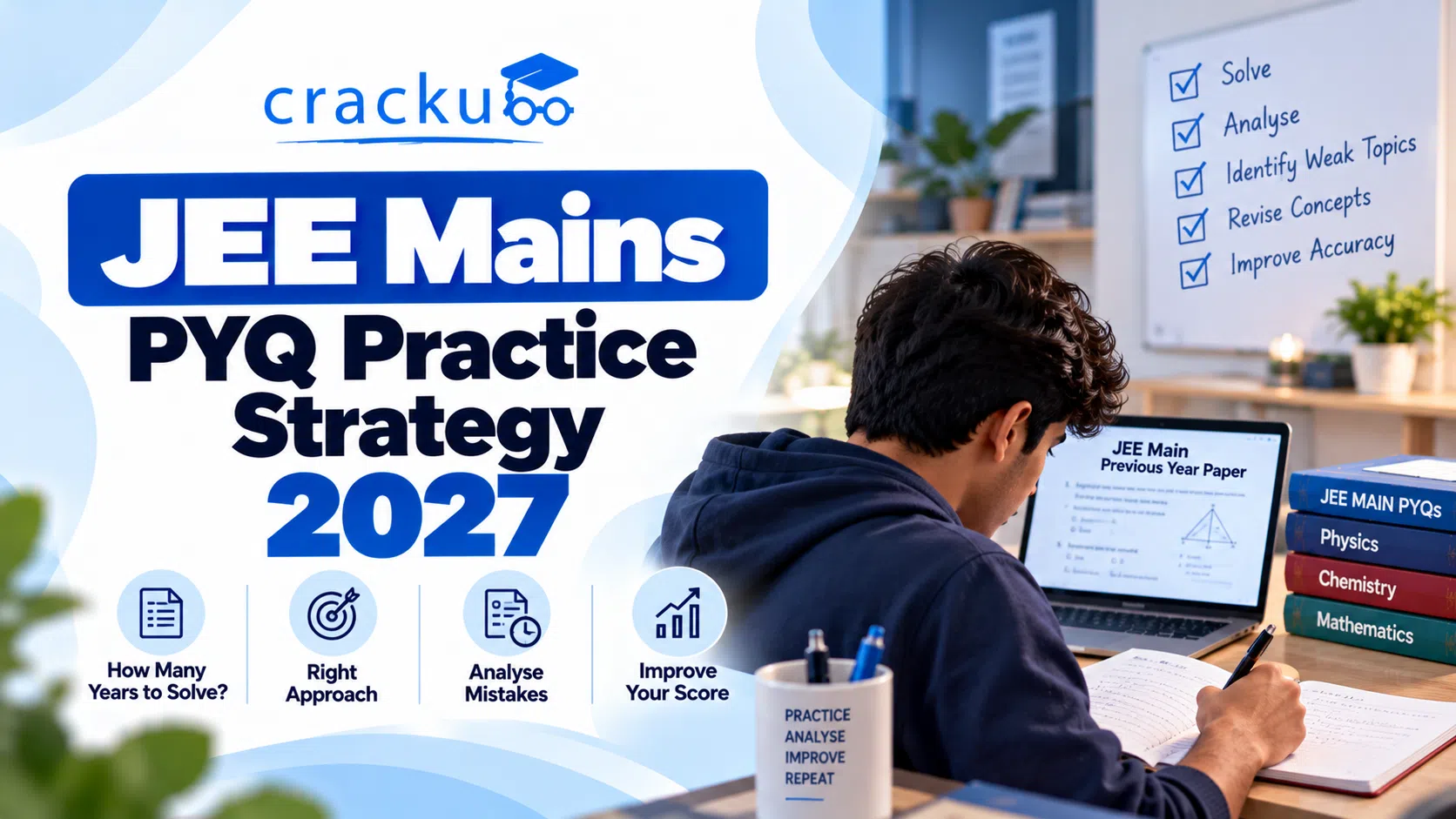
JEE Mains PYQ Practice Strategy 2027
Many JEE Main aspirants download previous year papers and spend hours solving questions. But are they checking where they went wrong? Solving hundreds of questions won't help much if you keep repeating the same mistakes. You need to look at the questions you answered incorrectly, the ones that took too long, and the chapters where you regularly lose marks. Your final score alone won't tell you all this.
Choose JEE Main previous year papers according to how much of the syllabus you've covered. Solve the questions without looking at the answers first. Once you're done, check your mistakes and spend some time revising the concepts you struggled with. Practise a few more questions from those chapters before moving to the next paper. You can adjust your practice based on your preparation level and the topics you still need to cover.
Best Time to Start Practising JEE Main PYQs
The best time to solve JEE Main PYQs is after one covers the basic concepts in a given chapter. You don't need to complete the entire syllabus before starting chapter-wise JEE Main PYQs. Full-length papers are most useful once an aspirant covers sufficient Physics, Chemistry, and Mathematics concepts. The table below shows when to start solving JEE Main previous papers by syllabus coverage.
Choose the practice format according to how much you've covered.
Preparation Stage | What to Solve | What to Check |
Class 11 | Chapter-wise PYQs | Concept clarity |
Class 12, syllabus in progress | Chapter-wise and subject-wise papers | Weak topics |
Most chapters completed | Full-length papers | Question selection |
Final revision | Recent papers with a timer | Accuracy and speed |
How to Select the Right JEE Main Question Papers for Practice
Your total score hides the reason behind it. Log every wrong, skipped or slow question by subject, chapter and error type. Most errors fall into five groups. These are concept gaps, formula gaps, calculation mistakes, misread questions and time problems.
Here's a simple way to choose what to attempt next.
Paper Type | When to Use It | Main Purpose |
Recent shift-wise paper | Full-paper revision | Exam practice |
Older year-wise paper | Additional practice | Question variety |
Subject-wise paper | One subject needs work | Subject-level practice |
Chapter-wise PYQs | Just after a chapter | Concept application |
Also Read: How to Solve JEE Main Previous Year Papers Effectively?
How to Identify Weak Chapters Using JEE Main Previous Year Papers
Five to seven years of JEE Main previous year papers can be a good starting point for practice, but it is not a fixed rule for every student. The number of papers you should solve depends on your syllabus coverage, preparation level, and the topics that need more revision. Some chapters may require you to practise older questions to understand different question patterns, while others may benefit more from revisiting recent papers to become familiar with the latest exam trends. Remember, completing every question is not enough; understanding the concepts behind each answer and learning from your mistakes are equally important.
To make your practice more effective, use clean copies of question papers along with matching answer keys and detailed solutions. JEE Main Previous Year Papers offers year-wise and shift-wise question papers, PDF downloads, and online tests to help you organise your preparation. Select papers based on the chapters you have completed and the areas where you need improvement. Instead of focusing only on the number of papers you finish, spend time reviewing incorrect answers, identifying recurring mistakes, and practising similar questions. The goal is not to complete the entire archive but to use previous year papers to improve your accuracy, speed, and confidence for JEE Main.
Also Read: How to Score 99+ Percentile in JEE Mains 2027?
How to Improve Speed and Accuracy While Solving JEE Main Papers
A low score tells you little about the cause. After each paper, review wrong, skipped and slow questions. Note the chapter and the mistake. Using the wrong sign isn't the same as misunderstanding the concept.
Look for repeats across papers. One difficult question doesn't make a chapter weak. But repeated electrostatics errors call for revision. Track both accuracy and attempts. High accuracy matters less when you attempt too few questions.
Use a short error log rather than writing out every solution again.
Problem | How You'll Spot It | Next Step |
Concept gap | Can't work out the approach | Revisit the example and theory |
Formula gap | Can't recall the required formula | Revise and apply it |
Calculation slip | Correct approach, wrong arithmetic | Redo similar numericals |
Reading error | Missed a condition or unit | Mark key details |
Time loss | Correct answer took too long | Try a timed set |
Accuracy shows how careful you are. Attempt rate shows how much of the paper you actually touch. Here are simple formulas you can use to track your progress.
Accuracy (%) = (Correct Answers ÷ Attempted Questions) × 100
Attempt Rate (%) = (Attempted Questions ÷ Total Questions) × 100
If you get 30 of 40 attempts right, your accuracy is 75%. Now check what you skipped. For repeated Integration errors, revise the method and solve fresh Chapter-wise PYQs. New questions test understanding better than memorised solutions.
Common Mistakes to Avoid While Practising JEE Main PYQs
Many students finish dozens of papers and still stall. The reason is usually a repeated habit, not a lack of effort. A bad habit practiced twenty times only makes the problem permanent.
- Checking solutions too soon. Attempt every question on your own before you read the solution.
- Ignoring mistakes. Keep an error log and revisit the concept behind each wrong answer.
- Solving only easy or familiar papers. Add unfamiliar questions and timed sets to your routine.
- Using old papers without checking format changes. Choose recent papers when you want to simulate the current exam.
- Judging progress by marks or paper count. Compare accuracy, error patterns and completion time instead.
JEE Main PYQ Practice Strategy 2027: Conclusion
An effective JEE Main PYQ practice strategy for 2027 involves more than solving a large number of previous year questions. Start with chapter-wise PYQs after learning the basic concepts, then move to subject-wise practice and full-length papers as your syllabus progresses. Use recent JEE Main question papers to understand the exam pattern, practise time management, and improve question selection. Track your accuracy, attempt rate, and recurring mistakes to identify the chapters that require additional revision.
Consistency and proper analysis are essential for making the most of JEE Main previous year papers. After every practice session, review incorrect and skipped questions, understand the concepts behind your mistakes, and solve similar questions to strengthen your preparation. You can use JEE Main Previous Year Papers to access year-wise and shift-wise papers, PDF downloads, and online tests. Focus on learning from every paper rather than simply completing more questions. With regular practice, targeted revision, and timed tests, you can build better accuracy, improve speed, and prepare more confidently for JEE Main 2027.