Join WhatsApp Icon JEE WhatsApp Group
JEE Chemical Thermodynamics Questions

JEE Chemical Thermodynamics Questions

Question 1

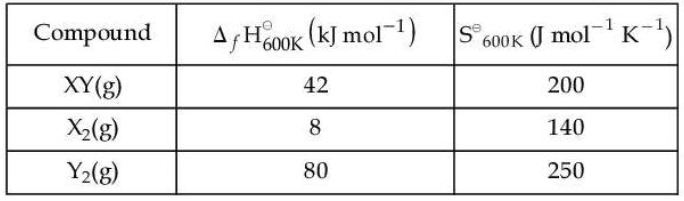
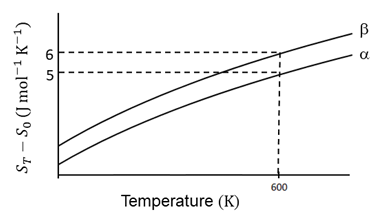
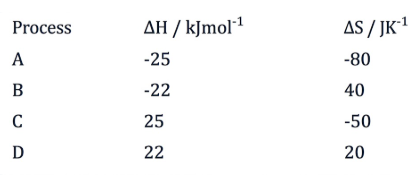
Consider the following data for the reaction 
$$\text{X}_2(g) + \text{Y}_2(g) \rightleftharpoons 2\text{XY}(g)$$
at 600 K.  The $$\Delta_r G^\circ$$ (in $$kJ/mol^{-1}$$) for the reaction is :

image
Question 2

Consider the following data.
(i) 2Al(s) + 6HCl(aq) → Al$$_2$$Cl$$_6$$(aq) + 3H$$_2$$(g) + 1200 kJ/mol
(ii) H$$_2$$(g) + Cl$$_2$$(g) → 2HCl(g) + 164 kJ/mol.
(iii) HCl(g) + aq → HCl(aq) + 83 kJ/mol.
(iv) Al$$_2$$Cl$$_6$$(s) + aq → Al$$_2$$Cl$$_6$$(aq) + 663 kJ/mol
The enthalpy of formation of anhydrous solid Al$$_2$$Cl$$_6$$ is :

Question 3

Gas 'A' undergoes change from state 'X' to state 'Y'. In this process, the heat absorbed and work done by the gas is 10 J and 18 J respectively. Now gas is brought back to state 'X' by another process during which 6 J of heat is evolved. In the reverse process of 'Y' to 'X' :

Question 4

Given below are two statements:
Statement I: For an ideal gas, heat capacity at constant volume is always greater than the heat capacity at constant pressure.
Statement II: In a constant volume process, no work is produced and all the heat withdrawn goes into the chaotic motion and is reflected by a temperature increase of the ideal gas.
In the light of the above statement, choose the correct answer from the options given below.  

Question 5

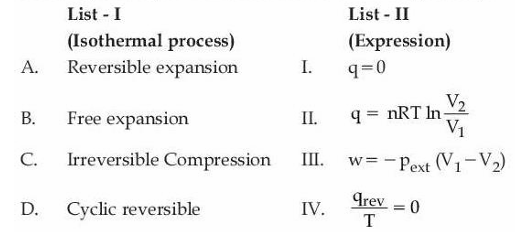
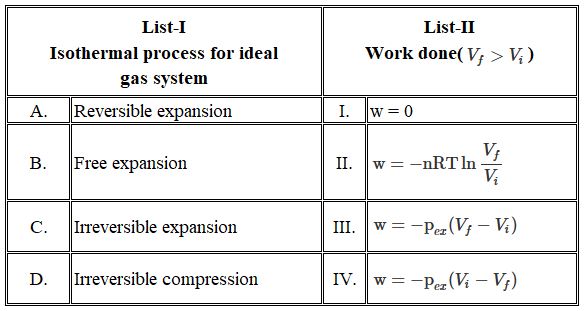
Match List - I with List - II.
Given $$V_1$$ and $$V_2$$ are initial and final volumes respectively. 

image

Choose the correct answer from the options given below :

Question 6

Arrange the following isothermal processes in order of the magnitude of the work (p - V) involved between states 1 and 2.

A. Expansion in single stage $$w_A$$
B. Expansion in multi stages $$w_B$$
C. Compression in single stage $$w_C$$
D. Compression in multi stages $$w_D$$

Choose the correct option.

Question 7

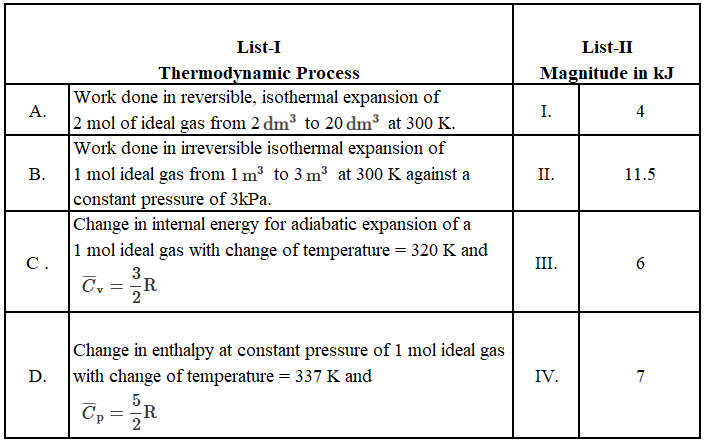
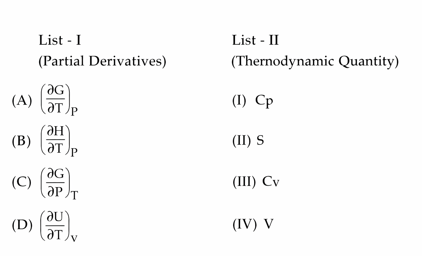
Match the LIST-I with LIST-II

Screenshot_50

Choose the correct answer from the options given below:

Question 8

The correct order of molar heat capacities measured at 298 K and 1 bar is :

Question 9

Consider the following data :
$$\Delta_f H^\ominus$$ (methane, g) = - X kJ $$mol^{-1}$$
Enthalpy of sublimation of graphite = Y kJ $$mol^{-1}$$
Dissociation enthalpy of $$H_{2}$$ = Zkj $$mol^{-1}$$
The bond enthalpy of C - H bond is given by :

Question 10

The heat of atomisation of methane and ethane are 'x' kJ $$mol^{-1}$$ and 'y' kJ $$mol^{-1}$$ respectively. The longest wavelength ($$\lambda$$) of light capable of breaking the C-C bond
can be expressed in SI unit as:

Question 11

$$20.0 dm^{3}$$ of an ideal gas 'X' at 600 K and 0.5 MPa undergoes isothermal reversible expansion until pressme of the gas is 0.2 MPa. Which of the following option is correct?
(Given: $$\log 2 = 0.30 10 and \log 5 = 0.6989$$)

Question 12

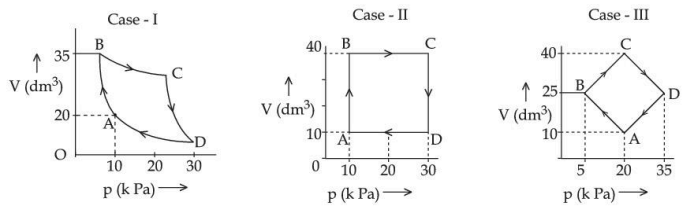
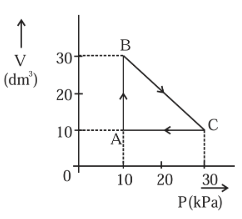
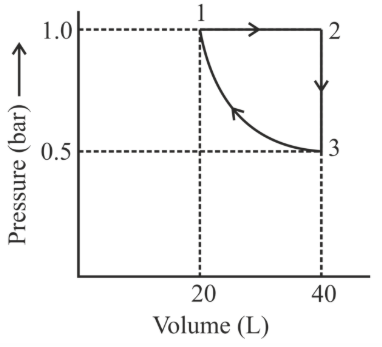
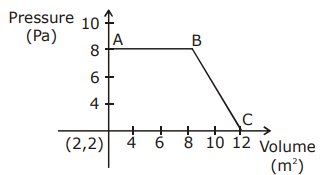
Which of the following graphs between pressure 'p' versus volume 'V' represents the maximum work done?

Question 13

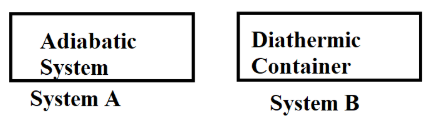
A cup of water at 5°C (system) is placed in a microwave oven and the oven is turned on for one minute during which the water begins to boil. Which of the following option is true ?

Question 14

Match the LIST-I with LIST-II

Screenshot_59


Choose the correct answer from the options given befow:

Question 15

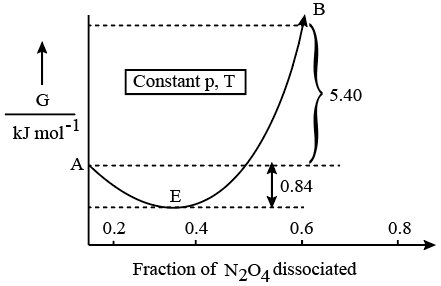
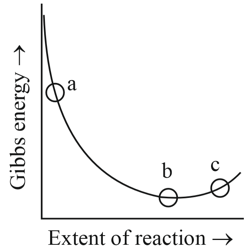
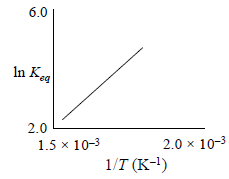
For the reaction $$N_{2}O_{4}\rightleftharpoons2NO_{2}$$ , graph is plotted as shown below. Identify correct statements.
A. Standard free energy change for the reaction is $$-5.40kJmol^{-1}$$.
B. As $$\triangle G^{\ominus}$$ in graph is positive, $$N_{2}O_{4}$$ will not dissociate into $$NO_{2}$$ at all.
C. Reverse reaction will go to completion.
D. When 1 mole of $$N_{2}O_{4}$$ changes into equilibrium mixture, value of $$\triangle G^{\ominus}$$ = -0.84kJ $$mol^{-1}$$.
E. When 2 mole of $$NO_{2}$$ changes into equilibrium mixture, $$\triangle G^{\ominus}$$ for equilibrium mixture is -6.24kJ $$mol^{-1}$$.

Screenshot_29


Choose the correct answer from the options given below:

Question 16

If 3.365 g of ethanol (l) is burnt completely in a bomb calorimeter at 298.15 K, the heat produced is 99.472 kJ. The $$|\Delta H_f°|$$ of ethanol at 298.15 K is _________ $$\times 10^2$$ kJ mol$$^{-1}$$. (Nearest integer)

Given: Standard enthalpy for combustion of graphite = $$-393.5$$ kJ mol$$^{-1}$$

Standard enthalpy of formation of water (l) = $$-285.8$$ kJ mol$$^{-1}$$

Molar mass in g mol$$^{-1}$$ of C, H, O are 12, 1 and 16 respectively

Question 17

For the following reaction at 50 °C and at 2 atm pressure,

$$2N_2O_5(g) \rightleftharpoons 2N_2O_4(g) + O_2(g)$$

N$$_2$$O$$_5$$ is 50% dissociated.

The magnitude of standard free energy change at this temperature is $$x$$.

$$x$$ = _________ J mol$$^{-1}$$ [Nearest integer].

Given: $$R = 8.314$$ J mol$$^{-1}$$ K$$^{-1}$$, $$\log 2 = 0.30$$, $$\log 3 = 0.48$$, $$\ln 10 = 2.303$$, °C + 273 = K

Question 18

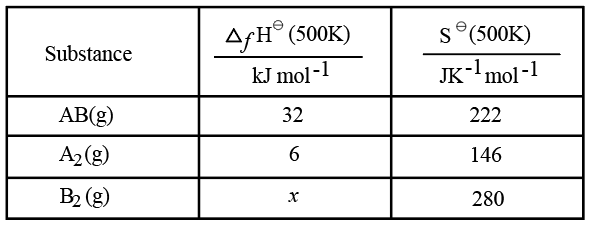
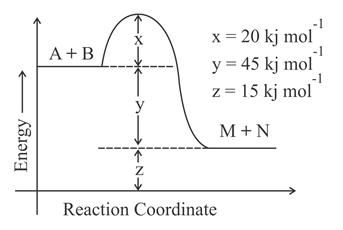
Use the following data :

Screenshot_31


One mole each of $$A_{2}(g)$$ and $$B_{2}(g)$$ are taken in a 1 L closed flask and allowed to establish the equilibrium at 500K
$$A_{2}(g)+B_{2}(g)\rightleftharpoons2AB(g)$$
The value of x $$(in kJ mol^{-1})$$ is ____ . (Nearest integer)
(Given: log K=2.2 R= 8.3 kJ $$K^{-1} mol^{-1}$$)

Question 19

Consider the reaction
$$2\text{H}_2\text{S(g)} + 3\text{O}_2\text{(g)} \to 2\text{H}_2\text{O(l)} + 2\text{SO}_2\text{(g)}$$
The magnitude of enthalpy change for the reaction in kJ mol$$^{-1}$$ is __________. (Nearest integer)
Given :
$$\Delta_f H^\ominus(\text{H}_2\text{S}) = -20.1$$ kJ mol$$^{-1}$$
$$\Delta_f H^\ominus(\text{H}_2\text{O}) = -286.0$$ kJ mol$$^{-1}$$
$$\Delta_f H^\ominus(\text{SO}_2) = -297.0$$ kJ mol$$^{-1}$$

Question 20

If the enthalpy of sublimation of Li is 155 kj $$mol^{-1}$$, enthalpy of dissociation of $$F_{2}$$ is 150 kj $$mol^{-1}$$, ionization enthalpy of Li is 520 kj $$mol^{-1}$$, electron gain enthalpy of F is - 313 kj $$mol^{-1}$$, standard enthalpy of formation of LiF is - 594 kj $$mol^{-1}$$. The magnitude of lattice enthalpy of LiF is _________ kJ $$mol_{-1}$$. (Nearest Integer)

Question 21

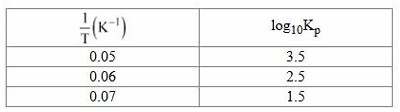
The values of pressure equilibrium constant recorded at different temperatures for the following equilibrium reaction have been given below
$$A(g) \rightleftharpoons B(g) + C(g)$$

image


The magnitude of $$\frac{\Delta H^\circ}{R}$$ calculated from the above data is _______. (Nearest integer)

Question 22

At the transition temperature T, A ⇌ B and ΔG$$^0$$ = 105 − 35 log T where A and B are two states of substance X. The transition temperature in °C when pressure is 1 atm is __________. (Nearest integer)

Question 23

Consider the reaction X $$\rightleftharpoons$$ Y at 300 K. If $$\Delta H^\theta$$ and K are 28.40 kJ mol$$^{-1}$$ and $$1.8 \times 10^{-7}$$ at the same temperature, then the magnitude of $$\Delta S^\theta$$ for the reaction in J K$$^{-1}$$ mol$$^{-1}$$ is _______. (Nearest integer)
(Given: R = 8.3 J K$$^{-1}$$ mol$$^{-1}$$, ln 10 = 2.3, log 3 = 0.48, log 2 = 0.30)

50,000+ JEE Students Trusted Our Score Calculator

Predict your JEE Main percentile, rank & performance in seconds