
Join Our JEE Preparation Group
Prep with like-minded aspirants; Get access to free daily tests and study material.
Sign in
Please select an account to continue using cracku.in
↓ →
Join Our JEE Preparation Group
Prep with like-minded aspirants; Get access to free daily tests and study material.
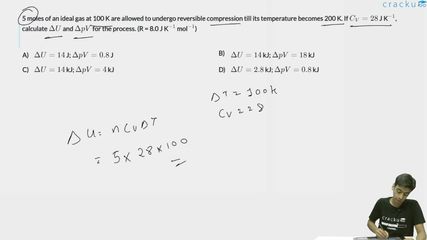
5 moles of an ideal gas at 100 K are allowed to undergo reversible compression till its temperature becomes 200 K. If $$C_V = 28$$ J K$$^{-1}$$, calculate $$\Delta U$$ and $$\Delta pV$$ for the process. (R = 8.0 J K$$^{-1}$$ mol$$^{-1}$$)
For any ideal gas, the change in its internal energy depends only on temperature. The quantitative relation is given by the formula
$$\Delta U = n\,C_V\,\Delta T,$$
where $$n$$ is the number of moles, $$C_V$$ is the molar heat capacity at constant volume, and $$\Delta T$$ is the change in temperature.
We have $$n = 5\ \text{mol},\; C_V = 28\ \text{J K}^{-1}\!\!\text{mol}^{-1},\; T_1 = 100\ \text{K},\; T_2 = 200\ \text{K}.$$ Hence
$$\Delta T = T_2 - T_1 = 200\ \text{K} - 100\ \text{K} = 100\ \text{K}.$$
Substituting the values,
$$\Delta U = 5 \times 28\ \text{J K}^{-1}\!\!\text{mol}^{-1} \times 100\ \text{K}.$$
Multiplying step by step, we get
$$28 \times 100 = 2800\ \text{J mol}^{-1},$$
and then
$$5 \times 2800\ \text{J mol}^{-1} = 14000\ \text{J}.$$
Converting joules to kilojoules gives
$$\Delta U = 14000\ \text{J} = 14\ \text{kJ}.$$
Next we evaluate the change in the quantity $$pV$$. For an ideal gas we have the equation of state
$$pV = nRT,$$
so any change in $$pV$$ is governed by
$$\Delta(pV) = nR\Delta T,$$
with the same $$\Delta T$$ as before. Taking $$R = 8.0\ \text{J K}^{-1}\!\!\text{mol}^{-1}$$, we substitute:
$$\Delta(pV) = 5 \times 8.0\ \text{J K}^{-1}\!\!\text{mol}^{-1} \times 100\ \text{K}.$$
First multiply the constants:
$$8.0 \times 100 = 800\ \text{J mol}^{-1},$$
then
$$5 \times 800\ \text{J mol}^{-1} = 4000\ \text{J}.$$
Changing units,
$$\Delta(pV) = 4000\ \text{J} = 4\ \text{kJ}.$$
We have obtained
$$\Delta U = 14\ \text{kJ}, \qquad \Delta(pV) = 4\ \text{kJ}.$$
Hence, the correct answer is Option C.
Was this solution helpful?
Click on the Email ☝️ to Watch the Video Solution
Create a FREE account and get:
_1.webp)

Educational materials for JEE preparation

Ask our AI anything

AI can make mistakes. Please verify important information.
AI can make mistakes. Please verify important information.


