
Join Our JEE Preparation Group
Prep with like-minded aspirants; Get access to free daily tests and study material.
Sign in
Please select an account to continue using cracku.in
↓ →
Join Our JEE Preparation Group
Prep with like-minded aspirants; Get access to free daily tests and study material.
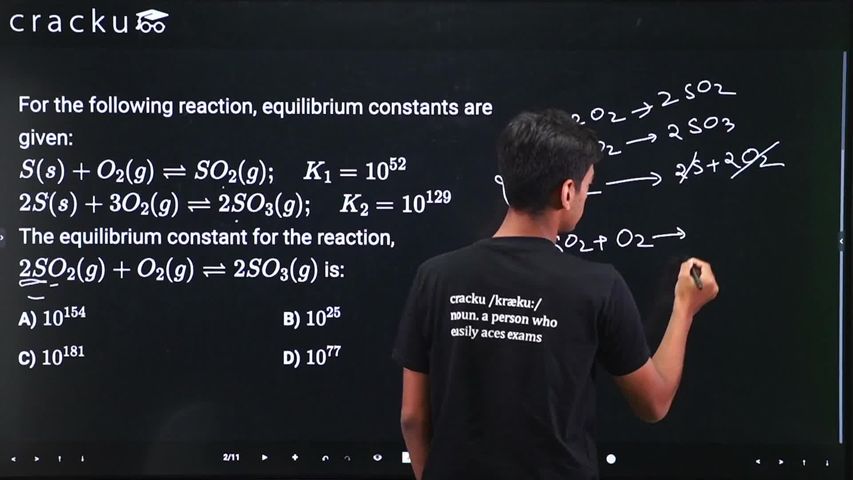
For the following reaction, equilibrium constants are given:
$$S(s) + O_2(g) \rightleftharpoons SO_2(g); \quad K_1 = 10^{52}$$
$$2S(s) + 3O_2(g) \rightleftharpoons 2SO_3(g); \quad K_2 = 10^{129}$$
The equilibrium constant for the reaction, $$2SO_2(g) + O_2(g) \rightleftharpoons 2SO_3(g)$$ is:
We have two given equilibria:
$$S(s) + O_2(g) \rightleftharpoons SO_2(g), \qquad K_1 = 10^{52}$$
$$2S(s) + 3O_2(g) \rightleftharpoons 2SO_3(g), \qquad K_2 = 10^{129}$$
Our task is to find the equilibrium constant for
$$2SO_2(g) + O_2(g) \rightleftharpoons 2SO_3(g)$$
First, we recall two rules for equilibrium constants:
1. If an equation is reversed, its new equilibrium constant is the reciprocal of the original, $$K_{\text{new}} = \dfrac{1}{K_{\text{old}}}\,.$$
2. If two (or more) equations are added, the equilibrium constant for the overall reaction equals the product of the individual constants, $$K_{\text{overall}} = K_1 \times K_2 \times \dots$$
Now we manipulate the given reactions so that, when added, they produce the desired equation.
Step 1 Double the first equilibrium to get exactly two moles of sulphur dioxide. Doubling a reaction squares its equilibrium constant:
$$2\bigl[S(s) + O_2(g) \rightleftharpoons SO_2(g)\bigr]$$
gives
$$2S(s) + 2O_2(g) \rightleftharpoons 2SO_2(g), \qquad K_1^{\,2} = \left(10^{52}\right)^2 = 10^{104}.$$
Step 2 Reverse this doubled equation, because in our target reaction $$2SO_2(g)$$ must appear on the left. Reversing gives the reciprocal of the constant:
$$2SO_2(g) \rightleftharpoons 2S(s) + 2O_2(g), \qquad K_{\text{rev}} = \dfrac{1}{10^{104}} = 10^{-104}.$$
Step 3 Keep the second given equilibrium unchanged:
$$2S(s) + 3O_2(g) \rightleftharpoons 2SO_3(g), \qquad K_2 = 10^{129}.$$
Step 4 Add the reversed, doubled first equation to the second equation. Adding the left and right sides we obtain
$$\bigl[2SO_2(g)\bigr] + \bigl[2S(s) + 3O_2(g)\bigr] \;\longrightarrow\; \bigl[2S(s) + 2O_2(g)\bigr] + \bigl[2SO_3(g)\bigr].$$
The solid sulphur $$2S(s)$$ appears on both sides and cancels. Subtracting $$2O_2(g)$$ from each side leaves
$$2SO_2(g) + O_2(g) \rightleftharpoons 2SO_3(g),$$
exactly the required reaction.
According to the multiplication rule, the equilibrium constant for the overall reaction is
$$K_3 = K_{\text{rev}} \times K_2 = 10^{-104} \times 10^{129} = 10^{25}.$$
Hence, the correct answer is Option B.
Was this solution helpful?
Click on the Email ☝️ to Watch the Video Solution
Create a FREE account and get:
_1.webp)

Educational materials for JEE preparation

Ask our AI anything

AI can make mistakes. Please verify important information.
AI can make mistakes. Please verify important information.


