
Join Our JEE Preparation Group
Prep with like-minded aspirants; Get access to free daily tests and study material.
Sign in
Please select an account to continue using cracku.in
↓ →
Join Our JEE Preparation Group
Prep with like-minded aspirants; Get access to free daily tests and study material.
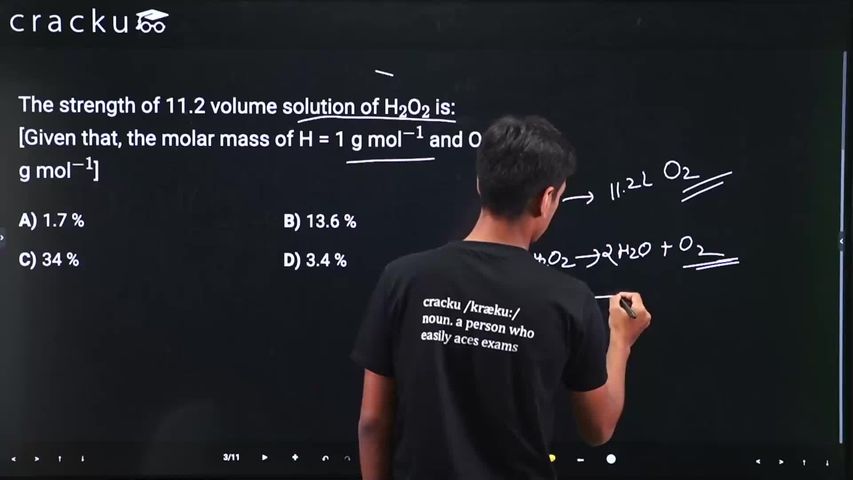
The strength of 11.2 volume solution of H$$_2$$O$$_2$$ is:
[Given that, the molar mass of H = 1 g mol$$^{-1}$$ and O = 16 g mol$$^{-1}$$]
First we recall the meaning of “11.2 volume” solution. One volume of the solution (we may conveniently take $$1\ \text{L}$$) liberates 11.2 volumes of oxygen gas at STP, that is $$11.2\ \text{L}$$ of $$\mathrm O_2$$.
Hydrogen peroxide decomposes according to
$$2\mathrm{H_2O_2}\;\longrightarrow\;2\mathrm H_2\mathrm O+\mathrm O_2$$
From the balanced equation we see that
$$2\ \text{mol H}_2\text O_2 \;\longrightarrow\;1\ \text{mol O}_2$$
The molar mass of $$\mathrm{H_2O_2}$$ is obtained from the data given:
$$M(\mathrm{H_2O_2}) = 2(1\,\text{g mol}^{-1}) + 2(16\,\text{g mol}^{-1}) = 34\ \text{g mol}^{-1}$$
Hence
$$2\ \text{mol H}_2\text O_2 = 2 \times 34\ \text{g} = 68\ \text{g}$$
At STP, one mole of any gas occupies $$22.4\ \text{L}$$. Therefore
$$68\ \text{g H}_2\text O_2 \;\longrightarrow\;22.4\ \text{L O}_2$$
Now we set up a simple proportion for the mass of $$\mathrm{H_2O_2}$$ required to give $$11.2\ \text{L O}_2$$:
$$\frac{68\ \text{g}}{22.4\ \text{L}} = \frac{x\ \text{g}}{11.2\ \text{L}}$$
Solving for $$x$$,
$$x = \frac{68 \times 11.2}{22.4}\ \text{g} = 34\ \text{g}$$
Thus, $$34\ \text{g}$$ of $$\mathrm{H_2O_2}$$ are present in the chosen $$1\ \text{L}$$ of solution. Strength in the usual “g per litre” sense is therefore
$$S = 34\ \text{g L}^{-1}$$
To express this as a percentage weight/volume (grams per 100 mL), we divide by 10:
$$\%\,(\text{w/v}) = \frac{34\ \text{g}}{1000\ \text{mL}}\times100\ \text{mL} = 3.4\ \text{g per}\ 100\ \text{mL}$$
Hence the solution is a $$3.4\%$$ w/v solution of hydrogen peroxide.
Hence, the correct answer is Option D.
Was this solution helpful?
Click on the Email ☝️ to Watch the Video Solution
Create a FREE account and get:
_1.webp)

Educational materials for JEE preparation

Ask our AI anything

AI can make mistakes. Please verify important information.
AI can make mistakes. Please verify important information.


