
Join Our JEE Preparation Group
Prep with like-minded aspirants; Get access to free daily tests and study material.
Sign in
Please select an account to continue using cracku.in
↓ →
Join Our JEE Preparation Group
Prep with like-minded aspirants; Get access to free daily tests and study material.
We begin by recalling the basic idea behind the type of bonding shown by a metal halide. According to $$\text{Fajans’ Rule}$$, the smaller the cation and the greater its charge, the higher is its polarising power. Greater polarising power means the cation can pull electron density from the anion toward itself, thereby introducing covalent character into what would otherwise be an ionic bond.
The alkaline-earth metals lie in Group $$2$$ of the periodic table. Moving down the group, the metallic cation radius increases in the order $$\mathrm{Be^{2+} \lt Mg^{2+} \lt Ca^{2+} \lt Sr^{2+} \lt Ba^{2+}}$$. A smaller radius implies a higher charge density $$\left(\dfrac{\text{charge}}{\text{radius}}\right)$$, hence a higher polarising power.
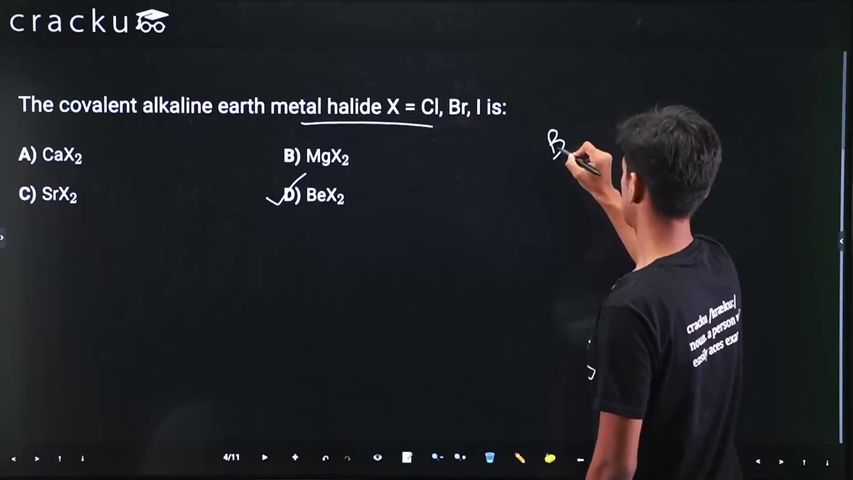
Therefore, of all alkaline-earth cations, $$\mathrm{Be^{2+}}$$ is the smallest and has the greatest ability to distort the electron cloud of the halide ion $$\mathrm{X^-}$$ where $$\mathrm{X = Cl, Br, I}$$. This strong distortion pulls electron density towards beryllium, making the bond appreciably covalent in nature.
Conversely, cations such as $$\mathrm{Mg^{2+}}, \mathrm{Ca^{2+}}$$ and $$\mathrm{Sr^{2+}}$$ are larger, possess lower charge density, and consequently have far less polarising power. Their interactions with halide ions remain predominantly ionic, not covalent.
Hence only the beryllium halides $$\mathrm{BeCl_2,\;BeBr_2,\;BeI_2}$$ exhibit pronounced covalent character, whereas $$\mathrm{MgX_2,\;CaX_2,\;SrX_2}$$ remain essentially ionic.
Therefore, the covalent alkaline-earth metal halide is $$\mathrm{BeX_2}$$.
Hence, the correct answer is Option D.
Was this solution helpful?
Click on the Email ☝️ to Watch the Video Solution
Create a FREE account and get:
_1.webp)

Educational materials for JEE preparation

Ask our AI anything

AI can make mistakes. Please verify important information.
AI can make mistakes. Please verify important information.


