
Join Our JEE Preparation Group
Prep with like-minded aspirants; Get access to free daily tests and study material.
Sign in
Please select an account to continue using cracku.in
↓ →
Join Our JEE Preparation Group
Prep with like-minded aspirants; Get access to free daily tests and study material.
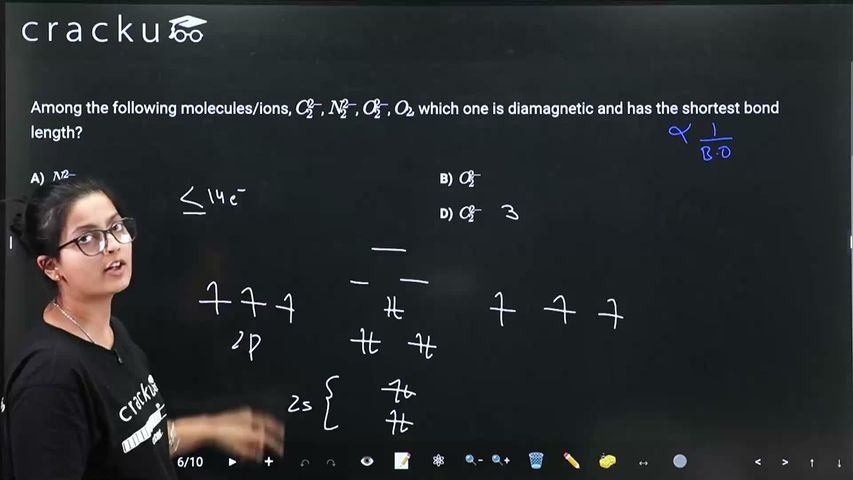
Among the following molecules/ions, $$C_2^{2-}$$, $$N_2^{2-}$$, $$O_2^{2-}$$, $$O_2$$, which one is diamagnetic and has the shortest bond length?
First we recall the Molecular Orbital (MO) theory facts that will be required. For second-period homonuclear diatomics we consider only the valence electrons (2s and 2p). Up to atomic number 7 (that is, for $$B_2,\,C_2,\,N_2$$) the order of valence MOs is $$\sigma(2s),\;\sigma^{*}(2s),\;\pi(2p_x)=\pi(2p_y),\;\sigma(2p_z),\;\pi^{*}(2p_x)=\pi^{*}(2p_y),\;\sigma^{*}(2p_z).$$ From oxygen onwards the order changes to $$\sigma(2s),\;\sigma^{*}(2s),\;\sigma(2p_z),\;\pi(2p_x)=\pi(2p_y),\;\pi^{*}(2p_x)=\pi^{*}(2p_y),\;\sigma^{*}(2p_z).$$
The two rules we shall apply repeatedly are:
• The bond order formula $$\text{B.O.}= \dfrac{n_b-n_a}{2},$$ where $$n_b$$ = number of bonding electrons and $$n_a$$ = number of antibonding electrons. • A species is diamagnetic when all electrons are paired and paramagnetic when at least one electron is unpaired.
We now examine each species one by one.
1. $$C_2^{2-}$$
Each C atom has 4 valence electrons, so for two carbon atoms we have $$8$$.
Because of the $$2-$$ charge we add two more electrons, giving
$$8+2=10\text{ valence e}^-.$$
Using the $$B,\,C,\,N$$ order we fill the MOs:
$$ \begin{aligned} \sigma(2s)&:2 \quad (2)\\ \sigma^{*}(2s)&:2 \quad (4)\\ \pi(2p_x)&:2 \quad (6)\\ \pi(2p_y)&:2 \quad (8)\\ \sigma(2p_z)&:2 \quad (10) \end{aligned} $$
All electrons are paired, so the species is diamagnetic. Bonding electrons $$n_b = 2+4+2 = 8$$, antibonding electrons $$n_a = 2$$. So
$$\text{B.O.}= \dfrac{8-2}{2}=3.$$
2. $$N_2^{2-}$$
Each N atom supplies 5 valence electrons, total $$10$$, plus $$2$$ extra for the negative charge: $$12\text{ e}^-.$$
The same energy order (up to N) is used:
$$ \begin{aligned} \sigma(2s)&:2 \quad (2)\\ \sigma^{*}(2s)&:2 \quad (4)\\ \pi(2p_x)&:2 \quad (6)\\ \pi(2p_y)&:2 \quad (8)\\ \sigma(2p_z)&:2 \quad (10)\\ \pi^{*}(2p_x)&:1 \quad (11)\\ \pi^{*}(2p_y)&:1 \quad (12) \end{aligned} $$
Two unpaired electrons appear in the $$\pi^{*}$$ set, so $$N_2^{2-}$$ is paramagnetic. Here $$n_b = 2+4+2 = 8$$ and $$n_a = 2+2 = 4$$, giving
$$\text{B.O.}= \dfrac{8-4}{2}=2.$$
3. $$O_2$$
Each O atom has 6 valence electrons, so neutral $$O_2$$ possesses $$12\text{ valence e}^-.$$
For oxygen the changed order must be employed:
$$ \begin{aligned} \sigma(2s)&:2 \quad (2)\\ \sigma^{*}(2s)&:2 \quad (4)\\ \sigma(2p_z)&:2 \quad (6)\\ \pi(2p_x)&:2 \quad (8)\\ \pi(2p_y)&:2 \quad (10)\\ \pi^{*}(2p_x)&:1 \quad (11)\\ \pi^{*}(2p_y)&:1 \quad (12) \end{aligned} $$
Again two unpaired electrons are present, so $$O_2$$ is paramagnetic. Now $$n_b = 2+2+4 = 8$$ and $$n_a = 2+2 = 4$$, hence
$$\text{B.O.}= \dfrac{8-4}{2}=2.$$
4. $$O_2^{2-}$$
Adding two extra electrons to $$O_2$$ gives $$14\text{ valence e}^-.$$
Continuing the same filling order:
$$ \begin{aligned} \sigma(2s)&:2 \quad (2)\\ \sigma^{*}(2s)&:2 \quad (4)\\ \sigma(2p_z)&:2 \quad (6)\\ \pi(2p_x)&:2 \quad (8)\\ \pi(2p_y)&:2 \quad (10)\\ \pi^{*}(2p_x)&:2 \quad (12)\\ \pi^{*}(2p_y)&:2 \quad (14) \end{aligned} $$
All electrons are paired, so $$O_2^{2-}$$ is diamagnetic. Here $$n_b = 2+2+4 = 8$$ and $$n_a = 2+4 = 6$$, which gives
$$\text{B.O.}= \dfrac{8-6}{2}=1.$$
We now summarise the crucial results:
Diamagnetic species: $$C_2^{2-}$$ (B.O. 3) and $$O_2^{2-}$$ (B.O. 1). The bond length trend is inversely related to bond order, so the shortest bond belongs to the highest bond order. Because $$C_2^{2-}$$ has $$\text{B.O.}=3$$, its bond is the strongest and therefore the shortest among the given options.
Hence, the correct answer is Option D.
Was this solution helpful?
Click on the Email ☝️ to Watch the Video Solution
Create a FREE account and get:
_1.webp)

Educational materials for JEE preparation

Ask our AI anything

AI can make mistakes. Please verify important information.
AI can make mistakes. Please verify important information.


