
Join Our JEE Preparation Group
Prep with like-minded aspirants; Get access to free daily tests and study material.
Sign in
Please select an account to continue using cracku.in
↓ →
Join Our JEE Preparation Group
Prep with like-minded aspirants; Get access to free daily tests and study material.
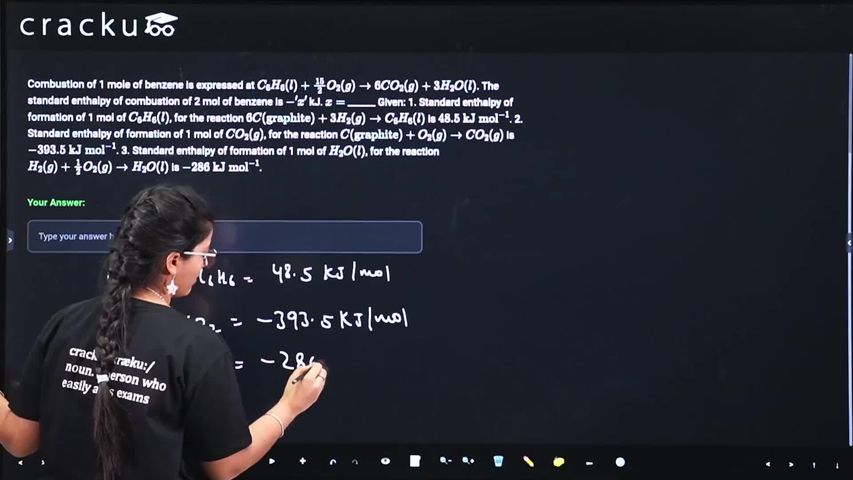
Combustion of 1 mole of benzene is expressed at $$C_6H_6(l) + \frac{15}{2}O_2(g) \rightarrow 6CO_2(g) + 3H_2O(l)$$. The standard enthalpy of combustion of 2 mol of benzene is $$-'x'$$ kJ. $$x =$$ ______ Given: 1. Standard enthalpy of formation of 1 mol of $$C_6H_6(l)$$, for the reaction $$6C \text{(graphite)} + 3H_2(g) \rightarrow C_6H_6(l)$$ is $$48.5 \text{ kJ mol}^{-1}$$. 2. Standard enthalpy of formation of 1 mol of $$CO_2(g)$$, for the reaction $$C \text{(graphite)} + O_2(g) \rightarrow CO_2(g)$$ is $$-393.5 \text{ kJ mol}^{-1}$$. 3. Standard enthalpy of formation of 1 mol of $$H_2O(l)$$, for the reaction $$H_2(g) + \frac{1}{2}O_2(g) \rightarrow H_2O(l)$$ is $$-286 \text{ kJ mol}^{-1}$$.
Correct Answer: 6535
We need to find the standard enthalpy of combustion of 2 moles of benzene. The standard enthalpies of formation are $$\Delta_f H^0 [C_6H_6(l)] = 48.5$$ kJ/mol, $$\Delta_f H^0 [CO_2(g)] = -393.5$$ kJ/mol, and $$\Delta_f H^0 [H_2O(l)] = -286$$ kJ/mol.
The balanced combustion reaction for one mole of benzene is $$ C_6H_6(l) + \frac{15}{2}O_2(g) \rightarrow 6CO_2(g) + 3H_2O(l) $$. Using Hess's Law, the enthalpy change is given by $$ \Delta_c H^0 = \sum \Delta_f H^0 (\text{products}) - \sum \Delta_f H^0 (\text{reactants}) $$. Note that $$\Delta_f H^0 [O_2(g)] = 0$$ (element in standard state).
Substituting the values yields $$ \Delta_c H^0 = [6 \times (-393.5) + 3 \times (-286)] - [48.5 + 0] $$. Simplifying gives $$ \Delta_c H^0 = [-2361 + (-858)] - 48.5 $$ $$ \Delta_c H^0 = -3219 - 48.5 $$ $$ \Delta_c H^0 = -3267.5 \text{ kJ/mol} $$.
For two moles of benzene, $$ \Delta_c H^0 (\text{2 mol}) = 2 \times (-3267.5) = -6535 \text{ kJ} $$. Therefore, $$x = 6535$$, and the answer is 6535.
Was this solution helpful?
Click on the Email ☝️ to Watch the Video Solution
Create a FREE account and get:
_1.webp)

Educational materials for JEE preparation

Ask our AI anything

AI can make mistakes. Please verify important information.
AI can make mistakes. Please verify important information.
