
Join Our JEE Preparation Group
Prep with like-minded aspirants; Get access to free daily tests and study material.
Sign in
Please select an account to continue using cracku.in
↓ →
Join Our JEE Preparation Group
Prep with like-minded aspirants; Get access to free daily tests and study material.
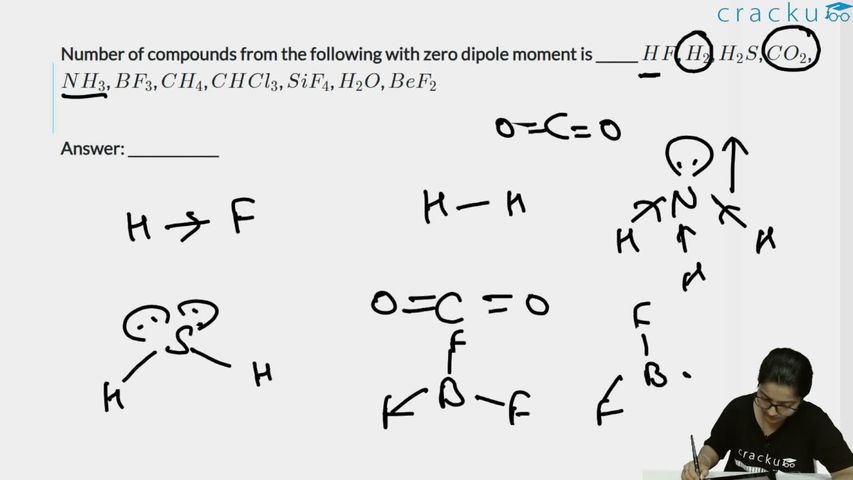
Number of compounds from the following with zero dipole moment is ______ $$HF$$, $$H_2$$, $$H_2S$$, $$CO_2$$, $$NH_3$$, $$BF_3$$, $$CH_4$$, $$CHCl_3$$, $$SiF_4$$, $$H_2O$$, $$BeF_2$$
Correct Answer: 6
We need to count the number of compounds with zero dipole moment from the given list.
Key concept: A molecule has zero dipole moment if it is either nonpolar (same atoms bonded) or if its geometry causes the individual bond dipoles to cancel out due to symmetry.
Let us check each compound:
1. HF — Linear, polar bond. Dipole moment $$\neq 0$$.
2. $$H_2$$ — Homonuclear diatomic, nonpolar. Dipole moment = 0.
3. $$H_2S$$ — Bent shape (like water). Dipole moment $$\neq 0$$.
4. $$CO_2$$ — Linear, $$O=C=O$$. Bond dipoles cancel. Dipole moment = 0.
5. $$NH_3$$ — Trigonal pyramidal with lone pair. Dipole moment $$\neq 0$$.
6. $$BF_3$$ — Trigonal planar, symmetric. Bond dipoles cancel. Dipole moment = 0.
7. $$CH_4$$ — Tetrahedral, symmetric. Bond dipoles cancel. Dipole moment = 0.
8. $$CHCl_3$$ — Tetrahedral but asymmetric (one H, three Cl). Dipole moment $$\neq 0$$.
9. $$SiF_4$$ — Tetrahedral, symmetric. Bond dipoles cancel. Dipole moment = 0.
10. $$H_2O$$ — Bent shape. Dipole moment $$\neq 0$$.
11. $$BeF_2$$ — Linear, $$F-Be-F$$. Bond dipoles cancel. Dipole moment = 0.
Compounds with zero dipole moment: $$H_2$$, $$CO_2$$, $$BF_3$$, $$CH_4$$, $$SiF_4$$, $$BeF_2$$ = 6 compounds.
The answer is 6.
Was this solution helpful?
Click on the Email ☝️ to Watch the Video Solution
Create a FREE account and get:
_1.webp)

Educational materials for JEE preparation

Ask our AI anything

AI can make mistakes. Please verify important information.
AI can make mistakes. Please verify important information.
