
Join Our JEE Preparation Group
Prep with like-minded aspirants; Get access to free daily tests and study material.
Sign in
Please select an account to continue using cracku.in
↓ →
Join Our JEE Preparation Group
Prep with like-minded aspirants; Get access to free daily tests and study material.
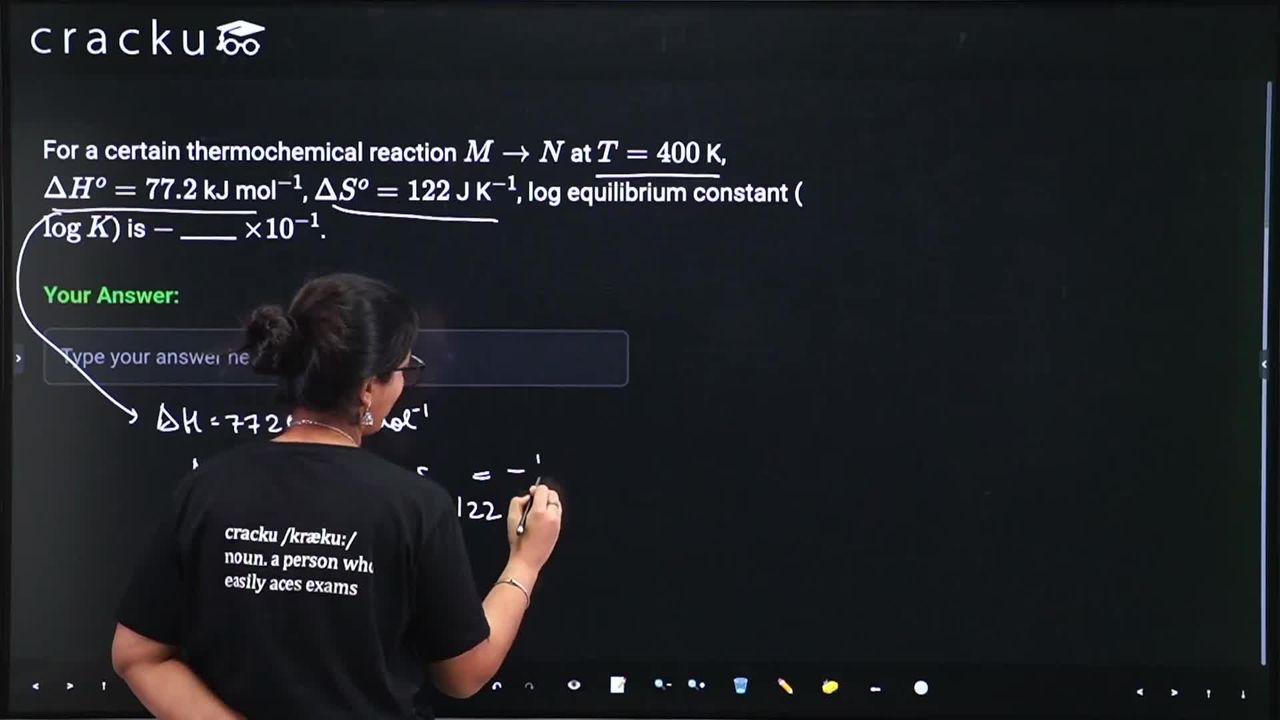
For a certain thermochemical reaction $$M \rightarrow N$$ at $$T = 400$$ K, $$\Delta H^o = 77.2$$ kJ mol$$^{-1}$$, $$\Delta S^o = 122$$ J K$$^{-1}$$, log equilibrium constant ($$\log K$$) is $$-$$ _____ $$\times 10^{-1}$$.
Correct Answer: 37
We need to determine the value of the log equilibrium constant ($$\log K$$) for the given thermochemical reaction $$M \rightarrow N$$ at $$T = 400 \text{ K}$$.
The relationship between standard Gibbs free energy change ($$\Delta G^o$$), enthalpy change ($$\Delta H^o$$), and entropy change ($$\Delta S^o$$) is:
$$\Delta G^o = \Delta H^o - T\Delta S^o$$
Substituting the given values ($$\Delta H^o = 77.2 \text{ kJ mol}^{-1} = 77200 \text{ J mol}^{-1}$$, $$T = 400 \text{ K}$$, and $$\Delta S^o = 122 \text{ J K}^{-1} \text{ mol}^{-1}$$):
$$\Delta G^o = 77200 - (400 \times 122)$$
$$\Delta G^o = 77200 - 48800 = 28400 \text{ J mol}^{-1}$$
The relationship between standard Gibbs free energy change ($$\Delta G^o$$) and the equilibrium constant ($$K$$) is:
$$\Delta G^o = -2.303 R T \log K$$
Rearranging the formula to solve for $$\log K$$ (using $$R = 8.314 \text{ J K}^{-1} \text{ mol}^{-1}$$):
$$\log K = -\frac{\Delta G^o}{2.303 R T}$$
$$\log K = -\frac{28400}{2.303 \times 8.314 \times 400}$$
$$\log K = -\frac{28400}{7658.84}$$
$$\log K \approx -3.708$$
$$-3.708 = -37.08 \times 10^{-1}$$
Rounding to the nearest integer, the value inside the blank is $$37$$.
The answer is 37.
Was this solution helpful?
Click on the Email ☝️ to Watch the Video Solution
Create a FREE account and get:
_1.webp)

Educational materials for JEE preparation

Ask our AI anything

AI can make mistakes. Please verify important information.
AI can make mistakes. Please verify important information.
