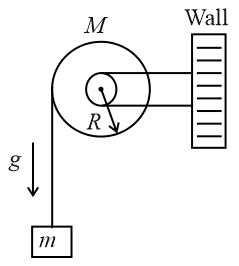
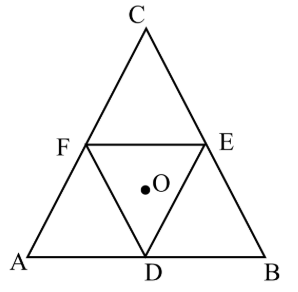
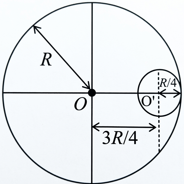
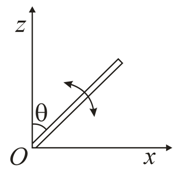
JEE Rigid Body Dynamics Questions

This page provides a focused collection of JEE Rigid Body Dynamics Questions for students preparing for JEE Main and JEE Advanced. The questions can also be used for revision before attempting a JEE Mains mock test, especially after completing the basic concepts of rotational motion and rigid body dynamics. The PDF available in this section contains selected questions along with detailed video solutions and explanations by IITians, helping students understand the complete problem-solving process.Rigid Body Dynamics deals with the motion of extended bodies and the relationship between force, torque, angular acceleration, and rotational energy. The question set covers important concepts such as moment of inertia, torque, angular momentum, rolling motion, rotational kinetic energy, equilibrium of rigid bodies, and conservation laws.

Question 1 JEE Advanced

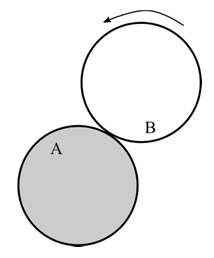
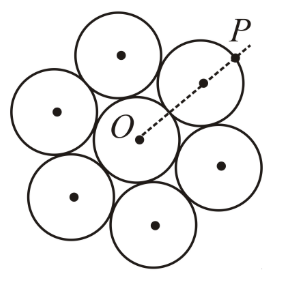
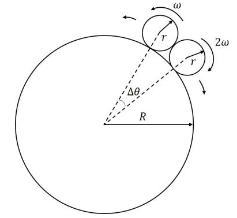
Consider a large disk of radius $$R$$ and two smaller disks, each of radius $$r=R/50$$, lying on its circumference, as shown in the figure. The smaller disks are initially in contact with each other, with an angular separation $$\Delta\theta$$ between their centers. They are made to roll without slipping in opposite directions, with constant angular velocities $$\omega$$ and $$2\omega$$ while the large disk is held stationary. The time $$\tau$$ at which the smaller disks are again in contact is:

[Use $$\sin(\Delta\theta)=\Delta\theta$$ and ignore gravity.]

image
Question 2 JEE Advanced

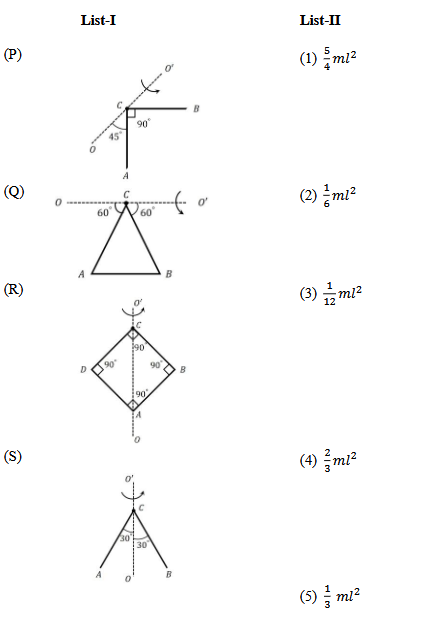
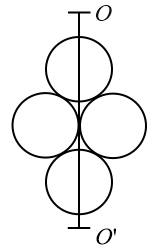
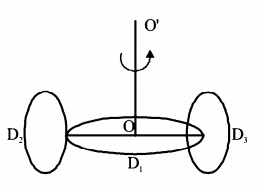
List-I shows four planar structures made of uniform solid rods each of mass $$m$$ and length $$l$$. In the List-II the possible moment of inertia of these structures about an axis $$OCO'$$, which lies in the plane of the structures, are given. Choose the option that describes the correct match between the entries in List-I to those in List-II.

image
Question 3 JEE Advanced

Question Stem for Question Nos. 17 and 18

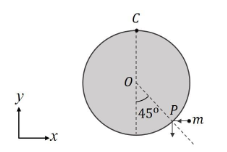
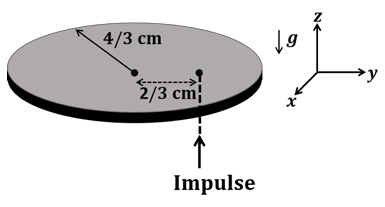
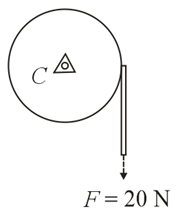
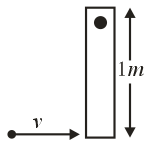
A uniform circular disk of radius $$0.2\,\mathrm{m}$$ and mass $$1\,\mathrm{kg}$$ is pivoted at its top point $$C$$ such that it can rotate freely around $$C$$ in the $$XY$$ plane, as shown in the figure. Initially, when the disk is at rest, a particle of mass $$20\,\mathrm{g}$$, travelling along negative $$x$$ direction in the $$XY$$ plane with speed $$100\,\mathrm{ms^{-1}}$$, hits the circumference of the disk at a point $$P$$. After collision the particle moves along negative $$y$$ direction at a speed of $$90\,\mathrm{ms^{-1}}$$.

[Given: the acceleration due to gravity $$(g)=-10\hat{j}\,\mathrm{ms^{-2}}$$]

image

After the collision the disk starts to rotate around point $$C$$ in the $$XY$$ plane. The maximum change in the height (in m) of its center $$O$$ is:

Question 4 JEE Advanced

Question Stem for Question Nos. 17 and 18

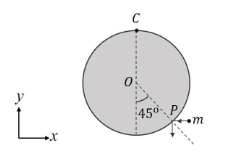
A uniform circular disk of radius $$0.2\,\mathrm{m}$$ and mass $$1\,\mathrm{kg}$$ is pivoted at its top point $$C$$ such that it can rotate freely around $$C$$ in the $$XY$$ plane, as shown in the figure. Initially, when the disk is at rest, a particle of mass $$20\,\mathrm{g}$$, travelling along negative $$x$$ direction in the $$XY$$ plane with speed $$100\,\mathrm{ms^{-1}}$$, hits the circumference of the disk at a point $$P$$. After collision the particle moves along negative $$y$$ direction at a speed of $$90\,\mathrm{ms^{-1}}$$.

[Given: the acceleration due to gravity $$(g)=-10\hat{j}\,\mathrm{ms^{-2}}$$]

image

Amount of energy loss (in J) in the collision is:

Question 5 JEE Mains

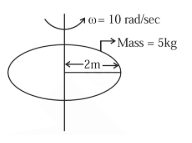
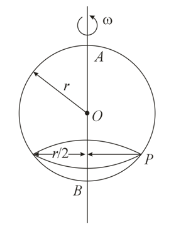
A 0.5 kg mass is in contact against the inner wall of a cylindrical drum of radius 4 m rotating about its vertical axis. The minimum rotational speed of the drum to enable the mass to remain stuck to the wall (without falling) is 5 rad/s. The coefficient of friction between the drum's inner wall surface and mass is : (Take $$g = 10$$ m/s$$^2$$)

Question 6 JEE Mains

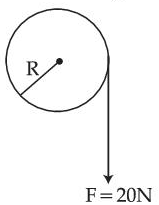
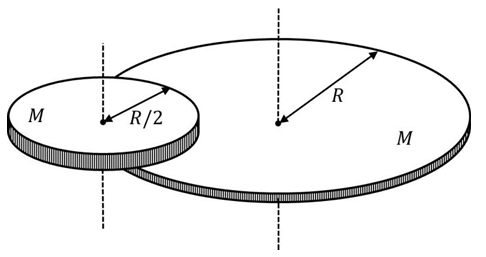
A solid sphere (A) of mass $$5m$$ and a spherical shell (B) of mass $$m$$, both having same radius, are placed on a rough surface. When a force of same magnitude is applied tangentially at the highest points of A and B, they start rolling without slipping with an acceleration of $$a_A$$ and $$a_B$$, respectively. The ratio of $$a_A$$ and $$a_B$$ is __________.

Question 7 JEE Mains

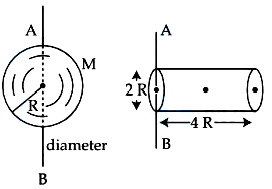
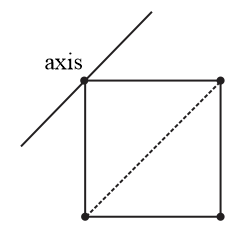
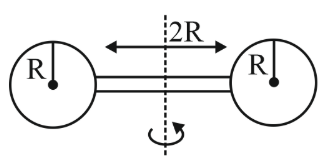
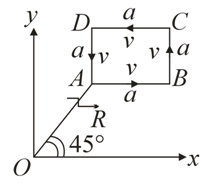
The moment of inertia of a square loop made of four uniform solid cylinders, each having radius R and length L (R<L) about an axis passing through the mid points of opposite sides, is (Take the mass of the entire loop as M) :

Question 8 JEE Advanced

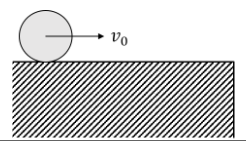
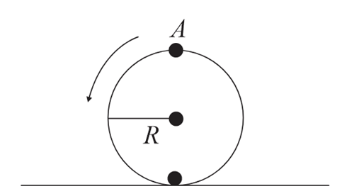
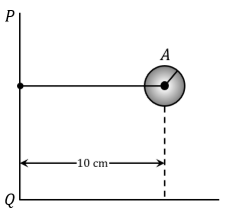
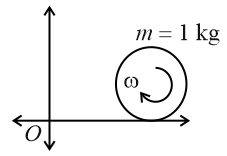
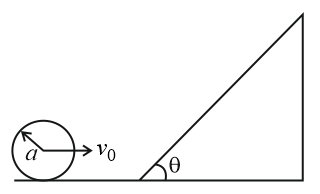
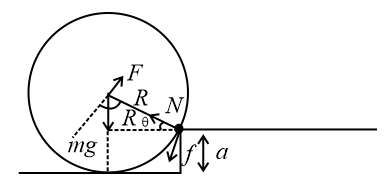
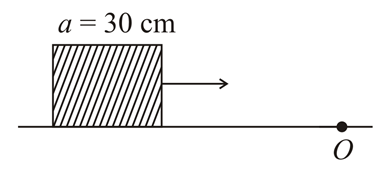
A solid cylinder of radius $$R$$ rolls without slipping with a center of mass speed $$v_0=\sqrt{\dfrac{gR}{3}}$$ on a horizontal surface with a vertical edge, as shown in the figure. Here, $$g$$ is the acceleration due to the gravity. At the moment when the cylinder loses contact with the surface due to rotation around the corner, the speed of its center of mass is:

image
Question 9 JEE Mains

A solid sphere of mass $$M$$ and radius $$R$$ is divided into two unequal parts. The smaller part having mass $$\frac{M}{8}$$ is converted to a sphere of radius $$r$$ and the larger part is converted into a circular disc of thickness $$t$$ and radius $$2R$$. If $$I_1$$ is moment of inertia of a sphere having radius $$r$$ about an axis through its centre and $$I_2$$ is the moment of inertia of a disc about its diameter, the ratio of their moment of inertia $$\frac{I_2}{I_1}$$ = :

Question 10 JEE Mains

A wheel initially at rest is subjected to a uniform angular acceleration about its axis. In the first 2 s, it rotates through an angle $$\theta_1$$. In the next 2 s, it rotates through an angle $$\theta_2$$. Then the ratio $$\frac{\theta_2}{\theta_1}$$ is :

Question 11 JEE Mains

A particle is rotating in a circular path and at any instant its motion can be described as $$\theta = \frac{5t^4}{40} - \frac{t^3}{3}$$. The angular acceleration of the particle after 10 seconds is __________ rad/s$$^2$$.

Question 12 JEE Mains

A solid sphere of radius 4 cm and mass 5 kg is rotating (rotation axis is passing through the centre of the sphere) with an angular velocity of 1200 rpm. It is brought to rest in 10 s by applying a constant torque. The torque applied and the number of rotations it made before it comes to rest are _______ and _______ respectively.

Question 13 JEE Mains

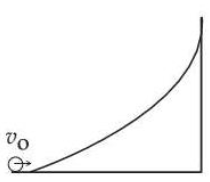
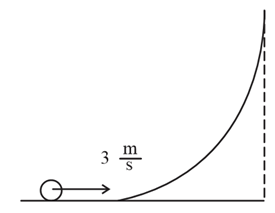
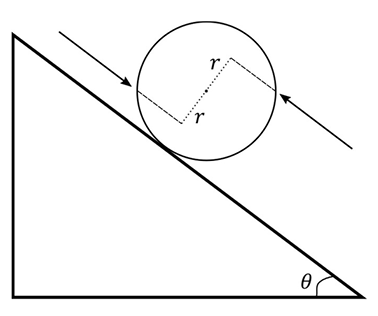
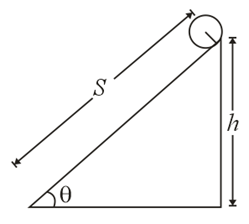
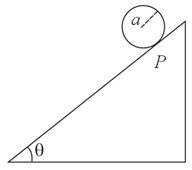
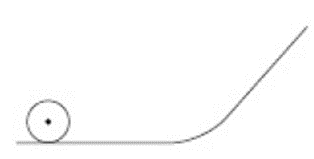
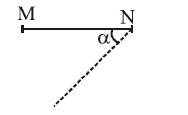
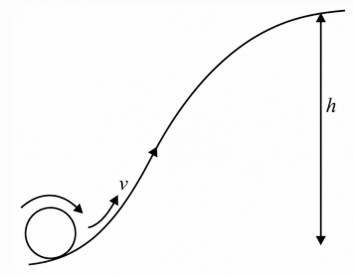
An object of uniform density rolls up a curved path with the initial velocity $$v_{\circ}$$ as shown in the figure. If the maximum height attained by an object is  $$\frac{7v_0^2}{10g}$$. (g = acceleration due to gravity), The object is a :

image
Question 14 JEE Mains

A solid cylinder having radius $$R$$ and length $$L$$ is slipping on a rough horizontal plane. At time $$t = 0$$ the cylinder has a translational velocity $$v_0 = 49$$ m/s, perpendicular to its axis and a rotational velocity $$v_0/4R$$ about the centre. The time taken by the cylinder to start rolling is __________ seconds. (coefficient of kinetic friction $$\mu_K = 0.25$$ and $$g = 9.8$$ m/s$$^2$$)

Question 15 JEE Mains

A solid sphere of mass 5 kg and radius 10 cm is kept in contact with another solid sphere of mass 10 kg and radius 20 cm. The moment of inertia of this pair of spheres about the tangent passing through the point of contact is _____ $$kg.m^{2}$$.

Question 16 JEE Mains

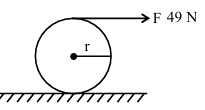
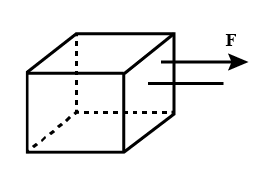
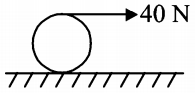
A force of 49 N acts tangentially at the highest point of a sphere (solid) of mass 20 kg, kept on a rough horizontal plane. If the sphere rolls without slipping, then the acceleration of the center of the sphere is

image
Question 17 JEE Mains

A thin circular ring of mass $$m$$ and radius $$R$$ is rotating about its axis with a constant angular velocity $$\omega$$. Two objects each of mass $$M$$ are attached gently to the opposite ends of a diameter of the ring. The ring now rotates with an angular velocity $$\omega' =$$

Question 18 JEE Mains

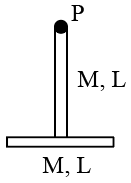
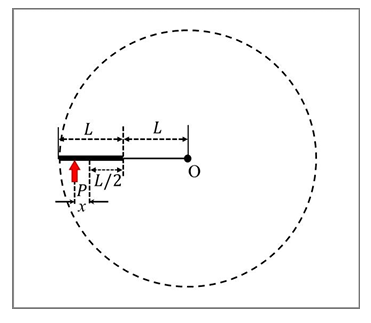
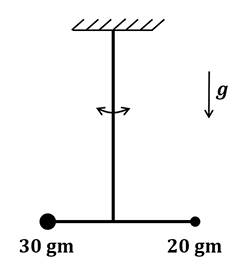
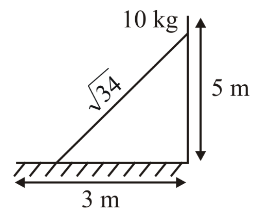
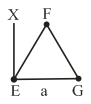
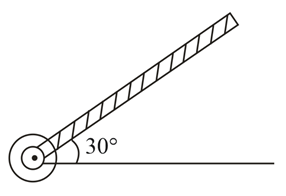
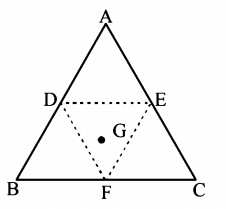
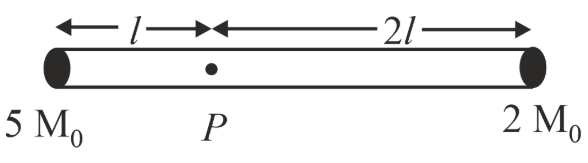
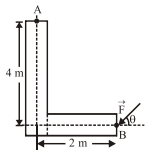
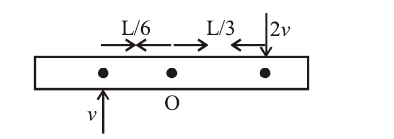
Two identical thin rods of mass M kg and length L m are connected as shown in the figure below. Moment of inertia of the combined rod system about an axis passing through point P and perpendicular to the plane of the rods is $$\frac{x}{12}ML^{2}\text{kg m}^{2}$$. The value of x is ____ .

Screenshot_6
Question 19 JEE Mains

A uniform solid cylinder of length L and radius R has moment of inertia about its axis equal to $$I_{1}$$. A small co-centric cylinder of length L/2 and radius R/3 carved from this cylinder has moment of inertia about its axis equals to $$I_{2}$$. The ratio $$I_{1}/I_{2}$$ is __________.

Question 20 JEE Mains

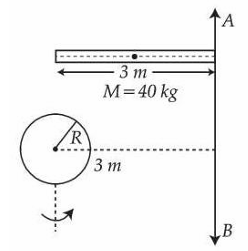
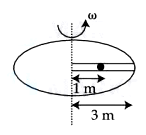
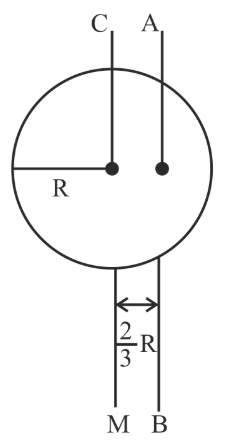
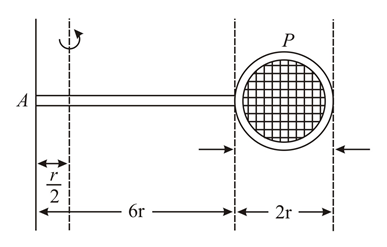
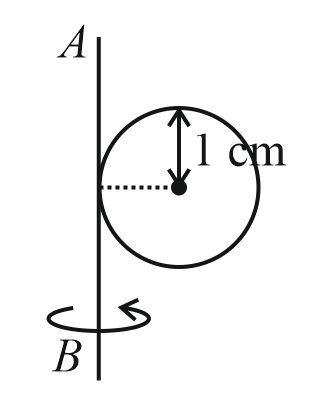
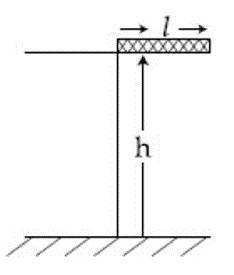
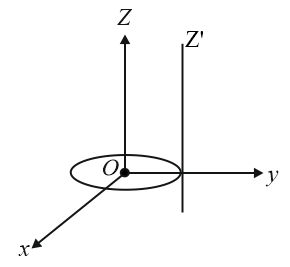
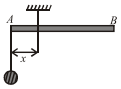
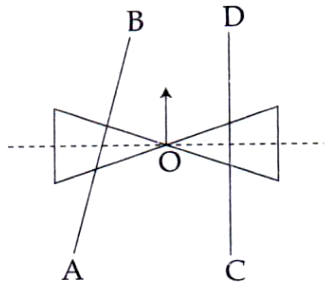
Moment of inertia about an axis $$AB$$ for a rod of mass 40 kg and length 3 m is same as that of a solid sphere of mass 10 kg and radius $$R$$ about an axis parallel to $$AB$$ axis with separation of 3 m as shown in figure. The value of $$R$$ is given as $$\sqrt{\frac{\alpha}{2}}$$. The value of $$\alpha$$ is _________.

image
Question 21 JEE Mains

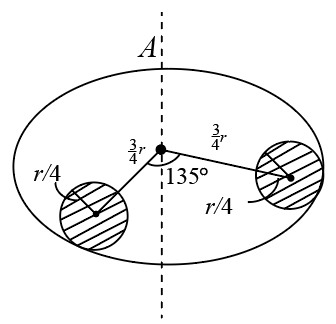
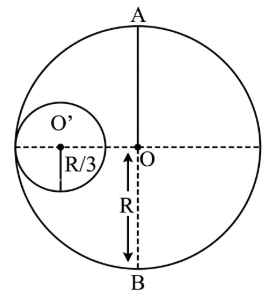
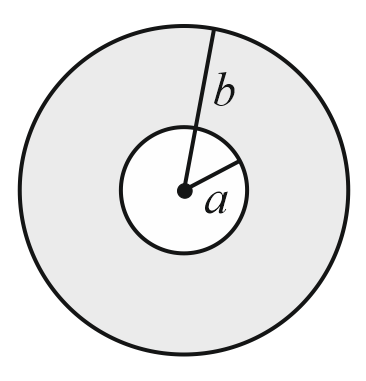
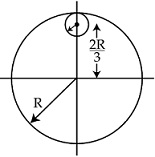
Suppose there is a uniform circular disc of mass $$M$$ kg and radius $$r$$ m shown in figure. The shaded regions are cut out from the disc. The moment of inertia of the remainder about the axis $$A$$ of the disc is given by $$ \frac{x}{256}Mr^{2} $$. The value of $$x$$ is______.

50

Students can attempt the questions independently and then refer to the detailed video solutions to understand the reasoning, equations, diagrams, and calculations involved. This approach helps identify mistakes in axis selection, sign convention, force analysis, or the application of rotational equations.

ResourceWhat It Provides
JEE Rigid Body Dynamics QuestionsNumerical and conceptual practice
Practice PDFFocused chapter-wise question set
Video SolutionsDetailed step-by-step explanations
IITian ExplanationsComplete reasoning and solution approach
Concept CoverageImportant rotational and rigid-body applications
Exam PreparationUseful for JEE Main and JEE Advanced

The PDF can be used after learning the chapter fundamentals and can be combined with previous year questions, revision notes, and timed practice.

Important Rigid Body Dynamics Topics for JEE

Rigid Body Dynamics requires students to understand both translational and rotational motion. Many questions become easier when a body is analysed through the correct axis, force balance, and torque equation rather than by directly applying a memorised result.

The important topics to prepare include:

Rigid Body Dynamics TopicWhat to Practise
Centre of MassMotion and position of extended bodies
Moment of InertiaStandard bodies and parallel-axis applications
TorqueTorque due to forces and rotational equilibrium
Angular MomentumAngular momentum and conservation
Rotational KinematicsAngular displacement, velocity, and acceleration
Rotational DynamicsRelation between torque and angular acceleration
Rolling MotionPure rolling and combined translation-rotation
Rotational EnergyKinetic energy of rotating bodies
Equilibrium of Rigid BodiesForce and torque balance
Collisions and RotationAngular momentum in impact problems
Pulley SystemsRotational effects in connected-body problems

Moment of inertia is particularly important because the result depends on both the mass distribution and the chosen axis. Students should become familiar with standard bodies such as rods, rings, discs, cylinders, and spheres and understand when the parallel-axis or perpendicular-axis theorem can be applied.

Rolling-motion problems require careful attention to the condition of pure rolling. In such questions, translational and rotational quantities are connected, and friction may play an important role even when no slipping occurs.

Students should also connect rigid-body problems with Newton's laws, Centre of Mass, work-energy, and angular momentum. This makes it easier to handle mixed questions rather than treating every rotational problem separately.

JEE Main & Advanced Rigid Body Dynamics Weightage Analysis

The number of Rigid Body Dynamics questions is not fixed across JEE Main shifts or JEE Advanced papers. The topic may be tested through direct rotational problems or combined with mechanics concepts such as friction, energy, collisions, and centre of mass. Therefore, JEE Mains Physics Chapter-wise weightage should be used as a preparation reference rather than a fixed prediction.

AreaCommon Question Applications
Moment of InertiaStandard bodies and axis transformation
TorqueAngular acceleration and equilibrium
Angular MomentumConservation-based problems
Rotational MotionAngular velocity and acceleration
Rolling MotionRolling without slipping
Rotational EnergyKinetic and potential energy applications
Rigid Body EquilibriumForce and torque balance
Pulley ProblemsTranslational and rotational motion together
CollisionsAngular momentum before and after impact
Mixed MechanicsRotation combined with friction or energy

For JEE Main, begin with standard moment-of-inertia, torque, rotational-energy, and rolling-motion questions. Once these become familiar, move to problems involving multiple forces and connected bodies.

For JEE Advanced, practise problems where the axis changes, the body has non-trivial mass distribution, or rotational motion is combined with friction, collisions, or conservation laws. JEE Chapter-wise PYQ practice can help you understand how rotational concepts have been used in different examination situations.

Rather than relying only on expected weightage, aim to understand the complete framework of rotational dynamics. A strong conceptual base allows you to approach unfamiliar configurations more confidently.

Why Practice JEE Rigid Body Dynamics Questions?

Rigid Body Dynamics contains several closely related quantities such as torque, angular momentum, moment of inertia, and rotational kinetic energy. Regular question practice helps students understand how these quantities interact and when each principle should be used.

Practising JEE Rigid Body Dynamics Questions can help you:

  • Understand the connection between force and rotational motion.
  • Improve moment-of-inertia calculations.
  • Apply torque equations correctly.
  • Strengthen concepts related to angular momentum.
  • Solve rolling-motion problems systematically.
  • Improve accuracy in multi-step rotational problems.

One effective way to practise is to classify the problem before solving it. Check whether the question is based mainly on torque, angular momentum, energy, moment of inertia, or rolling motion. Once the dominant concept is identified, selecting the appropriate equation becomes easier.

Students following a structured JEE Physics course can use the PDF after completing the relevant rotational-motion lessons. This gives an immediate opportunity to test whether the concepts studied in class can be applied independently.

The detailed IITian video solutions are useful for analysing difficult problems. When your answer differs from the explanation, compare the chosen axis, force diagram, torque direction, and equations before checking the arithmetic. In rotational problems, an incorrect initial setup often causes the final answer to go wrong.

Tips to Solve Rigid Body Dynamics Questions Faster

Rigid Body Dynamics problems can become much easier when you follow a fixed sequence of analysis. Start with the physical setup and decide which principle is most suitable before writing equations.

Choose the axis carefully

The choice of axis can simplify both moment-of-inertia and torque calculations. Whenever possible, select an axis that reduces the number of unknown torques or uses a known moment of inertia.

Draw the force diagram

Mark the weight, normal reaction, tension, friction, and applied forces. Then identify their lines of action and determine which forces produce torque about the selected axis.

Revise standard moments of inertia

Body

Moment of Inertia

Thin Rod About Centre

$$(I=\frac{1}{12}ML^2)$$

Thin Rod About End

$$(I=\frac{1}{3}ML^2)$$

Ring About Centre

$$(I=MR^2)$$

Disc About Centre

$$(I=\frac{1}{2}MR^2)$$

Solid Sphere About Diameter

$$(I=\frac{2}{5}MR^2)$$

Hollow Sphere About Diameter

$$(I=\frac{2}{3}MR^2)$$

Keep these standard results in your JEE Notes or revision material so that you do not need to derive them repeatedly during practice.

Check the rolling condition

For pure rolling, the point of contact has zero instantaneous velocity relative to the surface. Make sure the relation between translational and angular velocity is applied correctly.

Use conservation laws when possible

Problems involving angular momentum or energy can often be solved more efficiently through conservation principles than by writing separate force equations for every stage.

Practise chapter-wise PYQs

After learning the concepts, solve JEE Chapter-wise PYQ questions from Rigid Body Dynamics. This helps you become familiar with different combinations of torque, angular momentum, moment of inertia, and rolling motion.

Frequently Asked Questions