JEE Centre of Mass Questions

This page provides a focused collection of JEE Centre of Mass Questions for students preparing for JEE Main and JEE Advanced. The PDF placed in this section contains selected questions from the Centre of Mass chapter along with detailed video solutions and explanations by IITians. The solutions explain the complete approach, including how to choose coordinates, identify the relevant masses, apply the centre-of-mass formula, and interpret the result.The questions cover systems of particles, position of the centre of mass, motion of the centre of mass, composite bodies, rods and laminae, symmetry-based problems, momentum, and collision-related applications. Students can attempt each problem first and then refer to the video explanation to compare their approach with the detailed solution.

Instructions

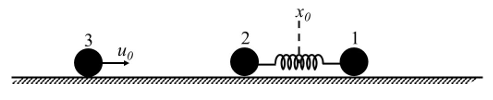
Two particles, 1 and 2, each of mass $$m$$, are connected by a massless spring, and are on a horizontal frictionless plane, as shown in the figure. Initially, the two particles, with their center of mass at $$x_0$$, are oscillating with amplitude $$a$$ and angular frequency $$\omega$$. Thus, their positions at time $$t$$ are given by $$x_1(t) = (x_0 + d) + a \sin \omega t$$ and $$x_2(t) = (x_0 - d) - a \sin \omega t$$, respectively, where $$d > 2a$$. Particle 3 of mass $$m$$ moves towards this system with speed $$u_0 = a\omega/2$$, and undergoes instantaneous elastic collision with particle 2, at time $$t_0$$. Finally, particles 1 and 2 acquire a center of mass speed $$v_{cm}$$ and oscillate with amplitude $$b$$ and the same angular frequency $$\omega$$.

image
Question 1 JEE Advanced

If the collision occurs at time $$t_0 = 0$$, the value of $$v_{cm}/(a\omega)$$ will be ________.

Question 2 JEE Mains

A body of mass 2 kg moving with a speed of 4 m s$$^{-1}$$ makes an elastic collision with another body at rest and continues to move in the original direction but with one fourth of its initial speed. The speed of the two body centre of mass is $$\frac{x}{10}$$. Find the value of x.

Question 3 JEE Mains

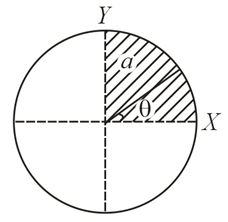
The disc of mass $$M$$ with uniform surface mass density $$\sigma$$ is shown in the figure. The center of mass of the quarter disc (the shaded area) is at the position $$\left(\frac{xa}{3\pi}, \frac{xa}{3\pi}\right)$$ where $$x$$ is ________. (Round off to the Nearest Integer) [$$a$$ is an area as shown in the figure]

Question 4 JEE Mains

The centre of mass of a solid hemisphere of radius $$8\,\text{cm}$$ is $$x\,\text{cm}$$ from the centre of the flat surface. Then value of $$x$$ is___

Question 5 JEE Mains

Two bodies of the same mass are moving with the same speed, but in different directions in a plane. They have a completely inelastic collision and move together thereafter with a final speed which is half of their initial velocities of the two bodies (in degree) is ___

Question 6 JEE Mains

A rod of length $$l$$ has non-uniform linear mass density given by $$\rho(x) = a + b\left(\frac{x}{l}\right)^2$$, where $$a$$ and $$b$$ are constants and $$0 < x \le l$$. The value of $$x$$ for the centre of mass of the rod is at:

Question 7 JEE Mains

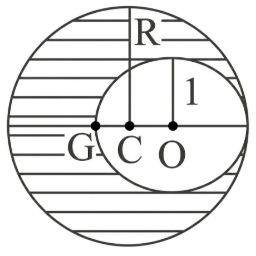
As shown in figure. When a spherical cavity (centred at O) of radius 1 is cut out of a uniform sphere of radius R (centred at C), the centre of mass of remaining (shaded part of sphere is at G, i.e., on the surface of the cavity. R can be determined by the equation:

image
Question 8 JEE Mains

Distance of the centre of mass of a solid uniform cone from its vertex is $$z_0$$. If the radius of its base is $$R$$ and its height is $$h$$ then $$z_0$$ is equal to

Question 9 JEE Mains

The identical spheres each of mass $$2M$$ are placed at the corners of a right angled triangle with mutually perpendicular sides equal to $$4$$ m each. Taking point of intersection of these two sides as origin, the magnitude of position vector of the centre of mass of the system is $$\frac{4\sqrt{2}}{x}$$, where the value of $$x$$ is ________.

Question 10 JEE Mains

Three identical spheres each of mass $$M$$ are placed at the corners of a right angled triangle with mutually perpendicular sides equal to $$3 \text{ m}$$ each. Taking point of intersection of mutually perpendicular sides as origin, the magnitude of position vector of centre of mass of the system will be $$\sqrt{x}$$ m. The value of $$x$$ is ______.

Question 11 JEE Mains

The distance of centre of mass from end A of a one dimensional rod (AB) having mass density $$\rho = \rho_0\left(1 - \frac{x^2}{L^2}\right)$$ kg m$$^{-1}$$ and length $$L$$ (in meter) is $$\frac{3L}{\alpha}$$ m. The value of $$\alpha$$ is _____ (where $$x$$ is the distance from end A)

Question 12 JEE Mains

A body of mass $$M$$ at rest explodes into three pieces, in the ratio of masses 1 : 1 : 2. Two smaller pieces fly off perpendicular to each other with velocities of 30 m s$$^{-1}$$ and 40 m s$$^{-1}$$ respectively. The velocity of the third piece will be

Question 13 JEE Mains

Two bodies of mass 1 kg and 3 kg have position vectors $$\hat{i} + 2\hat{j} + \hat{k}$$ and $$-3\hat{i} - 2\hat{j} + \hat{k}$$ respectively. The magnitude of position vector of centre of mass of this system will be similar to the magnitude of vector:

Question 14 JEE Mains

The position of the centre of mass of a uniform semi-circular wire of radius $$R$$ placed in $$x-y$$ plane with its centre at the origin and the line joining its ends as $$x$$-axis is given by $$\left(0, \frac{xR}{\pi}\right)$$. Then, the value of $$|x|$$ is ___.

Question 15 JEE Mains

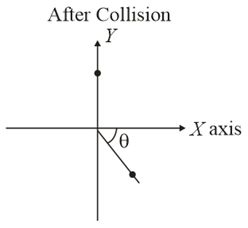
A ball of mass 10 kg moving with a velocity $$10\sqrt{3}$$ m s$$^{-1}$$ along $$X$$-axis, hits another ball of mass 20 kg which is at rest. After the collision, the first ball comes to rest and the second one disintegrates into two equal pieces. One of the pieces starts moving along $$Y$$-axis at a speed of 10 m s$$^{-1}$$. The second piece starts moving at a speed of 20 m s$$^{-1}$$ at an angle $$\theta$$ (degree) with respect to the $$X$$-axis. The configuration of pieces after the collision is shown in the figure. The value of $$\theta$$ to the nearest integer is ________.

Question 16 JEE Mains

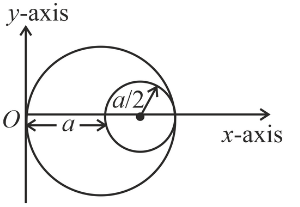
A circular hole of radius $$\frac{a}{2}$$ is cut out of a circular disc of radius $$a$$ as shown in figure. The centroid of the remaining circular portion with respect to point O will be:

image
Question 17 JEE Mains

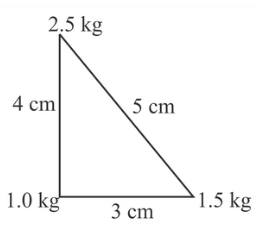
Three point particles of masses 1.0 kg, 1.5 kg and 2.5 kg are placed at three corners of a right angle triangle of sides 4.0 cm, 3.0 cm and 5.0 cm as shown in the figure. The centre of mass of the system is at a point:

image
Question 18 JEE Mains

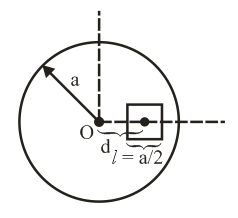
A square shaped hole of side $$l = \frac{a}{2}$$ is carved out at a distance $$d = \frac{a}{2}$$ from the centre 'O' of a uniform circular disk of radius a. If the distance of the centre of mass of the remaining portion from O is $$-\frac{a}{x}$$, value of X (to the nearest integer) is:

Question 19 JEE Mains

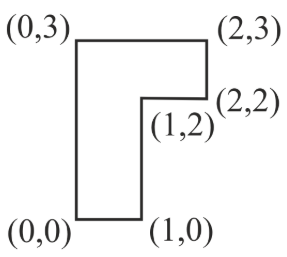
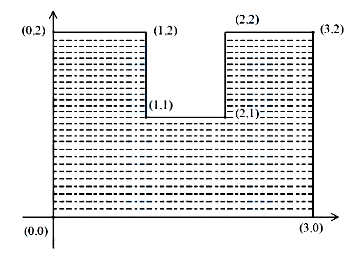
The coordinates of the centre of mass of a uniform flag-shaped lamina (thin flat plate) of mass 4 kg. (The coordinates of the same are shown in the figure) are:

image
Question 20 JEE Mains

A particle of mass $$m$$ is dropped from a height $$h$$ above the ground. At the same time another particle of the same mass is thrown vertically upwards from the ground with a speed of $$\sqrt{2gh}$$. If they collide head-on completely inelastically, the time taken for the combined mass to reach the ground, in units of $$\sqrt{\frac{h}{g}}$$ is

Question 21 JEE Mains

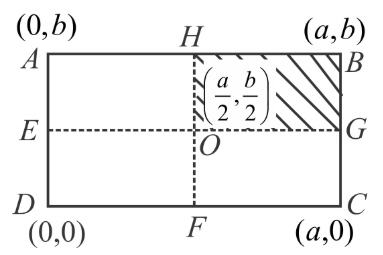
A uniform rectangular thin sheet $$ABCD$$ of mass $$M$$ has length $$a$$ and breadth $$b$$, as shown in the figure. If the shaded portion $$HBGO$$ is cut-off, the coordinates of the centre of mass of the remaining portion will be:

image
Question 22 JEE Mains

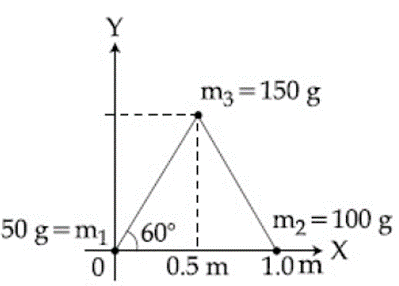
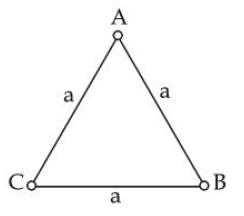
Three particles of masses 50 g, 100 g and 150 g are placed at the vertices of an equilateral triangle of side 1 m (as shown in the figure). The (x, y) coordinates of the centre of mass will be:

Question 23 JEE Mains

A uniform thin rod AB of length $$L$$ has linear mass density $$\mu(x) = a + \frac{bx}{L}$$, where $$x$$ is measured from A. If the CM of the rod lies at a distance of $$\left(\frac{7}{12}L\right)$$ from A, then $$a$$ and $$b$$ are related as:

Question 24 JEE Mains

A thin bar of length L has a mass per unit length $$\lambda$$, that increases linearly with distance from one end. If its total mass is M and its mass per unit length at the lighter end is $$\lambda_0$$, then the distance of the centre of mass from the lighter end is:

Question 25 JEE Mains

A boy of mass 20 kg is standing on a 80 kg free to move long cart. There is negligible friction between cart and ground. Initially, the boy is standing 25 m from a wall. If he walks 10 m on the cart towards the wall, then the final distance of the boy from the wall will be

Question 26 JEE Mains

A circular disc of radius $$R$$ is removed from a bigger circular disc of radius $$2R$$ such that the circumferences of the discs coincide. The centre of mass of the new disc is $$\alpha/R$$ from the centre of the bigger disc. The value of $$\alpha$$ is

Question 27 JEE Mains

Consider a two particle system with particles having masses $$m_1$$ and $$m_2$$. If the first particle is pushed towards the centre of mass through a distance $$d$$, by what distance should the second particle be moved, so as to keep the centre of mass at the same position?

Question 28 JEE Mains

A body $$A$$ of mass $$M$$ while falling vertically downwards under gravity breaks into two parts; a body $$B$$ of mass $$1/3 M$$ and a body $$C$$ of mass $$2/3 M$$. The centre of mass of bodies $$B$$ and $$C$$ taken together shifts compared to that of body $$A$$ towards

Question 29 JEE Mains

A uniform rod of mass 250 g having length 100 cm is balanced on a sharp edge at 40 cm mark. A mass of 400 g is suspended at 10 cm mark. To maintain the balance of the rod, the mass to be suspended at 90 cm mark, is

Question 30 JEE Mains

A uniform thin metal plate of mass $$10 \text{ kg}$$ with dimensions is shown in the figure below. The ratio of $$x$$ and $$y$$ coordinates of center of mass of the plate is $$\frac{n}{9}$$. The value of $$n$$ is ________.

image
Question 31 JEE Mains

In a system two particles of masses $$m_1 = 3$$ kg and $$m_2 = 2$$ kg are placed at certain distance from each other. The particle of mass $$m_1$$ is moved towards the center of mass of the system through a distance $$2$$ cm. In order to keep the center of mass of the system at the original position, the particle of mass $$m_2$$ should move towards the center of mass by the distance _____ cm.

Question 32 JEE Mains

Two blocks of masses $$10$$ kg and $$30$$ kg are placed on the same straight line with coordinates $$(0, 0)$$ cm and $$(x, 0)$$ cm respectively. The block of $$10$$ kg is moved on the same line through a distance of $$6$$ cm towards the other block. The distance through which the block of $$30$$ kg must be moved to keep the position of centre of mass of the system unchanged is

Question 33 JEE Mains

An engine of a train, moving with uniform acceleration, passes the signal-post with velocity $$u$$ and the last compartment with velocity $$v$$. The velocity with which middle point of the train passes the signal post is:

Question 34 JEE Mains

The position vector of the center of mass $$\vec{r_{cm}}$$ of an asymmetric uniform bar of negligible area of cross-section as shown in figure is:

image
Question 35 JEE Mains

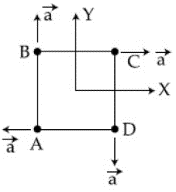
Four particles A, B, C and D with masses $$m_A = m$$, $$m_B = 2m$$, $$m_C = 3m$$ and $$m_D = 4m$$ are at the corners of a square. They have accelerations of equal magnitude with directions as shown. The acceleration of the centre of mass of the particles is:

Question 36 JEE Mains

In the figure shown $$ABC$$ is a uniform wire. If the center of mass of the wire lies vertically below point $$A$$, then $$\frac{BC}{AB}$$ is close to

image
Question 37 JEE Mains

A thin rod of length '$$L$$' is lying along the $$x$$-axis with its ends at $$x = 0$$ and $$x = L$$. Its linear density (mass/length) varies with $$x$$ as $$k\left(\frac{x}{L}\right)^n$$, where $$n$$ can be zero or any positive number. If the position $$x_{CM}$$ of the centre of mass of the rod is plotted against '$$n$$', which of the following graphs best approximates the dependence of $$x_{CM}$$ on $$n$$?

Question 38 JEE Mains
page6_img1


Three equal masses m are kept at vertices (A, B, C) of an equilateral triangle of side a in free space. At t=0, they are given an initial velocity $$\vec{V}_A = V_0 \overrightarrow{AC}$$, $$\vec{V}_B = V_0 \overrightarrow{BA}$$ and $$\vec{V}_C = V_0 \overrightarrow{CB}$$. Here $$\overrightarrow{AC}$$, $$\overrightarrow{CB}$$ and $$\overrightarrow{BA}$$ are unit vectors along the edges of the triangle. If the three masses interact gravitationally, then the magnitude of the net angular momentum of the system at the point of collision is :

Question 39 JEE Mains

Consider a binary star system of star A and star B with masses $$m_A$$ and $$m_B$$ revolving in a circular orbit of radii $$r_A$$ and $$r_B$$, respectively. If $$T_A$$ and $$T_B$$ are the time period of star A and star B, respectively, then:

Question 40 JEE Mains

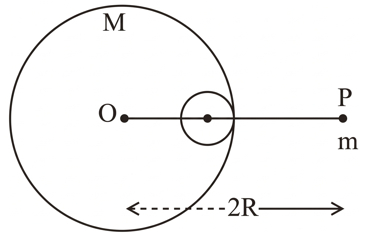
A small point of mass m is placed at a distance 2R from the centre 'O' of a big uniform solid sphere of mass M and radius R . The gravitational force on 'm' due to M is $$F_1$$. A spherical part of radius R/3 is removed from the big sphere as shown in the figure and the gravitational force on m due to the remaining part of M is found to be $$F_2$$ . The value of ratio $$F_1 : F_2$$ is

image
Question 41 JEE Mains

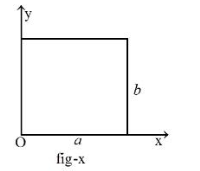
The center of mass of a thin rectangular plate (fig - x) with sides of length a and b, whose mass per unit area $$(\sigma)$$ varies as $$\sigma = \frac{\sigma_{\circ}x}{ab}$$ (where $$\sigma_{\circ}$$ is a constant), would be

page7_img1
Question 42 JEE Advanced

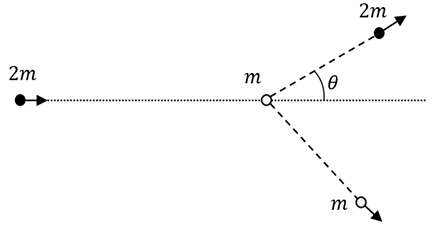
In a scattering experiment, a particle of mass $$2m$$ collides with another particle of mass $$m$$, which is initially at rest. Assuming the collision to be perfectly elastic, the maximum angular deviation $$\theta$$ of the heavier particle, as shown in the figure, in radians is:

image
Question 43 JEE Mains

Consider a circular disc of radius 20 cm with centre located at the origin. A circular hole of radius 5 cm is cut from this disc in such a way that the edge of the hole touches the edge of the disc. The distance of centre of mass of residual or remaining disc from the origin will be

Question 44 JEE Mains

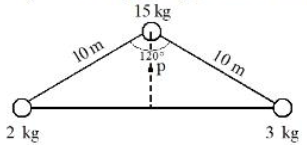
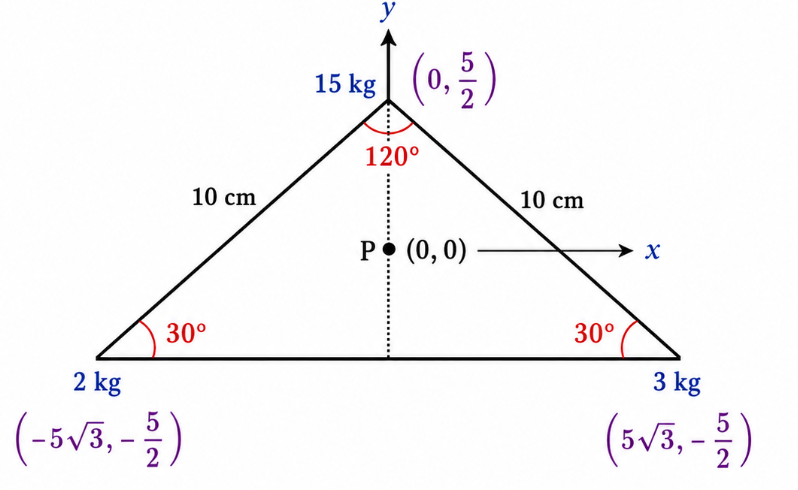
The position of center of mass of three masses 2 kg, 3 kg and 15 kg placed with respect to mid point (p) of normal bisector, as shown in the figure is _______.

image
Question 45 JEE Mains

Two identical bodies A and B of equal masses have initial velocities $$\vec{v_1} = 4\hat{i}$$ m/s and $$\vec{v_2} = 4\hat{j}$$ m/s respectively. The body A has acceleration $$\vec{a_1} = 6\hat{i} + 6\hat{j}$$ m/s$$^2$$ while the acceleration of the other body B is zero. The centre of mass of the two bodies moves in __________ path.

Question 46 JEE Mains

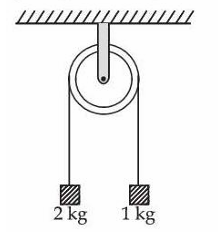
Two blocks of masses 2 kg and 1 kg respectively, are tied to the ends of a string which passes over a light frictionless pulley as shown in the figure. The masses are held at rest at the same horizontal level and then released. The distance traversed by the centre of mass in 2 s is _________ m. (Take $$g = 10$$ m/s$$^2$$)

image
Question 47 JEE Mains

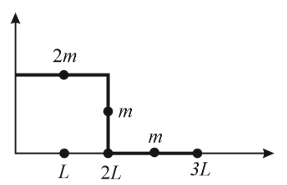
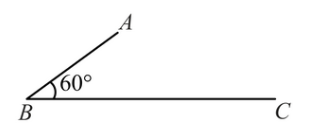
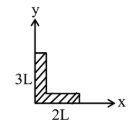
A rod of length 5L is bent right angle keeping one side length as 2L.

image

The position of the centre of mass of the system: (Consider L = 10 cm)

For effective preparation, use the PDF after studying the basic concepts and formulas. It can also be combined with previous year questions, chapter-wise practice, and regular revision.

ResourceWhat It Provides
JEE Centre of Mass QuestionsNumerical and conceptual practice
Question PDFFocused chapter-wise question set
Video SolutionsStep-by-step explanations
IITian ExplanationsDetailed reasoning and problem-solving approach
Concept PracticeProblems from important Centre of Mass concepts
Exam PreparationUseful for JEE Main and JEE Advanced

Try solving the questions without looking at the solutions initially. Reviewing the explanation afterwards can help you identify whether the difficulty was with the concept, coordinate selection, formula application, or calculation.

Important Centre of Mass Topics for JEE

Centre of Mass is an important Mechanics topic because it allows a system containing several particles or bodies to be analysed through a single representative point. A clear understanding of mass distribution is essential for solving both direct and advanced problems.

The major areas to prepare are:

Centre of Mass TopicWhat to Practise
Basic DefinitionMeaning and physical interpretation of COM
Two-Particle SystemMass-weighted position calculations
Multiple ParticlesCOM using coordinates and vectors
Continuous BodiesRods, wires, plates, and laminae
Composite ObjectsDividing complex bodies into simpler sections
SymmetryLocating COM using symmetry arguments
Motion of COMVelocity and acceleration of the centre of mass
Linear MomentumRelation between momentum and COM velocity
External ForceMotion of COM under a net external force
CollisionsCentre-of-mass frame and momentum applications

A common mistake is to assume that the centre of mass is always at the geometrical centre. This is true only when the mass distribution has the required symmetry. When different masses or differently shaped components are combined, their masses and individual centres of mass must be considered.

For composite objects, one efficient method is to divide the body into simple parts whose centres of mass are already known. The overall centre of mass can then be obtained using a mass-weighted average.

Students should also connect Centre of Mass with other JEE Physics Important Topics such as momentum, collisions, rotational motion, and Newton's laws. These links are especially useful in multi-concept questions.

JEE Main & Advanced Centre of Mass Weightage Analysis

The number of Centre of Mass questions is not fixed across every JEE Main shift or JEE Advanced paper. The topic may appear independently or as part of a larger problem involving momentum, collisions, mechanics, or multiple-body systems. Weightage should therefore be used as a preparation reference rather than as a fixed question count.

AreaCommon Applications
Particle SystemsFinding COM coordinates
Composite BodiesCombining simpler bodies
Symmetrical ObjectsUsing symmetry to locate COM
COM MotionFinding velocity and acceleration
External ForcesApplying (F_{\text{ext}}=Ma_{\text{cm}})
MomentumRelating total momentum to COM velocity
CollisionsSolving problems in the COM frame
Advanced SystemsMulti-body and changing configurations

For JEE Main, begin with standard coordinate-based questions, simple particle systems, and composite-body problems. Once the basic calculations become comfortable, move to questions involving momentum and motion of the centre of mass.

For JEE Advanced, practise more challenging problems in which the COM method reduces a complicated system to a simpler one. JEE Advanced previous papers can be particularly useful for understanding how Centre of Mass is combined with other Mechanics concepts.

The objective should be to understand why the centre-of-mass method works and when it offers a simpler solution, rather than memorising a collection of standard question patterns.

Why Practice JEE Centre of Mass Questions?

Centre of Mass questions test a student's ability to convert a physical arrangement into a mathematical model. The calculation itself may be simple, but identifying the correct coordinates, mass distribution, or symmetry often requires careful observation.

Regular practice helps students:

  • Apply the centre-of-mass formula confidently.
  • Solve systems containing multiple particles or bodies.
  • Recognise useful symmetry conditions.
  • Handle rods, wires, plates, and composite objects.
  • Connect centre-of-mass motion with momentum and external force.
  • Improve coordinate and vector-based calculations.

Start with simple two-particle problems and gradually move towards multiple particles and continuous bodies. After gaining confidence, practise mixed questions involving momentum, collisions, and motion.

A structured JEE Physics Course can help students learn the concepts in sequence, but question practice is essential for developing speed and flexibility. Use the PDF actively: attempt the question, note your approach, and then compare it with the detailed IITian explanation.

When reviewing a wrong answer, do not only correct the final value. Check where the solution went wrong. A misplaced coordinate, incorrect mass assignment, or wrong centre of an individual component can affect the complete calculation.

Tips to Solve Centre of Mass Questions Faster

A systematic approach can reduce the amount of calculation needed in Centre of Mass problems.

Select a convenient origin

Choose the origin and coordinate axes so that the positions of the masses become simple. Taking a symmetry point or one component as the origin can often reduce the algebra.

Look for symmetry first

Before writing equations, check whether the object or mass distribution is symmetric. Symmetry may immediately determine one or more coordinates of the centre of mass.

When the net external force is zero, the centre of mass moves with constant velocity. This relation can simplify problems involving several interacting bodies.

Revise standard results

Keep the important COM formulas and standard positions of centres of mass in your JEE Formula Sheet. Regular revision helps you recognise familiar structures quickly instead of deriving every result from the beginning.

Practise JEE Chapter-wise PYQ

Work through JEE Chapter-wise PYQ questions after completing the theory. Focus on particle systems, composite bodies, moving systems, momentum, and collision problems to gain exposure to different applications.

Practise under a time limit

Once the chapter is well understood, use a JEE Advanced mock test or a timed Mechanics practice session to check your speed. Pay attention to questions that take too long even when your final answer is correct.

Finally, maintain an error log for Centre of Mass problems. Note whether the mistake came from choosing coordinates, identifying the mass distribution, applying the formula, or performing the calculation. Regularly revising these errors along with your other JEE Physics Important Topics can make problem-solving more efficient and accurate.

Frequently Asked Questions