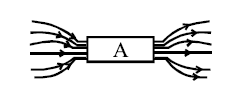
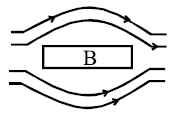
Given below are two statements: one is labelled as Assertion (A) and the other is labelled as Reason (R)
Consider a ferromagnetic material :
Assertion (A) : The individual atoms in a ferromagnetic material possess a magnetic dipole moment and interact with one another in such a way that they spontaneously align themselves forming domains.
Reason (R): At high enough temperature, the domain structure of ferromagnetic material disintegrates. Thus, magnetization will disappear at high enough temperature known as Curie temperature.
In the light of the above statements, choose the correct answer from the options given below :
JEE Magnetism & Magnetic Materials Questions
We need to evaluate the Assertion and Reason about ferromagnetic materials.
Assertion (A): "The individual atoms in a ferromagnetic material possess a magnetic dipole moment and interact with one another in such a way that they spontaneously align themselves forming domains."
Analysis: In ferromagnetic materials (like iron, cobalt, nickel), each atom has a permanent magnetic dipole moment due to unpaired electrons. These atomic magnetic moments interact through a quantum mechanical exchange interaction, which causes neighboring moments to align parallel to each other spontaneously, forming regions called magnetic domains. Assertion (A) is TRUE.
Reason (R): "At high enough temperature, the domain structure of ferromagnetic material disintegrates. Thus, magnetization will disappear at high enough temperature known as Curie temperature."
Analysis: Above the Curie temperature, thermal energy overcomes the exchange interaction energy, destroying the long-range ordering of magnetic moments. The material transitions from ferromagnetic to paramagnetic behavior. Reason (R) is TRUE.
Relationship: While both statements are true, Reason (R) describes what happens at high temperatures (loss of domain structure), which does not explain why domains form in the first place (Assertion A). The formation of domains is due to exchange interactions at lower temperatures, not related to their destruction at the Curie temperature. R does NOT explain A.
The correct answer is Option 1: Both (A) and (R) are true but (R) is not the correct explanation of (A).
A solenoid has a core made of material with relative permeability 400. The magnetic field produced in the interior of solenoid is 1.0 T. The magnetic intensity in SI units is $$\alpha \times 10^5$$. The value of $$\alpha$$ is ______.
(Free space permeability $$\mu_0 = 4\pi \times 10^{-7}$$ SI units.)
The magnetic flux density, magnetic field strength and permeability are related by
$$B = \mu\,H = \mu_{0}\,\mu_{r}\,H$$
Hence
$$H = \frac{B}{\mu_{0}\,\mu_{r}}$$
Given data:
$$B = 1.0\ \text{T},\qquad \mu_{r} = 400,\qquad \mu_{0} = 4\pi \times 10^{-7}\ \text{H m}^{-1}$$
Substituting the values:
$$H = \frac{1.0}{\bigl(4\pi \times 10^{-7}\bigr)\,(400)}$$
Simplify the denominator:
$$4\pi \times 10^{-7} \times 400 = 1600\pi \times 10^{-7} = 1.6\times10^{-4}\,\pi$$
Therefore
$$H = \frac{1}{1.6\times10^{-4}\,\pi}\ \text{A m}^{-1}$$
Working out the numerical factor:
$$\frac{1}{1.6\times10^{-4}} = \frac{1}{1.6}\times10^{4} = 0.625\times10^{4} = 6.25\times10^{3}$$
Hence
$$H = \frac{6.25\times10^{3}}{\pi}\ \text{A m}^{-1}$$
Express this in the form $$H = \alpha \times 10^{5}\ \text{A m}^{-1}$$:
$$\frac{6.25\times10^{3}}{\pi} = \frac{0.0625\times10^{5}}{\pi}$$
Thus
$$\alpha = \frac{0.0625}{\pi} = \frac{1}{16\pi}$$
Therefore, the correct choice is:
Option B which is: $$\frac{1}{16\pi}$$
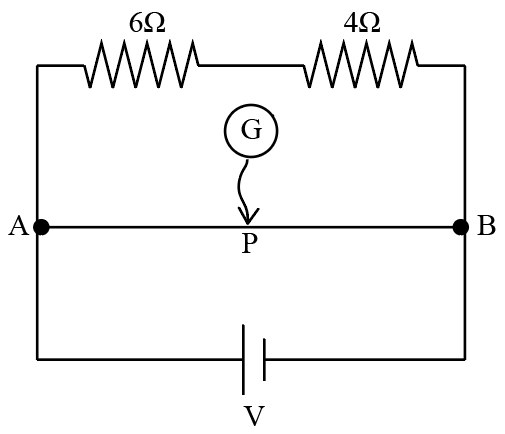
The total length of potentiometer wire AB is 50 cm in the arrangement as shown in figure. If P is the point where the galvanometer shows zero reading then the length AP is ____ cm.
potentiometer works on the principle of wheatstone bridge.
Length of segment AP = $$x$$
Length of segment PB = $$50 - x$$
resistance of potentiometer wire directly prorportional to length($$R = \rho \frac{l}{A}$$)
The balancing condition for the Wheatstone bridge is:
$$ \frac{R_1}{R_2} = \frac{\text{Length of AP}}{\text{Length of PB}} $$
$$ \frac{R_1}{R_2} = \frac{x}{50 - x} $$
$$ \frac{6}{4} = \frac{x}{50 - x} $$
$$x$$=30cm
A short bar magnet placed with its axis at 30° with an external field of 800 Gauss, experiences a torque of 0.016 N.m. The work done in moving it from most stable to most unstable position is $$\alpha \times 10^{-3}J$$. The value of $$\alpha$$ is ___.
We need to find the work done in moving a short bar magnet from the most stable to the most unstable position.
Angle with external field: $$\theta = 30°$$
External field: $$B = 800$$ Gauss = 0.08 T
Torque: $$\tau = 0.016$$ N.m
Torque on a magnetic dipole: $$\tau = mB\sin\theta$$
$$0.016 = m \times 0.08 \times \sin 30°$$
$$0.016 = m \times 0.08 \times 0.5 = 0.04m$$
$$m = \frac{0.016}{0.04} = 0.4 \text{ A.m}^2$$
The most stable position is when $$\theta = 0°$$ (magnet aligned with the field).
The most unstable position is when $$\theta = 180°$$ (magnet anti-parallel to the field).
Work done is the change in potential energy:
$$W = U_{final} - U_{initial} = (-mB\cos 180°) - (-mB\cos 0°)$$
$$W = mB + mB = 2mB$$
$$W = 2 \times 0.4 \times 0.08 = 0.064 \text{ J} = 64 \times 10^{-3} \text{ J}$$
Therefore, $$\alpha = $$ 64.
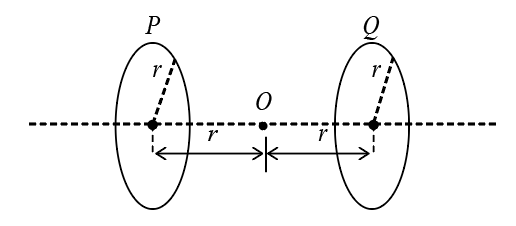
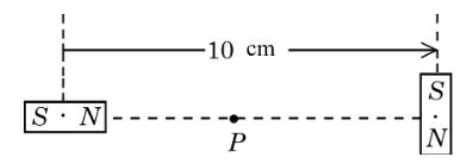
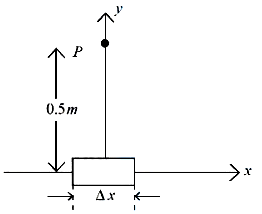
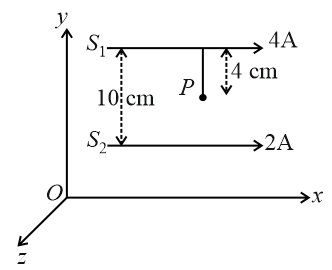
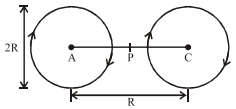
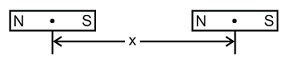
Two identical small bar magnets each of dipole moment $$3\sqrt{5}$$ J/T are placed at a center to center separation of 10 cm, with their axes perpendicular to each other as shown in figure. The value of magnetic field at the point P midway between the magnets is $$\alpha \times 10^{-3}$$ T. The value of $$\alpha$$ is ______
($$\mu_0 = 4\pi \times 10^{-7}$$ Tm/A)
The centres of the two identical magnets are $$10 \text{ cm}=0.10 \text{ m}$$ apart, so the midpoint $$P$$ is at a distance $$r=\dfrac{0.10}{2}=0.05 \text{ m}$$ from each magnet.
Choose the geometry so that the axis of magnet 1 lies along the line joining the two centres, while the axis of magnet 2 is perpendicular to that line (the axes are given to be perpendicular).
• Therefore, point $$P$$ is on the axial line of magnet 1.
• The same point $$P$$ is on the equatorial line of magnet 2.
For a magnetic dipole of moment $$m$$, the magnitudes of the magnetic field at a point situated at a distance $$r$$ are
Axial line: $$B_{\text{axial}}=\dfrac{\mu_0}{4\pi}\dfrac{2m}{r^{3}}$$
Equatorial line: $$B_{\text{eq}}=\dfrac{\mu_0}{4\pi}\dfrac{m}{r^{3}}$$
The given dipole moment of each magnet is $$m = 3\sqrt{5}\ \text{A·m}^2$$ and $$\dfrac{\mu_0}{4\pi}=10^{-7}\ \text{T·m/A}$$. With $$r = 0.05\ \text{m}$$, we have $$r^{3}=(0.05)^{3}=0.000125 = 1.25\times10^{-4}\ \text{m}^3$$.
Field at $$P$$ due to magnet 1 (axial):
$$B_1 = 10^{-7}\,\dfrac{2m}{r^{3}}
= 10^{-7}\,\dfrac{2(3\sqrt5)}{1.25\times10^{-4}}
= 10^{-7}\,(6\sqrt5)\times8\times10^{3}
= 4.8\sqrt5\times10^{-3}\ \text{T}$$
Numerically, $$4.8\sqrt5 = 4.8(2.236) \approx 10.733$$, so $$B_1 \approx 10.733\times10^{-3}\ \text{T}$$.
Field at $$P$$ due to magnet 2 (equatorial):
$$B_2 = 10^{-7}\,\dfrac{m}{r^{3}}
= 10^{-7}\,\dfrac{3\sqrt5}{1.25\times10^{-4}}
= 10^{-7}\,(3\sqrt5)\times8\times10^{3}
= 2.4\sqrt5\times10^{-3}\ \text{T}$$
Numerically, $$2.4\sqrt5 = 2.4(2.236) \approx 5.366$$, so $$B_2 \approx 5.366\times10^{-3}\ \text{T}$$.
The directions of $$B_1$$ and $$B_2$$ are perpendicular because each field is directed along the axis of its magnet, and the two axes are mutually perpendicular. Therefore, the resultant field magnitude at point $$P$$ is the vector sum:
$$B = \sqrt{B_1^{2}+B_2^{2}}
= \sqrt{(10.733\times10^{-3})^{2} + (5.366\times10^{-3})^{2}}
= 10^{-3}\sqrt{10.733^{2}+5.366^{2}}$$
$$10.733^{2}=115.238,\qquad 5.366^{2}=28.803$$
$$\therefore B = 10^{-3}\sqrt{115.238 + 28.803}
= 10^{-3}\sqrt{144.041}
\approx 10^{-3}\times 12.000
= 12.0\times10^{-3}\ \text{T}$$
Comparing with the required form $$B = \alpha \times 10^{-3}\ \text{T}$$, we get
$$\alpha = 12$$
Answer: 12

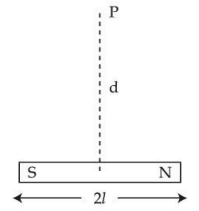
A bar magnet has total length $$2l = 20$$ units and the field point $$P$$ is at a distance d = 10 units from the centre of the magnet. If the relative uncertainty of length measurement is 1%, then uncertainty of the magnetic field at point P is :
A galvanometer having a coil of resistance 30Ω need 20 mA of current for full-scale deflection. If a maximum current of 3 A is to be measured using this galvanometer, the resistance of the shunt to be added to the galvanometer should be $$\frac{30}{X}$$Ω.where X is Options
We need to find the shunt resistance for a galvanometer.
G = 30 Ω, $$I_g$$ = 20 mA = 0.02 A, I = 3 A
$$S = \frac{GI_g}{I - I_g} = \frac{30 \times 0.02}{3 - 0.02} = \frac{0.6}{2.98} = \frac{60}{298} = \frac{30}{149}$$
So $$S = \frac{30}{149}$$ Ω, meaning X = 149.
The correct answer is Option 2: 149.
A magnetic dipole experiences a torque of $$80\sqrt{3}$$ N m when placed in uniform magnetic field in such a way that dipole moment makes angle of 60° with magnetic field. The potential energy of the dipole is:
A magnetic dipole with dipole moment $$M$$ in a uniform magnetic field $$B$$ experiences a torque $$\tau = MB\sin\theta$$ and has potential energy $$U = -MB\cos\theta$$.
Given $$\tau = 80\sqrt{3}$$ N m and $$\theta = 60°$$:
$$MB\sin 60° = 80\sqrt{3}$$
$$MB \cdot \dfrac{\sqrt{3}}{2} = 80\sqrt{3}$$
$$MB = 160$$
The potential energy is: $$U = -MB\cos 60° = -160 \cdot \dfrac{1}{2} = -80$$ J
Hence, the correct answer is Option D.
The relationship between the magnetic susceptibility ($$\chi$$) and the magnetic permeability ($$\mu$$) is given by: ($$\mu_0$$ is the permeability of free space and $$\mu_r$$ is relative permeability)
The magnetisation $$M$$ produced in a material kept in an external magnetic field $$H$$ is written as
$$M = \chi\,H$$, where $$\chi$$ is called the magnetic susceptibility.
The magnetic induction $$B$$ inside the same material is given by
$$B = \mu\,H$$, where $$\mu$$ is the magnetic permeability of the material.
For vacuum (or free space) the induction is $$B_0 = \mu_0\,H$$, so the relative permeability of the material is defined as
$$\mu_r = \frac{\mu}{\mu_0}$$.
By definition we can also write
$$B = \mu_0\,(H + M)$$. Substituting $$M = \chi\,H$$ gives
$$B = \mu_0\,(H + \chi H) = \mu_0\,(1 + \chi)\,H$$.
Comparing the two expressions for $$B$$:
$$\mu\,H = \mu_0\,(1 + \chi)\,H$$.
Cancelling the common factor $$H$$, we get
$$\mu = \mu_0\,(1 + \chi)$$.
Divide both sides by $$\mu_0$$:
$$\frac{\mu}{\mu_0} = 1 + \chi$$.
The left side is just $$\mu_r$$, so
$$\mu_r = 1 + \chi \quad$$(relation between $$\mu_r$$ and $$\chi$$).
Rearranging for susceptibility:
$$\chi = \mu_r - 1 = \frac{\mu}{\mu_0} - 1$$.
Thus the correct option is
$$\chi = \frac{\mu}{\mu_0} - 1$$ → Option A.
Given below are two statements : one is labelled as Assertion (A) and the other is labelled as Reason(R).
Assertion (A) : Magnetic monopoles do not exist.
Reason (R) : Magnetic field lines are continuous and form closed loops.
In the light of the above statements, choose the most appropriate answer from the options given below :
For a magnetic field $$\mathbf{B}$$, Gauss’s law for magnetism states $$\nabla\!\cdot\!\mathbf{B}=0$$ $$-(1)$$.
Equation $$(1)$$ means the net magnetic flux through any closed surface is zero. Hence there are no sources or sinks of the magnetic field analogous to electric charges. In other words, isolated north poles or south poles (magnetic monopoles) are absent. This validates Assertion (A).
Because $$\nabla\!\cdot\!\mathbf{B}=0$$ everywhere, magnetic field lines can neither start nor end; they must be continuous and form closed loops. Therefore Reason (R) is also a correct statement.
Moreover, the continuity of magnetic field lines (closed loops) is the direct physical manifestation of $$\nabla\!\cdot\!\mathbf{B}=0$$, which is precisely why magnetic monopoles do not exist. Thus Reason (R) correctly explains Assertion (A).
So, both Assertion (A) and Reason (R) are correct and Reason (R) is the correct explanation of Assertion (A).
Answer: Option C
The magnetic moment of a bar magnet is $$0.5$$ Am$$^2$$. It is suspended in a uniform magnetic field of $$8 \times 10^{-2}$$ T. The work done in rotating it from its most stable to most unstable position is:
{image}
The coercivity of a magnet is $$5 \times 10^3$$ A/m. The amount of current required to be passed in a solenoid of length 30 cm and the number of turns 150, so that the magnet gets demagnetised when inside the solenoid is _____ A.
We need to find the current required to demagnetise a magnet placed inside a solenoid, given the coercivity of the magnet.
Coercivity is the intensity of the magnetising field ($$H$$) required to reduce the magnetisation of a material to zero after it has been magnetised. In other words, to demagnetise the magnet, we need to apply a magnetic field intensity equal to its coercivity, which is $$H = 5 \times 10^3$$ A/m.
Since the magnetic field intensity inside a solenoid is given by $$H = nI = \frac{N}{L} \times I$$, where $$N$$ is the total number of turns, $$L$$ is the length of the solenoid, and $$I$$ is the current, we can use this relation to determine the required current.
Next, substituting $$N = 150$$ turns, $$L = 30$$ cm $$= 0.3$$ m, and $$H = 5 \times 10^3$$ A/m into the expression gives $$5 \times 10^3 = \frac{150}{0.3} \times I$$, which simplifies to $$5 \times 10^3 = 500 \times I$$. From this, $$I = \frac{5 \times 10^3}{500} = 10 \text{ A}$$.
The answer is 10 A.
The magnetic potential due to a magnetic dipole at a point on its axis situated at a distance of $$20$$ cm from its center is $$1.5 \times 10^{-5}$$ T m. The magnetic moment of the dipole is _______ A m$$^2$$. (Given: $$\frac{\mu_0}{4\pi} = 10^{-7}$$ T m A$$^{-1}$$)
Magnetic potential on axis: $$V = \frac{\mu_0}{4\pi}\frac{M\cos\theta}{r^2}$$. On axis, $$\theta = 0$$:
$$V = \frac{\mu_0 M}{4\pi r^2} = 10^{-7} \times \frac{M}{(0.2)^2} = 10^{-7} \times 25M$$
$$1.5 \times 10^{-5} = 25 \times 10^{-7} M$$. $$M = \frac{1.5 \times 10^{-5}}{25 \times 10^{-7}} = 6$$ Am².
The answer is $$\boxed{6}$$.
A coil of 200 turns and area $$0.20 \text{ m}^2$$ is rotated at half a revolution per second and is placed in uniform magnetic field of 0.01 T perpendicular to axis of rotation of the coil. The maximum voltage generated in the coil is $$\frac{2\pi}{\beta}$$ volt. The value of $$\beta$$ is ______.
A coil of 200 turns and area $$0.20 \text{ m}^2$$ is rotated at half a revolution per second in a uniform magnetic field of 0.01 T perpendicular to the axis of rotation. We need to find $$\beta$$ where the maximum voltage is $$\frac{2\pi}{\beta}$$ V.
The EMF induced in a rotating coil in a magnetic field is:
$$\varepsilon = NAB\omega\sin(\omega t)$$
The maximum EMF is:
$$\varepsilon_{\max} = NAB\omega$$
The coil rotates at $$\frac{1}{2}$$ revolution per second, so:
$$\omega = 2\pi \times \frac{1}{2} = \pi \text{ rad/s}$$
$$\varepsilon_{\max} = 200 \times 0.20 \times 0.01 \times \pi$$
$$= 200 \times 0.002 \times \pi$$
$$= 0.4\pi$$
$$= \frac{2\pi}{5}$$
Comparing $$\frac{2\pi}{5}$$ with $$\frac{2\pi}{\beta}$$:
$$\beta = 5$$
The answer is 5.
A straight magnetic strip has a magnetic moment of $$44 \text{ Am}^2$$. If the strip is bent in a semicircular shape, its magnetic moment will be ______ $$\text{Am}^2$$. (given $$\pi = \frac{22}{7}$$)
We need to find the magnetic moment of a straight magnetic strip after it is bent into a semicircular shape.
Original magnetic moment: $$M = 44 \text{ Am}^2$$
$$\pi = \frac{22}{7}$$
For a bar magnet (or magnetic strip), the magnetic moment is defined as:
$$M = m \times L$$
where $$m$$ is the pole strength and $$L$$ is the length of the strip (distance between the poles). Here:
$$44 = m \times L \implies m = \frac{44}{L}$$
When the strip of length $$L$$ is bent into a semicircular shape, the length of the strip equals the semicircular arc:
$$\pi R = L \implies R = \frac{L}{\pi}$$
where $$R$$ is the radius of the semicircle.
In a semicircle, the two ends of the strip (which carry the magnetic poles) are at diametrically opposite points. The distance between them is the diameter:
$$d = 2R = \frac{2L}{\pi}$$
The pole strength $$m$$ remains unchanged (it is an intrinsic property of the magnet). The new magnetic moment is:
$$M' = m \times d = m \times \frac{2L}{\pi} = \frac{2mL}{\pi} = \frac{2M}{\pi}$$
$$M' = \frac{2 \times 44}{\pi} = \frac{88}{\frac{22}{7}} = \frac{88 \times 7}{22} = \frac{616}{22} = 28 \text{ Am}^2$$
The answer is 28 Am$$^2$$.
In Young's double slit experiment, carried out with light of wavelength $$5000 \text{ \AA}$$, the distance between the slits is $$0.3 \text{ mm}$$ and the screen is at $$200 \text{ cm}$$ from the slits. The central maximum is at $$x = 0 \text{ cm}$$. The value of $$x$$ for third maxima is ______ mm.
We are given that $$\lambda = 5000$$ Å $$= 5 \times 10^{-7}$$ m, $$d = 0.3$$ mm $$= 3 \times 10^{-4}$$ m, and $$D = 200$$ cm $$= 2$$ m.
The position of the $$n$$-th maximum in YDSE is given by
$$x_n = \frac{n\lambda D}{d}$$
For the third maximum ($$n = 3$$), we then have
$$x_3 = \frac{3 \times 5 \times 10^{-7} \times 2}{3 \times 10^{-4}} = \frac{30 \times 10^{-7}}{3 \times 10^{-4}} = 10 \times 10^{-3} = 10 \text{ mm}$$
Hence, the third maximum is located at 10 mm from the central maximum.
A bar magnet with a magnetic moment 5.0 A m$$^2$$ is placed in parallel position relative to a magnetic field of 0.4 T. The amount of required work done in turning the magnet from parallel to antiparallel position relative to the field direction is ________.
The work done in rotating a magnetic dipole in a uniform magnetic field is:
$$ W = -mB(\cos\theta_2 - \cos\theta_1) $$
where $$m = 5.0$$ A m$$^2$$, $$B = 0.4$$ T.
Initial position: parallel ($$\theta_1 = 0°$$)
Final position: antiparallel ($$\theta_2 = 180°$$)
$$ W = -mB(\cos 180° - \cos 0°) = -5.0 \times 0.4 \times (-1 - 1) $$
$$ W = -2.0 \times (-2) = 4 \text{ J} $$
Given below are two statements: one is labelled as Assertion A and the other is labelled as Reason R.
Assertion A: Electromagnets are made of soft iron.
Reason R: Soft iron has high permeability and low retentivity.
In the light of above statements, choose the most appropriate answer from the options given below.
Assertion A: Electromagnets are made of soft iron. This is true — soft iron is the standard core material for electromagnets.
Reason R: Soft iron has high permeability and low retentivity.
High permeability means soft iron gets magnetized very easily when placed in a magnetic field. Low retentivity means it loses its magnetism quickly when the magnetizing field is removed.
These are exactly the properties needed for an electromagnet — it should magnetize strongly when current flows, and demagnetize immediately when current stops.
Both A and R are correct, and R correctly explains why soft iron is used for electromagnets (high permeability for strong magnetization, low retentivity for easy demagnetization).
Therefore, the answer is Option C.
Given below are two statements:
Statement I: For diamagnetic substance $$-1 \leq x < 0$$, where x is the magnetic susceptibility.
Statement II: Diamagnetic substance when placed in an external magnetic field, tend to move from stronger to weaker part of the field. In the light of the above statements, choose the correct answer from the options give below.
The magnetisation of a linear magnetic medium is given by $$\mathbf{M} = \chi \mathbf{H}$$, where $$\chi$$ is the (volume) magnetic susceptibility and $$\mathbf{H}$$ is the magnetising field.
Relative permeability is defined as $$\mu_r = 1 + \chi$$ $$-(1)$$
Case 1 → Statement I
For a diamagnetic substance:
• The induced dipoles are opposite to the applied field, hence $$\chi$$ is negative.
• In naturally occurring materials $$|\chi|$$ is very small (of the order $$10^{-5}$$).
• Condition $$\mu_r \gt 0$$ must hold for ordinary matter. From $$(1)$$ this gives
$$1 + \chi \gt 0 \;\;\Longrightarrow\;\; \chi \gt -1$$
Combining the facts “$$\chi$$ is negative” and “$$\chi \gt -1$$” we obtain the range
$$-1 \le \chi \lt 0$$
Therefore Statement I is correct.
Case 2 → Statement II
The potential energy of a small sample in a non-uniform field is $$U = -\tfrac{1}{2}\,\chi V \mu_0 H^2$$, where $$V$$ is its volume. For a diamagnet $$\chi \lt 0$$, so $$U$$ increases with $$H^2$$. To minimise energy the sample drifts toward the region where $$H$$ is smaller, that is, from the stronger part of the field to the weaker part.
Hence Statement II is also correct.
Since both statements are true, the correct choice is Option D.
Given below are two statements:
Statement I : The diamagnetic property depends on temperature.
Statement II : The induced magnetic dipole moment in a diamagnetic sample is always opposite to the magnetising field.
In the light of statements, choose the correct answer from the options given below
The free space inside a current carrying toroid is filled with a material of susceptibility $$2 \times 10^{-2}$$. The percentage increase in the value of magnetic field inside the toroid will be
We need to find the percentage increase in the magnetic field inside a toroid when the free space is filled with a material of magnetic susceptibility $$\chi = 2 \times 10^{-2}$$.
For a toroid with $$n$$ turns per unit length carrying current $$I$$, the magnetic field in free space is $$B_0 = \mu_0 n I$$.
When the interior is filled with a magnetic material, the relative permeability becomes $$\mu_r = 1 + \chi$$, so the total magnetic field is:
$$B = \mu_0(1 + \chi) n I = B_0(1 + \chi)$$
(This is because the magnetizing field $$H = nI$$ remains the same, being determined by the free current, and $$B = \mu H = \mu_0(1 + \chi)H$$.)
Now, the percentage increase in the magnetic field is:
$$\frac{\Delta B}{B_0} \times 100 = \frac{B_0 \chi}{B_0} \times 100 = \chi \times 100 = 2 \times 10^{-2} \times 100 = 2\%$$
Hence, the correct answer is Option 3.
A compass needle oscillates 20 times per minute at a place where the dip is $$30°$$ and 30 times per minute where the dip is $$60°$$. The ratio of total magnetic field due to the earth at two places respectively is $$\frac{4}{\sqrt{x}}$$. The value of $$x$$ is _____.
The current required to be passed through a solenoid of 15 cm length and 60 turns in order to demagnetise a bar magnet of magnetic intensity $$2.4 \times 10^3$$ A m$$^{-1}$$ is _______ A.
Given: Length $$l = 15$$ cm = 0.15 m, number of turns $$N = 60$$, magnetic intensity $$H = 2.4 \times 10^3$$ A/m.
The magnetic field intensity inside a solenoid is:
$$H = nI = \frac{N}{l}I$$
To demagnetise the bar magnet, the solenoid must produce a field of the same intensity:
$$I = \frac{Hl}{N} = \frac{2.4 \times 10^3 \times 0.15}{60} = \frac{360}{60} = 6 \text{ A}$$
The current required is 6 A.
Given below are two statements :
Statement - I : Susceptibilities of paramagnetic and ferromagnetic substances increase with decrease in temperature.
Statement - II : Diamagnetism is a result of orbital motions of electrons developing magnetic moments opposite to the applied magnetic field.
Choose the correct answer from the options given below
Statement I: Susceptibilities of paramagnetic and ferromagnetic substances increase with decrease in temperature.
For paramagnetic materials, Curie's law states $$\chi = \frac{C}{T}$$, so susceptibility increases as temperature decreases. This is true.
For ferromagnetic materials, below the Curie temperature, the susceptibility increases significantly as temperature decreases (the material becomes more strongly magnetized). Above the Curie temperature, it follows the Curie-Weiss law $$\chi = \frac{C}{T - T_c}$$, which also increases as temperature decreases toward $$T_c$$. So Statement I is true.
Statement II: Diamagnetism is a result of orbital motions of electrons developing magnetic moments opposite to the applied magnetic field.
This is true. Diamagnetism arises because the applied magnetic field modifies the orbital motion of electrons, inducing a net magnetic moment that opposes the applied field (Lenz's law at the atomic level). This effect is present in all materials but is very weak.
Since both statements are true:
Hence, the correct answer is Option A.
A compass needle of oscillation magnetometer oscillates 20 times per minute at a place P of dip $$30^\circ$$. The number of oscillations per minute become 10 at another place Q of $$60^\circ$$ dip. The ratio of the total magnetic field at the two places $$(B_Q : B_P)$$ is:
A compass needle oscillates 20 times/min at place P (dip $$30^\circ$$) and 10 times/min at place Q (dip $$60^\circ$$). Find $$B_Q : B_P$$.
Recall that the frequency of oscillation of a magnetic needle is given by $$f = \frac{1}{2\pi}\sqrt{\frac{MB_H}{I}}$$, where $$B_H$$ is the horizontal component of the magnetic field, $$M$$ is the magnetic moment, and $$I$$ is the moment of inertia. Since $$f \propto \sqrt{B_H}$$, it follows that $$f^2 \propto B_H$$.
The horizontal component of the magnetic field relates to the total magnetic field by $$B_H = B\cos\delta$$, where $$\delta$$ is the angle of dip. Therefore, at place P, $$B_{H_P} = B_P \cos 30^\circ = B_P \cdot \frac{\sqrt{3}}{2}$$ and at place Q, $$B_{H_Q} = B_Q \cos 60^\circ = B_Q \cdot \frac{1}{2}$$.
Using the ratio of squared frequencies, we write $$\frac{f_P^2}{f_Q^2} = \frac{B_{H_P}}{B_{H_Q}}$$. Substituting $$f_P = 20$$ and $$f_Q = 10$$ yields $$\frac{20^2}{10^2} = \frac{B_P \cdot \frac{\sqrt{3}}{2}}{B_Q \cdot \frac{1}{2}}$$, which simplifies to $$4 = \frac{B_P \sqrt{3}}{B_Q}$$. From this it follows that $$\frac{B_Q}{B_P} = \frac{\sqrt{3}}{4}$$.
Hence, the required ratio of the magnitudes of the magnetic fields is $$B_Q : B_P = \sqrt{3} : 4$$. Therefore, the answer is Option A: $$\sqrt{3} : 4$$.
A magnet hung at $$45°$$ with magnetic meridian makes an angle of $$60°$$ with the horizontal. The actual value of the angle of dip is
The magnetic moment of an electron ($$e$$) revolving in an orbit around nucleus with an orbital angular momentum is given by
We need to find the relation between the magnetic moment and the orbital angular momentum of an electron revolving around a nucleus.
An electron moving in a circular orbit constitutes a current loop whose magnetic moment is given by $$\mu_L = iA$$, where $$i$$ is the current and $$A$$ is the area of the orbit.
The current due to the electron moving with period $$T$$ is $$i = \frac{e}{T} = \frac{ev}{2\pi r}$$, and the area of the circular orbit is $$A = \pi r^2$$.
Substituting these expressions gives $$\mu_L = \frac{ev}{2\pi r} \times \pi r^2 = \frac{evr}{2}$$.
Since the orbital angular momentum is $$L = mvr$$, it follows that $$vr = \frac{L}{m}$$, and therefore $$\mu_L = \frac{eL}{2m}$$.
For a negatively charged electron, the magnetic moment is opposite in direction to the angular momentum, so $$\vec{\mu}_L = -\frac{e\vec{L}}{2m}$$.
Hence, the correct answer is Option B.
The space inside a straight current carrying solenoid is filled with a magnetic material having magnetic susceptibility equal to $$1.2 \times 10^{-5}$$. What is fractional increase in the magnetic field inside solenoid with respect to air as medium inside the solenoid?
The magnetic susceptibility of the material inside the solenoid is $$\chi_m = 1.2 \times 10^{-5}$$.
Write the magnetic field with and without the magnetic material.
With air (vacuum): $$B_0 = \mu_0 nI$$
With the magnetic material: $$B = \mu_0(1 + \chi_m) nI$$
Calculate the fractional increase in magnetic field.
$$\frac{\Delta B}{B_0} = \frac{B - B_0}{B_0} = \frac{\mu_0(1 + \chi_m)nI - \mu_0 nI}{\mu_0 nI}$$
$$\frac{\Delta B}{B_0} = (1 + \chi_m) - 1 = \chi_m = 1.2 \times 10^{-5}$$
The fractional increase in the magnetic field is equal to the magnetic susceptibility, which is $$1.2 \times 10^{-5}$$.
The correct answer is Option A.
A bar magnet having a magnetic moment of $$2.0 \times 10^5$$ J T$$^{-1}$$, is placed along the direction of uniform magnetic field of magnitude $$B = 14 \times 10^{-5}$$ T. The work done in rotating the magnet slowly through $$60°$$ from the direction of field is
We need to find the work done in rotating a bar magnet from 0° to 60° in a uniform magnetic field.
Magnetic moment: $$M = 2.0 \times 10^5$$ J T$$^{-1}$$
Magnetic field: $$B = 14 \times 10^{-5}$$ T
Initial angle: $$\theta_1 = 0°$$ (along the field)
Final angle: $$\theta_2 = 60°$$
The work done in rotating a magnetic dipole in a uniform magnetic field is:
$$W = -MB(\cos\theta_2 - \cos\theta_1)$$
$$W = MB(\cos\theta_1 - \cos\theta_2)$$
$$W = 2.0 \times 10^5 \times 14 \times 10^{-5} \times (\cos 0° - \cos 60°)$$
$$W = 28 \times \left(1 - \frac{1}{2}\right)$$
$$W = 28 \times \frac{1}{2} = 14 \text{ J}$$
Hence, the correct answer is Option A.
Two bar magnets oscillate in a horizontal plane in earth's magnetic field with time periods of $$3 \text{ s}$$ and $$4 \text{ s}$$ respectively. If their moments of inertia are in the ratio of $$3:2$$ then the ratio of their magnetic moments will be
Two bar magnets oscillate in Earth's magnetic field with time periods $$T_1 = 3$$ s and $$T_2 = 4$$ s, and their moments of inertia are in the ratio $$I_1 : I_2 = 3 : 2$$. We need the ratio of their magnetic moments.
Since the time period of a bar magnet oscillating in a magnetic field $$B$$ is given by $$T = 2\pi\sqrt{\frac{I}{MB}},$$ where $$I$$ is the moment of inertia and $$M$$ is the magnetic moment, squaring this expression yields $$T^2 = 4\pi^2 \frac{I}{MB} \implies M = \frac{4\pi^2 I}{T^2 B}.$$
Therefore, the ratio of the magnetic moments becomes $$\frac{M_1}{M_2} = \frac{I_1}{I_2} \times \frac{T_2^2}{T_1^2}.$$
Substituting the given ratios into the above expression yields $$\frac{M_1}{M_2} = \frac{3}{2} \times \frac{16}{9} = \frac{48}{18} = \frac{8}{3}.$$
Hence, the correct answer is Option B: $$8:3$$.
The susceptibility of a paramagnetic material is $$99$$. The permeability of the material in Wb/A - m, is
[Permeability of free space $$\mu_0 = 4\pi \times 10^{-7}$$ Wb/A - m]
Given: Susceptibility $$\chi = 99$$, and $$\mu_0 = 4\pi \times 10^{-7}$$ Wb/A-m.
The relationship between permeability and susceptibility is:
$$\mu = \mu_0(1 + \chi)$$
Substituting the values:
$$\mu = 4\pi \times 10^{-7} \times (1 + 99)$$
$$\mu = 4\pi \times 10^{-7} \times 100$$
$$\mu = 4\pi \times 10^{-5} \text{ Wb/A-m}$$
The correct answer is Option A.
The vertical component of the earth's magnetic field is $$6 \times 10^{-5}$$ T at any place where the angle of dip is 37°. The earth's resultant magnetic field at that place will be (Given tan 37° = 3/4)
We have the vertical component of the Earth's magnetic field $$B_V = 6 \times 10^{-5}$$ T and the angle of dip $$\delta = 37°$$, with $$\tan 37° = \frac{3}{4}$$.
The relationship between the vertical component, horizontal component, and the resultant magnetic field is: $$B_V = B \sin \delta$$, where $$B$$ is the resultant (total) magnetic field.
We also know that $$\sin 37° = \frac{3}{5}$$ (since $$\tan 37° = 3/4$$, we have a 3-4-5 triangle giving $$\sin 37° = 3/5$$).
Therefore: $$B = \frac{B_V}{\sin 37°} = \frac{6 \times 10^{-5}}{3/5} = 6 \times 10^{-5} \times \frac{5}{3} = 10 \times 10^{-5} = 1 \times 10^{-4}$$ T.
Hence, the correct answer is Option 4.
The soft-iron is a suitable material for making an electromagnet. This is because soft-iron has
An electromagnet needs to be easily magnetized when current flows and easily demagnetized when the current is switched off.
Understand the required properties: High permeability: Permeability measures how easily a material can be magnetized. A material with high permeability allows magnetic field lines to pass through it easily and becomes strongly magnetized even with a small applied magnetic field. This is essential for an electromagnet to be effective.
Low retentivity: Retentivity (or remanence) is the ability of a material to retain magnetization after the external magnetic field is removed. For an electromagnet, we need LOW retentivity so that the magnet can be easily switched off (demagnetized) when the current stops.
Low coercivity: Coercivity is the reverse field needed to demagnetize the material. Low coercivity also helps in easy demagnetization.
Evaluate the options: Option A: Low coercivity and high retentivity - High retentivity is undesirable as the electromagnet would remain magnetized after switching off.
Option B: Low coercivity and low permeability - Low permeability means the material would not magnetize strongly, making a weak electromagnet.
Option C: High permeability and low retentivity - This is the ideal combination: strong magnetization when ON, easy demagnetization when OFF.
Option D: High permeability and high retentivity - High retentivity would keep the magnet magnetized even after switching off.
Soft iron has high permeability (easily magnetized) and low retentivity (easily demagnetized), making it ideal for electromagnets.
The correct answer is Option C.
In a ferromagnetic material, below the curie temperature, a domain is defined as:
In a ferromagnetic material below the Curie temperature, the material is divided into small regions called magnetic domains. Within each domain, the atomic magnetic dipoles are aligned parallel to each other due to strong exchange interactions between neighbouring atoms.
This parallel alignment of all magnetic dipoles within a domain means that each domain is magnetised to saturation, i.e., it has the maximum possible magnetisation. The domain as a whole behaves like a tiny magnet with a definite magnetisation direction.
However, different domains may have their magnetisation directions oriented differently, so the net magnetisation of the bulk material can be zero in the demagnetised state. When an external magnetic field is applied, domains aligned with the field grow at the expense of others, leading to net magnetisation of the material.
Therefore, a domain in a ferromagnetic material below the Curie temperature is defined as a macroscopic region with saturation magnetisation.
A soft ferromagnetic material is placed in an external magnetic field. The magnetic domains:
In a ferromagnetic material, the atomic magnetic dipoles are grouped into regions called magnetic domains. Within each domain, the dipoles are aligned in the same direction, but different domains may point in different directions.
When a soft ferromagnetic material is placed in an external magnetic field, the domains respond in two ways. First, the domains whose magnetic moments are aligned (or nearly aligned) with the external field tend to grow in size at the expense of neighbouring domains that are less favourably oriented. This is called domain wall motion. Second, the magnetic moments of individual domains may rotate to align more closely with the applied field direction. This is called domain rotation.
Depending on the strength and direction of the external field relative to each domain's initial orientation, some domains increase in size while others decrease. Additionally, the orientation of domains changes to align with the field. In a soft ferromagnetic material, both these processes occur readily because the domain walls move easily.
Therefore, the magnetic domains may increase or decrease in size and change their orientation.
The correct answer is that domains may increase or decrease in size and change its orientation.
Statement I : The ferromagnetic property depends on temperature. At high temperature, ferromagnet becomes paramagnet.
Statement II : At high temperature, the domain wall area of a ferromagnetic substance increases. In the light of the above statements, choose the most appropriate answer from the options given below:
Statement I states that ferromagnetic property depends on temperature, and above a certain temperature (the Curie temperature), a ferromagnet becomes a paramagnet. This is correct — it is the well-established Curie temperature phenomenon.
Statement II states that at high temperature, the domain wall area of a ferromagnetic substance increases. This is incorrect. At high temperature, the domains actually break down or become disordered. The thermal energy disrupts the alignment of magnetic moments within domains. Above the Curie temperature, domain structure itself ceases to exist as the material becomes paramagnetic — it is not that domain walls increase in area. In fact, as temperature increases, thermal agitation destroys the long-range magnetic order, causing the domains to shrink and eventually disappear rather than domain walls expanding.
Therefore, Statement I is true but Statement II is false.
Choose the correct option.
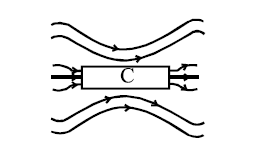
Which of the following statements are correct?
(A) Electric monopoles do not exist whereas magnetic monopoles exist.
(B) Magnetic field lines due to a solenoid at its ends and outside cannot be completely straight and confined.
(C) Magnetic field lines are completely confined within a toroid.
(D) Magnetic field lines inside a bar magnet are not parallel.
(E) $$\chi = -1$$ is the condition for a perfect diamagnetic material, where $$\chi$$ is its magnetic susceptibility.
Choose the correct answer from the options given below :
A bar magnet of length 14 cm is placed in the magnetic meridian with its north pole pointing towards the geographic north pole. A neutral point is obtained at a distance of 18 cm from the center of the magnet. If $$B_H = 0.4$$ G, the magnetic moment of the magnet is (1 G = $$10^{-4}$$ T):
A bar magnet of length $$2l = 14$$ cm (so $$l = 7$$ cm $$= 0.07$$ m) is placed in the magnetic meridian with its north pole pointing towards geographic north. A neutral point is found at a distance $$r = 18$$ cm $$= 0.18$$ m from the center of the magnet.
When the north pole of the magnet points toward geographic north, the magnet's axial field reinforces Earth's horizontal field on both sides along the axis. On the equatorial line (perpendicular bisector), the magnet's field points opposite to the magnet's magnetic moment direction (i.e., southward), opposing the Earth's field. So the neutral points lie on the equatorial line.
At the neutral point on the equatorial line, the magnetic field due to the magnet equals $$B_H$$: $$\frac{\mu_0}{4\pi} \cdot \frac{M}{(r^2 + l^2)^{3/2}} = B_H$$.
Solving for $$M$$: $$M = \frac{B_H \cdot (r^2 + l^2)^{3/2}}{\mu_0 / (4\pi)}$$.
Computing $$r^2 + l^2 = (0.18)^2 + (0.07)^2 = 0.0324 + 0.0049 = 0.0373$$ m$$^2$$.
$$(r^2 + l^2)^{3/2} = (0.0373)^{3/2} = 0.0373 \times \sqrt{0.0373} = 0.0373 \times 0.19314 = 7.204 \times 10^{-3}$$ m$$^3$$.
With $$B_H = 0.4$$ G $$= 4 \times 10^{-5}$$ T and $$\frac{\mu_0}{4\pi} = 10^{-7}$$ T m/A:
$$M = \frac{4 \times 10^{-5} \times 7.204 \times 10^{-3}}{10^{-7}} = \frac{2.8816 \times 10^{-7}}{10^{-7}} = 2.880$$ J T$$^{-1}$$.
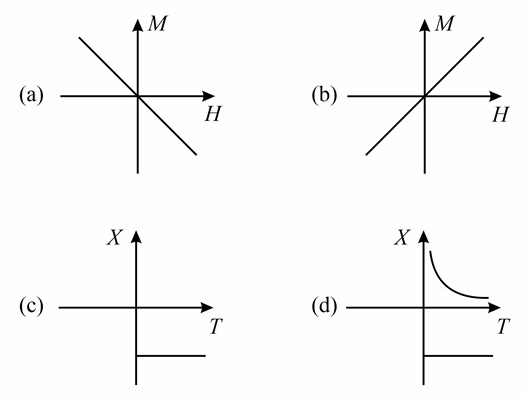
Following plots show Magnetization (M) vs Magnetising field (H) and Magnetic susceptibility ($$\chi$$) vs Temperature (T) graph:
Which of the following combination will be represented by a diamagnetic material?
At an angle of 30$$^\circ$$ to the magnetic meridian, the apparent dip is 45$$^\circ$$. Find the true dip:
The relation between apparent dip $$\delta'$$, true dip $$\delta$$, and the angle $$\phi$$ from the magnetic meridian is $$\tan\delta' = \frac{\tan\delta}{\cos\phi}$$.
Here $$\phi = 30^\circ$$ and $$\delta' = 45^\circ$$, so $$\tan 45^\circ = \frac{\tan\delta}{\cos 30^\circ}$$.
This gives $$1 = \frac{\tan\delta}{\sqrt{3}/2}$$, so $$\tan\delta = \frac{\sqrt{3}}{2}$$.
Therefore the true dip is $$\delta = \tan^{-1}\!\left(\dfrac{\sqrt{3}}{2}\right)$$.
The magnetic susceptibility of a material of a rod is 499. Permeability in vacuum is $$4\pi \times 10^{-7}$$ Hm$$^{-1}$$. Absolute permeability of the material of the rod is:
The relative permeability of a material is $$\mu_r = 1 + \chi_m$$, where $$\chi_m$$ is the magnetic susceptibility.
Given $$\chi_m = 499$$, we have $$\mu_r = 1 + 499 = 500$$.
The absolute permeability is $$\mu = \mu_r \mu_0 = 500 \times 4\pi \times 10^{-7}$$ Hm$$^{-1}$$.
Computing: $$\mu = 500 \times 4\pi \times 10^{-7} = 2000\pi \times 10^{-7} = 2\pi \times 10^{-4}$$ Hm$$^{-1}$$.
In a uniform magnetic field, the magnetic needle has a magnetic moment $$9.85 \times 10^{-2}$$ A m$$^{-2}$$ and moment of inertia $$5 \times 10^{-6}$$ kg m$$^2$$. If it performs 10 complete oscillations in 5 seconds then the magnitude of the magnetic field is _________ mT [Take $$\pi^2$$ as 9.85]
We are given a magnetic needle that executes small angular oscillations in a uniform magnetic field. The standard result for such a magnet is that the time period $$T$$ of one complete oscillation is related to its moment of inertia $$I$$, its magnetic moment $$M$$, and the magnetic-field magnitude $$B$$ by
$$T \;=\; 2\pi\sqrt{\dfrac{I}{M\,B}}$$
This follows from the equation of a physical torsional pendulum, where the restoring torque is $$M B \sin\theta \approx M B\,\theta$$ for small angles, giving simple harmonic motion.
The magnet makes 10 complete oscillations in 5 s, so the time period of one oscillation is
$$T \;=\; \dfrac{\text{total time}}{\text{number of oscillations}} \;=\; \dfrac{5\ \text{s}}{10} \;=\; 0.5\ \text{s}.$$
The numerical data are
$$I = 5\times10^{-6}\ \text{kg m}^2, \qquad M = 9.85\times10^{-2}\ \text{A m}^2.$$
First we isolate $$B$$ from the period formula. Beginning with
$$T = 2\pi\sqrt{\dfrac{I}{M B}},$$
divide by $$2\pi$$:
$$\dfrac{T}{2\pi} = \sqrt{\dfrac{I}{M B}}.$$
Now square both sides:
$$\left(\dfrac{T}{2\pi}\right)^2 = \dfrac{I}{M B}.$$
Cross-multiplying gives an explicit expression for $$B$$:
$$B = \dfrac{I}{M}\;\dfrac{4\pi^{2}}{T^{2}}.$$
The question supplies the approximation $$\pi^{2}=9.85$$, so
$$4\pi^{2} = 4 \times 9.85 = 39.4.$$
Calculate the numerator:
$$I \;(4\pi^{2}) = \bigl(5\times10^{-6}\bigr)\times39.4 = 197\times10^{-6} = 1.97\times10^{-4}.$$
Calculate the denominator $$M\,T^{2}$$ step by step:
$$T^{2} = (0.5)^{2} = 0.25,$$
$$M\,T^{2} = \bigl(9.85\times10^{-2}\bigr)\times0.25 = 2.4625\times10^{-2} = 0.024625.$$
Substituting into the expression for $$B$$:
$$B = \dfrac{1.97\times10^{-4}}{0.024625} = \dfrac{1.97}{2.4625}\times10^{-2}\ \text{T}.$$
The ratio $$\dfrac{1.97}{2.4625}$$ is exactly 0.8, so
$$B = 0.8\times10^{-2}\ \text{T} = 0.008\ \text{T}.$$
Because $$1\ \text{T}=10^{3}\ \text{mT}$$, converting to millitesla gives
$$B = 0.008 \times 10^{3}\ \text{mT} = 8\ \text{mT}.$$
So, the answer is $$8\text{ mT}$$.
A long solenoid with 1000 turns m$$^{-1}$$ has a core material with relative permeability 500 and volume $$10^3$$ cm$$^3$$. If the core material is replaced by another material having relative permeability of 750 with same volume maintaining same current of 0.75 A in the solenoid, the fractional change in the magnetic moment of the core would be approximately $$\frac{x}{499}$$. Find the value of $$x$$.
We have a long solenoid that originally contains a core material whose relative permeability is given as $$\mu_{r1}=500$$. The number of turns per unit length of the solenoid is $$n=1000\;\text{turns m}^{-1}$$ and the exciting current is $$I=0.75\;\text{A}$$. Later, the core is replaced by another material of the same volume but with a different relative permeability $$\mu_{r2}=750$$. We have to find the fractional change in the magnetic moment of the core.
First, recall the magnetic field strength inside a long solenoid. The standard result is
$$H = nI,$$
where $$H$$ is the magnetic field intensity, $$n$$ is the number of turns per unit length and $$I$$ is the current. Because both $$n$$ and $$I$$ remain the same before and after the replacement of the core, the quantity $$H$$ remains unchanged throughout this problem.
Next, recall the relationship between magnetisation $$M$$, magnetic susceptibility $$\chi_m$$ and the field strength $$H$$. The definition is
$$M = \chi_m\,H.$$
Magnetic susceptibility and relative permeability are connected through the familiar formula
$$\chi_m = \mu_r - 1.$$
Hence, for the first core material we have
$$\chi_{m1} = \mu_{r1} - 1 = 500 - 1 = 499,$$
and for the second core material we have
$$\chi_{m2} = \mu_{r2} - 1 = 750 - 1 = 749.$$
The magnetisations therefore become
$$M_1 = \chi_{m1}H = 499\,H,$$
$$M_2 = \chi_{m2}H = 749\,H.$$
The magnetic moment $$\mu$$ of a uniformly magnetised body is given by the product of its magnetisation $$M$$ and its volume $$V$$:
$$\mu = M\,V.$$
Because the volume of the core is stated to remain the same (namely $$V = 10^3\;\text{cm}^3$$, which we need not convert because it will cancel out), we may write
$$\mu_1 = M_1V = 499\,HV,$$
$$\mu_2 = M_2V = 749\,HV.$$
Now we compute the fractional change in the magnetic moment. The fractional change is the ratio of the change to the original value:
$$\text{Fractional change} = \frac{\mu_2 - \mu_1}{\mu_1}.$$ Substituting the expressions for $$\mu_2$$ and $$\mu_1$$ we get
$$\frac{749\,HV - 499\,HV}{499\,HV} = \frac{(749 - 499)\,HV}{499\,HV} = \frac{250}{499}.$$ Hence the fractional change can be written as $$\dfrac{x}{499}$$ with
$$x = 250.$$ Therefore, the required value is $$x = 250.$$
Hence, the correct answer is Option 250.
The value of aluminium susceptibility is $$2.2 \times 10^{-5}$$. The percentage increase in the magnetic field if space within a current carrying toroid is filled with aluminium is $$\frac{x}{10^4}$$. Then the value of $$x$$ is ___.
First recall the expression for the magnetic field in the core of a toroid. In an empty (air-filled) toroid the magnetic permeability is simply $$\mu_0$$, so the field is
$$B_0 = \mu_0\,nI,$$
where $$n = \dfrac{N}{\ell}$$ represents the number of turns per unit length and $$I$$ is the current.
When we fill the same space with a magnetic material of susceptibility $$\chi$$, its relative permeability becomes
$$\mu_r = 1 + \chi.$$
The actual permeability inside the material is therefore
$$\mu = \mu_0\,\mu_r = \mu_0(1+\chi).$$
Substituting this new permeability into the toroid formula, the magnetic field now becomes
$$B = \mu\,nI = \mu_0(1+\chi)\,nI.$$
The increase in the field strength is
$$\Delta B = B - B_0 = \mu_0(1+\chi)\,nI - \mu_0\,nI = \mu_0 nI\,\chi.$$
The fractional (or relative) increase is then
$$\frac{\Delta B}{B_0} = \frac{\mu_0 nI\,\chi}{\mu_0 nI} = \chi.$$
To turn this into a percentage increase, we multiply by 100 %:
$$\text{Percentage increase} = \chi \times 100\%.$$
For aluminium we are given
$$\chi = 2.2 \times 10^{-5}.$$
Hence
$$\text{Percentage increase} = 2.2 \times 10^{-5} \times 100 = 2.2 \times 10^{-3}.$$
According to the problem statement, this percentage is expressed as $$\dfrac{x}{10^{4}}$$. Setting the two expressions equal gives
$$\frac{x}{10^{4}} = 2.2 \times 10^{-3}.$$
Now we solve for $$x$$:
$$x = 2.2 \times 10^{-3} \times 10^{4} = 2.2 \times 10^{1} = 22.$$
So, the answer is $$22$$.
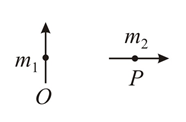
Two short magnetic dipoles $$m_1$$ and $$m_2$$ each having magnetic moment of 1 A m$$^2$$ are placed at point O and P respectively. The distance between OP is 1 m. The torque experienced by the magnetic dipole $$m_2$$ due to the presence of $$m_1$$ is _________ $$\times 10^{-7}$$ N m
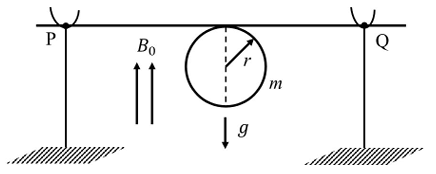
A small circular loop of conducting wire has radius $$a$$ and carries current $$I$$. It is placed in a uniform magnetic field $$B$$ perpendicular to its plane such that when rotated slightly about its diameter and released, it starts performing simple harmonic motion of time period $$T$$. The mass of the loop is $$m$$ then:
We have a thin circular loop of radius $$a$$, carrying a current $$I$$ and possessing mass $$m$$. In a uniform magnetic field $$B$$ directed perpendicular to the plane of the loop, the loop behaves like a magnetic dipole. Its magnetic dipole moment is, by definition,
$$\mu = I \,A = I\,(\pi a^{2}).$$
Next, we need the moment of inertia of the loop about the diameter about which it is allowed to oscillate. For a thin circular ring, the perpendicular-axis theorem gives
$$I_{x}+I_{y}=I_{z}.$$
Here $$I_{z}=m a^{2}$$ (axis through the centre and perpendicular to the plane). Because the two diameters in the plane are equivalent, $$I_{x}=I_{y}$$; hence
$$2I_{x}=m a^{2}\quad\Longrightarrow\quad I_{x}=I_{y}=\frac{1}{2}m a^{2}.$$
Thus the moment of inertia about the diameter of oscillation is
$$I_{\text{m.o.i.}}=\frac{1}{2}m a^{2}.$$
When the loop is given a small angular displacement $$\theta$$ from its equilibrium position, the restoring magnetic torque is
$$\tau = \mu B \sin\theta.$$
For small angles, $$\sin\theta \approx \theta$$, so
$$\tau \approx \mu B\,\theta.$$
The rotational form of Newton’s second law states
$$I_{\text{m.o.i.}}\;\frac{d^{2}\theta}{dt^{2}} = -\tau,$$
the negative sign indicating that the torque is restoring. Substituting the expressions for $$\tau$$ and $$I_{\text{m.o.i.}}$$, we obtain
$$\frac{1}{2}m a^{2}\;\frac{d^{2}\theta}{dt^{2}} \;=\; -\,\mu B\,\theta.$$
Simplifying,
$$\frac{d^{2}\theta}{dt^{2}} + \underbrace{\left(\frac{2\mu B}{m a^{2}}\right)}_{\omega^{2}}\theta = 0.$$
This is the standard differential equation of simple harmonic motion, $$\displaystyle \frac{d^{2}\theta}{dt^{2}}+\omega^{2}\theta = 0,$$ whose angular frequency is
$$\omega = \sqrt{\frac{2\mu B}{m a^{2}}}.$$
The time period is related to angular frequency by the formula
$$T = \frac{2\pi}{\omega}.$$
Substituting $$\omega$$,
$$T = 2\pi\sqrt{\frac{m a^{2}}{2\mu B}}.$$
Now we replace $$\mu$$ by $$I\pi a^{2}$$:
$$T = 2\pi\sqrt{\frac{m a^{2}}{2\,I\pi a^{2} B}} = 2\pi\sqrt{\frac{m}{2I\pi B}}.$$
Notice that $$a^{2}$$ cancels out. Extracting the common factors inside the square root,
$$T = 2\pi\;\frac{\sqrt{m}}{\sqrt{2I\pi B}} = \frac{2\sqrt{\pi}\,\sqrt{m}}{\sqrt{2I B}} = \sqrt{\frac{2\pi m}{I B}}.$$
Hence, the correct answer is Option C.
A small bar magnet is placed with its axis at 30° with an external magnetic field of 0.06 T experiences a torque of 0.018 Nm. The minimum work required to rotate it from its stable to unstable equilibrium position is:
We are told that a bar magnet placed in a uniform magnetic field experiences a torque. For a magnetic dipole, the relation between the torque $$\tau$$, the magnetic dipole moment $$M$$, the magnetic field $$B$$ and the angle $$\theta$$ between $$\vec M$$ and $$\vec B$$ is stated first:
$$\tau \;=\; M\,B\,\sin\theta$$
The numerical values given are
$$\tau = 0.018\ \text{N m}, \qquad B = 0.06\ \text{T}, \qquad \theta = 30^\circ.$$
We substitute these values into the formula to isolate $$M$$. We begin by writing
$$M = \dfrac{\tau}{B\,\sin\theta}.$$
Now, since $$\sin 30^\circ = \dfrac12,$$ we have
$$B\,\sin\theta \;=\; 0.06 \times \dfrac12 \;=\; 0.03.$$
So
$$M = \dfrac{0.018}{0.03} = 0.6\ \text{A m}^2.$$
Next we calculate the work needed to turn the magnet from its stable to its unstable equilibrium position. The potential energy $$U$$ of a magnetic dipole in a field is
$$U = -M\,B\,\cos\theta.$$
The stable equilibrium corresponds to $$\theta = 0^\circ$$ (magnet aligned with the field), and the unstable equilibrium corresponds to $$\theta = 180^\circ$$ (magnet anti-aligned). We compute the energies at these two orientations.
At $$\theta = 0^\circ$$:
$$U_{\text{stable}} = -M\,B\,\cos 0^\circ = -M\,B \times 1 = -M\,B.$$
At $$\theta = 180^\circ$$:
$$U_{\text{unstable}} = -M\,B\,\cos 180^\circ = -M\,B \times (-1) = +M\,B.$$
The work required is the increase in potential energy while going from the stable to the unstable state:
$$W = U_{\text{unstable}} - U_{\text{stable}} = (M\,B) - (-M\,B) = 2\,M\,B.$$
Substituting the values $$M = 0.6\ \text{A m}^2$$ and $$B = 0.06\ \text{T}$$ we get
$$W = 2 \times 0.6 \times 0.06 = 2 \times 0.036 = 0.072\ \text{J}.$$
Writing this in scientific notation,
$$W = 7.2 \times 10^{-2}\ \text{J}.$$
Hence, the correct answer is Option C.
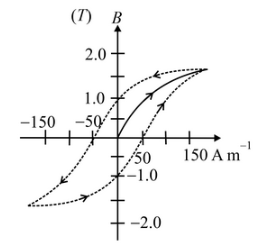
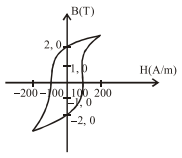
The figure gives experimentally measured B vs. H variation in a ferromagnetic material. The retentivity, coercivity and saturation, respectively, of the material are
A paramagnetic sample shows a net magnetisation of 6 A/m when it is placed in an external magnetic field of 0.4 T at a temperature of 4 K. When the sample is placed in an external magnetic field of 0.3 T at a temperature of 24 K, then the magnetisation will be:
A perfectly diamagnetic sphere has a small spherical cavity at its centre, which is filled with a paramagnetic substance. The whole system is placed in a uniform magnetic field $$\vec{B}$$. Then the field inside the paramagnetic substance is:
An iron rod of volume $$10^{-3}\,\text{m}^3$$ and relative permeability 1000 is placed as core in a solenoid with 10 turns $$\text{cm}^{-1}$$. If a current of $$0.5\,\text{A}$$ is passed through the solenoid, then the magnetic moment of the rod will be:
We are asked to find the magnetic dipole moment of the iron rod after it is inserted in the solenoid and an electric current is sent through the turns. Let us introduce the symbols that will be used:
$$$V = 10^{-3}\,\text{m}^3 \qquad (\text{volume of the rod})$$$ $$$\mu_r = 1000 \qquad (\text{relative permeability of iron})$$$ $$$n = 10\,\text{turns cm}^{-1} \qquad (\text{number of turns per centimetre})$$$ $$$I = 0.5\,\text{A} \qquad (\text{current through the solenoid})$$$
First we convert the turn density into SI units (turns per metre). Since $$1\,\text{cm} = 10^{-2}\,\text{m},$$ we obtain
$$$n = 10\,\text{turns cm}^{-1} = 10 \times \frac{1}{10^{-2}}\,\text{turns m}^{-1} = 10 \times 100\,\text{turns m}^{-1} = 1000\,\text{turns m}^{-1}.$$$
Now we recall the definition of the magnetising field $$H$$ inside an ideal long solenoid. The standard formula is
$$H = n I,$$
where $$n$$ is the number of turns per metre and $$I$$ is the current in amperes. Substituting the known values we get
$$$H = (1000\,\text{turns m}^{-1})(0.5\,\text{A}) = 500\,\text{A m}^{-1}.$$$
Next we connect the magnetising field $$H$$ to the magnetisation $$M$$ of the iron core. For a linear magnetic material we use the relation
$$M = \chi_m H,$$
where $$\chi_m$$ is the magnetic susceptibility given by
$$\chi_m = \mu_r - 1.$$
For the present rod,
$$\chi_m = 1000 - 1 = 999.$$
Hence the magnetisation becomes
$$$M = 999 \times 500\,\text{A m}^{-1} = 499{,}500\,\text{A m}^{-1} = 4.995 \times 10^{5}\,\text{A m}^{-1}.$$$
The total magnetic dipole moment $$m$$ of the rod is obtained by multiplying the magnetisation $$M$$ by the volume $$V$$ (because magnetisation is magnetic moment per unit volume):
$$m = M V.$$
Substituting $$M = 4.995 \times 10^{5}\,\text{A m}^{-1}$$ and $$V = 10^{-3}\,\text{m}^3$$ gives
$$$m = (4.995 \times 10^{5}\,\text{A m}^{-1})(10^{-3}\,\text{m}^3) = 4.995 \times 10^{2}\,\text{A m}^2.$$$
In scientific notation this is essentially
$$m \approx 5 \times 10^{2}\,\text{A m}^2.$$
This numerical value exactly matches option B among the given choices.
Hence, the correct answer is Option B.
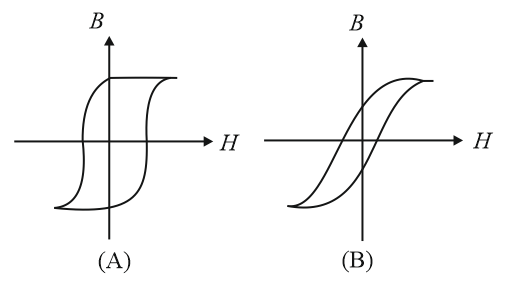
Magnetic materials used for making permanent magnets (P) and magnets in a transformer (T) have different properties of the following, which property best matches for the type of magnet required?
First, let us recall what the two keywords in the options mean.
Retentivity (also called remanence) is the residual value of magnetic induction $$B$$ left in the material when the magnetising field $$H$$ is reduced to zero. In simpler words, a material with large retentivity can hold on to its magnetism for a long time after the external field is removed.
Coercivity is the reverse magnetic field that must be applied to bring that residual induction back to zero. Thus a material with large coercivity needs a strong opposite field to demagnetise it; in other words, it strongly resists any attempt to lose its magnetisation.
Now we analyse the requirements for the two devices mentioned in the question.
For a permanent magnet, we want the magnet to remain magnetised under all ordinary circumstances. Therefore we require
$$\text{Retentivity : large}$$
so that a large residual magnetism is present, and
$$\text{Coercivity : large}$$
so that stray fields, heating, or mechanical shocks cannot easily demagnetise it.
For a transformer core, on the other hand, the magnetic field inside the core is made to reverse direction many times every second (50 Hz or 60 Hz). We need a material whose magnetisation follows the external field easily; otherwise energy will be wasted as heat. Hence, for a transformer we actually desire small coercivity and small retentivity, giving a narrow hysteresis loop and low hysteresis loss.
Scanning the given options, we see that Option D states
$$P : \text{large retentivity, large coercivity}$$
which is exactly the pair of properties we have just concluded to be essential for a permanent magnet. None of the other options simultaneously satisfies both conditions for the permanent magnet, and the statements given for the transformer in the other options are also not the ideal combination.
Hence, the correct answer is Option D.
A hoop and a solid cylinder of same mass and radius are made of a permanent magnetic material with their respective axes. But the magnetic moment of hoop is twice of solid cylinder. They are placed in a uniform magnetic field in such a manner that their magnetic moments make a small angle with the field. If the oscillation periods of hoop and cylinder are $$T_h$$ and $$T_c$$ respectively, then:
We first recall the relation between the restoring torque acting on a magnetic dipole and the angular acceleration it produces. A magnetic dipole of moment $$\mu$$ kept in a uniform magnetic field $$B$$ experiences a torque
$$\tau = \mu B\sin\theta,$$
where $$\theta$$ is the angle between $$\vec\mu$$ and $$\vec B$$. For very small oscillations, $$\sin\theta \approx \theta$$, so the torque becomes
$$\tau \;=\; -\,\mu B\,\theta.$$
(The minus sign only indicates that the torque is restoring.)
In rotational dynamics the torque is also related to the angular acceleration $$\alpha$$ by
$$\tau = I\alpha = I\frac{d^{2}\theta}{dt^{2}},$$
where $$I$$ is the moment of inertia about the axis of rotation. Combining the two expressions, we obtain
$$I\frac{d^{2}\theta}{dt^{2}} = -\,\mu B\,\theta.$$
This is the differential equation of simple harmonic motion, with the square of the angular frequency given by
$$\omega^{2} = \frac{\mu B}{I}.$$
Hence the time-period of small oscillations is
$$T = 2\pi\sqrt{\frac{I}{\mu B}}.$$
Now we analyse the two given bodies one by one.
Hoop (ring)
We are told that the mass of the hoop is $$M$$ and the radius is $$R$$. About its own axis the moment of inertia is well known:
$$I_h = MR^{2}.$$
The magnetic moment of the hoop is twice that of the solid cylinder, so if we denote the cylinder’s magnetic moment by $$\mu_c$$, then
$$\mu_h = 2\mu_c.$$
Substituting these values in the period formula, we find
$$T_h = 2\pi\sqrt{\frac{I_h}{\mu_h B}} = 2\pi\sqrt{\frac{MR^{2}}{(2\mu_c)B}} = 2\pi\sqrt{\frac{MR^{2}}{2\mu_c B}}.$$
Solid cylinder
For a solid cylinder of the same mass $$M$$ and radius $$R$$, the moment of inertia about its own axis is
$$I_c = \frac{1}{2}MR^{2}.$$
Its magnetic moment is simply $$\mu_c.$$
Putting these quantities into the period formula gives
$$T_c = 2\pi\sqrt{\frac{I_c}{\mu_c B}} = 2\pi\sqrt{\frac{\dfrac{1}{2}MR^{2}}{\mu_c B}} = 2\pi\sqrt{\frac{MR^{2}}{2\mu_c B}}.$$
We see that the square-root expressions for $$T_h$$ and $$T_c$$ are identical:
$$T_h = 2\pi\sqrt{\frac{MR^{2}}{2\mu_c B}} \quad \text{and} \quad T_c = 2\pi\sqrt{\frac{MR^{2}}{2\mu_c B}}.$$
Therefore
$$T_h = T_c.$$
Hence, the correct answer is Option B.
A paramagnetic material has $$10^{28}$$ atoms m$$^{-3}$$. Its magnetic susceptibility at temperature 350 K is $$2.8 \widetilde{A} \times 10^{-4}$$. Its susceptibility at 300 K is
For a paramagnetic substance we use Curie’s law, which states that the magnetic susceptibility $$\chi$$ varies inversely with the absolute temperature $$T$$:
$$\chi = \dfrac{C}{T},$$
where $$C$$ is Curie’s constant (a material‐specific constant).
Because the same specimen is observed at two different temperatures, the value of $$C$$ remains unchanged. Thus we may write for the two sets of observations
$$\chi_1 T_1 = C = \chi_2 T_2.$$
Rearranging to obtain the unknown susceptibility $$\chi_2$$ at temperature $$T_2$$ we get
$$\chi_2 = \chi_1 \dfrac{T_1}{T_2}.$$
The data provided are
Initial susceptibility: $$\chi_1 = 2.8 \times 10^{-4}.$$
Initial temperature: $$T_1 = 350 \text{ K}.$$
Required temperature: $$T_2 = 300 \text{ K}.$$
Substituting these values into the rearranged Curie’s law expression:
$$\chi_2 = \left(2.8 \times 10^{-4}\right)\dfrac{350}{300}.$$
First evaluate the fraction $$\dfrac{350}{300}$$:
$$\dfrac{350}{300} = \dfrac{35}{30} = \dfrac{7}{6} = 1.166\overline{6}.$$
Now multiply this factor with $$2.8 \times 10^{-4}$$:
$$\chi_2 = 2.8 \times 10^{-4} \times 1.166\overline{6}.$$
Carrying out the multiplication step by step:
$$2.8 \times 1.166\overline{6} = 3.266\overline{6}.$$
Hence
$$\chi_2 \approx 3.266\overline{6} \times 10^{-4}.$$
Rounding to three significant figures,
$$\chi_2 \approx 3.267 \times 10^{-4}.$$
This value matches the entry in Option C.
Hence, the correct answer is Option C.
A paramagnetic substance in the form of a cube with sides 1 cm has a magnetic dipole moment of $$20 \times 10^{-6}$$ J/T when a magnetic intensity of $$60 \times 10^3$$ A/m is applied. Its magnetic susceptibility is:
We begin by recalling that the magnetic moment of a uniformly magnetised body is related to its magnetisation by
$$\vec M \;=\; \frac{\text{total magnetic moment}}{\text{volume of the body}}\;.$$
Here the substance is a cube whose edge length is given as $$1\ \text{cm}$$. Converting this length into SI units, we have
$$1\ \text{cm}=1\times10^{-2}\ \text{m}=0.01\ \text{m}\,.$$
Now the volume of a cube is the cube of its side, so
$$V=(0.01\ \text{m})^{3}=0.01^{3}\ \text{m}^{3}=1\times10^{-6}\ \text{m}^{3}\,.$$
The total magnetic dipole moment of the cube is given as $$20\times10^{-6}\ \text{J/T}$$. Remembering that $$1\ \text{J/T}=1\ \text{A·m}^{2}$$, we can write
$$\mu =20\times10^{-6}\ \text{A·m}^{2}\,.$$
Substituting the values of $$\mu$$ and $$V$$ in the definition of magnetisation, we get
$$M=\frac{\mu}{V}=\frac{20\times10^{-6}\ \text{A·m}^{2}}{1\times10^{-6}\ \text{m}^{3}}=20\ \text{A/m}\,.$$
Next, magnetic susceptibility $$\chi_{m}$$ is defined as the ratio of magnetisation $$M$$ to the applied magnetic intensity $$H$$, that is,
$$\chi_{m}=\frac{M}{H}\,.$$
The applied magnetic intensity is given as $$60\times10^{3}\ \text{A/m}=60000\ \text{A/m}$$. Hence, substituting the known values,
$$\chi_{m}=\frac{20\ \text{A/m}}{60000\ \text{A/m}} =\frac{20}{60000} =\frac{2}{6000} =\frac{1}{3000} =3.33\times10^{-4}\,.$$
So we obtain
$$\chi_{m}\;\approx\;3.3\times10^{-4}\,.$$
Hence, the correct answer is Option D.
A magnet of total magnetic moment $$10^{-2} \hat{i}$$ A m$$^2$$ is placed in a time varying magnetic field, $$B\hat{i}(\cos\omega t)$$ where $$B = 1$$ Tesla and $$\omega = 0.125$$ rad s$$^{-1}$$. The work done for reversing the direction of the magnetic moment at $$t = 1$$ second, is:
We have a magnetic dipole whose magnetic moment vector is given as $$\vec m = 10^{-2}\,\hat i\;{\rm A\,m^2}.$$
The external magnetic field is time-dependent and is specified by
$$\vec B(t)=B\cos\omega t\;\hat i,$$
where the numerical values are $$B = 1\ {\rm T}$$ and $$\omega = 0.125\ {\rm rad\,s^{-1}}.$$
At the instant $$t = 1\ {\rm s}$$ the field becomes
$$\vec B(1)=1\cos(0.125\times1)\;\hat i =\cos(0.125)\;\hat i\ {\rm T}.$$
The angle $$0.125$$ rad is small, so
$$\cos(0.125)\approx 0.9922.$$
Hence the field magnitude at this instant is approximately
$$B_1 = 0.9922\ {\rm T}.$$
The formula for the potential energy of a magnetic dipole in a magnetic field is
$$U = -\vec m\cdot\vec B.$$
Initially the dipole is parallel to the field, so the angle between $$\vec m$$ and $$\vec B$$ is $$0^\circ$$. Therefore
$$U_i = -mB_1\cos 0^\circ = -mB_1.$$
To reverse the dipole, we make it point opposite to the field; the angle becomes $$180^\circ$$. Then
$$U_f = -mB_1\cos 180^\circ = -mB_1(-1) = +mB_1.$$
The work done by an external agent equals the increase in potential energy:
$$W = U_f - U_i = \left(+mB_1\right) - \left(-mB_1\right) = 2mB_1.$$
Substituting $$m = 10^{-2}\ {\rm A\,m^2}$$ and $$B_1 = 0.9922\ {\rm T}$$, we get
$$W = 2 \times 10^{-2} \times 0.9922 = 0.019844\ {\rm J} \approx 0.02\ {\rm J}.$$
Hence, the correct answer is Option B.
A magnetic compass needle oscillates 30 times per minute at a place where the dip is 45° and 40 times per minute where the dip is 30°. If B$$_1$$ and B$$_2$$ are the net magnetic fields due to the earth at the two places respectively, then the ratio B$$_1$$/B$$_2$$ is approximately equal to
We begin by recalling the theory of the small oscillations of a magnetic (compass) needle. When the needle is displaced slightly in the horizontal plane, the restoring torque is $$\tau = M B_H \sin\theta \approx M B_H \theta$$ for small $$\theta,$$ where $$M$$ is the magnetic moment and $$B_H$$ is the horizontal component of the earth’s magnetic field. For a body executing small-angle simple harmonic motion, the angular frequency is given by the standard formula
$$\omega = \sqrt{\dfrac{\text{restoring torque per unit angle}}{\text{moment of inertia}}} = \sqrt{\dfrac{M B_H}{I}}.$$
The ordinary (linear) frequency is $$f = \dfrac{\omega}{2\pi},$$ so we have
$$f = \dfrac{1}{2\pi}\sqrt{\dfrac{M}{I}}\,\sqrt{B_H}.$$
Everything except $$B_H$$ is constant for the same needle; hence
$$f \propto \sqrt{B_H} \quad\Longrightarrow\quad B_H \propto f^2.$$
Now we convert the given “oscillations per minute” to “oscillations per second” (hertz):
At the first place, the needle makes 30 oscillations in 60 s, so
$$f_1 = \dfrac{30}{60} = 0.50\ \text{Hz}.$$
At the second place, the needle makes 40 oscillations in 60 s, so
$$f_2 = \dfrac{40}{60} = 0.667\ \text{Hz}.$$
Using $$B_H \propto f^2,$$ we obtain
$$\dfrac{B_{H1}}{B_{H2}} = \left(\dfrac{f_1}{f_2}\right)^2 = \left(\dfrac{0.50}{0.667}\right)^2 = \left(0.75\right)^2 = 0.5625.$$
However, the question asks for the ratio of the total earth’s magnetic fields $$B_1$$ and $$B_2,$$ not just their horizontal components. The total field is related to its horizontal component by the well-known relation
$$B_H = B\cos\delta,$$
where $$\delta$$ is the dip (angle of inclination). Thus
$$B = \dfrac{B_H}{\cos\delta}.$$
So, for the two places,
$$\dfrac{B_1}{B_2} = \dfrac{B_{H1}/\cos\delta_1}{B_{H2}/\cos\delta_2} = \dfrac{B_{H1}}{B_{H2}}\;\dfrac{\cos\delta_2}{\cos\delta_1}.$$
The dips are $$\delta_1 = 45^\circ$$ and $$\delta_2 = 30^\circ.$$ We substitute their cosines:
$$\cos45^\circ = \dfrac{1}{\sqrt2} \approx 0.7071,\qquad \cos30^\circ = \dfrac{\sqrt3}{2} \approx 0.8660.$$
Therefore,
$$\dfrac{\cos\delta_2}{\cos\delta_1} = \dfrac{0.8660}{0.7071} \approx 1.2247.$$
Multiplying this with the earlier ratio of horizontal components, we get
$$\dfrac{B_1}{B_2} = 0.5625 \times 1.2247 \approx 0.688.$$
This value is very close to 0.7. Among the given options, the one that matches is 0.7.
Hence, the correct answer is Option D.
A bar magnet is demagnetized by inserting it inside a solenoid of length 0.2 m, 100 turns, and carrying a current of 5.2 A. The coercivity of the bar magnet is:
We have a bar magnet placed completely inside a current-carrying solenoid. In such a situation the magnetic field acting on the magnet is exactly the field produced by the solenoid itself. To make the magnet lose all its magnetisation, this external field must be equal in magnitude (but opposite in sense) to the magnet’s coercive field. Therefore the coercivity $$H_c$$ of the bar magnet is numerically the same as the magnetising field intensity $$H$$ created by the solenoid.
First we recall the standard formula for the field inside a long solenoid. For a solenoid having $$N$$ turns, length $$\ell$$, and carrying a current $$I$$,
$$B = \mu_0 \, n \, I,$$
where $$n$$ is the number of turns per unit length, $$n = \dfrac{N}{\ell}$$, and $$\mu_0$$ is the permeability of free space. The magnetic field intensity $$H$$ is related to the flux-density $$B$$ by
$$H = \dfrac{B}{\mu_0}.$$
Substituting $$B = \mu_0 n I$$ into this relation gives
$$H = \dfrac{\mu_0 n I}{\mu_0} = n I.$$
Thus, inside a long solenoid,
$$H = n I.$$
Now we substitute the numerical data given in the question. The solenoid has
$$N = 100 \text{ turns}, \qquad \ell = 0.2 \text{ m}.$$
So the turn density is
$$n = \dfrac{N}{\ell} = \dfrac{100}{0.2} = 500 \text{ turns per metre}.$$
The current flowing is
$$I = 5.2 \text{ A}.$$
Therefore the field intensity generated is
$$H = n I = 500 \times 5.2 = 2600 \text{ A/m}.$$
Since this field exactly cancels the magnet’s residual magnetism, the coercivity of the bar magnet is
$$H_c = 2600 \text{ A/m}.$$
Hence, the correct answer is Option 2.
At some location the horizontal component of earth's magnetic field is $$18 \times 10^{-6}$$ T. At this location, magnetic needle of length 0.12 m and pole strength 1.8 Am is suspended from its mid-point using a thread, it makes 45$$^{\circ}$$ angles with horizontal in equilibrium. To keep this needle horizontal, the vertical force that should be applied at one of its ends is:
We have the horizontal component of earth’s magnetic field at the place as $$B_h = 18 \times 10^{-6}\ \text{T}$$.
The magnetic needle, whose north and south poles have equal pole strength $$m = 1.8\ \text{A m}$$ and are separated by a length $$L = 0.12\ \text{m}$$, is suspended from its mid-point. In the earth’s field it comes to rest making an angle of $$45^{\circ}$$ with the horizontal.
The inclination (dip) angle of the earth’s field is defined by the relation
$$\tan\delta = \frac{B_v}{B_h},$$
where $$B_v$$ is the vertical component and $$\delta$$ is the angle that the total field makes with the horizontal.
Here the needle itself makes $$45^{\circ}$$ with the horizontal, so $$\delta = 45^{\circ}$$. Hence
$$\tan 45^{\circ} = 1 = \frac{B_v}{B_h} \quad\Longrightarrow\quad B_v = B_h = 18 \times 10^{-6}\ \text{T}.$$
Each pole of the magnet experiences a vertical magnetic force due to $$B_v$$ given by the basic formula
$$F_{\text{mag}} = m\,B_v.$$
For the north pole this force is, say, downward; for the south pole it is upward, so the two equal and opposite forces form a couple. The line joining the poles is the needle of length $$L$$, and the pivot is at the centre. The torque produced by this couple about the mid-point is obtained from the definition of torque of a couple (force × distance between the forces):
$$\tau_{\text{mag}} = m\,B_v \times L.$$
We now want the needle to stay exactly horizontal. For that we have to apply an external vertical force $$F$$ at one end of the needle. This force, acting at a perpendicular distance $$\dfrac{L}{2}$$ from the mid-point, produces an opposite torque
$$\tau_{\text{ext}} = F \times \frac{L}{2}.$$
In equilibrium the net torque must vanish, so
$$\tau_{\text{ext}} = \tau_{\text{mag}}.$$
Substituting the expressions, we get
$$F \times \frac{L}{2} = m\,B_v \times L.$$
Solving this for $$F$$ gives
$$F = \frac{m\,B_v \times L}{\dfrac{L}{2}} = 2\,m\,B_v.$$
Now we substitute the numerical values:
$$F = 2 \times 1.8\ \text{A m} \times 18 \times 10^{-6}\ \text{T}.$$
First multiply the ordinary numbers:
$$1.8 \times 18 = 32.4,$$
and then include the factor of 2:
$$2 \times 32.4 = 64.8.$$
Hence
$$F = 64.8 \times 10^{-6}\ \text{N} = 6.48 \times 10^{-5}\ \text{N}.$$
Rounding to two significant figures gives
$$F \approx 6.5 \times 10^{-5}\ \text{N}.$$
Hence, the correct answer is Option C.
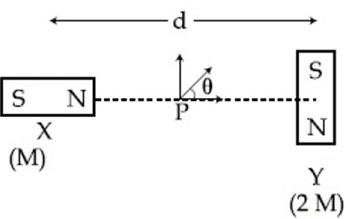
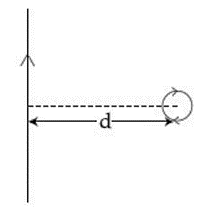
Two magnetic dipoles X and Y are placed at a separation d, with their axes perpendicular to each other. The dipole moment of Y is twice that of X. A particle of charge q is passing through their mid-point P, at angle $$\theta = 45°$$ with the horizontal line, as shown in figure. What would be the magnitude of force on the particle at that instant? (d is much larger than the dimension of the dipole)
The magnetic field at the midpoint P between the two dipoles is calculated using the formulas for axial and equatorial fields.
Let the dipole moment of X be M. Then the dipole moment of Y is 2M. The distance from each dipole to the midpoint P is r = d/2.
1. Magnetic field due to Dipole X (Axial point):
$$B_1 = \frac{\mu_0}{4\pi} \frac{2M}{(d/2)^3}$$
This field acts horizontally (along the axis of X).
2. Magnetic field due to Dipole $Y$ (Equatorial point):
$$B_2 = \frac{\mu_0}{4\pi} \frac{(2M)}{(d/2)^3}$$
This field acts vertically (perpendicular to the axis of Y).
3. Net Magnetic Field ($$B_{\text{net}}$$):
Since $$B_1 = B_2$$ and they are perpendicular to each other, the net magnetic field vector makes an angle with the horizontal:
$$\tan \phi = \frac{B_2}{B_1} = 1 \implies \phi = 45^\circ$$
4. Magnetic Force on the Particle:
The force on a charge $q$ moving with velocity $$\vec{v}$$ in a magnetic field $$\vec{B}$$ is:
$$\vec{F} = q(\vec{v} \times \vec{B})$$
$$F = qvB \sin \alpha$$
The particle is moving at an angle $$\theta = 45^\circ$$ with the horizontal, which is the same direction as $$\vec{B}_{\text{net}}$$. Therefore, the angle $$\alpha$$ between velocity and the magnetic field is $$0^\circ$$.
$$\sin(0^\circ) = 0$$
$$\boxed{F = 0}$$
The B-H curve for a ferromagnet is shown in the figure. The ferromagnet is placed inside a long solenoid with 1000 turns/cm. The current that should be passed in the solenoid to demagnetize the ferromagnet completely is:
A magnetic dipole in a uniform magnetic field has: (Take zero potential energy when magnetic dipole is perpendicular to magnetic field)
Let us denote the magnetic dipole moment vector by $$\vec p$$ and the uniform magnetic field by $$\vec B$$. The angle between the two vectors is called $$\theta$$.
First, we recall two standard relations for a magnetic dipole kept in a uniform magnetic field:
1. Magnitude of torque
We have the vector formula $$\vec \tau = \vec p \times \vec B$$. Taking magnitudes, the cross-product gives
$$\tau = pB\sin\theta.$$
2. Potential energy
The scalar product of two vectors tells us
$$U = -\,\vec p \cdot \vec B.$$
This dot product becomes
$$U = -pB\cos\theta.$$
The question clearly states that the reference level of potential energy is chosen to be zero when the dipole is perpendicular to the field. Mathematically, when $$\theta = 90^{\circ}$$ we obtain
$$\cos 90^{\circ} = 0 \;\;\Longrightarrow\;\; U = -pB \times 0 = 0,$$
so the usual formula $$U = -pB\cos\theta$$ is already consistent with the given convention; no extra constant has to be added.
Now we compare the conditions for maximum torque and for the potential energy values:
Maximum torque
From $$\tau = pB\sin\theta$$ the sine term reaches its greatest value of 1 when
$$\sin\theta = 1 \;\;\Longrightarrow\;\; \theta = 90^{\circ}.$$
Hence the torque is maximum when the dipole is perpendicular to the field.
Potential energy at that same orientation
Substituting $$\theta = 90^{\circ}$$ in the energy expression, we get
$$U = -pB\cos 90^{\circ} = -pB \times 0 = 0.$$
So, exactly at the orientation where the torque attains its maximum value, the potential energy is zero (with the chosen reference point).
Among the given statements we therefore select the one that says “zero potential energy when the torque is maximum.”
Hence, the correct answer is Option B.
A magnetic needle of magnetic moment $$6.7 \times 10^{-2}$$ A m$$^{2}$$ and moment of inertia $$7.5 \times 10^{-6}$$ kg m$$^{2}$$ is performing simple harmonic oscillations in a magnetic field of 0.01 T. Time taken for 10 complete oscillations is:
We know that a magnetic needle of magnetic moment $$M$$ placed in a uniform magnetic field $$B$$ executes torsional simple harmonic motion. The restoring torque on the needle is $$\tau = -MB\sin\theta$$. For very small angular displacements we can use the small-angle approximation $$\sin\theta \approx \theta$$, so the torque becomes $$\tau = -MB\,\theta$$.
Newton’s rotational equation is $$I\,\dfrac{d^{2}\theta}{dt^{2}} = \tau$$, where $$I$$ is the moment of inertia. Substituting the expression for $$\tau$$, we get
$$I\,\dfrac{d^{2}\theta}{dt^{2}} = -MB\,\theta.$$
This is the differential equation of a simple harmonic oscillator of the form $$\dfrac{d^{2}\theta}{dt^{2}} + \omega^{2}\theta = 0$$, where the square of the angular frequency is identified as
$$\omega^{2} = \dfrac{MB}{I}.$$
Therefore, the angular frequency is
$$\omega = \sqrt{\dfrac{MB}{I}}.$$
The time period $$T$$ of one complete oscillation is related to $$\omega$$ by the standard formula for SHM:
$$T = \dfrac{2\pi}{\omega} = 2\pi\sqrt{\dfrac{I}{MB}}.$$
Now we substitute the given numerical values. We have
$$M = 6.7 \times 10^{-2}\ \text{A m}^{2},\quad B = 0.01\ \text{T},\quad I = 7.5 \times 10^{-6}\ \text{kg m}^{2}.$$
First compute the product $$MB$$:
$$MB = \left(6.7 \times 10^{-2}\right)\left(0.01\right) = 6.7 \times 10^{-4}.$$
Next form the ratio $$\dfrac{I}{MB}$$:
$$\dfrac{I}{MB} = \dfrac{7.5 \times 10^{-6}}{6.7 \times 10^{-4}} = \dfrac{7.5}{6.7}\times 10^{-6+4} = 1.1194 \times 10^{-2}.$$
Taking the square root gives
$$\sqrt{\dfrac{I}{MB}} = \sqrt{1.1194 \times 10^{-2}} \approx 0.1058.$$
Now insert this value into the expression for the period:
$$T = 2\pi \left(0.1058\right) = 6.283 \times 0.1058 \approx 0.6647\ \text{s}.$$
This is the time for one complete oscillation. The question asks for the time taken for 10 complete oscillations, so we multiply by 10:
$$t_{10} = 10T = 10 \times 0.6647 \approx 6.647\ \text{s}.$$
Rounding to three significant figures, we obtain $$t_{10} \approx 6.65\ \text{s}.$$ Hence, the correct answer is Option B.
Hysteresis loops for two magnetic materials A and B are given below:
These materials are used to make magnets for electric generators, transformer core and electromagnet core. Then it is proper to use:
1. Material A:
Properties: This material has a large area within its hysteresis loop. It features high retentivity (residual magnetism when $$H=0$$) and high coercivity (resistance to being demagnetized).
Suitability: Because it is difficult to demagnetize and retains a strong magnetic field, it is ideal for making permanent magnets, such as those used in electric generators.
2. Material B:
Properties: This material has a narrow, thin loop. This indicates low coercivity and low hysteresis loss (the energy dissipated as heat during each cycle of magnetization).
Suitability: In devices like transformers and electromagnets, the magnetic field is constantly switching (alternating current). To prevent the device from overheating and to ensure high efficiency, you need a material that can be easily magnetized and demagnetized with minimal energy loss.
Applications: Specifically used for transformer cores and electromagnet cores.
A magnetic dipole is acted upon by two magnetic fields which are inclined to each other at an angle of 75°. One of the fields has a magnitude of 15 mT. The dipole attains stable equilibrium at an angle of 30° with this field. The magnitude of the other field (in mT) is close to
Let the magnitudes of the two magnetic fields be denoted by $$B_1$$ and $$B_2$$. We are told
$$B_1 = 15\ \text{mT},\qquad B_2 = ?$$
The angle between the two fields is given as
$$\alpha = 75^\circ.$$
The magnetic dipole finally comes to rest (stable equilibrium) along the direction of the resultant field $$\mathbf R = \mathbf B_1 + \mathbf B_2$$. At equilibrium the dipole therefore makes the same angle with $$\mathbf B_1$$ as the resultant field does. This angle is stated to be
$$\theta = 30^\circ.$$
So, in the triangle formed by the vectors $$\mathbf B_1,\ \mathbf B_2,\ \mathbf R$$, we know the angle between $$\mathbf B_1$$ and $$\mathbf R$$ (namely $$\theta$$) and the angle between $$\mathbf B_1$$ and $$\mathbf B_2$$ (namely $$\alpha$$).
To relate the magnitudes we resolve $$\mathbf B_2$$ into components parallel and perpendicular to $$\mathbf B_1$$. Using elementary vector addition, the magnitude of the perpendicular component of $$\mathbf B_2$$ is
$$B_2 \sin\alpha,$$
while the component of $$\mathbf B_2$$ along $$\mathbf B_1$$ is
$$B_2 \cos\alpha.$$
The resultant $$\mathbf R$$ therefore has
• a component along $$\mathbf B_1$$ equal to $$B_1 + B_2\cos\alpha$$, and
• a component perpendicular to $$\mathbf B_1$$ equal to $$B_2\sin\alpha.$$
The angle $$\theta$$ that $$\mathbf R$$ makes with $$\mathbf B_1$$ is then obtained from simple trigonometry:
$$\tan\theta \;=\;\frac{\text{perpendicular component}}{\text{parallel component}} \;=\;\frac{B_2\sin\alpha}{B_1 + B_2\cos\alpha}.$$
We now substitute the known numerical values:
$$\tan 30^\circ \;=\;\frac{B_2\sin 75^\circ}{15 + B_2\cos 75^\circ}.$$
Next we insert the standard trigonometric numbers
$$\tan 30^\circ = \frac{1}{\sqrt 3} \approx 0.577,\qquad \sin 75^\circ \approx 0.9659,\qquad \cos 75^\circ \approx 0.2588.$$
This gives
$$0.577 =\frac{B_2(0.9659)}{15 + B_2(0.2588)}.$$
We now carry out the algebra step by step.
First cross-multiply:
$$0.577\bigl(15 + 0.2588\,B_2\bigr) = 0.9659\,B_2.$$
Multiply out the brackets on the left:
$$0.577 \times 15 + 0.577 \times 0.2588\,B_2 = 0.9659\,B_2.$$
Calculate the numerical products:
$$8.655 + 0.1493\,B_2 = 0.9659\,B_2.$$
Bring the $$B_2$$ terms together on one side:
$$8.655 = 0.9659\,B_2 - 0.1493\,B_2.$$
Combine the coefficients of $$B_2$$ on the right:
$$8.655 = (0.9659 - 0.1493)\,B_2 = 0.8166\,B_2.$$
Finally, solve for $$B_2$$ by dividing both sides by $$0.8166$$:
$$B_2 = \frac{8.655}{0.8166} \approx 10.6\ \text{mT}.$$
The closest option to $$10.6\ \text{mT}$$ is $$11\ \text{mT}$$.
Hence, the correct answer is Option B.
A short bar magnet is placed in the magnetic meridian of the earth with North Pole pointing north. Neutral points are found at a distance of 30 cm from the magnet on the East-West line, drawn through the middle point of the magnet. The magnetic moment of the magnet in Am$$^2$$ is close to: (Given $$\frac{\mu_0}{4\pi} = 10^{-7}$$ in SI units and $$B_H$$ = Horizontal component of earth's magnetic field = $$3.6 \times 10^{-5}$$ Tesla.)
We are told that the neutral points lie on the East-West line drawn through the mid-point of the bar magnet. Such points are situated on the equatorial (broadside) line of the magnet. For a short bar magnet the magnetic induction at a point on the equatorial line, at a distance $$r$$ from the centre of the magnet, is given by the standard formula
$$B_{\text{equatorial}}=\frac{\mu_0}{4\pi}\,\frac{M}{r^{3}}$$
where $$M$$ is the magnetic moment of the magnet. This field is directed opposite to the direction of the earth’s horizontal field $$B_H$$. At a neutral point the two fields cancel in magnitude, so we must have
$$B_H = \frac{\mu_0}{4\pi}\,\frac{M}{r^{3}}$$
Now we solve for $$M$$. Rearranging the above equality gives
$$M = B_H \, r^{3}\,\left(\frac{4\pi}{\mu_0}\right)$$
We substitute the numerical values. The distance of the neutral point from the magnet’s centre is given as 30 cm, which in SI units is
$$r = 30\ \text{cm} = 0.30\ \text{m}$$
Cubing this distance, step by step,
$$r^{3} = (0.30\ \text{m})^{3} = 0.30 \times 0.30 \times 0.30 = 0.027\ \text{m}^{3}$$
The horizontal component of the earth’s magnetic field is
$$B_H = 3.6 \times 10^{-5}\ \text{T}$$
The constant $$\frac{\mu_0}{4\pi}$$ is given as $$10^{-7}$$ in SI units, hence
$$\frac{4\pi}{\mu_0} = \frac{1}{\mu_0/4\pi} = \frac{1}{10^{-7}} = 10^{7}$$
Substituting everything into the expression for $$M$$, we get
$$M = \left(3.6 \times 10^{-5}\right)\,\left(0.027\right)\,\left(10^{7}\right)$$
We first multiply the two decimal numbers:
$$3.6 \times 0.027 = 0.0972$$
Next we combine the powers of ten:
$$10^{-5} \times 10^{7} = 10^{2} = 100$$
Finally we multiply these results:
$$M = 0.0972 \times 100 = 9.72$$
So, the magnetic moment is
$$M \approx 9.7\ \text{A m}^2$$
Among the given choices, this value corresponds to Option D (9.7 A m2).
Hence, the correct answer is Option D.
A 25 cm long solenoid has the radius 2 cm and 500 turns. It carries a current of 15 A. If it is equivalent to a magnet of the same size and magnetization $$\vec{M}$$ $$\left(\frac{\text{Magnetic Moment}}{\text{volume}}\right)$$, then $$|\vec{M}|$$ is:
We are given a solenoid with length 25 cm, radius 2 cm, 500 turns, and current 15 A. We need to find the magnitude of the magnetization $$\vec{M}$$, which is defined as the magnetic moment per unit volume. The solenoid is equivalent to a magnet of the same size, so we will calculate the magnetic moment of the solenoid and then divide by its volume.
First, convert all units to SI units. Length $$L = 25$$ cm = $$25 \times 10^{-2}$$ m = 0.25 m. Radius $$r = 2$$ cm = $$2 \times 10^{-2}$$ m = 0.02 m. Current $$I = 15$$ A. Number of turns $$N = 500$$.
The magnetic moment ($$m$$) of a solenoid is given by the product of the number of turns, the current, and the area of one turn. The area $$A$$ of one turn is the cross-sectional area of the solenoid, which is circular: $$A = \pi r^2$$.
Calculate $$A$$:
$$ A = \pi \times (0.02)^2 = \pi \times 0.0004 = 4 \times 10^{-4} \pi \text{ m}^2 $$
Now, calculate the magnetic moment $$m$$:
$$ m = N \times I \times A = 500 \times 15 \times (4 \times 10^{-4} \pi) $$
First, multiply 500 and 15:
$$ 500 \times 15 = 7500 $$
Then multiply by $$4 \times 10^{-4} \pi$$:
$$ 7500 \times 4 \times 10^{-4} \pi = 7500 \times 4 \times 0.0001 \pi = 7500 \times 0.0004 \pi $$
$$ 7500 \times 0.0004 = 3 \quad \text{(since } 7500 \times 4 \times 10^{-4} = 7500 \times 4 \times 0.0001 = 30000 \times 0.0001 = 3\text{)} $$
So,
$$ m = 3\pi \text{ A} \cdot \text{m}^2 $$
The volume ($$V$$) of the solenoid is the product of its cross-sectional area and length:
$$ V = A \times L = (4 \times 10^{-4} \pi) \times 0.25 $$
First, multiply 0.25 and $$4 \times 10^{-4}$$:
$$ 0.25 \times 4 \times 10^{-4} = 1 \times 10^{-4} = 0.0001 $$
So,
$$ V = 0.0001 \pi = \pi \times 10^{-4} \text{ m}^3 $$
Magnetization $$\vec{M}$$ is the magnetic moment per unit volume:
$$ |\vec{M}| = \frac{m}{V} = \frac{3\pi}{\pi \times 10^{-4}} $$
Simplify by canceling $$\pi$$:
$$ |\vec{M}| = \frac{3}{10^{-4}} = 3 \times 10^{4} = 30000 \text{ A m}^{-1} $$
Comparing with the options, 30000 A m$$^{-1}$$ corresponds to option B. The problem states that the correct answer is option 2, which is B.
Hence, the correct answer is Option B.
An example of a perfect diamagnet is a superconductor. This implies that when a superconductor is put in a magnetic field of intensity B, the magnetic field $$B_s$$ inside the superconductor will be such that:
A superconductor acts as a perfect diamagnet by expelling all internal magnetic flux via the Meissner Effect, resulting in an internal magnetic field ($$B_s$$) of zero.
The coercivity of a small magnet, where the ferromagnet gets demagnetised is $$3 \times 10^3$$ A/m. The current required to be passed in a solenoid of length 10 cm and number of turns 100, so that the magnet gets demagnetised when inside the solenoid is:
We are told that the magnet will be demagnetised when it experiences an opposing magnetic field intensity (also called magnetic field strength) equal to its coercivity. Mathematically, the required magnetic field intensity is
$$H_c = 3 \times 10^3\ \text{A m}^{-1}.$$
The magnet is placed inside a long solenoid. For an ideal long solenoid, the magnetic field intensity $$H$$ produced at any interior point is related to the current $$I$$ flowing through it by the well-known relation
$$H = n I,$$
where $$n$$ is the number of turns per unit length of the solenoid.
Now we calculate $$n$$. The data given are:
Number of turns $$N = 100$$, length of the solenoid $$L = 10\ \text{cm}.$$ We first convert the length to metres so that all quantities are in SI units:
$$L = 10\ \text{cm} = 10 \times 10^{-2}\ \text{m} = 0.10\ \text{m}.$$
Hence, the turn density is
$$n = \frac{N}{L} = \frac{100}{0.10} = 1000\ \text{turns m}^{-1}.$$
To demagnetise the magnet, the solenoid must supply an equal magnetic field intensity, so we set
$$H = H_c.$$
Substituting $$H = nI$$ and the numerical values, we get
$$n I = H_c$$ $$\Longrightarrow I = \frac{H_c}{n} = \frac{3 \times 10^3\ \text{A m}^{-1}}{1000\ \text{m}^{-1}} = 3\ \text{A}.$$
So, the current that has to be passed through the solenoid is
$$I = 3\ \text{A}.$$
Hence, the correct answer is Option C.
The mid points of two small magnetic dipoles of length $$d$$ in end-on positions, are separated by a distance $$x$$ ($$x \gg d$$). The magnitude of force between them is proportional to $$x^{-n}$$ where n is:
The magnetic field $$B$$ produced by the first dipole at the center of the second dipole along its axis is $$B = \frac{\mu_0}{4\pi} \frac{2M_1}{x^3}$$
$$U = -\vec{M_2} \cdot \vec{B} = -M_2 B \cos(0^\circ) = -\frac{\mu_0}{4\pi} \frac{2M_1 M_2}{x^3}$$
$$F = -\frac{dU}{dx} = -\frac{d}{dx} \left( -\frac{\mu_0}{4\pi} \frac{2M_1 M_2}{x^3} \right)$$
$$F = \frac{\mu_0}{4\pi} (2M_1 M_2) \frac{d}{dx} (x^{-3})$$
$$F = \frac{\mu_0}{4\pi} (2M_1 M_2) (-3x^{-4})$$
$$|F| \propto x^{-4}$$
$$n = 4$$
The magnetic field of earth at the equator is approximately $$4 \times 10^{-5}$$ T. The radius of earth is $$6.4 \times 10^6$$ m. Then the dipole moment of the earth will be nearly of the order of:
The magnetic field ($$B_{\text{eq}}$$) on the equatorial line of a dipole is given by:
$$B_{\text{eq}} = \frac{\mu_0}{4\pi} \frac{M}{R^3}$$
$$M = \frac{B_{\text{eq}} \cdot R^3}{\frac{\mu_0}{4\pi}}$$
$$M = \frac{4 \times 10^{-5} \times (6.4 \times 10^6)^3}{10^{-7}}$$
$$M \approx 1.05 \times 10^{23}\text{ A m}^2$$
Three identical bars A, B and C are made of different magnetic materials. When kept in a uniform magnetic field, the field lines around them look as follows:
Make the correspondence of these bars with their material being diamagnetic (D), ferromagnetic (F) and paramagnetic (P):
Magnet A is allowing all the field lines passing through it , therefore, it is ferromagnetic.
Magnet B is repelling the field lines, therefore, it is diamagnet.
Magnet C is attracting the field lines, therefore, it is paramagnet.
The earth's magnetic field lines resemble that of a dipole at the centre of the earth. If the magnetic moment of this dipole is close to $$8 \times 10^{22}$$ Am$$^2$$, the value of earth's magnetic field near the equator is close to (radius of the earth = $$6.4 \times 10^6$$ m)
The magnetic field at a distance $$R$$ on the equatorial line of a short dipole is given by:
$$B_{eq} = \frac{\mu_0}{4\pi} \frac{M}{R^3}$$
$$B_{eq} = 10^{-7} \times \frac{8 \times 10^{22}}{(6.4 \times 10^6)^3}$$
$$B_{eq} \approx 0.0305 \times 10^{-3}\text{ T} = 3.05 \times 10^{-5}\text{ T}$$
$$B_{eq} = 3.05 \times 10^{-5} \times 10^4\text{ Gauss}$$ ($$1\text{ Tesla} = 10^4\text{ Gauss}$$)
$$B_{eq} \approx 0.305\text{ Gauss} \approx 0.32\text{ Gauss}$$
Two short bar magnets of length 1 cm each have magnetic moments 1.20 A m$$^2$$ and 1.00 A m$$^2$$ respectively. They are placed on a horizontal table parallel to each other with their N poles pointing towards the south. They have a common magnetic equator and are separated by a distance of 20.0 cm. The value of the resultant horizontal magnetic induction at the mid-point O of the line joining their centres is close to
(Horizontal component of earth's magnetic induction is $$3.6 \times 10^{-5}$$ Wb m$$^{-2}$$)
We have two identical short magnets of length $$l = 1\;\text{cm} = 0.01\;\text{m}$$, but for the magnetic induction at a distant point only the magnetic moment is needed. Their magnetic moments are
$$M_1 = 1.20\; \text{A m}^2,$$
$$M_2 = 1.00\; \text{A m}^2.$$
The magnets are kept parallel to one another so that the line joining their centres is the common magnetic equator (broad-side line) for both of them. The distance between their centres is
$$d = 20.0\;\text{cm} = 0.20\;\text{m}.$$
Hence the mid-point $$O$$ of this line is at a distance
$$r = \dfrac{d}{2} = \dfrac{0.20\;\text{m}}{2} = 0.10\;\text{m}$$
from the centre of each magnet.
For a short bar magnet the magnetic induction at a point on its equatorial line is given by the standard formula
$$B_{\text{equator}} = \dfrac{\mu_0}{4\pi}\,\dfrac{M}{r^{3}},$$
where $$\mu_0/4\pi = 10^{-7}\;\text{T m A}^{-1}$$. The field is directed opposite to the magnetic moment vector. Since both magnets have their moments parallel, the fields produced by them at $$O$$ are along the same horizontal direction and hence add algebraically.
Magnetic induction at $$O$$ due to magnet 1:
$$B_1 = 10^{-7}\;\dfrac{M_1}{r^{3}} = 10^{-7}\;\dfrac{1.20}{(0.10)^3} = 10^{-7}\;\dfrac{1.20}{0.001} = 10^{-7}\times 1.20 \times 10^{3} = 1.20 \times 10^{-4}\;\text{T}.$$
Magnetic induction at $$O$$ due to magnet 2:
$$B_2 = 10^{-7}\;\dfrac{M_2}{r^{3}} = 10^{-7}\;\dfrac{1.00}{0.001} = 1.00 \times 10^{-4}\;\text{T}.$$
Adding these two gives the total field at $$O$$ because of the two magnets:
$$B_{\text{magnets}} = B_1 + B_2 = (1.20 + 1.00) \times 10^{-4} = 2.20 \times 10^{-4}\;\text{T}.$$
The horizontal component of the Earth’s magnetic induction is supplied as
$$B_{\text{Earth}} = 3.6 \times 10^{-5}\;\text{T} = 0.36 \times 10^{-4}\;\text{T}.$$
The equatorial fields of the magnets are directed towards geographic north (opposite to their moments), which is the same direction as the Earth’s horizontal field. Therefore the two contributions add directly. The resultant horizontal magnetic induction at $$O$$ is
$$B_{\text{resultant}} = B_{\text{magnets}} + B_{\text{Earth}} = 2.20 \times 10^{-4}\; \text{T} + 0.36 \times 10^{-4}\; \text{T} = 2.56 \times 10^{-4}\;\text{T}.$$
Expressing in the requested units of $$\text{Wb m}^{-2}$$ (which are identical to tesla), we have
$$B_{\text{resultant}} = 2.56 \times 10^{-4}\;\text{Wb m}^{-2}.$$
Hence, the correct answer is Option 4.
A bar magnet of length 6 cm has a magnetic moment of $$4\ \text{J T}^{-1}$$. Find the strength of magnetic field at a distance of 200 cm from the centre of the magnet along its equatorial line.
Relative permittivity and permeability of a material are $$\varepsilon_r$$ and $$\mu_r$$, respectively. Which of the following values of these quantities are allowed for a diamagnetic material?
Needles $$N_1, N_2$$ and $$N_3$$ are made of a ferromagnetic, a paramagnetic and a diamagnetic substance respectively. A magnet when brought close to them will
A magnetic needle is kept in a non-uniform magnetic field. It experiences
The length of a magnet is large compared to its width and breadth. The time period of its oscillation in a vibration magnetometer is $$2$$ s. The magnet is cut along its length into three equal parts and three parts are then placed on each other with their like poles together. The time period of this combination will be
The materials suitable for making electromagnets should have