
Join Our JEE Preparation Group
Prep with like-minded aspirants; Get access to free daily tests and study material.
Sign in
Please select an account to continue using cracku.in
↓ →
Join Our JEE Preparation Group
Prep with like-minded aspirants; Get access to free daily tests and study material.
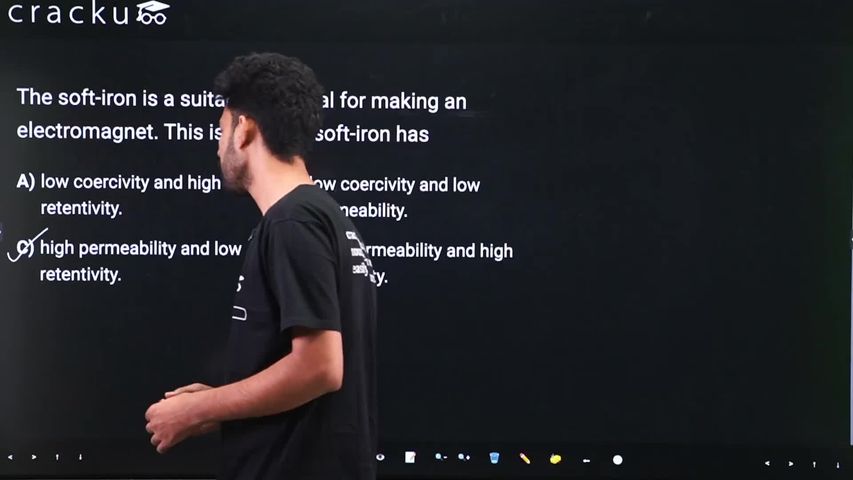
The soft-iron is a suitable material for making an electromagnet. This is because soft-iron has
An electromagnet needs to be easily magnetized when current flows and easily demagnetized when the current is switched off.
Understand the required properties: High permeability: Permeability measures how easily a material can be magnetized. A material with high permeability allows magnetic field lines to pass through it easily and becomes strongly magnetized even with a small applied magnetic field. This is essential for an electromagnet to be effective.
Low retentivity: Retentivity (or remanence) is the ability of a material to retain magnetization after the external magnetic field is removed. For an electromagnet, we need LOW retentivity so that the magnet can be easily switched off (demagnetized) when the current stops.
Low coercivity: Coercivity is the reverse field needed to demagnetize the material. Low coercivity also helps in easy demagnetization.
Evaluate the options: Option A: Low coercivity and high retentivity - High retentivity is undesirable as the electromagnet would remain magnetized after switching off.
Option B: Low coercivity and low permeability - Low permeability means the material would not magnetize strongly, making a weak electromagnet.
Option C: High permeability and low retentivity - This is the ideal combination: strong magnetization when ON, easy demagnetization when OFF.
Option D: High permeability and high retentivity - High retentivity would keep the magnet magnetized even after switching off.
Soft iron has high permeability (easily magnetized) and low retentivity (easily demagnetized), making it ideal for electromagnets.
The correct answer is Option C.
Was this solution helpful?
Click on the Email ☝️ to Watch the Video Solution
Create a FREE account and get:
_1.webp)

Educational materials for JEE preparation

Ask our AI anything

AI can make mistakes. Please verify important information.
AI can make mistakes. Please verify important information.
