
Join Our JEE Preparation Group
Prep with like-minded aspirants; Get access to free daily tests and study material.
Sign in
Please select an account to continue using cracku.in
↓ →
Join Our JEE Preparation Group
Prep with like-minded aspirants; Get access to free daily tests and study material.
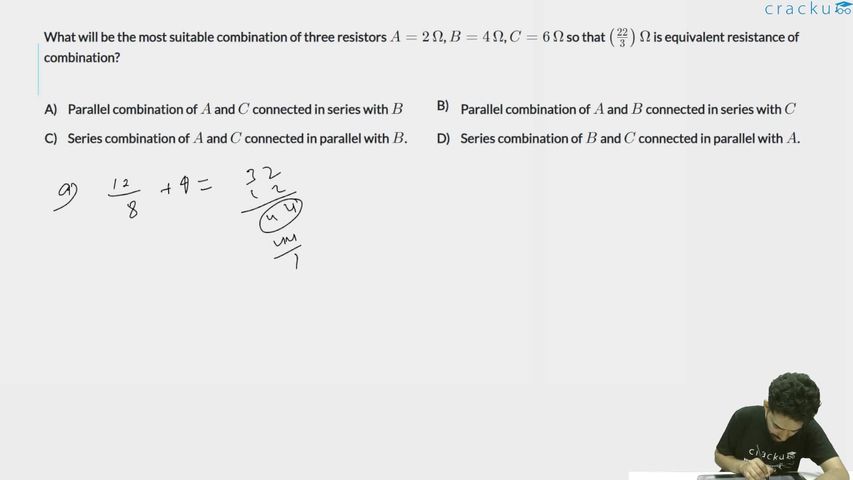
What will be the most suitable combination of three resistors $$A = 2$$ $$\Omega$$, $$B = 4$$ $$\Omega$$, $$C = 6$$ $$\Omega$$ so that $$\left(\frac{22}{3}\right)\Omega$$ is equivalent resistance of combination?
Given: $$A = 2 \, \Omega$$, $$B = 4 \, \Omega$$, $$C = 6 \, \Omega$$. Required equivalent resistance $$= \frac{22}{3} \, \Omega$$.
Checking Option B: Parallel combination of A and B, in series with C
Find the parallel combination of A and B: $$R_{A \| B} = \frac{A \times B}{A + B} = \frac{2 \times 4}{2 + 4} = \frac{8}{6} = \frac{4}{3} \, \Omega$$
Add C in series: $$R_{\text{eq}} = R_{A \| B} + C = \frac{4}{3} + 6 = \frac{4}{3} + \frac{18}{3} = \frac{22}{3} \, \Omega$$
This matches the required value.
Verifying other options do not give $$\frac{22}{3} \, \Omega$$:
Option A: $$A \| C$$ in series with $$B$$: $$\frac{2 \times 6}{2+6} + 4 = \frac{12}{8} + 4 = 1.5 + 4 = 5.5 \, \Omega$$. Does not match.
Option C: $$(A + C) \| B$$: $$\frac{(2+6) \times 4}{(2+6)+4} = \frac{32}{12} = \frac{8}{3} \, \Omega$$. Does not match.
Option D: $$(B + C) \| A$$: $$\frac{(4+6) \times 2}{(4+6)+2} = \frac{20}{12} = \frac{5}{3} \, \Omega$$. Does not match.
The correct answer is Option B: Parallel combination of A and B connected in series with C.
Was this solution helpful?
Click on the Email ☝️ to Watch the Video Solution
Create a FREE account and get:
_1.webp)

Educational materials for JEE preparation

Ask our AI anything

AI can make mistakes. Please verify important information.
AI can make mistakes. Please verify important information.
