
Join Our JEE Preparation Group
Prep with like-minded aspirants; Get access to free daily tests and study material.
Sign in
Please select an account to continue using cracku.in
↓ →
Join Our JEE Preparation Group
Prep with like-minded aspirants; Get access to free daily tests and study material.
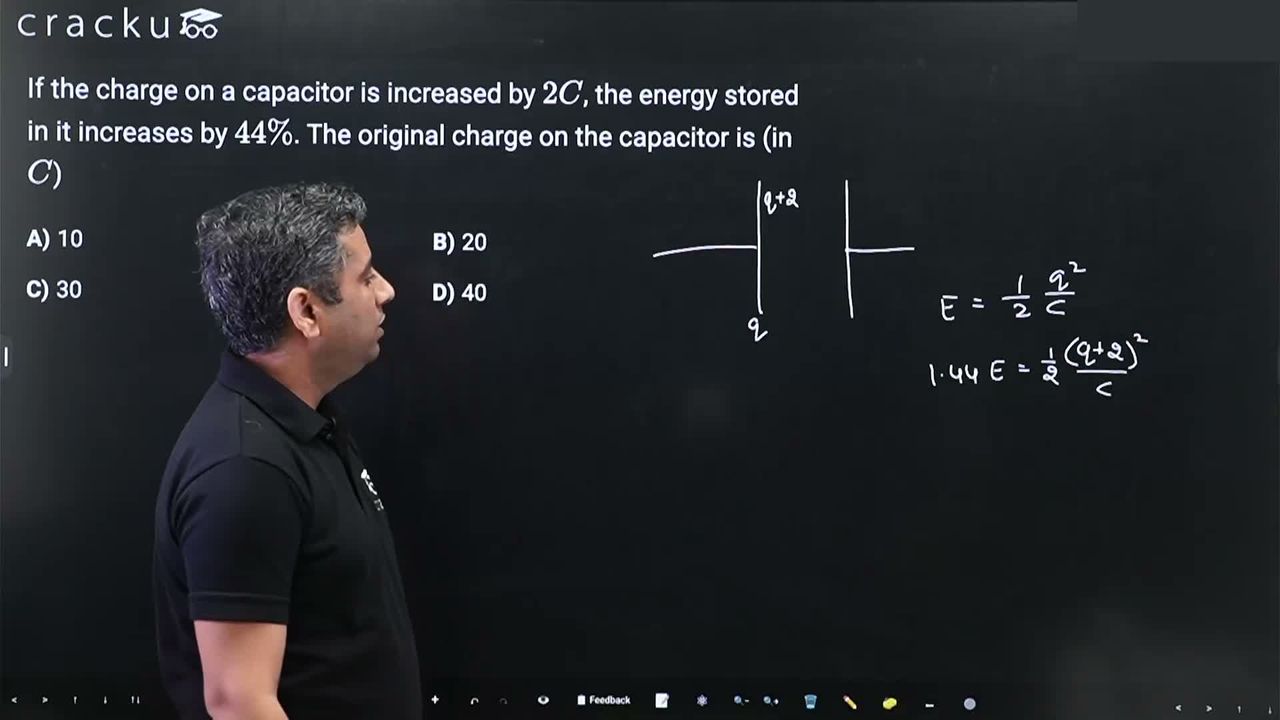
If the charge on a capacitor is increased by $$2C$$, the energy stored in it increases by $$44\%$$. The original charge on the capacitor is (in $$C$$)
Let the original charge on the capacitor be $$Q$$ (in Coulombs) and the capacitance be $$C$$.
Write the energy stored in a capacitor: The energy stored in a capacitor is:
$$E = \frac{Q^2}{2C}$$
Set up the equation for the given condition: When the charge is increased by $$2$$ C, the new charge is $$(Q + 2)$$ C.
The new energy is:
$$E' = \frac{(Q + 2)^2}{2C}$$
The energy increases by $$44\%$$, so:
$$E' = 1.44 \times E$$
Substitute and simplify: $$\frac{(Q + 2)^2}{2C} = 1.44 \times \frac{Q^2}{2C}$$
Cancel $$\frac{1}{2C}$$ from both sides:
$$(Q + 2)^2 = 1.44 \, Q^2$$
Expand and solve: $$Q^2 + 4Q + 4 = 1.44 \, Q^2$$
$$0.44 \, Q^2 - 4Q - 4 = 0$$
Multiply through by 100 to clear decimals:
$$44Q^2 - 400Q - 400 = 0$$
Divide by 4:
$$11Q^2 - 100Q - 100 = 0$$
Solve the quadratic equation: Using the quadratic formula:
$$Q = \frac{100 \pm \sqrt{10000 + 4400}}{22} = \frac{100 \pm \sqrt{14400}}{22} = \frac{100 \pm 120}{22}$$
Taking the positive root (charge must be positive):
$$Q = \frac{100 + 120}{22} = \frac{220}{22} = 10 \text{ C}$$
The original charge on the capacitor is $$10$$ C.
The correct answer is Option A.
Was this solution helpful?
Click on the Email ☝️ to Watch the Video Solution
Create a FREE account and get:
_1.webp)

Educational materials for JEE preparation

Ask our AI anything

AI can make mistakes. Please verify important information.
AI can make mistakes. Please verify important information.
