JEE Ray Optics Questions

This page provides a comprehensive collection of JEE Ray Optics Questions for students preparing for JEE Main and JEE Advanced. The PDF available in this section contains selected questions along with detailed video solutions and explanations by IITians. These solutions help students understand the complete problem-solving process, from identifying the optical principle to applying the relevant equation and arriving at the final answer. Ray Optics deals with the behaviour of light when it travels through different media and interacts with mirrors, lenses, prisms, and optical instruments. The question set covers important applications such as reflection, refraction, total internal reflection, spherical mirrors, lens combinations, prisms, optical instruments, and refraction through different surfaces.

Question 1 JEE Mains

If sunlight is focused on a paper using convex lens, it starts burning the paper in shortest time when the lens is kept at 30 cm above the paper. If the radius of curvature of the lens is 60 cm then the refractive index of the lens material is $$\frac{\alpha}{10}$$. The value of $$\alpha$$ is _________.

Question 2 JEE Mains

A spherical surface of radius of curvature R, separates air from glass (refractive index = 1.5). The centre of curvature is in the glass medium. A point object $$'O'$$ placed in air on the optical axis of the surface, so that its real image is formed at $$'I'$$ inside glass. The line $$OI$$ intersects the spherical surface at $$P$$ and $$PO=PI$$ . The distance $$PO$$ equals to

Question 3 JEE Mains

If the distance between object and its two times magnified virtual image produced by a curved mirror is $$15$$ cm, the focal length of the mirror must be:

Question 4 JEE Mains

An effective power of a combination of 5 identical convex lenses which are kept in contact along the principal axis is 25D. Focal length of each of the convex lens is:

Question 5 JEE Advanced

A glass beaker has a solid, plano-convex base of refractive index 1.60, as shown in the figure. The radius of curvature of the convex surface (SPU) is 9 cm, while the planar surface (STU) acts as a mirror. This beaker is filled with a liquid of refractive index $$n$$ up to the level $$QPR$$. If the image of a point object $$O$$ at a height of $$h$$ ($$OT$$ in the figure) is formed onto itself, then, which of the following option(s) is (are) correct?

image
Question 6 JEE Advanced

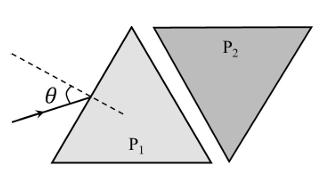
Two equilateral-triangular prisms $$P_1$$ and $$P_2$$ are kept with their sides parallel to each other, in vacuum, as shown in the figure. A light ray enters prism $$P_1$$ at an angle of incidence $$\theta$$ such that the outgoing ray undergoes minimum deviation in prism $$P_2$$. If the respective refractive indices of $$P_1$$ and $$P_2$$ are $$\sqrt{\dfrac{3}{2}}$$ and $$\sqrt{3}$$, $$\theta = \sin^{-1}\left[\sqrt{\dfrac{3}{2}} \sin\left(\dfrac{\pi}{\beta}\right)\right]$$, where the value of $$\beta$$ is ________.

image
Question 7 JEE Mains

A microscope is focused on an object at the bottom of a bucket. If liquid with refractive index $$\dfrac{5}{3}$$ is poured inside the bucket, then microscope have to be raised by 30 cm to focus the object again. The height of the liquid in the bucket is:

Question 8 JEE Mains

A person has been using spectacles of power $$-1.0$$ diopter for distant vision and a separate reading glass of power $$2.0$$ diopters. What is the least distance of distinct vision for this person:

Question 9 JEE Mains

A scientist is observing a bacteria through a compound microscope. For better analysis and to improve its resolving power he should. (Select the best option)

Question 10 JEE Mains

An ice cube has a bubble inside. When viewed from one side the apparent distance of the bubble is $$12$$ cm. When viewed from the opposite side, the apparent distance of the bubble is observed as $$4$$ cm. If the side of the ice cube is $$24$$ cm, the refractive index of the ice cube is

Question 11 JEE Mains

Given below are two statements:
Statement I: If the Brewster's angle for the light propagating from air to glass is $$\theta_B$$, then Brewster's angle for the light propagating from glass to air is $$\frac{\pi}{2} - \theta_B$$.
Statement II: The Brewster's angle for the light propagating from glass to air is $$\tan^{-1} \mu_g$$, where $$\mu_g$$ is the refractive index of glass.
In the light of the above statements, choose the correct answer from the options given below:

Question 12 JEE Mains

In a reflecting telescope, a secondary mirror is used to:

Question 13 JEE Mains

The critical angle for a denser-rarer interface is 45$$^\circ$$. The speed of light in rarer medium is $$3 \times 10^8$$ m s$$^{-1}$$. The speed of light in the denser medium is:

Question 14 JEE Mains

Two objects $$A$$ and $$B$$ are placed at $$15$$ cm and $$25$$ cm from the pole in front of a concave mirror having radius of curvature $$40$$ cm. The distance between images formed by the mirror is:

Question 15 JEE Mains

When one light ray is reflected from a plane mirror with 30$$^\circ$$ angle of reflection, the angle of deviation of the ray after reflection is:

Question 16 JEE Mains

The light rays from an object have been reflected towards an observer from a standard flat mirror, the image observed by the observer are:-
A. Real
B. Erect
C. Smaller in size than object
D. Laterally inverted
Choose the most appropriate answer from the options below:

Question 17 JEE Advanced

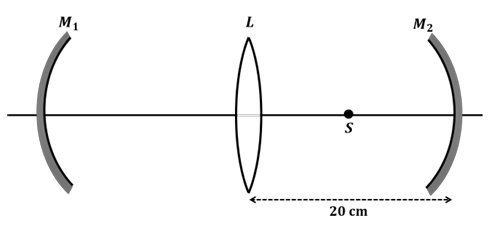
An optical arrangement consists of two concave mirrors M$$_1$$ and M$$_2$$, and a convex lens L with a common principal axis, as shown in the figure. The focal length of L is 10 cm. The radii of curvature of M$$_1$$ and M$$_2$$ are 20 cm and 24 cm, respectively. The distance between L and M$$_2$$ is 20 cm. A point object S is placed at the mid-point between L and M$$_2$$ on the axis. When the distance between L and M$$_1$$ is $$n/7$$ cm, one of the images coincides with S. The value of $$n$$ is ______.

image
Question 18 JEE Mains

In an experiment for estimating the value of focal length of converging mirror, image of an object placed at $$40$$ cm from the pole of the mirror is formed at distance $$120$$ cm from the pole of the mirror. These distances are measured with a modified scale in which there are 20 small divisions in $$1$$ cm. The value of error in measurement of focal length of the mirror is $$\frac{1}{K}$$ cm. The value of $$K$$ is ______.

Question 19 JEE Mains

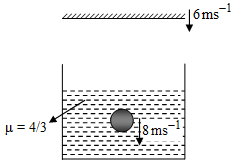
A fish rising vertically upward with a uniform velocity of $$8$$ m s$$^{-1}$$, observes that a bird is diving vertically downward towards the fish with the velocity of $$12$$ m s$$^{-1}$$. If the refractive index of water is $$\frac{4}{3}$$, then the actual velocity of the diving bird to pick the fish, will be _____ m s$$^{-1}$$.

image
Question 20 JEE Mains

A bi convex lens of focal length $$10$$ cm is cut in two identical parts along a plane perpendicular to the principal axis. The power of each lens after cut is _____ D.

Question 21 JEE Mains

A convex lens of refractive index 1.5 and focal length 18 cm in air, is immersed in water. The change in the focal length of the lens will be _____ cm.
(Given refractive index of water = $$\frac{4}{3}$$)

Question 22 JEE Mains

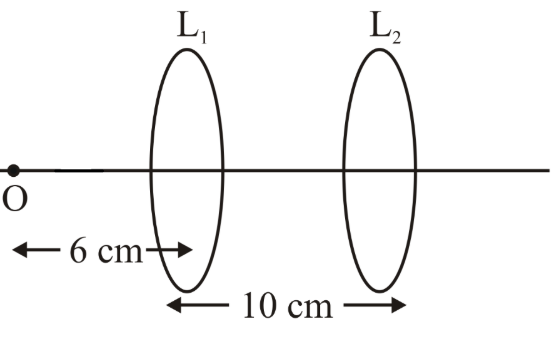
A point object O is placed in front of two thin symmetrical coaxial convex lenses $$L_1$$ and $$L_2$$ with focal length 24 cm and 9 cm respectively. The distance between two lenses is 10 cm and the object is placed 6 cm away from lens $$L_1$$ as shown in the figure. The distance between the object and the image formed by the system of two lenses is _______ cm.

image
Question 23 JEE Mains

A pole is vertically submerged in swimming pool, such that it gives a length of shadow 2.15 m within water when sunlight is incident at an angle of 30° with the surface of water. If swimming pool is filled to a height of 1.5 m, then the height of the pole above the water surface in centimeters is $$(n_w = \dfrac{4}{3})$$ ______.

Question 24 JEE Mains

A ray of light is incident from air on a glass plate having thickness $$\sqrt{3}$$ cm and refractive index $$\sqrt{2}$$. The angle of incidence of a ray is equal to the critical angle for glass-air interface. The lateral displacement of the ray when it passes through the plate is _____ $$\times 10^{-2}$$ cm. (given sin 15° = 0.26)

Question 25 JEE Mains

A thin cylindrical rod of length 10 cm is placed horizontally on the principle axis of a concave mirror of focal length 20 cm. The rod is placed in a such a way that mid point of the rod is at 40 cm from the pole of mirror. The length of the image formed by the mirror will be $$\frac{x}{3}$$ cm. The value of $$x$$ is _____.

Question 26 JEE Mains

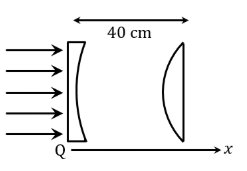
As shown in the figure, a combination of a thin plano-concave lens and a thin plano-convex lens is used to image an object placed at infinity. The radius of curvature of both the lenses is 30 cm and refraction index of the material for both the lenses is 1.75. Both the lenses are placed at distance of 40 cm from each other. Due to the combination, the image of the object is formed at distance x = _____ cm, from concave lens.

Question 27 JEE Mains

As shown in the figure, a combination of a thin plano-concave lens and a thin plano-convex lens is used to image an object placed at infinity. The radius of curvature of both the lenses is 30 cm and refraction index of the material for both the lenses is 1.75. Both the lenses are placed at distance of 40 cm from each other. Due to the combination, the image of the object is formed at distance $$x =$$ ______ cm, from concave lens.

image
Question 28 JEE Mains

The radius of curvature of each surface of a convex lens having refractive index 1.8 is 20 cm. The lens is now immersed in a liquid of refractive index 1.5. The ratio of power of lens in air to its power in the liquid will be $$x$$ : 1. The value of $$x$$ is _______

Question 29 JEE Mains

The refractive index of a transparent liquid filled in an equilateral hollow prism is $$\sqrt{2}$$. The angle of minimum deviation for the liquid will be _____°.

Question 30 JEE Mains

Two convex lenses of focal length $$20$$ cm each are placed coaxially with a separation of $$60$$ cm between them. The image of the distant object formed by the combination is at _____ cm from the first lens.

Question 31 JEE Mains

Two transparent media having refractive indices 1.0 and 1.5 are separated by a spherical refracting surface of radius of curvature 30 cm. The centre of curvature of surface is towards denser medium and a point object is placed on the principal axis in rarer medium at a distance of 15 cm from the pole of the surface. The distance of image from the pole of the surface is _______ cm.

Question 32 JEE Mains

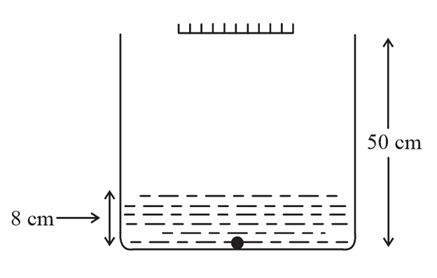
As shown in the figure, a plane mirror is fixed at a height of 50 cm from the bottom of tank containing water ($$\mu = \frac{4}{3}$$). The height of water in the tank is 8 cm. A small bulb is placed at the bottom of the water tank. The distance of image of the bulb formed by mirror from the bottom of the tank is _______ cm.

image
Question 33 JEE Mains

The refracting angle of a prism is $$A$$ and refractive index of the material of the prism is $$\cot\left(\frac{A}{2}\right)$$. Then the angle of minimum deviation will be

Question 34 JEE Mains

A light wave travelling linearly in a medium of dielectric constant $$4$$, incidents on the horizontal interface separating medium with air. The angle of incidence for which the total intensity of incident wave will be reflected back into the same medium will be :
(Given : relative permeability of medium $$\mu_r = 1$$)

Question 35 JEE Mains

The difference of speed of light in the two media $$A$$ and $$B$$ ($$v_A - v_B$$) is $$2.6 \times 10^7$$ m s$$^{-1}$$. If the refractive index of medium $$B$$ is $$1.47$$, then the ratio of refractive index of medium $$B$$ to medium $$A$$ is: (Given : speed of light in vacuum $$c = 3 \times 10^8$$ m s$$^{-1}$$)

Question 36 JEE Mains

Light travels in two media $$M_1$$ and $$M_2$$ with speeds $$1.5 \times 10^8 \text{ m s}^{-1}$$ and $$2.0 \times 10^8 \text{ m s}^{-1}$$ respectively. The critical angle between them is

Question 37 JEE Mains

The power of a lens (biconvex) is 1.25 m$$^{-1}$$ in particular medium. Refractive index of the lens is 1.5 and radii of curvature are 20 cm and 40 cm respectively. The refractive index of surrounding medium:

Question 38 JEE Mains

Which of the following statement is correct?

Question 39 JEE Mains

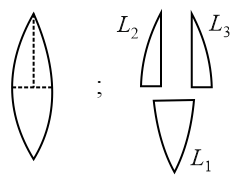
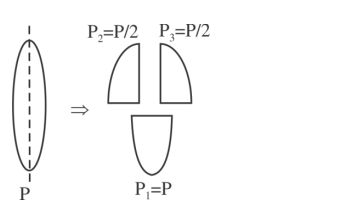
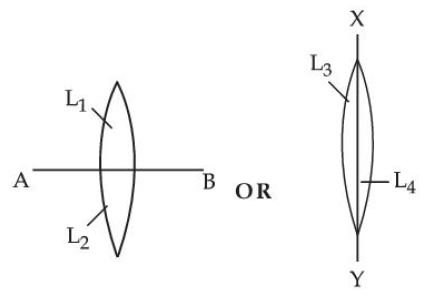
A convex lens has power $$P$$. It is cut into two halves along its principal axis. Further one piece (out of the two halves) is cut into two halves perpendicular to the principal axis (as shown in figures). Choose the incorrect option for the reported pieces.

Question 40 JEE Mains

Consider a light ray travelling in air is incident into a medium of refractive index $$\sqrt{2n}$$. The incident angle is twice that of refracting angle. Then, the angle of incidence will be

Question 41 JEE Mains

For an object placed at a distance $$2.4 \text{ m}$$ from a lens, a sharp focused image is observed on a screen placed at a distance $$12 \text{ cm}$$ from the lens. A glass plate of refractive index $$1.5$$ and thickness $$1 \text{ cm}$$ is introduced between lens and screen such that the glass plate plane faces parallel to the screen. By what distance should the object be shifted so that a sharp focused image is observed again on the screen?

Question 42 JEE Mains

Light enters from air into a given medium at an angle of 45° with interface of the air-medium surface. After refraction, the light ray is deviated through an angle of 15° from its original direction. The refractive index of the medium is:

Question 43 JEE Mains

Time taken by light to travel in two different materials $$A$$ and $$B$$ of refractive indices $$\mu_A$$ and $$\mu_B$$ of same thickness is $$t_1$$ and $$t_2$$ respectively. If $$t_2 - t_1 = 5 \times 10^{-10} \text{ s}$$ and the ratio of $$\mu_A$$ to $$\mu_B$$ is $$1:2$$. Then the thickness of material, in meter is: (Given $$v_A$$ and $$v_B$$ are velocities of light in $$A$$ and $$B$$ materials respectively).

Question 44 JEE Advanced

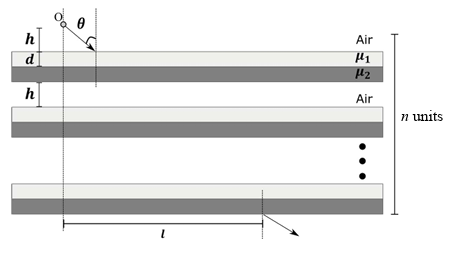
Consider a configuration of $$n$$ identical units, each consisting of three layers. The first layer is a column of air of height $$h = \dfrac{1}{3}$$ cm, and the second and third layers are of equal thickness $$d = \dfrac{\sqrt{3}-1}{2}$$ cm, and refractive indices $$\mu_1 = \dfrac{\sqrt{3}}{2}$$ and $$\mu_2 = \sqrt{3}$$, respectively. A light source O is placed on the top of the first unit as shown in the figure. A Ray of light from $$O$$ is incident on the second layer of the first unit at an angle of $$\theta = 60^\circ$$ to the normal. For a specific value of $$n$$, the ray of light emerges from the bottom of the configuration at a distance $$l = \dfrac{8}{\sqrt{3}}$$ cm, as shown in the figure. The value of $$n$$ is _______.

image
Question 45 JEE Advanced

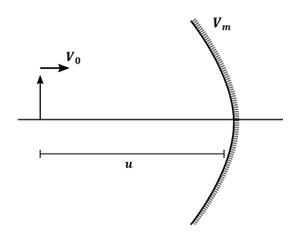
An object and a concave mirror of focal length $$f = 10$$ cm both move along the principal axis of the mirror with constant speeds. The object moves with speed $$V_0 = 15$$ cm s$$^{-1}$$ towards the mirror with respect to a laboratory frame. The distance between the object and the mirror at a given moment is denoted by $$u$$. When $$u = 30$$ cm, the speed of the mirror $$V_m$$ is such that the image is instantaneously at rest with respect to the laboratory frame, and the object forms a real image. The magnitude of $$V_m$$ is _______ cm s$$^{-1}$$.

image
Question 46 JEE Mains

A ray of light is incident at an angle of incidence $$60°$$ on the glass slab of refractive index $$\sqrt{3}$$. After refraction, the light ray emerges out from other parallel faces and lateral shift between incident ray and emergent ray is $$4\sqrt{3}$$ cm. The thickness of the glass slab is ______ cm.

Question 47 JEE Mains

Two identical thin biconvex lenses of focal length $$15$$ cm and refractive index $$1.5$$ are in contact with each other. The space between the lenses is filled with a liquid of refractive index $$1.25$$. The focal length of the combination is ______ cm.

Question 48 JEE Mains

A convex lens of focal length $$20 \text{ cm}$$ is placed in front of convex mirror with principal axis coinciding each other. The distance between the lens and mirror is $$10 \text{ cm}$$. A point object is placed on principal axis at a distance of $$60 \text{ cm}$$ from the convex lens. The image formed by combination coincides the object itself. The focal length of the convex mirror is ______ cm.

Question 49 JEE Mains

A small bulb is placed at the bottom of a tank containing water to a depth of $$\sqrt{7}$$ m. The refractive index of water is $$\frac{4}{3}$$. The area of the surface of water through which light from the bulb can emerge out is $$x\pi$$ m$$^2$$. The value of $$x$$ is ______

Question 50 JEE Mains

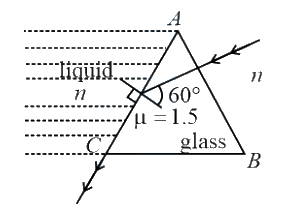
In the given figure, the face $$AC$$ of the equilateral prism is immersed in a liquid of refractive index $$n$$. For incident angle $$60°$$ at the side $$AC$$, the refracted light beam just grazes along face $$AC$$. The refractive index of the liquid $$n = \dfrac{\sqrt{x}}{4}$$. The value of $$x$$ is ______. (Given refractive index of glass $$= 1.5$$)

image
Question 51 JEE Mains

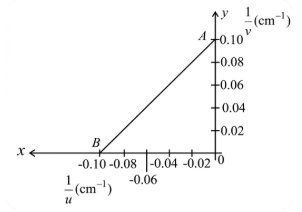
The graph between $$\dfrac{1}{u}$$ and $$\dfrac{1}{v}$$ for a thin convex lens in order to determine its focal length is plotted as shown in the figure. The refractive index of lens is $$1.5$$ and its both the surfaces have same radius of curvatures $$R$$. The value of $$R$$ will be ______ cm. (Where $$u$$ = object distance, $$v$$ = image distance)

image
Question 52 JEE Mains

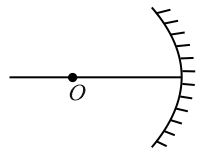
An object 'O' is placed at a distance of 100 cm in front of a concave mirror of radius of curvature 200 cm as shown in the figure. The object starts moving towards the mirror at a speed 2 cm s$$^{-1}$$. The position of the image from the mirror after 10 s will be at _____ cm.

Question 53 JEE Mains

The X-Y plane be taken as the boundary between two transparent media $$M_1$$ and $$M_2$$. $$M_1$$ in $$Z \geq 0$$ has a refractive index of $$\sqrt{2}$$ and $$M_2$$ with $$Z < 0$$ has a refractive index of $$\sqrt{3}$$. A ray of light travelling in $$M_1$$ along the direction given by the vector $$\vec{A} = 4\sqrt{3}\hat{i} - 3\sqrt{3}\hat{j} - 5\hat{k}$$, is incident on the plane of separation. The value of difference between the angle of incident in $$M_1$$ and the angle of refraction in $$M_2$$ will be _____ degree.

Question 54 JEE Mains

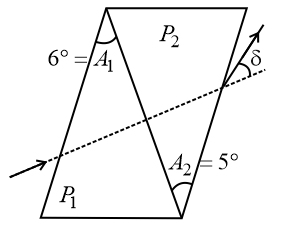
A thin prism of angle $$6^\circ$$ and refractive index for yellow light $$(n_Y) = 1.5$$ is combined with another prism of angle $$5^\circ$$ and $$n_Y = 1.55$$. The combination produces no dispersion. The net average deviation $$\delta$$ produced by the combination is $$\left(\frac{1}{x}\right)^\circ$$. The value of $$x$$ is _____

Question 55 JEE Mains

In an experiment with a convex lens, the plot of the image distance ($$v'$$) against the object distance ($$\mu'$$) measured from the focus gives a curve $$v'\mu' = 225$$. If all the distances are measured in cm. The magnitude of the focal length of the lens is _____ cm.

Question 56 JEE Advanced

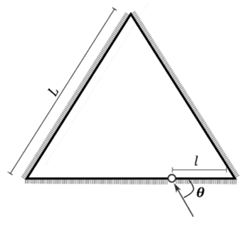
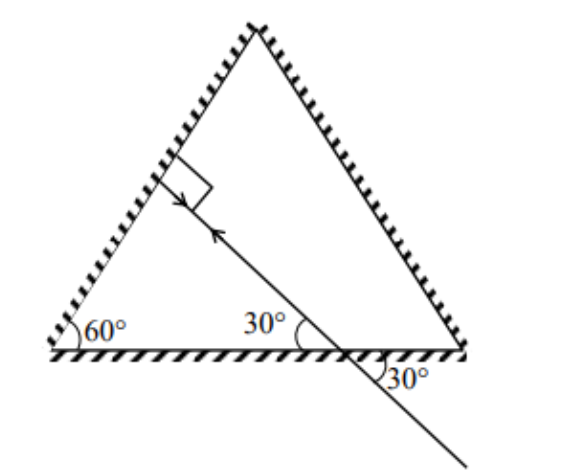
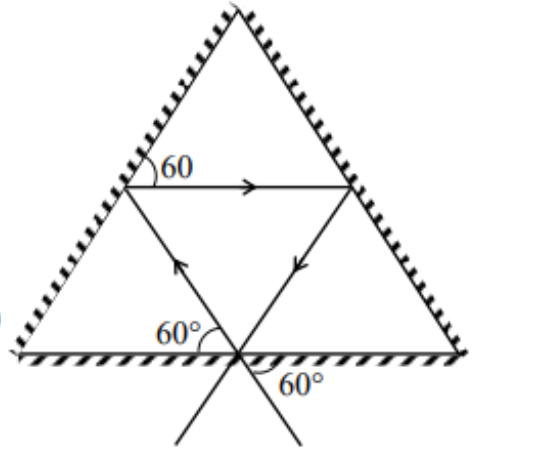
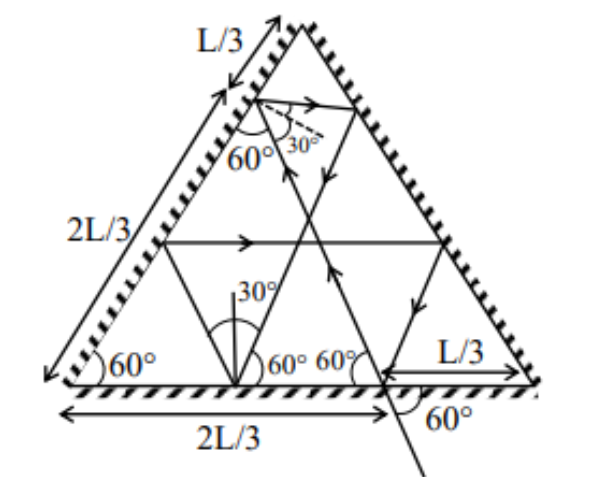
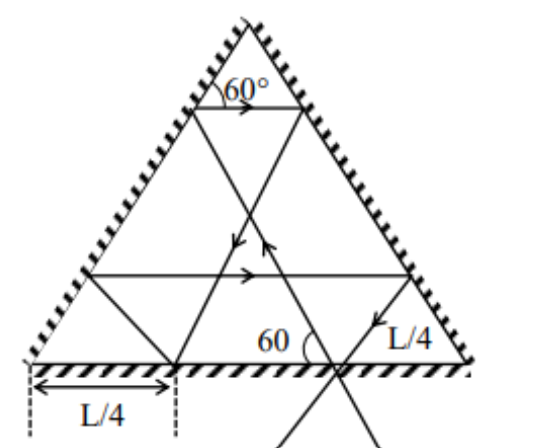
Three plane mirrors form an equilateral triangle with each side of length $$L$$. There is a small hole at a distance $$l > 0$$ from one of the corners as shown in the figure. A ray of light is passed through the hole at an angle $$\theta$$ and can only come out through the same hole. The cross section of the mirror configuration and the ray of light lie on the same plane.

image

Which of the following statement(s) is(are) correct?

Question 57 JEE Advanced

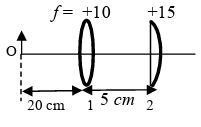
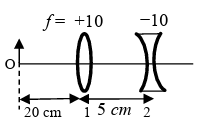
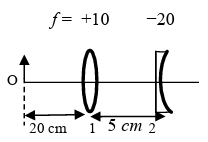
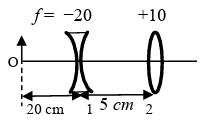
List I contains four combinations of two lenses (1 and 2) whose focal lengths (in cm) are indicated in the figures. In all cases, the object is placed 20 cm from the first lens on the left, and the distance between the two lenses is 5 cm. List II contains the positions of the final images.

List-IList-II
(I) image(P) Final image is formed at 7.5 cm on the right side of lens 2.
(II)image(Q) Final image is formed at 60.0 cm on the right side of lens 2.
(III) image(R) Final image is formed at 30.0 cm on the left side of lens 2.
(IV) image(S) Final image is formed at 6.0 cm on the right side of lens 2.
(T) Final image is formed at 30.0 cm on the right side of lens 2.

Which one of the following options is correct?

Question 58 JEE Mains

A ray of laser of a wavelength 630 nm is incident at an angle of 30$$^\circ$$ at the diamond-air interface. It is going from diamond to air. The refractive index of diamond is 2.42 and that of air is 1. Choose the correct option.

Question 59 JEE Mains

An object is placed at the focus of concave lens having focal length $$f$$. What is the magnification and distance of the image from the optical centre of the lens?

Question 60 JEE Mains

The refractive index of a converging lens is 1.4. What will be the focal length of this lens if it is placed in a medium of same refractive index? (Assume the radii of curvature of the faces of lens are $$R_1$$ and $$R_2$$ respectively)

Question 61 JEE Mains

The thickness at the centre of a plano convex lens is 3 mm and the diameter is 6 cm. If the speed of light in the material of the lens is $$2 \times 10^8$$ m s$$^{-1}$$. The focal length of the lens is:

Question 62 JEE Mains

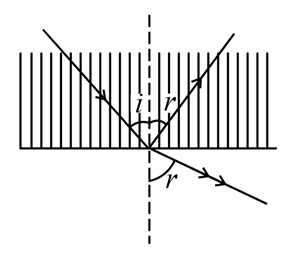
A ray of light passes from a denser medium to a rarer medium at an angle of incidence $$i$$. The reflected and refracted rays make an angle of 90$$^\circ$$ with each other. The angle of reflection and refraction are respectively $$r$$ and $$r'$$. The critical angle is given by,

Question 63 JEE Mains

Given below are two statements: one is labeled as Assertion A and the other is labeled as Reason R.
Assertion A: For a simple microscope, the angular size of the object equals the angular size of the image.
Reason R: Magnification is achieved as the small object can be kept much closer to the eye than 25 cm and hence it subtends a large angle. In the light of the above statements, choose the most appropriate answer from the options given below:

Question 64 JEE Mains

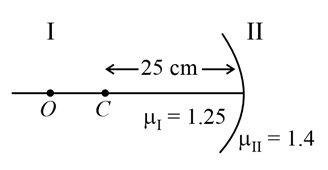
Region I and II are separated by a spherical surface of radius 25 cm. An object is kept in region I at a distance of 40 cm from the surface. The distance of the image from the surface is:

Question 65 JEE Mains

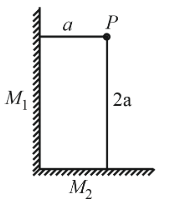
Two plane mirrors $$M_1$$ and $$M_2$$ are at right angle to each other as shown. A point source $$P$$ is placed at $$a$$ and $$2a$$ meter away from $$M_1$$ and $$M_2$$ respectively. The shortest distance between any two images thus formed is: (Take $$\sqrt{5} = 2.3$$)

image
Question 66 JEE Mains

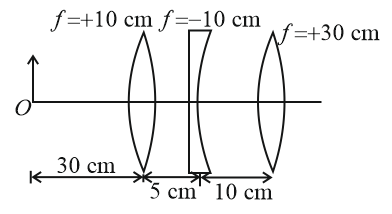
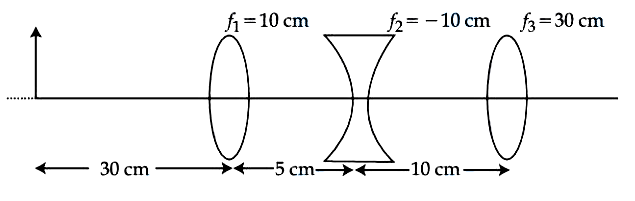
Find the distance of the image from object $$O$$, formed by the combination of lenses in the figure:

Question 67 JEE Mains

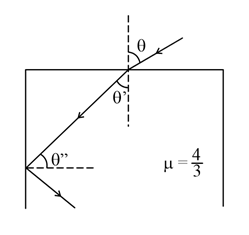
A ray of light entering from air into a denser medium of refractive index $$\frac{4}{3}$$, as shown in figure. The light ray suffers total internal reflection at the adjacent surface as shown. The maximum value of angle $$\theta$$ should be equal to:

Question 68 JEE Mains

The angle of deviation through a prism is minimum when


(A) Incident ray and emergent ray are symmetric to the prism
(B) The refracted ray inside the prism becomes parallel to its base
(C) Angle of incidence is equal to that of the angle of emergence
(D) When angle of emergence is double the angle of incidence
Choose the correct answer from the options given below:

Question 69 JEE Mains

A prism of refractive index $$n_1$$ and another prism of refractive index $$n_2$$ are stuck together (as shown in the figure). $$n_1$$ and $$n_2$$ depend on $$\lambda$$, the wavelength of light, according to the relation $$n_1 = 1.2 + \frac{10.8 \times 10^{-14}}{\lambda^2}$$ and $$n_2 = 1.45 + \frac{1.8 \times 10^{-14}}{\lambda^2}$$
The wavelength for which rays incident at any angle on the interface $$BC$$ pass through without bending at that interface will be _________ nm.

Question 70 JEE Mains

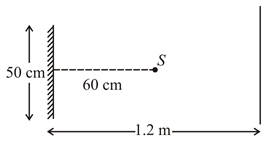
A point source of light S, placed at a distance 60 cm infront of the centre of a plane mirror of width 50 cm, hangs vertically on a wall. A man walks infront of the mirror along a line parallel to the mirror at a distance 1.2 m from it (see in the figure). The distance between the extreme points where he can see the image of the light source in the mirror is ______ cm

Question 71 JEE Mains

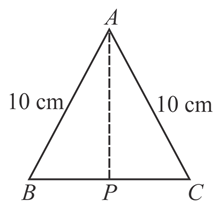
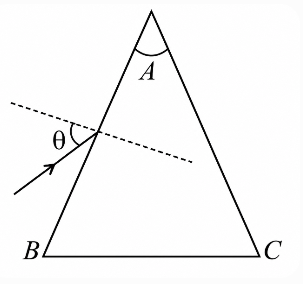
Cross-section view of a prism is the equilateral triangle $$ABC$$ shown in the figure. The minimum deviation is observed using this prism when the angle of incidence is equal to the prism angle. The time taken by light to travel from P (midpoint of BC) to A is _________ $$\times 10^{-10}$$ s. (Given, speed of light in vacuum = $$3 \times 10^8$$ m s$$^{-1}$$ and $$\cos 30° = \frac{\sqrt{3}}{2}$$)

Question 72 JEE Mains

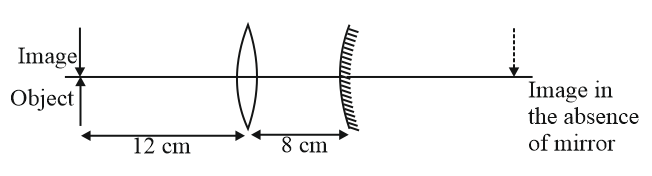
An object is placed at a distance of 12 cm from a convex lens. A convex mirror of focal length 15 cm is placed on another side of the lens at 8 cm as shown in the figure. The image of the object coincides with the object.


When the convex mirror is removed, a real and inverted image is formed at a position. The distance of the image from the object will be _________ cm

Question 73 JEE Mains

A ray of light passing through a prism $$\left(\mu = \sqrt{3}\right)$$ suffers minimum deviation. It is found that the angle of incidence is double the angle of refraction within the prism. Then, the angle of prism is ___ (in degrees).

Question 74 JEE Mains

An object viewed from a near point distance of 25 cm, using a microscopic lens with magnification 6, gives an unresolved image. A resolved image is observed at infinite distance with a total magnification double the earlier using an eyepiece along with the given lens and a tube of length 0.6 m, if the focal length of the eyepiece is equal to ___ cm.

Question 75 JEE Mains

The image of an object placed in air formed by a convex refracting surface is at a distance of 10 m behind the surface. The image is real and is at $$\frac{2rd}{3}$$ of the distance of the object from the surface. The wavelength of light inside the surface is $$\frac{2}{3}$$ times the wavelength in air. The radius of the curved surface is $$\frac{x}{13}$$ m, the value of $$x$$ is ________.

Question 76 JEE Mains

A deviation of 2° is produced in the yellow ray when prism of crown and flint glass are achromatically combined. Taking dispersive powers of crown and flint glass are 0.02 and 0.03 respectively and refractive index for yellow light for these glasses are 1.5 and 1.6 respectively. The refracting angles for crown glass prism will be ________° (in degree). (Round off to the Nearest Integer)

Question 77 JEE Mains

A glass tumbler having inner depth of 17.5 cm is kept on a table. A student starts pouring water ($$\mu = \frac{4}{3}$$) into it while looking at the surface of water from the above. When he feels that the tumbler is half filled, he stops pouring water. Up to what height, the tumbler is actually filled?

Question 78 JEE Mains

A point like object is placed at distance of $$1\,\text{m}$$ in front of a convex lens of focal length $$0.5\,\text{m}$$. A plane mirror is placed at a distance of $$2\,\text{m}$$ behind the lens. The position and nature of the image formed by the system is:

Question 79 JEE Mains

If we need a magnification of 375 from a compound microscope of tube length 150mm and an objective of focal length 5mm, the focal length of the eye-piece, should be close to:

Question 80 JEE Mains

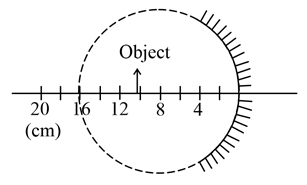
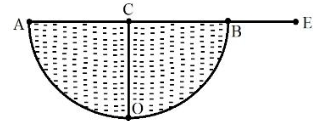
A spherical mirror is obtained as shown in the figure from a hollow glass sphere, if an object is positioned in front of the mirror, what will be the nature and magnification of the image of the object? (Figure down as schematic and not to scale)

Question 81 JEE Mains

A thin lens made of glass (refractive index = 1.5) of focal length $$f = 16$$ cm is immersed in a liquid of refractive index 1.42. If its focal length in liquid is $$f_l$$, then the ratio $$f_l/f$$ is closest to the integer:

Question 82 JEE Mains

A vessel of depth $$2h$$ is half filled with a liquid of refractive index $$2\sqrt{2}$$ and the upper half with another liquid of refractive index $$\sqrt{2}$$. The liquids are immiscible. The apparent depth of the inner surface of the bottom of the vessel will be:

Question 83 JEE Mains

An object is gradually moving away from the focal point of a concave mirror along the axis of the mirror. The graphical representation of the magnitude of linear magnification (m) versus distance of the object from the mirror (x) is correctly given by (Graphs are drawn schematically and are not to scale)

Question 84 JEE Mains

The magnifying power of a telescope with tube length 60 cm is 5. What is the focal length of its eye piece?

Question 85 JEE Mains

There is a small source of light at some depth below the surface of water (refractive index $$= \frac{4}{3}$$) in a tank of large cross sectional surface area. Neglecting any reflection from the bottom and absorption by water, percentage of light that emerges out of surface is (nearly):
[Use the fact that surface area of a spherical cap of height $$h$$ and radius of curvature $$r$$ is $$2\pi rh$$]

Question 86 JEE Mains

A double convex lens has power P and same radii of curvature R of both the surfaces. The radius of curvature of a surface of a plano-convex lens made of the same material with power $$1.5\,P$$ is:

Question 87 JEE Mains

For a concave lens of focal length $$f$$, the relation between object and image distance $$u$$ and $$v$$, respectively, from its pole can best be represented by ($$u = v$$ is the reference line):

Question 88 JEE Mains

A compound microscope consists of an objective lens of focal length $$1\,\text{cm}$$ and an eye piece of focal length $$5\,\text{cm}$$ with a separation of $$10\,\text{cm}$$. The distance between an object and the objective lens, at which the strain on the eye is minimum is $$\frac{n}{40}\,\text{cm}$$. The value of $$n$$ is.......

Question 89 JEE Mains

A prism of angle $$A = 1^\circ$$, $$\mu = 1.5$$. A good estimate for the minimum angle of deviation (in degrees) is close to $$\frac{N}{10}$$. Value of N is.........

Question 90 JEE Mains

In a compound microscope, the magnified virtual image is formed at a distance of 25 cm from the eye-piece. The focal length of its objective lens is 1 cm. If the magnification is 100 and the tube length of the microscope is 20 cm, then the focal length of the eye-piece lens (in cm) is __________

Question 91 JEE Mains

The distance between an object and a screen is 100 cm. A lens can produce real image of the object on the screen for two different positions between the screen and the object. The distance between these two positions is 40 cm. If the power of the lens is close to $$\left(\frac{N}{100}\right)$$D where N is an integer, the value of N is __________

Question 92 JEE Mains

A point object in air is in front of the curved surface of a plano-convex lens. The radius of curvature of the curved surface is 30 cm and the refractive index of the lens material is 1.5, then the focal length of the lens (in cm) is

Question 93 JEE Mains

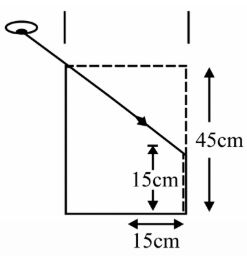
An observer can see through a small hole on the side of a jar (radius 15 cm) at a point at height of 15 cm from the bottom (see figure). The hole is at a height of 45 cm. When the jar is filled with a liquid up to a height of 30 cm the same observer can see the edge at the bottom of the jar. If the refractive index of the liquid is $$\frac{N}{100}$$, where N is an integer, the value of N i

image
Question 94 JEE Mains

When an object is kept at a distance of 30 cm from a concave mirror, the image is formed at a distance of 10 cm from the mirror. If the object is moved with a speed of 9 cm s$$^{-1}$$, the speed (in cm s$$^{-1}$$) with which image moves at that instant is

Question 95 JEE Mains

A concave mirror for face viewing has a focal length of 0.4 m. The distance at which you hold the mirror from your face in order to see your image upright with a magnification of 5 is:

Question 96 JEE Mains

The eye can be regarded as a single refracting surface. The radius of curvature of this surface is equal to that of the cornea (7.8 mm). This surface separates two media of refractive indices 1 and 1.34. Calculate the distance from the refracting surface at which a parallel beam of light will come to focus.

Question 97 JEE Mains

A convex lens is put 10 cm from a light source and it makes a sharp image on a screen, kept 10 cm from the lens. Now a glass block (refractive index 1.5) of 1.5 cm thickness is placed in between the light source and the lens. To get the sharp image again, the screen is shifted by a distance $$d$$. Then $$d$$ is:

Question 98 JEE Mains

A convex lens (of focal length 20 cm) and a concave mirror, having their principal axes along the same lines, are kept 80 cm apart from each other. The concave mirror is to the right of the convex lens. When an object is kept at a distance of 30 cm to the left of the convex lens, its image remains at the same position even if the concave mirror is removed. The maximum distance of the object for which this concave mirror, by itself would produce a virtual image would be:

Question 99 JEE Mains

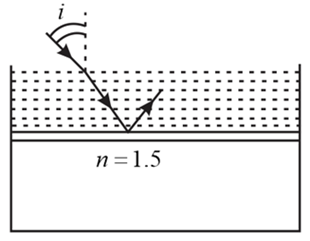
Consider a tank made of glass (refractive index 1.5) with a thick bottom. It is filled with a liquid of refractive index $$\mu$$. A student finds that, irrespective of what the incident angle $$i$$ (see figure) is for a beam of light entering the liquid, the light reflected from the liquid glass interface is never completely polarized. For this to happen, the minimum value of $$\mu$$ is:

Question 100 JEE Mains

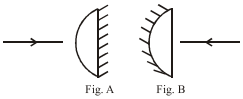
A planoconvex lens becomes an optical system of 28 cm focal length when its plane surface is silvered and illuminated from left to right as shown in Fig. A. If the same lens is instead silvered on the curved surface and illuminated from other side as in Fig. B, it acts like an optical system of focal length 10 cm. The refractive index of the material of lens is:

Question 101 JEE Mains

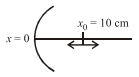
A particle is oscillating on the X-axis with an amplitude 2 cm about the point $$x_0 = 10$$ cm with a frequency $$\omega$$. A concave mirror of focal length 5 cm is placed at the origin (see figure). Identify the correct statements: (A) The image executes periodic motion (B) The image executes non-periodic motion (C) The turning points of the image are asymmetric w.r.t the image of the point at x = 10 cm (D) The distance between the turning points of the oscillation of the image is $$\frac{100}{21}$$ cm.

Question 102 JEE Mains

A convergent doublet of separated lenses, corrected for spherical aberration, has resultant focal length of 10 cm. The separation between the two lenses is 2 cm. The focal lengths of the component lenses are:

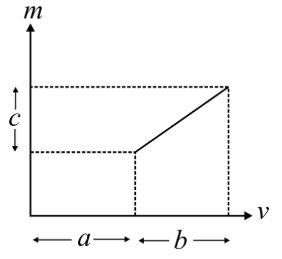
Question 103 JEE Mains

A ray of light is incident at an angle of 60$$^\circ$$ on one face of a prism of angle 30$$^\circ$$. The emergent ray of light makes an angle of 30$$^\circ$$ with incident ray. The angle made by the emergent ray with second face of prism will be:

Question 104 JEE Mains

Let the refractive index of a denser medium with respect to a rarer medium be $$n_{12}$$ and its critical angle be $$\theta_C$$. At an angle of incidence $$A$$ when light is travelling from denser medium to rarer medium, a part of the light is reflected and the rest is refracted and the angle between reflected and refracted rays is 90°. Angle $$A$$ is given by:

Question 105 JEE Mains

A diverging lens with magnitude of focal length 25 cm is placed at a distance of 15 cm from a converging lens of magnitude of focal length 20 cm. A beam of parallel light falls on the diverging lens. The final image formed is:

Question 106 JEE Mains

In an experiment a convex lens of focal length 15 cm is placed coaxially on an optical bench in front of a convex mirror at a distance of 5 cm from it. It is found that an object and its image coincide, if the object is placed at a distance of 20 cm from the lens. The focal length of the convex mirror is-

Question 107 JEE Mains

An observer looks at a distant tree of height 10 m with a telescope of magnifying power of 20. To the observer, the tree appears as

Question 108 JEE Mains

In an experiment for determination of refractive index of glass of a prism by i v/s $$\delta$$ plot, it was found that a ray incident at angle 35°, suffers a deviation of 40° and that it emerges at angle 79°. In that case which of the following is closest to the maximum possible value of the refractive index?

Question 109 JEE Mains

To determine refractive index of glass slab using a travelling microscope, minimum number of readings required are:

Question 110 JEE Mains

To find the focal length of a convex mirror, a student records the following data:
Object pin: 22.2 cm, Convex Lens: 32.2 cm, Convex Mirror: 45.8 cm, Image Pin: 71.2 cm
The focal length of the convex lens is $$f_1$$ and that of mirror is $$f_2$$. Then taking index correction to be negligibly small, $$f_1$$ and $$f_2$$ are close to:

Question 111 JEE Mains

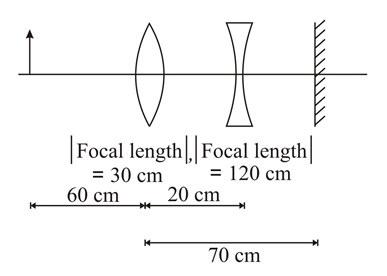
A convex lens, of focal length 30 cm, a concave lens of focal length 120 cm, and a plane mirror are arranged as shown. For an object kept at a distance of 60 cm from the convex lens, the final image, formed by the combination, is a real image, at a distance of:

Question 112 JEE Mains

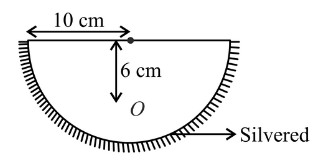
A hemispherical glass body of radius 10 cm and refractive index 1.5 is silvered on its curved surface. A small air bubble is 6 cm below the flat surface inside it along the axis. The position of the image of the air bubble made by the mirror is seen:

image
Question 113 JEE Mains

A telescope has an objective lens of focal length 150 cm and an eyepiece of focal length 5 cm. If a 50 m tall tower at a distance of 1 km is observed through this telescope in a normal setting, the angle formed by the image of the tower is $$\theta$$, then $$\theta$$ is close to

Question 114 JEE Mains

A thin convex lens of focal length $$f$$ is put on a plane mirror as shown in the figure. When an object is kept at a distance $$a$$ from the lens-mirror combination, its image is formed at a distance $$\dfrac{a}{3}$$ in front of the combination. The value of $$a$$ is:

image
Question 115 JEE Mains

Monochromatic light is incident on a glass prism of angle A. If the refractive index of the material of the prism is $$\mu$$, a ray, incident at an angle $$\theta$$, on the face AB would get transmitted through the face AC of the prism provided:

image
Question 116 JEE Mains

You are asked to design a shaving mirror assuming that a person keeps it at 10 cm from his face and views the magnified image of the face at the closest comfortable distance of 25 cm. The radius of curvature of the mirror would then be:

Question 117 JEE Mains

A diver looking up through the water sees the outside world contained in a circular horizon. The refractive index of water is $$\frac{4}{3}$$, and the diver's eyes are 15 cm below the surface of the water. Then the radius of the circle is:

Question 118 JEE Mains

The diameter of the objective lens of the microscope makes an angle $$\beta$$ at the focus of the microscope. Further, the medium between the object and the lens is the oil of the refractive index n. Then the resolving power of the microscope:

Question 119 JEE Mains

A ray of light is incident from a denser to a rarer medium. The critical angle for total internal reflection is $$\theta_{iC}$$ and Brewster's angle of incidence is $$\theta_{iB}$$, such that $$\frac{\sin\theta_{iC}}{\sin\theta_{iB}} = \eta = 1.28$$. The relative refractive index of the two media is:

Question 120 JEE Mains

A thin convex lens made from crown glass ($$\mu = \frac{3}{2}$$) has focal length $$f$$. When it is measured in two different liquids having refractive indices $$\frac{4}{3}$$ and $$\frac{5}{3}$$, it has the focal lengths $$f_1$$ and $$f_2$$ respectively. The correct relation between the focal lengths is:

Question 121 JEE Mains

An object is located in a fixed position in front of a screen. Sharp image is obtained on the screen for two positions of a thin lens separated by 10 cm. The size of the images in two situations are in the ratio 3 : 3. What is the distance between the screen and the object?

Question 122 JEE Mains

The focal lengths of objective lens and eye lens of a Galilean Telescope are respectively 30 cm and 3.0 cm. Telescope produces virtual, erect image of an object situated far away from it at least distance of distinct vision from the eye lens. In this condition the Magnifying Power of the Galilean Telescope should be:

Question 123 JEE Mains

The refractive index of the material of a concave lens is $$\mu$$. It is immersed in a medium of refractive index $$\mu_1$$. A parallel beam of light is incident on the lens. The path of the emergent rays when $$\mu_1 > \mu$$ is:

Question 124 JEE Mains

A green light is incident from the water to the air-water interface at the critical angle ($$\theta_c$$). Select the correct statement.

Question 125 JEE Mains

In a compound microscope the focal length of objective lens is 1.2 cm and focal length of eye piece is 3.0 cm. When object is kept at 1.25 cm in front of objective, final image is formed at infinity. Magnifying power of the compound microscope should be:

Question 126 JEE Mains

A printed page is pressed by a glass of water. The refractive index of the glass and water is 1.5 and 1.33, respectively. If the thickness of the bottom of glass is 1 cm and depth of water is 5 cm, how much the page will appear to be shifted if viewed from the top?

Question 127 JEE Mains

The graph between angle of deviation ($$\delta$$) and angle of incidence ($$i$$) for a triangular prism is represented by :

Question 128 JEE Mains

This question has Statement-1 and Statement-2. Of the four choices given after the Statements, choose the one that best describes the two Statements.
Statement 1: Very large size telescopes are reflecting telescopes instead of refracting telescopes.
Statement 2: It is easier to provide mechanical support to large size mirrors than large size lenses.

Question 129 JEE Mains

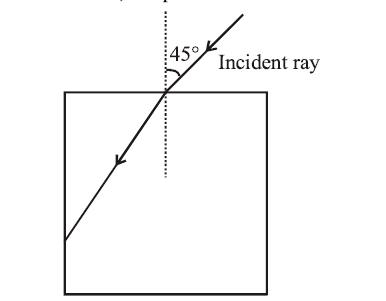
A light ray falls on a square glass slab as shown in the diagram. The index of refraction of the glass, if total internal reflection is to occur at the vertical face, is equal to :

Question 130 JEE Mains

Diameter of a plano-convex lens is 6 cm and thickness at the centre is 3 mm. If the speed of light in the material of lens is $$2 \times 10^8$$ m s$$^{-1}$$, the focal length of the lens is:

Question 131 JEE Mains

Light is incident from a medium into air at two possible angles of incidence (A) 20° and (B) 40°. In the medium light travels 3.0 cm in 0.2 ns. The ray will :

Question 132 JEE Mains

The focal length of the objective and the eyepiece of a telescope are 50 cm and 5 cm respectively. If the telescope is focussed for distinct vision on a scale distant 2 m from its objective, then its magnifying power will be :

Question 133 JEE Mains

The image of an illuminated square is obtained on a screen with the help of a converging lens. The distance of the square from the lens is 40 cm. The area of the image is 9 times that of the square. The focal length of the lens is :

Question 134 JEE Mains

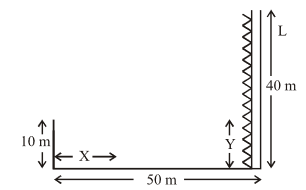
A person lives in a high-rise building on the bank of a river 50 m wide. Across the river is a well lit tower of height 40 m. When the person, who is at a height of 10 m, looks through a polarizer at an appropriate angle at light of the tower reflecting from the river surface, he notes that intensity of light coming from distance X from his building is the least and this corresponds to the light coming from light bulbs at height 'Y' on the tower. The values of X and Y are respectively close to (refractive index of water $$\sim \frac{4}{3}$$)

Question 135 JEE Mains

An object $$2.4$$ m in front of a lens forms a sharp image on a film $$12$$ cm behind the lens. A glass plate $$1$$ cm thick, of refractive index $$1.50$$ is interposed between lens and film with its plane faces parallel to film. At what distance (from lens) should object be shifted to be in sharp focus on film?

Question 136 JEE Mains

A glass prism of refractive index $$1.5$$ is immersed in water (refractive index $$\frac{4}{3}$$ ) as shown in figure. A light beam incident normally on the face $$AB$$ is totally reflected to reach the face $$BC$$, if

image
Question 137 JEE Mains

We wish to make a microscope with the help of two positive lenses both with a focal length of $$20$$ mm each and the object is positioned $$25$$ mm from the objective lens. How far apart the lenses should be so that the final image is formed at infinity?

Question 138 JEE Mains

Which of the following processes play a part in the formation of a rainbow? (i) Refraction (ii) Total internal reflection (iii) Dispersion (iv) Interference

Question 139 JEE Mains

A beam of light consisting of red, green and blue colours is incident on a right-angled prism on face $$AB$$. The refractive indices of the material for the above red, green and blue colours are 1.39, 1.44 and 1.47 respectively.

image

A person looking on surface $$AC$$ of the prism will see

Question 140 JEE Mains

A telescope of aperture $$3 \times 10^{-2}$$ m diameter is focused on a window at 80 m distance fitted with a wire mesh of spacing $$2 \times 10^{-3}$$ m. Given: $$\lambda = 5.5 \times 10^{-7}$$ m, which of the following is true for observing the mesh through the telescope?

Question 141 JEE Mains

Let the $$x-z$$ plane be the boundary between two transparent media. Medium 1 in $$z \geq 0$$ has a refractive index of $$\sqrt{2}$$ and medium 2 with $$z < 0$$ has a refractive index of $$\sqrt{3}$$. A ray of light in medium 1 given by the vector $$\vec{A} = 6\sqrt{3}\,\hat{i} + 8\sqrt{3}\,\hat{j} - 10\hat{k}$$ is incident on the plane of separation. The angle of refraction in medium 2 is:

Question 142 JEE Mains

A car is fitted with a convex side-view mirror of focal length $$20 \, \text{cm}$$. A second car $$2.8 \, \text{m}$$ behind the first car is overtaking the first car at relative speed of $$15 \, \text{m/s}$$. The speed of the image of the second car as seen in the mirror of the first one is:

Question 143 JEE Mains

An initially parallel cylindrical beam travels in a medium of refractive index $$\mu(I) = \mu_0 + \mu_2 I$$, where $$\mu_0$$ and $$\mu_2$$ are positive constants and $$I$$ is the intensity of the light beam. The intensity of the beam is decreasing with increasing radius. As the beam enters the medium, it will

Question 144 JEE Mains

An initially parallel cylindrical beam travels in a medium of refractive index $$\mu(I) = \mu_0 + \mu_2 I$$, where $$\mu_0$$ and $$\mu_2$$ are positive constants and $$I$$ is the intensity of the light beam. The intensity of the beam is decreasing with increasing radius. The speed of light in the medium is

Question 145 JEE Mains

In an optics experiment, with the position of the object fixed, a student varies the position of a convex lens and for each position, the screen is adjusted to get a clear image of the object. A graph between the object distance $$u$$ and the image distance $$v$$, from the lens, is plotted using the same scale for the two axes. A straight line passing through the origin and making an angle of $$45°$$ with the x-axis meets the experimental curve at $$P$$. The coordinates of $$P$$ will be

Question 146 JEE Mains

A transparent solid cylindrical rod has a refractive index of $$\frac{2}{\sqrt{3}}$$. It is surrounded by air. A light ray is incident at the mid point of one end of the rod as shown in the figure. The incident angle $$\theta$$ for which the light ray grazes along the wall of the rod is

Question 147 JEE Mains

A student measures the focal length of convex lens by putting an object pin at a distance '$$u$$' from the lens and measuring the distance '$$v$$' of the image pin. The graph between '$$u$$' and '$$v$$' plotted by the student should look like

Question 148 JEE Mains

An experiment is performed to find the refractive index of glass using a travelling microscope. In this experiment distance are measured by

Question 149 JEE Mains

Two lenses of power $$-15 D$$ and $$+5 D$$ are in contact with each other. The focal length of the combination is

Question 150 JEE Mains

The refractive index of glass is $$1.520$$ for red light and $$1.525$$ for blue light. Let $$D_1$$ and $$D_2$$ be the angles of minimum deviation for red and blue light respectively in a prism of this glass. Then

Question 151 JEE Mains

A fish looking up through the water sees the outside world contained in a circular horizon. If the refractive index of water is $$4/3$$ and the fish is $$12$$ cm below the surface, the radius of this circle in cm is

Question 152 JEE Mains

A thin glass (refractive index $$1.5$$) lens has optical power of $$-5D$$ in air. Its optical power in a liquid medium with refractive index $$1.6$$ will be

Question 153 JEE Mains

A plane convex lens of refractive index $$1.5$$ and radius of curvature $$30$$ cm is silvered at the curved surface. Now this lens has been used to form the image of an object. At what distance from this lens an object be placed in order to have a real image of the size of the object?

Question 154 JEE Mains

A ray of light passing through an equilateral prism is having velocity $$2.12 \times 10^8$$ m/s in the prism material, then the minimum angle of deviation is _______ degrees.

Question 155 JEE Mains

For a thin symmetric prism made of glass (refractive index 1.5), the ratio of incident angle and minimum deviation will be __________.

Question 156 JEE Mains

A convex lens is made from glass material having refractive index of 1.4 with same radius of curvature on both sides. The ratio of its focal length and radius of curvature is ______.

Question 157 JEE Mains

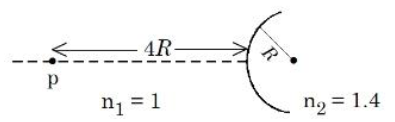
A spherical interface lens of radius $$R$$ separates two media of refractive indices 1 and 1.4 respectively as shown in the figure below. A point source is placed at a distance of $$4R$$ in front of spherical interface. The magnitude of the magnification of point source image is _______.

image
Question 158 JEE Mains

Refer the figure given below. $$\mu_1$$ and $$\mu_2$$ are refractive indices of air and lens material. The height of image will be __________ cm.

image
Question 159 JEE Mains

A compound microscope is designed with two symmetric biconvex lenses. The objective lens is cut vertically, creating two identical plano-convex lenses. One of them is used in place of original objective lens. To retain same magnification keeping the object distance unchanged, the tube length has to be

Question 160 JEE Mains

A thin prism with angle 5° of refractive index 1.72 is combined with another prism of refractive index 1.9 to produce dispersion w ithout deviation. The angle of second prism is ____ .

Question 161 JEE Mains

Five persons $$P_{1},P_{2},P_{3},P{4}, \text{and} P_{5}$$ recorded object distance (u) and image distance (v) using same convex lens having powei· +5D as (25,96), (30,62), (35,37), (45,35)
and (50,32) respectively. Identify correct statement

Question 162 JEE Mains

For a transparent prism, if the angle of minimum deviation is equal to its refracting angle, the refractive index n of the prism satisfies.

Question 163 JEE Mains

In a microscope of tube length 1O cm two convex lenses are arranged with focal length of 2 cm and 5 cm. Total magnification obtained with this system for normal adjustment is $$(5)^{k}$$ The value of k is ___.

Question 164 JEE Mains

The size of the images of an object, formed by a thin lens are equal when the object is placed at two different positions 8 cm and 24 cm from the lens. The focal length of the lens is _______ cm.

Question 165 JEE Mains

A collimated beam of light of diameter 2 mm is propagating along x-axis. The beam is required to be expanded in a collimated beam of diameter 14 mm using a system of two convex lenses. lf first lens has focal length 40 mm, then the focal length of second lens is ____ mm.

Question 166 JEE Mains

Object O is moving with a velocity $$8\ m.s^{-1}$$ inside water and mirror is moving with a velocity $$6\ m.s^{-1}$$ of as shown in the figure. Then find the velocity of image formed by the plane mirror with respect to object in $$ (m.s^{-1}$$ )

image
Question 167 JEE Advanced

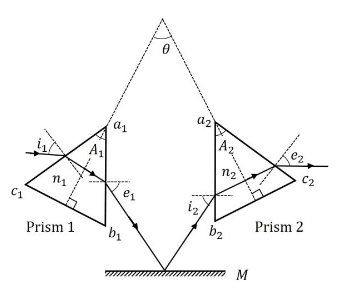
Consider two isosceles prisms 1 and 2 with prism angles $$A_1$$ and $$A_2$$ and refractive indices $$n_1$$ and $$n_2$$, respectively, as shown in the figure. The faces $$a_1b_1$$ and $$a_2b_2$$ are parallel to each other and perpendicular to the mirror $$M$$. If a ray of light is incident on the face $$a_1c_1$$ and emerges from the face $$a_2c_2$$, then the correct statement(s) is/are:

image
Question 168 JEE Mains

A concave mirror of focal length 10 cm forms an image which is double the size of object when the object is placed at two different positions. The distance between the two positions of the object is __________ cm.

Question 169 JEE Mains

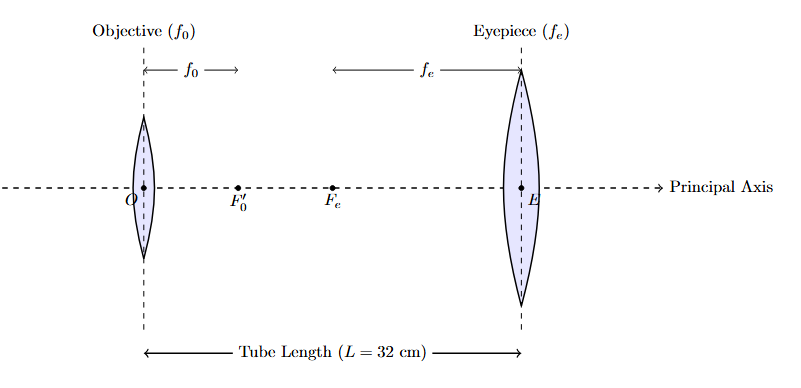
In a microscope the objective is having focal length $$f_{0}=2 \text{cm}$$ and eye-piece is having focal length $$f_{e} = 4 \text{cm}$$ The tube length is 32 cm. the magnification produced by this microscope for normal adjustment is _______.

Question 170 JEE Advanced

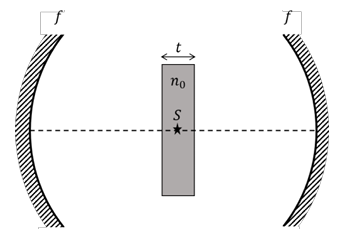
Two identical concave mirrors each of focal length $$f$$ are facing each other as shown in the schematic diagram. The focal length $$f$$ is much larger than the size of the mirrors. A glass slab of thickness $$t$$ and refractive index $$n_0$$ is kept equidistant from the mirrors and perpendicular to their common principal axis. A monochromatic point light source $$S$$ is embedded at the center of the slab on the principal axis, as shown in the schematic diagram. For the image to be formed on $$S$$ itself, which of the following distances between the two mirrors is/are correct:

image
Question 171 JEE Advanced

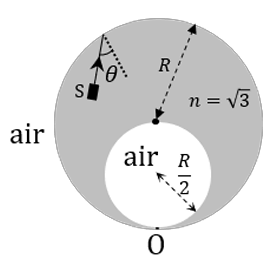
A solid glass sphere of refractive index $$n = \sqrt{3}$$ and radius $$R$$ contains a spherical air cavity of radius $$\frac{R}{2}$$, as shown in the figure. A very thin glass layer is present at the point O so that the air cavity (refractive index $$n = 1$$) remains inside the glass sphere. An unpolarized, unidirectional and monochromatic light source $$S$$ emits a light ray from a point inside the glass sphere towards the periphery of the glass sphere. If the light is reflected from the point O and is fully polarized, then the angle of incidence at the inner surface of the glass sphere is $$\theta$$. The value of $$\sin \theta$$ is ________.

image
Question 172 JEE Mains

Given a thin convex lens (refractive index $$\mu_{2}$$), kept in a liquid (refractive index $$\mu_{1},\mu_{1}<\mu_{2}$$) having radii of curvatures $$|R_{1}|$$ and $$|R_{2}|$$ . Its second surface is silver polished. Where should an object be placed on the optic axis so that a real and inverted image is formed at the same place?

Question 173 JEE Mains

Given is a thin convex lens of glass (refractive index $$\mu$$) and each side having radius of curvature R. One side is polished for complete reflection. At what distance from the lens, an object be placed on the optic axis so that the image gets formed on the object itself ?

Question 174 JEE Mains

A concave mirror of focal length $$f$$ in air is dipped in a liquid of refractive index $$\mu$$. Its focal length in the liquid will be:

Question 175 JEE Mains

A lens having refractive index 1.6 has focal length of 12 cm, when it is in air. Find the focal length of the lens when it is placed in water. (Take refractive index of water as 1.28)

Question 176 JEE Mains

In a long glass tube, mixture of two liquids A and B with refractive indices 1.3 and 1.4 respectively, forms a convex refractive meniscus towards . If an object placed at 13 cm from the vertex of the meniscus in A forms an image with a magnification of '-2' then the radius of curvature of meniscus is :

Question 177 JEE Mains

What is the relative decrease in focal length of a lens for an increase in optical power  by $$0.1\,D$$ from  $$2.5\,D? \quad [\text{'D' stands for dioptre}] $$

Question 178 JEE Mains

A monochromatic light of frequency $$5 \times 10^{14}$$ Hz travelling through air, is incident on a medium of refractive index '2'. Wavelength of the refracted light will be:

Question 179 JEE Mains

When an object is placed 40 cm away from a spherical mirror an image of magnification $$\dfrac{1}{2}$$ is produced. To obtain an image with magnification of $$\dfrac{1}{3}$$, the object is to be moved:

Question 180 JEE Mains

A thin plano convex lens made of glass of refractive index 1.5 is immersed in a liquid of refractive index 1.2. When the plane side of the lens is silver coated for complete reflection, the lens immersed in the liquid behaves like a concave mirror of focal length 0.2 m. The radius of curvature of the curved surface of the lens is

Question 181 JEE Mains

The refractive index of the material of a glass prism is $$\sqrt{3}$$. The angle of minimum deviation is equal to the angle of the prism. What is the angle of the prism?

Question 182 JEE Mains

Two thin convex lenses of focal lengths 30 cm and 10 cm are placed coaxially, 10 cm apart. The power of this combination is :

Question 183 JEE Mains

A convex lens made of glass (refractive index = 1.5) has focal length 24 cm in air. When it is totally immersed in water (refractive index 1.33), its focal length changes to

Question 184 JEE Mains

Let u and $$\upsilon$$ be the distances of the object and the image from a lens of focal length $$f$$. The correct graphical representation of u and $$\upsilon$$ for a convex lens when $$|u| > f$$, is

Question 185 JEE Mains

A convex lens of focal length 30 cm is placed in contact with a concave lens of focal length 20 cm. An object is placed at 20 cm to the left of this lens system. The distance of the image from the lens in cm is _____.

Question 186 JEE Mains

A photograph of a landscape is captured by a drone camera at a height of 18 km . The size of the camera film is $$ 2 cm \times 2 cm $$ and the area of the landscape photographed is $$ 400 km^{2} $$. The focal length of the lens in the drone camera is :

Question 187 JEE Mains

A plano-convex lens having radius of curvature of first surface  $$2\,cm$$ exhibits focal length $$f_1$$ in air. Another plano-convex lens with first surface radius of curvature  $$3\,cm$$ has focal length $$f_2$$ when it is immersed in a liquid of refractive index  $$1.2.$$ If both the lenses are made of same glass of refractive index  $$1.5,$$ then the ratio $$f_1:f_2$$ will be:

Question 188 JEE Mains

Given below are two statements : one is labelled as Assertion (A) and the other is labelled as Reason(R).
Assertion (A) :
Refractive index of glass is higher than that of air.
Reason (R) : Optical density of a medium is directly proportionate to its mass density which results in a proportionate refractive index.
In the light of the above statements, choose the most appropriate answer from the options given below :

Question 189 JEE Mains

Two identical objects are placed in front of convex mirror and concave mirror having same radii of curvature of 12 cm, at same distance of 18 cm from the respective mirrors. The ratio of the sizes of images formed by convex mirror and by concave mirror is :

Question 190 JEE Mains

What is the lateral shift of a ray refracted through a parallel-sided glass slab of thickness 'h' in terms of the angle of incidence 'i' and angle of refraction 'r', if the glass slab is placed in air medium?

Question 191 JEE Mains
page7_img2


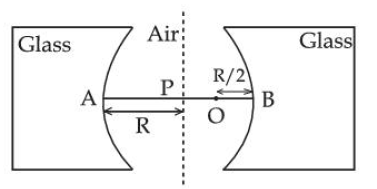
Two concave refracting surfaces of equal radii of curvature and refractive index 1.5 face each other in air as shown in figure. A point object O is placed midway, between P and B . The separation between the images of O , formed by each refracting surface is :

Question 192 JEE Mains

A bi-convex lens has radius of curvature of both the surfaces same as 1/6 cm. If this lens is required to be replaced by another convex lens having different radii of curvatures on both sides $$(R_1 \neq R_2)$$, without any change in lens power then possible combination of $$R_1$$ and $$R_2$$ is :

Question 193 JEE Mains
image


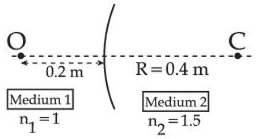
A spherical surface separates two media of refractive indices 1 and 1.5 as shown in figure. Distance of the image of an object 'O', is: (C is the center of curvature of the spherical surface and R is the radius of curvature)

Question 194 JEE Mains

The radii of curvature for a thin convex lens are 10 cm and 15 cm respectively. The focal length of the lens is 12 cm. The refractive index of the lens material is

Question 195 JEE Mains

A finite size object is placed normal to the principal axis at a distance of 30 cm from a convex mirror of focal length 30 cm. A plane mirror is now placed in such a way that the image produced by both the mirrors coincide with each other. The distance between the two mirrors is :

Question 196 JEE Mains

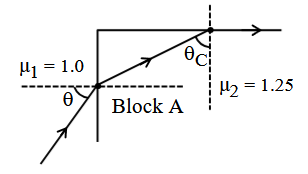
A transparent block A having refractive index $$\mu = 1.25$$ is surrounded by another medium of refractive index $$\mu = 1.0$$. A light ray is incident on the flat face of the block with incident angle $$\theta$$. What is the maximum value of $$\theta$$ for which light suffers total internal reflection at the top surface of the block?

image
Question 197 JEE Mains

Consider following statements for refraction of light through prism, when angle of deviation is minimum.
(A) The refracted ray inside prism becomes parallel to the base.
(B) Larger angle prisms provide smaller angle of minimum deviation.
(C) Angle of incidence and angle of emergence becomes equal.
(D) There are always two sets of angle of incidence for which deviation will be same except at minimum deviation setting.
(E) Angle of refraction becomes double of prism angle.

Choose the correct answer from the options given below.

Question 198 JEE Mains

Light from a point source in air falls on a spherical glass surface (refractive index, $$\mu = 1.5$$ and radius of curvature = 50 cm). The image is formed at a distance of 200 cm inside the glass. The magnitude of distance of the light source from the glass surface is ________ m.

Question 199 JEE Mains

The driver sitting inside a parked car is watching vehicles approaching from behind with the help of his side view mirror, which is a convex mirror with radius of curvature R=2 m. Another car approaches him from behind with a uniform speed of 90 km/hr. When the car is at a distance of 24 m from him, the magnitude of the acceleration of the image of the car in the side view mirror is ' a '. The value of 100 a is ________ $$m/s^{2}$$.

Question 200 JEE Mains

A container contains a liquid with refractive index of 1.2 up to a height of 60 cm and another liquid having refractive index 1.6 is added to height H above first liquid. If viewed from above, the apparent shift in the position of bottom of container is 40 cm. The value of H is ___ cm.
(Consider liquids are immisible)

Question 201 JEE Mains

A ray of light suffers minimum deviation when incident on a prism having angle of the prism equal to 60°. The refractive index of the prism material is $$\sqrt{2}$$. The angle of incidence (in degrees) is _________.

Question 202 JEE Mains

Distance between object and its image (magnified by $$-\dfrac{1}{3}$$) is 30 cm. The focal length of the mirror used is $$\left(\dfrac{x}{4}\right)$$ cm, where magnitude of value of x is ________.

Question 203 JEE Mains

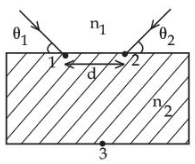
Two light beams fall on a transparent material block at point 1 and 2 with angle $$\theta_{1}$$ and $$\theta_{2}$$, respectively, as shown in figure. After refraction, the beams intersect at point 3 which is exactly on the interface at other end of the block. Given : the distance between 1 and 2, $$d = 4\sqrt{3} cm$$ and $$\theta_{1} = \theta_{2} = \cos^{-1}(\frac{n_{2}}{2n_{1}})$$, where refractive index of the block $$n_{2} > $$ refractive index of the outside medium $$n_{1}$$, then the thickness of the block is ________cm. 

page8_img1
Question 204 JEE Mains

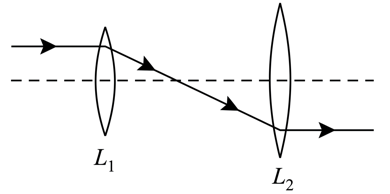
The following figure represents two biconvex lenses $$L_1$$ and $$L_2$$ having focal length $$10 \text{ cm}$$ and $$15 \text{ cm}$$ respectively. The distance between $$L_1$$ & $$L_2$$ is 

image
Question 205 JEE Mains

Critical angle of incidence for a pair of optical media is $$45°$$. The refractive indices of first and second media are in the ratio:

Question 206 JEE Mains

A convex mirror of radius of curvature $$30$$ cm forms an image that is half the size of the object. The object distance is :

Question 207 JEE Mains

For the thin convex lens, the radii of curvature are at $$15 \text{ cm}$$ and $$30 \text{ cm}$$ respectively. The focal length the lens is $$20 \text{ cm}$$. The refractive index of the material is :

Question 208 JEE Mains

Given below are two statements : 

Statement (I) : When an object is placed at the centre of curvature of a concave lens, image is formed at the centre of curvature of the lens on the other side. 

Statement (II) : Concave lens always forms a virtual and erect image. 

In the light of the above statements, choose the correct answer from the options given below :

Question 209 JEE Mains

A biconvex lens of refractive index $$1.5$$ has a focal length of $$20$$ cm in air. Its focal length when immersed in a liquid of refractive index $$1.6$$ will be:

Question 210 JEE Mains

A light ray is incident on a glass slab of thickness $$4\sqrt{3}$$ cm and refractive index $$\sqrt{2}$$. The angle of incidence is equal to the critical angle for the glass slab with air. The lateral displacement of ray after passing through glass slab is _____ cm. (Given $$\sin 15° = 0.25$$)

Question 211 JEE Mains

Light from a point source in air falls on a convex curved surface of radius 20 cm and refractive index 1.5. If the source is located at 100 cm from the convex surface, the image will be formed at ______ cm from the object.

Question 212 JEE Mains

The distance between object and its $$3$$ times magnified virtual image as produced by a convex lens is $$20$$ cm. The focal length of the lens used is ________ cm.

Question 213 JEE Mains

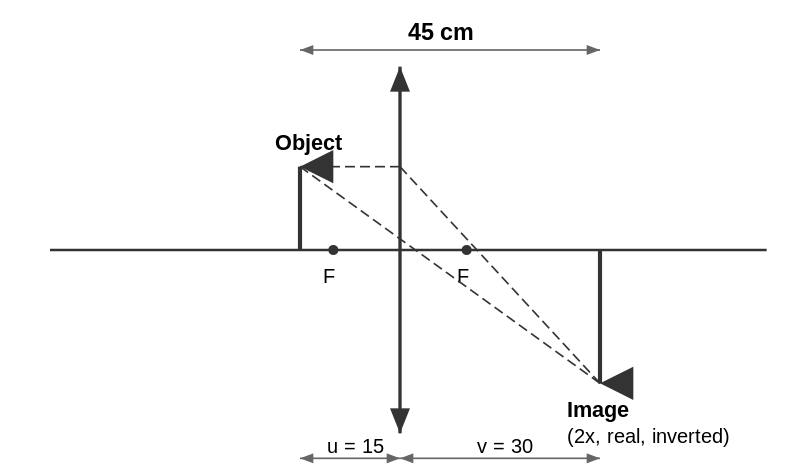
The distance between object and its two times magnified real image as produced by a convex lens is $$45 \text{ cm}$$. The focal length of the lens used is ________ cm.

Question 214 JEE Mains

The refractive index of prism is $$\mu = \sqrt{3}$$ and the ratio of the angle of minimum deviation to the angle of prism is one. The value of angle of prism is _______.

Question 215 JEE Mains

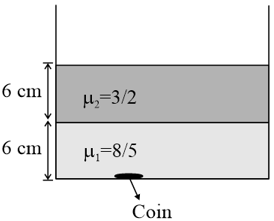
Two immiscible liquids of refractive indices $$\frac{8}{5}$$ and $$\frac{3}{2}$$ respectively are put in a beaker as shown in the figure. The height of each column is $$6$$ cm. A coin is placed at the bottom of the beaker. For near normal vision, the apparent depth of the coin is $$\frac{\alpha}{4}$$ cm. The value of $$\alpha$$ is _______.

image
Question 216 JEE Mains

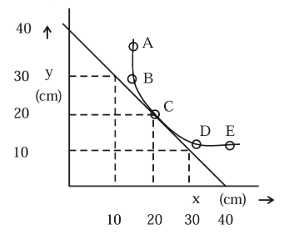
In an experiment to measure the focal length $$(f)$$ of a convex lens, the magnitude of object distance $$(x)$$ and the image distance $$(y)$$ are measured with reference to the focal point of the lens. The $$y - x$$ plot is shown in figure. The focal length of the lens is ____ cm.

image
Question 217 JEE Advanced

A light ray is incident on the surface of a sphere of refractive index $$n$$ at an angle of incidence $$\theta_0$$. The ray partially refracts into the sphere with angle of refraction $$\phi_0$$ and then partly reflects from the back surface. The reflected ray then emerges out of the sphere after a partial refraction. The total angle of deviation of the emergent ray with respect to the incident ray is $$\alpha$$. Match the quantities mentioned in List-I with their values in List-II and choose the correct option.

List-IList-II
(P)If $$n = 2$$ and $$\alpha = 180°$$, then all the possible values of $$\theta_0$$ will be(1)$$30°$$ and $$0°$$
(Q)If $$n = \sqrt{3}$$ and $$\alpha = 180°$$, then all the possible values of $$\theta_0$$ will be(2)$$60°$$ and $$0°$$
(R)If $$n = \sqrt{3}$$ and $$\alpha = 180°$$, then all the possible values of $$\phi_0$$ will be(3)$$45°$$ and $$0°$$
(S)If $$n = \sqrt{2}$$ and $$\theta_0 = 45°$$, then all the possible values of $$\alpha$$ will be(4)$$150°$$
(5)$$0°$$
Question 218 JEE Mains

A thin prism $$P_1$$ with an angle $$6°$$ and made of glass of refractive index $$1.54$$ is combined with another prism $$P_2$$ made from glass of refractive index $$1.72$$ to produce dispersion without average deviation. The angle of prism $$P_2$$ is:

Question 219 JEE Mains

A monochromatic light wave with wavelength $$\lambda_1$$ and frequency $$\nu_1$$ in air enters another medium. If the angle of incidence and angle of refraction at the interface are 45° and 30° respectively, then the wavelength $$\lambda_2$$ and frequency $$\nu_2$$ of the refracted wave are:

Question 220 JEE Mains

A 2 meter long scale with least count of 0.2 cm is used to measure the locations of objects on an optical bench. While measuring the focal length of a convex lens, the object pin and the convex lens are placed at 80 cm mark and 1 m mark, respectively. The image of the object pin on the other side of lens coincides with image pin that is kept at 180 cm mark. The % error in the estimation of focal length is:

Question 221 JEE Mains

An object is placed at a distance of 12 cm in front of a plane mirror. The virtual and erect image is formed by the mirror. Now the mirror is moved by 4 cm towards the stationary object. The distance by which the position of image would be shifted, will be

Question 222 JEE Mains

When a beam of white light is allowed to pass through convex lens parallel to principal axis, the different colours of light converge at different point on the principle axis after refraction. This is called:

Question 223 JEE Advanced

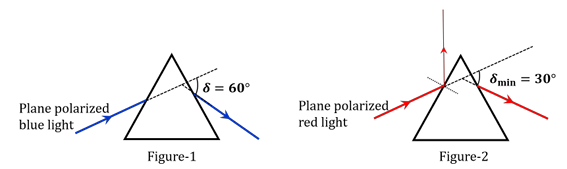
A plane polarized blue light ray is incident on a prism such that there is no reflection from the surface of the prism. The angle of deviation of the emergent ray is $$\delta = 60^\circ$$ (see Figure-1). The angle of minimum deviation for red light from the same prism is $$\delta_{min} = 30^\circ$$ (see Figure-2). The refractive index of the prism material for blue light is $$\sqrt{3}$$. Which of the following statement(s) is(are) correct?

image
Question 224 JEE Advanced

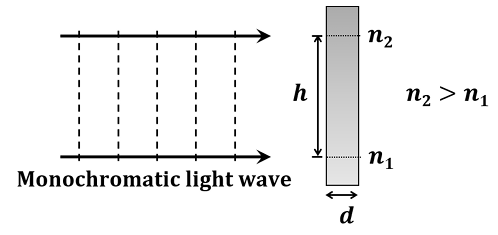
A monochromatic light wave is incident normally on a glass slab of thickness d, as shown in the figure. The refractive index of the slab increases linearly from $$n_1$$ to $$n_2$$ over the height h. Which of the following statement(s) is (are) true about the light wave emerging out of the slab?

image
Question 225 JEE Mains

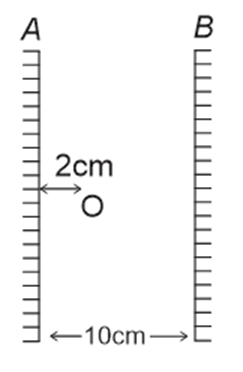
Two vertical parallel mirrors A and B are separated by 10 cm. A point object O is placed at a distance of 2 cm from mirror A. The distance of the second nearest image behind mirror A from the mirror A is ______ cm.

Question 226 JEE Mains

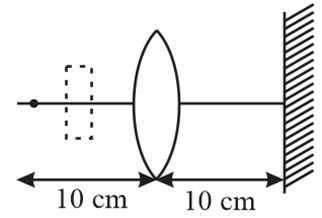
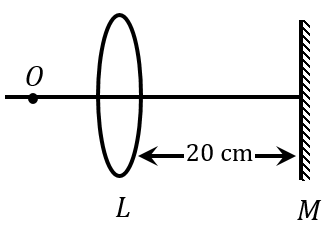
An object is placed on the principal axis of convex lens of focal length 10 cm as shown. A plane mirror is placed on the other side of lens at a distance of 20 cm. The image produced by the plane mirror is 5 cm inside the mirror. The distance of the object from the lens is _____ cm.

Question 227 JEE Mains

In normal adjustment, for a refracting telescope, the distance between objective and eye piece is 30 cm. The focal length of the objective, when the angular magnification of the telescope is 2, will be:

Question 228 JEE Mains

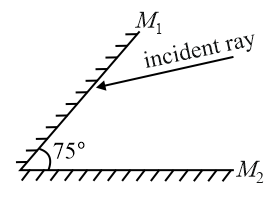
A light ray is incident, at an incident angle $$\theta_1$$, on the system of two plane mirrors $$M_1$$ and $$M_2$$ having an inclination angle $$75°$$ between them (as shown in figure). After reflecting from mirror $$M_1$$ it gets reflected back by the mirror $$M_2$$ with an angle of reflection $$30°$$. The total deviation of the ray will be ______ degree.

Question 229 JEE Mains

Car $$B$$ overtakes another car $$A$$ at a relative speed of 40 m s$$^{-1}$$. How fast will the image of car $$B$$ appear to move in the mirror of focal length 10 cm fitted in car $$A$$, when the car $$B$$ is 1.9 m away from the car $$A$$?

Question 230 JEE Mains

An object is placed beyond the centre of curvature $$C$$ of the given concave mirror. If the distance of the object is $$d_1$$ from $$C$$ and the distance of the image formed is $$d_2$$ from $$C$$, the radius of curvature of this mirror is:

Question 231 JEE Mains

Curved surfaces of a plano-convex lens of refractive index $$\mu_1$$ and a plano-concave lens of refractive index $$\mu_2$$ have equal radius of curvature as shown in figure. Find the ratio of radius of curvature to the focal length of the combined lenses.

Question 232 JEE Mains

The focal length $$f$$ is related to the radius of curvature $$r$$ of the spherical convex mirror by:

Question 233 JEE Mains

A prism of refractive index $$\mu$$ and angle of prism $$A$$ is placed in the position of minimum angle of deviation. If minimum angle of deviation is also $$A$$, then in terms of refractive index,

Question 234 JEE Mains

The expected graphical representation of the variation of angle of deviation '$$\delta$$' with angle of incidence 'i' in a prism is:

Question 235 JEE Mains

The incident ray, reflected ray and the outward drawn normal are denoted by the unit vectors $$\vec{a}$$, $$\vec{b}$$ and $$\vec{c}$$ respectively. Then choose the correct relation for these vectors.

Question 236 JEE Mains

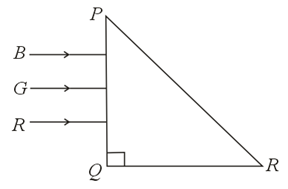
Three rays of light, namely red (R), green (G) and blue (B) are incident on the face PQ of a right angled prism PQR as shown in figure.


The refractive indices of the material of the prism for red, green and blue wavelength are 1.27, 1.42 and 1.49 respectively. The colour of the ray(s) emerging out of the face PR is :

Question 237 JEE Mains

The same size images are formed by a convex lens when the object is placed at 20 cm or at 10 cm from the lens. The focal length of convex lens is ______

Question 238 JEE Mains

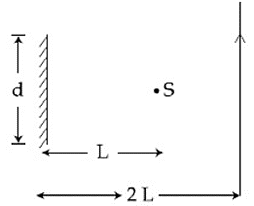
A point source of light, S is placed at a distance L in front of the center of plane mirror of width d which is hanging vertically on a wall. A man walks in front of the mirror along a line parallel to the mirror, at a distance 2L as shown below. The distance over which the man can see the image of the light source in the mirror is:

Question 239 JEE Mains

A plano-convex lens (focal length $$f_2$$, refractive index $$\mu_2$$, radius of curvature R) fits exactly into a plano-concave lens (focal length $$f_1$$, refractive index $$\mu_1$$, radius of curvature R). Their plane surfaces are parallel to each other. Then, the focal length of the combination will be:

Question 240 JEE Mains

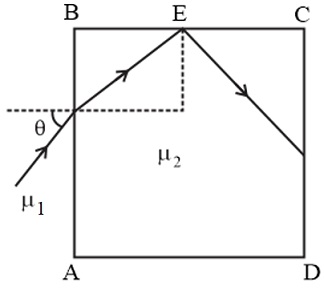
A transparent cube of side d, made of a material of refractive index $$\mu_2$$, is immersed in a liquid of refractive index $$\mu_1$$ ($$\mu_1 < \mu_2$$). A ray is incident on the face AB at an angle $$\theta$$ (shown in the figure). Total internal reflection takes place at point E on the face BC.

Then $$\theta$$ must satisfy

Question 241 JEE Mains

An object is at a distance of 20 m from a convex lens of focal length 0.3 m. The lens forms an image of the object. If the object moves away from the lens at a speed of 5 m/s the speed and direction of the image will be

Question 242 JEE Mains

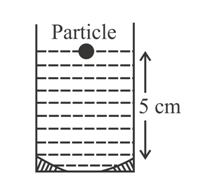
A concave mirror has radius of curvature of 40 cm. It is at the bottom of a glass that has water filled up to 5 cm (see figure). If a small particle is floating on the surface of water, its image as seen, from directly above the glass, is at a distance d from the surface of water. The value of d is close to: (Refractive index of water = 1.33)

Question 243 JEE Mains

A convex lens of focal length 20 cm produces images of the same magnification 2 when an object is kept at two distances $$x_1$$ and $$x_2$$ ($$x_1 > x_2$$) from the lens. The ratio of $$x_1$$ and $$x_2$$ is:

Question 244 JEE Mains

A monochromatic light is incident at a certain angle on an equilateral triangular prism and suffers minimum deviation. If the refractive index of the material of the prism is $$\sqrt{3}$$, then the angle of incidence is:

Question 245 JEE Mains

A plano-convex lens of refractive index $$\mu_1$$ and focal length $$f_1$$ is kept in contact with another plano-concave lens of refractive index $$\mu_2$$ and focal length $$f_2$$. If the radius of curvature of their spherical faces is $$R$$ each and $$f_1 = 2f_2$$, the $$\mu_1$$ and $$\mu_2$$ are related as:

Question 246 JEE Mains

Formation of real image using a biconvex lens is shown below.

image

If the whole set up is immersed in water without disturbing the object and the screen positions, what will one observe on the screen?

Question 247 JEE Mains

In figure, the optical fiber is $$l = 2$$ m long and has a diameter of $$d = 20 \; \mu$$m. If a ray of light is incident on one end of the fiber at angle $$\theta_1 = 40°$$, the number of reflections it makes before emerging from the other end is close to: (refractive index of fiber is 1.31, sin 40° = 0.64 and sin$$^{-1}$$(0.49) = 30°.)

Question 248 JEE Mains

The graph shows how the magnification m produced by a thin lens varies with image distance v. The focal length of the lens used is

image
Question 249 JEE Mains

The variation of refractive index of a crown glass thin prism with wavelength of the incident light is shown. Which of the following graphs is the correct one, if $$D_m$$ is the angle of minimum deviation?

Question 250 JEE Mains

What is the position and nature of image formed by lens combination shown in figure? ($$f_1$$, $$f_2$$ are focal lengths)

image
Question 251 JEE Mains

A thin convex lens L (refractive index = 1.5) is placed on a plane mirror M. When a pin is placed at A, such that OA = 18 cm, its real inverted image is formed at A itself, as shown in figure. When liquid of refractive index $$\mu_l$$ is put between the lens and the mirror, the pin has to be moved to A', such that OA' = 27 cm, to get its inverted real image at A' itself. The value of $$\mu_l$$ will be:

image
Question 252 JEE Mains

An upright object is placed at a distance of 40 cm in front of a convergent lens of focal length 20 cm. A convergent mirror of focal length 10 cm is placed at a distance of 60 cm on the other side of the lens. The position and size of the final image will be:

Question 253 JEE Mains

One plano-convex and one plano-concave lens of the same radius of curvature R but of different materials are joined side by side as shown in the figure. If the refractive index of the material of 1 is $$\mu_1$$ and that of 2 is $$\mu_2$$, then the focal length of the combination is:

image
Question 254 JEE Mains

A light ray is incident perpendicular to one face of a $$90^\circ$$ prism and is totally internally reflected at the glass-air interface. If the angle of reflection is $$45^\circ$$, we conclude that the refractive index $$n$$

image
Question 255 JEE Mains

Au unpolarised light is incident at an inteiface of two dielectric media having refractive indices of 2 (incident medium) and $$2\sqrt{3}$$ (medium) respectively. To satisfy the condition that reflected and refracted rays are perpendicular to each other, the angle of incidence is ___.

Question 256 JEE Mains

In parallax method for the determination of focal length of a concave mirror, the object should always be placed:

Question 257 JEE Mains

The magnitudes of power of a biconvex lens (refractive index 1.5) and that of a piano-concave lens (refractive index = l.7) are same. If the curvature of plano-concave lens exactly matches with the curvature of back surface of the biconvex lens, then ratio of radius of curvature of front and back smface of the biconvex lens is________.

Question 258 JEE Mains

An object AB is placed 15 cm to the left of a convex lens P of focal length $$10 cm$$. Another convex lens Q is now placed $$15 cm$$ right of lens P . If the focal length of lens Q is 15 cm,  final image is______.

Question 259 JEE Mains

One side of an equilateral prism is painted by a transparent material of refractive index $$n_2$$. The refractive index of prism is 1.6. The minimum value of $$n_2$$ required for total internal reflection from painted face is ________ .

image
Question 260 JEE Mains

Angle of minimum deviation is equal to the half of the angle of prism in an equilateral prism. The refractive index of the prism is __________.

Question 261 JEE Mains

Light ray incident along a vector $$\vec{AO}$$ ($$\vec{AO} = 2\hat{i} - 3\hat{j}$$) emerges out along vector $$\vec{OB}$$ ($$\vec{OB} = C\hat{i} - 4\hat{j}$$) as shown in the figure below. The value of C is __________.

image
Question 262 JEE Mains

Distance between an object and three times magnified real image is 40 cm. The focal length of the mirror used is ___ cm.

Question 263 JEE Mains

A parallel beam of light travelling in air (refractive index 1.0) is incident on a convex spherical glass surface of radius of curvature 50 cm. Refractive index of glass is 1.5. The rays converge to a point at a distance $$x$$ cm from the centre of the curvature of the spherical surface. The value of $$x$$ is ____ cm

Question 264 JEE Mains

A convex lens of refractive index 1.5 and focal length f = 18 cm is immersed in water. The difference in focal lengths of the given lens when it is in water and in air is $$\alpha \times f$$. The value of$$\alpha$$ is______.
(refractive index of water = 4/3)

Question 265 JEE Mains

Two identical symmetric double convex lenses of focal length f are cut into two equal parts $$L_{1}, L_{2}$$ by AB plane and $$L_{3}, L_{4}$$ by XY plane as shown in figure respectively. The ratio of focal lengths of lenses $$L_{1}$$ and $$L_{3}$$ is

page4_img1
Question 266 JEE Mains

A slanted object AB is placed on one side of convex lens as shown in the diagram. The image is formed on the opposite side. Angle made by the image with principal axis is:

image
Question 267 JEE Mains

A symmetric thin biconvex lens is cut into four equal parts by two planes AB and CD as shown in figure. If the power of original lens is 4 D then the power of a part of the divided lens is

image
Question 268 JEE Mains

A thin prism $$P_{1}$$ with angle $$4^{\circ}$$ made of glass having refractive index 1.54 , is combined with another thin prism $$P_{2}$$ made of glass having refractive index 1.72 to get dispersion without deviation. The angle of the prism $$P_{2}$$ in degrees is

Question 269 JEE Mains

A hemispherical vessel is completely filled with a liquid of refractive index $$\mu$$. A small coin is kept at the lowest point (O) of the vessel as shown in figure. The minimum value of the refractive index of the liquid so that a person can see the coin from point E (at the level of the vessel) is

page5_img1
Question 270 JEE Mains

A mirror is used to produce an image with magnification of $$\frac{1}{4}$$. If the distance between object and its image is 40 cm, then the focal length of the mirror is :

Question 271 JEE Mains

In the diagram given below, there are three lenses formed. Considering negligible thickness of each of them as compared to $$\mid R_1 \mid \text{ and } \mid R_2 \mid$$, i.e., the radii of curvature for upper and lower surfaces of the glass lens, the power of the combination is

image
Question 272 JEE Mains

The position of the image formed by the combination of lenses is 

page3_img1
Question 273 JEE Mains

Given below are two statements : Statement I : When the white light passed through a prism, the red light bends lesser than yellow and violet. Statement II : The refractive indices are different for different wavelengths in dispersive medium. In the light of the above statements, choose the correct answer from the options given below :

Question 274 JEE Mains

If the refractive index of the material of a prism is $$\cot\left(\frac{A}{2}\right)$$, where $$A$$ is the angle of prism then the angle of minimum deviation will be

Question 275 JEE Mains

The refractive index of a prism with apex angle $$A$$ is $$\cot\frac{A}{2}$$. The angle of minimum deviation is :

Question 276 JEE Mains

A vessel of depth $$d$$ is half filled with oil of refractive index $$n_1$$ and the other half is filled with water of refractive index $$n_2$$. The apparent depth of this vessel when viewed from above will be-

Question 277 JEE Advanced

As shown in the figure, a ray $$AB$$ of unpolarized light enters from water of refractive index $$n_w=4/3$$ into a medium of refractive index $$n_p=4/\sqrt{3}$$ after passing through a glass plate of refractive index $$n_g=1.5$$ and a layer of water. At a particular incident angle $$i$$ the reflected ray $$CD$$ is polarized in the direction as shown in the figure. The value of $$i$$ (in degrees) is:

image
Question 278 JEE Advanced

A beam of polychromatic light passes through a thin prism of prism angle $$6^\circ$$. The refractive index of the material of the prism varies with wavelength $$(\lambda)$$ as $$n(\lambda)=\alpha\lambda+\dfrac{\beta}{\lambda^2}$$, where $$\alpha=3\,\mu\mathrm{m^{-1}}$$ and $$\beta=0.096\,\mu\mathrm{m^2}$$. If $$\lambda_{\min}$$ is the wavelength at which the angle of minimum deviation $$D_m$$ is smallest, then the correct value of $$D_m$$ at $$\lambda_{\min}$$ is

Question 279 JEE Mains

A thin biconvex lens is prepared from the glass ($$\mu = 1.5$$) both curved surfaces of which have equal radii of 20 cm each. Left side surface of the lens is silvered from outside to make it reflecting. To have the position of image and object at the same place, the object should be placed, from the lens at a distance of __________ cm.

Question 280 JEE Mains

A prism of angle $$75^{o}$$ and refractive index $$\sqrt{3}$$ is coated with thin film of refractive index 1.5 only at the back exit surface. To have total internal reflection at the back exit surface the incident angle must be______.
($$\sin 15^{o}$$ = 0.25 and $$\sin 25^{o}$$ = 0.43)

Question 281 JEE Mains

A narrow parallel beam of light is incident paraxially on a solid transparent sphere of radius R . What should be the refractive index if the beam is to be focused at the surface of the sphere,

Question 282 JEE Advanced

A double convex lens made of glass of refractive index $$1.5$$ and radii of curvature of the curved surfaces $$20\,\mathrm{cm}$$ each is immersed in a liquid of refractive index $$n_L$$. The correct plot showing the variation of the power, in the units of diopter ($$D$$), as a function of $$n_L$$ is:

Question 283 JEE Mains

The angle of polarization for any medium is $$60^{\circ\ }$$, what will be critical angle for this :

Question 284 JEE Mains

The exit surface of a prism with refractive index n is coated with a material having refractive index $$\frac{n}{2}$$. When this prism is set for minimum angle of deviation, it exactly meets the condition of critical angle. The prism angle is ___ .

Question 285 JEE Mains

A biconvex lens is formed by using two thin planoconvex lenses, as shown in the figure. The refractive index and radius of curved surfaces are also mentioned in figure. When an object is placed on the left side of lens at a distance of 30 cm from the biconvex lens, the magnification of the image will be:

image
Question 286 JEE Mains

A concave mirror produces an image of an object such that the distance between the object and image is 20 cm . If the magnification of the image is ' -3 ', then the magnitude of the radius of curvature of the mirror is :

Question 287 JEE Mains

A concave-convex lens of refractive index $$1.5$$ and the radii of curvature of its surfaces are $$30 cm$$ and $$20 cm$$, respectively. The concave surface is upwards and is filled with a liquid of refractive index $$1.3$$. The focal length of the liquid-glass combination will be

Question 288 JEE Mains

As shown in the diagram, when the incident ray is parallel to base of the prism, the emergent ray grazes along the second surface.If refractive index of the material of prism is $$\sqrt{2}$$, the angle $$\theta$$ of prism is.

image
Question 289 JEE Mains

A rod of length 10 cm lies along the principal axis of a concave mirror of focal length 10 cm as shown in figure. The length of the image is _____ cm.

image
Question 290 JEE Mains

A thin convex lens and a thin concave lens are kept in  contact and are co-axial. Which of the following statements is correct for this combination of two lenses ?

Question 291 JEE Mains

A thin convex lens of focal length 5 cm and a thin concave lens of focal length 4 cm are combined together (without any gap) and this combination has magnification $$m_{1}$$ when an object is placed 10 cm before the convex lens. Keeping the positions of convex lens and object undisturbed a gap of 1 cm is introduced between the lenses by moving the concave lens away, which lead to a change in magnification of total lens system to $$m_{2}$$.
The value of $$ \mid\frac{m_{1}}{m_{2}}\mid $$ is______.

Question 292 JEE Advanced

In the List-I, four optical effects are mentioned. The physical phenomena of light which are essential to describe these optical effects are given in List-II. Choose the option which describes the correct match between the entries in List-I to those in List-II.

image
Question 293 JEE Mains

Consider an equilateral prism (refractive index $$\sqrt{2}$$). A ray of light is incident on its one surface at a certain angle $$i$$. If the emergent ray is found to graze along the other surface then the angle of refraction at the incident surface is close to ______.

Students can first attempt the questions without looking at the solution and then use the detailed video explanation to compare their approach. This helps them understand not only what the correct answer is, but also why a particular method works.

ResourceWhat It Provides
JEE Ray Optics QuestionsConceptual and numerical practice
Practice PDFFocused questions from Ray Optics
Video SolutionsDetailed step-by-step explanations
IITian ExplanationsClear concepts and problem-solving methods
Multiple ApplicationsMirrors, lenses, prisms, refraction, and instruments
Exam PreparationUseful for JEE Main and JEE Advanced

The PDF can be used after completing the chapter and as part of regular revision before attempting full-length tests or previous year papers.

Important Ray Optics Topics for JEE

Ray Optics contains several formulas, but understanding the path of light is more important than memorising equations individually. Students should be able to trace rays, identify the interface between media, and determine how reflection or refraction changes the direction of light.

The major topics to prepare are:

Ray Optics TopicWhat to Practise
ReflectionLaws of reflection and plane mirrors
Spherical MirrorsMirror formula, magnification, and sign convention
RefractionSnell's law and apparent depth
Total Internal ReflectionCritical angle and optical applications
Refraction at Spherical SurfacesImage formation at curved interfaces
LensesLens formula, power, and magnification
Lens CombinationsEquivalent focal length and power
PrismDeviation, minimum deviation, and dispersion
Optical InstrumentsMicroscope and telescope concepts
Lens-Mirror SystemsCombined image formation
DispersionSeparation of colours through prisms

Mirror and lens problems require careful use of the Cartesian sign convention. A correct diagram can often tell you whether the image is real or virtual, erect or inverted, and magnified or diminished before the calculation begins.

Refraction problems require equal attention to the direction of the incident and refracted rays. In problems involving multiple media, students should track each interface separately rather than trying to use one formula for the entire system.

Prism questions may involve minimum deviation, refractive index, or total internal reflection. Similarly, lens-combination problems can become more challenging when lenses are separated by a distance or combined with mirrors.

Using structured JEE Questions and reliable revision resources helps students move from basic ray diagrams to more complex applications.

JEE Main & Advanced Ray Optics Weightage Analysis

The number of Ray Optics questions is not fixed in every JEE Main shift or JEE Advanced paper. The chapter can appear through direct numerical questions, conceptual questions, diagrams, or problems that combine several optical principles. Therefore, weightage should be treated as a preparation guide rather than a guaranteed question count.

AreaCommon Question Applications
MirrorsImage formation, focal length, and magnification
RefractionSnell's law and apparent depth
Total Internal ReflectionCritical angle and optical systems
LensesImage position, magnification, and power
Lens CombinationsEquivalent focal length and separated lenses
PrismDeviation and minimum-deviation conditions
Optical InstrumentsMagnifying power and image formation
Mixed SystemsMirrors, lenses, and multiple interfaces

For JEE Main, begin with standard questions on mirrors, lenses, refraction, and total internal reflection. Solving JEE Mains previous papers is useful for understanding the question formats and calculation level encountered in the examination.

For JEE Advanced, include more complicated situations such as multiple lenses, lens-mirror combinations, prisms, changing media, and problems where several optical principles must be applied in sequence. Focus on understanding the geometry and physical conditions before performing the mathematical calculation.

Students should also use previous year questions as an analysis tool. Instead of simply counting questions from one topic, observe which concepts you find difficult and give additional practice to those areas.

Why Practice JEE Ray Optics Questions?

Ray Optics is a highly visual chapter. Many problems become much easier once the path of the ray and the position of the optical elements are represented correctly. Regular practice helps students develop this visual and analytical ability.

Solving JEE Ray Optics Questions can help you:

  • Improve ray-diagram and image-formation skills.
  • Apply mirror and lens formulas more confidently.
  • Understand refraction and total internal reflection.
  • Handle prism and optical-instrument problems.
  • Become comfortable with sign conventions.
  • Improve speed in multi-step numerical questions.

A useful method is to draw the setup before writing an equation. Identify the object, optical element, principal axis, incident ray, refracted or reflected ray, and image position. This simple step can prevent many errors.

The IITian-led video solutions are useful for analysing the reasoning behind difficult problems. When your answer differs from the solution, compare the diagram and sign convention first. In many Ray Optics questions, the calculation goes wrong because the initial geometry was interpreted incorrectly.

Students can also use these questions as focused practice before taking a Free JEE Mains mock test. Solving chapter-wise problems first can help identify weak concepts before moving to a mixed Physics test.

Tips to Solve Ray Optics Questions Faster

A consistent approach can significantly reduce the time needed for Ray Optics problems.

1. Draw the ray diagram

Start with a simple, labelled diagram. Mark the principal axis, optical centre, focus, centre of curvature, normal, or angles as required.

2. Follow the sign convention consistently

Do not change the sign convention midway through a problem. Write the known values with their signs before substituting them into an equation.

3. Revise the core formulas

Keep the essential relations in your JEE Mains Formula Sheet and revise them regularly.

Concept

Formula

Mirror Formula

$$(\frac{1}{f}=\frac{1}{v}+\frac{1}{u})$$

Mirror Magnification

$$(m=-\frac{v}{u})$$

Lens Formula

$$(\frac{1}{f}=\frac{1}{v}-\frac{1}{u})$$

Lens Magnification

$$(m=\frac{v}{u})$$

Lens Power

$$(P=\frac{1}{f})$$

Snell's Law

$$(n_1\sin i=n_2\sin r)$$

Critical Angle

$$(\sin C=\frac{n_2}{n_1})$$

Prism at Minimum Deviation

$$(\mu=\frac{\sin\left(\frac{A+D_m}{2}\right)}{\sin\left(\frac{A}{2}\right)})$$

4. Track each optical interface

When light passes through multiple media, apply refraction at each interface carefully. The refractive index and angle should correspond to the two media involved at that particular surface.

5. Use standard ray results

Knowing the standard rays for mirrors and lenses can help you locate images quickly. This is especially useful when a problem is primarily based on a diagram rather than a lengthy calculation.

6. Check special conditions

Words such as "minimum deviation," "critical angle," "normal incidence," and "image at infinity" indicate specific optical conditions. Identify these conditions before selecting the formula.

7. Practise previous year questions

After completing the basic theory, solve Ray Optics questions from previous JEE examinations. This helps you become familiar with recurring concepts and improves your ability to recognise the appropriate method quickly.

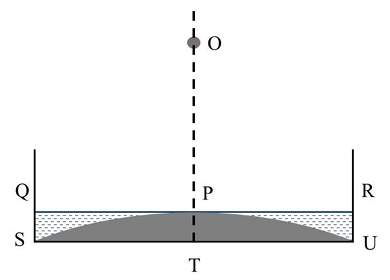
Frequently Asked Questions