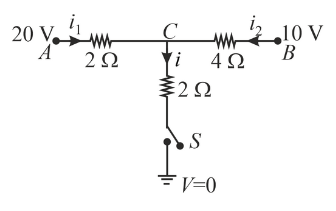
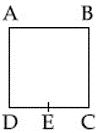
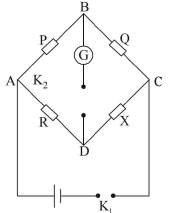
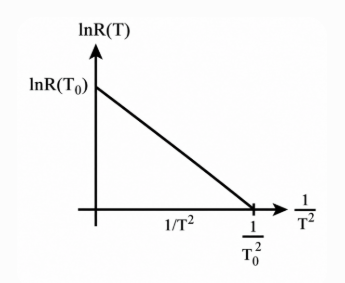
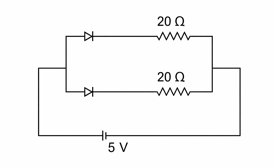
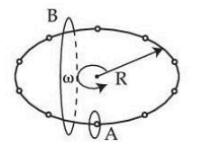
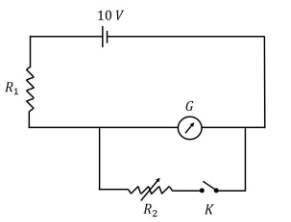
JEE Current Electricity Questions

This page provides a collection of JEE Current Electricity Questions to help students practise important concepts from Current Electricity for JEE Main and JEE Advanced. The PDF available on this page contains carefully selected questions along with detailed video solutions and explanations. The solutions are explained by IITians, helping students understand the concepts, calculations, circuit analysis, and problem-solving approach required for JEE-level questions.The questions cover important areas such as electric current, drift velocity, mobility, Ohm's law, resistance, resistivity, temperature dependence of resistance, combinations of resistors, cells and batteries, Kirchhoff's laws, Wheatstone bridge, meter bridge, potentiometer, electrical power, and heating effects.

Question 1 JEE Mains

A galvanometer of resistance $$100\Omega$$ when connected in series with $$400\Omega$$ measures a voltage of upto $$10$$ V. The value of resistance required to convert the galvanometer into ammeter to read upto $$10$$ A is $$x \times 10^{-2} \Omega$$. The value of $$x$$ is :

Question 2 JEE Mains

By what percentage will the illumination of the lamp decrease if the current drops by 20%?

Question 3 JEE Mains

The number of electrons flowing per second in the filament of a $$110 \text{ W}$$ bulb operating at $$220 \text{ V}$$ is : (Given $$e = 1.6 \times 10^{-19} \text{ C}$$)

Question 4 JEE Mains

Wheatstone bridge principle is used to measure the specific resistance $$S_1$$ of given wire, having length $$L$$, radius $$r$$. If X is the resistance of wire, then specific resistance is : $$S_1 = X\frac{\pi r^2}{L}$$. If the length of the wire gets doubled then the value of specific resistance will be :

Question 5 JEE Mains

When a potential difference $$V$$ is applied across a wire of resistance $$R$$, it dissipates energy at a rate $$W$$. If the wire is cut into two halves and these halves are connected mutually parallel across the same supply, the energy dissipation rate will become:

Question 6 JEE Mains

A wire of length $$10$$ cm and radius $$\sqrt{7} \times 10^{-4}$$ m connected across the right gap of a meter bridge. When a resistance of $$4.5 \; \Omega$$ is connected on the left gap by using a resistance box, the balance length is found to be at $$60$$ cm from the left end. If the resistivity of the wire is $$R \times 10^{-7} \; \Omega$$ m, then value of $$R$$ is :

Question 7 JEE Mains

An electric toaster has resistance of $$60 \text{ } \Omega$$ at room temperature $$(27°C)$$. The toaster is connected to a $$220 \text{ V}$$ supply. If the current flowing through it reaches $$2.75 \text{ A}$$, the temperature attained by toaster is around: (if $$\alpha = 2 \times 10^{-4} \text{ °C}^{-1}$$)

Question 8 JEE Mains

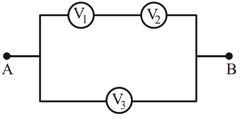
Three voltmeters, all having different internal resistances are joined as shown in figure. When some potential difference is applied across A and B, their readings are $$V_1$$, $$V_2$$ and $$V_3$$. Choose the correct option.

image
Question 9 JEE Mains

At room temperature $$(27°C)$$, the resistance of a heating element is $$50\Omega$$. The temperature coefficient of the material is $$2.4 \times 10^{-4} \text{ °C}^{-1}$$. The temperature of the element, when its resistance is $$62\Omega$$, is ______ °C.

Question 10 JEE Mains

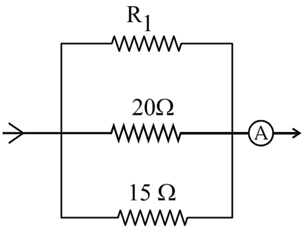
In the given circuit, the current flowing through the resistance $$20 \;\Omega$$ is $$0.3$$ A, while the ammeter reads $$0.9$$ A. The value of $$R_1$$ is ______ $$\Omega$$.

image
Question 11 JEE Mains

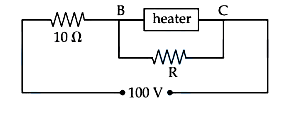
A heater is designed to operate with a power of 1000 W in a 100 V line. It is connected in combination with a resistance of $$10\Omega$$ and a resistance $$R$$, to a 100 V mains as shown in figure. For the heater to operate at 62.5 W, the value of $$R$$ should be _____ $$\Omega$$

page4_img3
Question 12 JEE Mains

A wire of resistance $$20\Omega$$ is divided into 10 equal parts, resulting pairs. A combination of two parts are connected in parallel and so on. Now resulting pairs of parallel combination are connected in series. The equivalent resistance of final combination is ______ $$\Omega$$.

Question 13 JEE Mains

A wire of resistance $$R$$ and radius $$r$$ is stretched till its radius became $$r/2$$. If new resistance of the stretched wire is $$xR$$, then value of $$x$$ is _______

Question 14 JEE Mains

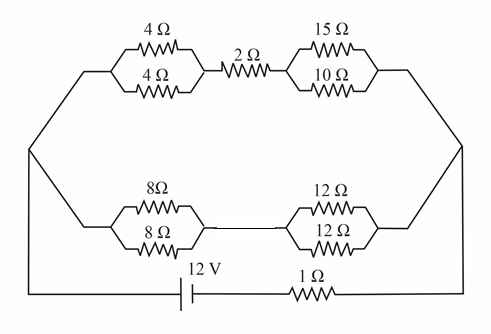
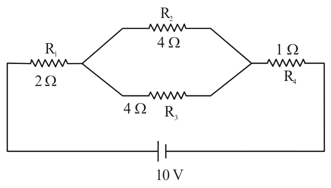
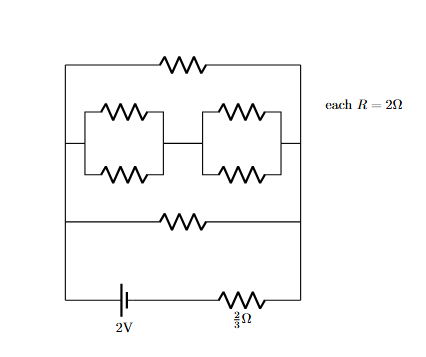
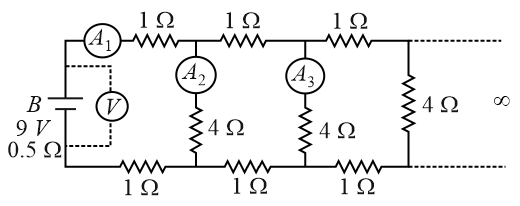
Equivalent resistance of the following network is ______ $$\Omega$$.

image
Question 15 JEE Mains

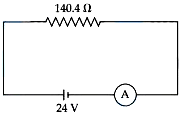
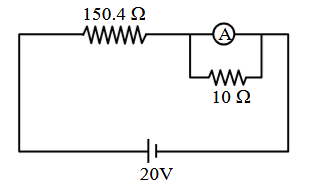
In the given figure an ammeter A consists of a $$240 \Omega$$ coil connected in parallel to a $$10 \Omega$$ shunt. The reading of the ammeter is ___________ mA.

image
Question 16 JEE Mains

Resistance of a wire at $$0°C$$, $$100°C$$ and $$t°C$$ is found to be $$10\Omega$$, $$10.2\Omega$$ and $$10.95\Omega$$ respectively. The temperature $$t$$ in Kelvin scale is ________.

Question 17 JEE Mains

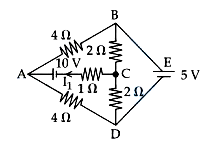
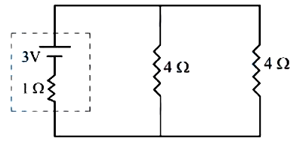
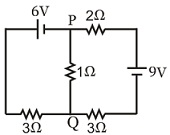
The current flowing through the $$1\Omega$$ resistor is $$\frac{n}{10}$$ A. The value of $$n$$ is ________

page4_img1
Question 18 JEE Mains

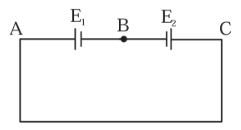
Two cells are connected in opposition as shown. Cell $$E_1$$ is of $$8 \text{ V}$$ emf and $$2 \text{ } \Omega$$ internal resistance; the cell $$E_2$$ is of $$2 \text{ V}$$ emf and $$4 \text{ } \Omega$$ internal resistance. The terminal potential difference of cell $$E_2$$ is ______ V.

image
Question 19 JEE Mains

Two wires $$A$$ and $$B$$ are made up of the same material and have the same mass. Wire $$A$$ has radius of $$2.0$$ mm and wire $$B$$ has radius of $$4.0$$ mm. The resistance of wire $$B$$ is $$2\Omega$$. The resistance of wire $$A$$ is _____ $$\Omega$$.

Question 20 JEE Mains


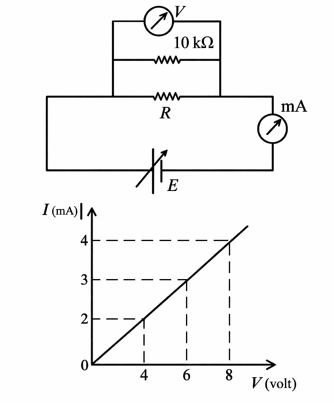
To determine the resistance $$(R)$$ of a wire, a circuit is designed below. The $$V - I$$ characteristic curve for this circuit is plotted for the voltmeter and the ammeter readings as shown in figure. The value of $$R$$ is ______ $$\Omega$$.

image
Question 21 JEE Mains

Two resistance of $$100\Omega$$ and $$200\Omega$$ are connected in series with a battery of 4 V and negligible internal resistance. A voltmeter is used to measure voltage across $$100\Omega$$ resistance, which gives reading as 1 V. The resistance of voltmeter must be _______ $$\Omega$$.

Question 22 JEE Mains

The charge flowing in a conductor changes with time as $$Q(t) = \alpha t - \beta t^2 + \gamma t^3$$, where $$\alpha$$, $$\beta$$ and $$\gamma$$ are constants. Minimum value of current is:

Question 23 JEE Mains
image

The current flowing through $$R_2$$ is:

Question 24 JEE Mains

The drift velocity of electrons for a conductor connected in an electrical circuit is $$V_d$$. The conductor is now replaced by another conductor with same material and same length but double the area of cross-section. The applied voltage remains same. The new drift velocity of electrons will be

Question 25 JEE Mains

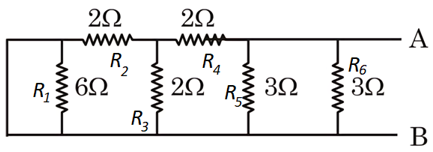
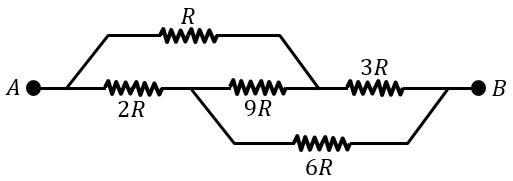
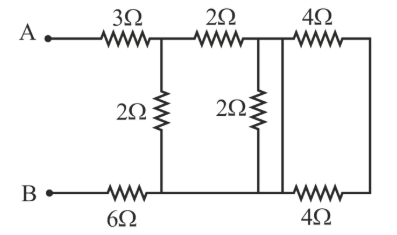
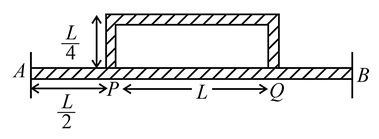
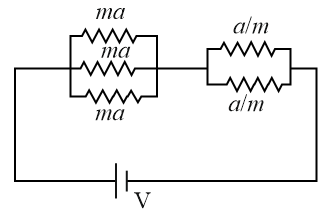
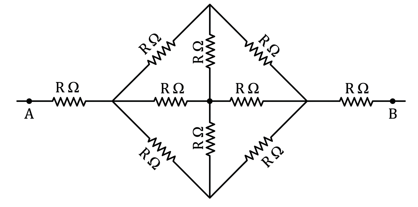
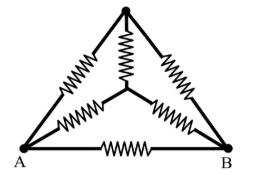
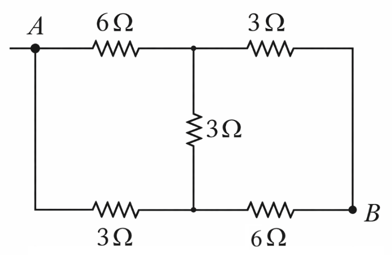
The equivalent resistance between A and B of the network shown in the figure:

Question 26 JEE Mains

Two identical heater filaments are connected first in parallel and then in series. At the same applied voltage, the ratio of heat produced in same time for parallel to series will be:

Question 27 JEE Mains

Given below are two statements:
Statement I : The equivalent resistance of resistors in a series combination is smaller than least resistance used in the combination.
Statement II : The resistivity of the material is independent of temperature. In the light of the above statements, choose the correct answer from the options given below:

Question 28 JEE Mains

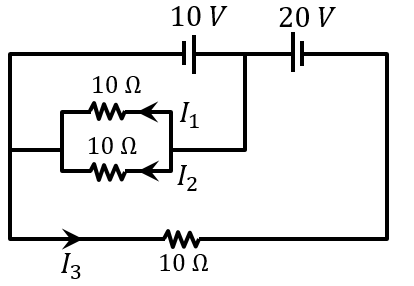
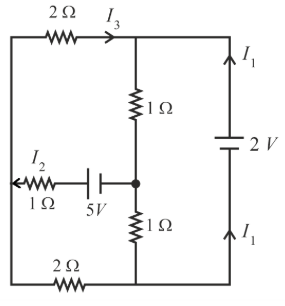
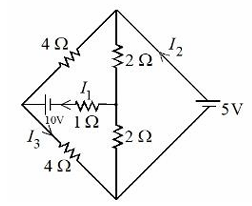
In the given circuit the value of $$\left|\frac{I_1+I_3}{I_2}\right|$$ is:

Question 29 JEE Mains

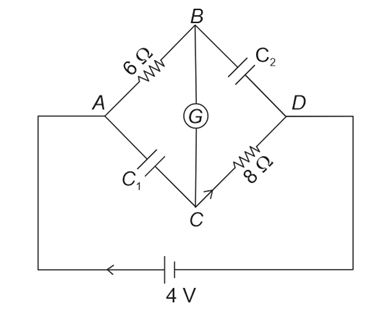
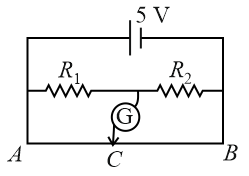
In this figure the resistance of the coil of galvanometer G is 2 $$\Omega$$. The emf of the cell is 4 V. The ratio of potential difference across C$$_1$$ and C$$_2$$ is

Question 30 JEE Mains

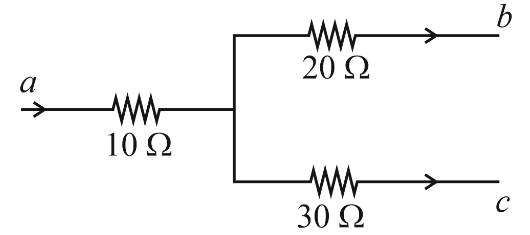
The figure below shows a part of an electric circuit. The potentials at points $$a$$, $$b$$ and $$c$$ are 30 V, 12 V and 2 V respectively. The current through the 20 $$\Omega$$ resistor will be,

image
Question 31 JEE Mains

The resistance of a wire is 5 $$\Omega$$. Its new resistance in ohm, if stretched to 5 times of its original length will be:

Question 32 JEE Mains

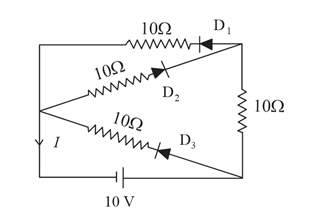
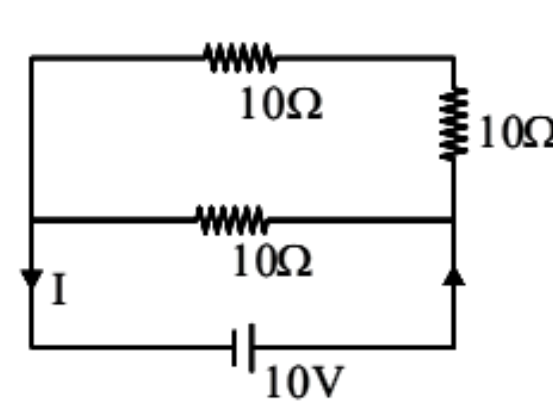
In the given circuit, the current $$I$$ through the battery will be

Question 33 JEE Mains

The length of a metallic wire is increased by 20% and its area of cross-section is reduced by 4%. The percentage change in resistance of the metallic wire is ______.

Question 34 JEE Mains

A potential $$V_0$$ is applied across a uniform wire of resistance $$R$$. The power dissipation is $$P_1$$. The wire is then cut into two equal halves and a potential of $$V_0$$ is applied across the length of each half. The total power dissipation across two wires is $$P_2$$. The ratio of $$P_2 : P_1$$ is $$\sqrt{x} : 1$$. The value of $$x$$ is _____.

Question 35 JEE Mains

In the following circuit, the magnitude of current $$I_1$$, is ______ A.

image
Question 36 JEE Mains

10 resistors each of resistance 10 $$\Omega$$ can be connected in such as to get maximum and minimum equivalent resistance. The ratio of maximum and minimum equivalent resistance will be _______.

Question 37 JEE Mains

A current of 2 A flows through a wire of cross-sectional area 25.0 mm$$^2$$. The number of free electrons in a cubic meter are $$2.0 \times 10^{28}$$. The drift velocity of the electrons is ______ $$\times 10^{-6}$$ ms$$^{-1}$$
(given, charge on electron = $$1.6 \times 10^{-19}$$ C).

Question 38 JEE Mains

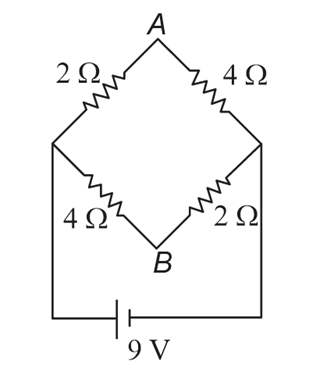
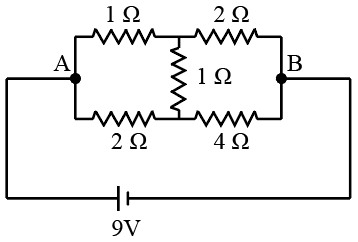
A network of four resistances is connected to $$9$$ V battery, as shown in figure. The magnitude of voltage difference between the points $$A$$ and $$B$$ is _____ V.

Question 39 JEE Mains

A null point is found at $$200$$ cm in potentiometer when cell in secondary circuit is shunted by $$5$$ $$\Omega$$. When a resistance of $$15$$ $$\Omega$$ is used for shunting null point moves to $$300$$ cm. The internal resistance of the cell is ______ $$\Omega$$.

Question 40 JEE Mains

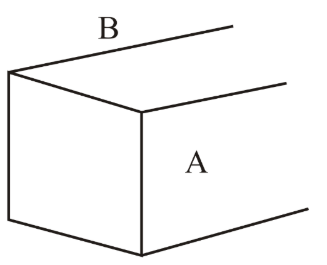
A rectangular parallelopiped is measured as 1 cm $$\times$$ 1 cm $$\times$$ 100 cm. If its specific resistance is $$3 \times 10^{-7}$$ $$\Omega$$ m, then the resistance between its two opposite rectangular faces will be _______ $$\times 10^{-7}$$ $$\Omega$$.

image
Question 41 JEE Mains

If a copper wire is stretched to increase its length by 20%. The percentage increase in resistance of the wire is _____%.

Question 42 JEE Mains

In an experiment to find emf of a cell using potentiometer, the length of null point for a cell of emf 1.5 V is found to be 60 cm. If this cell is replaced by another cell of emf $$E$$, the length-of null point increases by 40 cm. The value of $$E$$ is $$\frac{x}{10}$$ V. The value of $$x$$ is _____.

Question 43 JEE Mains

The current flowing through a conductor connected across a source is $$2$$ A and $$1.2$$ A at $$0°$$C and $$100°$$C respectively. The current flowing through the conductor at $$50°$$C will be _____ $$\times 10^2$$ mA.

Question 44 JEE Mains

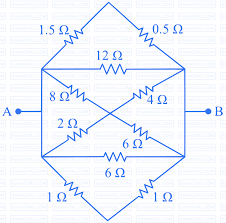
The equivalent resistance between $$A$$ and $$B$$ is ______ $$\Omega$$.

image
Question 45 JEE Mains

The number density of free electrons in copper is nearly $$8 \times 10^{28}$$ m$$^{-3}$$. A copper wire has its area of cross-section $$= 2 \times 10^{-6}$$ m$$^2$$ and is carrying a current of 3.2 A. The drift speed of the electrons is _______ $$\times 10^{-6}$$ m s$$^{-1}$$.

Question 46 JEE Mains

When a resistance of $$5 \ \Omega$$ is shunted with a moving coil galvanometer, it shows a full scale deflection for a current of $$250$$ mA, however when $$1050 \ \Omega$$ resistance is connected with it in series, it gives full scale deflection for $$25$$ volt. The resistance of galvanometer is _____ $$\Omega$$.

Question 47 JEE Mains

A hollow cylindrical conductor has length of 3.14 m, while its inner and outer diameters are 4 mm and 8 mm respectively. The resistance of the conductor is $$n \times 10^{-3}$$ $$\Omega$$. If the resistivity of the material is $$2.4 \times 10^{-8}$$ $$\Omega$$ m. The value of $$n$$ is _____.

Question 48 JEE Mains

A hollow cylindrical conductor has length of 3.14 m, while its inner and outer diameters are 4 mm and 8 mm respectively. The resistance of the conductor is $$n \times 10^{-3} \Omega$$. If the resistivity of the material is $$2.4 \times 10^{-8} \Omega$$ m. The value of n is _____.

Question 49 JEE Mains

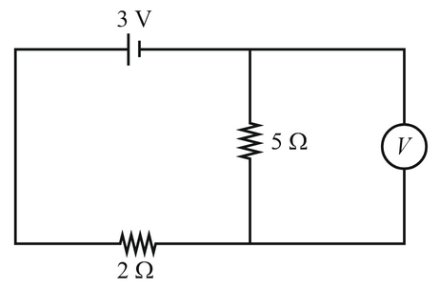
As shown in the figure below, the voltmeter reads 2 V across the 5 $$\Omega$$ resistor. The resistance of the voltmeter is ______ $$\Omega$$.

image
Question 50 JEE Mains

If the potential difference between $$B$$ and $$D$$ is zero, the value of $$x$$ is $$\frac{1}{n}$$ $$\Omega$$. The value of $$n$$ is ______.

image
Question 51 JEE Mains

In the circuit diagram shown in figure given below, the current flowing through resistance 3 $$\Omega$$ is $$\frac{x}{3}$$ A. The value of $$x$$ is _______.

image
Question 52 JEE Mains

In the given circuit, the equivalent resistance between the terminals A and B is _____ $$\Omega$$

image
Question 53 JEE Mains

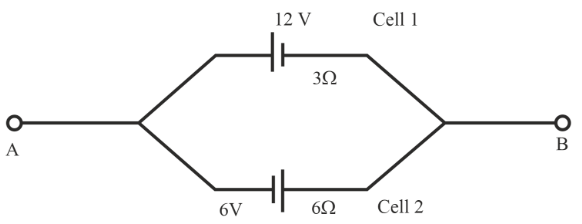
Two cells are connected between points A and B as shown. Cell 1 has emf of 12 V and internal resistance of 3 $$\Omega$$. Cell 2 has emf of 6 V and internal resistance of 6 $$\Omega$$. An external resistor R of 4 $$\Omega$$ is connected across A and B. The current flowing through R will be _____ A.

image
Question 54 JEE Mains

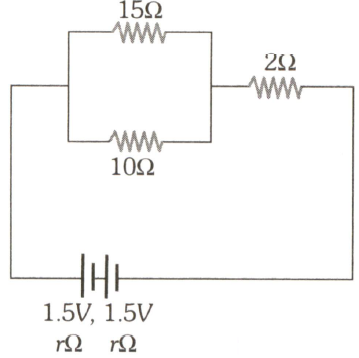
Two identical cells each of emf 1.5 V are connected in series across a 10 $$\Omega$$ resistance. An ideal voltmeter connected across 10 $$\Omega$$ resistance reads 1.5 V. The internal resistance of each cell is _______ $$\Omega$$.

Question 55 JEE Mains

Two identical cells, when connected either in parallel or in series gives same current in an external resistance 5 $$\Omega$$. The internal resistance of each cell will be ______ $$\Omega$$.

Question 56 JEE Mains

In a metre bridge experiment the balance point is obtained if the gaps are closed by $$2$$ $$\Omega$$ and $$3$$ $$\Omega$$. A shunt of $$X$$ $$\Omega$$ is added to $$3$$ $$\Omega$$ resistor to shift the balancing point by $$22.5$$ cm. The value of $$X$$ is ______.

Question 57 JEE Mains

When two resistance $$R_1$$ and $$R_2$$ connected in series and introduced into the left gap of a meter bridge and a resistance of $$10$$ $$\Omega$$ is introduced into the right gap, a null point is found at $$60$$ cm from left side. When $$R_1$$ and $$R_2$$ are connected in parallel and introduced into the left gap, a resistance of $$3$$ $$\Omega$$ is introduced into the right gap to get null point at $$40$$ cm from left end. The product of $$R_1 R_2$$ is ______ $$\Omega^2$$

Question 58 JEE Mains

If $$n$$ represents the actual number of deflections in a converted galvanometer of resistance $$G$$ and shunt resistance $$S$$. Then the total current $$I$$ when its figure of merit is $$K$$ will be

Question 59 JEE Mains

A wire of resistance $$R_1$$ is drawn out so that its length is increased by twice of its original length. The ratio of new resistance to original resistance is:

Question 60 JEE Mains

An aluminium wire is stretched to make its length, $$0.4\%$$ larger. The percentage change in resistance is

Question 61 JEE Mains

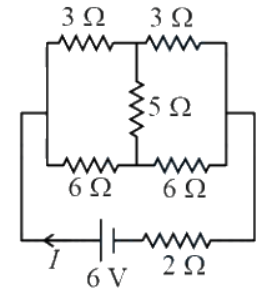
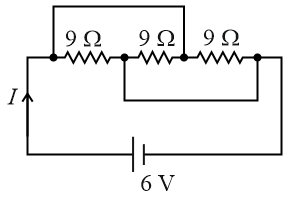
A battery of $$6 \text{ V}$$ is connected to the circuit as shown below. The current $$I$$ drawn from the battery is

image
Question 62 JEE Mains

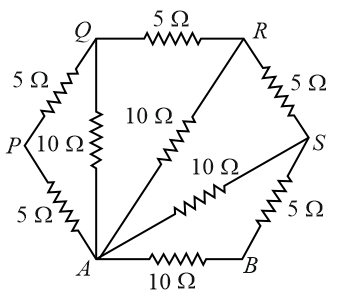
Find the equivalent resistance between point A and B

Question 63 JEE Mains

Given below are two statements: one is labelled as Assertion A and the other is labelled as Reason R.
Assertion A: Alloys such as constantan and manganin are used in making standard resistance coils.
Reason R: Constantan and manganin have very small value of temperature coefficient of resistance.
In the light of the above statements, choose the correct answer from the options given below.

Question 64 JEE Mains

A $$72$$ $$\Omega$$ galvanometer is shunted by a resistance of $$8$$ $$\Omega$$. The percentage of the total current which passes through the galvanometer is

Question 65 JEE Mains

The combination of two identical cells, whether connected in series or parallel combination provides the same current through an external resistance of 2 $$\Omega$$. The value of internal resistance of each cell is

Question 66 JEE Mains

Two coils require 20 minutes and 60 minutes respectively to produce same amount of heat energy when connected separately to the same source. If they are connected in parallel arrangement to the same source; the time required to produce same amount of heat by the combination of coils, will be ______ min.

Question 67 JEE Mains

A cell, shunted by a $$8$$ $$\Omega$$ resistance, is balanced across a potentiometer wire of length $$3$$ m. The balancing length is $$2$$ m when the cell is shunted by $$4$$ $$\Omega$$ resistance. The value of internal resistance of the cell will be ______ $$\Omega$$.

Question 68 JEE Mains

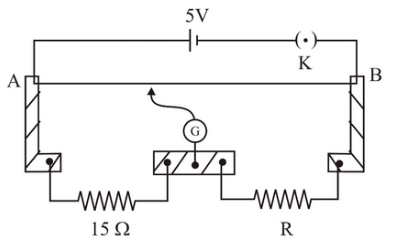
A meter bridge setup is shown in the figure. It is used to determine an unknown resistance $$R$$ using a given resistor of $$15$$ $$\Omega$$. The galvanometer $$(G)$$ shows null deflection when tapping key is at $$43$$ cm mark from end $$A$$. If the end correction for end $$A$$ is $$2$$ cm, then the determined value of $$R$$ will be ______ $$\Omega$$.

image
Question 69 JEE Mains

A potentiometer wire of length $$300 \text{ cm}$$ is connected in series with a resistance $$780 \Omega$$ and a standard cell of emf $$4 \text{ V}$$. A constant current flows through potentiometer wire. The length of the null point for cell of emf $$20 \text{ mV}$$ is found to be $$60 \text{ cm}$$. The resistance of the potentiometer wire is ______ $$\Omega$$.

Question 70 JEE Mains

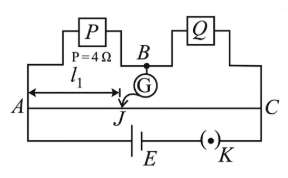
Resistances are connected in a meter bridge circuit as shown in the figure. The balancing length $$l_1$$ is $$40 \text{ cm}$$. Now an unknown resistance $$x$$ is connected in series with $$P$$ and new balancing length is found to be $$80 \text{ cm}$$ measured from the same end. Then the value of $$x$$ will be ______ $$\Omega$$.( Value of Q = 6 $$\Omega$$)

image
Question 71 JEE Mains

The current density in a cylindrical wire of radius $$r = 4.0$$ mm is $$1.0\times10^6A.m^{-2}$$. The current through the outer portion of the wire between radial distances $$\frac{r}{2}$$ and $$r$$ is $$x\pi$$ A; where $$x$$ is ______

Question 72 JEE Mains

An electrical bulb rated 220 V, 100 W, is connected in series with another bulb rated 220 V, 60 W. If the voltage across combination is 220 V, the power consumed by the 100 W bulb will be about _____ W.

Question 73 JEE Mains

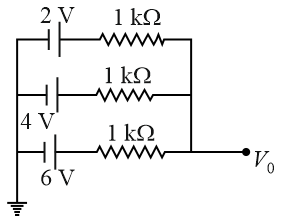
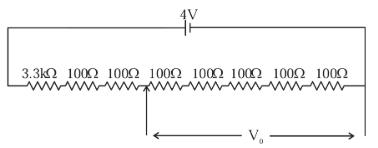
In the given figure, the value of $$V_0$$ will be ______ V.

Question 74 JEE Mains

The current density in a cylindrical wire of radius $$4$$ mm is $$4 \times 10^6$$ A m$$^{-2}$$. The current through the outer portion of the wire between radial distances $$\frac{R}{2}$$ and $$R$$ is ______ $$\pi$$ A.

Question 75 JEE Mains

Eight copper wires of length $$l$$ and diameter $$d$$ are joined in parallel to form a single composite conductor of resistance $$R$$. If a single copper wire of length $$2l$$ has the same resistance $$R$$ then its diameter will be ______ $$d$$.

Question 76 JEE Advanced

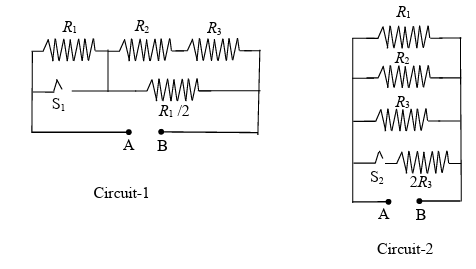
In Circuit-1 and Circuit-2 shown in the figures, $$R_1 = 1$$ $$\Omega$$, $$R_2 = 2$$ $$\Omega$$ and $$R_3 = 3$$ $$\Omega$$. $$P_1$$ and $$P_2$$ are the power dissipations in Circuit-1 and Circuit-2 when the switches $$S_1$$ and $$S_2$$ are in open conditions, respectively.

$$Q_1$$ and $$Q_2$$ are the power dissipations in Circuit-1 and Circuit-2 when the switches $$S_1$$ and $$S_2$$ are in closed conditions, respectively.

image

Which of the following statement(s) is(are) correct?

Question 77 JEE Advanced

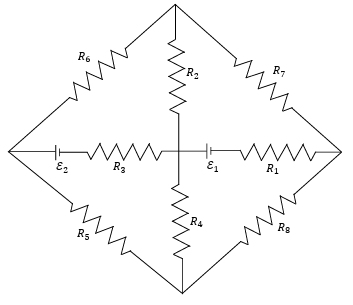
The figure shows a circuit having eight resistances of 1 $$\Omega$$ each, labelled $$R_1$$ to $$R_8$$, and two ideal batteries with voltages $$\varepsilon_1 = 12$$ V and $$\varepsilon_2 = 6$$ V.

image

Which of the following statement(s) is(are) correct?

Question 78 JEE Mains

A teacher in his physics laboratory allotted an experiment to determine the resistance $$G$$ a galvanometer. Students took the observations for $$\frac{1}{3}$$ deflection in the galvanometer. Which of the below is true for measuring value of $$G$$?

Question 79 JEE Mains

A wire of 1 $$\Omega$$ has a length of 1 m. It is stretched till its length increases by 25%. The percentage change in resistance to the nearest integer is:

Question 80 JEE Mains

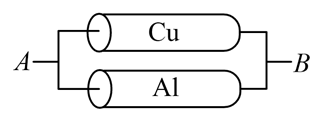
A Copper (Cu) rod of length 25 cm and cross-sectional area 3 mm$$^2$$ is joined with a similar Aluminium (Al) rod as shown in figure. Find the resistance of the combination between the ends A and B.
(Take resistivity of Copper = 1.7 $$\times 10^{-8}$$ $$\Omega$$m, Resistivity of aluminium = 2.6 $$\times 10^{-8}$$ $$\Omega$$m)

Question 81 JEE Mains

A resistor develops 500 J of thermal energy in 20 s when a current of 1.5 A is passed through it. If the current is increased from 1.5 A to 3 A, what will be the energy developed in 20 s.

Question 82 JEE Mains

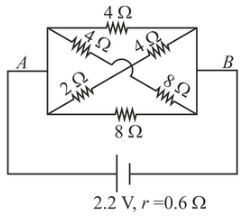
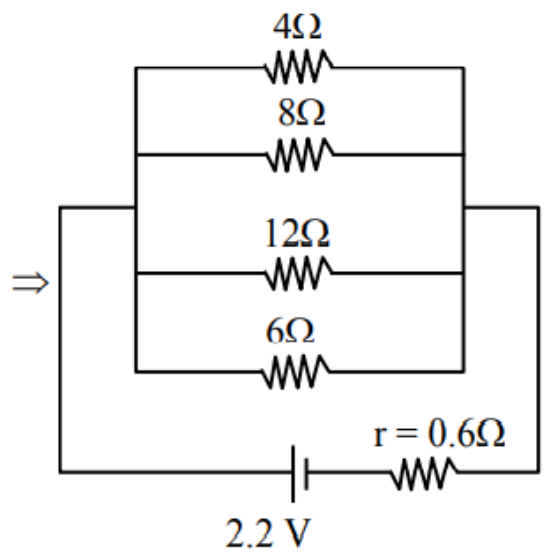
In the given figure, the emf of the cell is 2.2 V and if internal resistance is 0.6 $$\Omega$$. Calculate the power dissipated in the whole circuit:

image
Question 83 JEE Mains

Consider a galvanometer shunted with 5 $$\Omega$$ resistance and 2% of current passes through it. What is the resistance of the given galvanometer?

Question 84 JEE Mains

In the given figure, there is a circuit of potentiometer of length AB = 10 m. The resistance per unit length is 0.1 $$\Omega$$ per cm. Across AB, a battery of emf E and internal resistance r is connected. The maximum value of emf measured by this potentiometer is:

Question 85 JEE Mains


The value of current in the 6 $$\Omega$$ resistance is:

Question 86 JEE Mains

What equal length of an iron wire and a copper-nickel alloy wire, each of 2 mm diameter connected parallel to give an equivalent resistance of 3 $$\Omega$$?
(Given resistivities of iron and copper-nickel alloy wire are 12 $$\mu\Omega$$ cm and 51 $$\mu\Omega$$ cm respectively)

Question 87 JEE Mains

A conducting wire of length $$l$$, area of cross-section $$A$$ and electric resistivity $$\rho$$ is connected between the terminals of a battery. A potential difference $$V$$ is developed between its ends, causing an electric current. If the length of the wire of the same material is doubled and the area of cross-section is halved, the resultant current would be:

Question 88 JEE Mains

A current of 10 A exists in a wire of cross-sectional area of 5 mm$$^2$$ with a drift velocity of $$2 \times 10^{-3}$$ m s$$^{-1}$$. The number of free electrons in each cubic meter of the wire is:

Question 89 JEE Mains

A current of 5 A is passing through a non-linear magnesium wire of cross-section 0.04 m$$^2$$. At every point the direction of current density is at an angle of 60$$^\circ$$ with the unit vector of area of cross-section. The magnitude of electric field at every point of the conductor is: (resistivity of magnesium $$\rho = 44 \times 10^{-8}$$ $$\Omega$$m)

Question 90 JEE Mains

Five identical cells each of internal resistance 1 $$\Omega$$ and emf 5 V are connected in series and in parallel with an external resistance $$R$$. For what value of $$R$$, current in series and parallel combination will remain the same?

Question 91 JEE Mains

For full scale deflection of total 50 divisions, 50 mV voltage is required in galvanometer. The resistance of galvanometer if its current sensitivity is 2 div / mA will be:

Question 92 JEE Mains

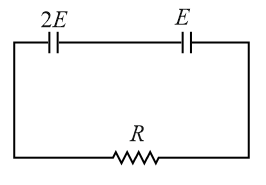
Two cells of emf $$2E$$ and $$E$$ with internal resistance $$r_1$$ and $$r_2$$ respectively are connected in series to an external resistor $$R$$ (see figure). The value of $$R$$, at which the potential difference across the terminals of the first cell becomes zero is:

Question 93 JEE Mains

An electric bulb of 500 W at 100 V is used in a circuit having a 200 V supply. Calculate the resistance $$R$$ to be connected in series with the bulb so that the power delivered by the bulb is 500 W.

Question 94 JEE Mains

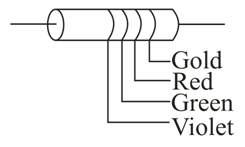
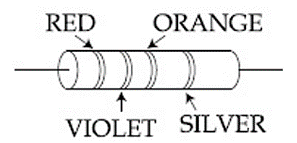
The colour coding on a carbon resistor is shown in the given figure. The resistance value of the given resistor is:

Question 95 JEE Mains

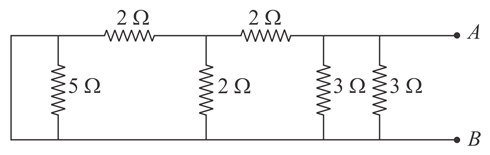
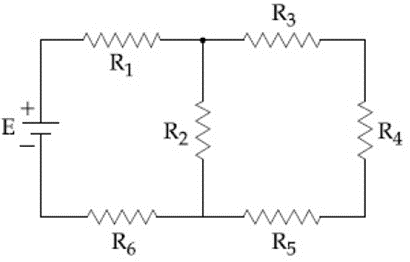
The equivalent resistance of the given circuit between the terminals $$A$$ and $$B$$ is:

Question 96 JEE Mains

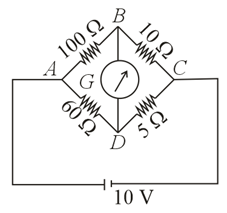
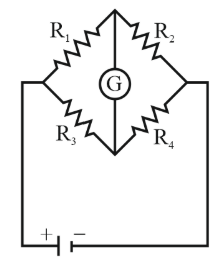
The four arms of a Wheatstone bridge have resistances as shown in the figure. A galvanometer of 15$$\Omega$$ resistance is connected across BD. Calculate the current through the galvanometer when a potential difference of 10 V is maintained across AC.

Question 97 JEE Mains

Two resistors $$R_1 = (4 \pm 0.8)$$ $$\Omega$$ and $$R_2 = (4 \pm 0.4)$$ $$\Omega$$ are connected in parallel. The equivalent resistance of their parallel combination will be:

Question 98 JEE Mains

A current through a wire depends on time as $$i = \alpha_0 t + \beta t^2$$, where $$\alpha_0 = 20$$ A s$$^{-1}$$ and $$\beta = 8$$ A s$$^{-2}$$. Find the charge crossed through a section of the wire in 15 s.

Question 99 JEE Mains

If you are provided a set of resistances, 2 $$\Omega$$, 4 $$\Omega$$, 6 $$\Omega$$ and 8 $$\Omega$$. Connect these resistances to obtain an equivalent resistance of $$\frac{46}{3}$$ $$\Omega$$.

Question 100 JEE Mains

The given potentiometer has its wire of resistance 10 $$\Omega$$. When the sliding contact is in the middle of the potentiometer wire, the potential drop across 2 $$\Omega$$ resistor is:

Question 101 JEE Mains

The resistance of a conductor at 15°C is 16 $$\Omega$$ and at 100°C is 20 $$\Omega$$. What will be the temperature coefficient of resistance of the conductor?

Question 102 JEE Mains

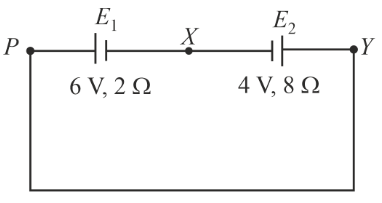
A cell $$E_1$$ of emf 6 V and internal resistance 2$$\Omega$$ is connected with another cell $$E_2$$ of emf 4 V and internal resistance 8 $$\Omega$$ (as shown in the figure). The potential difference across points X and Y is:

image
Question 103 JEE Mains

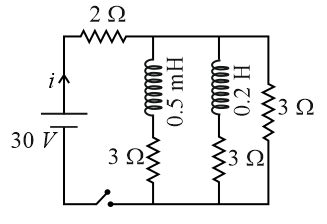
For the given circuit the current $$i$$ through the battery when the key is closed and the steady state has been reached is:

Question 104 JEE Mains

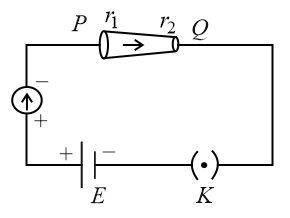
In the given figure, a battery of emf $$E$$ is connected across a conductor $$PQ$$ of length $$l$$ and different area of cross-sections having radii $$r_1$$ and $$r_2$$ ($$r_2 < r_1$$).


Choose the correct option as one moves from $$P$$ to $$Q$$.

Question 105 JEE Mains

A 16 $$\Omega$$ wire is bent to form a square loop. A 9 V supply having an internal resistance of 1 $$\Omega$$ is connected across one of its sides. The potential drop across the diagonals of the square loop is _________ $$\times 10^{-1}$$ V.

Question 106 JEE Mains

A resistor dissipates 192 J of energy in 1 s when a current of 4 A is passed through it. Now, when the current is doubled, the amount of thermal energy dissipated in 5 s is _________ J.

Question 107 JEE Mains

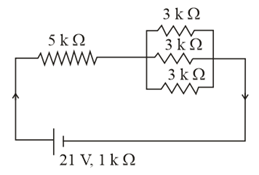
In the figure given, the electric current flowing through the 5 k$$\Omega$$ resistor is $$x$$ mA.


The value of $$x$$ to the nearest integer is ________.

Question 108 JEE Mains

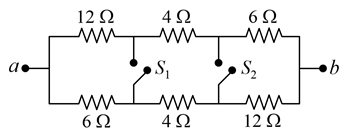
In the given figure switches $$S_1$$ and $$S_2$$ are in open condition. The resistance across $$ab$$ when the switches $$S_1$$ and $$S_2$$ are closed is ___ $$\Omega$$.

Question 109 JEE Mains

A uniform heating wire of resistance 36 $$\Omega$$ is connected across a potential difference of 240 V. The wire is then cut into half and a potential difference of 240 V is applied across each half separately. The ratio of power dissipation in first case to the total power dissipation in the second case would be 1 : $$x$$, where $$x$$ is _________.

Question 110 JEE Mains

An electric bulb rated as 200 W at 100 V is used in a circuit having 200 V supply. The resistance R that must be put in series with the bulb so that the bulb delivers the same power is ___ $$\Omega$$.

Question 111 JEE Mains

First, a set of $$n$$ equal resistors of 10 $$\Omega$$ each are connected in series to a battery of E.M.F. 20 V and internal resistance 10 $$\Omega$$. A current $$I$$ is observed to flow. Then, the $$n$$ resistors are connected in parallel to the same battery. It is observed that the current is increased 20 times, then the value of $$n$$ is _________.

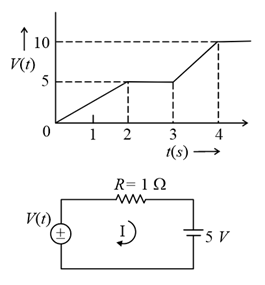
Question 112 JEE Mains

For the circuit shown, the value of current at time $$t = 3.2$$ s will be _________ A.


[Voltage distribution V(t) is shown by Fig. (1) and the circuit is shown in Fig. (2)]

Question 113 JEE Mains

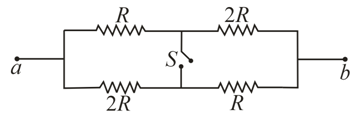
The ratio of the equivalent resistance of the network (shown in figure) between the points $$a$$ and $$b$$ when switch is open and switch is closed is $$x : 8$$. The value of $$x$$ is _________.

Question 114 JEE Mains

A cylindrical wire of radius 0.5 mm and conductivity $$5 \times 10^7$$ S m$$^{-1}$$ is subjected to an electric field of 10 mV m$$^{-1}$$. The expected value of current in the wire will be $$x^3\pi$$ mA. The value of $$x$$ is ______.

Question 115 JEE Mains

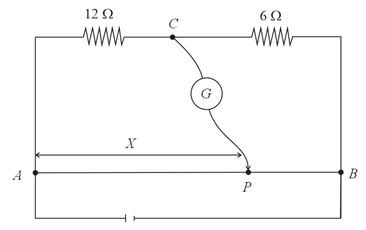
Consider a 72 cm long wire AB as shown in the figure. The galvanometer jockey is placed at P on AB at a distance $$x$$ cm from A. The galvanometer shows zero deflection.


The value of $$x$$, to the nearest integer, is ___.

Question 116 JEE Mains

In Bohr's atomic model, the electron is assumed to revolve in a circular orbit of radius 0.5 $$\mathring{A}$$. If the speed of electron is $$2.2 \times 10^6$$ m s$$^{-1}$$. Then the current associated with the electron will be _________ $$\times 10^{-2}$$ mA. [Take $$\pi$$ as $$\frac{22}{7}$$]

Question 117 JEE Mains

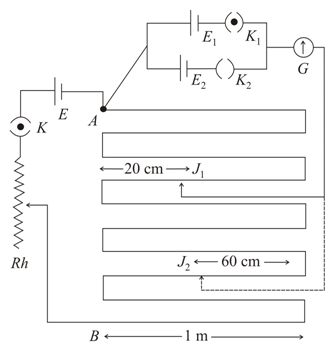
In the given circuit of potentiometer, the potential difference $$E$$ across $$AB$$ (10 m length) is larger than $$E_1$$ and $$E_2$$ as well. For key $$K_1$$ (closed), the jockey is adjusted to touch the wire at point $$J_1$$ so that there is no deflection in the galvanometer. Now the first battery ($$E_1$$) is replaced by second battery ($$E_2$$) for working by making $$K_1$$ open and $$K_2$$ closed. The galvanometer gives then null deflection at $$J_2$$. The value of $$\frac{E_1}{E_2}$$ is $$\frac{a}{2}$$, where $$a$$ = ______.

Question 118 JEE Mains

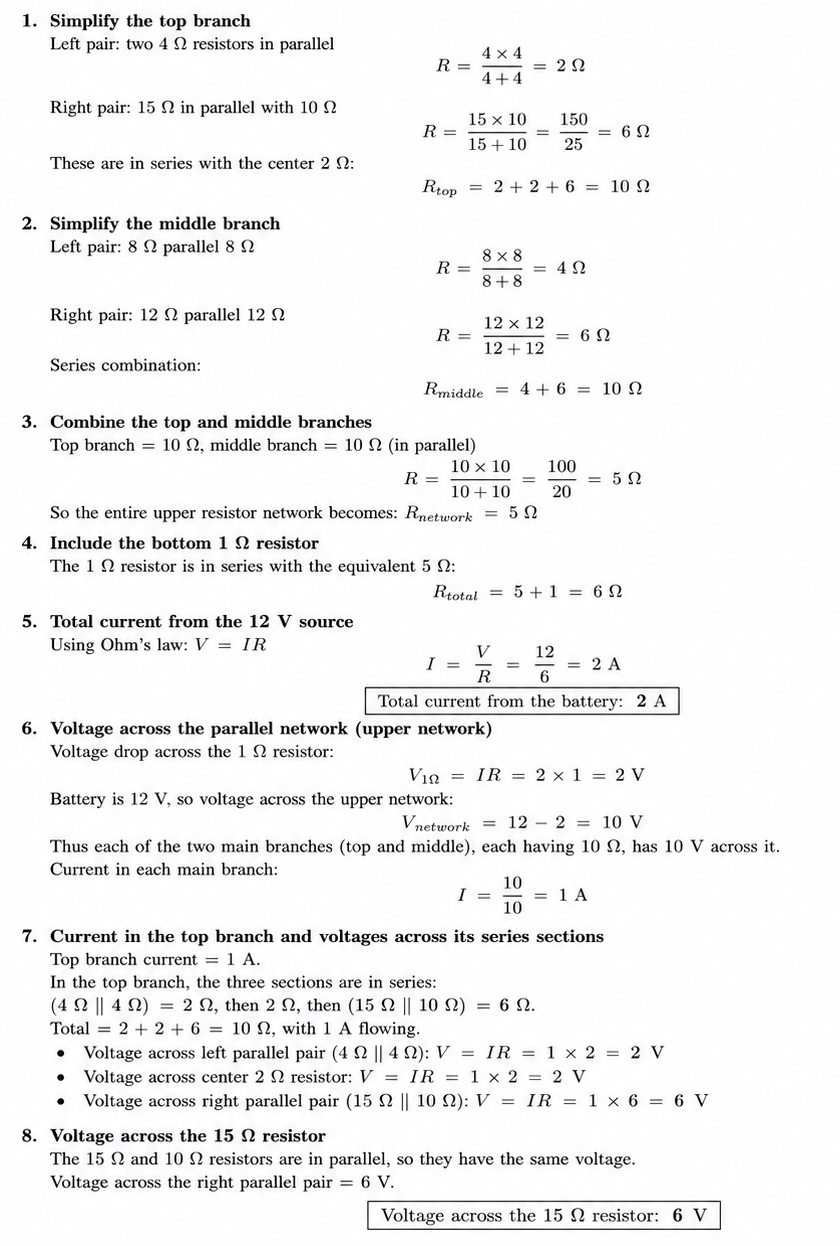
The voltage drop across 15 $$\Omega$$ resistance in the given figure will be _________ V.

Question 119 JEE Mains

A square-shaped wire with a resistance of each side 3 $$\Omega$$ is bent to form a complete circle. The resistance between two diametrically opposite points of the circle in a unit of $$\Omega$$ will is _________.

Question 120 JEE Mains

In an electric circuit, a call of certain emf provides a potential difference of 1.25 V across a load resistance of 5 $$\Omega$$. However, it provides a potential difference of 1 V across a load resistance of 2 $$\Omega$$. The emf of the cell is given by $$\frac{x}{10}$$ V. Then the value of $$x$$ is ___.

Question 121 JEE Mains

The equivalent resistance of series combination of two resistors is $$s$$. When they are connected in parallel, the equivalent resistance is $$p$$. If $$s = np$$, then the minimum value for $$n$$ is ________. (Round off to the Nearest Integer)

Question 122 JEE Mains

Two wires of same length and thickness having specific resistances 6 $$\Omega$$ cm and 3 $$\Omega$$ cm respectively are connected in parallel. The effective resistivity is $$\rho$$ $$\Omega$$ cm. The value of $$\rho$$ to the nearest integer, is ___.

Question 123 JEE Mains

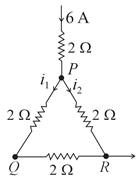
A current of 6 A enters one corner $$P$$ of an equilateral triangle $$PQR$$ having 3 wires of resistance 2 $$\Omega$$ each and leaves by the corner $$R$$. The currents $$i_1$$ in ampere is ______

Question 124 JEE Mains

The energy dissipated by a resistor is 10 mJ in 1 s, when an electric current of 2 mA flows through it. The resistance is ________ $$\Omega$$. (Round off to the Nearest Integer)

Question 125 JEE Mains

In a building there are 15 bulbs of 45 W, 15 bulbs of 100 W, 15 small fans of 10 W and 2 heaters of 1 kW. The voltage of electric main supply is 220 V. The minimum fuse capacity (rated value) of the building will be:

Question 126 JEE Mains

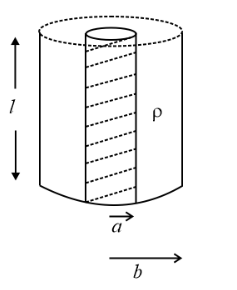
Model a torch battery of length $$l$$ to be made up of a thin cylindrical bar of radius $$a$$ and a concentric thin cylindrical shell of radius $$b$$ filled in between with an electrolyte of resistivity $$\rho$$ (see figure). If the battery is connected to a resistance of value $$R$$, the maximum Joule heating in $$R$$ will take place for:

image
Question 127 JEE Mains

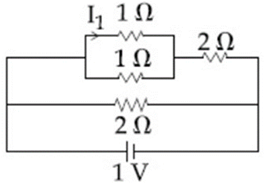
The current $$I_1$$ (in A) flowing through 1$$\Omega$$ resistor in the following circuit is:

Question 128 JEE Mains

A battery of 3.0 V is connected to a resistor dissipating 0.5 W of power. If the terminal voltage of the battery is 2.5 V, the power dissipated within the internal resistance is:

Question 129 JEE Mains

Consider four conducting materials copper, tungsten, mercury and aluminium with resistivity $$\rho_C$$, $$\rho_T$$, $$\rho_M$$ and $$\rho_A$$ respectively. Then:

Question 130 JEE Mains

In the figure, potential difference between A and B is:

Question 131 JEE Mains

In the given circuit diagram, a wire is joining points B and D. The current in this wire is:
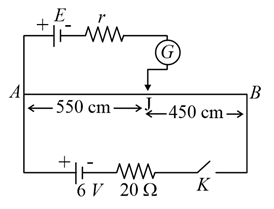
Question 132 JEE Mains

Two resistors 400 $$\Omega$$ and 800 $$\Omega$$ are connected in series across a 6V battery. The potential difference measured by a voltmeter of 10 k$$\Omega$$ across 400 $$\Omega$$ resistor is close to:

Question 133 JEE Mains

A galvanometer having a coil resistance 100 $$\Omega$$ gives a full scale deflection when a current of 1 mA is passed through it. What is the value of the resistance which can convert this galvanometer into a voltmeter giving full scale deflection for a potential difference of 10 V?

Question 134 JEE Mains

A galvanometer is used in laboratory for detecting the null point in electrical experiments. If, on passing a current of $$6\,mA$$ it produces a deflection of $$2^\circ$$, its figure of merit is close to:

Question 135 JEE Mains

In the figure shown, the current in the $$10\,\text{V}$$ battery is close to:

Question 136 JEE Mains

The length of a potentiometer wire is 1200 cm and it carries a current of 60 mA. For a cell of emf 5 V and internal resistance of 20 $$\Omega$$ the null point on it is found to be at 1000 cm. The resistance of whole wire is:

Question 137 JEE Mains

The value of current $$i_1$$ flowing from A to C in the circuit diagram is:

Question 138 JEE Mains

A circuit to verify Ohm's law uses ammeter and voltmeter in series or parallel connected correctly to the resistor. In the circuit:

Question 139 JEE Mains

A galvanometer of resistance $$G$$ is converted into a voltmeter of range $$0 - 1\,\text{V}$$ by connecting a resistance $$R$$ in series with it. The additional resistance that should be connected in series with $$R_1$$ to increase the range of the voltmeter to $$0 - 2\,\text{V}$$ will be:

Question 140 JEE Mains

In the circuit, given in the figure currents in different branches and value of one resistor are shown. Then potential at point $$B$$ with respect to the point $$A$$ is:

Question 141 JEE Mains

An electrical power line, having a total resistance of $$2\,\Omega$$, delivers $$1\,\text{kW}$$ at $$220\,\text{V}$$. The efficiency of the transmission line is approximately:

Question 142 JEE Mains

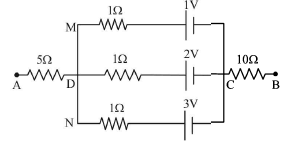
The current $$i$$ in the network is:

Question 143 JEE Mains

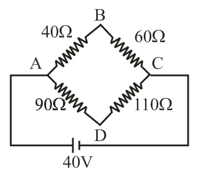
Four resistances 40 $$\Omega$$, 60 $$\Omega$$, 90 $$\Omega$$, 110 $$\Omega$$ and make the arms of a quadrilateral ABCD. Across AC is a battery of emf 40 V and internal resistance negligible. The potential difference across BD in V is __________
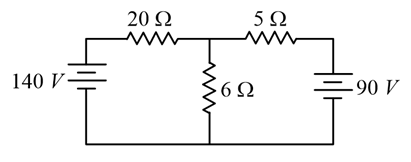
Question 144 JEE Mains

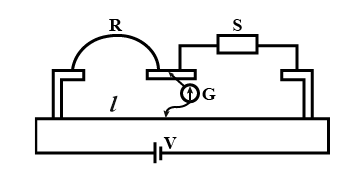
In a meter bridge experiment $$S$$ is a standard resistance. $$R$$ is a resistance wire. It is found that balancing length is $$l = 25$$ cm. If $$R$$ is replaced by a wire of half length and half diameter that of $$R$$ of same material, then the balancing distance $$l'$$ (in cm) will now be ___________.

Question 145 JEE Mains

Four resistances of 15 $$\Omega$$, 12 $$\Omega$$, 4 $$\Omega$$ and 10 $$\Omega$$ respectively in cyclic order to form Wheatstone's network. The resistance that is to be connected in parallel with the resistance of 10 $$\Omega$$ to balance the network is __________ $$\Omega$$.

Question 146 JEE Mains

The series combination of two batteries, both of the same emf 10 V, but different internal resistance of 20 $$\Omega$$ and 5 $$\Omega$$, is connected to the parallel combination of two resistors 30 $$\Omega$$ and x $$\Omega$$. The voltage difference across the battery of internal resistance 20 $$\Omega$$ is zero, the value of x (in $$\Omega$$) is

Question 147 JEE Mains

The balancing length for a cell is 560 cm in a potentiometer experiment. When an external resistance of 10 $$\Omega$$ is connected in parallel to the cell, the balancing length changes by 60 cm. If the internal resistance of the cell is $$\frac{n}{10}$$ $$\Omega$$, where n is an integer then value of n is

Question 148 JEE Mains

Temperature difference of 120$$^{\circ}$$C is maintained between two ends of a uniform rod $$AB$$ of length $$2L$$. Another bent rod $$PQ$$, of same cross-section as $$AB$$ and length $$\frac{3L}{2}$$, is connected across $$AB$$ (See figure). In steady state, temperature difference between $$P$$ and $$Q$$ will be close to:

Question 149 JEE Mains

A current of 5 A passes through a copper conductor (resistivity = $$1.7 \times 10^{-8}$$ Ω m) of radius of cross-section 5 mm. Find the mobility of the charges if their drift velocity is $$1.1 \times 10^{-3}$$ ms$$^{-1}$$.

Question 150 JEE Mains

In the given circuit, an ideal voltmeter connected across the 10 Ω resistance reads 2 V. The internal resistance r, of each cell is:

Question 151 JEE Mains

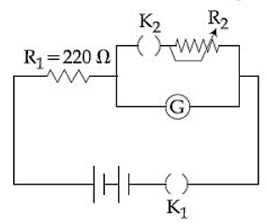
The galvanometer deflection, when key $$K_1$$ is closed but $$K_2$$ is open, equals $$\theta_0$$ (see figure). On closing $$K_2$$ also and adjusting $$R_2$$ to $$5\Omega$$, the deflection in galvanometer becomes $$\frac{\theta_0}{5}$$. The resistance of the galvanometer is, then, given by [Neglect the internal resistance of battery]:

Question 152 JEE Mains

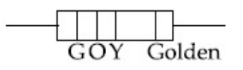
A carbon resistance has a following colour code. What is the value of the resistance?


GOY Golden

Question 153 JEE Mains

A galvanometer, whose resistance is 50 ohm, has 25 divisions in it. When a current of $$4 \times 10^{-4}$$ A passes through it, its needle (pointer) deflects by one division. To use this galvanometer as a voltmeter of range 2.5 V it should be connected to a resistance of:

Question 154 JEE Mains

A metal wire of resistance 3 $$\Omega$$ is elongated to make a uniform wire of double its previous length. This new wire is now bent and the ends joined to make a circle. If two points on this circle make an angle 60° at the center, the equivalent resistance between these two points will be:

Question 155 JEE Mains

A moving coil galvanometer allows a full scale current of $$10^{-4}$$ A. A series resistance of $$2 \times 10^4$$ Ω is required to convert the galvanometer into a voltmeter of range 0 - 5 V. Therefore, the value of shunt resistance required to convert the above galvanometer into an ammeter of range 0 - 10 mA is:

Question 156 JEE Mains

An ideal battery of emf 4V and resistance R are connected in series in the primary circuit of a potentiometer of length 1 m and resistance $$5\Omega$$. The value of R, to give a potential difference of 5 mV across 10 cm of potentiometer wire, is:

Question 157 JEE Mains

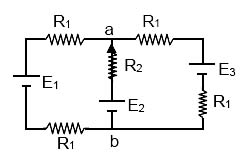
For the circuit shown, with $$R_1 = 1.0 \; \Omega$$, $$R_2 = 2.0 \; \Omega$$, $$E_1 = 2$$ V and $$E_2 = E_3 = 4$$ V, the potential difference between the points 'a' and 'b' is approximately (in V):

Question 158 JEE Mains

In the circuit shown, the potential difference between A and B is

Question 159 JEE Mains

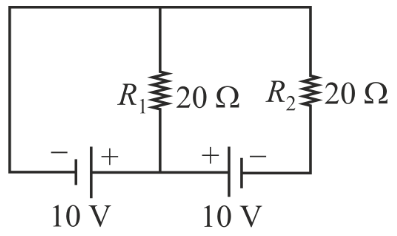
In the given circuit the cells have zero internal resistance. The currents (in amperes) passing through resistance $$R_1$$ and $$R_2$$ respectively, are:

image
Question 160 JEE Mains

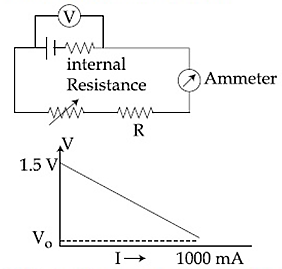
To verify Ohm's law, a student connects the voltmeter across the battery as shown in the figure. The measured voltage is plotted as a function of the current, and the following graph is obtained.

If V$$_0$$ is almost zero, identify the correct statement:

Question 161 JEE Mains

Two equal resistances when connected in series to a battery, consume electric power of 60 W. If these resistance are now connected in parallel combination to the same battery, the electric power consumed will be:

Question 162 JEE Mains

When the switch $$S$$, in the circuit shown, is closed, then the value of current $$i$$ will be:

image
Question 163 JEE Mains

A 200 $$\Omega$$ resistor has certain colour code. If one replaced the red colour by green in the code, the new resistance will be:

Question 164 JEE Mains

A galvanometer having a resistance of $$20\Omega$$ and 30 division on both sides has figure of merit 0.005 ampere/division. The resistance that should be connected in series such that it can be used as a voltmeter upto 15 volt, is:

Question 165 JEE Mains

A galvanometer of resistance 100 Ω has 50 divisions on its scale and has sensitivity of 20 μA/division. It is to be converted to voltmeter with three ranges, of 0 - 2 V, 0 - 10 V and 0 - 20 V. The appropriate circuit to do so is:

Question 166 JEE Mains

A moving coil galvanometer, having a resistance G, produces full scale deflection when a current I$$_G$$ flows through it. This galvanometer can be converted into (i) an ammeter of range 0 to I$$_0$$ (I$$_0$$ > I$$_g$$) by connecting a shunt resistance R$$_A$$ to it and (ii) into a voltmeter of range 0 to V (V = GI$$_0$$) by connecting a series resistance R$$_V$$ to it. Then,

Question 167 JEE Mains

A uniform metallic wire has a resistance of 18 $$\Omega$$ and is bent into an equilateral triangle. Then, the resistance between any two vertices of the triangle is:

Question 168 JEE Mains

A wire of resistance R is bent to form a square ABCD as shown in the figure. The effective resistance between E and C is: (E is mid-point of arm CD)

Question 169 JEE Mains

Drift speed of electrons, when 1.5 A current flows in a copper wire of cross section 5 mm$$^2$$ is $$v_d$$. If the electron density in copper is $$9 \times 10^{28}$$ m$$^{-3}$$, the value of $$v_d$$ in mm s$$^{-1}$$ is close to (Take charge of an electron to be $$= 1.6 \times 10^{-19}$$ C)

Question 170 JEE Mains

In a Wheatstone bridge (see fig.), Resistances P and Q are approximately equal. When $$R = 400\Omega$$, the bridge is balanced. On interchanging P and Q, the value of R, for balance, is $$405\Omega$$. The value of Y is close to

Question 171 JEE Mains

In an experiment, the resistance of a material is plotted as a function of temperature (in some range). As shown in the figure, it is a straight line.

image

One may conclude that

Question 172 JEE Mains

In the circuit shown, a four-wire potentiometer is made of a 400 cm long wire, which extends between A and B. The resistance per unit length of the potentiometer wire is r = 0.01 $$\Omega$$/cm. If an ideal voltmeter is connected as shown with jockey J at 50 cm from end A, the expected reading of the voltmeter will be:

Question 173 JEE Mains

In the given circuit the internal resistance of the 18V cell is negligible. If $$R_1 = 400$$ $$\Omega$$, $$R_3 = 100$$ $$\Omega$$ and $$R_4 = 500$$ $$\Omega$$ and the reading of an ideal voltmeter across $$R_4$$ is 5 V, then the value of $$R_2$$ will be:

Question 174 JEE Mains

The resistance of a galvanometer is 50 ohm and the maximum current which can be passed through it is 0.002 A. What resistance must be connected to it in order to convert it into an ammeter of range 0 - 0.5 A?

Question 175 JEE Mains

Two electric bulbs, rated at (25 W, 220 V) and (100 W, 220 V), are connected in series across a 220 V voltage source. If the 25 W and 100 W bulbs draw powers $$P_1$$ and $$P_2$$ respectively, then:

Question 176 JEE Mains

A 2 W carbon resistor is color coded with green, black, red and silver respectively. The maximum current which can be passed through this resistor is:

Question 177 JEE Mains

A cell of internal resistance r drives current through an external resistance R. The power delivered by the cell to the external resistance will be maximum when:

Question 178 JEE Mains

In a conductor, if the number of conduction electrons per unit volume is $$8.5 \times 10^{28}$$ m$$^{-3}$$ and mean free time is 25 fs (femto second), it's approximate resistivity is: ($$m_e = 9.1 \times 10^{-31}$$ kg)

Question 179 JEE Mains

The actual value of resistance $$R$$, shown in the figure is 30$$\Omega$$. This is measured in an experiment as shown using the standard formula $$R = \frac{V}{I}$$, where V and I are the readings of the voltmeter and ammeter, respectively. If the measured value of $$R$$ is 5% less, then the internal resistance of the voltmeter is:

Question 180 JEE Mains

The resistive network shown below is connected to a D.C. source of 16 V. The power consumed by the network is 4 Watt. The value of R is:

image
Question 181 JEE Mains

A copper wire is stretched to make it 0.5% longer. The percentage change in its electrical resistance if its volume remains unchanged is:

Question 182 JEE Mains

A moving coil galvanometer has resistance 50 $$\Omega$$ and it indicates full deflection at 4 mA current. A voltmeter is made using this galvanometer and a 5 k$$\Omega$$ resistance. The maximum voltage, that can be measured using this voltmeter, will be close to:

Question 183 JEE Mains

A resistance is shown in the figure. Its value and tolerance are given respectively by:

Question 184 JEE Mains

In the figure shown, what is the current (in Ampere) drawn from the battery? You are given: $$R_1 = 15 \; \Omega$$, $$R_2 = 10 \; \Omega$$, $$R_3 = 20 \; \Omega$$, $$R_4 = 5 \; \Omega$$, $$R_5 = 25 \; \Omega$$, $$R_6 = 30 \; \Omega$$, $$E = 15$$ V

Question 185 JEE Mains

Space between two concentric conducting spheres of radii a and b (b > a) is filled with a medium of resistivity $$\rho$$. The resistance between the two spheres will be:

Question 186 JEE Mains

The Wheatstone bridge shown in the figure below, gets balanced when the carbon resistor used as $$R_1$$ has the colour code (orange, red, brown). The resistors $$R_2$$ and $$R_4$$ are 80 $$\Omega$$ and 40 $$\Omega$$, respectively. Assuming that the colour code for the carbon resistors gives their accurate values, the colour code for the carbon resistor, used as $$R_3$$, would be:

image
Question 187 JEE Mains

A current of 2 mA was passed through an unknown resistor which dissipated a power of 4.4 W. Dissipated power when an ideal power supply of 11 V is connected across it is:

Question 188 JEE Mains

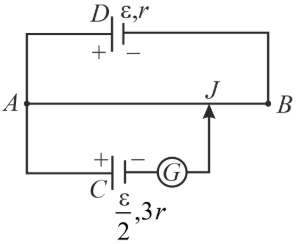
A potentiometer wire AB having length $$L$$ and resistance $$12r$$ is joined to a cell D of emf $$\varepsilon$$ and internal resistance $$r$$. A cell C having EMF $$\varepsilon/2$$ and internal resistance $$3r$$ is connected. The length AJ, at which the galvanometer, as shown in the figure, shows no deflection is:

image
Question 189 JEE Mains

In a meter bridge, the wire of length 1 m has a non-uniform cross-section such that, the variation $$\frac{dR}{dl}$$ of its resistance R with length l is $$\frac{dR}{dl} \propto \frac{1}{\sqrt{l}}$$. Two equal resistances are connected as shown in the figure. The galvanometer has zero deflection when the jockey is at point P. What is the length AP?

Question 190 JEE Mains

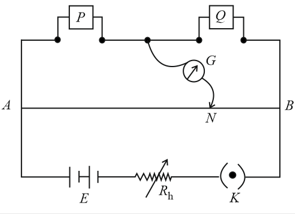
The resistance of the meter bridge AB in given figure is $$4\Omega$$. With a cell of emf $$\varepsilon = 0.5$$ V and rheostat resistance $$R_h = 2\Omega$$ the null point is obtained at some point J. When the cell is replaced by another one of emf $$\varepsilon = \varepsilon_2$$ the same null point J is found for $$R_h = 6\Omega$$. The emf $$\varepsilon_2$$ is:

Question 191 JEE Mains

A copper rod of cross-sectional area A carries a uniform current I through it. At temperature T, if the volume charge density of the rod is $$\rho$$, how long will the charges take to travel a distance d?

Question 192 JEE Mains

In the given circuit all resistances are of value R ohm each. The equivalent resistance between A and B is:

Question 193 JEE Mains

A heating element has a resistance of 100 $$\Omega$$ at room temperature. When it is connected to a supply of 220 V, a steady current of 2 A passes in it and temperature is 500$$^\circ$$C more than the room temperature. The temperature coefficient of resistance of the heating element is:

Question 194 JEE Mains

In a meter bridge, as shown in the figure, it is given that resistance Y = 12.5 $$\Omega$$ and that the balance is obtained at a distance 39.5 cm from end A (by jockey J). After interchanging the resistances X and Y a new balance point is found at a distance $$l_2$$ from end A. What are the values of X and $$l_2$$?

Question 195 JEE Mains

Two batteries with e.m.f. 12 V and 13 V are connected in parallel across a load resistor of 10 $$\Omega$$. The internal resistance of the two batteries are 1 $$\Omega$$ and 2 $$\Omega$$ respectively. The voltage across the load lies between,

Question 196 JEE Mains

A galvanometer with its coil resistance 25 $$\Omega$$ requires a current of 1 mA for its full deflection. In order to construct an ammeter to read up to a current of 2 A the approximate value of the shunt resistance should be:

Question 197 JEE Mains

On interchanging the resistances, the balance point of a meter bridge shifts to the left by 10 cm. The resistance of their series combination is 1 k$$\Omega$$. How much was the resistance on the left slot before interchanging the resistances?

Question 198 JEE Mains

A constant voltage is applied between two ends of a metallic wire. If the length is halved and the radius of the wire is doubled, the rate of heat developed in the wire will be:

Question 199 JEE Mains

In a circuit for finding the resistance of a galvanometer by half deflection method, a 6 V battery and a high resistance of 11 k$$\Omega$$ are used. The figure of merit of the galvanometer is 60 $$\mu$$A division$$^{-1}$$. In the absence of shunt resistance, the galvanometer produces a deflection of $$\theta$$ = 9 divisions when current flows in the circuit. The value of the shunt resistance that can cause the deflection of $$\frac{\theta}{2}$$, is closest to:

Question 200 JEE Mains

In a potentiometer experiment, it is found that no current passes through the galvanometer when the terminals of the cell are connected across 52 cm of the potentiometer wire. If the cell is shunted by a resistance of 5 $$\Omega$$, a balance is found when the cell is connected across 40 cm of the wire. Find the internal resistance of the cell.

Question 201 JEE Mains

In a meter bridge experiment resistances are connected as shown in the figure. Initially resistance $$P = 4 \; \Omega$$ and the neutral point $$N$$ is at 60 cm from $$A$$. Now an unknown resistance $$R$$ is connected in series to $$P$$ and the new position of the neutral point is at 80 cm from $$A$$. The value of unknown resistance $$R$$ is -

image
Question 202 JEE Mains

A uniform wire of length $$l$$ and radius $$r$$ has a resistance of 100 $$\Omega$$. It is recast into a wire of radius $$\frac{r}{2}$$. The resistance of new wire will be-

Question 203 JEE Mains

Which of the following statements is false?

Question 204 JEE Mains

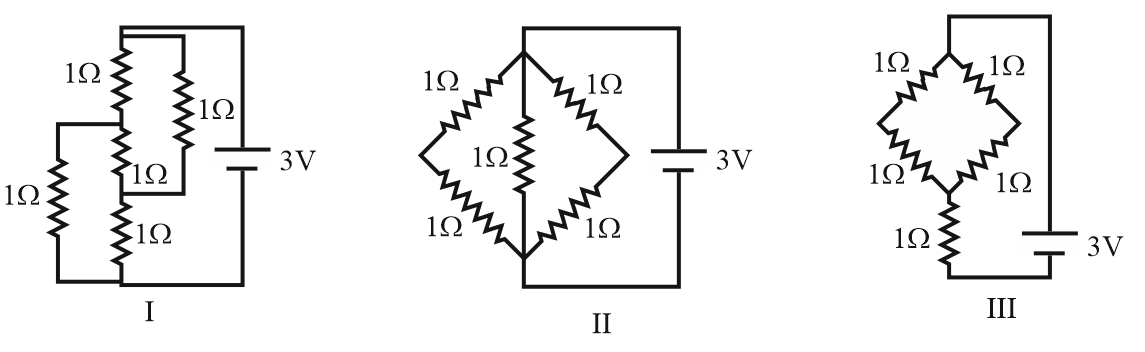
The figure shows three circuits I, II and III which are connected to a 3 V battery. If the powers dissipated by the configurations I, II and III are $$P_1$$, $$P_2$$ and $$P_3$$ respectively, then -

Question 205 JEE Mains

When a current of 5 mA is passed through a galvanometer having a coil of resistance 15 Ω, it shows full-scale deflection. The value of the resistance to be put in series with the galvanometer to convert it into a voltmeter of range 0 - 10 V is:

Question 206 JEE Mains

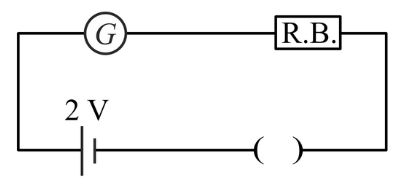
A galvanometer has a 50 division scale. Battery has no internal resistance. It is found that there is deflection of 40 divisions when R.B. = 2400 $$\Omega$$. Deflection becomes 20 divisions when resistance taken from resistance box is 4900 $$\Omega$$. Then we can conclude:

image


Note: This question is awarded as the bonus. Now the question is corrected.

Question 207 JEE Mains

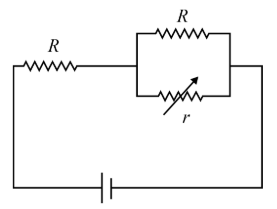
In the circuit shown, the resistance r is a variable resistance. If for $$r = fR$$, the heat generation in r is maximum then the value of f is

image
Question 208 JEE Mains

The resistance of an electrical toaster has a temperature dependence given by $$R(T) = R_0[1 + \alpha(T - T_0)]$$ in its range of operation. At $$T_0 = 300$$ K, $$R = 100$$ $$\Omega$$ and at $$T = 500$$ K, $$R = 120$$ $$\Omega$$. The toaster is connected to a voltage source at 200 V and its temperature is raised at a constant rate from 300 to 500 K in 30 s. The total work done in raising the temperature is:
Note: This question was awarded as the bonus since all options were incorrect in the exam.

Question 209 JEE Mains

To know the resistance $$G$$ of a galvanometer by half deflection method, a battery of emf $$V_E$$ and resistance $$R$$ is used to deflect the galvanometer by angle $$\theta$$. If a shunt of resistance $$S$$ is needed to get half deflection the $$G$$, $$R$$ and $$S$$ are related by the equation:

Question 210 JEE Mains

A 50 $$\Omega$$ resistance is connected to a battery of 5 V. A galvanometer of resistance 100 $$\Omega$$ is to be used as an ammeter to measure current through the resistance, for this a resistance $$r_S$$ is connected to the galvanometer. Which of the following connections should be employed if the measured current is with in 1% of the current without the ammeter in the circuit?

Question 211 JEE Mains

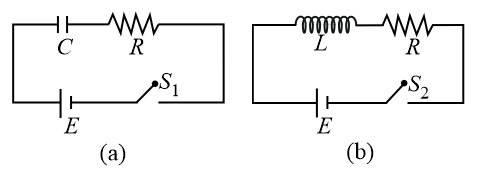
In the given circuits (a) and (b), switches $$S_1$$ and $$S_2$$ are closed at $$t = 0$$ and kept close for a long time. The variation of currents in the two circuits for $$t \geq 0$$ are shown in the options. (Figures are schematic and not drawn to scale.)

Question 212 JEE Mains

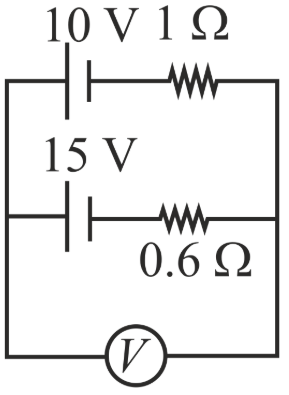
A 10 V battery with internal resistance 1 $$\Omega$$ and a 15 V battery with internal resistance 0.6 $$\Omega$$ are connected in parallel to a voltmeter (see figure). The reading in the voltmeter will be close to:

image
Question 213 JEE Mains

In the circuit shown, the current in the 1 $$\Omega$$ resistor is:

Question 214 JEE Mains

In the electric network shown, when no current flows through the 4 $$\Omega$$ resistor in the arm EB, the potential difference between the points A and D will be:

image
Question 215 JEE Mains

Suppose the drift velocity $$v_d$$ in a material varied with the applied electric field E as $$v_d \propto \sqrt{E}$$. Then V - I graph for a wire made of such a material is best given by:

Question 216 JEE Mains

When 5 V potential difference is applied across a wire of length 0.1 m, the drift speed of electrons is $$2.5 \times 10^{-4}$$ m s$$^{-1}$$. If the electron density in the wire is $$8 \times 10^{28}$$ m$$^{-3}$$, the resistivity of the material is close to:

Question 217 JEE Mains

A d.c. main supply of e.m.f. 220 V is connected across a storage battery of e.m.f. 200 V through a resistance of 1 $$\Omega$$. The battery terminals are connected to external resistance $$R$$. The minimum value of $$R$$, so that a current passes through the battery to charge it is:

Question 218 JEE Mains

Four bulbs B$$_1$$, B$$_2$$, B$$_3$$ and B$$_4$$ of 100 W each are connected to 220 V main as shown in the figure. The reading in the ideal ammeter will be:

Question 219 JEE Mains

In a large building, there are 15 bulbs of 40 W, 5 bulbs of 100 W, 5 fans of 80 W and 1 heater of 1 kW. The voltage of the electric mains is 220 V. The minimum capacity of the main fuse of the building will be:

Question 220 JEE Mains

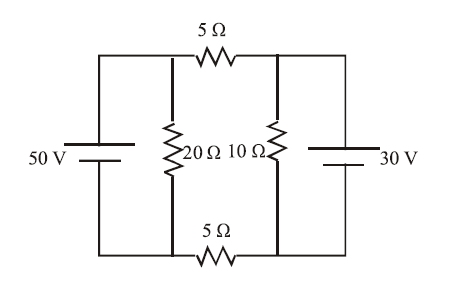
In the circuit shown, current (in A) through 50 V and 30 V batteries are, respectively:

Question 221 JEE Mains

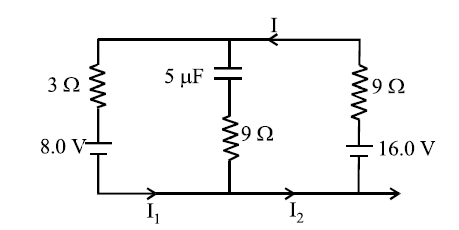
The circuit shown here has two batteries of 8.0 V and 16.0 V and three resistors 3$$\Omega$$, 9$$\Omega$$ and 9$$\Omega$$ and a capacitor of 5.0 $$\mu$$F. How much is the current I in the circuit in steady state?

Question 222 JEE Mains

In the circuit diagrams (A, B, C and D) shown below, R is a high resistance and S is a resistance of the order of galvanometer resistance G. The correct circuit, corresponding to the half deflection method for finding the resistance and figure of merit of the galvanometer, is the circuit labelled as:

(a)

(b)

(c)

(d)

Question 223 JEE Mains

In a metre bridge experiment null point is obtained at 40 cm from one end of the wire when resistance X is balanced against another resistance Y. If X < Y, then the new position of the null point from the same end, if one decides to balance a resistance of 3X against Y, will be close to :

Question 224 JEE Mains

Six equal resistances are connected between points P, Q and R as shown in the figure. Then net resistance will be maximum between :

Question 225 JEE Mains

The supply voltage to a room is 120 V. The resistance of the lead wires is 6 $$\Omega$$. A 60 W bulb is already switched on. What is the decrease of voltage across the bulb, when a 240 W heater is switched on in parallel to the bulb?

Question 226 JEE Mains

A dc source of emf $$E_1 = 100$$ V and internal resistance $$r = 0.5\Omega$$, a storage battery of emf $$E_2 = 90$$ V and an external resistance R are connected as shown in figure. For what value of R no current will pass through the battery?

image
Question 227 JEE Mains

A letter 'A' is constructed of a uniform wire with resistance 1.0$$\Omega$$ per cm. The sides of the letter are 20 cm and the cross piece in the middle is 10 cm long. The apex angle is 60°. The resistance between the ends of the legs is close to:

Question 228 JEE Mains

This question has Statement I and Statement II. Of the four choices given after the Statements, choose the one that best describes the two Statements.
Statement - I : Higher the range, greater is the resistance of ammeter.
Statement - II : To increase the range of ammeter, additional shunt needs to be used across it.

Question 229 JEE Mains

A shunt of resistance 1 $$\Omega$$ is connected across a galvanometer of 120 $$\Omega$$ resistance. A current of 5.5 ampere gives full scale deflection in the galvanometer. The current that will give full scale deflection in the absence of the shunt is nearly :

Question 230 JEE Mains

To find the resistance of a galvanometer by the half deflection method, the following circuit is used with resistances $$R_1 = 9970$$ $$\Omega$$, $$R_2 = 30$$ $$\Omega$$ and $$R_3 = 0$$. The deflection in the galvanometer is d. With $$R_3 = 107$$ $$\Omega$$, the deflection changed to $$\frac{d}{2}$$. The galvanometer resistance is approximately:

Question 231 JEE Mains

Which of the four resistances P, Q, R and S generate the greatest amount of heat when a current flows from A to B?

Question 232 JEE Mains

Correct set up to verify Ohm's law is :

Question 233 JEE Mains

Three resistors of $$4\Omega, 6\Omega$$ and $$12\Omega$$ are connected in parallel and the combination is connected in series with a $$1.5$$ V battery of $$1\Omega$$ internal resistance. The rate of Joule heating in the $$4\Omega$$ resistor is

Question 234 JEE Mains

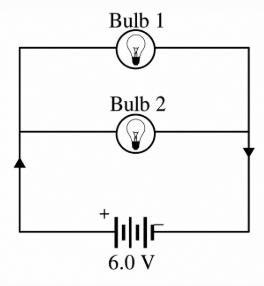
A $$6.0$$ volt battery is connected to two light bulbs as shown in figure. Light bulb 1 has resistance $$3$$ ohm while light bulb 2 has resistance $$6$$ ohm. Battery has negligible internal resistance. Which bulb will glow brighter?

image
Question 235 JEE Mains

It is preferable to measure the e.m.f. of a cell by potentiometer than by a voltmeter because of the following possible reasons. (i) In case of potentiometer, no current flows through the cell. (ii) The length of the potentiometer allows greater precision. (iii) Measurement by the potentiometer is quicker. (iv) The sensitivity of the galvanometer, when using a potentiometer is not relevant. Which of these reasons are correct?

Question 236 JEE Mains

Two electric bulbs marked $$25\ W - 220\ V$$ and $$100\ W - 220\ V$$ are connected in series to a $$440\ V$$ supply. Which of the bulbs will fuse?

Question 237 JEE Mains

In a sensitive meter bridge apparatus the bridge wire should possess

Question 238 JEE Mains

The resistance of a wire is $$R$$. It is bent at the middle by $$180°$$ and both the ends are twisted together to make a shorter wire. The resistance of the new wire is

Question 239 JEE Mains

In an experiment of potentiometer for measuring the internal resistance of primary cell a balancing length $$\ell$$ is obtained on the potentiometer wire when the cell is open circuit. Now the cell is short circuited by a resistance $$R$$. If $$R$$ is to be equal to the internal resistance of the cell the balancing length on the potentiometer wire will be

Question 240 JEE Mains

This question has Statement 1 and Statement 2. Of the four choices given after the Statements, choose the one that best describes the two Statements. Statement 1: The possibility of an electric bulb fusing is higher at the time of switching ON. Statement 2: Resistance of an electric bulb when it is not lit up is much smaller than when it is lit up.

Question 241 JEE Mains

If a wire is stretched to make it $$0.1\%$$ longer, its resistance will:

Question 242 JEE Mains

Two conductors have the same resistance at $$0^\circ$$C but their temperature coefficients of resistance are $$\alpha_1$$ and $$\alpha_2$$. The respective temperature coefficients of their series and parallel combinations are nearly

Question 243 JEE Mains

This question contains Statement-1 and Statement-2. Of the four choices given after the statements, choose the one that best describes the two statements. 

Statement-1: The temperature dependence of resistance is usually given as $$R = R_0(1 + \alpha\Delta t)$$. The resistance of a wire changes from $$100\Omega$$ to $$150\Omega$$ when its temperature is increased from $$27°C$$ to $$227°C$$. This implies that $$\alpha = 2.5 \times 10^{-3}/°C$$. 

Statement 2: $$R = R_t(1 + \alpha\Delta T)$$ is valid only when the change in the temperature $$\Delta T$$ is small and $$\Delta R = (R - R_0) \ll R_0$$.

Question 244 JEE Mains

Paragraph: Consider a block of conducting material of resistivity '$$\rho$$' shown in the figure. Current '$$I$$' enters at '$$A$$' and leaves from '$$D$$'. We apply superposition principle to find voltage '$$\Delta V$$' developed between '$$B$$' and '$$C$$'. The calculation is done in the following steps: (i) Take current '$$I$$' entering from '$$A$$' and assume it to spread over a hemispherical surface in the block. (ii) Calculate field $$E(r)$$ at distance '$$r$$' from $$A$$ by using Ohm's law $$E = \rho j$$, where $$j$$ is the current per unit area at '$$r$$'. (iii) From the '$$r$$' dependence of $$E(r)$$, obtain the potential $$V(r)$$ at $$r$$. (iv) Repeat (i), (ii) and (iii) for current '$$I$$' leaving '$$D$$' and superpose results for '$$A$$' and '$$D$$'.
Question: $$\Delta V$$ measured between $$B$$ and $$C$$ is

Question 245 JEE Mains

Paragraph: Consider a block of conducting material of resistivity '$$\rho$$' shown in the figure. Current '$$I$$' enters at '$$A$$' and leaves from '$$D$$'. We apply superposition principle to find voltage '$$\Delta V$$' developed between '$$B$$' and '$$C$$'. The calculation is done in the following steps: (i) Take current '$$I$$' entering from '$$A$$' and assume it to spread over a hemispherical surface in the block. (ii) Calculate field $$E(r)$$ at distance '$$r$$' from $$A$$ by using Ohm's law $$E = \rho j$$, where $$j$$ is the current per unit area at '$$r$$'. (iii) From the '$$r$$' dependence of $$E(r)$$, obtain the potential $$V(r)$$ at $$r$$. (iv) Repeat (i), (ii) and (iii) for current '$$I$$' leaving '$$D$$' and superpose results for '$$A$$' and '$$D$$'.
Question: For current entering at $$A$$, the electric field at a distance '$$r$$' from $$A$$ is

Question 246 JEE Mains

A 5 V battery with internal resistance $$2\Omega$$ and a 2 V battery with internal resistance $$1\Omega$$ are connected to a $$10\Omega$$ resistor as shown in the figure. The current in the $$10\Omega$$ resistor is

Question 247 JEE Mains

Shown in the figure below is a meter-bridge set up with null deflection in the galvanometer.
The value of the unknown resistor $$R$$ is

Question 248 JEE Mains

The resistance of a wire is 5 ohm at $$50^\circ C$$ and 6 ohm at $$100^\circ C$$. The resistance of the wire at $$0^\circ C$$ will be

Question 249 JEE Mains

Consider the circuit shown below. The current $$I$$ drawn from the 5 volt source will be

Question 250 JEE Mains

The resistance of a bulb filament is $$100\,\Omega$$ at a temperature of $$100^\circ C$$. If its temperature coefficient of resistance be $$0.005$$ per $$^\circ C$$, its resistance will become $$200\,\Omega$$ at a temperature of

Question 251 JEE Mains

An electric bulb is rated $$220$$ volt $$- 100$$ watt. The power consumed by it when operated on $$110$$ volt will be

Question 252 JEE Mains

A moving coil galvanometer has $$150$$ equal divisions. Its current sensitivity is $$10$$ divisions per milliampere and voltage sensitivity is $$2$$ divisions per millivolt. In order that each division reads $$1$$ volt, the resistance in ohms needed to be connected in series with the coil will be

Question 253 JEE Mains

Two voltameters one of copper and another of silver, are joined in parallel. When a total charge $$q$$ flows through the voltameters, equal amount of metals are deposited. If the electrochemical equivalents of copper and silver are $$z_1$$ and $$z_2$$ respectively the charge which flows through the silver voltameter is

Question 254 JEE Mains

In the circuit, the galvanometer $$G$$ shows zero deflection. If the batteries $$A$$ and $$B$$ have negligible resistance, the value of the resistor $$R$$ will be

Question 255 JEE Mains

Two sources of equal emf are connected to an external resistance $$R$$. The internal resistance of the two sources are $$R_1$$ and $$R_2$$ ($$R_2 > R_1$$). If the potential difference across the source having internal resistance $$R_2$$ is zero, then

Question 256 JEE Mains

A heater coil is cut into two equal parts and only one part is now used in the heater. The heat generated will now be

Question 257 JEE Mains

An energy source will supply a constant current into the load if its internal resistance is

Question 258 JEE Mains

In a potentiometer experiment the balancing with a cell is at length $$240$$ cm. On shunting the cell with a resistance of $$2 \Omega$$ the balancing length becomes $$120$$ cm. The internal resistance of the cell is

Question 259 JEE Mains

The resistance of hot tungsten filament is about $$10$$ times the cold resistance. What will be the resistance of $$100$$ W and $$200$$ V lamp when not in use?

Question 260 JEE Mains

The resistance of the series combination of two resistances is $$S$$. When they are joined in parallel through total resistance is $$P$$. If $$S = nP$$, then the minimum possible value of $$n$$ is

Question 261 JEE Mains

In a metre bridge experiment null point is obtained at $$20$$ cm from one end of the wire when resistance $$X$$ is balanced against another resistance $$Y$$. If $$X < Y$$, then where will be the new position of the null point from the same end, if one decides to balance a resistance of $$4X$$ against $$Y$$?

Question 262 JEE Mains

The electrochemical equivalent of a metal is $$3.3 \times 10^{-7}$$ kg per coulomb. The mass of the metal liberated at the cathode when a $$3$$ A current is passed for $$2$$ seconds will be

Question 263 JEE Mains

The net current flowing in the given circuit is_______ A.
image

Question 264 JEE Mains

Two cells of emf 1V and 2V and internal resistance 2 $$\Omega$$ and 1 $$\Omega$$, respectively, are connected in series with an external resistance of 6 $$\Omega$$. The total current in the circuit is $$I_1$$. Now the same two cells in parallel configuration are connected to same external resistance. In this case, the total current drawn is $$I_2$$. The value of $$\left(\dfrac{I_1}{I_2}\right)$$ is $$\dfrac{x}{3}$$. The value of x is ________.

Question 265 JEE Mains

A wire of resistance $$9\,\Omega$$ is bent to form an equilateral triangle. Then the equivalent resistance across any two vertices will be  $$\underline{\hspace{2cm}}\,\Omega.$$

Question 266 JEE Mains

A potential divider circuit is shown in the figure below. The output voltage $$V_0$$ is

image
Question 267 JEE Mains

A galvanometer has a coil of resistance $$200\Omega$$ with a full scale deflection at $$20\mu A$$. The value of resistance to be added to use it as an ammeter of range $$(0 - 20)$$ mA is :

Question 268 JEE Mains

An electric bulb rated $$50$$ W $$- 200$$ V is connected across a $$100$$ V supply. The power dissipation of the bulb is:

Question 269 JEE Mains

In a metre-bridge when a resistance in the left gap is $$2 \Omega$$ and unknown resistance in the right gap, the balance length is found to be 40 cm. On shunting the unknown resistance with $$2 \Omega$$, the balance length changes by:

Question 270 JEE Mains

In the given circuit, the current in resistance $$R_3$$ is:

image
Question 271 JEE Mains

In the given circuit, the terminal potential difference of the cell is :

image
Question 272 JEE Mains


The reading in the ideal voltmeter $$V$$ shown in the given circuit diagram is: 

image
Question 273 JEE Mains

The resistance per centimeter of a meter bridge wire is $$r$$, with $$X$$ $$\Omega$$ resistance in left gap. Balancing length from left end is at 40 cm with 25 $$\Omega$$ resistance in right gap. Now the wire is replaced by another wire of $$2r$$ resistance per centimeter. The new balancing length for same settings will be at

Question 274 JEE Mains

The value of unknown resistance $$(x)$$ for which the potential difference between $$B$$ and $$D$$ will be zero in the arrangement shown, is :

image
Question 275 JEE Mains

Water boils in an electric kettle in 20 minutes after being switched on. Using the same main supply, the length of the heating element should be _____ to _____ times of its initial length if the water is to be boiled in 15 minutes.

Question 276 JEE Mains

A galvanometer has a resistance of $$50\ \Omega$$ and it allows maximum current of $$5$$ mA. It can be converted into voltmeter to measure upto $$100$$ V by connecting in series a resistor of resistance.

Question 277 JEE Mains

In the given figure $$R_1 = 10\Omega, R_2 = 8\Omega, R_3 = 4\Omega$$ and $$R_4 = 8\Omega$$. Battery is ideal with emf $$12 \text{ V}$$. Equivalent resistance of the circuit and current supplied by battery are respectively :

image
Question 278 JEE Mains

The electric current through a wire varies with time as $$I = I_0 + \beta t$$, where $$I_0 = 20$$ A and $$\beta = 3$$ A s$$^{-1}$$. The amount of electric charge crossed through a section of the wire in $$20$$ s is:

Question 279 JEE Mains
page2_img2


The equivalent resistance between A and B is :

Question 280 JEE Mains

To measure the internal resistance of a battery, potentiometer is used. For R = 10Ω, the balance point is observed at l = 500 cm and for R = 1Ω the balance point is observed at l = 400 cm. The internal resistance of the battery is approximately:

Question 281 JEE Mains

A galvanometer having coil resistance $$10 \Omega$$ shows a full scale deflection for a current of $$3$$ mA. For it to measure a current of $$8$$ A, the value of the shunt should be:

Question 282 JEE Mains

The deflection in moving coil galvanometer falls from $$25$$ divisions to $$5$$ division when a shunt of $$24 \Omega$$ is applied. The resistance of galvanometer coil will be:

Question 283 JEE Mains

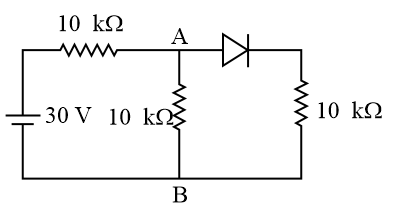
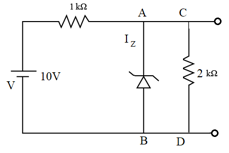
In the given circuit, the breakdown voltage of the Zener diode is $$3.0$$ V. What is the value of $$I_z$$?

image
Question 284 JEE Mains

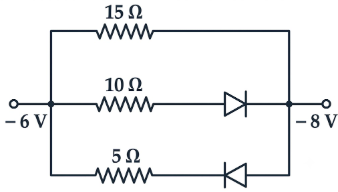
The value of net resistance of the network as shown in the given figure  is:

image
Question 285 JEE Mains

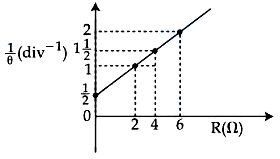
In the experiment to determine the galvanometer resistance by half-deflection method, the plot of $$1/\theta$$ vs the resistance $$(R)$$ of the resistance box is shown in the figure. The figure of merit of the galvanometer is ______ $$\times 10^{-1} \text{ A/division}$$. [The source has emf 2V]

image
Question 286 JEE Mains

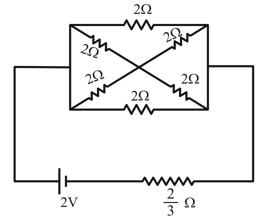
In the following circuit, the battery has an emf of 2 V and an internal resistance of $$\frac{2}{3}$$ $$\Omega$$. The power consumption in the entire circuit is ______ W.

image
Question 287 JEE Mains

The current in a conductor is expressed as $$I = 3t^2 + 4t^3$$, where $$I$$ is in Ampere and $$t$$ is in second. The amount of electric charge that flows through a section of the conductor during $$t = 1$$ s to $$t = 2$$ s is ____________ C.

Question 288 JEE Mains

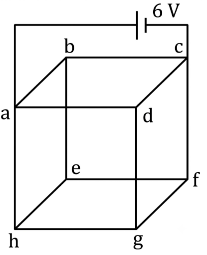
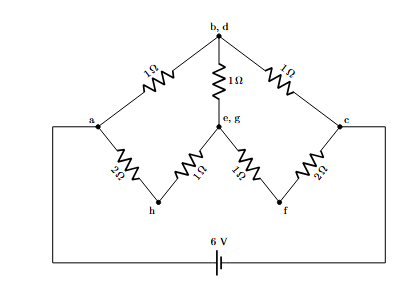
Twelve wires each having resistance 2Ω are joined to form a cube. A battery of emf 6 V is joined across point a and c. The voltage difference between e and f is ______ V.

image
Question 289 JEE Mains

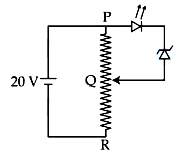
A potential divider circuit is connected with a dc source of 20 V, a light emitting diode of glow in voltage 1.8 V and a zener diode of breakdown voltage of 3.2 V. The length (PR) of the resistive wire is 20 cm. The minimum length of PQ to just glow the LED is _____ cm

page5_img1
Question 290 JEE Mains

The resistances of the platinum wire of a platinum resistance thermometer at the ice point and steam point are 8Ω and 10Ω respectively. After inserting in a hot bath of temperature 400°C, the resistance of platinum wire is:

Question 291 JEE Mains

Two conductors have the same resistances at $$0°C$$ but their temperature coefficients of resistance are $$\alpha_1$$ and $$\alpha_2$$. The respective temperature coefficients for their series and parallel combinations are :

Question 292 JEE Mains

With the help of potentiometer, we can determine the value of emf of a given cell. The sensitivity of the potentiometer is
(A) directly proportional to the length of the potentiometer wire
(B) directly proportional to the potential gradient of the wire
(C) inversely proportional to the potential gradient of the wire
(D) inversely proportional to the length of the potentiometer wire
Choose the correct option for the above statements:

Question 293 JEE Mains

A cell of emf 90 V is connected across series combination of two resistors each of 100 $$\Omega$$ resistance. A voltmeter of resistance 400 $$\Omega$$ is used to measure the potential difference across each resistor. The reading of the voltmeter will be:

Question 294 JEE Mains

Equivalent resistance between the adjacent corners of a regular $$n$$-sided polygon of uniform wire of resistance $$R$$ would be:

Question 295 JEE Mains

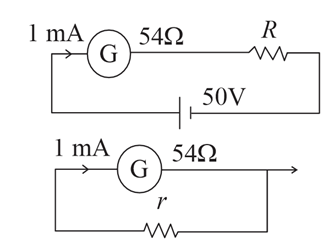
For designing a voltmeter of range 50 V and an ammeter of range 10 mA using a galvanometer which has a coil of resistance 54 $$\Omega$$ showing a full scale deflection for 1 mA as in figure.

(A) for voltmeter $$R \approx 50$$ k$$\Omega$$
(B) for ammeter $$r \approx 0.2 \ \Omega$$
(C) for ammeter $$r \approx 6 \ \Omega$$
(D) for voltmeter $$R \approx 5$$ k$$\Omega$$
(E) for voltmeter $$R \approx 500 \ \Omega$$
Choose the correct answer from the options given below:

Question 296 JEE Mains

The equivalent resistance of the circuit shown below between points a and b is:

image
Question 297 JEE Mains

The $$H$$ amount of thermal energy is developed by a resistor in 10 s when a current of 4 A is passed through it. If the current is increased to 16 A, the thermal energy developed by the resistor in 10 s will be

Question 298 JEE Mains

Different combination of 3 resistors of equal resistance $$R$$ are shown in the figures. The increasing order for power dissipation is:
(A)

image

(B)

image

(C)

image

(D)

image
Question 299 JEE Mains

A. The drift velocity of electrons decreases with the increase in the temperature of conductor.
B. The drift velocity is inversely proportional to the area of cross-section of given conductor.
C. The drift velocity does not depend on the applied potential difference to the conductor.
D. The drift velocity of electron is inversely proportional to the length of the conductor.
E. The drift velocity increases with the increase in the temperature of conductor.
Choose the correct answer from the options given below:

Question 300 JEE Mains

Given below are two statements:
Statement I: A uniform wire of resistance 80 $$\Omega$$ is cut into four equal parts. These parts are now connected in parallel. The equivalent resistance of the combination will be 5 $$\Omega$$.
Statement II: Two resistances 2R and 3R are connected in parallel in an electric circuit. The value of thermal energy developed in 3R and 2R will be in the ratio 3:2.
In the light of the above statements, choose the most appropriate answer from the options given below

Question 301 JEE Mains

The current $$I$$ in the given circuit will be

image
Question 302 JEE Mains

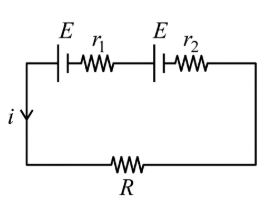
Two sources of equal emfs are connected in series. This combination is connected to an external resistance $$R$$. The internal resistances of the two sources are $$r_1$$ and $$r_2$$ ($$r_1 > r_2$$). If the potential difference across the source of internal resistance $$r_1$$ is zero then the value of $$R$$ will be

Question 303 JEE Mains

A current of $$15 \text{ mA}$$ flows in the circuit as shown in figure. The value of potential difference between the points $$A$$ and $$B$$ will be

Question 304 JEE Mains

A 1 m long wire is broken into two unequal parts X and Y. The X part of the wire is stretched into another wire W. Length of W is twice the length of X and the resistance of W is twice that of Y. Find the ratio of length of X and Y.

Question 305 JEE Mains

Two identical cells each of emf $$1.5$$ V are connected in parallel across a parallel combination of two resistors each of resistance $$20$$ $$\Omega$$. A voltmeter connected in the circuit measures $$1.2$$ V. The internal resistance of each cell is :

Question 306 JEE Mains

What will be the most suitable combination of three resistors $$A = 2$$ $$\Omega$$, $$B = 4$$ $$\Omega$$, $$C = 6$$ $$\Omega$$ so that $$\left(\frac{22}{3}\right)\Omega$$ is equivalent resistance of combination?

Question 307 JEE Advanced

Two resistances $$R_1 = X$$ $$\Omega$$ and $$R_2 = 1$$ $$\Omega$$ are connected to a wire AB of uniform resistivity, as shown in the figure. The radius of the wire varies linearly along its axis from 0.2 mm at A to 1 mm at B. A galvanometer (G) connected to the center of the wire, 50 cm from each end along its axis, shows zero deflection when A and B are connected to a battery. The value of X is _______.

image
Question 308 JEE Mains

A $$1 \text{ m}$$ long copper wire carries a current of $$1 \text{ A}$$. If the cross section of the wire is $$2.0 \text{ mm}^2$$ and the resistivity of copper is $$1.7 \times 10^{-8} \Omega \text{ m}$$. The force experienced by moving electron in the wire is ______ $$\times 10^{-23} \text{ N}$$. (Charge of electron $$= 1.6 \times 10^{-19} \text{ C}$$)

Question 309 JEE Mains

A potentiometer wire of length $$10$$ m and resistance $$20$$ $$\Omega$$ is connected in series with a $$25$$ V battery and an external resistance $$30$$ $$\Omega$$. A cell of emf $$E$$ in secondary circuit is balanced by $$250$$ cm long potentiometer wire. The value of $$E$$ (in volt) is $$\frac{x}{10}$$. The value of $$x$$ is ______.

Question 310 JEE Mains

The variation of applied potential and current flowing through a given wire is shown in figure. The length of wire is 31.4 cm. The diameter of wire is measured as 2.4 cm. The resistivity of the given wire is measured as $$x \times 10^{-3}$$ $$\Omega$$ cm. The value of $$x$$ is ______. [Take $$\pi = 3.14$$]

Question 311 JEE Mains

All resistances in figure are 1 $$\Omega$$ each. The value of current '$$I$$' is $$\frac{a}{5}$$ A. The value of $$a$$ is ______.

image
Question 312 JEE Mains

For the network shown below, the value of $$V_B - V_A$$ is ______ V.

Question 313 JEE Mains

As shown in the figure, a potentiometer wire of resistance 20 $$\Omega$$ and length 300 cm is connected with resistance box (R.B.) and a standard cell of emf 4 V. For a resistance 'R' of resistance box introduced into the circuit, the null point for a cell of 20 mV is found to be 60 cm. The value of 'R' is _____ $$\Omega$$.

Question 314 JEE Mains

In meter bridge experiment for measuring unknown resistance '$$S$$', the null point is obtained at a distance $$30 \text{ cm}$$ from the left side as shown at point $$D$$. If $$R$$ is $$5.6 \text{ k}\Omega$$, then the value of unknown resistance '$$S$$' will be ______ $$\Omega$$.

image
Question 315 JEE Mains

In the given circuit 'a' is an arbitrary constant. The value of $$m$$ for which the equivalent circuit resistance is minimum, will be $$\sqrt{\frac{x}{2}}$$. The value of $$x$$ is ______.

Question 316 JEE Mains

A resistor develops $$300$$ J of thermal energy in $$15$$ s, when a current of $$2$$ A is passed through it. If the current increases to $$3$$ A, the energy developed in $$10$$ s is ______ J.

Question 317 JEE Mains

In the given figure of meter bridge experiment, the balancing length AC corresponding to null deflection of the galvanometer is 40 cm. The balancing length, if the radius of the wire AB is doubled, will be _____ cm.

Question 318 JEE Mains

The length of a given cylindrical wire is increased to double of its original length. The percentage increase in the resistance of the wire will be ______ %.

Question 319 JEE Mains

The total current supplied to the circuit as shown in the figure by the $$5$$ V battery is ______ A.

image
Question 320 JEE Mains

Resistance of the wire is measured as $$2 \Omega$$ and $$3 \Omega$$ at $$10°$$C and $$30°$$C respectively. Temperature coefficient of resistance of the material of the wire is

Question 321 JEE Mains

Two cells of the same EMF $$E$$ but different internal resistances, $$r_1$$ and $$r_2$$ are connected in series with an external resistance $$R$$ as shown in the figure. The terminal potential difference across the second cell is found to be zero. The external resistance $$R$$ must then be:

image
Question 322 JEE Mains

Two metallic wires of identical dimensions are connected in series. If $$\sigma_1$$ and $$\sigma_2$$ are the conductivities of these wires respectively, the effective conductivity of the combination is:

Question 323 JEE Mains

In the given potentiometer circuit arrangement, the balancing length AC is measured to be 250 cm. When the galvanometer connection is shifted from point (1) to point (2) in the given diagram, the balancing length becomes 400 cm. The ratio of the emf of two cells $$\frac{\varepsilon_1}{\varepsilon_2}$$ is:

Question 324 JEE Mains

In the given circuit diagram, the currents, $$I_1 = -0.3$$ A, $$I_4 = 0.8$$ A and $$I_5 = 0.4$$ A, are flowing as shown. The currents $$I_2$$, $$I_3$$ and $$I_6$$, respectively, are:

image
Question 325 JEE Mains

In the experimental set up of metre bridge shown in the figure, the null point is obtained at a distance of 40 cm from A. If a $$10\Omega$$ resistor is connected in series with $$R_1$$, the null point shifts by 10 cm. The resistance that should be connected in parallel with $$(R_1 + 10)\Omega$$ such that the null point shifts back to its initial position is

Question 326 JEE Mains


A 9 V battery with an internal resistance of 0.5 $$\Omega$$ is connected across an infinite network, as shown in the figure. All ammeters $$A_1$$, $$A_2$$, $$A_3$$ and voltmeter $$V$$ are ideal. Choose the correct statement.

Question 327 JEE Mains


In the above circuit the current in each resistance is:

Question 328 JEE Mains

A galvanometer having a coil resistance of 100 $$\Omega$$ gives a full scale deflection, when a current of 1 mA is passed through it. The value of the resistance, which can convert this galvanometer into ammeter giving a full scale deflection for a current of 10 A, is:

Question 329 JEE Mains

A material '$$B$$' has twice the specific resistance of '$$A$$'. A circular wire made of '$$B$$' has twice the diameter of a wire made of '$$A$$'. Then for the two wires to have the same resistance, the ratio $$\ell_A/\ell_B$$ of their respective lengths must be

Question 330 JEE Mains

The Kirchhoff's first law $$\left(\sum i = 0\right)$$ and second law $$\left(\sum iR = \sum E\right)$$, where the symbols have their usual meanings, are respectively based on

Question 331 JEE Mains

In a Wheatstone's bridge, there resistances $$P, Q$$ and $$R$$ connected in the three arms and the fourth arm is formed by two resistances $$S_1$$ and $$S_2$$ connected in parallel. The condition for bridge to be balanced will be

Question 332 JEE Mains

An electric current is passed through a circuit containing two wires of the same material, connected in parallel. If the length and radii of the wires are in the ratio of $$4/3$$ and $$2/3$$, then the ratio of the currents passing through the wire will be

Question 333 JEE Mains

The battery of a mobile phone is rated as 4.2 V, 5800 mAh. How much energy is stored in it when fully charged?

Question 334 JEE Mains

The value of current I in the electrical circuit as given below, when potential at A is equal to the potential at B, will be ____ A.

page7_img1
Question 335 JEE Mains

In the figure shown below, a resistance of 150.4 $$\Omega$$ is connected in series to an ammeter A of resistance 240 $$\Omega$$. A shunt resistance of 10 $$\Omega$$ is connected in parallel with the ammeter. The reading of the ammeter is _________ mA.

image
Question 336 JEE Mains

A wire of resistance $$R$$ and length $$L$$ is cut into $$5$$ equal parts. If these parts are joined parallely, then resultant resistance will be :

Question 337 JEE Mains

The ratio of heat dissipated per second through the resistors $$5\Omega$$ and $$10\Omega$$ in the circuit given below is 

page2_img1
Question 338 JEE Mains

In an ammeter, 5% of the main current passes through the galvanometer. If resistance of the galvanometer is G, the resistance of ammeter will be:

Question 339 JEE Mains

A uniform metallic wire carries a current 2 A, when 3.4 V battery is connected across it. The mass of uniform metallic wire is $$8.92 \times 10^{-3}$$ kg, density is $$8.92 \times 10^3$$ kg m$$^{-3}$$ and resistivity is $$1.7 \times 10^{-8}$$ $$\Omega$$ - m. The length of wire is:

Question 340 JEE Mains

As shown in the figure, a network of resistors is connected to a battery of 24 V with an internal resistance of 3 $$\Omega$$. The currents through the resistors $$R_4$$ and $$R_5$$ are $$I_4$$ and $$I_5$$ respectively. The values of $$I_4$$ and $$I_5$$ are:

Question 341 JEE Mains

As shown in the figure, a network of resistors is connected to a battery of 24 V with an internal resistance of 3 $$\Omega$$. The currents through the resistors $$R_4$$ and $$R_5$$ are $$I_4$$ and $$I_5$$ respectively. The values of $$I_4$$ and $$I_5$$ are:

image
Question 342 JEE Mains

Given below are two statements: One is labelled as Assertion A and the other is labelled as Reason R.
Assertion A: For measuring the potential difference across a resistance of $$600$$ $$\Omega$$, the voltmeter with resistance $$1000$$ $$\Omega$$ will be preferred over voltmeter with resistance $$4000$$ $$\Omega$$.
Reason R: Voltmeter with higher resistance will draw smaller current than voltmeter with lower resistance.
In the light of the above statements, choose the most appropriate answer from the options given below

Question 343 JEE Mains

A student is provided with a variable voltage source $$V$$, a test resistor $$R_T = 10\Omega$$, two identical galvanometers $$G_1$$ and $$G_2$$ and two additional resistors, $$R_1 = 10M\Omega$$ and $$R_2 = 0.001\Omega$$. For conducting an experiment to verify ohm's law, the most suitable circuit is:

Question 344 JEE Mains

A wire of resistance $$160 \ \Omega$$ is melted and drawn in a wire of one-fourth of its length. The new resistance of the wire will be

Question 345 JEE Mains

The equivalent resistance between A and B as shown in figure is:

Question 346 JEE Mains

Two resistors are connected in series across a battery as shown in figure. If a voltmeter of resistance 2000 $$\Omega$$ is used to measure the potential difference across 500 $$\Omega$$ resister, the reading of the voltmeter will be ______ V.

Question 347 JEE Mains

The current I flowing through the given circuit will be _____ A.

Question 348 JEE Mains

Current measured by the ammeter $$(A)$$ in the reported circuit when no current flows through $$10\Omega$$ resistance, will be ______ A.

image
Question 349 JEE Mains

To compare EMF of two cells using potentiometer the balancing lengths obtained are 200 cm and 150 cm. The least count of scale is 1 cm. The percentage error in the ratio of EMFs is______

Question 350 JEE Mains

Two resistors of 200 $$\Omega$$ and 400 $$\Omega$$ are connected in series with a battery of 100 V. A bulb rated at 200 V, 100 W is connected across the 400 $$\Omega$$ resistance. The potential drop across the bulb is :

Question 351 JEE Mains
image

Sliding contact of a potentiometer is in the middle of the potentiometer wire having resistance $$R_p = 1 \Omega$$ as shown in the figure. An external resistance of $$R_e = 2 \Omega$$ is connected via the sliding contact. The electric current in the circuit is :

Question 352 JEE Mains

What is the current through the battery in the circuit shown below

image
Question 353 JEE Mains
page6_img1


N equally spaced charges each of value q , are placed on a circle of radius R . The circle rotates about its axis with an angular velocity $$\omega$$ as shown in the figure. A bigger Amperian loop B encloses the whole circle where as a smaller Amperian loop A encloses a small segment. The difference between enclosed currents, $$I_A - I_B$$, for the given Amperian loops is

Question 354 JEE Mains

A wire of resistance R is bent into an equilateral triangle and an identical wire is bent into a square. The ratio of resistance between the two end points of an edge of the triangle to that of the square is Options.

Question 355 JEE Mains

A motor operating on 100 V draws a current of 1 A. If the efficiency of the motor is 91.6%, then the loss of power in units of cal/s is

Question 356 JEE Mains


The effective resistance between $$A$$ and $$B$$, if resistance of each resistor is $$R$$, will be

image
Question 357 JEE Mains

In a metallic conductor, under the effect of applied electric field, the free electrons of the conductor

Question 358 JEE Mains

Ratio of thermal energy released in two resistor $$R$$ and $$3R$$ connected in parallel in an electric circuit is:

Question 359 JEE Mains

The total current supplied to the circuit by the battery is

Question 360 JEE Advanced

As shown in the figure, the resistance of a galvanometer $$G$$ can be found by the half-deflection method. Here the resistance $$R_2$$ is adjusted such that when the key $$K$$ is closed the deflection in the galvanometer becomes half of the value as compared to when $$K$$ is open. Half-deflection is obtained at $$R_2=4\,\Omega$$ and thus the galvanometer resistance is found to be $$6\,\Omega$$. In this half-deflection condition the current (in mA) through the resistor $$R_1$$ is:

image
Question 361 JEE Mains

In the potentiometer, when the cell in the secondary circuit is shunted with 4Ω resistance, the balance is obtained at the length 120 cm of wire. Now when the same cell is shunted with 12Ω resistance, the balance is shifted to a length of 180 cm. The internal resistance of cell is_________Ω

Question 362 JEE Mains

For the two cells having same EMF E and internal resistance r, the current passing through the external resistor 6Ω is same when both the cells are connected either in parallel or in series. The value of internal resistance r is ____ Ω .

Question 363 JEE Mains

Rods $$x$$ and $$y$$ of equal dimensions but of different materials are joined as shown in figure. Temperatures of end points $$A$$ and $$F$$ are maintained at $$100 ^{o}C$$ and $$40 ^{o}C$$ respectively. Given the thermal conductivity of rod $$x$$ is three times of that of rod $$y$$, the temperature at junction points $$B$$ and $$E$$ are (close to):

Screenshot_41
Question 364 JEE Mains

A moving coil of galvanometer when shunted with 2 $$\Omega$$ resistance gives a full scale deflection for a current of 500 mA. When a resistance of 470 $$\Omega$$ is connected in series it gives a full scale deflection for 10 V potential applied on it. The value of resistance of galvanometer coil is __________ $$\Omega$$.

Question 365 JEE Mains

Current passing through a wire as function of time is given as $$I(t) = 0.02t + 0.01$$ A. The charge that will flow through the wire from $$t = 1$$ s to $$t = 2$$ s is:

Question 366 JEE Mains

Which of the following resistivity $$(\rho) v/s$$ temperature (T) curves is most suitable to be used in wire bound standard resistors?

Question 367 JEE Mains

A regular hexagon is fonned by six wires each of resistance $$r \Omega$$ and the corners are joined to the centre by wires of same resistance. If the current enters at one corner and and leaves at. the opposite corner,the equivalent. resistance of the hexagon between the two opposite corners will be

Question 368 JEE Mains

A voltmeter with internal resistance of $$x \; \Omega$$ can be used to measure upto 20 V. In order to increase its measuring range to 30 V, the required modification is :

Question 369 JEE Mains

An electric power line having total resistance of $$2\Omega$$, delivers 1 kW of power at 250 V. The percentage efficiency of transmission line is ____ .

Question 370 JEE Mains

A moving coil galvanometer of resistance $$100\Omega$$ shows a full scale deflection for a current of 1 mA. The value of resistance required to convert this galvanometer into an ammeter, showing full scale deflection for a current of 5 mA, is ____ $$\Omega$$

Question 371 JEE Mains

Refer to the circuit diagram given below. The heat generated across the 6 $$\Omega$$ resistance in 100 second is $$\frac{\alpha}{100}$$ J. The value of $$\alpha$$ is _______. (Nearest integer)

image
Question 372 JEE Mains

The heat generated in 1 minute between points A and B in the given circuit, when a battery of 9 V with internal resistance of 1Ω is connected across these points is ____ J

Screenshot_7
Question 373 JEE Mains

A cylindrical conductor of length 2 m and area of cross-section $$0.2mm^{2}$$ carries an electric current of 1.6 A when its ends are connected to a 2 V battery. Mobility of electrons in the conductor is $$\alpha \times 10^{-3}m^{2}/V.s.$$ The value of $$\alpha$$ is :
(electron concentration = $$5 \times 10^{28}/m^{3}$$ and electron charge = $$1.6 \times 10^{-19}C$$)

Question 374 JEE Mains

In a meter bridge experiment to determine the value of unknown resistance, first the resistances $$2\Omega$$ and $$3\Omega$$ are connected in the left and right gaps of the bridge and the null point is obtained at a distance l cm from the left. Now when an unknown resistance $$x\Omega$$ is connected in parallel to $$3\Omega$$ resistance, the null point is shifted by 10 cm to the right of wire. The value of unknown resistance x is __________ $$\Omega$$ .

Question 375 JEE Mains

Given below are two statements :
Statement-I : The equivalent emf of two nonideal batteries connected in parallel is smaller than either of the two emfs.
Statement-II : The equivalent internal resistance of two nonideal batteries connected in parallel is smaller than the internal resistance of either of the two batteries. In the light of the above statements, choose the correct answer from the options given below.

Question 376 JEE Mains

A wire of length 25 m and cross-sectional area 5 mm$$^2$$ having resistivity of $$2 \times 10^{-6}\,\Omega$$ m is bent into a complete circle. The resistance between diametrically opposite points will be

Question 377 JEE Mains

Refer to the circuit diagram given in the figure. which of the following observations are correct?

A. Total resistance of circuit is $$6\Omega$$

B. Current in Ammeter is 1 A 

C. Potential across AB is 4 Volts.

D. Potential across CD is 4 Volts 
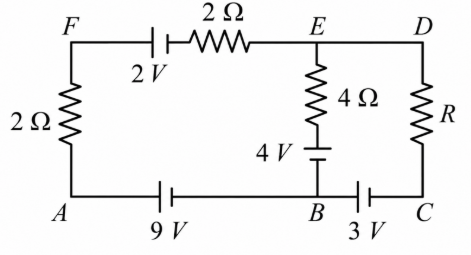
E. Total resistance of the circuit is $$8\Omega$$ . 
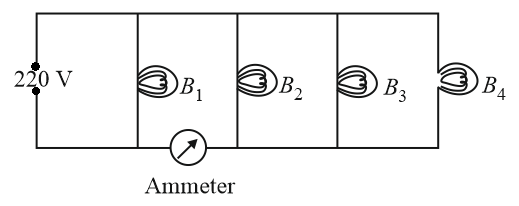
Choose the correct answer from the options given below:

page5_img1
Question 378 JEE Mains

Find the equivalent resistance between two ends of the following circuit

page6_img2
Question 379 JEE Mains

A wire of uniform resistance $$\lambda$$Ω/m is bent into a circle of radius r and another piece of wire with length 2r is connected between points A and B (AOB) as shown in figure. The equivalent resistance between points A and B is ____Ω .

34
Question 380 JEE Mains

Two resistors 2Ω and 3Ω are connected in the gaps of bridge as shown in figure. The null point is obtained with the contact of jockey at some point on wire XY. When an unknown resistor is connected in parallel with 3Ω resistor, the null point is shifted by 22.5 cm toward Y. The resistance of unknown resistor is ____ Ω .

image
Question 381 JEE Mains

Two resistors of 100Ω each are connected in series with a 9 V batte1y. A voltmeter of 400Ω resistance is connected to measure the voltage drop across one of the resistors. The voltmeter reading is ____ V.

Question 382 JEE Mains

The voltage and the current between A and B points shown in the circuit are :

image
Question 383 JEE Mains

Two cells of emfs 1 V and 2 V and internal resistance 2 $$\Omega$$ and 1 $$\Omega$$, respectively connected in parallel, gave a current of 1 A through an external resistance. If the polarity of one cell is reversed, then value of current through the external resistance will be $$\dfrac{\alpha}{5}$$ A. The value of $$\alpha$$ is __________.

Question 384 JEE Mains

When an external resistance of $$5\,\Omega$$ is connected across terminals of a cell,  a current of $$0.25$$ A flow through it. When the $$5\,\Omega$$ resistor is replaced by a  $$2\,\Omega$$ resistor, a current of $$0.5$$ A flow through it. The internal resistance of the cell is________ $$\Omega$$.

Question 385 JEE Mains

A wire of resistance R is bent into a triangular pyramid as shown in figure with each segment having same length. The resistance between points A and B is R/n. The value of n is :

image
Question 386 JEE Mains

From the combination of resistors with resistance values $$R_1 = R_2 = R_3 = 5 \, \Omega$$ and $$R_4 = 10 \, \Omega$$, which of the following combination is the best circuit to get an equivalent resistance of $$6\Omega$$?

Question 387 JEE Mains

Refer to the figure given below. The values of $$I_1$$, $$I_2$$ and $$I_3$$ are _______.

image
Question 388 JEE Mains

A meter bridge with two resistances $$R_{1}$$ and $$R_{2}$$ as shown in figure was balanced (null point) at 40 cm from the point $$P$$. The null point changed to 50 cm from the point $$P$$, when 16 $$\Omega$$ resistance is connected in parallel to $$R_{2}$$. The values of resistances $$R_{1}$$ and $$R_{2}$$ are ______

Screenshot_42
Question 389 JEE Mains

There are 'n' number of identical electric bulbs, each is designed to draw a power p independently from the mains supply. They are now joined in series across the main supply. The total power drawn by the combination is :

Question 390 JEE Mains

A Wheatstone bridge is initially at room temperature and all arms of the bridge have same value of resistances $$(R_{1}=R_{2}=R_{3}=R_{4})$$. When $$R_{3}$$ resistance is heated to some temperature, its resistance value has gone up by 10%. The potential difference $$(V_{a}-V_{b})$$ (after $$R_{3}$$ is heated) is ____ V.

image
Question 391 JEE Mains

Refer to the figure given below, current between terminals $$A$$ and $$B$$ is _______A.

image
Question 392 JEE Mains

Two known resistances of $$R \Omega$$ and $$2R \Omega$$ and one unknown resistance $$X \Omega$$ are connected in a circuit as shown in the figure. If the equivalent resistance between points A and B in the circuit is $$X \Omega$$, then the value of X is __________ $$\Omega$$.

43 Slot 2
Question 393 JEE Mains

The reading of the ammeter (A) in steady state in the following circuit (assuming negligible internal resistance of the ammeter) is ___ A.

image
Question 394 JEE Mains

The equivalent resistance between the points A and B in the following circuit is $$\frac{x}{5}$$Ω. The value ofx is________.

50-1
Question 395 JEE Mains
images

Find the equivalent resistance of the given electrical network across terminals A and B:

Question 396 JEE Mains

A battery with EMF E and internal resistance r is connected across a resistance R. The power consumption in R will be maximum when :

Question 397 JEE Advanced

A metal wire of cross-sectional area $$0.5\,\mathrm{mm^2}$$ and length $$100\,\mathrm{m}$$ is connected across a battery of e.m.f. $$2\,\mathrm{V}$$ and internal resistance $$1\,\Omega$$. The density, atomic mass and electrical conductivity of the metal are $$6.35\times 10^{3}\,\mathrm{kg\,m^{-3}}$$, $$63.5\,\mathrm{gm/mole}$$ and $$2\times 10^{8}\,\mathrm{mho\,m^{-1}}$$, respectively. Assuming one conduction electron per atom of the metal, the drift velocity (in $$\mathrm{mm\,s^{-1}}$$) of the electrons in the wire is:

[Take Avogadro's number as $$6\times 10^{23}$$ and charge of the electron as $$1.6\times 10^{-19}\,\mathrm{C}$$.]

Students can first attempt the questions independently and then refer to the video solutions to understand each step. The PDF is useful for chapter-wise practice and revision after completing the basic Current Electricity concepts.

What You GetDetails
JEE Current Electricity QuestionsQuestions covering important Current Electricity concepts
Practice PDFDownloadable PDF for focused chapter-wise practice
Video SolutionsStep-by-step solutions to the questions
Detailed ExplanationsConcepts, formulas, calculations, and circuit analysis
Expert GuidanceSolutions explained by IITians
Exam PreparationUseful for JEE Main and JEE Advanced

Regular practice with these questions can improve circuit-solving skills, numerical accuracy, and speed. Students can also combine them with a JEE Mains Previous Papers collection to understand how Current Electricity concepts are asked in actual examinations.

Important Current Electricity Topics for JEE

Current Electricity is a fundamental chapter in JEE Physics and includes both conceptual and numerical applications. Students should understand the movement of charge, the relationship between potential difference and current, and the behaviour of different circuit components before attempting advanced problems.

The following topics should be covered carefully:

Current Electricity TopicKey Areas to Practise
Electric CurrentCurrent, charge flow, and conventional current
Drift VelocityDrift speed, current density, and electron motion
Ohm's LawRelation between voltage, current, and resistance
Resistance & ResistivityDependence on length, area, and material
Temperature DependenceChange in resistance with temperature
Resistor CombinationsSeries and parallel circuits
Cells and BatteriesEMF, internal resistance, and terminal voltage
Kirchhoff's LawsJunction and loop equations
Wheatstone BridgeBalanced bridge and resistance calculations
Meter BridgePractical measurement of unknown resistance
PotentiometerComparison of EMF and potential gradient
Electrical PowerPower, energy, and heating effect

Many JEE Questions from this chapter require students to combine two or more concepts. For example, a circuit problem may involve equivalent resistance and internal resistance together, while another may require Kirchhoff's laws to determine unknown currents.

Understanding circuit diagrams is particularly important. Before applying equations, identify the nodes, branches, series connections, parallel combinations, and the direction of assumed currents.

Students can use detailed JEE Study material for concept revision and then move to chapter-wise question practice. This approach helps connect theoretical concepts with practical circuit problems.

JEE Main & Advanced Current Electricity Weightage Analysis

The exact number of Current Electricity questions is not fixed in every JEE Main shift or JEE Advanced paper. The distribution can vary across years, shifts, and individual papers. Therefore, JEE mains Physics Chapter-wise weightage should be used as a preparation reference rather than a fixed prediction.

Current Electricity questions can range from direct formula-based problems to complex circuit analysis involving multiple equations.

TopicCommon Question Types
Current & Drift VelocityCurrent density and electron drift
ResistanceResistance, resistivity, and dimensions
Resistor NetworksSeries, parallel, and equivalent resistance
CellsEMF, internal resistance, and terminal potential
Kirchhoff's LawsMultiple-loop circuit calculations
Wheatstone BridgeBalance condition and unknown resistance
Meter BridgeMeasurement of resistance
PotentiometerEMF comparison and potential gradient
Power & HeatingElectrical power and energy consumption
Advanced CircuitsDiodes, inductive/capacitive effects, and mixed networks

For JEE Main, students should practise standard numerical and conceptual problems and solve questions from previous examinations. A JEE Mains Previous Papers practice set can help students become familiar with common circuit configurations and calculation patterns.

For JEE Advanced, practise questions involving multiple loops, non-trivial resistor networks, changing circuit conditions, and combinations of different concepts. Rather than focusing only on expected weightage, ensure that the fundamental principles of Current Electricity are clear.

Why Practice JEE Current Electricity Questions?

Current Electricity requires accurate circuit interpretation as well as mathematical calculation. Even when the formulas are familiar, small mistakes in identifying current direction, resistance combinations, or potential differences can change the final answer.

Practising JEE Current Electricity Questions can help you:

  • Understand the practical application of current and voltage concepts.
  • Improve circuit analysis and equation-forming skills.
  • Become comfortable with resistor and battery combinations.
  • Strengthen the use of Kirchhoff's laws.
  • Improve numerical speed and accuracy.
  • Identify common mistakes in circuit calculations.

A useful practice cycle is learn the concept → draw or simplify the circuit → solve the question → check the solution → analyse the mistake → practise a similar problem.

The detailed video solutions available with the PDF can help students understand how experienced problem-solvers approach complicated circuits. Instead of looking only at the final answer, compare the sequence of circuit simplification, equation formation, and calculation with your own method.

Students following a structured JEE Physics Course can use these questions after completing the Current Electricity lessons. Chapter-wise practice helps reinforce concepts and makes it easier to identify topics that require further revision.

These questions can also be used before taking a Free JEE Mains Mock Test. Revising a chapter and solving focused questions before a mock test can help students identify gaps in understanding and improve their overall test performance.

Tips to Solve Current Electricity Questions Faster

Current Electricity questions become easier when you follow a consistent circuit-analysis method. The following strategies can improve both speed and accuracy.

1. Understand the circuit first

Before writing equations, identify all components, nodes, branches, and connections. Check which resistors are in series or parallel and mark the relevant potential differences.

2. Revise the core formulas

Keep the important equations in your JEE Physics Formula Sheet and revise them regularly.

Concept

Formula

Electric Current

$$(I=\frac{Q}{t})$$

Ohm's Law

$$(V=IR)$$

Resistance

$$(R=\rho\frac{L}{A})$$

Current Density

$$(J=\frac{I}{A})$$

Drift Velocity

$$(I=neAv_d)$$

Electrical Power

$$(P=VI=I^2R=\frac{V^2}{R})$$

Electrical Energy

$$(E=Pt)$$

Terminal Voltage

$$(V=E-Ir)$$

3. Simplify the circuit wherever possible

Look for obvious series and parallel combinations before applying Kirchhoff's laws. Reducing the circuit first can significantly decrease the amount of calculation required.

4. Apply Kirchhoff's laws systematically

For complex circuits, assign current directions and write junction and loop equations carefully. A chosen current direction does not have to be correct initially; the sign of the calculated result indicates the actual direction.

5. Check units and signs

Current Electricity questions may involve amperes, volts, ohms, coulombs, metres, and seconds. Keep units consistent and pay attention to the polarity of cells and potential differences.

6. Practise previous year questions

After completing the chapter, solve previous year questions to understand the types of circuits and concepts that have appeared in JEE. Regular practice of Current Electricity questions can improve speed and help you recognise familiar patterns more quickly.

Finally, analyse every incorrect problem and identify the reason for the mistake. Check whether the issue was circuit interpretation, formula selection, sign convention, equation formation, or calculation. Consistent chapter-wise practice, formula revision, and problem analysis can help you approach Current Electricity questions with greater accuracy and confidence in the JEE examination.

Frequently Asked Questions