JEE Electrostatics Questions

This page provides a collection of JEE Electrostatics Questions to help students practise important concepts from Electrostatics for JEE Main and JEE Advanced. The PDF available on this page contains carefully selected questions along with detailed video solutions and explanations. The solutions are explained by IITians, helping students understand the concepts, calculations, and problem-solving approach required for JEE-level questions. The questions cover important areas such as electric charge, Coulomb's law, electric field, electric potential, electric dipole, electric flux, Gauss's law, capacitors, and electrostatic energy. Students can attempt the questions independently and then use the video solutions to understand the complete method of solving each problem.

Question 1 JEE Advanced

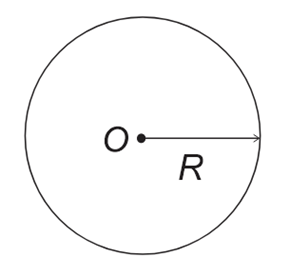
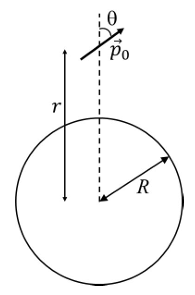
A small electric dipole $$\vec{p}_0$$, having a moment of inertia $$I$$ about its center, is kept at a distance $$r$$ from the center of a spherical shell of radius $$R$$. The surface charge density $$\sigma$$ is uniformly distributed on the spherical shell. The dipole is initially oriented at a small angle $$\theta$$ as shown in the figure. While staying at a distance $$r$$, the dipole is free to rotate about its center.

image

If released from rest, then which of the following statement(s) is (are) correct?

[$$\varepsilon_0$$ is the permittivity of free space.]

Question 2 JEE Advanced

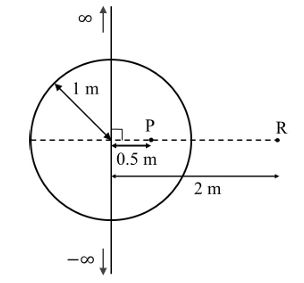
An infinitely long thin wire, having a uniform charge density per unit length of $$5\ \frac{nC}{m}$$ , is passing through a spherical shell of radius $$1\ m$$, as shown in the figure. A $$10\ nC$$ charge is distributed uniformly over the spherical shell. If the configuration of the charges remains static, the magnitude of the potential difference between points $$P$$ and $$R$$, in Volt, is ________.

[Given: In SI units $$\dfrac{1}{4\pi \varepsilon_0} = 9 \times 10^9$$, ln 2 = 0.7. Ignore the area pierced by the wire.]

image
Question 3 JEE Mains

A dipole comprises of two charged particles of identical magnitude $$q$$ and opposite in nature. The mass $$m$$ of the positive charged particle is half of the mass of the negative charged particle. The two charges are separated by a distance $$l$$. If the dipole is placed in a uniform electric field $$\vec{E}$$, in such a way that dipole axis makes a very small angle with the electric field, $$\vec{E}$$. The angular frequency of the oscillations of the dipole when released is given by:

Question 4 JEE Advanced

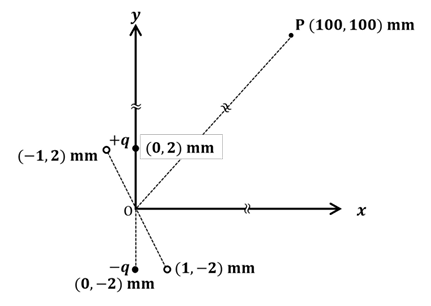
An electric dipole is formed by two charges $$+q$$ and $$-q$$ located in xy-plane at (0, 2) mm and (0, -2) mm, respectively, as shown in the figure. The electric potential at point P(100, 100) mm due to the dipole is $$V_0$$. The charges $$+q$$ and $$-q$$ are then moved to the points (-1, 2) mm and (1, -2) mm, respectively. What is the value of electric potential at P due to the new dipole?

image
Question 5 JEE Mains

Experimentally it is found that 12.8 eV energy is required to separate a hydrogen atom into a proton and an electron. So the orbital radius of the electron in a hydrogen atom is $$\dfrac{9}{x} \times 10^{-10}$$ m. The value of the $$x$$ is ______.
(1 eV = $$1.6 \times 10^{-19}$$ J, $$\dfrac{1}{4\pi\varepsilon_0} = 9 \times 10^9$$ $$\dfrac{Nm^2}{C^2}$$ and electronic charge = $$1.6 \times 10^{-19}$$ C)

Question 6 JEE Mains

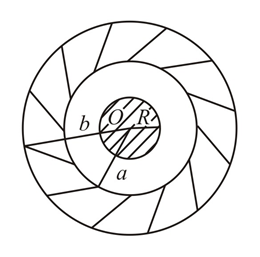
Three concentric spherical metallic shells $$X$$, $$Y$$ and $$Z$$ of radius $$a$$, $$b$$ and $$c$$ respectively $$a < b < c$$ have surface charge densities $$\sigma$$, $$-\sigma$$ and $$\sigma$$, respectively. The shells $$X$$ and $$Z$$ are at same potential. If the radii of $$X$$ & $$Y$$ are 2 cm and 3 cm, respectively. The radius of shell Z is _______ cm.

Question 7 JEE Mains

The volume charge density of a sphere of radius $$6 \text{ m}$$ is $$2 \mu C \text{ cm}^{-3}$$. The number of lines of force per unit surface area coming out from the surface of the sphere is ______ $$\times 10^{10} \text{ N C}^{-1}$$.
[Given: Permittivity of vacuum $$\epsilon_0 = 8.85 \times 10^{-12} \text{ C}^2 \text{ N}^{-1} \text{ m}^{-2}$$]

Question 8 JEE Mains

Two electric dipoles of dipole moments $$1.2 \times 10^{-30}$$ Cm and $$2.4 \times 10^{-30}$$ Cm are placed in two different uniform electric fields of strengths $$5 \times 10^4$$ N C$$^{-1}$$ and $$15 \times 10^4$$ N C$$^{-1}$$ respectively. The ratio of maximum torque experienced by the electric dipoles will be $$\frac{1}{x}$$. The value of $$x$$ is _____.

Question 9 JEE Advanced

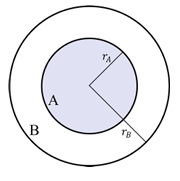
In the figure, the inner (shaded) region A represents a sphere of radius $$r_A = 1$$, within which the electrostatic charge density varies with the radial distance $$r$$ from the center as $$\rho_A = kr$$, where $$k$$ is positive. In the spherical shell B of outer radius $$r_B$$, the electrostatic charge density varies as $$\rho_B = \dfrac{2k}{r}$$. Assume that dimensions are taken care of. All physical quantities are in their SI units.

image

Which of the following statement(s) is(are) correct?

Question 10 JEE Advanced

A disk of radius $$R$$ with uniform positive charge density $$\sigma$$ is placed on the $$xy$$ plane with its center at the origin. The Coulomb potential along the z-axis is

$$V(z) = \dfrac{\sigma}{2\epsilon_0}\left(\sqrt{R^2 + z^2} - z\right)$$

A particle of positive charge $$q$$ is placed initially at rest at a point on the z axis with $$z = z_0$$ and $$z_0 > 0$$. In addition to the Coulomb force, the particle experiences a vertical force $$\vec{F} = -c\hat{k}$$ with $$c > 0$$. Let $$\beta = \dfrac{2c\epsilon_0}{q\sigma}$$. Which of the following statement(s) is(are) correct?

Question 11 JEE Mains

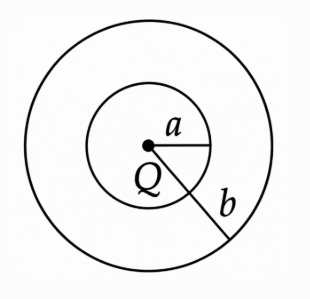
The region between two concentric spheres of radii 'a' and 'b', respectively (see figure), has volume charge density $$\rho = \frac{A}{r}$$, where A is a constant and r is the distance from the centre. At the centre of the spheres is a point charge Q. The value of A such that the electric field in the region between the spheres will be constant, is:

image
Question 12 JEE Mains

A liquid drop having 6 excess electrons is kept stationary under a uniform electric field of 25.5 kVm$$^{-1}$$. The density of liquid is $$1.26 \times 10^3$$ kg m$$^{-3}$$. The radius of the drop is (neglect buoyancy).

Question 13 JEE Mains

The electric potential $$V(x)$$ in a region around the origin is given by $$V(x) = 4x^2$$ volts. The electric charge enclosed in a cube of 1 m side with its centre at the origin is (in coulomb)

Question 14 JEE Mains

Four charges equal to $$-Q$$ are placed at the four corners of a square and a charge $$q$$ is at its centre. If the system is in equilibrium the value of $$q$$ is

Question 15 JEE Mains

Two charges of $$-4 \mu$$C and $$+4 \mu$$C are placed at the points $$A(1, 0, 4)$$ m and $$B(2, -1, 5)$$ m located in an electric field $$\vec{E} = 0.20\hat{i}$$ V cm$$^{-1}$$. The magnitude of the torque acting on the dipole is $$8\sqrt{\alpha} \times 10^{-5}$$ N m, where $$\alpha$$ = _____.

Question 16 JEE Advanced

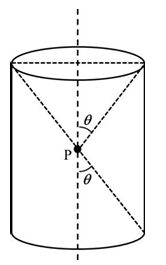
A charge is kept at the central point $$P$$ of a cylindrical region. The two edges subtend a half-angle $$\theta$$ at $$P$$, as shown in the figure. When $$\theta = 30^\circ$$, then the electric flux through the curved surface of the cylinder is $$\Phi$$. If $$\theta = 60^\circ$$, then the electric flux through the curved surface becomes $$\Phi / \sqrt{n}$$, where the value of $$n$$ is ________.

image
Question 17 JEE Mains

Considering a group of positive charges, which of the following statements is correct?

Question 18 JEE Mains

Given below are two statements: one is labelled as Assertion A and the other is labelled as Reason R.
Assertion A : If an electric dipole of dipole moment $$30 \times 10^{-5}$$ C m is enclosed by a closed surface, the net flux coming out of the surface will be zero.
Reason R : Electric dipole consists of two equal and opposite charges.
In the light of above, statements, choose the correct answer from the options given below.

Question 19 JEE Mains

The electric field due to a short electric dipole at a large distance $$(r)$$ from center of dipole on the equatorial plane varies with distance as :

Question 20 JEE Mains

Two charges of each magnitude $$0.01$$ C and separated by a distance of $$0.4$$ mm constitute an electric dipole. If the dipole is placed in an uniform electric field $$\vec{E}$$ of $$10$$ dyne $$\cdot$$ C$$^{-1}$$ making $$30°$$ angle with $$\vec{E}$$, the magnitude of torque acting on dipole is:

Question 21 JEE Mains

An electric dipole of dipole moment is $$6.0 \times 10^{-6}$$ C m placed in a uniform electric field of $$1.5 \times 10^3$$ N C$$^{-1}$$ in such a way that dipole moment is along electric field. The work done in rotating dipole by 180° in this field will be ______ mJ.

Question 22 JEE Mains

A stream of a positively charged particles having $$\frac{q}{m} = 2 \times 10^{11} \text{ C kg}^{-1}$$ and velocity $$\vec{v}_0 = 3 \times 10^7 \hat{i} \text{ m s}^{-1}$$ is deflected by an electric field $$1.8\hat{j} \text{ kV m}^{-1}$$. The electric field exists in a region of 10 cm along $$x$$ direction. Due to the electric field, the deflection of the charge particles in the $$y$$ direction is _____ mm.

Question 23 JEE Mains

A stream of positively charged particles having $$\frac{q}{m} = 2 \times 10^{11}$$ C kg$$^{-1}$$ and velocity $$\vec{v_0} = 3 \times 10^7 \hat{i}$$ m s$$^{-1}$$ is deflected by an electric field $$1.8\hat{j}$$ kV m$$^{-1}$$. The electric field exists in a region of 10 cm along $$x$$ direction. Due to the electric field, the deflection of the charge particles in the $$y$$ direction is _____ mm.

Question 24 JEE Mains

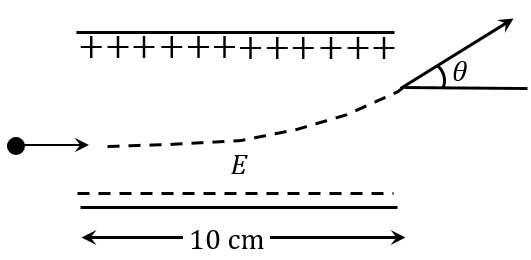
A uniform electric field of 10 N C$$^{-1}$$ is created between two parallel charged plates (as shown in figure). An electron enters the field symmetrically between the plates with a kinetic energy 0.5 eV. The length of each plate is 10 cm. The angle ($$\theta$$) of deviation of the path of electron as it comes out of the field is _____ (in degree).

Question 25 JEE Mains

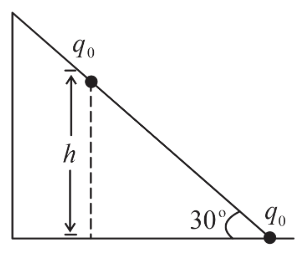
As shown in the figure, a configuration of two equal point charges $$q_0 = +2\mu C$$ is placed on an inclined plane. Mass of each point charge is 20 g. Assume that there is no friction between charge and plane. For the system of two point charges to be in equilibrium (at rest) the height $$h = x \times 10^{-3}$$ m. The value of x is _______
Take $$\frac{1}{4\pi\varepsilon_0} = 9 \times 10^9$$ N m$$^2$$ C$$^{-2}$$, $$g = 10$$ m s$$^{-2}$$

image
Question 26 JEE Advanced

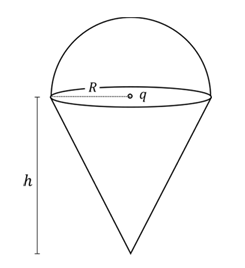
A charge $$q$$ is surrounded by a closed surface consisting of an inverted cone of height $$h$$ and base radius $$R$$, and a hemisphere of radius $$R$$ as shown in the figure. The electric flux through the conical surface is $$\dfrac{nq}{6\epsilon_0}$$ (in SI units). The value of $$n$$ is _______.

image
Question 27 JEE Mains

Sixty four conducting drops each of radius $$0.02$$ m and each carrying a charge of $$5$$ $$\mu$$C are combined to form a bigger drop. The ratio of surface charge density of bigger drop to the smaller drop will be

Question 28 JEE Mains

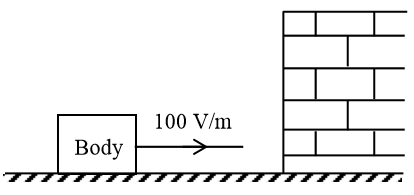
A body having specific charge 8 $$\mu$$C g$$^{-1}$$ is resting on a frictionless plane at a distance 10 cm from the wall (as shown in the figure). It starts moving towards the wall when a uniform electric field of 100 V m$$^{-1}$$ is applied horizontally towards the wall. If the collision of the body with the wall is perfectly elastic, then the time period of the motion will be ___ s.

Question 29 JEE Mains

The electric field in a region is given by $$\vec{E} = \left(\frac{3}{5}E_0\hat{i} + \frac{4}{5}E_0\hat{j}\right)$$ N C$$^{-1}$$. The ratio of flux of reported field through the rectangular surface of area 0.2 m$$^2$$ (parallel to $$y-z$$ plane) to that of the surface of area 0.3 m$$^2$$ (parallel to $$x-z$$ plane) is $$a : b = a : 2$$, where $$a$$ = ______?[Here $$\hat{i},\hat{j}$$ and$$\hat{k}$$ are unit vectors along $$x,y$$ and $$z$$-axes respectively]

Question 30 JEE Mains

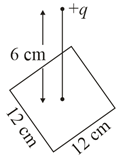
A point charge of $$+12$$ $$\mu C$$ is at a distance 6 cm vertically above the centre of a square of side 12 cm as shown in figure. The magnitude of the electric flux through the square will be ______ $$\times 10^3$$ N m$$^2$$ C$$^{-1}$$.

page5_img1
Question 31 JEE Mains

The electric field in a region is given by $$\vec{E} = \frac{2}{5}E_0\hat{i} + \frac{3}{5}E_0\hat{j}$$ with $$E_0 = 4.0 \times 10^3$$ N C$$^{-1}$$. The flux of this field through a rectangular surface, area 0.4 m$$^2$$ parallel to the $$Y-Z$$ plane is ________ N m$$^2$$ C$$^{-1}$$.

Question 32 JEE Mains

Two identical conducting spheres with negligible volume have 2.1 nC and $$-0.1$$ nC charges, respectively. They are brought into contact and then separated by a distance of 0.5 m. The electrostatic force acting between the spheres is ______ $$\times 10^{-9}$$ N.
[Given : $$4\pi \epsilon_{\circ}$$ = $$ \frac{1}{9\times 10^{9}}$$ SI Units}]

Question 33 JEE Mains

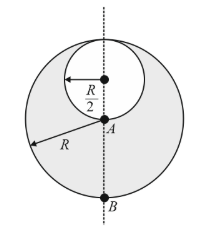
Consider a sphere of radius $$R$$ which carries a uniform charge density $$\rho$$. If a sphere of radius $$\frac{R}{2}$$ is carved out of it, as shown, the ratio $$\frac{|\vec{E_A}|}{|\vec{E_B}|}$$ of magnitude of electric field $$\vec{E_A}$$ and $$\vec{E_B}$$, respectively, at points $$A$$ and $$B$$ due to the remaining portion is:

image
Question 34 JEE Mains

A small point mass carrying some positive charge on it, is released from the edge of a table. There is a uniform electric field in this region in the horizontal direction. Which of the following options then correctly describe the trajectory of the mass? (Curves are drawn schematically and are not to scale)

Question 35 JEE Mains

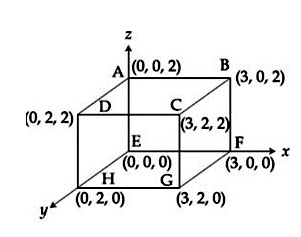
An electric field $$\vec{E} = 4x\hat{i} - (y^2 + 1)\hat{j}$$ N/C passes through the box shown in figure. The flux of the electric field through surfaces ABCD and BCGF are marked as $$\phi_I$$ and $$\phi_{II}$$ respectively. The absolute difference between $$(\phi_I - \phi_{II})$$ is (in Nm$$^2$$/C) ___________.

Question 36 JEE Mains

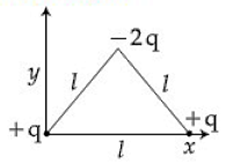
Determine the electric dipole moment of the system of three charges, placed on the vertices of an equilateral triangle, as shown in the figure:

Question 37 JEE Mains

An electric dipole is formed by two equal and opposite charges q with separation d. The charges have same mass m. It is kept in a uniform electric field E. If it is slightly rotated from its equilibrium orientation, then its angular frequency $$\omega$$ is:

Question 38 JEE Mains

Four point charges -q, +q, +q and -q are placed on y-axis at y = -2d, y = -d, and y = +2d, respectively. The magnitude of the electric field E at a point on the x-axis at x = D, with D >> d, will behave as:

Question 39 JEE Mains

Two point charges $$q_1(\sqrt{10}$$ $$\mu$$C) and $$q_2(-25$$ $$\mu$$C) are placed on the $$x$$-axis at $$x = 1$$ m and $$x = 4$$ m respectively. The electric field (in V/m) at a point $$y = 3$$ m on $$y$$-axis is, [Take $$\frac{1}{4\pi\varepsilon_0} = 9 \times 10^9$$ N m$$^2$$C$$^{-2}$$]

Question 40 JEE Mains

Let a total charge 2Q be distributed in a sphere of radius R, with the charge density given by $$\rho(r) = kr$$, where r is the distance from the centre. Two charges A and B, of -Q each, are placed on diametrically opposite points, at equal distance, a, from the centre. If A and B do not experience any force, then:

Question 41 JEE Mains

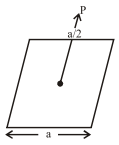
A charge Q is placed at a distance a/2 above the centre of the square surface of edge a as shown in the figure. The electric flux through the square surface is:

Question 42 JEE Mains

A solid ball of radius R has a charge density $$\rho$$ given by $$\rho = \rho_0\left(1 - \frac{r}{R}\right)$$ for $$0 \leq r \leq R$$. The electric field outside the ball is:

Question 43 JEE Mains

Three concentric metal shells A, B and C of respective radii a, b and c (a < b < c) have surface charge densities $$+\sigma$$, $$-\sigma$$ and $$+\sigma$$ respectively. The potential of shell B is:

Question 44 JEE Mains

Two identical conducting spheres A and B carry an equal charge. They are separated by a distance much larger than their diameters, and the force between them is F. A third identical conducting sphere, C, is uncharged. Sphere C is first touched to A, then to B, and then removed. As a result, force between A and B would be equal to:

Question 45 JEE Mains

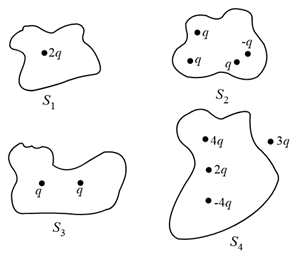
Four closed surfaces and corresponding charge distributions are shown below.

Let the respective electric fluxes through the surfaces be $$\phi_1$$, $$\phi_2$$, $$\phi_3$$ and $$\phi_4$$. Then:

Question 46 JEE Mains

The potential (in volts) of a charge distribution is given by
$$V(z) = 30 - 5z^2$$ for $$|z| \leq 1$$ m
$$V(z) = 35 - 10|z|$$ for $$|z| \geq 1$$ m.
$$V(z)$$ does not depend on x and y. If this potential is generated by a constant charge per unit volume $$\rho_0$$ (in units of $$\epsilon_0$$) which is spread over a certain region, then choose the correct statement.

Question 47 JEE Mains

Within a spherical charge distribution of charge density $$\rho(r)$$, N equipotential surfaces of potential $$V_0$$, $$V_0 + \Delta V$$, $$V_0 + 2\Delta V$$, ... $$V_0 + N\Delta V$$ $$(\Delta V > 0)$$, are drawn and have increasing radii $$r_0$$, $$r_1$$, $$r_2$$, ... $$r_N$$, respectively. If the difference in the radii of the surfaces is constant for all values of $$V_0$$ and $$\Delta V$$ then:

Question 48 JEE Mains

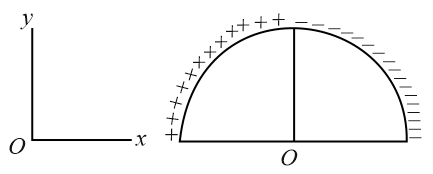
A wire of length $$L = 20$$ cm is bent into a semi-circular arc and the two equal halves of the arc are uniformly charged with charges $$+Q$$ and $$-Q$$ as shown in the figure. The magnitude of the charge on each half is $$|Q| = 10^3\varepsilon_0$$, where $$\varepsilon_0$$ is the permittivity of free space. The net electric field at the centre $$O$$ is

Question 49 JEE Mains

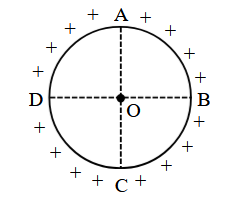
A long cylindrical shell carries positive surface charge $$\sigma$$ in the upper half and negative surface charge $$-\sigma$$ in the lower half. The electric field lines around the cylinder will look like figure given in: (figures are schematic and not drawn to scale)

Question 50 JEE Mains

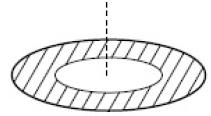
A thin disc of radius $$b = 2a$$ has a concentric hole of radius $$a$$ in it (see figure). It carries uniform surface charge $$\sigma$$ on it. If the electric field on its axis at a height h (h $$<<$$ a) from its centre is given as Ch then the value of C is

Question 51 JEE Mains

A cone of base radius R and height h is located in a uniform electric field $$\vec{E}$$ parallel to its base. The electric flux entering the cone is:

Question 52 JEE Mains

A spherically symmetric charge distribution is characterised by the following charge density variations: $$\rho(r) = \rho_o\left(1 - \frac{r}{R}\right)$$ for $$r < R$$, $$\rho(r) = 0$$ for $$r \geq R$$. Where r is the distance from the centre of the charge distribution and $$\rho_o$$ is a constant. The electric field at an internal point ($$r < R$$) is:

Question 53 JEE Mains

The electric field in a region of space is given by, $$\vec{E} = E_0\hat{i} + 2E_0\hat{j}$$ where $$E_0 = 100$$ N C$$^{-1}$$. The flux of this field through a circular surface of radius 0.02 m parallel to the Y-Z plane is nearly:

Question 54 JEE Mains

The magnitude of the average electric field normally present in the atmosphere just above the surface of the Earth is about 150 N/C, directed inward towards the center of the Earth. This gives the total net surface charge carried by the Earth to be: [Given: $$\epsilon_0 = 8.85 \times 10^{-12}$$ C$$^2$$/N-m$$^2$$, $$R_E = 6.37 \times 10^6$$ m]

Question 55 JEE Mains

Two charges, each equal to q, are kept at $$x = -a$$ and $$x = a$$ on the x-axis. A particle of mass m and charge $$q_0 = -\frac{q}{2}$$ is placed at the origin. If charge $$q_0$$ is given a small displacement ($$y << a$$) along the y-axis, the net force acting on the particle is proportional to :

Question 56 JEE Mains

The surface charge density of a thin charged disc of radius R is $$\sigma$$. The value of the electric field at the centre of the disc is $$\frac{\sigma}{2\epsilon_0}$$. With respect to the field at the centre, the electric field along the axis at a distance R from the centre of the disc:

Question 57 JEE Mains

Two point dipoles of dipole moment $$\vec{p_1}$$ and $$\vec{p_2}$$ are at a distance x from each other and $$\vec{p_1} \| \vec{p_2}$$. The force between the dipoles is :

Question 58 JEE Mains

Two balls of same mass and carrying equal charge are hung from a fixed support of length $$l$$. At electrostatic equilibrium, assuming that angles made by each thread is small, the separation, x between the balls is proportional to :

Question 59 JEE Mains

Two small equal point charges of magnitude $$q$$ are suspended from a common point on the ceiling by insulating mass less strings of equal lengths. They come to equilibrium with each string making angle $$\theta$$ from the vertical. If the mass of each charge is $$m$$, then the electrostatic potential at the centre of line joining them will be $$\left(\frac{1}{4\pi\epsilon_0} = k\right)$$.

Question 60 JEE Mains

A uniform electric field $$\vec{E}$$ exists between the plates of a charged condenser. A charged particle enters the space between the plates and perpendicular to $$\vec{E}$$. The path of the particle between the plates is a:

Question 61 JEE Mains

In a uniformly charged sphere of total charge $$Q$$ and radius $$R$$, the electric field $$E$$ is plotted as a function of distance from the centre. The graph which would correspond to the above will be

Question 62 JEE Mains

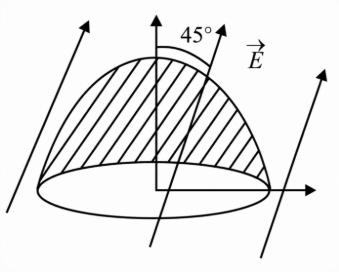
The flat base of a hemisphere of radius $$a$$ with no charge inside it lies in a horizontal plane. A uniform electric field $$\vec{E}$$ is applied at an angle $$\frac{\pi}{4}$$ with the vertical direction. The electric flux through the curved surface of the hemisphere is

image
Question 63 JEE Mains

Two identical charged spheres suspended from a common point by two massless strings of length $$l$$ are initially a distance $$d \, (d \ll l)$$ apart because of their mutual repulsion. The charge begins to leak from both the spheres at a constant rate. As a result the charges approach each other with a velocity $$v$$. Then as a function of distance $$x$$ between them,

Question 64 JEE Mains

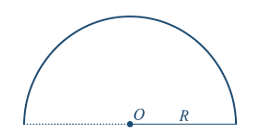
A thin semi-circular ring of radius $$r$$ has a positive charge $$q$$ distributed uniformly over it. The net field $$\vec{E}$$ at the centre $$O$$ is

image
Question 65 JEE Mains

Let there be a spherically symmetric charge distribution with charge density varying as $$\rho(r) = \rho_0 \left(\frac{5}{4} - \frac{r}{R}\right)$$ upto $$r = R$$, and $$\rho(r) = 0$$ for $$r > R$$, where $$r$$ is the distance from the origin. The electric field at a distance $$r$$ ($$r < R$$) from the origin is given by

Question 66 JEE Mains

Two identical charged spheres are suspended by strings of equal lengths. The strings make an angle of $$30^\circ$$ with each other. When suspended in a liquid of density $$0.8$$ g cm$$^{-3}$$, the angle remains the same. If density of the material of the sphere is $$16$$ g cm$$^{-3}$$, the dielectric constant of the liquid is

Question 67 JEE Mains

Let $$P(r) = \frac{Q}{\pi R^4}r$$ be the charge density distribution for a solid sphere of radius $$R$$ and total charge $$Q$$. For a point '$$p$$' inside the sphere at distance $$r_1$$ from the centre of the sphere, the magnitude of electric field is

Question 68 JEE Mains

A charge $$Q$$ is placed at each of the opposite corners of a square. A charge $$q$$ is placed at each of the other two corners. If the net electrical force on $$Q$$ is zero, then the $$Q/q$$ equals

Question 69 JEE Mains

A thin spherical shell of radius $$R$$ has charge $$Q$$ spread uniformly over its surface. Which of the following graphs most closely represents the electric field $$E(r)$$ produced by the shell in the range $$0 \le r < \infty$$, where $$r$$ is the distance from the centre of the shell?

Question 70 JEE Mains

Charges are placed on the vertices of a square as shown. Let $$\vec{E}$$ be the electric field and $$V$$ the potential at the centre. If the charges on $$A$$ and $$B$$ are interchanged with those on $$D$$ and $$C$$ respectively, then

Question 71 JEE Mains

If $$g_E$$ and $$g_m$$ are the accelerations due to gravity on the surfaces of the earth and the moon respectively and if Millikan's oil drop experiment could be performed on the two surfaces, one will find the ratio $$\frac{\text{electronic charge on the moon}}{\text{electronic charge on the earth}}$$ to be

Question 72 JEE Mains

A electric dipole is placed at an angle of $$30^\circ$$ to a non-uniform electric field. The dipole will experience

Question 73 JEE Mains

Two spherical conductors $$A$$ and $$B$$ of radii $$1\,mm$$ and $$2\,mm$$ are separated by a distance of $$5\,cm$$ and are uniformly charged. If the spheres are connected by a conducting wire then in equilibrium condition, the ratio of the magnitude of the electric fields at the surface of spheres $$A$$ and $$B$$ is

Question 74 JEE Mains

In a region, steady and uniform electric and magnetic fields are present. These two fields are parallel to each other. A charged particle is released from rest in this region. The path of the particle will be a

Question 75 JEE Mains

Two point charges $$+8q$$ and $$-2q$$ are located at $$x = 0$$ and $$x = L$$ respectively. The location of a point on the $$x$$ axis at which the net electric field due to these two point charges is zero is

Question 76 JEE Mains

Two thin wires rings each having a radius $$R$$ are placed at a distance $$d$$ apart with their axes coinciding. The charges on the two rings are $$+q$$ and $$-q$$. The potential difference between the centres of the two rings is

Question 77 JEE Mains

A charged oil drop is suspended in a uniform field of $$3 \times 10^4$$ V/m so that it neither falls nor rises. The charge on the drop will be (take the mass of the charge $$= 9.9 \times 10^{-15}$$ kg and $$g = 10 \text{ m/s}^2$$)

Question 78 JEE Advanced

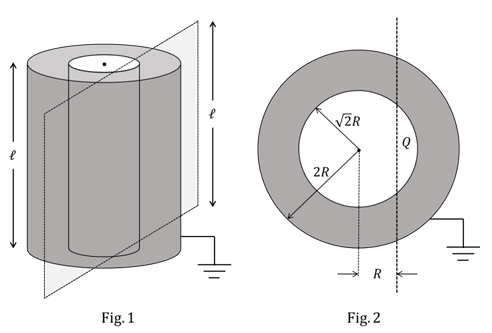
Two co-axial conducting cylinders of same length $$\ell$$ with radii $$\sqrt{2}R$$ and $$2R$$ are kept, as shown in Fig. 1. The charge on the inner cylinder is $$Q$$ and the outer cylinder is grounded. The annular region between the cylinders is filled with a material of dielectric constant $$\kappa = 5$$. Consider an imaginary plane of the same length $$\ell$$ at a distance $$R$$ from the common axis of the cylinders. This plane is parallel to the axis of the cylinders. The cross-sectional view of this arrangement is shown in Fig. 2. Ignoring edge effects, the flux of the electric field through the plane is ($$\epsilon_0$$ is the permittivity of free space):

image
Question 79 JEE Mains

A dipole with two electric charges of 2 $$\mu$$C magnitude each, with separation distance 0.5 $$\mu$$m, is placed between the plates of a capacitor such that its axis is parallel to an electric field established between the plates when a potential difference of 5 V is applied. Separation between the plates is 0.5 mm. If the dipole is rotated by 30° from the axis, the value of the torque is :

Question 80 JEE Mains

Two small spherical balls of mass 10g each with charges $$-2\mu C$$ and $$2\mu C$$, are attached to two ends of very light rigid rod of length 20 cm. The arrangement is now placed near an infinite non-conducting charge sheet with uniform charge density $$100 \mu C/m^2$$ such that length of rod makes an angle of 30° with electric field generated by charge sheet. Net torque acting on the rod is: (Take $$\varepsilon_0 : 8.85 \times 10^{-12} C^2/Nm^2$$)

Question 81 JEE Mains

An electric dipole of dipole moment $$6 \times 10^{-6}Cm$$ is placed in uniform electric field of magnitude $$10^{6}V/m$$. Initially, the dipole moment is parallel to electric field. The work that needs to be done on the dipole to make its dipole moment opposite to the field, will be ____ J.

Question 82 JEE Advanced

Two beads, each with charge $$q$$ and mass $$m$$, are on a horizontal, frictionless, non-conducting, circular hoop of radius $$R$$. One of the beads is glued to the hoop at some point, while the other one performs small oscillations about its equilibrium position along the hoop. The square of the angular frequency of the small oscillations is given by

[$$\varepsilon_0$$ is the permittivity of free space.]

Question 83 JEE Mains

A thin metallic wire having cross sectional area of $$10^{-4} \text{ m}^2$$ is used to make a ring of radius $$30$$ cm. A positive charge of $$2\pi$$ C is uniformly distributed over the ring, while another positive charge of $$30$$ pC is kept at the centre of the ring. The tension in the ring is _______ N; provided that the ring does not get deformed (neglect the influence of gravity). (Given, $$\frac{1}{4\pi\epsilon_0} = 9 \times 10^9$$ SI units)

Question 84 JEE Mains

An infinite plane sheet of charge having uniform surface charge density $$+\sigma_s\ C/m^2$$ is placed on x−y plane. Another infinitely long line charge having uniform linear charge density $$+\lambda_e\ C/m$$ is placed at z = 4 m plane and parallel to y-axis. If the magnitude values $$|\sigma_s| = 2|\lambda_e|$$, then at point (0, 0, 2), the ratio of magnitudes of electric field values due to sheet charge to that of line charge is $$\pi\sqrt{n} : 1$$. The value of n is _____.

Question 85 JEE Mains

Two identical charged spheres are suspended by strings of equal lengths. The strings make an angle $$\theta$$ with each other. When suspended in water the angle remains the same. If density of the material of the sphere is $$1.5$$ g/cc, the dielectric constant of water will be ______. (Take density of water $$= 1$$ g/cc)

Question 86 JEE Mains

A point charge $$2 \times 10^{-2}$$ C is moved from $$P$$ to $$S$$ in a uniform electric field of $$30$$ N C$$^{-1}$$ directed along positive $$x$$-axis. If coordinates of $$P$$ and $$S$$ are $$(1, 2, 0)$$ m and $$(0, 0, 0)$$ m respectively, the work done by electric field will be

Question 87 JEE Mains

If two charges $$q_1$$ and $$q_2$$ are separated with distance $$d$$ and placed in a medium of dielectric constant $$k$$. What will be the equivalent distance between charges in air for the same electrostatic force?

Question 88 JEE Mains

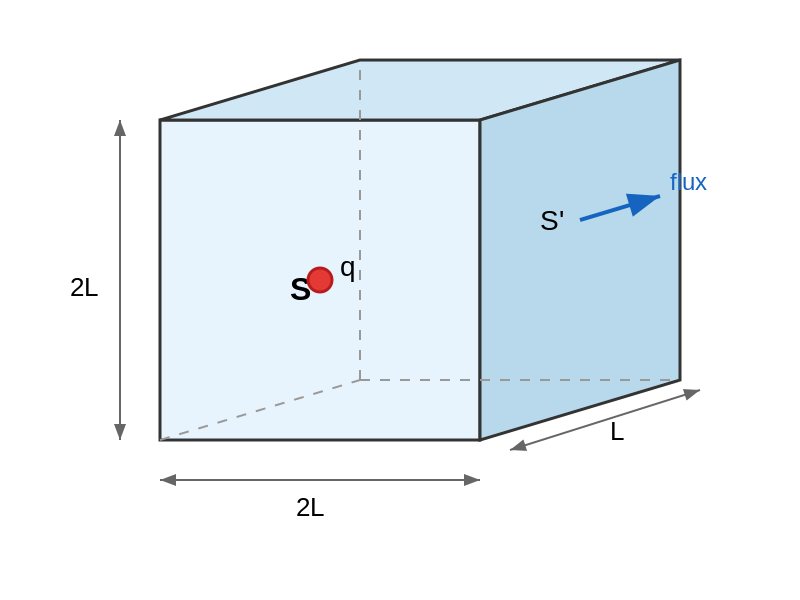
In a cuboid of dimension $$2L \times 2L \times L$$, a charge $$q$$ is placed at the centre of the surface $$S$$ having area of $$4L^2$$. The flux through the opposite surface to $$S$$ is given by

Question 89 JEE Mains

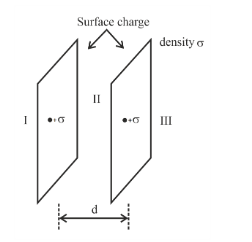
Let $$\sigma$$ be the uniform surface charge density of two infinite thin plane sheets as shown in the figure. Then the electric fields in three different regions, $$E_I$$, $$E_{II}$$ and $$E_{III}$$ are:

image
Question 90 JEE Mains

A point charge of 10 $$\mu$$C is placed at the origin. At what location on the X-axis should a point charge of 40 $$\mu$$C be placed so that the net electric field is zero at $$x = 2$$ cm on the X-axis?

Question 91 JEE Mains

A thin infinite charged sheet and an infinite line charge of respective charge densities $$+\sigma$$ and $$+\lambda$$ are placed parallel at $$5$$ m distance from each other. Points P and Q are at $$\frac{3}{\pi}$$ m and $$\frac{4}{\pi}$$ m perpendicular distances from line charge towards sheet charge, respectively. $$E_P$$ and $$E_Q$$ are the magnitudes of resultant electric field intensities at point P and Q respectively. If $$\frac{E_P}{E_Q} = \frac{4}{a}$$ for $$2|\sigma| = |\lambda|$$, then the value of $$a$$ is _____.

Question 92 JEE Mains

A point charge $$q_1 = 4q_0$$ is placed at origin. Another point charge $$q_2 = -q_0$$ is placed at $$x = 12$$ cm. Charge of proton is $$q_0$$. The proton is placed on $$x$$-axis so that the electrostatic force on the proton in zero. In this situation, the position of the proton from the origin is ______ cm.

Question 93 JEE Mains

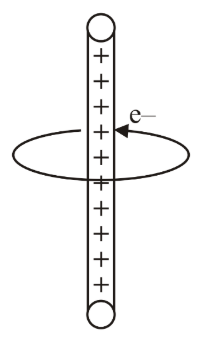
An electron revolves around an infinite cylindrical wire having uniform linear charge density $$2 \times 10^{-8}$$ C m$$^{-1}$$ in circular path under the influence of attractive electrostatic field as shown in the figure. The velocity of electron with which it is revolving is _______ $$\times 10^6$$ m s$$^{-1}$$. Given mass of electron $$= 9 \times 10^{-31}$$ kg

image
Question 94 JEE Mains

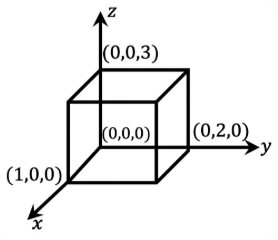
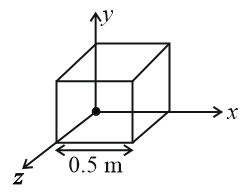
As shown in figure, a cuboid lies in a region with electric field $$E = 2x^2\hat{i} - 4y\hat{j} + 6\hat{k}$$ N C$$^{-1}$$. The magnitude of charge within the cuboid is $$n\varepsilon_0$$ C. The value of $$n$$ is ______ (if dimension of cuboid is $$1 \times 2 \times 3$$ m$$^3$$)

image
Question 95 JEE Mains

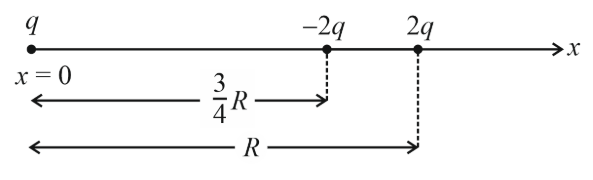
Three point charges $$q$$, $$-2q$$ and $$2q$$ are placed on x axis at a distance $$x = 0$$, $$x = \frac{3}{4}R$$ and $$x = R$$ respectively from origin as shown. If $$q = 2 \times 10^{-6}$$ C and $$R = 2$$ cm, the magnitude of net force experienced by the charge $$-2q$$ is _____ N.

image
Question 96 JEE Mains

Two equal positive point charges are separated by a distance $$2a$$. The distance of a point from the centre of the line joining two charges on the equatorial line (perpendicular bisector) at which force experienced by a test charge $$q_0$$ becomes maximum is $$\frac{a}{\sqrt{x}}$$. The value of $$x$$ is _____.

Question 97 JEE Mains

A cubical volume is bounded by the surfaces $$x = 0$$, $$x = a$$, $$y = 0$$, $$y = a$$, $$z = 0$$, $$z = a$$. The electric field in the region is given by $$\vec{E} = E_0 x \hat{i}$$. Where $$E_0 = 4 \times 10^4$$ NC$$^{-1}$$ m$$^{-1}$$. If $$a = 2$$ cm, the charge contained in the cubical volume is $$Q \times 10^{-14}$$ C. The value of $$Q$$ is ______. (Take $$\epsilon_0 = 9 \times 10^{-12}$$ C$$^2$$ N$$^{-1}$$m$$^{-2}$$)

Question 98 JEE Mains

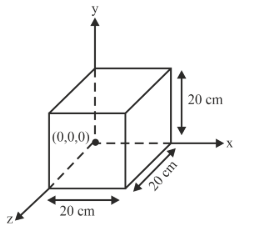
Expression for an electric field is given by $$\vec{E} = 4000 \; x^2 \; \hat{i}$$ V m$$^{-1}$$. The electric flux through the cube of side 20 cm when placed in electric field (as shown in the figure) is ______ V cm.

image
Question 99 JEE Mains

Statement-I : A point charge is brought in an electric field. The value of electric field at a point near to the charge may increase if the charge is positive.
Statement-II : An electric dipole is placed in a uniform electric field. The net electric force on the dipole will not be zero.

Question 100 JEE Mains

Two identical metallic spheres A and B when placed at certain distance in air repel each other with a force of F. Another identical uncharged sphere C is first placed in contact with A and then in contact with B and finally placed at midpoint between spheres A and B. The force experienced by sphere C will be:

Question 101 JEE Mains

A vertical electric field of magnitude $$4.9 \times 10^{5}$$ N C$$^{-1}$$ just prevents a water droplet of a mass $$0.1$$ g from falling. The value of charge on the droplet will be : (Given $$g = 9.8$$ m s$$^{-2}$$)

Question 102 JEE Mains

A positive charge particle of 100 $$\mu\ g$$ is thrown in opposite direction to a uniform electric field of strength $$1 \times 10^5$$ N C$$^{-1}$$. If the charge on the particle is 40 $$\mu$$C and the initial velocity is 200 m s$$^{-1}$$, how much distance it will travel before coming to the rest momentarily

Question 103 JEE Mains

Given below two statements : One is labelled as Assertion (A) and other is labelled as Reason (R).
Assertion (A): Non-polar materials do not have any permanent dipole moment.
Reason (R): When a non-polar material is placed in an electric field, the centre of the positive charge distribution of it's individual atom or molecule coincides with the centre of the negative charge distribution.
In the light of above statements, choose the most appropriate answer from the options given below.

Question 104 JEE Mains

Three point charges of magnitude $$5 \mu C$$, $$0.16 \mu C$$ and $$0.3 \mu C$$ are located at the vertices $$A$$, $$B$$, $$C$$ of a right angled triangle whose sides are $$AB = 3 \text{ cm}$$, $$BC = 3\sqrt{2} \text{ cm}$$ and $$CA = 3 \text{ cm}$$ and point $$A$$ is the right angle corner. Charge at point $$A$$ experiences ______ N of electrostatic force due to the other two charges.

Question 105 JEE Advanced

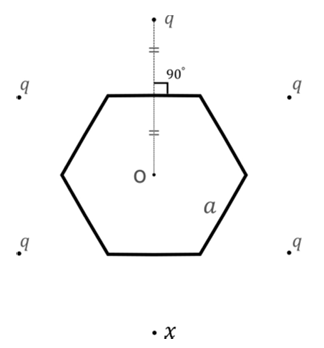
Six charges are placed around a regular hexagon of side length $$a$$ as shown in the figure. Five of them have charge $$q$$, and the remaining one has charge $$x$$. The perpendicular from each charge to the nearest hexagon side passes through the center O of the hexagon and is bisected by the side.

image

Which of the following statement(s) is(are) correct in SI units?

Question 106 JEE Mains

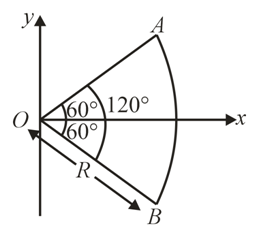
Figure shows a rod $$AB$$, which is bent in a 120° circular arc of radius $$R$$. A charge $$(-Q)$$ is uniformly distributed over rod AB. What is the electric field $$\vec{E}$$ at the centre of curvature O?

Question 107 JEE Mains

A cube is placed inside an electric field, $$\vec{E} = 150y^2\hat{j}$$. The side of the cube is 0.5 m and is placed in the field as shown in the given figure. The charge inside the cube is:

Question 108 JEE Mains

Given below are two statements
Statement I: An electric dipole is placed at the centre of a hollow sphere. The flux of electric field through the sphere is zero, but the electric field is not zero anywhere in the sphere.
Statement II: If $$R$$ is the radius of a solid metallic sphere and $$Q$$ be the total charge on it. The electric field at any point on the spherical surface of radius $$r (< R)$$ is zero but the electric flux passing through this closed spherical surface of radius $$r$$ is not.
In the light of the above statements, choose the correct answer from the options given below:

Question 109 JEE Mains

An infinite number of point charges, each carrying $$1 \mu C$$ charge, are placed along the y-axis at $$y = 1$$ m, 2 m, 4 m, 8 m .....
The total force on a 1 C point charge, placed at the origin, is $$x \times 10^3$$ N. The value of $$x$$, to the nearest integer, is ___.
[Take $$\frac{1}{4\pi\varepsilon_0} = 9 \times 10^9$$ N m$$^2$$ C$$^{-2}$$]

Question 110 JEE Mains

A solid metal sphere of radius $$R$$ having charge $$q$$ is enclosed inside the concentric spherical shell of inner radius $$a$$ and outer radius $$b$$ as shown in the figure. The approximate variation electric field $$\vec{E}$$, as a function of distance $$r$$, from centre $$O$$, is given by:

Question 111 JEE Mains

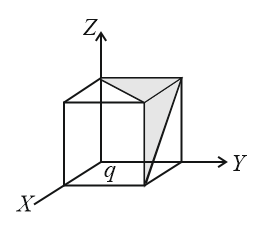
A charge $$q$$ is placed at one corner of a cube as shown in figure. The flux of electrostatic field $$\vec{E}$$ through the shaded area is:

Question 112 JEE Mains

Two charged thin infinite plane sheets of uniform charge density $$\sigma_+$$ and $$\sigma_-$$, where $$|\sigma_+| > |\sigma_-|$$, intersect at the right angle. Which of the following best represents the electric field lines for the system:

Question 113 JEE Mains

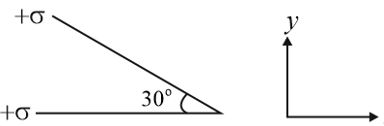
Two infinite planes each with uniform surface charge density $$+\sigma$$ are kept in such a way that the angle between them is 30$$^\circ$$. The electric field in the region shown between them is given by:

Question 114 JEE Mains

For a uniformly charged ring of radius $$R$$, the electric field on its axis has the largest magnitude at a distance $$h$$ from its centre. Then value of $$h$$ is:

Question 115 JEE Mains

An electric dipole has fixed dipole moment $$\vec{p}$$, which makes angle $$\theta$$ with respect to $$x$$-axis. When subjected to an electric field $$\vec{E}_{1} = E\hat{i}$$, it experiences a torque $$\vec{T}_{1} = \tau\hat{k}$$. When subjected to another electric field $$\vec{E}_{2} = \sqrt{3}E_{1}\hat{j}$$, it experiences a torque $$\vec{T}_{2} = -\vec{T}_{1}$$. The angle $$\theta$$ is:

Question 116 JEE Mains

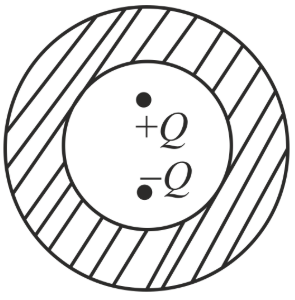
Shown in the figure are two point charges $$+Q$$ and $$-Q$$ inside the cavity of a spherical shell. The charges are kept near the surface of the cavity on opposite sides of the centre of the shell. If $$\sigma_1$$ is the surface charge on the inner surface and $$Q_1$$ net charge on it and $$\sigma_2$$ the surface charge on the outer surface and $$Q_2$$ net charge on it then:

image
Question 117 JEE Mains

Three positive charges of equal value $$q$$ are placed at vertices of an equilateral triangle. The resulting lines of force should be sketched as in

Question 118 JEE Mains

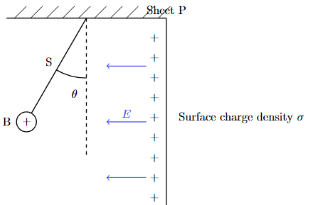
A charged ball $$B$$ hangs from a silk thread $$S$$ which makes an angle $$\theta$$ with a large charged conducting sheet $$P$$, as show in the figure. The surface charge density $$\sigma$$ of the sheet is proportional to

image
Question 119 JEE Mains

Two spherical conductor $$B$$ and $$C$$ having equal radii and carrying equal charges in them repel each other with a force $$F$$ when kept apart at some distance. A third spherical conductor having same radius as that of $$B$$ but uncharged brought in contact with $$B$$, then brought in contact with $$C$$ and finally removed away from both. The new force of repulsion, between $$B$$ and $$C$$ is

Question 120 JEE Advanced

A positive point charge of $$10^{-8}$$ C is kept at a distance of 20 cm from the center of a neutral conducting sphere of radius 10 cm. The sphere is then grounded and the charge on the sphere is measured. The grounding is then removed and subsequently the point charge is moved a distance of 10 cm further away from the center of the sphere along the radial direction. Taking $$\frac{1}{4\pi\epsilon_0} = 9 \times 10^9$$ Nm$$^2$$/C$$^2$$ (where $$\epsilon_0$$ is the permittivity of free space), which of the following statements is/are correct:

Question 121 JEE Mains

An infinitely long wire has uniform linear charge density $$\lambda = 2$$ nC/m. The net flux through a Gaussian cube of side length $$\sqrt{3}$$ cm, if the wire passes through two corners of the cube that are maximally displaced from each other, would be $$x$$   Nm$$^2$$C$$^{-1}$$, where x is :
[Neglect any edge effects and use $$\frac{1}{4\pi\epsilon_0}= 9\times10^{9}$$ SI units]

Question 122 JEE Mains

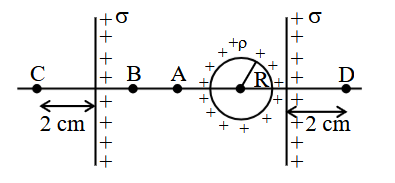
Two infinite identical charged sheets and a charged spherical body of charge density '$$\rho$$' are arranged as shown in figure. Then the correct relation between the electrical fields at A, B, C and D points is:

image
Question 123 JEE Mains

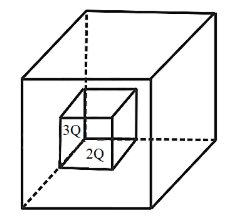
$$C_1$$ and $$C_2$$ are two hollow concentric cubes enclosing charges $$2Q$$ and $$3Q$$ respectively as shown in figure. The ratio of electric flux passing through $$C_1$$ and $$C_2$$ is

image
Question 124 JEE Mains

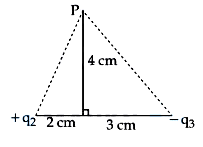
If the net electric field at point P along Y axis is zero, then the ratio of $$\left|\frac{q_2}{q_3}\right|$$ is $$\frac{8}{5\sqrt{x}}$$, where $$x =$$ _____

page4_img2
Question 125 JEE Mains


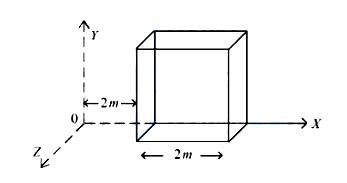
An electric field $$\vec{E} = (2x\hat{i}) \text{ NC}^{-1}$$ exists in space. A cube of side $$2 \text{ m}$$ is placed in the space as per figure given below.

page4_img3

The electric flux through the cube is ______ $$\text{Nm}^2/\text{C}$$.

Question 126 JEE Mains

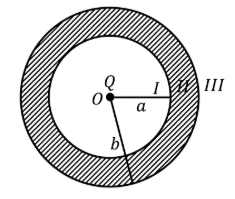
As shown in the figure, a point charge $$Q$$ is placed at the centre of conducting spherical shell of inner radius $$a$$ and outer radius $$b$$. The electric field  in three different regions I, II and III is given by:
(I: $$r < a$$, II: $$a < r < b$$, III: $$r > b$$)

image
Question 127 JEE Mains

A charge of $$4\mu C$$ is to be divided into two. The distance between the two divided charges is constant. The magnitude of the divided charges so that the force between them is maximum, will be:

Question 128 JEE Mains

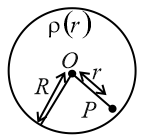
A spherically symmetric charge distribution is considered with charge density varying as $$\rho(r) = \begin{cases} \rho_0\left(\frac{3}{4} - \frac{r}{R}\right) & \text{for } r \leq R \\ 0 & \text{for } r > R \end{cases}$$
Where, $$r(r < R)$$ is the distance from the centre O (as shown in figure). The electric field at point P will be:

Question 129 JEE Mains

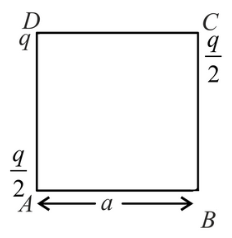
The three charges $$\frac{q}{2}, q$$ and $$\frac{q}{2}$$ are placed at the corners $$A, D$$ and $$C$$ of a square of side $$a$$ as shown in figure. The magnitude of electric field ($$E$$) at the corner $$B$$ of the square, is

image
Question 130 JEE Mains

Two point charges $$Q$$ each are placed at a distance $$d$$ apart. A third point charge $$q$$ is placed at a distance $$x$$ from mid-point on the perpendicular bisector. The value of $$x$$ at which charge $$q$$ will experience the maximum Coulomb's force is:

Question 131 JEE Mains

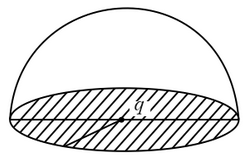
If a charge $$q$$ is placed at the centre of a closed hemispherical non-conducting surface, the total flux passing through the flat surface would be

image
Question 132 JEE Advanced

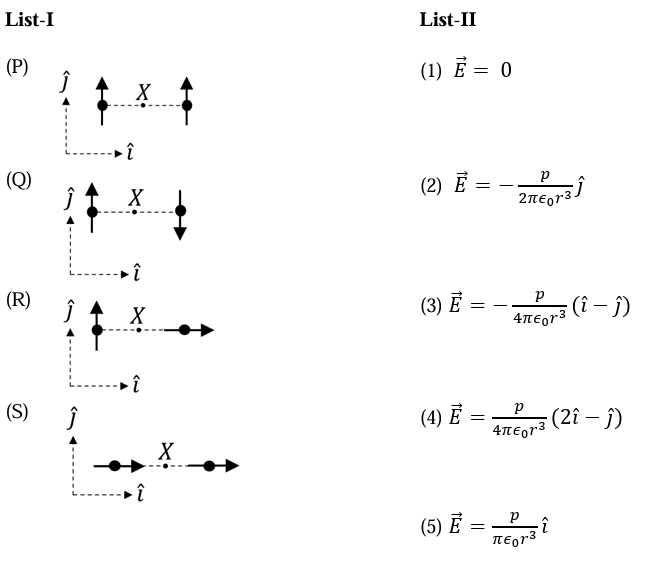
List-I shows four configurations, each consisting of a pair of ideal electric dipoles. Each dipole has a dipole moment of magnitude $$p$$, oriented as marked by arrows in the figures. In all the configurations the dipoles are fixed such that they are at a distance $$2r$$ apart along the $$x$$ direction. The midpoint of the line joining the two dipoles is $$X$$. The possible resultant electric fields $$\vec{E}$$ at $$X$$ are given in List-II.

Choose the option that describes the correct match between the entries in List-I to those in List-II.

image
Question 133 JEE Mains

A small uncharged conducting sphere is placed in contact with an identical sphere but having $$4\times10^{-8} C$$ charge and then removed to a distance such that the force of repulsion between them is $$9\times10^{-3} N$$. The distance between them is $$ \text{ (Take } \frac{1}{4\pi \epsilon_o} \text{ as }9\times10^{9} \text{ in SI units)}$$

Question 134 JEE Mains

Two metal spheres of radius R and 3R have same surface charge density $$\sigma$$. If they are brought in contact and then separated, the surface charge density on smaller and bigger sphere becomes $$\sigma_1$$ and $$\sigma_2$$, respectively. The ratio $$\frac{\sigma_1}{\sigma_2}$$ is :

Question 135 JEE Mains

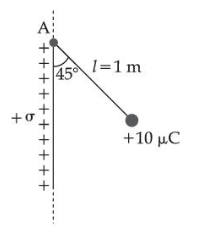
A small bob of mass 100 $$\mu g$$ and charge $$+10$$ $$\mu$$C is connected to an insulating string of length 1 m. It is brought near to an infinitely long non-conducting sheet of charge density '$$\sigma$$' as shown in figure. If string subtends an angle of 45° with sheet at equilibrium the charge density of sheet will be:

(Given, $$\epsilon_0 = 8.85 \times 10^{-12}$$ F/m and acceleration due to gravity, $$g = 10$$ m/s$$^2$$)

image
Question 136 JEE Mains

Consider a circular loop that is uniformly charged and has a radius $$a\sqrt{2}$$. Find the position along the positive z-axis of the cartesian coordinate system where the electric field is maximum if the ring was assumed to be placed in xy-plane at the origin :

Question 137 JEE Mains

The electric field in a region is given by $$\vec{E} = (2\hat{i} + 4\hat{j} + 6\hat{k}) \times 10^3$$ N/C. The flux of the field through a rectangular surface parallel to x-z plane is 6.0 Nm$$^2$$C$$^{-1}$$. The area of the surface is _____ cm$$^2$$.

Question 138 JEE Mains

Two charges of $$5Q$$ and $$-2Q$$ are situated at the points $$(3a, 0)$$ and $$(-5a, 0)$$ respectively. The electric flux through a sphere of radius $$4a$$ having centre at origin is:

Question 139 JEE Mains

A $$10 \ \mu$$C charge is divided into two parts and placed at $$1$$ cm distance so that the repulsive force between them is maximum. The charges of the two parts are:

Question 140 JEE Mains

Graphical variation of electric field due to a uniformly charged insulating solid sphere of radius R, with distance r from the centre O is represented by:

Question 141 JEE Mains

A certain charge $$Q$$ is divided into two parts $$q$$ and $$(Q - q)$$. How should the charges $$Q$$ and $$q$$ be divided so that $$q$$ and $$(Q - q)$$ placed at a certain distance apart experience maximum electrostatic repulsion?

Question 142 JEE Mains

A particle of charge $$q$$ and mass $$m$$ is projected  from origin with an initial velocity has $$\vec{v} = \frac{v_0}{\sqrt{2}}\hat{x} + \frac{v_0}{\sqrt{2}}\hat{y}$$. There exists a uniform magnetic field $$\vec{B} = B_0\hat{z}$$ and a space varying electric field $$\vec{E} = E_0 e^{-\lambda x}\hat{x}$$ within the region $$0 \leq x \leq L$$. After travelling a distance such that x-coordinate has changed from $$x=0$$ to $$x=L$$, the change in the kinetic energy  is_________.

Question 143 JEE Mains

A particle of charge $$-q$$ and mass $$m$$ moves in a circle of radius $$r$$ around an infinitely long line charge of linear density $$+\lambda$$. Then time period will be given as: (Consider $$k$$ as Coulomb's constant)

Question 144 JEE Mains

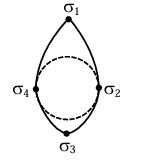
Electric charge is transferred to an irregular metallic disk as shown in figure. If $$\sigma_1$$, $$\sigma_2$$, $$\sigma_3$$ and $$\sigma_4$$ are charge densities at given points then, choose the correct answer from the options given below :

image

(A) $$\sigma_1 > \sigma_3 \; ; \; \sigma_2 = \sigma_4$$             (B) $$\sigma_1 > \sigma_2 \; ; \; \sigma_3 > \sigma_4$$

(C) $$\sigma_1 > \sigma_3 > \sigma_2 = \sigma_4$$                   (D) $$\sigma_1 = \sigma_2 = \sigma_3 = \sigma_4$$

(E) $$\sigma_1 = \sigma_2 > \sigma_3 = \sigma_4$$

Question 145 JEE Mains

Two point charges $$-4\mu c$$ and $$4\mu c$$, constituting an electric dipole, are placed at (−9, 0, 0)cm and (9, 0, 0)cm in a uniform electric field of strength $$10^{4}NC^{-1}$$. The work done on the dipole in rotating it from the equilibrium through $$180^{\circ}$$ is :

Question 146 JEE Mains

A point charge $$+q$$ is placed at the origin. A second point charge $$+9q$$ is placed at $$(d, 0, 0)$$ in Cartesian coordinate system. The point in between them where the electric field vanishes is:

Question 147 JEE Mains


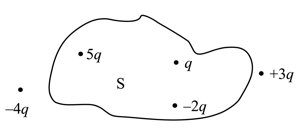
Five charges $$+q, +5q, -2q, +3q$$ and $$-4q$$ are situated as shown in the figure.

image

The electric flux due to this configuration through the surface $$S$$ is :

Question 148 JEE Mains

A rigid dipole undergoes a simple harmonic motion about its centre in the presence of an electric field $$\vec{E}_1 = E_0\hat{x}$$. If another electric field $$\vec{E}_2 = 2E_0(\hat{y} + \hat{z})$$ is introduced to the system, what will be the percentage change in the frequency of the oscillation (approximate)?

Question 149 JEE Mains

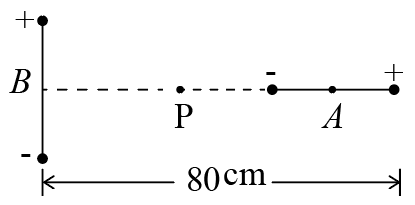
Two shorts dipoles $$(A, B)$$, $$A$$ having charges $$\pm 2\mu C$$ and length 1 cm and $$B$$ having charges $$\pm 4\mu C$$ and length 1 cm are placed with their centres 80 cm apart as shown in the figure. The electric field at a point $$P$$ , equi-distant from the centres of both dipoles is ____ N/ C.

45
Question 150 JEE Advanced

Consider an electric dipole comprising two charges $$+q$$ and $$-q$$ each with mass $$m$$, separated by a fixed distance $$d$$ and initially at rest with its dipole moment pointing along $$\hat{i}$$. A uniform electric field $$E\hat{j}$$ is turned on at time $$t=0$$ and it is turned off at $$t=t_f$$, when the dipole moment makes an angle $$\theta_f$$ with $$\hat{i}$$. Neglecting any sources of energy loss, correct option(s) is/are:

Question 151 JEE Advanced

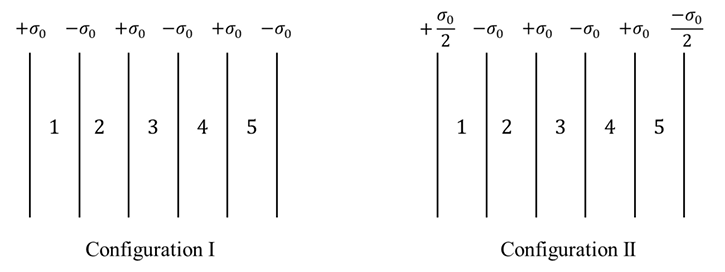
Six infinitely large and thin non-conducting sheets are fixed in configurations I and II. As shown in the figure, the sheets carry uniform surface charge densities which are indicated in terms of $$\sigma_0$$. The separation between any two consecutive sheets is $$1 \, \mu$$m. The various regions between the sheets are denoted as 1, 2, 3, 4 and 5. If $$\sigma_0 = 9 \, \mu$$C/m$$^2$$, then which of the following statements is/are correct:

(Take permittivity of free space $$\epsilon_0 = 9 \times 10^{-12}$$ F/m)

image
Question 152 JEE Mains

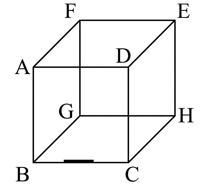
A line charge of length $$\frac{'a'}{2}$$is kept at the center of an edge BC of a cube ABCDEFGH having edge length 'a' as shown in the figure. If the density of line charge is $$\lambda C$$ per unit length, then the total electric flux through

image

all the faces of the cube will be . (Take, $$\epsilon _o$$ as the free space permittivity)

Question 153 JEE Mains

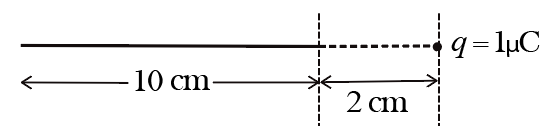
A point charge q = l $$\mu C$$ is located at a distance 2 cm from one end of a thin insulating wire of length 10 cm having a charge Q = 24 $$\mu C$$, distributed uniformly along its length, as shown in figure. Force between q and wire is __ N.
(Use: $$\frac{1}{4\pi\epsilon_{0}}=9 \times10^{9} N.m^{2}/C^{2}$$)

image
Question 154 JEE Mains

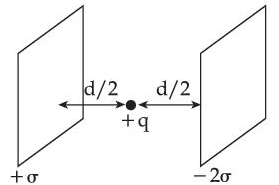
Consider two infinitely large plane parallel conducting plates as shown below. The plates are uniformly charged with a surface charge density $$+\sigma$$ and $$-2\sigma$$. The force experienced by a point charge $$+q$$ placed at the mid point between two plates will be:

image
Question 155 JEE Mains

If $$\epsilon_0$$ denotes the permittivity of free space and $$\Phi_E$$ is the flux of the electric field through the area bounded by the closed surface, then dimension of $$\left(\epsilon_0 \frac{d\Phi_E}{dt}\right)$$ are that of :

Question 156 JEE Mains

A metallic ring is uniformly charged as shown in figure. AC and BD are two mutually perpendicular diameters. Electric field due to arc AB to 'O' is 'E' is magnitude. What would be the magnitude of electric field at 'O' due to arc ABC?

image
Question 157 JEE Mains

A thin half ring of radius 35 cm is uniformly charged with a total charge of $$Q$$ coulomb. If the magnitude of the electric field at centre of the half ring is 100 V/m, then the value of $$Q$$ is _______ nC.
$$(\varepsilon_0 = 8.85 \times 10^{-12}$$ C$$^2$$/Nm$$^2$$ and $$\pi = 3.14)$$

Question 158 JEE Mains

Two point charges $$q_1 = 3 \, \mu C$$ and $$q_2 = -4 \, \mu C$$ are placed at points $$(2\hat{i} + 3\hat{j} + 3\hat{k})$$ and $$(\hat{i} + \hat{j} + \hat{k})$$ respectively. Force on charge $$q_2$$ is __________ N. $$\left(\text{Take } \frac{1}{4\pi\epsilon_0} = 9 \times 10^9 \text{ SI Units}\right)$$

Question 159 JEE Mains

Given below are two statements : one is labelled as Assertion (A) and the other is labelled as Reason (R).

Assertion (A) : Net dipole moment of a polar linear isotropic dielectric substance is not zero even in the absence of an external electric field.

Reason (R) : In absence of an external electric field, the different permanent dipoles of a polar dielectric substance are oriented in random directions.

In the light of the above statements, choose the most appropriate answer from the options given below :

Question 160 JEE Mains

Given below are two statements : one is labelled as Assertion (A) and the other is labelled as Reason (R).
Assertion (A) : The outer body of an air craft is made of metal which protects persons sitting inside from lightning-strikes.
Reason (R) : The electric field inside the cavity enclosed by a conductor is zero.
In the light of the above statements, choose the most appropriate answer from the options given below :

Question 161 JEE Mains

Given below are two statements: one is labelled as Assertion A and the other is labelled as Reason R
Assertion A :
Work done in moving a test charge between two points inside a uniformly charged spherical shell is zero, no matter which path is chosen.
Reason R : Electrostatic potential inside a uniformly charged spherical shell is constant and is same as that on the surface of the shell.
Choose the correct answer :

Question 162 JEE Mains

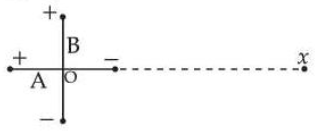
Two short electric dipoles A and B having dipole moment p$$_1$$ and p$$_2$$ respectively are placed with their axis mutually perpendicular as shown in the figure. The resultant electric field at a point x is making an angle of 60° with the line joining points O and x. The ratio of the dipole moments p$$_2$$/p$$_1$$ is __________.

image
Question 163 JEE Mains

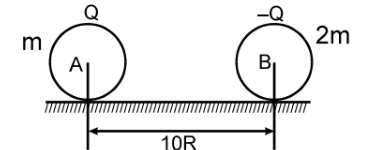
Two smooth spherical non conducting shells each of radius $$R$$ having uniformly distributed charge $$Q$$ & $$-Q$$ on their surfaces are released on a smooth non-conducting surface when the distance between their centers is $$10R$$. The mass of A is $$m$$ and that of B is $$2m$$. The speed of A just before A and B collide is: [Neglect gravitational interaction]

image
Question 164 JEE Mains

Given below are two statements: one is labelled as Assertion A and the other is labelled as Reason R

Assertion A: In electrostatics, a conductor does not store any net charge inside.

Reason R: Inside the capacitor (with no dielectric medium), the free charge carriers, if placed between the plates of capacitor, experience force and drift.
Choose the correct answer from the options given below:

Question 165 JEE Mains

Two point charges $$8\,\mu$$C and $$-2\,\mu$$C are located at $$x = 2$$ cm and $$x = 4$$ cm, respectively on the x-axis. The ratio of electric flux due to these charges through two spheres of radii 3 cm and 5 cm with their centers at the origin is _______.

Question 166 JEE Mains

The electric potential as a function of $$x, y$$ is given by $$V = 5(x^2 - y^2)$$ V. The electric field at a point $$(2, 3)$$ m is __________ V/m.

Question 167 JEE Mains

A simple pendulum has a bob with mass $$m$$ and charge $$q$$. The pendulum string has negligible mass. When a uniform and horizontal electric field it is applied, the tension in the string changes. The final tension in the string, when pendulum attains an equilibrium position is ______.
($$g$$: acceleration due to gravity)

Question 168 JEE Mains

Three charges+ 2q, +3q and -4q are situated at (0, -3a), (2a, 0) and (-2a, 0) respectively in the x y plane. The resultant dipole moment about origin is ___ .

Question 169 JEE Mains

Two charged conducting spheres S$$_1$$ and S$$_2$$ of radii 8 cm and 18 cm are connected to each other by a wire. After equilibrium is established, the ratio of electric fields on S$$_1$$ and S$$_2$$ spheres are E$$_{S1}$$ and E$$_{S2}$$ respectively. The value of $$\frac{E_{S1}}{E_{S2}}$$ is __________.

Question 170 JEE Mains

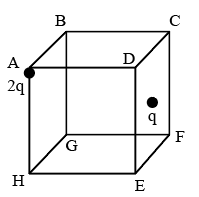
Two point charges 2q and q are placed at vertex A and centre of face CDEF of the cube as shown in figure. The electric flux passing through the cube is :

35
Question 171 JEE Mains

Consider two identical metallic spheres of radius R each having charge Q and mass m. Their centers have an initial separation of 4R. Both the spheres are given an initial speed of u towards each other. The minimum value of u, so that they can just touch each other is :
(Take $$k= \frac{1}{4\pi \epsilon_{0}}$$ and assume $$kQ^{2}$$ > $$Gm^{2}$$ where G is the Gravitational constant)

Question 172 JEE Mains

Identify the correct statements :
A. Electrostatic field lines form closed loops .
B. The eleclric field lines point radially outward when charge is greater than zero.
C. The Gauss - Law is valid only for inverse - square force.
D. The workdone in moving a charged particle in a static eleclric field around a closed path is zero.
E. The motion of a particle under Coulomb's force must take place in a plane.
Choose the correct answer from the options given below:

Practising these questions regularly can improve conceptual clarity, numerical accuracy, and confidence in solving Physics problems. The PDF can also be used along with JEE Questions, previous year papers, formula revision, and other chapter-wise preparation resources.

What You GetDetails
JEE Electrostatics QuestionsQuestions covering important Electrostatics concepts
Practice PDFDownloadable PDF for focused chapter-wise practice
Video SolutionsStep-by-step solutions to the questions
Detailed ExplanationsConcepts, formulas, calculations, and approach
Expert GuidanceSolutions explained by IITians
Exam PreparationUseful for JEE Main and JEE Advanced

Use the PDF after completing the basic concepts of Electrostatics. Try each question yourself before checking the explanation so that you can identify where your approach needs improvement.

Important Electrostatics Topics for JEE

Electrostatics is a fundamental part of JEE Physics and provides the foundation for several concepts in electricity and magnetism. Students should understand the physical meaning of electric field, potential, flux, and capacitance instead of relying only on formula memorisation.

The following topics should be covered carefully:

Electrostatics TopicKey Areas to Practise
Electric ChargeProperties and conservation of charge
Coulomb's LawForce between point charges
Electric FieldField due to point and continuous charge distributions
Electric DipoleField, potential, torque, and dipole moment
Electric PotentialPotential due to charges and potential difference
Electric FluxFlux through surfaces and symmetry-based problems
Gauss's LawApplications to spherical, cylindrical, and planar systems
ConductorsCharge distribution and electric field inside conductors
CapacitanceCombination of capacitors and dielectric effects
Electrostatic EnergyEnergy stored in capacitors and charged systems

Many JEE Questions from Electrostatics require students to connect multiple concepts. For example, a problem may combine Coulomb's law with the principle of superposition, or use electric potential and energy to determine the motion of a charged particle.

Students should also practise symmetry-based problems because identifying symmetry can significantly simplify electric field and flux calculations. Detailed Electrostatics JEE Notes can be useful for revising definitions, important results, diagrams, and formulas before starting a question set.

JEE Main & Advanced Electrostatics Weightage Analysis

The exact number of Electrostatics questions is not fixed in every JEE Main shift or JEE Advanced paper. The distribution can vary between years, shifts, and papers. Therefore, JEE Physics Chapter Wise weightage should be treated as a preparation reference rather than a guarantee of the number of questions that will appear.

Electrostatics can include direct formula-based questions as well as conceptual, graphical, and multi-step numerical problems.

TopicCommon Question Types
Coulomb's LawForce and superposition of charges
Electric FieldField due to point and distributed charges
Electric PotentialPotential, potential difference, and energy
Electric DipoleField, torque, and potential
Electric FluxFlux through closed and symmetric surfaces
Gauss's LawField calculations using symmetry
ConductorsCharge distribution and electrostatic equilibrium
CapacitanceEquivalent capacitance and dielectric problems
EnergyEnergy stored in capacitors and charged systems

For JEE Main, students should practise standard numerical and conceptual problems and solve a JEE Mains Previous Year Paper to understand how Electrostatics concepts are presented in the actual examination.

For JEE Advanced, include more problems involving superposition, symmetry, multiple charges, changing configurations, and combinations of field, potential, and energy. Understanding the underlying concept is more useful than preparing only according to expected weightage.

Why Practice JEE Electrostatics Questions?

Electrostatics contains several closely related quantities, so students may sometimes confuse electric field with potential or force with energy. Regular problem-solving helps build a clear understanding of these relationships.

Practising JEE Electrostatics Questions can help you:

  • Strengthen the fundamentals of electrostatics.
  • Understand when to use field, potential, force, or energy methods.
  • Improve numerical speed and calculation accuracy.
  • Develop better understanding of symmetry and Gauss's law.
  • Identify common mistakes in signs, directions, and units.
  • Build confidence before attempting full-length tests.

A useful practice cycle is learn the concept → revise formulas → solve the question → check the solution → analyse the mistake → practise a similar question.

Students following a JEE Physics Course can use these questions after completing the Electrostatics lessons. Chapter-wise practice helps reinforce concepts while they are still fresh and makes it easier to identify weak areas.

The detailed video solutions in the PDF are particularly useful when a question is difficult to solve independently. Instead of checking only the final answer, compare the complete reasoning with your own method and note the step where your approach differs.

Tips to Solve Electrostatics Questions Faster

Electrostatics questions become easier when you first identify the physical quantity being asked and then select the most suitable method. The following strategies can improve speed and accuracy.

1. Identify the concept first

Determine whether the problem involves Coulomb's law, electric field, potential, dipole, flux, Gauss's law, capacitance, or electrostatic energy before starting the calculation.

2. Revise the core formulas

Keep the important equations in your JEE Physics Formula Sheet and revise them regularly.

Concept

Formula

Coulomb's Law

(F=\frac{1}{4\pi\epsilon_0}\frac{q_1q_2}{r^2})

Electric Field

(E=\frac{1}{4\pi\epsilon_0}\frac{q}{r^2})

Electric Potential

(V=\frac{1}{4\pi\epsilon_0}\frac{q}{r})

Electric Dipole Moment

(p=q(2a))

Electric Flux

(\Phi_E=\frac{q_{\text{enclosed}}}{\epsilon_0})

Capacitance

(C=\frac{Q}{V})

Capacitor Energy

(U=\frac{1}{2}CV^2)

3. Use superposition carefully

When multiple charges are present, calculate the contribution from each charge separately and then combine the results using the correct vector or scalar relationship.

4. Look for symmetry

Before performing lengthy calculations, check whether the charge distribution has spherical, cylindrical, or planar symmetry. Recognising symmetry can make Gauss's law problems much faster to solve.

5. Check signs and directions

Electric field and force are vector quantities, while electric potential is scalar. Pay close attention to direction, sign, and the nature of the charge before combining quantities.

6. Practise JEE Electrostatics PYQ

After completing the theory, solve JEE Electrostatics PYQ questions to understand how the concepts are tested in actual examination problems. Reviewing the detailed solutions can help you identify shortcuts and common errors.

Finally, use chapter-wise question practice before attempting a Free JEE Mains Mock test. Analyse incorrect answers after the test and revise the specific Electrostatics concepts responsible for those mistakes. Consistent practice with questions, formulas, and previous year problems can improve both speed and accuracy in JEE Physics.

Frequently Asked Questions