91- 6303239042
 JEE WhatsApp Group


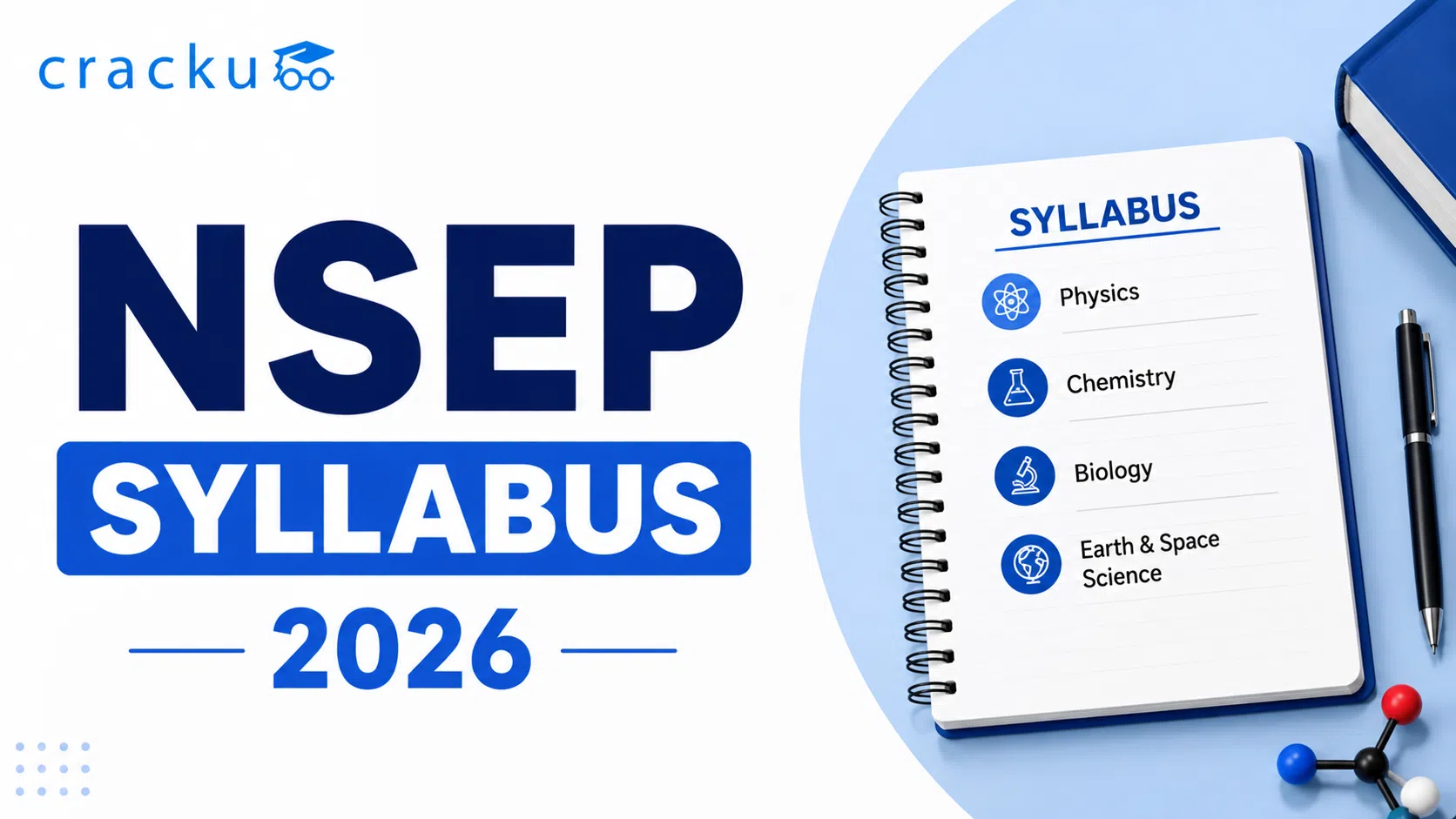
NSEP Syllabus 2026
The NSEP Syllabus 2026 provides a structured roadmap for students preparing for the National Standard Examination in Physics, conducted by the Indian Association of Physics Teachers (IAPT). The syllabus is broadly aligned with the Physics curriculum at the senior-secondary level and focuses on developing strong conceptual understanding, analytical thinking and problem-solving skills.
Understanding the complete syllabus helps students plan their preparation effectively, identify important topics and allocate sufficient time to challenging concepts. Along with studying the prescribed topics, students should practise numerical problems, previous-year NSEP questions and application-based questions to improve accuracy and speed. A systematic approach to the NSEP 2026 syllabus can help students build confidence and prepare effectively for the examination.
NSEP Syllabus 2026 PDF
Check out the NSEP Syllabus 2026 PDF below to get the complete syllabus and understand the topics you need to cover for the National Standard Examination in Physics. The official IAPT syllabus is broadly equivalent to the CBSE Class 12 Physics syllabus.
NSEP Important Topics 2026
The NSEP 2026 syllabus is broadly aligned with the CBSE Class 11 and 12 Physics syllabus. Since the exam tests conceptual understanding and problem-solving ability, students should give extra attention to the following high-priority topics.
Physics Unit |
Important Topics for NSEP 2026 |
Priority |
Mechanics |
Kinematics, Laws of Motion, Work, Energy and Power, Circular Motion, Centre of Mass, Momentum and Collisions |
Very High |
Rotational Motion |
Torque, Angular Momentum, Moment of Inertia, Rolling Motion and Rotational Dynamics |
High |
Gravitation |
Gravitational Field and Potential, Satellites, Escape Velocity and Kepler's Laws |
High |
Properties of Matter |
Elasticity, Fluid Mechanics, Viscosity, Surface Tension and Bernoulli's Principle |
Medium |
Thermodynamics |
Laws of Thermodynamics, Heat Engines, Refrigerators and Kinetic Theory of Gases |
Very High |
Oscillations and Waves |
SHM, Wave Motion, Sound Waves, Superposition, Standing Waves and Doppler Effect |
Very High |
Electrostatics |
Electric Charges and Fields, Gauss's Law, Electric Potential and Capacitance |
Very High |
Current Electricity |
Ohm's Law, Kirchhoff's Laws, Resistance, Cells, Wheatstone Bridge and Electrical Instruments |
Very High |
Magnetism |
Moving Charges and Magnetism, Magnetic Field, Lorentz Force, Biot–Savart Law and Ampere's Law |
Very High |
Electromagnetic Induction and AC |
Faraday's Law, Lenz's Law, Self and Mutual Induction, AC Circuits, LCR Circuits and Resonance |
Very High |
Electromagnetic Waves |
Properties of EM Waves, Electromagnetic Spectrum and Applications |
Medium |
Optics |
Ray Optics, Optical Instruments, Mirrors, Lenses, Wave Optics, Interference and Diffraction |
Very High |
Dual Nature of Matter and Radiation |
Photoelectric Effect, Einstein's Equation, de Broglie Wavelength and Matter Waves |
High |
Atoms and Nuclei |
Rutherford Model, Bohr Model, Hydrogen Spectrum, Radioactivity, Nuclear Binding Energy, Fission and Fusion |
High |
Semiconductors |
Semiconductor Devices, p-n Junction, Diodes, Rectifiers, Zener Diode, LED, Photodiode and Solar Cell |
High |
Units and Measurements |
Dimensions, Significant Figures, Errors, Accuracy and Precision and Measurement Techniques |
Medium |
NSEP Syllabus 2026: Topic-Wise Weightage
The official IAPT syllabus does not prescribe a fixed chapter-wise weightage for NSEP 2026. The examination syllabus is broadly equivalent to the CBSE Class 12 Physics level. Therefore, the table below uses previous-year NSEP paper analysis as an indicative guide rather than an official 2026 distribution.
Topic/Chapter |
Approx. Weightage |
Priority |
Ray Optics and Optical Instruments | 11.25% | Very High |
Work, Energy and Power | 5.75% | Very High |
Oscillations | 5.50% | Very High |
Mechanical Properties of Fluids | 5.25% | Very High |
Moving Charges and Magnetism | 5.25% | Very High |
Waves | 5.00% | High |
Alternating Current | 4.50% | High |
Electric Charges and Fields | 4.50% | High |
Thermal Properties of Matter | 4.50% | High |
Current Electricity | 4.25% | High |
Dual Nature of Radiation and Matter | 4.25% | High |
Semiconductor Electronics | 4.25% | High |
System of Particles and Rotational Motion | 4.00% | High |
Electrostatic Potential and Capacitance | 3.50% | Moderate |
Thermodynamics | 3.00% | Moderate |
Wave Optics | 3.00% | Moderate |
Atoms | 2.75% | Moderate |
Electromagnetic Induction | 2.25% | Moderate |
Motion in a Plane | 3.75% | Moderate |
Laws of Motion | 2.50% | Moderate |
Gravitation | 2.00% | Moderate |
Units and Measurements | 2.00% | Moderate |
Nuclei | 1.50% | Moderate |
Kinetic Theory | 1.25% | Moderate |
Magnetism and Matter | 1.25% | Moderate |
Electromagnetic Waves | 1.00% | Low |
Mechanical Properties of Solids | 0.75% | Low |
Students should use the indicative weightage only to prioritise their preparation and should not completely skip any chapter. After covering the important concepts, they should solve NSEP previous year papers to understand the question pattern, difficulty level and frequently tested topics. Regular paper analysis can also help students identify weak areas and improve their speed and accuracy.
Also Read: NSEC Exam Date 2026, Registration Schedule and Pattern
Best Books and Study Resources for NSEP 2026
Choosing the right study material is important for NSEP preparation because the exam tests conceptual understanding, application and problem-solving skills rather than simple formula-based learning. The official IAPT syllabus for NSEP 2026 is broadly equivalent to the Class 12 CBSE Physics level.
Book/Resource |
Best For |
How to Use It |
NCERT Physics Class 11 and 12 |
Building fundamentals |
Read concepts, examples, diagrams and important derivations thoroughly. |
Concepts of Physics by H.C. Verma – Vol. 1 and 2 |
Conceptual clarity and problem-solving |
Make this your primary reference book after completing NCERT. |
Understanding Physics by D.C. Pandey |
Additional numerical practice |
Practise chapter-wise questions after strengthening concepts. |
Fundamentals of Physics by Halliday, Resnick and Walker |
In-depth conceptual understanding |
Use selected chapters when you need deeper explanations. |
Problems in General Physics by I.E. Irodov |
Advanced problem-solving |
Attempt selected problems after mastering H.C. Verma and NSEP-level questions. |
NSEP Previous Year Question Papers |
Understanding the actual exam level |
Solve papers under timed conditions and analyse every mistake. |
JEE Advanced Physics PYQs |
Application-based practice |
Use challenging questions to improve multi-concept problem-solving. |
IAPT Official Resources |
Syllabus, papers and official information |
Regularly check IAPT for NSEP 2026 updates, question papers and solutions. |
Also Read: NSEP Registration Date 2026, Fee and Eligibility Criteria
Common Mistakes to Avoid While Preparing the NSEP Syllabus
Preparing for NSEP requires more than simply completing the syllabus. Since the examination focuses heavily on conceptual understanding and application, students should avoid these common mistakes:
Common Mistake |
Why It Can Be a Problem |
What to Do Instead |
Relying only on NCERT |
NCERT is excellent for fundamentals but may not provide enough challenging problems for NSEP-level preparation. |
Use NCERT for concepts and supplement it with H.C. Verma, PYQs and advanced problems. |
Memorising formulas without understanding them |
NSEP questions often require applying concepts in unfamiliar situations. |
Understand the derivation, assumptions and physical meaning behind each formula. |
Ignoring Class 11 topics |
NSEP preparation covers a broad Physics syllabus, and strong Class 11 fundamentals are essential. |
Revise Mechanics, Thermodynamics, Waves and other Class 11 concepts thoroughly. |
Skipping difficult chapters |
Avoiding challenging topics can leave major gaps in preparation. |
Identify weak areas early and practise them regularly. |
Solving only easy questions |
Easy problems may not develop the analytical skills needed for the exam. |
Gradually move from basic questions to Olympiad- and NSEP-level problems. |
Not practising previous-year papers |
Students may be unfamiliar with the question style and difficulty level. |
Solve previous NSEP papers regularly and analyse mistakes afterwards. |
Ignoring units and dimensions |
Calculation and conceptual questions can involve careful dimensional reasoning. |
Practise dimensional analysis, estimation and unit conversions alongside regular problems. |
Neglecting time management |
Spending too long on a single difficult question can affect overall performance. |
Practise timed tests and learn when to skip and return to a question. |
Using too many books at once |
Switching between multiple resources can lead to incomplete preparation and confusion. |
Follow a focused resource plan and complete one source before adding another. |
Also Read: NSEJS Syllabus 2026, Important Topics and Chapter-Wise Weightage
NSEP Syllabus 2026: Conclusion
The NSEP Syllabus 2026 covers a broad range of senior-secondary Physics topics, including Mechanics, Thermodynamics, Electrodynamics, Optics and Modern Physics. Students should understand the complete syllabus, prioritise concept-heavy chapters and avoid relying entirely on unofficial weightage predictions.
Begin with NCERT and standard concept-building resources before moving to previous NSEP papers and advanced problems. Regular numerical practice, timed tests, formula revision and detailed mistake analysis can help students complete the syllabus systematically and improve their speed, accuracy and confidence.
.webp)