

 Group
 Group


 Preferred Source

 Google Discover

JEE Electromagnetic Waves PYQs
JEE Electromagnetic Waves PYQs are previous year questions covering the nature of electromagnetic waves, electric and magnetic field relationships, displacement current, energy transport, and the electromagnetic spectrum. Solving these questions helps you apply the chapter’s concepts to numerical and theory-based problems.
Electromagnetic waves are transverse waves that can travel through a vacuum. In a plane electromagnetic wave in vacuum, the electric and magnetic fields oscillate in phase and are perpendicular to each other and to the direction of propagation. Their relative directions determine the direction in which the wave carries energy.
JEE Electromagnetic Waves Questions may ask you to calculate wavelength, compare field amplitudes, identify a region of the electromagnetic spectrum, or explain displacement current. Before solving, identify whether the question concerns a wave in vacuum or a material medium, and distinguish field amplitudes from instantaneous values.
This page provides downloadable PYQ and formula PDFs, a formula reference, and common mistakes to avoid. Use these resources to revise the main ideas and check your understanding through practice.
JEE Electromagnetic Waves Important PYQs PDF
Download the Top 30 JEE Electromagnetic Waves PYQs PDF for chapter-wise practice. Attempt each question independently before checking its answer or solution. For numerical problems, note the given quantities and convert them into consistent units before calculating.
While practising JEE Mains previous papers, review how questions test field directions, wave speed, displacement current, and spectrum properties. For theory questions, explain why the selected option is correct and why the other options do not apply.
Keep a short record of mistakes, such as reversing the spectrum order or confusing peak and RMS field values. Reattempt those questions after revision to check whether you have corrected the underlying concept.
Important Formulas for JEE Electromagnetic Waves PYQs
The main formulas in this chapter connect wave speed, frequency, wavelength, electric and magnetic fields, energy density, and intensity. Learn the conditions for each expression. For example, E = cB applies to a travelling plane electromagnetic wave in vacuum, while radiation pressure depends on whether the incident radiation is absorbed or reflected.
Download the chapter formula PDF below and use it alongside the JEE Mains Formula sheet PDF for revision across Physics topics.
| Concept | Formula | Condition or Meaning |
|---|---|---|
| Speed of Electromagnetic Waves in Vacuum | $$c = \frac{1}{\sqrt{\mu_0\varepsilon_0}}$$ | Approximately 3 × 10⁸ metres per second. |
| Speed, Frequency, and Wavelength | $$v = f\lambda$$ | In vacuum, v = c. In a material medium, use the wave speed in that medium. |
| Electric and Magnetic Field Amplitudes | $$E_0 = cB_0$$ | For a travelling plane electromagnetic wave in vacuum. |
| Displacement Current | $$I_d = \varepsilon_0\frac{d\Phi_E}{dt}$$ | For electric flux ΦE through a fixed surface in vacuum. |
| Instantaneous Electric Field Energy Density | $$u_E = \frac{1}{2}\varepsilon_0 E^2$$ | E is the instantaneous electric field magnitude in vacuum. |
| Instantaneous Magnetic Field Energy Density | $$u_B = \frac{B^2}{2\mu_0}$$ | B is the instantaneous magnetic field magnitude in vacuum. |
| Total Instantaneous Energy Density | $$u = \varepsilon_0 E^2 = \frac{B^2}{\mu_0}$$ | For a travelling plane wave in vacuum, electric and magnetic energy densities are equal. |
| Average Total Energy Density | $$\langle u\rangle = \frac{1}{2}\varepsilon_0 E_0^2$$ | For a sinusoidal plane wave in vacuum; E₀ is the peak electric field. |
| Average Intensity | $$I = c\langle u\rangle = \frac{1}{2}\varepsilon_0 cE_0^2$$ | Average energy crossing unit area per unit time, measured perpendicular to propagation. |
| Momentum Carried by Radiation | $$p = \frac{U_{\mathrm{rad}}}{c}$$ | For radiation travelling in one direction in vacuum; Uᵣₐᵈ is its energy. |
| Radiation Pressure on a Perfect Absorber | $$P_{\mathrm{rad}} = \frac{I}{c}$$ | For normal incidence, using the average incident intensity. |
| Radiation Pressure on a Perfect Reflector | $$P_{\mathrm{rad}} = \frac{2I}{c}$$ | For normal incidence and complete reflection back along the incident direction. |
Here, ε₀ is the permittivity of vacuum and μ₀ is the permeability of vacuum. Use frequency in hertz, wavelength in metres, electric field in volts per metre, and magnetic field in teslas. When solving JEE Questions on energy and intensity, check whether the field value given is instantaneous, peak, or RMS.
Top 5 Common Mistakes to Avoid in JEE Electromagnetic Waves PYQs
Most errors in this chapter come from overlooking directions, wave conditions, or the meaning of a given quantity. Check these five points during practice.
1. Confusing field directions with the direction of propagation
In a plane electromagnetic wave, the electric field and magnetic field are perpendicular to each other and to propagation. The wave travels in the direction of the vector product E × B. Draw the three directions and use the right-hand rule when the question asks for an unknown direction.
2. Applying E = cB without checking the given values
For a travelling plane wave in vacuum, compare corresponding quantities: peak electric field with peak magnetic field, or RMS electric field with RMS magnetic field. Mixing a peak value with an RMS value gives an incorrect result. In a suitable material medium, the field ratio depends on the wave speed there.
3. Mixing up frequency and wavelength
For waves travelling at the same speed, higher frequency means shorter wavelength. When a wave passes from vacuum into a stationary medium, its frequency remains unchanged, while its speed and wavelength can change. Use the speed appropriate to the medium.
4. Reversing the electromagnetic spectrum order
In order of increasing frequency, the spectrum is radio waves, microwaves, infrared, visible light, ultraviolet, X-rays, and gamma rays. Wavelength decreases along this sequence. Within visible light, violet has a higher frequency and shorter wavelength than red.
5. Misreading statements about displacement current and wave propagation
Electromagnetic waves do not require a material medium. Displacement current is associated with a changing electric flux and does not require charges to cross a vacuum gap. For example, between the plates of an ideal charging capacitor, changing electric flux accounts for displacement current even though no conduction current crosses the gap.
After chapter-wise practice, attempt JEE Mains Mocks to check your recall and accuracy under time pressure. Review both incorrect answers and uncertain guesses, then revise the relevant concept before attempting similar questions again.
List of JEE Electromagnetic Waves PYQs
Here is a short set of JEE-style electromagnetic waves questions for practice. These include common question types from wave speed, field relations, spectrum, and radiation pressure. Solving them regularly can help you become faster and more confident.
Question 1
An electromagnetic wave of frequency 100 MHz propagates through a medium of conductivity, $$\sigma$$ = 10mho/m. The ratio of maximum conduction current density to maximum displacement current
density is ___________.
[Take $$\frac{1}{4\pi \epsilon_{0}} = 9 \times 10^{9} Nm^{2}/C^{2}$$]
correct answer:- 1800
Question 2
The electric field in a plan a electromagnetic wave is given by :
$$E_{y}=69\sin[0.6\times10^{3}x-1.8\times10^{11}t]V/m$$
The expression for magneticfield associated with this electromagnetic wave is ___ T.
correct answer:- 4
Question 3
A laser beam has intensity of $$4.0 \times 10^{14} W/m^{2}.$$ The amplitude of magnetic field associated with beam is____________T. (Take $$\epsilon_{0}= 8.85 \times 10^{-12} C^{2}/Nm^{2}$$ and $$c= 3 \times 10^{8} m/s$$ )
correct answer:- 2
Question 4
The equation of the electric field of an electromagnetic wave propagating through free space is given
by: E=$$\sqrt{377}$$ $$\sin(6.27\times10^{3}t-2.09\times 10^{-5}x)N/C$$
The average power of the electromagnetic wave is $$\left(\frac{1}{\alpha}\right)W/m^{2}$$. The value of $$\alpha$$ is______
$$\left(Take \sqrt{\frac{\mu_{\circ}}{\epsilon_{\circ}}}=377 in SI units \right)$$
correct answer:- 2
Question 5
The electric field of a plane electromagnetic wave, travelling in an unknown non-magnetic medium is given by,
$$ E_{y}=20 \sin (3\times 10^{6}x - 4.5\times 10^{14}t)V/m $$
(where $$x, t$$ and other values have S.I. units). The dielectric constant of the medium iS_________
(speed oflight in free space is $$ 3\times 10^{8} m/s $$)
correct answer:- 4

Question 6
Match the LIST-I with LIST-II
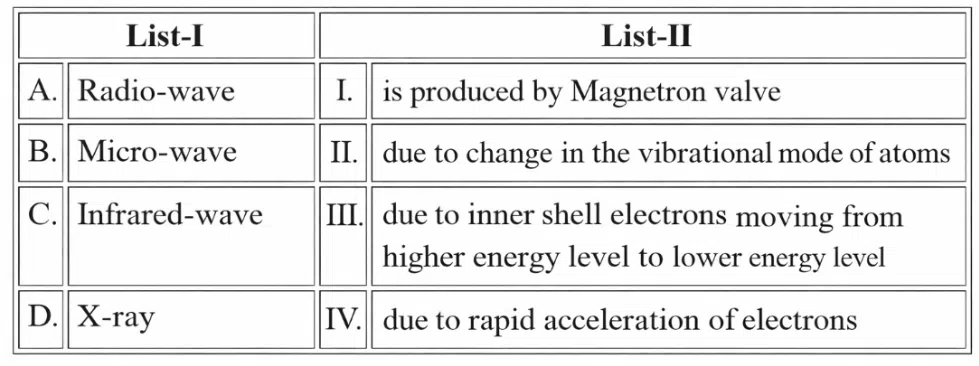
Choose the correct answer from the options given below:
correct answer:- 3
Question 7
The electric field of an electromagnetic wave travelling through a medimn is given by $$\overrightarrow{E}(x,t)=25\sin(2.0\times 10^{15}t-10^{7}x)\widehat{n}$$ then the refractive index of the medium is______.
(All given measurement are in SI uits)
correct answer:- 1
Question 8
The ratio of speeds of electromagnetic waves in vacuum and a medium, having dielectric constant $$k = 3$$ and permeability of $$ \mu = 2 \mu_{0}$$, is
($$\mu_{0}$$ = permeability of vacuum)
correct answer:- 2
Question 9
A plane electromagnetic wave is moving in free space with velocity $$c=3\times 10^{8} m/s$$ and its eleclric field is given as $$\overrightarrow{E}=54\sin (kz-\omega t)\widehat{j} V/m$$, where $$\widehat{j}$$ is the unit vector along y-axis. The magnetic field vector $$\overrightarrow{B}$$ of the wave is :
correct answer:- 3
Question 10
A parallel plate capacitor of area $$A=16 cm^{2}$$ and separation between the plates 10 cm , is charged by a DC current. Consider a hypothetical plane surface of area $$A_{\circ}=3.2 cm^{2}$$ inside the capacitor and parallel to the plates. At an instant, the current through the circuit is 6A. At the same instant the displacement current through $$A_{\circ}$$ is ________ mA
correct answer:- 1200

Question 11
A plane electromagnetic wave of frequency 20 MHz travels in free space along the +x direction. At a particular point in space and time, the electric field vector of the wave is $$E_{y}=9.3Vm^{-1}$$. Then, the magnetic field vector of the wave at that point is
correct answer:- 2
Question 12
Arrange the following in the ascending order of wavelength $$ (\lambda) $$ : (A) Microwaves $$ (\lambda_1) $$(B) Ultraviolet rays $$ (\lambda_2) $$ (C) Infrared rays $$ (\lambda_3) $$ (D) X-rays $$ (\lambda_4) $$ Choose the most appropriate answer from the options given below
correct answer:- 4
Question 13
Due to presence of an em-wave whose electric component is given by $$E = 100\sin(\omega t - kx)NC^{-1}$$, a cylinder of length 200 cm holds certain amount of em-energy inside it. If another cylinder of same length but half diameter than previous one holds same amount of em-energy, the magnitude of the electric field of the corresponding em-wave should be modified as
correct answer:- 2
Question 14
Given below are two statements : one is labelled as Assertion (A) and the other is labelled as Reason (R). Assertion (A) : Electromagnetic waves carry energy but not momentum. Reason (R): Mass of a photon is zero. In the light of the above statements, choose the most appropriate answer from the options given below :
correct answer:- 3
Question 15
The electric field of an electromagnetic wave in free space is
$$\vec{E} = 57 \cos \left[ 7.5 \times 10^{6} t - 5 \times 10^{-3} (3x + 4y) \right] (4\hat{i} - 3\hat{j}) N / C$$. The associated magnetic field in Tesla is
correct answer:- 3

Question 16
The magnetic field of an E.M. wave is given by $$\vec{B} = \left(\frac{\sqrt{3}}{2}\,\hat{i} + \frac{1}{2}\,\hat{j}\right) 30 \sin\left[\omega \left(t - \frac{z}{c}\right)\right] \; \text{(S.I. Units)}.$$ corresponding electric field in S.I. units is :
correct answer:- 1
Question 17
A parallel plate capacitor has a capacitance $$C = 200$$ pF. It is connected to $$230$$ V ac supply with an angular frequency $$300$$ rad s$$^{-1}$$. The rms value of conduction current in the circuit and displacement current in the capacitor respectively are :
correct answer:- 4
Question 18
If frequency of electromagnetic wave is 60 MHz and it travels in air along z direction then the corresponding electric and magnetic field vectors will be mutually perpendicular to each other and the wavelength of the wave in m is:
correct answer:- 3
Question 19
A plane electromagnetic wave propagating in $$x$$-direction is described by $$E_y = (200 \text{ V m}^{-1}) \sin[1.5 \times 10^7 t - 0.05x]$$. The intensity of the wave is : (Use $$\epsilon_0 = 8.85 \times 10^{-12} \text{ C}^2 \text{ N}^{-1} \text{ m}^{-2}$$)
correct answer:- 2
Question 20
An object is placed in a medium of refractive index 3. An electromagnetic wave of intensity $$6 \times 10^8$$ W m$$^{-2}$$ falls normally on the object and it is absorbed completely. The radiation pressure on the object would be (speed of light in free space = $$3 \times 10^8$$ m s$$^{-1}$$) :
correct answer:- 3

Question 21
A plane electromagnetic wave of frequency $$35$$ MHz travels in free space along the $$X$$-direction. At a particular point (in space and time) $$\vec{E} = 9.6\hat{j}$$ V m$$^{-1}$$. The value of magnetic field at this point is:
correct answer:- 1
Question 22
The electric field of an electromagnetic wave in free space is represented as $$\vec{E} = E_0 \cos(\omega t - kz)\hat{i}$$. The corresponding magnetic induction vector will be :
correct answer:- 2
Question 23
If the total energy transferred to a surface in time $$t$$ is $$6.48 \times 10^5$$ J, then the magnitude of the total momentum delivered to this surface for complete absorption will be:
correct answer:- 2
Question 24
In a plane EM wave, the electric field oscillates sinusoidally at a frequency of $$5 \times 10^{10}$$ Hz and an amplitude of $$50 \text{ V m}^{-1}$$. The total average energy density of the electromagnetic field of the wave is : [Use $$\varepsilon_0 = 8.85 \times 10^{-12} \text{ C}^2 \text{N}^{-1}\text{m}^{-2}$$]
correct answer:- 1
Question 25
Given below are two statements:
Statement I: Electromagnetic waves carry energy as they travel through space and this energy is equally shared by the electric and magnetic fields.
Statement II: When electromagnetic waves strike a surface, a pressure is exerted on the surface.
In the light of the above statements, choose the most appropriate answer from the options given below:
correct answer:- 2

Question 26
Match List I with List II:
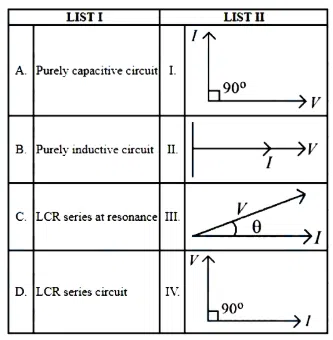
Choose the correct answer from the options given below:
correct answer:- 1
Question 27
Arrange the following in the ascending order of wavelength: A. Gamma rays $$(\lambda_1)$$, B. x-rays $$(\lambda_2)$$, C. Infrared waves $$(\lambda_3)$$, D. Microwaves $$(\lambda_4)$$. Choose the most appropriate answer from the options given below:
correct answer:- 3
Question 28
Match List-I with List-II :
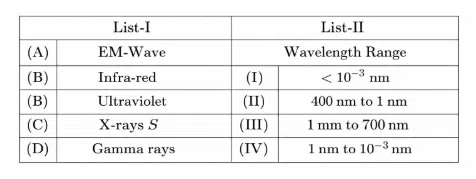
correct answer:- 1
Question 29
The density and breaking stress of a wire are $$6 \times 10^4 \text{ kg/m}^3$$ and $$1.2 \times 10^8 \text{ N/m}^2$$ respectively. The wire is suspended from a rigid support on a planet where acceleration due to gravity is $$\frac{1}{3}^{rd}$$ of the value on the surface of earth. The maximum length of the wire with breaking is ______ m (take, $$g = 10 \text{ m/s}^2$$).
correct answer:- 600
Question 30
Average force exerted on a non-reflecting surface at normal incidence is $$2.4 \times 10^{-4} \text{ N}$$. If $$360 \text{ W/cm}^2$$ is the light energy flux during span of 1 hour 30 minutes, Then the area of the surface is:
correct answer:- 4