Group
Group
 Group
Group


 Preferred Source

 Google Discover

JEE Rotational Motion PYQs
JEE Rotational Motion PYQs are an important part of the JEE Physics syllabus. These questions check how well you understand the main ideas of rotational motion, such as torque, moment of inertia, angular momentum, rolling motion, angular acceleration, rotational kinetic energy, and conservation of angular momentum.
In the exam, rotational motion questions may come as direct numerical problems or as concept-based questions. The good thing is that this chapter becomes much easier when your basics are clear. Once you understand the core concepts and know which formula to use, solving questions feels much more manageable. You do not need to think of rotational motion as a very difficult topic. With regular practice and careful steps, you can solve these questions with confidence.
In this blog, you will get a simple formula PDF, a section for important JEE Rotational Motion PYQs in download format, a few practice questions with answers, and some extra questions to solve on your own. You will also learn about common mistakes students often make and some easy tips to save time in the exam.
JEE Rotational Motion Important PYQs PDF
This PDF can include the most important previous year questions from rotational motion. It may cover topics like torque, moment of inertia, angular momentum, radius of gyration, rolling motion, rotational kinetic energy, angular acceleration, and conservation of angular momentum.
Practicing these questions can help you understand the kind of problems asked in JEE. It also improves your speed, accuracy, and confidence before the exam.
Important Formulas for JEE Rotational Motion PYQs
You only need a few important formulas to solve most rotational motion questions in JEE. These formulas help you calculate torque, moment of inertia, angular velocity, angular acceleration, rotational energy, and other values used in this chapter.
You can download the full formula PDF from the link above. Here is a quick look at some of the main formulas:
| Concept | Formula |
|---|---|
| Torque | $$\tau = rF\sin\theta$$ |
| Angular Momentum | $$L = I\omega$$ |
| Newton’s Second Law for Rotation | $$\tau = I\alpha$$ |
| Rotational Kinetic Energy | $$K = \frac{1}{2}I\omega^2$$ |
| Work Done in Rotation | $$W = \tau\theta$$ |
| Power in Rotation | $$P = \tau\omega$$ |
| Moment of Inertia of Ring | $$I = MR^2$$ |
| Moment of Inertia of Disc | $$I = \frac{1}{2}MR^2$$ |
| Moment of Inertia of Solid Sphere | $$I = \frac{2}{5}MR^2$$ |
| Radius of Gyration | $$I = Mk^2$$ |
| Relation Between Linear and Angular Velocity | $$v = r\omega$$ |
| Relation Between Linear and Angular Acceleration | $$a = r\alpha$$ |
These formulas are commonly used in questions based on torque, rolling motion, angular momentum, moment of inertia, and rotational energy. If you revise them well, many JEE questions become much easier to solve.
Top 5 Common Mistakes to Avoid in JEE Rotational Motion PYQs
Many students find rotational motion difficult not because the chapter is too hard, but because of small mistakes during solving. Here are some common mistakes you should avoid:
Forgetting the axis of rotation
In moment of inertia questions, the answer depends on the axis of rotation. If you do not read the question carefully, you may apply the wrong formula.
Using the wrong formula for moment of inertia
A ring, disc, rod, and sphere all have different moment of inertia formulas. Many students mix them up and lose marks in easy questions.
Ignoring the angle in torque
Torque depends on the angle between the force and the radius. If the force is not perpendicular, you must use the full formula correctly.
Mixing up linear and angular quantities
Students often confuse linear speed with angular speed, or linear acceleration with angular acceleration. Try to keep both ideas separate while solving.
Applying conservation of angular momentum without checking the condition
This law can be used only when no external torque acts on the system. If external torque is present, the law cannot be applied directly.
List of JEE Rotational Motion PYQs
Here is a short set of JEE-style rotational motion questions for practice. These include common question types from torque, moment of inertia, angular velocity, and rolling motion. Solving them regularly can help you become faster and more confident.
Question 1
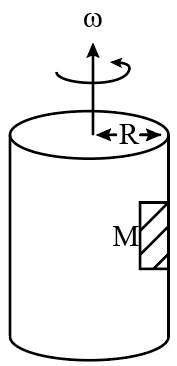
A large drum having radius R is spinning around its axis with angular velocity $$\omega$$, as shown in figure. The minimum value of $$\omega$$ so that a body of mass M remains stuck to the inner wall of the drum, taking the coefficient of friction between the drum surface and mass M as $$\mu$$, is :
correct answer:- 1
Question 2
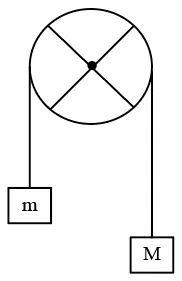
The pulley shown in figure is made using a thin rim and two rods of length equal to diameter of the rim. The rim and each rod have a mass of M. Two blocks of mass of M and m are attached to two ends of a light string passing over the pulley, which is hinged to rotate freely in vertical plane about its center. The magnitudes of the acceleration experienced by the blocks is ___________
(assume no slipping of string on pulley).
correct answer:- 3
Question 3
Two cars A and B each of mass $$10^{3}$$ kg are moving on parallel tracks separated by a distance of 10 m, in same direction with speeds 72 km/h and 36 km/h. The magnitude of angular momentum of car A with respect to car B is __________ J.s.
correct answer:- 1
Question 4
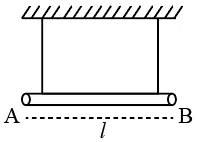
A uniform rod of mass m and length l suspended by means of two identical inextensible light strings as shown in figure. Tension in one string immediately after the other string is cut, is ____ . (g acceleration due to gravity)
correct answer:- 2
Question 5
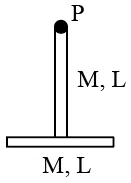
Two identical thin rods of mass M kg and length L m are connected as shown in figure. Moment of inertia of the combined rod system about an axis passing through point P and perpendicular to the plane of the rods is $$\frac{x}{12}ML^{2}\text{kg m}^{2}$$. The value of x is ____ .
correct answer:- 17

Question 6
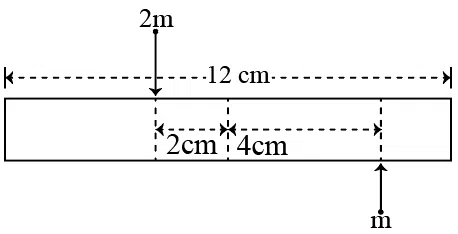
A uniform bar of length 12 cm and mass 20m lies on a smooth horizontal table. Two point masses m and 2m are moving in opposite directions with same speed of $$\nu$$ and in the same plane as the bar, as shown in figure. These masses strike the bar simultaneously and get stuck to it. After collision the entire system is rotating with angular frequency $$\omega$$. The ratio of $$\nu$$ and $$\omega$$ is :
correct answer:- 4
Question 7
Two small balls with masses m and 2m are attached to both ends of a rigid rod of length d and negligible mass. If angular momentum of this system is L about an axis (A) passing through its centre of mass and perpendicular to the rod then angular velocity of the system about A is :
correct answer:- 2
Question 8
The moment of inertia of a square loop made of four uniform solid cylinders, each having radius R and length L (R<L) about an axis passing through the mid points of opposite sides, is (Take the mass of the entire loop as M) :
correct answer:- 2
Question 9
A solid sphere of mass 5 kg and radius 10 cm is kept in contact with another solid sphere of mass 10 kg and radius 20 cm. The moment of inertia of this pair of spheres about the tangent passing through the point of contact is _____ $$kg.m^{2}$$.
correct answer:- 4
Question 10
A circular disc has radius $$R_{1}$$ and thickness $$T_{1}$$. Another circular disc made of the same material has radius $$R_{2} and thickness $$T_{2}. If the moment of inertia of both discs are same and $$ \frac{R_{1}}{R_{2}}=2 \text { then }\frac{T_{1}}{T_{2}}=\frac{1}{\alpha} $$. The value of $$\alpha$$ is__________.
correct answer:- 16

Question 11
Two masses 400 g and 350 g are suspended from the ends of a light string passing over a heavy pulley of radius 2 cm. When released from rest the heavier mass is observed to fall 81 cm in 9 s. The rotational inertia of the pulley is ___ $$kg.m^{2}$$.$$(g=9.8 m/s^{2})$$
correct answer:- 1
Question 12
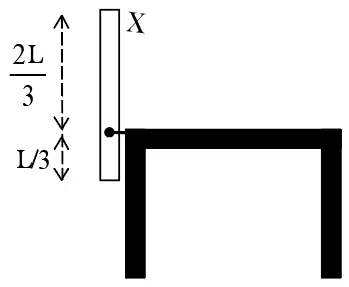
A thin unifonn rod (X) of mass Mand length L is pivoted at a height $$(\frac{L}{3})$$ as shown in the figure. The rod is allowed to fall from a vertical position and lie horizontally on the table. The angular velocity of this rod when it hits the table top, is __________.
(g = gravitational acceleration)
correct answer:- 3
Question 13
A uniform solid cylinder of length L and radius R has moment of inertia about its axis equal to $$I_{1}$$. A small co-centric cylinder of length L/2 and radius R/3 carved from this cylinder has moment of inertia about its axis equals to $$I_{2}$$. The ratio $$I_{1}/I_{2}$$ is __________.
correct answer:- 162
Question 14
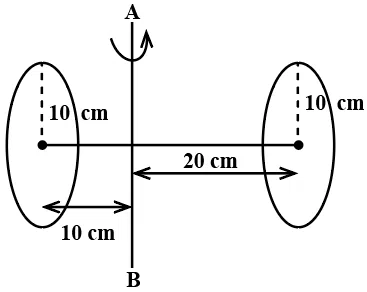
Two circular discs of radius each 10 cm are joined at their centres by a rod of length 30 cm and mass 600 gm as shown in figure.
If the mass of each disc is 600 gm and applied torque between two discs is $$43\times 10^{5} dyne.cm$$. the angular acceleration of the discs about the given axis AB is_______$$rad/s^{2}$$.
correct answer:- 2
Question 15
A solid sphere of radius 10 cm is rotating about an axis which is at a distance 15cm from its centre. The radius of gyration about this axis is$$\sqrt{n}cm$$. The value of n is
correct answer:- 265

Question 16
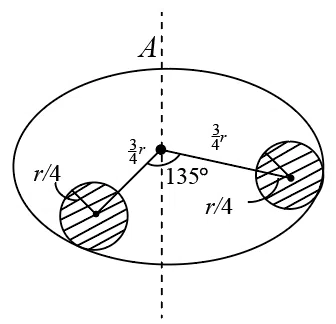
Suppose there is a uniform circular disc of mass $$M$$ kg and radius $$r$$ m shown in figure. The shaded regions are cut out from the disc. The moment of inertia of the remainder about the axis $$A$$ of the disc is given by $$ \frac{x}{256}Mr^{2} $$. The value of $$x$$ iS______.
correct answer:- 109
Question 17
A fly wheel having mass 3 kg and radius 5 m is free to rotate about a horizontal axis. A string having negligible mass is wound around the wheel and the loose end of the string is connected to 3 kg mass. The mass is kept at rest initially and released. Kinetic energy of the wheel when the mass descends by 3 m is ___ J.$$(g=10 m/s^{2})$$
correct answer:- 30
Question 18
The torque due to the force $$(2\widehat{i}+\widehat{j}+2\widehat{k})$$ about the origin, acting on a particle whose position vector is $$(\widehat{i}+\widehat{j}+\widehat{k})$$, would be
correct answer:- 1
Question 19
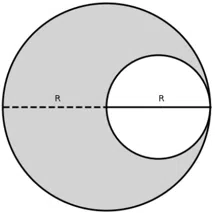
A uniform circular disc of radius ' R ' and mass ' M ' is rotating about an axis perpendicular to its plane and passing through its centre. A small circular part of radius R/2 is removed from the original disc as shown in the figure. Find the moment of inertia of the remaining part of the original disc about the axis as given above.
correct answer:- 4
Question 20
The position vectors of two 1 kg particles, (A) and (B), are given by $$ \overrightarrow{r_A}=\left( \alpha_1 t^{2}\widehat{i}+ \alpha_2 t\widehat{j}+\alpha_3 t\widehat{k} \right)m \text{ and } \overrightarrow{r_B}=\left( \beta_1 t\widehat{i} + \beta_2 t^{2}\widehat{j} + \beta_3 t \widehat{k} \right)m,$$ respectively; $$ \left( \alpha_1= 1 m/s^{2}, \alpha_2 = 3nm/s, \alpha_3= 2m/s, \beta_1 = 2m/s, \beta_2 = -1 m/s^{2}, \beta_3 = 4pm/s \right),$$ where t is time, n and p are constants. At $$ t=1s, \mid \overrightarrow{V_A}\mid = \mid \overrightarrow{V_B} \mid \text{ and velocities } \overrightarrow{V_A} \text{ and } \overrightarrow{V_B}\text{ of the particles are orthogonal to each other. At } t=1 s,$$ the magnitude of angular momentum of particle (A) with respect to the position of particle (B) is $$ \sqrt{L} kgm^{2} s^{-1}.\text{ The value of L is }$$ _______ .
correct answer:- 90

Question 21
A circular disk of radius R meter and mass M kg is rotating around the axis perpendicular to the disk. An external torque is applied to the disk such that $$\theta (t)=5t^{2}-8t$$, where $$\theta (t)$$ is the angular position of the rotating disc as a function of time t. How much power is delivered by the applied torque, when t = 2 s ?
correct answer:- 4
Question 22
A uniform solid cylinder of mass $$m$$ and radius $$r$$ rolls along an inclined rough plane of inclination $$45^\circ.$$ If it starts to roll from rest from the top of the plane, then the linear acceleration of the cylinder's axis will be:
correct answer:- 3
Question 23
An object of mass $$m$$ is projected from origin in a vertical $$xy$$ plane at an angle $$45^\circ$$ with the $$x$$ -axis with an initial velocity $$v_0.$$ The magnitude and direction of the angular momentum of the object with respect to origin, when it reaches at the maximum height, will be $$[g$$ is acceleration due to gravity]
correct answer:- 3
Question 24
A solid sphere and a hollow sphere of the same mass and of same radius are rolled on an inclined plane. Let the time taken to reach the bottom by the solid sphere and the hollow sphere be $$t_1 \text{ and } t_2$$, respectively, then
correct answer:- 3
Question 25
A solid sphere is rolling without slipping on a horizontal plane. The ratio of the linear kinetic energy of the centre of mass of the sphere and rotational kinetic energy is :
correct answer:- 3

Question 26
The center of mass of a thin rectangular plate (fig - x ) with sides of length a and b, whose mass per unit area $$(\sigma)$$ varies as
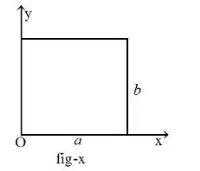
$$\sigma = \frac{\sigma_{\circ}x}{ab}$$ (where $$\sigma_{\circ}$$ is a constant), would be
correct answer:- 1
Question 27
Two iron solid discs of negligible thickness have radii $$R_{1}$$ and $$R_{2}$$ and moment of intertia $$I_{1}$$ and $$I_{2}$$, respectively. For $$R_{2}=2R_{1}$$, the ratio of $$I_{1}$$ and $$I_{2}$$ would be $$1/x$$, where x = __________.
correct answer:- 16
Question 28
The moment of inertia of a solid disc rotating along its diameter is 2.5 times higher than the moment of inertia of a ring rotating in similar way. The moment of inertia of a solid sphere which has same radius as the disc and rotating in similar way, is $$n$$ times higher than the moment of inertia of the given ring. Here, n=_________Consider all the bodies have equal masses.
correct answer:- 4
Question 29
The coordinates of a particle with respect to origin in a given reference frame is (1, 1, 1) meters. If a force of $$\overrightarrow{F} = \hat{i} - \hat{j} + \hat{k}$$ acts on the particle, then the magnitude of torque (with respect to origin) in z-direction is_________.
correct answer:- 2
Question 30
Consider a circular disc of radius 20 cm with centre located at the origin. A circular hole of radius 5 cm is cut from this disc in such a way that the edge of the hole touches the edge of the disc. The distance of centre of mass of residual or remaining disc from the origin will be
correct answer:- 3
Question 31
A solid sphere of mass 'm' and radius 'r' is allowed to roll without slipping from the highest point of an inclined plane of length 'L' and makes an angle $$30^{\circ}$$ with the horizontal. The speed of the particle at the bottom of the plane is $$\upsilon_{1}$$ . If the angle of inclination is increased $$45^{\circ}$$ to while keeping L constant. Then the new speed of the sphere at the bottom of the plane is $$\upsilon_{2}$$ . The ratio $$\upsilon_1^2:\upsilon_2^2$$ is
correct answer:- 1
Question 32
A uniform rod of mass 250 g having length 100 cm is balanced on a sharp edge at 40 cm mark. A mass of 400 g is suspended at 10 cm mark. To maintain the balance of the rod, the mass to be suspended at 90 cm mark, is
correct answer:- 1
Question 33
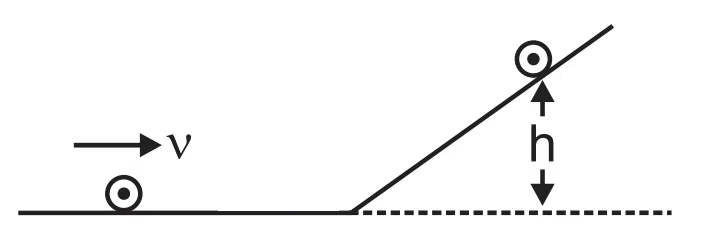
A disc of radius $$R$$ and mass $$M$$ is rolling horizontally without slipping with speed $$v$$. It then moves up an inclined smooth surface as shown in figure. The maximum height that the disc can go up the incline is
correct answer:- 3
Question 34
A uniform rod AB of mass 2 kg and length 30 cm at rest on a smooth horizontal surface. An impulse of force 0.2 N s is applied to end B. The time taken by the rod to turn through at right angles will be $$\frac{\pi}{x}$$ s, where $$x$$ = ______.
correct answer:- 4
Question 35
Four particles, each of mass $$1$$ kg are placed at four corners of a square of side $$2$$ m. The moment of inertia of the system about an axis perpendicular to its plane and passing through one of its vertex is ______ kg m$$^2$$.
correct answer:- 16
Question 36
A heavy iron bar of weight 12 kg is having its one end on the ground and the other on the shoulder of a man. The rod makes an angle 60° with the horizontal, the normal force applied by the man on bar is :
correct answer:- 3
Question 37
A ring and a solid sphere roll down the same inclined plane without slipping. They start from rest. The radii of both bodies are identical and the ratio of their kinetic energies is $$\frac{7}{x}$$, where x is _____.
correct answer:- 7
Question 38
A cylinder is rolling down on an inclined plane of inclination $$60°$$. Its acceleration during rolling down will be $$\frac{x}{\sqrt{3}}$$ m s$$^{-2}$$, where $$x =$$ _______ (use $$g = 10$$ m s$$^{-2}$$).
correct answer:- 10
Question 39
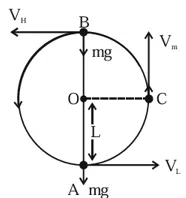
A bob of mass $$m$$ is suspended by a light string of length $$L$$. It is imparted a minimum horizontal velocity at the lowest point $$A$$ such that it just completes half circle reaching the top most position $$B$$. The ratio of kinetic energies $$\frac{(K.E.)_A}{(K.E.)_B}$$ is:
correct answer:- 2
Question 40
A body of mass $$5$$ kg moving with a uniform speed $$3\sqrt{2} \text{ m s}^{-1}$$ in $$X-Y$$ plane along the line $$y = x + 4$$. The angular momentum of the particle about the origin will be ______ kg m$$^2$$ s$$^{-1}$$.
correct answer:- 60
Question 41
Consider a disc of mass $$5 \text{ kg}$$, radius $$2 \text{ m}$$, rotating with angular velocity of $$10 \text{ rad s}^{-1}$$ about an axis perpendicular to the plane of rotation. An identical disc is kept gently over the rotating disc along the same axis. The energy dissipated so that both the discs continue to rotate together without slipping is _________ J.
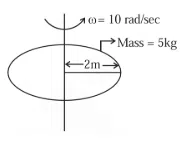
correct answer:- 250
Question 42
Two discs of moment of inertia $$I_1 = 4$$ kg m$$^2$$ and $$I_2 = 2$$ kg m$$^2$$ about their central axes & normal to their planes, rotating with angular speeds 10 rad s$$^{-1}$$ & 4 rad s$$^{-1}$$ respectively are brought into contact face to face with their axes of rotation coincident. The loss in kinetic energy of the system in the process is _________ J.
correct answer:- 24
Question 43
A solid circular disc of mass $$50$$ kg rolls along a horizontal floor so that its center of mass has a speed of $$0.4 \text{ m s}^{-1}$$. The absolute value of work done on the disc to stop it is ______ J.
correct answer:- 6
Question 44
Two identical spheres each of mass 2 kg and radius 50 cm are fixed at the ends of a light rod so that the separation between the centers is 150 cm. Then, moment of inertia of the system about an axis perpendicular to the rod and passing through its middle point is $$\frac{x}{20}$$ kg m$$^2$$, where the value of $$x$$ is
correct answer:- 53
Question 45
In a system two particles of masses $$m_1 = 3$$ kg and $$m_2 = 2$$ kg are placed at certain distance from each other. The particle of mass $$m_1$$ is moved towards the center of mass of the system through a distance $$2$$ cm. In order to keep the center of mass of the system at the original position, the particle of mass $$m_2$$ should move towards the center of mass by the distance _____ cm.
correct answer:- 3
Question 46
A hollow sphere is rolling on a plane surface about its axis of symmetry. The ratio of rotational kinetic energy to its total kinetic energy is $$\frac{x}{5}$$. The value of $$x$$ is ______.
correct answer:- 2
Question 47
Ratio of radius of gyration of a hollow sphere to that of a solid cylinder of equal mass, for moment of Inertia about their diameter axis AB as shown in figure is $$\sqrt{8/x}$$. The value of $$x$$ is :
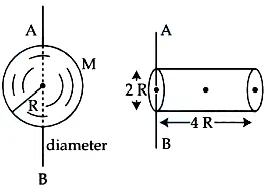
correct answer:- 4
Question 48
Two conducting circular loops A and B are placed in the same plane with their centers coinciding as shown in figure. The mutual inductance between them is :
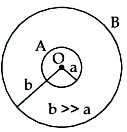
correct answer:- 4
Question 49
Three infinitely long charged thin sheets are placed as shown in figure. The magnitude of electric field at the point $$P$$ is $$\frac{x\sigma}{\epsilon_o}$$. The value of $$x$$ is _______ (all quantities are measured in SI units).
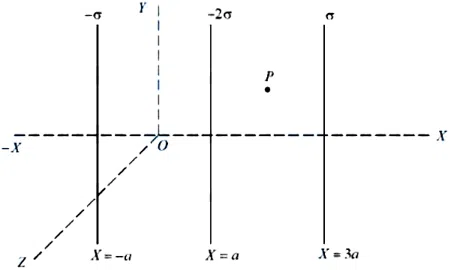
correct answer:- 2
Question 50
Three balls of masses $$2 \text{ kg}$$, $$4 \text{ kg}$$ and $$6 \text{ kg}$$ respectively are arranged at centre of the edges of an equilateral triangle of side $$2 \text{ m}$$. The moment of inertia of the system about an axis through the centroid and perpendicular to the plane of triangle, will be ___________ $$\text{kgm}^2$$.
correct answer:- 4
.webp)