
Join Our JEE Preparation Group
Prep with like-minded aspirants; Get access to free daily tests and study material.
Sign in
Please select an account to continue using cracku.in
↓ →
Join Our JEE Preparation Group
Prep with like-minded aspirants; Get access to free daily tests and study material.
A uniform bar of length 12 cm and mass 20m lies on a smooth horizontal table. Two point masses m and 2m are moving in opposite directions with same speed of $$\nu$$ and in the same plane as the bar, as shown in the figure below. These masses strike the bar simultaneously and get stuck to it. After collision the entire system is rotating with angular frequency $$\omega$$. The ratio of $$\nu$$ and $$\omega$$ is :
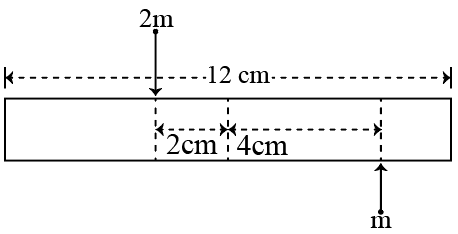
$$COM$$ of the system after the collision relative to the center of the bar ($$x=0$$):
$$x_{cm} = \frac{(20m \cdot 0) + (2m \cdot -2) + (m \cdot 4)}{20m + 2m + m} = \frac{-4m + 4m}{23m} = 0$$
Initial Angular Momentum ($$L_i$$):
For mass $$2m$$: $$L_1 = (2m) \cdot v \cdot (2 \text{ cm}) = 4mv$$ (Counter-clockwise)
For mass $$m$$: $$L_2 = (m) \cdot v \cdot (4 \text{ cm}) = 4mv$$ (Counter-clockwise)
$$L_i = 4mv + 4mv = 8mv$$
Final Angular Momentum ($$L_f$$):
Bar: $$I_{bar} = \frac{1}{12}ML^2 = \frac{1}{12}(20m)(12)^2 = 240m$$
Mass $$2m$$: $$I_{2m} = (2m)(2)^2 = 8m$$
Mass $$m$$: $$I_m = (m)(4)^2 = 16m$$
$$I_f = 240m + 8m + 16m = 264m$$
Applying conservation of angular momentum ($$L_i = I_f \omega$$):
$$8mv = 264m \cdot \omega$$
$$\frac{v}{\omega} = \frac{264}{8}$$
$$\frac{v}{\omega} = 33$$
Was this solution helpful?
Create a FREE account and get:
_1.webp)

Educational materials for JEE preparation

Ask our AI anything

AI can make mistakes. Please verify important information.
AI can make mistakes. Please verify important information.
