JEE WhatsApp Group




JEE Properties of Solids and Liquids PYQs
JEE Properties of Solids and Liquids PYQs are an important part of the JEE Physics syllabus. They help you understand the kind of questions asked from this chapter and how well you know the main concepts, such as elasticity, stress, strain, Young’s modulus, surface tension, viscosity, pressure, and capillary rise.
In the exam, questions from this chapter usually come as direct numerical problems or simple concept-based questions. The good thing is that this chapter becomes much easier when your basics are clear. Once you understand the main ideas and know which formula to use, solving questions feels much more manageable. You do not need to think of this chapter as too difficult. With regular revision and smart practice, it can become one of the more scoring parts of JEE Physics.
In this blog, you will find a simple formula PDF, a section for important JEE Properties of Solids and Liquids PYQs in download format, a few practice questions with answers, and some extra questions to solve on your own. You will also learn about common mistakes students often make and a few simple tips to save time in the exam.
JEE Properties of Solids and Liquids Important PYQs PDF
This PDF can include the most important previous year questions from properties of solids and liquids. It may cover topics like elasticity, stress and strain, elastic moduli, pressure, Pascal’s law, viscosity, streamline flow, surface tension, angle of contact, and capillary action.
Practicing these questions will help you understand the exam pattern better. It will also improve your speed, accuracy, and confidence before the exam.
Important Formulas for JEE Properties of Solids and Liquids PYQs
You only need a few important formulas and ideas to solve most properties of solids and liquids questions in JEE. These formulas help you understand deformation, flow of liquids, pressure, and surface effects more clearly.
You can download the full formula PDF from the link above. Here is a quick look at some of the main formulas:
Concept | Formula |
Stress | Force / Area |
Strain | Change in Dimension / Original Dimension |
Young’s Modulus | Y = Stress / Strain |
Bulk Modulus | K = Pressure / Volume Strain |
Shear Modulus | G = Shearing Stress / Shearing Strain |
Pressure | P = F / A |
Hydrostatic Pressure | P = hρg |
Surface Tension | T = Force / Length |
Capillary Rise | h = 2T cos θ / rρg |
Viscous Force | F = ηA(v/d) |
Stokes’ Law | F = 6πηrv |
These formulas are commonly used in questions based on elasticity, pressure, viscosity, surface tension, and capillary action. If you revise them properly, many JEE questions start to feel much easier.
Top 5 Common Mistakes to Avoid in JEE Properties of Solids and Liquids PYQs
Many students find this chapter confusing at first because it includes both solid mechanics and fluid concepts. But most mistakes happen because small details are missed while solving. Here are some common mistakes you should avoid:
Mixing up stress and strain
Stress and strain are related, but they are not the same. Stress is force per unit area, while strain is the ratio of change in dimension to original dimension.
Using the wrong elastic modulus
Young’s modulus, bulk modulus, and shear modulus are used in different situations. Many students use the wrong one because they do not identify the type of deformation properly.
Ignoring units in viscosity and surface tension
Questions from this chapter often involve different SI units. If you do not keep track of the units carefully, the final answer can go wrong.
Forgetting the role of angle of contact in capillary rise
In capillary action problems, the value of cos θ matters. Students often forget this and use the formula incorrectly.
Confusing streamline flow and turbulent flow
Many concept-based questions ask about the type of fluid flow. If the basic difference between streamline flow and turbulent flow is not clear, such questions become tricky.
List of JEE Properties of Solids and Liquids PYQs
Here is a short set of JEE-style properties of solids and liquids questions for practice. These include common question types from elasticity, pressure, viscosity, and surface tension. Solving them regularly can help you become faster and more confident.
Question 1
A spherical body of radius r and density $$\sigma$$ falls freely through a viscous liquid having density $$\rho$$ and viscosity $$\eta$$ and attains a terminal velocity $$\upsilon_{0}$$. Estimated maximum error in the quantity $$\eta$$ is: (Ignore errors associated with $$\sigma,\rho$$ and g, gravitational acceleration)
correct answer:- 1
Question 2
The terminal velocity of a metallic ball of radius 6 mm in a viscous fluid is 20 cm/s. The terminal velocity of another ball of same material and having radius 3 mm in the same fluid will be ________ cm/ s.
correct answer:- 5
Question 3
Water flows through a horizontal tube as shown in the figure. The difference in height between the water colunms in vertical tubes is 5 cm and the area of cross-sections at A and B are $$6cm^{2}$$ and $$3cm^{2}$$ respectively. The rate of flow will be ____ $$cm^{3/s}$$. $$(take g=10m/s^{2})$$
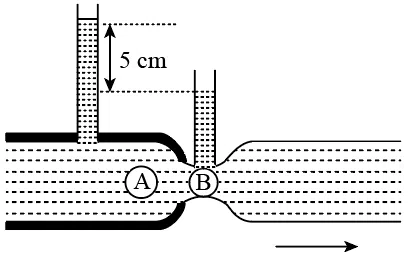
correct answer:- 1
Question 4
Given below are two statements:
Statement I : Pressure of a fluid is exerted only on a solid surface in contact as the fluid-pressure does not exist everywhere in a still fluid.
Statement II: Excess potential energy of the molecules on the surface of a liquid, when compared to interior, results in surface tension.
In the light of the above statements, choose the correct answer from the options given below
correct answer:- 4
Question 5
Sixty four rain drops of radius 1 mm each falling down w-ith a terminal velocity of 10 cm/s coalesce to fonn a bigger drop. The terminal velocity of bigger drop is_____cm/s
correct answer:- 160

Question 6
A cubical block of density $$\rho_{b}= 600kg/m^{3}$$ floats in a liquid of density $$\rho_{e}= 900kg/m^{3}$$. If the height of block is H = 8.0 cm then height of the submerged part is ________ cm.
correct answer:- 4
Question 7
A soap bubble of surface tension 0.04 N/m is blown to a diameter of 7 cm. If (15000 - x) $$\mu J$$ of work is done in blowing it further to make its diameterl4 cm, then the value of x is_____.
$$\left(\pi=22/7\right)$$
correct answer:- 11304
Question 8
Water drops fall from a tap on the floor, 5 m below, at regular intervals of time, the first drop strikes the floor when the sixth drop begins to fall. The height at which the fourth drop will be from ground, at the instant when the first drop strikes the ground is _____ m.
$$(g=10m/s^{2}$$
correct answer:- 3
Question 9
A small metallic sphere of diameter 2 mm and density $$10.5 g/cm ^{3}$$ is dropped in glycerine having viscosity 10 Poise and density $$1.5 g/cm^{3}$$ respectively. The terminal velocity attained by the sphere is __ $$cm/s$$.
$$(\pi=\frac{22}{7} \text { and } g=m/s^{2})$$
correct answer:- 2
Question 10
A ball of radius r and density $$\rho$$ dropped through a viscous liquid of density $$\sigma$$ and viscosity $$\eta$$ attains its terminal velocity at time t, given by $$t= A \rho^{a}r^{b}\eta^{c}\sigma^{d}$$, where A is a constant and a, b, c and d are integers. The value of $$\frac{b+c}{a+d}$$ is _________.
correct answer:- 1

Question 11
A small rigid spherical ball of mass M is dropped in a long vertical tube containing glycerine. The velocity of the ball becomes constant after some time. If the density of glycerine is half of the density of the ball, then the viscous force acting on the ball will be (consider g as acceleration due to gravity)
correct answer:- 4
Question 12
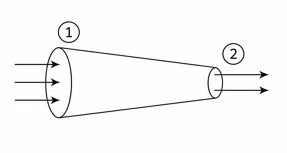
A tube of length L is shown in the figure. The radius of cross section at the point (1) is 2 cm and at the point (2) is 1 cm , respectively. If the velocity of water entering at point (1) is 2 m/s, then velocity of water leaving the point (2) will be
correct answer:- 4
Question 13
A tube of length 1 m is filled completely with an ideal liquid of mass 2 M , and closed at both ends. The tube is rotated uniformly in horizontal plane about one of its ends. If the force exerted by the liquid at the other end is F then angular velocity of the tube is $$\sqrt{\frac{F}{\alpha M}}$$ in SI unit. The value of $$\alpha$$ is __________.
correct answer:- 1
Question 14
Two soap bubbles of radius 2 cm and 4 cm , respectively, are in contact with each other. The radius of curvature of the common surface, in cm , is ________ .
correct answer:- 4
Question 15
Water flows in a horizontal pipe whose one end is closed with a valve. The reading of the pressure gauge attached to the pipe is $$P_{1}$$. The reading of the pressure gauge falls to $$P_{2}$$ when the valve is opened. The speed of water flowing in the pipe is proportional to
correct answer:- 4

Question 16
An air bubble of radius 1.0 mm is observed at a depth of 20 cm below the free surface of a liquid having surface tension $$0.095 J/m^{2}$$ and density $$10^{3}kg/m^{3}$$. The difference between pressure inside the bubble and atmospheric pressure is _____$$N/m^{2}.(\text{ take }g=10m/s^{2})$$
correct answer:- 2190
Question 17
The amount of work done to break a big water drop of radius $$' R '$$ into 27 small drops of equal radius is $$10\,J.$$ The work done required to break the same big drop into 64 small drops of equal radius will be:
correct answer:- 1
Question 18
An air bubble of radius $$0.1\,cm$$ lies at a depth of $$20\,cm$$ below the free surface of a liquid of density $$1000\,kg/m^3.$$ If the pressure inside the bubble is $$2100\,N/m^2$$ greater than the atmospheric pressure, then the surface tension of the liquid in SI unit is $$(g=10\,m/s^2):$$
correct answer:- 2
Question 19
In the experiment for measurement of viscosity $$'\eta'$$ of given liquid with a ball having radius R, consider following statements. A. Graph between terminal velocity V and R will be a parabola. B. The terminal velocities of different diameter balls are constant for a given liquid. C. Measurement of terminal velocity is dependent on the temperature. D. This experiment can be utilized to assess the density of a given liquid. E. If balls are dropped with some initial speed, the value of $$\eta$$ will change. Choose the correct answer from the options given below:
correct answer:- 3
Question 20
In a hydraulic lift, the surface area of the input piston is $$6 cm^{2}$$ and that of the output piston is $$1500 cm^{2}$$. If 100 N force is applied to the input piston to raise the output piston by 20 cm, then the work done is _______ kJ.
correct answer:- 5

Question 21
A 400 g solid cube having an edge of length 10 cm floats in water. How much volume of the cube is outside the water ? (Given : density of water $$= 1000 kg m^{-3}$$)
correct answer:- 2
Question 22
A plane is in level flight at constant speed and each of its two wings has an area of $$40$$ m$$^2$$. If the speed of the air is $$180$$ km h$$^{-1}$$ over the lower wing surface and $$252$$ km h$$^{-1}$$ over the upper wing surface, the mass of the plane is ________kg. (Take air density to be $$1$$ kg m$$^{-3}$$ and $$g = 10$$ m s$$^{-2}$$)
correct answer:- 9600
Question 23
Given below are two statements :
Statement (I) : Viscosity of gases is greater than that of liquids.
Statement (II) : Surface tension of a liquid decreases due to the presence of insoluble impurities. In the light of the above statements, choose the most appropriate answer from the options given below :
correct answer:- 2
Question 24
The reading of pressure metre attached with a closed pipe is $$4.5 \times 10^4$$ N m$$^{-2}$$. On opening the valve, water starts flowing and the reading of pressure metre falls to $$2.0 \times 10^4$$ N m$$^{-2}$$. The velocity of water is found to be $$\sqrt{V}$$ m s$$^{-1}$$. The value of $$V$$ is _____.
correct answer:- 50
Question 25
In a test experiment on a model aeroplane in wind tunnel, the flow speeds on the upper and lower surfaces of the wings are $$70$$ m s$$^{-1}$$ and $$65$$ m s$$^{-1}$$ respectively. If the wing area is $$2$$ m$$^2$$, the lift of the wing is _______ N. (Given density of air $$= 1.2$$ kg m$$^{-3}$$)
correct answer:- 810

Question 26
A small steel ball is dropped into a long cylinder containing glycerine. Which one of the following is the correct representation of the velocity time graph for the transit of the ball?
correct answer:- 2
Question 27
A small spherical ball of radius $$r$$, falling through a viscous medium of negligible density has terminal velocity $$v$$. Another ball of the same mass but of radius $$2r$$, falling through the same viscous medium will have terminal velocity:
correct answer:- 1
Question 28
Mercury is filled in a tube of radius $$2$$ cm up to a height of $$30$$ cm. The force exerted by mercury on the bottom of the tube is _____ N. (Given, atmospheric pressure $$= 10^5$$ Nm$$^{-2}$$, density of mercury $$= 1.36 \times 10^4$$ kg m$$^{-3}$$, $$g = 10$$ m s$$^{-2}$$, $$\pi = \frac{22}{7}$$)
correct answer:- 177
Question 29
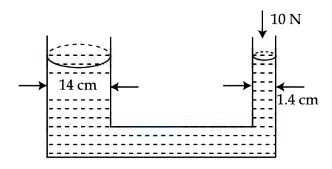
A hydraulic press containing water has two arms with diameters as mentioned in the figure. A force of $$10$$ N is applied on the surface of water in the thinner arm. The force required to be applied on the surface of water in the thicker arm to maintain equilibrium of water is ______ N.
correct answer:- 1000
Question 30
A small ball of mass $$m$$ and density $$\rho$$ is dropped in a viscous liquid of density $$\rho_0$$. After sometime, the ball falls with constant velocity. The viscous force on the ball is :
correct answer:- 4
Question 31
Correct Bernoulli's equation is (symbols have their usual meaning) :
correct answer:- 2
Question 32
A cube of ice floats partly in water and partly in kerosene oil. The ratio of volume of ice immersed in water to that in kerosene oil (specific gravity of Kerosene oil $$= 0.8$$, specific gravity of ice $$= 0.9$$)
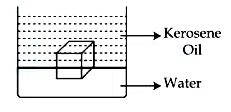
correct answer:- 1
Question 33
Small water droplets of radius 0.01 mm are formed in the upper atmosphere and falling with a terminal velocity of 10 cm/s. Due to condensation, if 8 such droplets are coalesced and formed a larger drop, the new terminal velocity will be _____ cm/s.
correct answer:- 40
Question 34
A sphere of relative density $$\sigma$$ and diameter $$D$$ has concentric cavity of diameter $$d$$. The ratio of $$\frac{D}{d}$$, if it just floats on water in a tank is :
correct answer:- 2
Question 35
A spherical ball of radius $$1 \times 10^{-4} \text{ m}$$ and density $$10^5 \text{ kg/m}^3$$ falls freely under gravity through a distance $$h$$ before entering a tank of water. If after entering in water the velocity of the ball does not change, then the value of $$h$$ is approximately: (The coefficient of viscosity of water is $$9.8 \times 10^{-6} \text{ N s/m}^2$$)
correct answer:- 2
Question 36
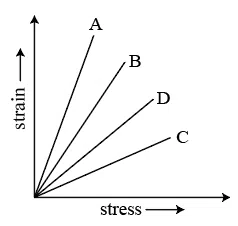
The strain-stress plot for materials A, B, C and D is shown in the figure. Which material has the largest Young's modulus?
correct answer:- 4
Question 37
Two wires A and B made of different materials of lengths 6.0 cm and 5.4 cm, respectively and area of cross sections $$3.0\times 10^{-5}m^{2}\text{ and }4.5\times 10^{-5}m^{2}$$, respectively are stretched by the same magnitude under a given load. The ratio of the Young's modulus of A to that of B is x : 3. The value of x is ___ .
correct answer:- 4
Question 38
The increase in pressure required to decrease the volume of a water sample by $$0.2%$$ is $$P \times10^5\,Nm^{-2}.$$ Bulk modulus of water is $$2.15\times10^9\,Nm^{-2}.$$ The value of $$P$$ is $$\underline{\hspace{2cm}}.$$
correct answer:- 43
Question 39
Given below are two statements: one is labelled as Assertion A and the other is labelled as Reason R Assertion A:A sound wave has higher speed in solids than gases. Reason R: Gases have higher value of Bulk modulus than solids. In the light of the above statements, choose the correct answer from the options given below
correct answer:- 2
Question 40
The fractional compression $$(\frac{\Delta V}{V})$$ of water at the depth of 2.5 km below the sea level is ______%.Given, the Bulk modulus of water $$= 2\times 10^{9}Nm^{-2}$$, density of water $$= 10^{3}kgm^{-3}$$, acceleration due to gravity $$= g =10 m s^{-2}$$.
correct answer:- 1
Question 41
In an experiment with photoelectric effect, the stopping potential,
correct answer:- 4
Question 42
The volume contraction of a solid copper cube of edge length 10 cm , when subjected to a hydraulic pressure of $$7 \times 10^{6}Pa$$, would be ____ $$mm^{3}$$. (Given bulk modulus of copper $$= 1.4 \times 10^{11} Nm^{-2}$$)
correct answer:- 50
Question 43
One end of a metal wire is fixed to a ceiling and a load of 2 kg hangs from the other end. A similar wire is attached to the bottom of the load and another load of 1 kg hangs from this lower wire. Then the ratio of longitudinal strain of upper wire to that of the lower wire will be [Area of cross section of wire = $$0.005 \text{ cm}^2$$, $$Y = 2 \times 10^{11} \text{ N m}^{-2}$$ and $$g = 10 \text{ m s}^{-2}$$]
correct answer:- 3
Question 44
If average depth of an ocean is $$4000$$ m and the bulk modulus of water is $$2 \times 10^9 \text{ N m}^{-2}$$, then fractional compression $$\frac{\Delta V}{V}$$ of water at the bottom of ocean is $$\alpha \times 10^{-2}$$. The value of $$\alpha$$ is _______, (Given, $$g = 10 \text{ m s}^{-2}, \rho = 1000 \text{ kg m}^{-3}$$)
correct answer:- 2
Question 45
Given below are two statements : one is labelled as Assertion (A) and the other is labelled as Reason (R).
Assertion (A) : The property of body, by virtue of which it tends to regain its original shape when the external force is removed, is Elasticity.
Reason (R) : The restoring force depends upon the bonded inter atomic and inter molecular force of solid.
In the light of the above statements, choose the correct answer from the options given below :
correct answer:- 3
Question 46
A wire of length $$L$$ and radius $$r$$ is clamped at one end. If its other end is pulled by a force $$F$$, its length increases by $$l$$. If the radius of the wire and the applied force both are reduced to half of their original values keeping original length constant, the increase in length will become:
correct answer:- 4
Question 47
Two metallic wires $$P$$ and $$Q$$ have same volume and are made up of same material. If their area of cross sections are in the ratio $$4 : 1$$ and force $$F_1$$ is applied to $$P$$, an extension of $$\Delta l$$ is produced. The force which is required to produce same extension in $$Q$$ is $$F_2$$. The value of $$\frac{F_1}{F_2}$$ is ______.
correct answer:- 16
Question 48
Young's modulus of material of a wire of length $$L$$ and cross-sectional area $$A$$ is $$Y$$. If the length of the wire is doubled and cross-sectional area is halved then Young's modulus will be:
correct answer:- 3
Question 49
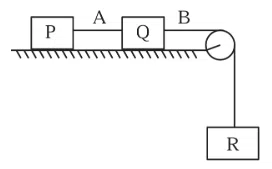
Each of three blocks $$P$$, $$Q$$ and $$R$$ shown in figure has a mass of $$3 \text{ kg}$$. Each of the wire $$A$$ and $$B$$ has cross-sectional area $$0.005 \text{ cm}^2$$ and Young's modulus $$2 \times 10^{11} \text{ N m}^{-2}$$. Neglecting friction, the longitudinal strain on wire $$B$$ is $$\_\_\_\_ \times 10^{-4}$$. (Take $$g = 10 \text{ m s}^{-2}$$)
correct answer:- 2
Question 50
The depth below the surface of sea to which a rubber ball be taken so as to decrease its volume by $$0.02\%$$ is _____ m. (Take density of sea water $$= 10^3 \text{ kg m}^{-3}$$, Bulk modulus of rubber $$= 9 \times 10^8 \text{ N m}^{-2}$$, and $$g = 10 \text{ m s}^{-2}$$)
correct answer:- 18
.webp)