JEE WhatsApp Group



JEE Electromagnetic Induction PYQs
JEE Electromagnetic Induction PYQs are an important part of the JEE Physics syllabus. These questions help you understand how well you know the basic ideas of this chapter, such as magnetic flux, Faraday’s law, Lenz’s law, motional emf, self-induction, mutual induction, eddy currents, and AC generators.
In the exam, electromagnetic induction questions can come as direct numerical sums or as concept-based problems. The good thing is that this chapter becomes much easier when your basics are strong. Once you understand the concepts clearly and know which formula to use, solving questions feels much more manageable. You do not need to think of this chapter as too difficult. With regular practice and careful solving, you can score well in it.
In this blog, you will get a simple formula PDF, a section for important JEE Electromagnetic Induction PYQs in download format, a few practice questions with answers, and some extra questions to solve on your own. You will also learn about common mistakes students often make and a few easy tips to save time in the exam.
JEE Electromagnetic Induction Important PYQs PDF
This PDF can include the most important previous year questions from electromagnetic induction. It may cover topics like magnetic flux, Faraday’s law, Lenz’s law, induced emf, motional emf, self-induction, mutual induction, eddy currents, and AC generators.
Practicing these questions will help you understand the kind of problems asked in JEE. It will also improve your speed, accuracy, and confidence before the exam.
Important Formulas for JEE Electromagnetic Induction PYQs
You only need a few important formulas to solve most electromagnetic induction questions in JEE. These formulas help you calculate induced emf, magnetic flux, current, inductance, and other values used in this chapter.
You can download the full formula PDF from the link above. Here is a quick look at some of the main formulas:
Concept | Formula |
Magnetic Flux | Φ = BA cos θ |
Faraday’s Law | e = -dΦ/dt |
Average Induced EMF | e = -ΔΦ/Δt |
Motional EMF | e = Bℓv |
Induced Current | I = e/R |
Self-Induced EMF | e = -L(dI/dt) |
Mutual Induced EMF | e = -M(dI/dt) |
Energy Stored in Inductor | U = ½LI² |
Time Constant of LR Circuit | τ = L/R |
Power in AC Circuit | P = VI cos φ |
These formulas are commonly used in questions based on magnetic flux, induced emf, moving conductors, inductors, eddy currents, and LR circuits. If you revise them properly, many JEE questions become easier to solve.
Top 5 Common Mistakes to Avoid in JEE Electromagnetic Induction PYQs
Many students feel that this chapter is difficult, but most of the time the problem is not the chapter itself. It is the small mistakes made while solving. Here are some common mistakes you should avoid:
Forgetting the negative sign in Faraday’s law
The negative sign is important because it shows the direction according to Lenz’s law. Many students ignore it and lose marks in concept-based questions.
Using the wrong angle in magnetic flux
In magnetic flux questions, the angle is taken between the magnetic field and the normal to the surface. This is a very common point of confusion.
Confusing self-induction and mutual induction
Self-induction happens in the same coil, while mutual induction happens between two different coils. If you do not read the question properly, it is easy to mix them up.
Ignoring units
Always check units carefully while solving. Values may be given in tesla, weber, henry, volt, ampere, or ohm. A small unit mistake can change the whole answer.
Not reading the question carefully
Sometimes the question asks for induced emf, sometimes current, and sometimes the direction of induced current. Read every part of the question properly before you start solving.
List of JEE Electromagnetic Induction PYQs
Here is a short set of JEE-style electromagnetic induction questions for practice. These include common question types from magnetic flux, induced emf, motional emf, inductance, and current. Solving them regularly can help you become faster and more confident.
Question 1
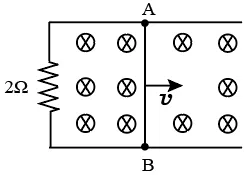
A 1 m long metal rod AB completes the circuit as shown in figure. The area of circuit is perpendicular to the magnetic field of 0.10 T. lf the resistance of the total circuit is 2Ω then the force needed to move the rod towards right with constant speed (v) of 1.5 m/s is ___ N
correct answer:- 2
Question 2
A conducting circular loop is rotated about its diameter at a constant angular speed of 100 rad/s in a magnetic field of 0.5 T perpendicular to the axis of rotation. When the loop is rotated by $$30 ^{\circ}$$ from the horizontal position, the induced EMF is 15.4 mV. The radius of the loop is ____ mm. (Take $$\pi = \frac{22}{7}$$)
correct answer:- 14
Question 3
A 20 m long uniform copper wire held horizontally is allowed to fall under the gravity $$(g=10m/s^{2})$$ through a uniform horizontal magnetic fie ld of 0.5 Gauss perpendicular to the length of the wire. The induced EMF across the wire when it travells a vertical distance of200 m is ____ mV.
correct answer:- 3
Question 4
Three identical coils $$C_{1}, C_{2}$$ and $$C_{3}$$ are closely placed such that they share a common axis. $$C_{2}$$ is exactly midway. $$C_{1}$$ carries current $$I$$ in anti-clockwise direction while $$C_{3}$$ carries current $$I$$ in clockwise direction. An induced Current flows through $$C_{2}$$ will be in clockwise direction when
correct answer:- 2
Question 5
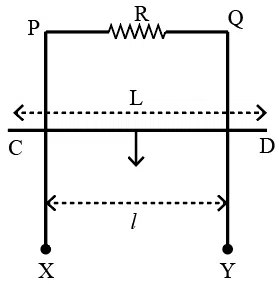
$$XPQY$$ is a vertical smooth long loop having a total resistance $$R$$ where $$PX$$ is parallel to $$QY$$ and separation between them is $$l$$. A constant magnetic field $$B$$ perpendicular to the plane of the loop exists in the entire space. A rod $$CD$$ of length $$L (L > l)$$ and mass $$m$$ is made to slide down from rest under the gravity as shown in figure. The terminal speed acquired by the rod is _______ $$m/s. (g$$ = acceleration due to gravity)
correct answer:- 2

Question 6
Inductance of a coil with $$ 10^{4} $$ tums is $$10 mH$$ and it is connected to a dc source of $$10 V$$ with internal resistance of $$10\Omega $$ The energy density in the inductor when the
current reaches $$ \left( \frac{1}{e} \right) $$ of its maximum value is $$ \alpha\pi \times \frac{1}{e^{2}}J/m^{3} $$. The value of $$ \alpha$$ is_______.
$$ (\mu_{o}=4\pi\times 10^{-7}Tm/A). $$
correct answer:- 20
Question 7
Suppose a long solenoid of 100 cm length, radius 2 cm having 500 turns per unit length, carries a current $$I= 10 \sin (\omega t)$$ A, where $$\omega$$ = 1000 rad.ls. A circular conducting loop (B) of radius 1 cm coaxially slided through the solenoid at a speed $$v = 1 cm/s$$. The r.m.s. current through the loop when the coil B is inserted 10 cm inside the solenoid is $$\alpha/\sqrt{2}\mu A$$. The value of $$\alpha$$ is ______.
[Resistance of the loop= 10$$\Omega$$]
correct answer:- 2
Question 8
A rectangular metallic loop is moving out of a uniform magnetic field region to a field free region with a constant speed. When the loop is partially inside the magnate field, the plot of magnitude of induced emf (ε) with time (t) is given by
correct answer:- 4
Question 9
A coil of area A and N turns is rotating with angular velocity $$\omega$$ in a uniform magnetic field $$\overrightarrow{B}$$ about an axis perpendicular to $$\overrightarrow{B}$$. Magnetic flux $$\varphi$$ and induced emf ε across it, at an instant when $$\overrightarrow{B}$$ is parallel to the plane of coil, are :
correct answer:- 3
Question 10
Regarding self-inductance:
A. The self-inductance of the coil depends on its geometry.
B. Self-inductance does not depend on the permeability of the medium.
C. Self-induced e.m.f. opposes any change in the current in a circuit.
D. Self-inductance is electromagnetic analogue of mass in mechanics.
E. Work needs to be done against self-induced e.m.f. in establishing the current.
Choose the correct answer from the options given below:
correct answer:- 3

Question 11
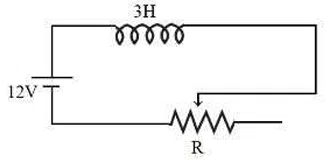
In the given circuit the sliding contact is pulled outwards such that electric current in the circuit changes at the rate of 8 A/s. At an instant when R is $$12\Omega$$ , the value of the current in the circuit will be ______ A.
correct answer:- 3
Question 12
A uniform magnetic field of 0.4 T acts perpendicular to a circular copper disc 20 cm in radius. The disc is having a uniform angular velocity of $$10\pi rads^{-1}$$ about an axis through its centre and perpendicular to the disc. What is the potential difference developed between the axis of the disc and the rim ? $$(\pi = 3.14)$$
correct answer:- 3
Question 13
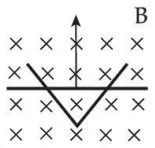
A conducting bar moves on two conducting rails as shown in the figure. A constant magnetic field B exists into the page. The bar starts to move from the vertex at time $$t = 0$$ with a constant velocity. If the induced EMF is $$E \propto t^n$$. then value of n is _.
correct answer:- 1
Question 14
A rectangular loop of sides $$12$$ cm and $$5$$ cm, with its sides parallel to the $$x$$-axis and $$y$$-axis respectively moves with a velocity of $$5$$ cm s$$^{-1}$$ in the positive $$x$$ axis direction, in a space containing a variable magnetic field in the positive $$z$$ direction. The field has a gradient of $$10^{-3}$$ T cm$$^{-1}$$ along the negative $$x$$ direction and it is decreasing with time at the rate of $$10^{-3}$$ T s$$^{-1}$$. If the resistance of the loop is $$6$$ m$$\Omega$$, the power dissipated by the loop as heat is ______ $$\times 10^{-9}$$ W.
correct answer:- 216
Question 15
A rectangular loop of length $$2.5$$ m and width $$2$$ m is placed at $$60°$$ to a magnetic field of $$4$$ T. The loop is removed from the field in $$10$$ sec. The average emf induced in the loop during this time is
correct answer:- 3

Question 16
Two coils have mutual inductance $$0.002$$ H. The current changes in the first coil according to the relation $$i = i_0 \sin \omega t$$, where $$i_0 = 5$$ A and $$\omega = 50\pi \text{ rad s}^{-1}$$. The maximum value of emf in the second coil is $$\frac{\pi}{\alpha}$$ V. The value of $$\alpha$$ is
correct answer:- 2
Question 17
The electric potential at the surface of an atomic nucleus ($$Z = 50$$) of radius $$9 \times 10^{-13}$$ cm is $$\alpha \times 10^6$$ V. What is the value of $$\alpha$$?
(Charge of proton $$1.6 \times 10^{-19}$$ C)
correct answer:- 8
Question 18
A horizontal straight wire $$5$$ m long extending from east to west falling freely at right angle to horizontal component of earth's magnetic field $$0.60 \times 10^{-4}$$ Wb m$$^{-2}$$. The instantaneous value of emf induced in the wire when its velocity is $$10 \text{ m s}^{-1}$$ is ______ $$\times 10^{-3}$$ V.
correct answer:- 3
Question 19
A ceiling fan having $$3$$ blades of length $$80 \text{ cm}$$ each is rotating with an angular velocity of $$1200 \text{ rpm}$$. The magnetic field of earth in that region is $$0.5 \text{ G}$$ and angle of dip is $$30°$$. The emf induced across the blades is $$N\pi \times 10^{-5} \text{ V}$$. The value of $$N$$ is ______.
correct answer:- 32
Question 20
A coil is placed perpendicular to a magnetic field of $$5000$$ T. When the field is changed to $$3000$$ T in $$2$$ s, an induced emf of $$22$$ V is produced in the coil. If the diameter of the coil is $$0.02$$ m, then the number of turns in the coil is:
correct answer:- 2

Question 21
A small square loop of wire of side $$l$$ is placed inside a large square loop of wire of side $$L(L = l^2)$$. The loops are coplanar and their centers coincide. The value of the mutual inductance of the system is $$\sqrt{x} \times 10^{-7}$$ H, where $$x$$ = ______.
correct answer:- 128
Question 22
The magnetic flux $$\phi$$ (in weber) linked with a closed circuit of resistance 8 $$\Omega$$ varies with time (in seconds) as $$\phi = 5t^2 - 36t + 1$$. The induced current in the circuit at $$t = 2$$ s is ______ A.
correct answer:- 2
Question 23
A rod of length $$60$$ cm rotates with a uniform angular velocity $$20$$ rad s$$^{-1}$$ about its perpendicular bisector, in a uniform magnetic field $$0.5$$ T. The direction of magnetic field is parallel to the axis of rotation. The potential difference between the two ends of the rod is _____ V.
correct answer:- 0
Question 24
The current in an inductor is given by $$I = (3t + 8)$$ where $$t$$ is in second. The magnitude of induced emf produced in the inductor is $$12$$ mV. The self-inductance of the inductor ______ mH.
correct answer:- 4
Question 25
In a coil, the current changes from $$-2 \text{ A}$$ to $$+2 \text{ A}$$ in $$0.2 \text{ s}$$ and induces an emf of $$0.1 \text{ V}$$. The self inductance of the coil is :
correct answer:- 3

Question 26
An electric field, $$\vec{E} = \frac{2\hat{i} + 6\hat{j} + 8\hat{k}}{\sqrt{6}}$$ passes through the surface of $$4 \text{ m}^2$$ area having unit vector $$\hat{n} = \left(\frac{2\hat{i} + \hat{j} + \hat{k}}{\sqrt{6}}\right)$$. The electric flux for that surface is ______ Vm.
correct answer:- 12
Question 27
Match the List-I with List-II:
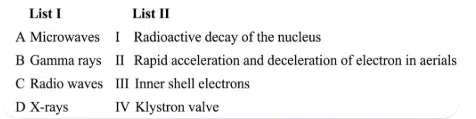
Choose the correct answer from the options given below:
correct answer:- 2
Question 28
A coil is placed in magnetic field such that plane of coil is perpendicular to the direction of magnetic field. The magnetic flux through a coil can be changed:
A. By changing the magnitude of the magnetic field within the coil.
B. By changing the area of coil within the magnetic field.
C. By changing the angle between the direction of magnetic field and the plane of the coil.
D. By reversing the magnetic field direction abruptly without changing its magnitude.
Choose the most appropriate answer from the options given below:
correct answer:- 3
Question 29
A square shaped coil of area $$70 \text{ cm}^2$$ having 600 turns rotates in a magnetic field of $$0.4 \text{ Wb m}^{-2}$$, about an axis which is parallel to one of the side of the coil and perpendicular to the direction of field. If the coil completes 500 revolution in a minute, the instantaneous emf when the plane of the coil is inclined at $$60°$$ with the field, will be ______ V.
(Take $$\pi = \frac{22}{7}$$)
correct answer:- 44
Question 30
A conducting loop of radius $$\frac{10}{\sqrt{\pi}}$$ cm is placed perpendicular to a uniform magnetic field of 0.5 T. The magnetic field is decreased to zero in 0.5 s at a steady rate. The induced emf in the circular loop at 0.25 s is:
correct answer:- 2
.webp)