
Join Our JEE Preparation Group
Prep with like-minded aspirants; Get access to free daily tests and study material.
Sign in
Please select an account to continue using cracku.in
↓ →
Join Our JEE Preparation Group
Prep with like-minded aspirants; Get access to free daily tests and study material.
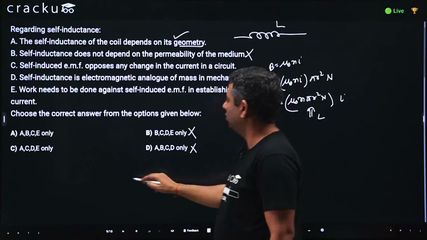
Regarding self-inductance:
A. The self-inductance of the coil depends on its geometry.
B. Self-inductance does not depend on the permeability of the medium.
C. Self-induced e.m.f. opposes any change in the current in a circuit.
D. Self-inductance is electromagnetic analogue of mass in mechanics.
E. Work needs to be done against self-induced e.m.f. in establishing the current.
Choose the correct answer from the options given below:
Let us analyze each statement about self-inductance:
Statement A: The self-inductance of a coil depends on its geometry (shape, size, number of turns). This is correct. For example, for a solenoid, $$L = \mu_0 n^2 A l$$.
Statement B: Self-inductance does not depend on the permeability of the medium. This is incorrect. Self-inductance is directly proportional to the permeability. For a solenoid with a core, $$L = \mu n^2 A l$$, where $$\mu = \mu_0 \mu_r$$.
Statement C: Self-induced e.m.f. opposes any change in the current in a circuit. This is correct (Lenz's law). The self-induced emf is $$\varepsilon = -L\frac{dI}{dt}$$.
Statement D: Self-inductance is the electromagnetic analogue of mass in mechanics. This is correct. In the energy analogy, $$\frac{1}{2}LI^2$$ (electromagnetic) corresponds to $$\frac{1}{2}mv^2$$ (mechanical), so $$L$$ is analogous to mass $$m$$.
Statement E: Work needs to be done against self-induced e.m.f. in establishing the current. This is correct. The energy stored in the inductor $$\frac{1}{2}LI^2$$ is the work done against the self-induced emf.
Statements A, C, D, E are correct.
The correct answer is Option 3: A, C, D, E only.
Was this solution helpful?
Click on the Email ☝️ to Watch the Video Solution
Create a FREE account and get:
_1.webp)

Educational materials for JEE preparation

Ask our AI anything

AI can make mistakes. Please verify important information.
AI can make mistakes. Please verify important information.
