JEE WhatsApp Group



JEE Gravitation PYQs
JEE Gravitation PYQs are an important part of the JEE Physics syllabus. They help you understand the kind of questions asked from this chapter and show how well you know topics like gravitational force, Newton’s law of gravitation, acceleration due to gravity, gravitational potential, escape velocity, orbital velocity, and satellites.
In the exam, gravitation questions can appear as direct numerical problems or as simple concept-based questions. The best part is that this chapter is not as difficult as it may seem at first. Once your basics are clear and you know which formula to use, most questions become much easier to handle. With regular practice and careful solving, gravitation can turn into a scoring chapter for you.
In this blog, you will find a simple formula PDF, a section for important JEE Gravitation PYQs in download format, a few practice questions with answers, and some extra questions to solve on your own. You will also learn about common mistakes students make and a few easy tips that can help you save time in the exam.
JEE Gravitation Important PYQs PDF
This PDF can include the most important previous year questions from gravitation. It may cover key topics such as Newton’s law of gravitation, gravitational field, gravitational potential, acceleration due to gravity, variation in g, escape velocity, orbital motion, and satellites.
Practicing these questions will help you understand the exam pattern better. It will also improve your speed, accuracy, and confidence before the exam.
Important Formulas for JEE Gravitation PYQs
You only need a few important formulas to solve most gravitation questions in JEE. These formulas help you calculate gravitational force, field strength, potential, escape velocity, orbital velocity, and other important values from this chapter.
You can download the full formula PDF from the link above. Here is a quick look at some of the main formulas:
Concept | Formula |
Newton’s Law of Gravitation | F = Gm₁m₂/r² |
Acceleration Due to Gravity | g = GM/R² |
Gravitational Potential | V = -GM/r |
Gravitational Field | E = GM/r² |
Potential Energy | U = -Gm₁m₂/r |
Escape Velocity | vₑ = √2gR |
Orbital Velocity | vₒ = √GM/r |
Relation Between Escape and Orbital Velocity | vₑ = √2 vₒ |
Time Period of Satellite | T = 2π √(r³/GM) |
Height Dependence of g | g(h) = gR²/(R + h)² |
These formulas are used often in questions based on gravitational force, satellites, orbital motion, escape speed, and variation in gravity. If you revise them properly, many JEE questions will feel much simpler.
Top 5 Common Mistakes to Avoid in JEE Gravitation PYQs
Many students think gravitation is easy, but they still lose marks because of small mistakes. Here are some common ones you should avoid:
Confusing mass and weight
Mass always stays the same, but weight depends on gravity. Many students mix these two terms and end up using the wrong concept in the question.
Forgetting the negative sign in potential and potential energy
Gravitational potential and gravitational potential energy are negative because gravity is an attractive force. Missing this sign can lead to the wrong answer.
Using the wrong distance
In gravitation, distance is usually measured from the center of the Earth or planet, not from the surface. This is one of the most common mistakes in numerical questions.
Mixing up escape velocity and orbital velocity
These two terms are related, but they are not the same. Escape velocity is the minimum speed needed to leave the gravitational field, while orbital velocity is the speed needed to keep moving around a planet in orbit.
Ignoring units
Always check your units carefully. Use SI units like kilogram, metre, second, and newton. Even if your method is correct, a unit mistake can spoil the final answer.
List of JEE Gravitation PYQs
Here is a short set of JEE-style gravitation questions for practice. These cover common question types from gravitational force, acceleration due to gravity, potential, escape velocity, and satellites. Solving them regularly can help you become faster and more confident.
Question 1
Initially a satellite of 100 kg is in a circular orbit of radius $$1.5R_{E}$$ This satellite can be moved to a circular orbit of radius $$3R_{E}$$ by supplying $$\alpha\times10^{6}J$$ of energy The value of $$\alpha$$ is ____. (Take Radius of Earth $$R_{E}=6\times10^{6}m\text{ and }g=10m/s^{2}$$)
correct answer:- 2
Question 2
Given below are two statements:
Statement I : A satellite is moving around earth in the orbit very close to the earth surface. The time period of revolution of satellite depends upon the density of earth.
Statement II: The time period of revolution of the satellite is $$T= 2\pi \sqrt{\frac{R_{e}}{g}}$$ (for satellite very close to the earth surface), where $$R_{e}$$ radius of earth and g acceleration due to gravity. In the light of the above statements , choose the correct answer from the options given below:
correct answer:- 1
Question 3
Net gravitational force at the center of a square is found to be $$F_{1}$$ when four particles having mass $$M, 2M, 3M$$ and $$4M$$ are placed at the four corners of the square as shown in figure and it is $$F_{2}$$ when the positions of $$3M$$ and $$4M$$ are interchanged.
The ratio $$\frac{F_{1}}{F_{2}}$$ is $$\frac{\alpha}{\sqrt{5}}$$ The value of $$\alpha$$ is _________.
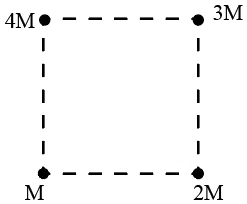
correct answer:- 4
Question 4
The escape velocity from a spherical planet $$A$$ is $$10 km/s.$$ The escape velocity from another planet $$B$$ whose density and radius are 10% of those of planet $$A$$, is ______$$m/s.$$
correct answer:- 2
Question 5
Given below are two statements. One is labelled as Assertion (A) and the other is labelled as Reason (R). Assertion (A) : A simple pendulum is taken to a planet of mass and radius, 4 times and 2 times, respectively, than the Earth. The time period of the pendulum remains same on earth and the planet. Reason (R): The mass of the pendulum remains unchanged at Earth and the other planet. In the light of the above statements, choose the correct answer from the options given below :
correct answer:- 4

Question 6
A small point of mass m is placed at a distance 2R from the centre 'O' of a big uniform solid sphere of mass M and radius R . The gravitational force on ' m ' due to M is $$F_1$$. A spherical part of radius R/3 is removed from the big sphere as shown in the figure and the gravitational force on m due to remaining part of M is found to be $$F_2$$ . The value of ratio $$F_1 : F_2$$ is
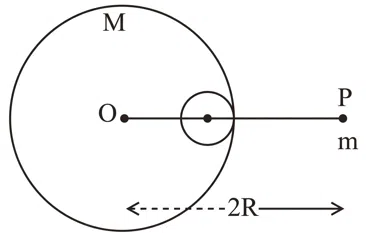
correct answer:- 1
Question 7
If a satellite orbiting the Earth is 9 times closer to the Earth than the Moon, what is the time period of rotation of the satellite? Given rotational time period of Moon =27 days and gravitational attraction between the satellite and the moon is neglected.
correct answer:- 2
Question 8
A satellite of mass $$\frac{M}{2}$$ is revolving around earth in a circular orbit at a height of $$\frac{R}{3}$$ from earth surface. The angular momentum of the satellite is $$M\sqrt{\frac{GMR}{x}}$$.The value of $$x$$ is ______ , where M and R are the mass and radius of earth, respectively. ( G is the gravitational constant)
correct answer:- 3
Question 9
A satellite is launched into a circular orbit of radius $$R$$ around the earth. A second satellite is launched into an orbit of radius $$1.03R.$$ The time period of revolution of the second satellite is larger than the first one approximately by:
correct answer:- 3
Question 10
Acceleration due to gravity on the surface of earth is $$g$$. If the diameter of earth is reduced to one third of its original value and mass remains unchanged, then the acceleration due to gravity on the surface of the earth is $$\underline{\hspace{2cm}}\,g.$$
correct answer:- 9

Question 11
A positive ion A and a negative ion B has charges $$6.67\times10^{-19}C$$ and $$9.6\times10^{-10}C$$, and masses $$19.2\times10^{-27}Kg$$ and $$9\times10^{-27}Kg$$ respectively. At an instant, the ions are separated by a certain distance r. At that instant the ratio of the magnitudes of electrostatic force to gravitational force is $$P\times10^{45}$$ , where the value of 10P is (Take $$\frac{1}{4\pi\epsilon_{0}}=9\times10^{9}NM^{2}C^{-1}$$ and universal gravitational constant as $$6.67\times10^{-11}NM^{2}Kg^{-2}$$)
Assume that charge may not be an integral multiple of electrons.
correct answer:- 5
Question 12
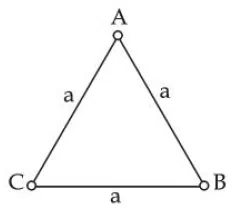
Three equal masses m are kept at vertices (A, B, C) of an equilateral triangle of side a in free space. At t=0, they are given an initial velocity $$\vec{V}_A = V_0 \overrightarrow{AC}$$, $$\vec{V}_B = V_0 \overrightarrow{BA}$$ and $$\vec{V}_C = V_0 \overrightarrow{CB}$$. Here $$\overrightarrow{AC}$$, $$\overrightarrow{CB}$$ and $$\overrightarrow{BA}$$ are unit vectors along the edges of the triangle. If the three masses interact gravitationally, then the magnitude of the net angular momentum of the system at the point of collision is :
correct answer:- 3
Question 13
Two planets, A and B are orbiting a common star in circular orbits of radii $$R_{A}$$ and $$R_{B}$$, respectively, with $$R_{B} = 2R_{A}$$. The planet B is $$4\sqrt{2}$$ times more massive than planet A. The ratio $$\left(\frac{L_{B}}{L_{A}}\right)$$ of angular momentum $$(L_{B})$$ of planet B to that of planet $$A(L_{A})$$ is closest to integer ________.
correct answer:- 8
Question 14
A metal wire of uniform mass density having length L and mass M is bent to form a semicircular arc and a particle of mass m is placed at the centre of the arc. The gravitational force on the particle by the wire is:
correct answer:- 4
Question 15
Earth has mass 8 times and radius 2 times that of a planet. If the escape velocity from the earth is 11.2 km/s. the escape velocity in km/s from the planet will be :
correct answer:- 3

Question 16
If $$R$$ is the radius of the earth and the acceleration due to gravity on the surface of earth is $$g = \pi^2$$ m s$$^{-2}$$, then the length of the second's pendulum at a height $$h = 2R$$ from the surface of earth will be:
correct answer:- 2
Question 17
A light planet is revolving around a massive star in a circular orbit of radius $$R$$ with a period of revolution $$T$$. If the force of attraction between planet and star is proportional to $$R^{-3/2}$$ then choose the correct option:
correct answer:- 1
Question 18
The acceleration due to gravity on the surface of earth is $$g$$. If the diameter of earth reduces to half of its original value and mass remains constant, then acceleration due to gravity on the surface of earth would be :
correct answer:- 4
Question 19
Given below are two statements : one is labelled as Assertion (A) and the other is labelled as Reason (R).
Assertion (A) : The angular speed of the moon in its orbit about the earth is more than the angular speed of the earth in its orbit about the sun.
Reason (R) : The moon takes less time to move around the earth than the time taken by the earth to move around the sun.
In the light of the above statements, choose the most appropriate answer from the options given below :
correct answer:- 2
Question 20
At what distance above and below the surface of the earth a body will have same weight? (Take radius of earth as $$R$$)
correct answer:- 4

Question 21
A planet takes $$200$$ days to complete one revolution around the Sun. If the distance of the planet from Sun is reduced to one fourth of the original distance, how many days will it take to complete one revolution?
correct answer:- 1
Question 22
The gravitational potential at a point above the surface of earth is $$-5.12 \times 10^7 \text{ J kg}^{-1}$$ and the acceleration due to gravity at that point is $$6.4 \text{ m s}^{-2}$$. Assume that the mean radius of earth to be $$6400 \text{ km}$$. The height of this point above the earth's surface is:
correct answer:- 1
Question 23
Escape velocity of a body from earth is 11.2 km s$$^{-1}$$. If the radius of a planet be one-third the radius of earth and mass be one-sixth that of earth, the escape velocity from the planet is:
correct answer:- 4
Question 24
Four identical particles of mass $$m$$ are kept at the four corners of a square. If the gravitational force exerted on one of the masses by the other masses is $$\frac{2\sqrt{2}+1}{32}\frac{Gm^2}{L^2}$$, the length of the sides of the square is
correct answer:- 2
Question 25
The mass of the moon is $$\frac{1}{144}$$ times the mass of a planet and its diameter $$\frac{1}{16}$$ times the diameter of a planet. If the escape velocity on the planet is $$v$$, the escape velocity on the moon will be:
correct answer:- 1

Question 26
A $$90$$ kg body placed at $$2R$$ distance from surface of earth experiences gravitational pull of: ($$R$$ = Radius of earth, $$g = 10$$ m s$$^{-2}$$)
correct answer:- 1
Question 27
Correct formula for height of a satellite from earth's surface is:
correct answer:- 2
Question 28
A satellite revolving around a planet in stationary orbit has time period 6 hours. The mass of planet is one-fourth the mass of earth. The radius orbit of planet is : (Given = Radius of geo-stationary orbit for earth is $$4.2 \times 10^4$$ km)
correct answer:- 2
Question 29
If $$G$$ be the gravitational constant and $$u$$ be the energy density then which of the following quantity have the dimensions as that of the $$\sqrt{uG}$$ :
correct answer:- 4
Question 30
A simple pendulum doing small oscillations at a place R height above earth surface has time period of $$T_1 = 4 \text{ s}$$. $$T_2$$ would be its time period if it is brought to a point which is at a height $$2R$$ from earth surface. Choose the correct relation $$[R = \text{radius of earth}]$$ :
correct answer:- 4
.webp)